

Note: This article contains affiliate links. If you click on these links and make a purchase, I may earn a small commission at no extra cost to you. This helps support my research and content. Read my full affiliate disclaimer here.
If you drive a Subaru Legacy and suspect your catalytic converter is underperforming, choosing the right replacement matters for emissions, drivability, and compliance. You want a unit that fits correctly, restores exhaust flow, and reliably reduces pollutants without causing recurring check-engine issues. This guide presents six shortlisted catalytic converters for the Subaru Legacy that meet our core criteria. We evaluated fitment reliability, emissions control effectiveness, build quality, and long-term durability to help you narrow the options. Read on for the factors that matter and practical advice before you buy.
Looking for other parts? See all Subaru Legacy parts & accessories.
Top Picks at a Glance
| Best Reviewed A top-rated pick with lots of positive feedback | pulcherflow Catalytic Converter — Direct-Fit for 1999–2005 Subaru Forester and 2000–2005 Legacy/Outback (2.5L, EPA Compliant) |  |
| Most Popular A crowd favorite that many people choose with confidence | PHILTOP Front Catalytic Converter for Subaru Legacy 2.5L (2006–2012) |  |
| Best Budget The cheapest option that still gets the job done reliably | PHILTOP High Flow Catalytic Converter Compatible with Subaru Legacy/Outback Front |  |
| Most Sold A high-volume bestseller chosen again and again | pulcherflow Catalytic Converter for 2006–2012 Subaru Legacy/Outback 2.5L |  |
| Best Value for Money The sweet spot between price and what you get | pulcherflow Front Catalytic Converter for 2015–2019 Subaru Outback/Legacy 2.5L H4 |  |
| Best Overall The best all-around choice for most situations | Walker Ultra 55585 Direct-Fit Catalytic Converter for Subaru |  |
1. pulcherflow Catalytic Converter — Direct-Fit for 1999–2005 Subaru Forester and 2000–2005 Legacy/Outback (2.5L, EPA Compliant)

| Vehicle fitment | 1999–2005 Forester, 2000–2005 Legacy/Outback, 2002–2005 Impreza, 2003–2006 Baja (2.5L, excludes turbo models) |
|---|---|
| EPA status | EPA compliant (federal emissions) |
This pulcherflow catalytic converter is a direct-fit replacement intended for Subaru 2.5L models including Legacy and Forester; it installs using the existing bolt locations and ships with gaskets and hardware. It uses an enlarged honeycomb ceramic substrate with increased precious metal loading, which aims to improve purification efficiency and reduce tailpipe emissions compared with a degraded original. Constructed with a stainless steel shell and mandrel-bent tubing, it is built to resist corrosion and high exhaust temperatures for longer service life. Real-world buyers report it can cure P0420/P0422-style codes and fits without extensive modification on many compatible cars, though some users needed small hardware adjustments or found tubing geometry and heat shielding did not exactly match OEM routing. It is EPA certified for federal emissions only and is not legal for sale or use in certain states. For reliability-minded owners wanting a budget-friendly factory-style replacement to restore emissions function, this is a practical option, but those requiring guaranteed inspection passability or perfect OEM shielding should plan for possible additional adjustments.
Best for: Reliability-focused buyers who prioritize restoring emissions function and clearing catalyst-related codes with an affordable, factory-style replacement for a Subaru 2.5L.
Less Ideal for: Owners who must pass strict state emissions inspections or need an exact factory-fit replacement including OEM heat shields and routing without any modification.
- Direct-fit design with included gaskets and hardware simplifies installation on listed Subaru 2.5L models.
- EPA compliant for federal emissions and uses increased precious metal loading to improve catalytic efficiency.
- Stainless steel shell and computerized mandrel bends offer improved corrosion and heat resistance over cheaper replacements.
- Large substrate size increases contact time for exhaust gases, helping to reduce common catalyst-related fault codes.
- Not legal for sale or use in California, Colorado, New York, or Maine emissions-controlled vehicles.
- Tube bends and heat shielding may not match factory geometry on every vehicle, occasionally requiring trimming or bracket adjustments.
- Some buyers reported vibration, rattling, or recurrence of O2 sensor codes after installation on certain cars.
Verdict A budget-friendly, EPA-certified direct-fit catalytic converter that restores emissions function on Subaru 2.5L cars but may require minor adjustments for perfect OEM fit.
2. PHILTOP Front Catalytic Converter for Subaru Legacy 2.5L (2006–2012)

| Vehicle fitment | Subaru Legacy 2.5L 2006–2012 |
|---|---|
| Position | Front |
| Material | Stainless steel housing |
| Included hardware | Gaskets and mounting hardware |
| Emissions | EPA compliant |
This PHILTOP front catalytic converter is a direct-replacement unit for the Subaru Legacy 2.5L (2006–2012). It installs in the front exhaust position and is supplied with gaskets and mounting hardware so a mechanic can swap it in without fabricating parts. The housing is machined stainless steel and the seller says the internal substrate is EPA compliant, which means it is intended to meet emissions requirements outside regulated states. In everyday use it performs the basic job of restoring catalytic function, clearing codes such as P0420 for many buyers and reducing exhaust noise and emissions. Fitment reports are mixed: several customers found it an exact fit and passed emissions testing right away, while a minority experienced early honeycomb failure. The kit is convenient for someone who wants a ready-to-install replacement and avoids complex modifications, but there is some risk of variable long-term durability compared with higher-end factory-quality converters.
Best for: Convenience-driven buyers who prioritize a plug-and-play replacement that minimizes shop time and avoids custom fabrication when restoring emissions function on a Subaru Legacy 2.5L (2006–2012).
Less Ideal for: Owners seeking the longest possible service life or a factory-quality OEM part for high-mileage or performance-driven vehicles should consider higher-end factory-replacement converters or dealer options instead.
- Direct-fit design for Subaru Legacy 2.5L 2006–2012 that simplifies replacement.
- Includes gaskets and mounting hardware for straightforward installation by a shop.
- Stainless steel machined housing resists corrosion and high exhaust temperatures.
- EPA compliant unit intended to restore emissions function and clear fault codes when compatible.
- Some buyers reported internal ceramic substrate failure after limited mileage, indicating inconsistent longevity.
- Cannot be sold or used in certain states due to EPA-compliant aftermarket restrictions.
- Instructions and two-piece fitment details may be unclear for average DIY installers.
Verdict A convenient, direct-fit replacement for Legacy 2.5L owners who want a ready-to-install catalytic converter, but expect variable long-term durability compared with higher-end factory-quality units.
3. PHILTOP High Flow Catalytic Converter Compatible with Subaru Legacy/Outback Front
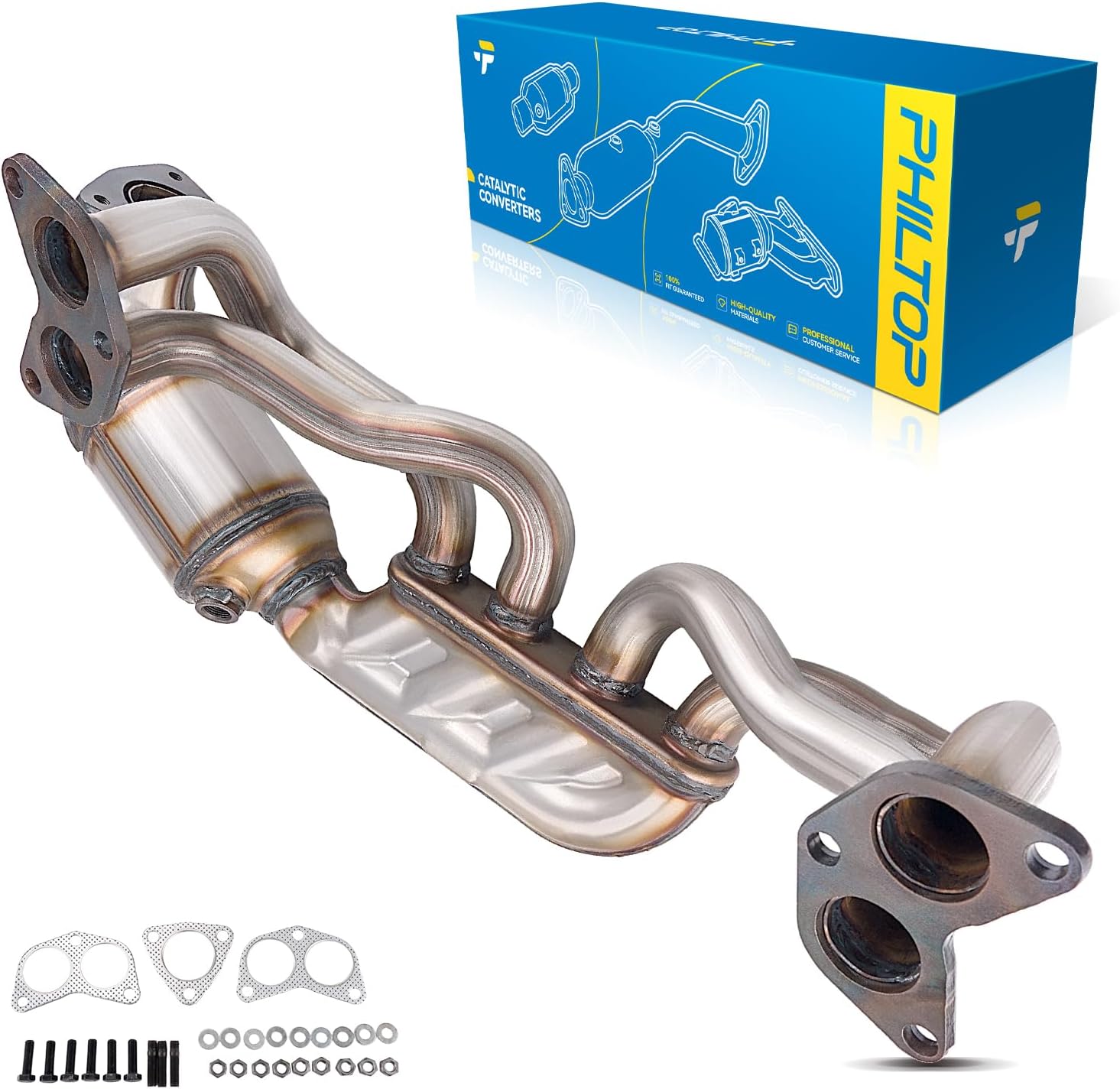
| Position | Front |
|---|---|
| Manufacturer | PHILTOP |
| EPA Compliance | Yes (not legal in all states) |
This PHILTOP high flow catalytic converter is a cost-focused replacement for the front converter on compatible Subaru Legacy and Outback 2.5L models. It installs in place of the factory unit using the supplied gaskets and hardware and is intended to restore emissions performance and clear P0420-style codes. Construction uses aluminized stainless steel with a double-layer, high-temperature ceramic carrier to increase flow area, which the listing says improves engine breathing and fuel economy compared with a clogged unit. Buyers report solid welds and flange fitment that bolts up without major modification, though some heat shield brackets may need minor adjustment during installation. The unit is EPA compliant for most states but may not be legal in California and a few other jurisdictions. As an aftermarket budget option it delivers good value and practical emissions repair, but it is not a factory-quality OEM part so expect small fitment tweaks and less refinement than a dealer replacement.
Best for: Budget-conscious Subaru Legacy/Outback owners who need an affordable, functional front catalytic converter to fix emissions faults and restore drivability without paying for dealer parts.
Less Ideal for: Owners who require a perfect factory-fit OEM replacement or who live in states with strict aftermarket converter regulations should seek dealer parts or state-approved units instead.
- Made from aluminized stainless steel for corrosion resistance
- Double-layer high-temperature ceramic carrier aimed at improving flow and oxygen storage
- Comes with gaskets and hardware for direct bolt-in installation
- EPA compliant outside restricted states, suitable to clear emissions codes
- Not an exact factory-quality replacement so some heat shield or bracket alignment may require adjustment
- EPA compliance excludes some states, limiting legal use in strict emissions jurisdictions
Verdict A practical, low-cost front catalytic converter for Subaru Legacy/Outback owners needing an emission repair, but expect minor fitment tweaks and check state legality first.
4. pulcherflow Catalytic Converter for 2006–2012 Subaru Legacy/Outback 2.5L

| Vehicle Fitment | 2006–2012 Subaru Legacy/Outback 2.5L |
|---|---|
| EPA Compliance | Meets U.S. EPA criteria for federal emissions models |
| Shell Material | Stainless steel |
| Includes | Gaskets and installation hardware |
This pulcherflow catalytic converter is a direct-fit replacement for the 2006–2012 Subaru Legacy/Outback 2.5L and is intended to restore catalytic function after the factory unit fails. It installs in place of the original with provided gaskets and hardware, and the manufacturer highlights an enlarged ceramic substrate and increased precious metal loading for better conversion efficiency. The stainless steel shell and mandrel-bent tubing aim to resist corrosion and hold up under heat, which matters for long-term durability. Practical benefits reported by owners include elimination of P0420-style catalytic efficiency codes when sensors and installation are correct, and most buyers find the fitment straightforward. Limitations include variable tubing geometry compared with factory parts that can complicate heat shield reuse and occasional reports of vibration or rattling if center mounting is not addressed. This converter is EPA-compliant for federal emissions models but is not legal for sale or use in certain states, and some installs have still triggered O2-related check engine lights in a minority of cases.
Best for: Risk-averse mainstream buyers seeking a straightforward, factory-replacement style catalytic converter for a Subaru Legacy/Outback 2.5L who prioritize restoring emissions function reliably over performance upgrades.
Less Ideal for: Buyers in states with their own emissions requirements or those who need an exact OEM-matching tubing layout for preserving original heat shields and underbody fitment.
- Direct-fit design with included gaskets and hardware for simpler replacement
- Enlarged ceramic substrate and higher precious metal loading for improved conversion efficiency
- Stainless steel shell and mandrel-bent tubing for better corrosion and heat resistance
- Not legal for sale or use in certain states with strict emissions rules
- Tubing geometry can differ from factory parts, which may require modification to heat shielding or extra installation time
- Some users report vibration or rattling unless center bracket or mounting is adjusted
Verdict A budget-friendly, EPA-compliant direct-fit replacement that restores emissions function for the 2.5L Subaru Legacy/Outback but may require minor fitment tweaks and is restricted in some states.
5. pulcherflow Front Catalytic Converter for 2015–2019 Subaru Outback/Legacy 2.5L H4

| Vehicle fitment | 2015–2019 Subaru Outback/Legacy 2.5L H4 |
|---|---|
| Position | Front |
| EPA compliance | 46-state federal emissions models |
| Shell material | Stainless steel |
This pulcherflow front catalytic converter replaces the factory front catted pipe on 2015–2019 Subaru Outback and Legacy 2.5L H4 models. It installs as a direct-fit replacement and ships with the necessary gaskets and hardware so a professional or experienced DIYer can bolt it in place without major modification. The unit uses an enlarged ceramic substrate and increased precious metal loading to improve conversion efficiency and meets EPA requirements for federal-emissions vehicles. A stainless steel shell with mandrel bends promises better corrosion and heat resistance than cheaper stamped replacements. Practical benefits include a lower-cost path to clear P0420-style codes and restoring emissions function without changing upstream or downstream sensors in many cases. Limitations to expect are occasional fitment quirks in tubing geometry that can require trimming or extra time during installation, variable noise or rattling reported by some users, and it is not legal for sale or use in certain states with stricter emissions rules.
Best for: Buyers who prioritize practical, budget-conscious repairs and want a cost-effective factory-replacement catalytic converter to clear emissions faults and keep an older Subaru running reliably.
Less Ideal for: Buyers in states with strict emissions laws or anyone who needs a guaranteed pass in official emissions inspections should look for a state-legal or dealer-sourced factory-quality part instead.
- Direct-fit design with included gaskets and hardware for straightforward installation
- Enlarged ceramic substrate and higher precious metal loading aimed at better conversion efficiency
- Stainless steel shell and mandrel bends improve corrosion and heat resistance
- EPA compliant for federal emissions models (46-state legal)
- Not legal for sale or use in California, New York, and Maine emissions models
- Some units show mismatched tubing geometry requiring modification to heat shielding or extra installation time
- Reports of rattling or check-engine light persistence on a minority of vehicles
Verdict A practical, lower-cost direct-fit front catalytic converter for 2015–2019 Subaru Outback and Legacy that balances improved substrate efficiency with some fitment and state-legal limitations.
6. Walker Ultra 55585 Direct-Fit Catalytic Converter for Subaru

| Manufacturer | Walker Exhaust |
|---|---|
| Model | Catalytic Converter |
| Manufacturer Part Number | 55585 |
The Walker Ultra 55585 is a direct-fit catalytic converter built to replace a factory unit on compatible Subaru vehicles, including Subaru Legacy applications. It installs as a bolt-on replacement with OE-style hangers, flanges, brackets and heat shields so professional installers can swap it in without welding or fabrication. The unit is engineered to meet EPA OBDII emissions requirements and uses a high-technology washcoat and precious metal loading to reduce tailpipe emissions to factory-like levels. Constructed with a stainless-steel body and thick flanges and brackets, it feels robust and aligns with factory mounting points for straightforward installation. Some buyers report excellent fit and durability while a small number have seen premature failures at welded brackets, so longevity may vary by environment and driving conditions. Expect dependable emissions performance and an easier install than universal or custom converters, but keep in mind occasional fitment or welding-quality issues reported by a minority of users.
Best for: A balanced, all-round Subaru buyer who wants a factory-style, emissions-compliant replacement that installs with minimal fuss and maintains original emissions performance.
Less Ideal for: Not the best choice for owners seeking an upgraded high-flow performance converter or those who prefer custom-fabricated exhaust solutions.
- Direct-fit design with OE-style hangers and flanges for bolt-on installation
- Engineered to meet EPA OBDII emissions standards for compliant operation
- Stainless-steel body and thick mounting flanges intended for durability
- Includes heat shields and OEM-style routing to match factory undercarriage protection
- Some users have reported weld or bracket failures after limited mileage
- Occasional minor fitment alignment or bolt-hole sizing issues that may require washers or different hardware
Verdict A practical, EPA-compliant direct-fit replacement that restores factory emissions performance for Subaru Legacy owners, though a few reports suggest occasional weld or fit issues.
Choosing the Right Subaru Legacy Catalytic Converter: Key Factors to Consider
Fitment and Mounting
Accurate fitment is critical because an exact match to the Subaru Legacy exhaust routing minimizes installation time and avoids stress on hangers and flanges. If bolt patterns, flange thickness, or inlet/outlet diameters differ, you may need adaptors or modifications that introduce leaks or vibration.
Consider whether the converter is a direct-fit unit or a universal model. Direct-fit units typically include correct flange types and oxygen sensor bungs in the right locations, which reduces the risk of check-engine light triggers from sensor misplacement. Verify installation clearances around heat-sensitive components to prevent heat soak or damage.
Catalyst Type and Conversion Efficiency
The internal catalyst substrate and washcoat determine how effectively the converter reduces hydrocarbons, carbon monoxide, and NOx. Higher cell density substrates can increase surface area for reactions, but they also affect flow and backpressure. Washcoat chemistry impacts light-off temperature and conversion rates during cold starts.
Look for specifications or test data showing conversion efficiency across typical operating temperatures. A unit that reaches effective conversion quickly will better control exhaust emissions during short trips and reduce the chance of failing emissions checks.
Thermal Durability and Heat Management
Catalytic converters operate at high temperatures, so materials and design that manage heat are important for longevity. Proper thermal insulation and robust substrate mounting reduce the risk of substrate cracking or washcoat detachment from repeated thermal cycling. Heat shields or thicker flanges can also protect nearby components and reduce the risk of heat-related failures.
Assess whether the converter design accounts for the Subaru Legacy engine's exhaust temperatures and whether it includes measures to prevent overheating under heavy load. Units with better thermal tolerance tend to have longer service lives.
Backpressure and Engine Performance
Excessive backpressure from an undersized conduit or overly dense substrate can hinder exhaust flow and reduce engine efficiency. On the other hand, too little restriction might not provide adequate residence time for the catalyst reactions. Choosing a converter that balances flow with conversion needs helps preserve throttle response and fuel economy.
Consider how the converter affects overall exhaust dynamics, especially if you have other exhaust modifications. Measure or review published backpressure figures if available, because changes in backpressure can influence engine management and may trigger diagnostic trouble codes.
Materials and Corrosion Resistance
The external housing, flanges, and welds should resist corrosion from road salt, moisture, and exhaust byproducts. Stainless steel housings and corrosion-resistant coatings extend service life and reduce the risk of leaks developing at welds or flange joints. Robust construction also helps the converter withstand road debris impacts and vibration.
Inspect fabrication quality claims and warranty coverage related to corrosion. A well-made converter will maintain sealing surfaces and sensor threads, reducing the likelihood of installation problems or premature failure.
Sensor Provision and Emissions Compliance
Having properly located oxygen sensor bungs and compatible sensor threads is essential for the Subaru Legacy engine to read exhaust conditions accurately. If sensors are too far from the intended position, the vehicle may register abnormally and illuminate the check-engine light. Correct sensor placement also supports closed-loop control for efficient combustion and emissions reduction.
Confirm that the converter either includes the required sensor ports or that the ports match the OEM locations. Additionally, evaluate whether the unit is designed to meet regulatory emissions standards applicable to on-road use, as this affects legal compliance and inspection outcomes.
FAQ
What are common catalytic converter symptoms on a Subaru Legacy?
Common signs often include reduced engine performance, a noticeable drop in fuel economy, and a persistent check-engine light. You may also detect a sulfur or rotten-egg smell from the exhaust or hear rattling noises if the internal substrate is damaged. These symptoms usually warrant a diagnostic scan and visual inspection.
Will a failing catalytic converter trigger the check engine light?
Yes, converter problems frequently cause the check engine light to come on, often accompanied by codes related to oxygen sensor readings or catalyst efficiency. The light indicates the engine control module has detected emissions control performance outside expected parameters, which can stem from the converter or related components.
How does a replacement catalytic converter affect exhaust emissions?
A properly matched replacement restores the converter's ability to reduce hydrocarbons, carbon monoxide, and NOx, helping the vehicle meet emissions standards. Effectiveness depends on correct fitment, catalyst composition, and operating temperature. Replacing a degraded unit can reduce visible smoke and lower pollutant output.
Can I use a universal converter instead of a direct-fit unit?
Universal converters can work but often require cutting, welding, or adaptors to match the Subaru Legacy exhaust layout. That adds installation complexity and increases the risk of leaks or improper sensor placement. For most owners, a direct-fit unit minimizes modifications and helps ensure correct sensor locations.
What maintenance helps prolong catalytic converter life?
Maintaining the engine in good tune is the best preventive measure. Fixing misfires, addressing oil or coolant leaks, and ensuring proper fuel mixture reduce deposits that can poison the catalyst. Regular inspections for physical damage and prompt attention to check-engine codes also help avoid premature failures.
How do I know if the converter fits my Subaru Legacy?
Confirm fitment by matching inlet and outlet diameters, flange types, and oxygen sensor bung locations to the Subaru Legacy specifications for your model year. Installation guides or fitment documentation can verify whether a unit is direct-fit. When in doubt, compare measured dimensions to the vehicle's exhaust layout before purchasing.
How We Chose the Best Subaru Legacy Catalytic Converter
To assemble this list we focused on factors that directly affect fitment and long-term emissions performance for the Subaru Legacy. Key evaluation points included OEM-compatible fitment dimensions to ensure bolt-on installation, catalyst substrate type and washcoat formulation that influence emissions conversion efficiency, thermal management features that resist substrate degradation, and construction materials and weld quality for corrosion resistance. We also considered backpressure characteristics so the converter does not negatively affect engine performance or fuel economy. Durability under typical driving cycles and resistance to common failure modes were part of the assessment. We excluded units that lack documented fitment data or have unverified emissions claims. We did not include products intended for off-road or competition use that alter emissions control. The resulting shortlist emphasizes converters designed for on-road Subaru Legacy applications where proper fit and verified emissions control are the priorities.
Our full evaluation process is outlined in our review methodology.
Conclusion
When replacing a catalytic converter on a Subaru Legacy, prioritize correct fitment, catalyst conversion efficiency, and thermal durability. These factors most directly affect emissions performance, engine behavior, and long-term reliability. Balance backpressure and materials quality against the practicalities of installation and sensor placement. Focusing on those tradeoffs will help you select a unit that restores emissions control and minimizes the risk of repeat issues.
Explore More:
- Check out all Subaru Legacy parts & accessories
- Explore Exhaust & Emissions
- Browse all Auto Parts
