

Note: This article contains affiliate links. If you click on these links and make a purchase, I may earn a small commission at no extra cost to you. This helps support my research and content. Read my full affiliate disclosure here.
If you own a 2010-2014 Subaru Legacy and are facing emissions trouble or a persistent check engine light, the catalytic converter can be a common source. Choosing the right catalytic converter matters because fitment, durability, and emissions performance directly affect drivability, inspection readiness, and long-term engine health.This guide highlights six shortlisted catalytic converters that suit the 2010-2014 Legacy and explains the criteria used to evaluate them. You will get a clear sense of how each option addresses fitment, emissions control, and installation considerations before the product list.
Looking for other parts? See all Subaru Legacy parts & accessories.
Top Picks at a Glance
| Best Overall The best all-around choice for most situations | PHILTOP Rear High Flow Catalytic Converter for 2010–2012 Subaru 2.5L (EPA Compliant) |  |
| Best Quality Built to a higher standard if you want something more solid | MagnaFlow 24416 Direct-Fit Catalytic Converter (HM Grade, Federal/EPA Compliant) |  |
| Best Value The sweet spot between price and what you get | PHILTOP High Flow Catalytic Converter (Front) for 2013-2014 Subaru Outback / 2011-2016 Forester Compatible |  |
| Best Budget The cheapest option that still gets the job done reliably | PHILTOP Rear Direct-Fit Catalytic Converter for Subaru Outback/Legacy 2.5L (55644) |  |
| Highest Rated A top-rated pick with lots of positive feedback | SPEEDFusion High-Flow Catalytic Converter (EPA Compliant) |  |
| Best Seller A high-volume bestseller chosen again and again | ECHO AUTOMILES Catalytic Converter for Subaru Forester/Impreza/Outback/Legacy 2.5L (EPA Compliant) |  |
1. PHILTOP Rear High Flow Catalytic Converter for 2010–2012 Subaru 2.5L (EPA Compliant)

| Fitment years | 2010–2012 |
|---|---|
| Engine | 2.5L |
| Position | Rear |
| EPA status | EPA compliant |
| Included hardware | OE-style gaskets and mounting hardware |
This PHILTOP rear catalytic converter replaces the factory rear unit on 2010–2012 Subaru Outback and Legacy 2.5L cars with a high-flow ceramic substrate intended to reduce backpressure and restore emission control. It installs using the included OE-style gaskets and hardware and is sized to match factory mounting points so installation is straightforward for a competent DIYer or a typical muffler shop in about 3 to 4 hours. The high-flow honeycomb core can improve exhaust flow compared with a clogged or failing original converter, which may reduce engine strain and help the vehicle pass federal smog checks when the original unit is compromised. It is EPA certified for federal emissions but not for use in states with their own stricter rules, so confirm local regulations before buying. Buyers should expect a direct replacement focused on restoring emissions performance and quieter operation rather than a performance part for significant horsepower gains.
Best for: Buyers who want a practical, factory-matching replacement to restore emissions compliance, reduce exhaust noise, and improve exhaust flow on a 2010–2012 Subaru Legacy or Outback without major modifications.
Less Ideal for: Drivers seeking a California-compliant converter or a high-performance aftermarket unit for significant power gains should look at other, state-approved options.
- Direct-fit rear replacement matched to factory mounting points for straightforward installation
- High-flow ceramic honeycomb substrate that reduces backpressure compared to a clogged converter
- Supplied with OE-style gaskets and hardware to simplify installation
- EPA-compliant for federal emissions standards when used outside states with separate regulations
- Not approved for sale or installation in certain states with stricter emissions rules
- Does not target big horsepower gains—primarily restores emissions and reduces exhaust noise
Verdict: A straightforward, factory-matching rear converter that restores emissions compliance and improves exhaust flow for 2010–2012 Subaru 2.5L models.
2. MagnaFlow 24416 Direct-Fit Catalytic Converter (HM Grade, Federal/EPA Compliant)

| Brand | MagnaFlow Exhaust Products |
|---|---|
| Model Number | 24416 |
| Compliance | Federal/EPA Compliant |
| Plug Type | Type G |
The MagnaFlow 24416 is a direct-fit catalytic converter designed to replace a factory unit with minimal modification. It uses a spun stainless-steel body, mandrel-bent piping, and OEM-style oxygen sensor port locations so it bolts in cleanly for most installations; MagnaFlow includes the hardware required for a straightforward swap. Built to HM grade, this converter contains extra catalyst material to increase conversion efficiency, which helps reduce emissions and can support performance-tuned engines that still need a compliant emissions solution. The federal/EPA compliance makes it legal for street use outside restricted states, and the construction promises good corrosion resistance and durability. Limitations are state restrictions that prohibit sale or use in California, Colorado, and New York and that some rare applications may still require welding or minor modifications for a perfect fit. This is a solid choice for someone upgrading or replacing a converter while keeping emissions compliance in allowed jurisdictions.
Best for: Owners who want a performance-friendly, compliant replacement that retains emissions control while supporting tuned engines and straightforward installation.
Less Ideal for: Drivers in states where federal converters are prohibited or buyers seeking a high-flow race-only converter without emissions equipment.
- Direct-fit design with included hardware for mostly bolt-on installation
- HM grade core provides extra catalyst material for improved emissions conversion
- Stainless-steel spun body and mandrel-bent piping for corrosion resistance and flow consistency
- OEM-style O2 port locations simplify sensor installation
- Not legal for sale, installation, or use in certain states (California, Colorado, New York)
Verdict: Choose this MagnaFlow direct-fit HM-grade converter if you need a durable, performance-compatible replacement that maintains federal emissions compliance.
3. PHILTOP High Flow Catalytic Converter (Front) for 2013-2014 Subaru Outback / 2011-2016 Forester Compatible
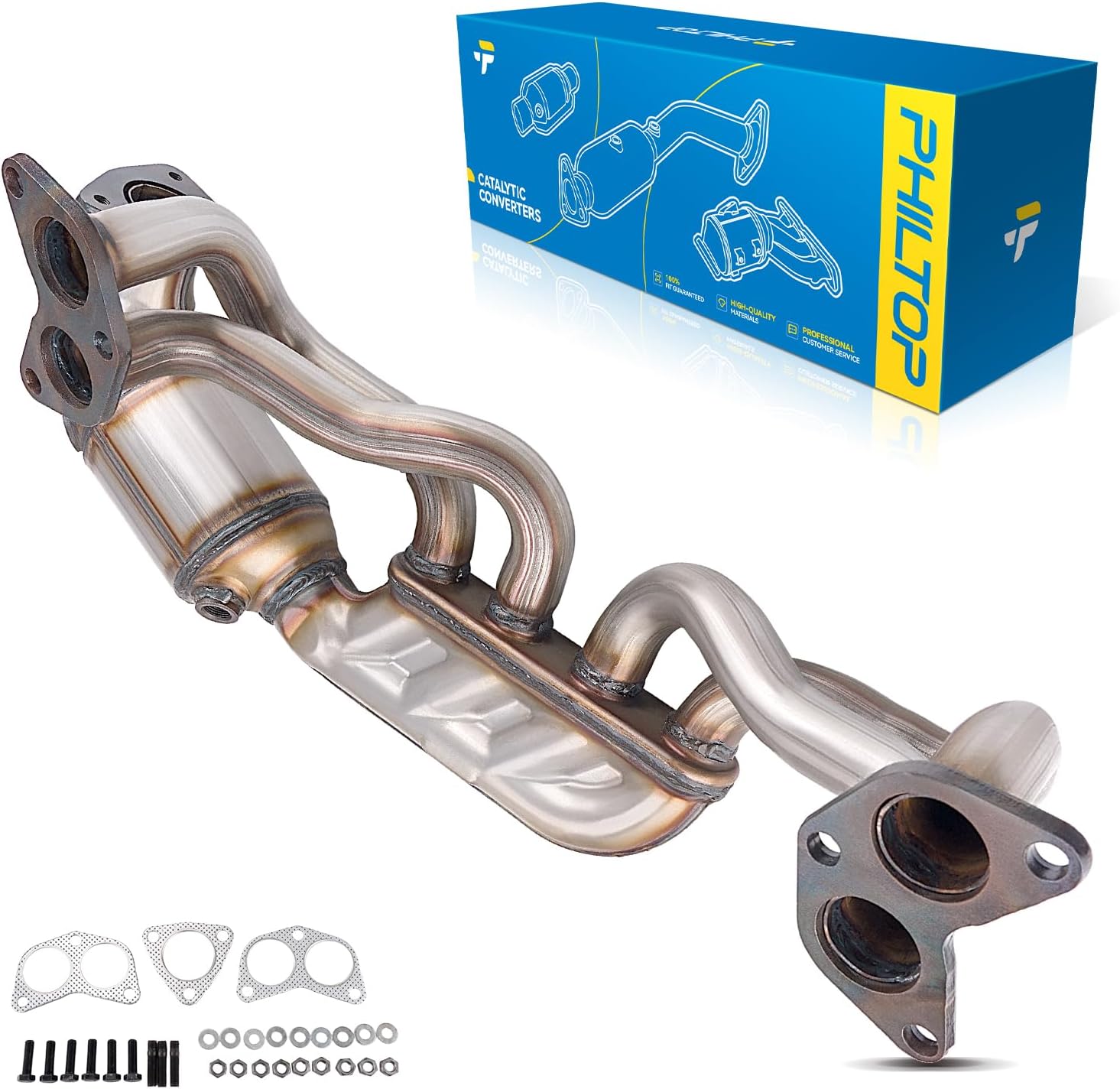
| Position | Front |
|---|---|
| Compatibility note | Fits select 2011–2016 Subaru Forester, 2013–2014 Outback/Legacy and similar models (verify reference number) |
| Material | 409L stainless steel |
| EPA status | EPA-compliant for federal emissions areas |
This PHILTOP front catalytic converter is a direct-fit replacement engineered to match factory mounting points for select Subaru models from the 2011–2016 era. It uses a high-flow ceramic honeycomb substrate to reduce backpressure compared with a clogged or failed unit, which can improve drivability and marginally help fuel efficiency. The converter comes with OE-style gaskets and hardware for a bolt-in install that most independent shops can complete in 3 to 4 hours. Constructed from 409L stainless steel, it is intended for long service life and includes EPA compliance for federal emissions areas. Limitations are that it is not legal for sale or installation in certain states with stricter rules, and buyers should confirm the exact reference number fitment for a 2010–2014 Legacy before purchasing since this listing targets multiple Subaru models; professional installation is recommended to ensure correct sensor alignment and clearances.
Best for: A practical owner who needs a reliable, factory-style replacement to restore emissions compliance and normal exhaust flow on a 2010–2014 Subaru Legacy and prioritizes straightforward fitment and long-term durability.
Less Ideal for: Do not choose this if you live in a state with tighter emissions regulations or if you want a custom performance exhaust part rather than a direct factory-style replacement.
- Designed as a direct-fit front converter with OE-style gaskets and hardware for straightforward installation
- High-flow honeycomb substrate reduces backpressure compared with a failing unit, aiding throttle response
- Made from 409L stainless steel for corrosion resistance and longer service life
- EPA-compliant for federal emissions areas
- Not legal for sale or installation in some states with stricter emissions rules
Verdict: If you need a durable, direct-fit front catalytic converter to restore emissions function and maintain factory-style installation on a 2010–2014 Subaru Legacy, this PHILTOP unit is a practical choice.
4. PHILTOP Rear Direct-Fit Catalytic Converter for Subaru Outback/Legacy 2.5L (55644)

| Compatible vehicles | 2010–2012 Outback/Legacy 2.5L |
|---|---|
| OEM reference number | 55644 |
| Position | Rear |
| Manufacturer | PHILTOP |
This PHILTOP rear catalytic converter is a bolt-on, flange-to-flange replacement for 2010–2012 Subaru Outback and Legacy 2.5L models that aims to restore emissions control and exhaust flow without modification. It uses a high-flow ceramic substrate and a stainless steel shell to reduce backpressure, which can help recover a bit of lost power and improve catalytic efficiency compared with a clogged or damaged unit. The part ships with OE-style gaskets and mounting hardware so a competent DIYer or independent shop can complete installation in a few hours. It is described as EPA-compliant for federal emissions but is not legal for states that require California standards. Expect durable welds and OEM-like fitment, though extended longevity depends on upstream engine condition and fuel/tune. If you need a direct replacement to pass federal smog checks and avoid dealer pricing, this offers a practical, budget-focused solution with straightforward installation.
Best for: Buyers looking for an affordable, direct-replacement catalytic converter to restore emissions function and exhaust flow on a 2010–2012 Subaru Legacy/Outback 2.5L who want a part they can install or have installed without modifications.
Less Ideal for: Drivers in states that require California emissions compliance or owners seeking a performance-oriented aftermarket converter for racing or modified engines.
- Direct-fit flange-to-flange design for bolt-on installation using factory mounting points
- High-flow ceramic substrate aimed at reducing backpressure and improving conversion efficiency
- Stainless steel outer shell and welded connections for increased durability
- Includes OE-style gaskets and hardware so no additional parts are typically required
- EPA-compliant for federal emissions testing in qualifying states
- Not legal for use in states requiring California emissions standards
Verdict: A cost-conscious, direct-fit replacement that restores emissions control and exhaust flow for 2010–2012 Subaru Outback and Legacy 2.5L models without modifications.
5. SPEEDFusion High-Flow Catalytic Converter (EPA Compliant)

| Compatible engines | 2.0L and 2.5L H4 (specified Subaru models) |
|---|---|
| Material | 409L stainless steel |
| Substrate | OEM-grade 400-hole ceramic with Pt/Rh/Pd |
| Certification | EPA compliant (federal) |
This SPEEDFusion catalytic converter is a direct-replacement unit designed to fit certain Subaru H4 vehicles from the 2011–2014 era and similar model years listed by the manufacturer. It uses a polished 409L stainless steel shell and an OEM-grade 400-hole ceramic substrate plated with platinum, rhodium, and palladium to boost conversion efficiency and keep the malfunction indicator light from triggering under normal conditions. Installation is intended to be straightforward as a direct fit, but professional installation is recommended to ensure correct sealing and emissions operation. The unit is EPA certified for federal emissions compliance, so it is suitable where federal standards apply, though it is not CARB-compliant. Practical benefits include durable stainless construction, an emphasis on emission control, and a warranty that covers structural and emissions performance for a limited period. Buyers should note the legal limitation in CARB states and that a proper shop installation is advised to avoid fitment or sensor-related issues.
Best for: Buyers who prioritize a reliable, factory-style emissions repair for covered Subaru H4 vehicles and want a durable, emission-certified replacement that minimizes the chance of check-engine lights related to the converter.
Less Ideal for: Do not choose this if you need a California-compliant catalytic converter or if you require a universal or performance-only aftermarket part for non-emissions-focused builds.
- Direct-fit design simplifies replacement for covered Subaru H4 models listed by the manufacturer.
- 409L stainless steel shell for corrosion resistance in typical road conditions.
- OEM-grade 400-hole ceramic substrate with precious metal coating to improve catalytic conversion.
- EPA certification for federal emission compliance supports passing emissions checks outside CARB states.
- Not CARB-compliant so it cannot legally be used in CARB-regulated states.
- Professional installation is recommended, so DIY buyers may need shop labor to ensure correct fit and sensor operation.
Verdict: A durable, EPA-certified direct-fit replacement that restores factory-style emissions performance for covered 2011–2014 Subaru H4 models.
6. ECHO AUTOMILES Catalytic Converter for Subaru Forester/Impreza/Outback/Legacy 2.5L (EPA Compliant)
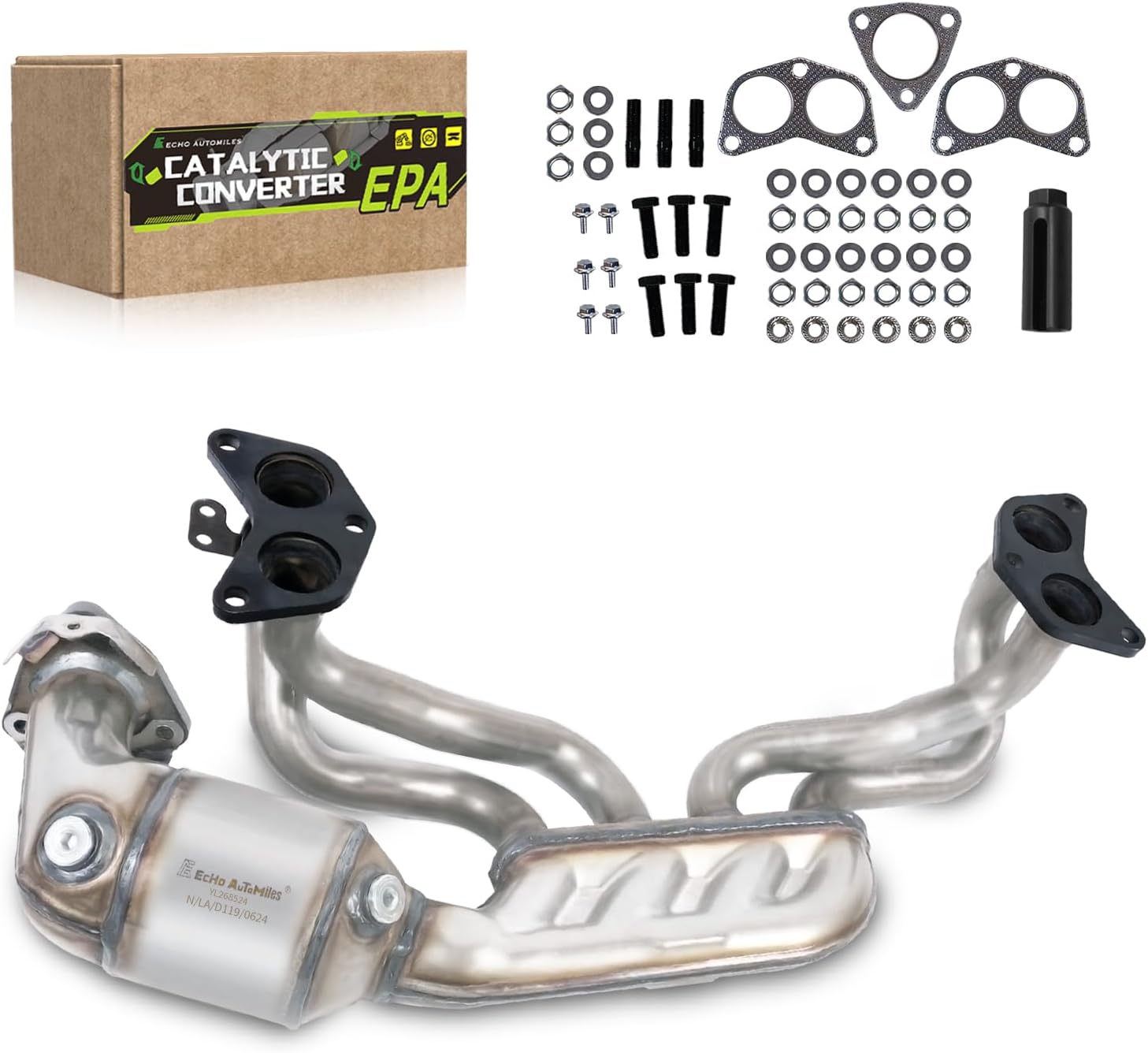
| Compatible engine | 2.5L Subaru |
|---|---|
| Substrate | 400-cell honeycomb |
| Compliance | EPA compliant |
| Warranty | 2.5 years / 25,000 miles |
This catalytic converter is built as a direct replacement for 2.5L Subaru applications and uses a 400-cell honeycomb substrate intended to match factory flow while resisting high-temperature damage. It arrives with the gaskets and hardware needed for installation, which simplifies swapping the failed unit and reduces the need for extra parts. The 400-cell design aims to keep backpressure low so engine performance and fuel economy remain close to factory levels, and the polished exterior suggests corrosion resistance for street use. Notably, the listing states local sale restrictions for certain states, so buyers should confirm legality before purchase. For a risk-averse buyer, the included 2.5-year or 25,000-mile warranty provides added protection, though this is shorter than typical vehicle lifespans and professional installation is recommended to ensure proper fit and emissions compliance.
Best for: Buyers who prioritize a straightforward, factory-style repair and want a backed replacement that restores emissions function with minimal headaches and parts hunting.
Less Ideal for: Do not choose this if you need a lifetime emissions solution or if your vehicle is registered in a state where the part is restricted; performance-focused tuners should look at specialized options instead.
- Direct-fit replacement designed for Subaru 2.5L models to simplify installation
- 400-cell honeycomb substrate aimed at preserving engine power and reducing backpressure
- Includes necessary gaskets and hardware so no extra parts are usually required
- EPA-compliant design intended to meet emissions requirements in most states
- Not legal for sale or installation in certain states, so compatibility with local regulations must be confirmed
Verdict: A direct-fit, EPA-compliant replacement that simplifies getting a legally acceptable catalytic converter back on your 2.5L Subaru with included hardware and a short-term warranty.
Choosing the Right 2010-2014 Subaru Legacy Catalytic Converter: Key Factors to Consider
Fitment And Mounting
Correct fitment is the single most important factor for a 2010-2014 Subaru Legacy catalytic converter. A converter that matches the factory flange type, pipe diameter, and hanger locations minimizes the need for cutting, welding, or adapter pieces. Improper fitment can cause exhaust leaks, added vibration, and accelerated warranty or component issues.
When evaluating fitment, confirm whether the unit is a direct bolt-on replacement or requires minor fabrication. Also check if the converter includes necessary gaskets, hardware, or integrated heatshields that affect installation complexity. Selecting a unit designed for the Legacy reduces shop labor time and ensures the exhaust backpressure stays within expected ranges for the stock engine and emissions control systems.
Emissions Efficiency And Substrate Type
The substrate and cell density determine how effectively the converter reduces hydrocarbons, carbon monoxide, and nitrogen oxides. For 2010-2014 Subaru Legacy owners concerned with passing emissions tests, choosing a converter with the right substrate design helps maintain catalytic efficiency across a range of temperatures and engine loads.
Higher cell densities increase surface area for catalytic coating but can raise backpressure; lower densities may flow better but reduce conversion efficiency. Balance is important for the Legacy so that emissions control is restored without harming throttle response or fuel economy.
Durability And Materials
Materials and construction quality influence how long a catalytic converter will last under thermal cycling and road conditions. Stainless steel shells and robust internal welds resist corrosion and cracking, which are common failure modes in regions with road salt or frequent temperature swings.
Also consider the thermal tolerance of internal components and the quality of the ceramic or metallic substrate. A more durable converter reduces the likelihood of premature failure signs and keeps the exhaust system functioning reliably for more miles on your Legacy.
Oxygen Sensor And ECU Compatibility
The Legacy's engine management relies on correct oxygen sensor readings before and after the converter. Some replacement converters include pre-bored ports for upstream and downstream oxygen sensors, while others require relocation or adapter fittings. A converter that preserves sensor spacing and probe orientation helps prevent false check engine light catalytic converter codes.
If sensor placement changes, the vehicle may need additional diagnostics or sensor extensions. Ensuring compatibility reduces troubleshooting time and helps maintain steady air-fuel control and emissions monitoring on the 2010-2014 Subaru Legacy.
Installation Complexity And Serviceability
Consider whether the converter is designed for DIY installation or requires professional service. Bolt-on direct-fit units typically simplify installation and lower labor time, while universal or welded designs can add hours of shop work. For owners planning to replace the unit themselves, look for clear hardware inclusion and straightforward instructions.
Serviceability also covers whether the converter allows easy access to oxygen sensors and downstream components. Designs that facilitate future maintenance or sensor replacement without extensive disassembly are preferable for long-term ownership.
Warranty And Regulatory Compliance
Warranty length and coverage are useful proxies for expected lifespan and manufacturer confidence. For vehicles registered in areas with emissions inspections, regulatory compliance or certification for on-road use is crucial. Ensure the replacement indicates whether it meets relevant emissions standards for the 2010-2014 Subaru Legacy.
A solid warranty can offset the inconvenience of a future failure and signal that the unit is built to withstand the operating conditions typical for this vehicle.
Common Catalytic Converter Symptoms On The 2010-2014 Legacy
Recognizing early signs of catalytic converter trouble helps you act before a minor issue becomes a costly repair. Typical symptoms on a Legacy include a persistent check engine light catalytic converter code, reduced engine performance under load, and unusual exhaust odors. You may also notice decreased fuel economy or a rotten egg smell from unconverted fuel.
Some symptoms overlap with other exhaust or engine issues, so use symptom patterns—such as the light returning immediately after clearing codes or performance loss during acceleration—to narrow the cause toward the catalytic converter rather than unrelated components.
- Persistent check engine light catalytic converter or O2 sensor diagnostic trouble codes
- Loss of power or hesitation under acceleration
- Noticeable decrease in fuel efficiency
- Strange sulfur or rotten egg exhaust odor
- Rattling noises from the converter housing indicating internal breakdown
How Converter Fitment Affects Emissions Testing
Proper fitment is critical for emissions performance because exhaust leaks or incorrect backpressure can skew oxygen sensor readings and lead to failed inspections. A converter that seals correctly at flange joints and maintains the factory pipe alignment helps the Legacy meet emissions thresholds during standardized testing.
When evaluating CAT converter fitment for the 2010-2014 Legacy, confirm that the unit supports the same sensor locations and that any required adaptors are approved for on-road use in your jurisdiction. Poorly matched converters are a common source of test failures even when the catalytic substrate itself is functioning.
- Sealed flanges prevent false O2 readings
- Correct pipe diameter maintains designed backpressure
- Preserved sensor spacing ensures accurate emissions monitoring
DIY Replacement Considerations For Legacy Owners
Many owners replace catalytic converters themselves, but the job can vary in difficulty depending on rust, access, and whether the unit is a direct fit. For the 2010-2014 Subaru Legacy, plan for penetrating oil on corroded bolts, proper safety supports for the vehicle, and the potential need for a cutting wheel if the old converter is welded in place.
If you plan to follow a how to replace catalytic converter procedure, ensure you have the correct torque specs for exhaust fasteners, a replacement gasket set, and any oxygen sensor extensions if the new unit changes sensor locations. If welding is required, factor in shop time or the appropriate welding equipment and experience.
- Prepare for rusted hardware and possible cutting or welding
- Confirm included hardware and gaskets before starting
- Check sensor port locations to avoid extra wiring or adapters
Diagnosing Converter Failure Signs Without Replacing Parts
Before replacing the catalytic converter, perform diagnostic checks that can indicate converter failure signs. A visual inspection for dents, corrosion, or external damage may reveal obvious issues. You can also monitor exhaust backpressure and perform a temperature differential test, where a healthy converter is typically hotter at the outlet than the inlet after a steady drive.
Onboard diagnostics are useful: look for stored codes related to efficiency below threshold or oxygen sensor discrepancies. These checks help avoid unnecessary catalytic converter replacement and guide whether internal substrate damage or external exhaust leaks are the likely culprit.
- Visual inspection for corrosion, dents, or rattle
- Temperature check: outlet hotter than inlet indicates flow
- Scan for efficiency and O2 sensor mismatch codes
Maintaining Your Replacement To Avoid Early Failure
After installing a new converter, maintaining the engine and related systems extends its life. Keep ignition and fuel systems in proper condition because misfires or rich running create excess unburned fuel that can poison the catalytic substrate. Regular oil and coolant maintenance also reduce contamination risks from leaks that can damage the converter.
Avoid frequent short trips that prevent full catalytic light-off temperatures, and address any exhaust leaks promptly to prevent corrosion. These habits help protect the converter and sustain emissions performance on the 2010-2014 Legacy.
- Promptly repair misfires and fuel system issues
- Prevent coolant or oil leaks from entering the exhaust
- Drive periodically at operating temperature to maintain catalyst efficiency
Still looking for the perfect fit?
Select your Subaru Legacy configuration to see the most relevant Catalytic Converters recommendations
How We Chose the Best 2010-2014 Subaru Legacy Catalytic Converter
We focused on the attributes that most affect real-world use on 2010-2014 Subaru Legacy vehicles. Key evaluation criteria included fitment accuracy and flange type to ensure direct replacement without extensive modification; emissions performance based on substrate type and cell density that influence conversion efficiency; material and construction quality for resistance to thermal cycling and corrosion in typical driving climates. We also weighed mounting and heatshield design because secure installation reduces exhaust leaks and rattles, and considered warranty coverage and manufacturer support as indicators of expected longevity.Excluded from consideration were units intended only for off-road use or labeled as performance-only without emissions certification, units requiring engine or ECU modifications, and converters that did not list explicit fitment for the 2010-2014 Legacy. Our process prioritized converters that restore catalytic function while matching the vehicle's factory exhaust geometry and emissions requirements.
Our full evaluation process is outlined in our review methodology.
FAQ
What are the most common catalytic converter symptoms on a 2010-2014 Subaru Legacy?
Common symptoms include a persistent check engine light catalytic converter code, reduced power under acceleration, decreased fuel economy, a sulfur-like exhaust odor, and rattling noises if the internal substrate has broken apart.
Can I replace the catalytic converter myself on a 2010-2014 Legacy?
Many owners can do a direct-fit replacement with basic tools, but rusted bolts or welded units can complicate the job. Be prepared with proper safety equipment, gaskets, and possibly welding or cutting tools for older, corroded exhaust systems.
Will a new catalytic converter clear a check engine light immediately?
Replacing the converter may not clear the light instantly because the ECU may need a drive cycle to verify emissions performance. Additionally, residual oxygen sensor codes or unrelated engine faults can keep the light on until those issues are resolved.
How can I confirm the converter is failing before purchasing a replacement?
Perform a visual inspection, check for rattling, scan for efficiency or O2 sensor mismatch codes, and compare inlet vs outlet temperatures after a steady drive. These checks help distinguish converter failure signs from other exhaust or engine problems.
Does converter fitment affect emissions test results for the Legacy?
Yes. Incorrect fitment, exhaust leaks, or altered sensor placement can lead to false oxygen sensor readings and potential emissions test failures even if the converter itself is functional.
How long should a replacement catalytic converter last on a 2010-2014 Subaru Legacy?
Lifespan depends on driving habits and maintenance. Properly installed and maintained converters can last many years, but exposure to corrosion, frequent engine misfires, or contamination can shorten service life. Warranty coverage is a useful indicator of expected durability.
Final Verdict
For 2010-2014 Subaru Legacy owners, prioritize a catalytic converter that matches factory fitment and preserves oxygen sensor locations to avoid extra labor and false diagnostic codes. Balance substrate design with expected backpressure so emissions efficiency is restored without harming drivability.Weigh durability, warranty, and installation complexity when deciding between direct-fit and universal offerings. Focusing on fitment, emissions performance, and proper installation will give you the most reliable outcome and reduce the chance of repeat trips to the shop.
Explore More:
- Check out all Subaru Legacy parts & accessories
- Explore Catalytic Converters Maintenance & Repair Guides
- Explore Exhaust & Emissions
- Browse all Auto Parts
