

Note: This article contains affiliate links. If you click on these links and make a purchase, I may earn a small commission at no extra cost to you. This helps support my research and content. Read my full affiliate disclosure here.
If you drive a 1998-2002 Subaru Forester, a failing catalytic converter can cause reduced performance, higher emissions, and an illuminated engine warning light. Choosing the right catalytic converter matters because fitment, emissions compliance, and durability directly affect drivability and whether your vehicle passes inspections.This guide covers our top six shortlisted catalytic converters for the 1998-2002 Forester and explains the evaluation criteria we used, including physical fit, emissions performance, and build quality. Read on to find options that match your replacement goals and learn what to check before installation.
Looking for other parts? See all Subaru Forester parts & accessories.
Top Picks at a Glance
| Best Overall The best all-around choice for most situations | KAX Catalytic Converter for Subaru 2.5L (front or rear) |  |
| Best Quality Built to a higher standard if you want something more solid | MagnaFlow Catalytic Converter 49490 (Direct-Fit, EPA Compliant) |  |
| Best Value The sweet spot between price and what you get | ABysmauto Direct-Fit Catalytic Converter for 2.5L H4 Subaru (EPA Compliant) |  |
| Best Budget The cheapest option that still gets the job done reliably | FortunaFlow Catalytic Converter Compatible with Subaru 2.5L (Direct Fit) |  |
| Highest Rated A top-rated pick with lots of positive feedback | PHILTOP High-Flow Catalytic Converter for Subaru 2.5L (1999–2005) |  |
| Most Popular A crowd favorite that many people choose with confidence | FOMIUZY Catalytic Converter for Subaru Forester 2.5L (1999–2005) |  |
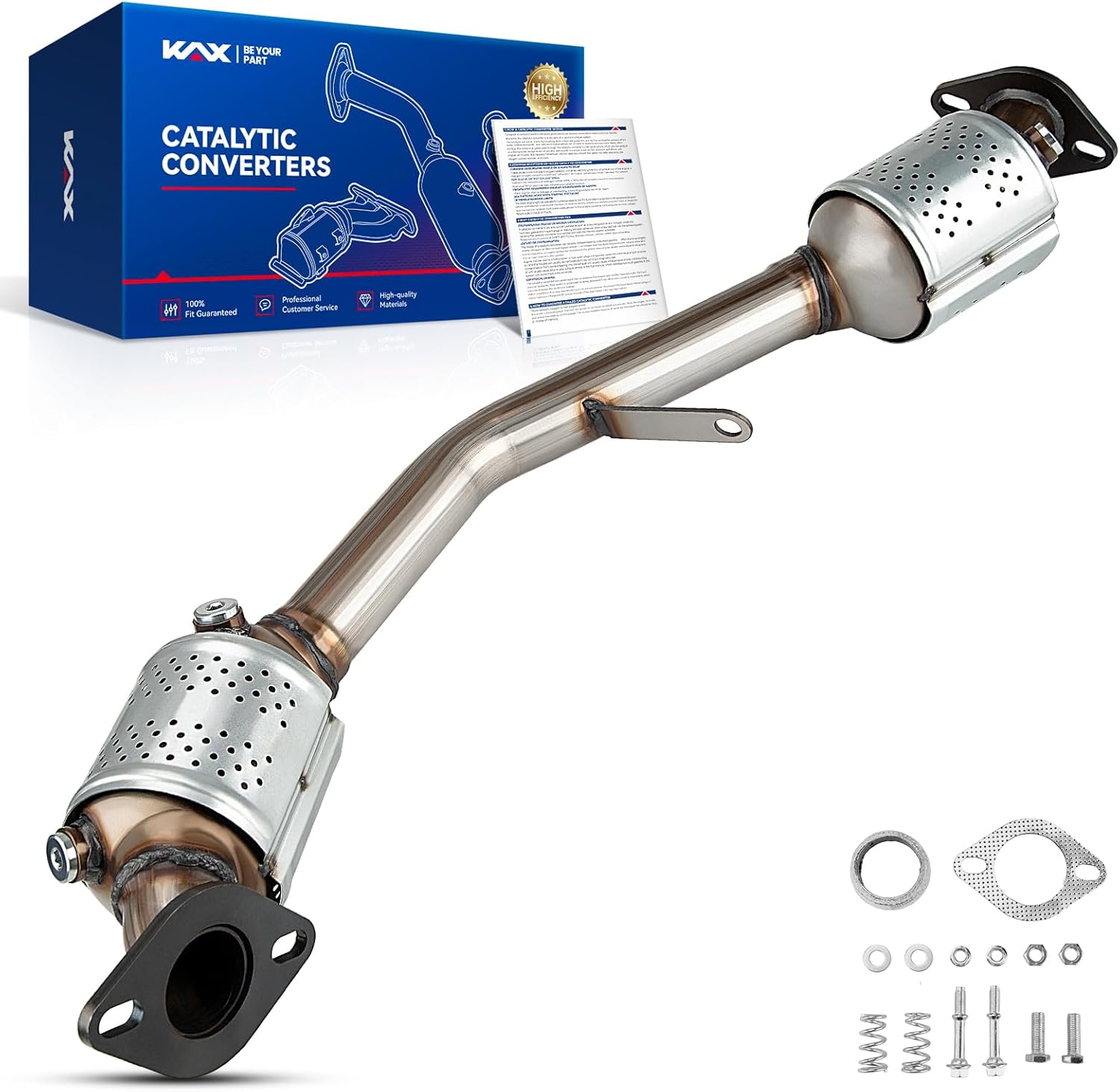
1. KAX Catalytic Converter for Subaru 2.5L (front or rear)
| Fitment | Forester 1999-2005, Outback 2000-2005, Legacy/Impreza 2002-2005, Baja 2003-2006, 9-2X 2005-2006 (2.5L) |
|---|---|
| Position | Front, Rear |
| Manufacturer | KAX |
| Manufacturer Part Number | 4566CAC0733US |
| OEM Part Numbers | 54573, 40237, 44139FA161, 44139FA010, 44139SA010, others |
This KAX catalytic converter is a factory-quality replacement intended for Subaru 2.5L applications from the late 1990s through the mid 2000s. It installs where your original front or rear converter sits and uses a high-flow ceramic honeycomb substrate with rare-earth CeO2 stabilizer coating to promote efficient emissions conversion while reducing backpressure. The listing says it includes OE-style gaskets and hardware so installation typically matches factory mounting points and can be completed in a few hours without modification. In practice the high-flow design should help restore engine breathing and may reduce rattling or loud exhaust if the old unit is internally damaged. Important limitations are that this is a federal-emissions model not approved for use in some states with stricter rules, and fitment must be confirmed against your vehicle since multiple OEM part numbers are referenced. Expect a straightforward swap for the specified Forester/Outback/Legacy/Impreza/Baja 2.5L applications when emissions rules and part numbers align.
Best for: Buyers who want a practical, balanced factory-style replacement to restore emissions control and exhaust performance on an early 2000s Subaru 2.5L without custom work.
Less Ideal for: Do not choose this if your vehicle is registered in a state requiring CARB-compliant parts or if you need a universal or performance-oriented converter for a modified engine.
- Designed as a direct-fit replacement for specified 2.5L Subaru models with matching mounting points and included OE-style gaskets and hardware
- High-flow ceramic honeycomb substrate reduces backpressure and can improve exhaust flow and engine responsiveness
- CeO2 rare-earth stabilizer coating and porous substrate increase catalytic surface area for better conversion efficiency
- Available for either front or rear position to match the failed unit
- Not approved for use in states with stricter emissions requirements such as California
- Compatibility relies on matching OEM part numbers so you must verify fitment for your exact year and trim
Verdict: Choose this KAX converter if you need a ready-to-install, high-flow factory-style replacement to restore emissions function and exhaust flow on an early 2000s Subaru 2.5L.
2. MagnaFlow Catalytic Converter 49490 (Direct-Fit, EPA Compliant)

| Manufacturer | MagnaFlow Exhaust Products |
|---|---|
| Model | OEM Grade |
| Exterior | Stainless Steel |
| Manufacturer Part Number | 49490 |
| OEM Part Number | 44139SA010, 44139SA000, 44139FA010, 44139FA161, 44659AA00A, 44139FA160 |
The MagnaFlow 49490 is a direct-fit catalytic converter engineered to match factory flow and emissions standards for the specified Subaru forester/outback applications. It installs in place of the factory converter using included gaskets and hardware to reduce the risk of exhaust leaks and avoid reusing corroded parts. The unit uses mandrel-bent tubing and a high-strength stainless steel shell intended to preserve smooth exhaust flow and resist corrosion for long service life. For a performance-minded buyer this part aims to maintain factory power and fuel economy while ensuring EPA compliance, rather than increasing horsepower. Notable practical benefits include the direct-fit design for straightforward installation and materials that improve durability versus older corroded converters. Important limitations are that it is a replacement for emissions control, not a high-flow race part, and it is restricted from sale or use in certain states per the legal disclaimer.
Best for: Buyers who want a durable, legal replacement that restores factory exhaust flow and emissions control while minimizing installation hassle on their Subaru.
Less Ideal for: Drivers seeking a high-flow or racing catalytic converter for measurable performance gains should look at performance-specific units or full exhaust upgrades instead.
- Direct-fit design with included gaskets and hardware for easier installation
- Mandrel-bent tubing to preserve smooth exhaust flow and factory-like performance
- Stainless steel construction for improved corrosion resistance and longevity
- EPA-compliant for legal emissions replacement on eligible vehicles
- Not designed as a high-flow performance upgrade; does not increase power beyond factory levels
- Not legal for sale or use in certain states as noted in the legal disclaimer
Verdict: Choose this MagnaFlow if you need a reliable, EPA-compliant direct-fit replacement that preserves factory exhaust flow and durability on your Subaru.
3. ABysmauto Direct-Fit Catalytic Converter for 2.5L H4 Subaru (EPA Compliant)

| Vehicle fitment | Subaru 2.5L H4 models (specified years) excluding turbo models |
|---|---|
| Material | Stainless steel |
| Compliance | EPA compliant (not CARB) |
| Manufacturer part number | SRCZ007Y |
This ABysmauto catalytic converter is a direct-fit replacement designed for Subaru 2.5L H4 models from the early 2000s and installs in place of the factory unit without major modification. It is constructed from stainless steel with a high-flow catalyst core and is aimed at restoring emissions control while minimizing exhaust restriction compared with worn converters. Typical installation is bolt-on for compatible Forester, Outback, Legacy, Impreza, Baja and Saab 9-2X models (non-turbo) within the specified years, making it useful for repair or emissions-related replacement. The unit is EPA compliant but not CARB approved, so it cannot be used where California or equivalent rules apply. Buyers should appreciate the durable materials and the simplified fitment approach, though professional installation is recommended to ensure correct gasket alignment and oxygen sensor positioning. The manufacturer provides a one-year limited warranty for defects, and the converter is intended primarily as a functional, value-focused factory-quality replacement rather than a performance aftermarket upgrade.
Best for: Buyers who want a practical, budget-conscious factory-quality replacement to restore emissions function and maintain drivability on older Subaru 2.5L H4 vehicles.
Less Ideal for: Anyone who needs a CARB-compliant part for emissions testing in states with strict regulations or those seeking a performance-focused aftermarket converter upgrade.
- Direct-fit design for bolt-on replacement in compatible Subaru 2.5L H4 models
- Stainless steel construction suited to high-temperature exhaust conditions
- EPA-compliant for use in most U.S. states outside CARB jurisdictions
- High-flow catalyst intended to reduce exhaust restriction compared with degraded converters
- Not CARB compliant so cannot be used in California, Colorado, New York, or Maine registered vehicles
Verdict: A straightforward, EPA-compliant direct-fit replacement that restores emissions control and exhaust flow for older Subaru 2.5L H4 models outside CARB states.
4. FortunaFlow Catalytic Converter Compatible with Subaru 2.5L (Direct Fit)

| Compatible engines | 2.2L and 2.5L Subaru petrol |
|---|---|
| Direct fit | Yes, flange and mounting holes match factory locations |
| Manufacturer | FortunaFlow |
| Item model number | SB032.5 |
| Exterior | Metallic Finish |
This FortunaFlow catalytic converter is a direct-fit aftermarket replacement intended to restore emissions function and clear P0420/P0430 codes on compatible Subaru 2.2L and 2.5L vehicles. It is used in the same position as the factory converter and installs using the supplied gaskets and hardware; the seller states the flange and bolt locations match factory specifications so no major modification should be required. The unit is stainless steel with CNC MIG welds for durability and a heat shield for EPA-compliant installations outside restricted states. For a budget-focused buyer this offers a straightforward way to pass OBD-II readiness checks and get an older Subaru back to emissions compliance without an expensive dealer part. Limitations include regional sale restrictions for California, New York, Colorado, and Maine and the listing does not provide detailed internal substrate or precious-metal load information, so long-term catalyst performance and mileage lifespan are uncertain compared with higher-end branded replacements.
Best for: Buyers seeking the most affordable path to restore emissions function and clear check-engine codes on older Subaru 2.2L/2.5L vehicles who prioritize upfront cost and a direct-fit replacement.
Less Ideal for: Drivers in states with stricter emissions rules or buyers who need documented long-term catalyst durability and high precious-metal content should consider higher-spec or state-compliant alternatives.
- Direct-fit design with matching flange and mounting hole locations to simplify installation
- Stainless steel construction with CNC MIG welding for corrosion and heat resistance
- Includes gaskets and hardware so you get what is needed for a typical replacement install
- Not available for sale or shipment to California, New York, Colorado, or Maine due to emissions rules
- No manufacturer data on catalyst substrate type or precious metal loading, so longevity is unclear
Verdict: A budget-friendly, direct-fit replacement that gets older Subaru 2.2L/2.5L models back to emissions readiness without major modifications.
5. PHILTOP High-Flow Catalytic Converter for Subaru 2.5L (1999–2005)

| Compatible engines | 2.5L Subaru (1999–2005 Forester, 2000–2005 Impreza, 2005 Saab 9-2X) |
|---|---|
| EPA status | EPA compliant (federal models) |
| Position | Front, Rear |
| Manufacturer | PHILTOP |
This PHILTOP catalytic converter is a direct replacement designed for Subaru 2.5L vehicles from the late 1990s through mid 2000s, offering a high-flow ceramic substrate to lower backpressure and help the engine breathe better. Typical use is as a like-for-like repair when a worn or damaged converter triggers a check engine light or fails an emissions test. Notable features include a stainless steel aluminized body for corrosion resistance, a double-layer high-temperature ceramic carrier for increased flow area, and included OE-style gaskets and hardware to simplify installation. In practice the high-flow design can slightly improve throttle response and may help fuel economy compared with a clogged unit, while the plug-and-play fitment keeps installation time to a few hours with common tools. This unit is EPA compliant for federal use but is not legal for sale or installation in some states, and buyers should verify local regulations before purchase. It is intended as a direct replacement rather than a performance upgrade for heavily modified engines.
Best for: Buyers who prioritize a dependable, factory-style replacement to restore emissions performance and drivability without modifying the exhaust system.
Less Ideal for: Not a good choice for those seeking a high-performance racing converter or anyone who needs a state-specific certified unit where federal EPA parts are restricted.
- Direct-fit design with OE-style gaskets and hardware for straightforward install
- High-flow double-layer ceramic substrate reduces backpressure compared with clogged converters
- Aluminized stainless steel body improves corrosion resistance and service life
- EPA-compliant for federal emissions standards
- Not legal for sale or installation in states with their own stricter emissions rules
Verdict: Choose this PHILTOP converter when you want a reliable, direct-fit replacement that restores emissions compliance and improves exhaust flow over a failing unit.
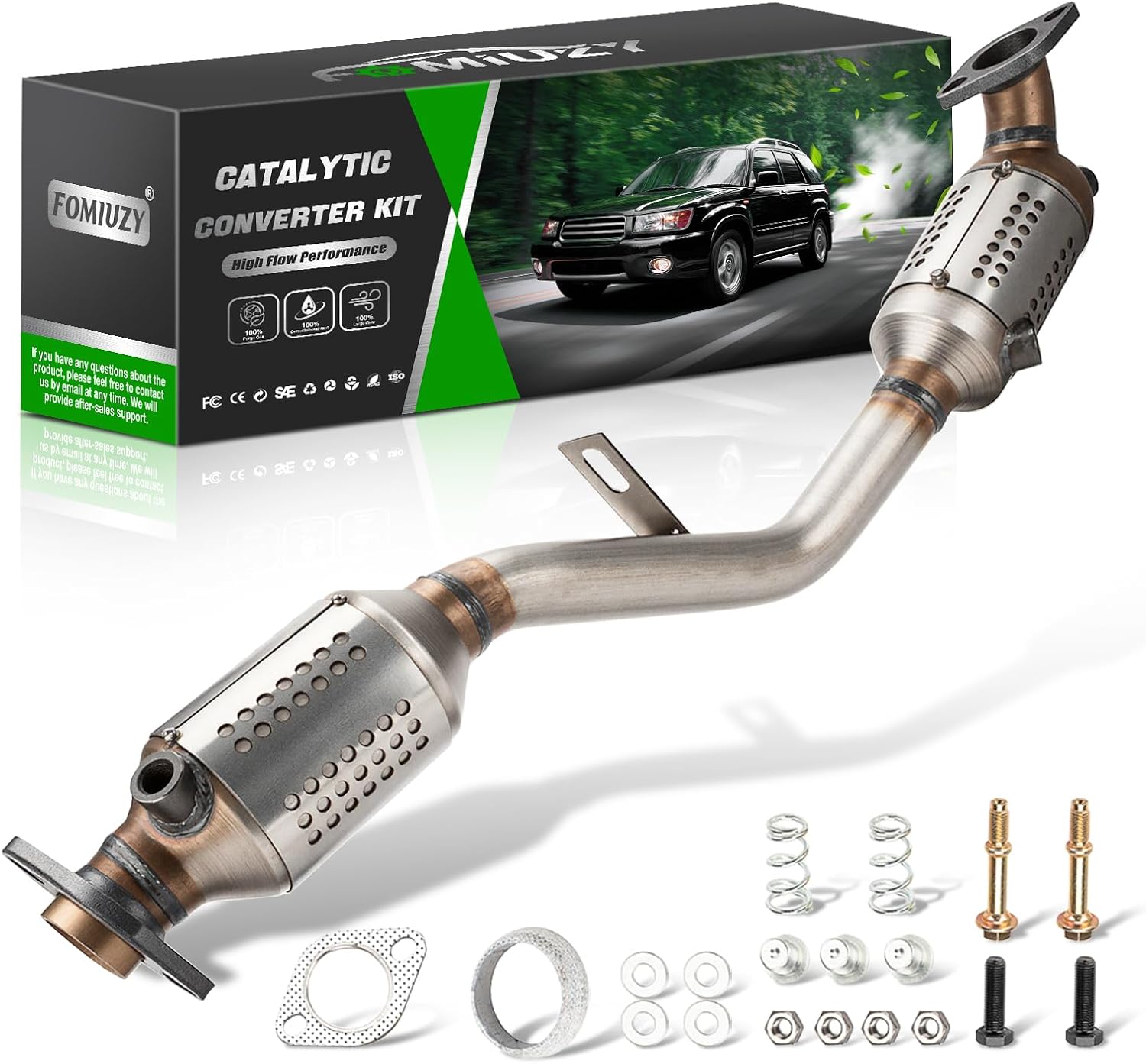
6. FOMIUZY Catalytic Converter for Subaru Forester 2.5L (1999–2005)
| Compatible engines | Subaru 2.5L |
|---|---|
| Fitment years | 1999–2005 (Forester) and select 2000–2006 Subaru 2.5L models |
| Exterior | Milled stainless steel |
| Manufacturer part number | Forester wqpf 99-05 |
This FOMIUZY catalytic converter is a direct-fit replacement intended for Subaru 2.5L models from the late 1990s and early 2000s and is built from stainless steel with a ceramic substrate loaded with platinum, rhodium, and palladium. It installs where the factory unit sits and is intended to restore emissions control and engine performance after a failed converter; the listing notes it matches the original shape so it can be bolted in and then welded for a better seal. In real-world use the stainless construction should resist exhaust heat and corrosion, and the high-surface substrate increases the contact area for catalytic reactions, which helps reduce harmful emissions. Important limitations are that it is not compliant with California emissions rules and may not be legal for sale or installation in restricted states, and buyers should confirm part numbers for fitment before ordering. The unit comes as a single kit and the manufacturer offers a lifetime warranty and customer support for installation or quality issues.
Best for: Buyers who want a direct replacement catalytic converter to restore emissions control on older Subaru 2.5L vehicles and who prioritize a factory-style fit and manufacturer warranty when assessing options.
Less Ideal for: Drivers living in California or New York or those who require a CARB-compliant replacement should choose a certified emission-legal unit instead.
- Stainless steel body for improved resistance to heat and corrosion
- High-load ceramic substrate with Pt, Rh, and Pd to improve catalytic conversion efficiency
- Direct-fit design intended to match the original unit for simpler installation
- Manufacturer-provided lifetime warranty and direct customer support
- Not compliant with California emissions standards and may be illegal in restricted states
Verdict: A factory-style stainless steel replacement for 2.5L Subaru owners who want a direct-fit catalytic converter backed by a lifetime warranty.
Choosing the Right 1998-2002 Subaru Forester Catalytic Converter: Key Factors to Consider
Fitment and Mounting
Correct physical fit is the single most important factor when replacing a catalytic converter on a 1998-2002 Forester. The converter must align with the stock flange pattern, hanger locations, and exhaust routing to avoid stress on joints or the need for custom fabrication. A direct-fit unit reduces installation time and risk of leaks that can trigger a check engine light catalytic converter complaints.
When assessing fitment, verify inlet and outlet diameters, overall length, and bolt-hole spacing. Also confirm whether the unit includes necessary gaskets, flanges, or integrated heat shields. Poor fitment can lead to exhaust leaks, increased vibration, and premature failure of adjacent components.
Emissions Performance
Emissions effectiveness determines how well the converter reduces hydrocarbons, carbon monoxide, and nitrogen oxides. For a Forester in the 1998-2002 range, meeting local emissions standards and helping the vehicle pass inspections is often a priority. Look for information on substrate type and cell density, as higher cell densities and proper washcoat formulations typically yield more efficient conversion.
Consider whether the replacement is intended to meet original equipment emissions levels or aftermarket durability targets. Units designed to match OEM emissions performance will better address exhaust emissions catalytic converter concerns and reduce the likelihood of a failed emissions test.
Durability and Materials
Materials and construction affect how long a catalytic converter will last under real-world conditions. Stainless steel housings, quality welds, and robust internal substrates resist corrosion and thermal cracking that commonly cause catalytic converter failure signs. The 1998-2002 Forester often sees a variety of climates and road salts, so corrosion-resistant materials extend service life.
Also consider the substrate type and whether the converter uses a monolithic ceramic or metallic core. Each has tradeoffs in thermal tolerance and vibration resistance. Durability influences long-term maintenance needs and how soon you might face another replacement.
Backpressure and Engine Performance
A replacement converter should preserve the Forester's intended exhaust flow to avoid unnecessary backpressure that can reduce power and fuel efficiency. Excessive restriction can worsen symptoms like sluggish acceleration or increased fuel consumption. Conversely, an undersized substrate can reduce emissions performance.
Look for units engineered to balance conversion efficiency with acceptable flow characteristics. Where possible, check technical specs or manufacturer flow data to ensure the converter will not noticeably impact throttle response or engine load for these years.
Oxygen Sensor Compatibility
The Forester's engine management relies on upstream and downstream oxygen sensors to monitor combustion and catalyst efficiency. Replacement converters should accommodate the original sensor locations and threaded bung sizes. A converter lacking proper sensor bungs can prevent accurate monitoring and lead to a persistent check engine light catalytic converter message.
Confirm whether the unit includes pre-drilled bung positions or requires sensor relocation. Proper sensor placement ensures the vehicle's computer can adjust the air-fuel mixture and detect catalytic converter symptoms accurately.
Installation and Maintenance Considerations
Ease of installation affects how quickly you can get the Forester back on the road and whether the job is feasible for a home mechanic. Direct-fit converters that include gaskets and hardware minimize shop time. Also consider the accessibility of the converter under the vehicle and whether corrosion or seized bolts are likely to complicate removal.
Maintenance factors include how the converter tolerates fuel or oil contamination and whether future access for diagnostics is straightforward. Choose a unit that balances long-term serviceability with straightforward replacement procedures for the 1998-2002 Forester.
Common Catalytic Converter Symptoms On The 1998-2002 Forester
Recognizing failure signs early can prevent further engine damage. Typical catalytic converter symptoms for this Forester include a persistent check engine light catalytic converter-related code, a noticeable drop in engine performance, and increased exhaust odor. You may also notice rattling from the converter body if the internal substrate has disintegrated.
Some drivers report reduced fuel economy and an inability to reach normal cruising speeds when the converter is heavily restricted. Identifying these symptoms alongside a diagnostic scan helps determine whether the converter or another component is responsible.
- Persistent check engine light catalytic converter codes
- Rattling noise from under the vehicle indicating broken substrate
- Reduced acceleration and higher fuel consumption
- Strong sulfur or rotten-egg smell from the exhaust
- Failed emissions test or visible smoke under heavy load
Fitment Notes For 1998-2002 Forester Owners
When selecting a replacement, expect variations in exhaust layout between certain model years and engine options. Confirm the converter's compatibility with the Forester's exhaust flange pattern and hanger locations. Minor differences in length or angle can require an adapter or slight alteration.
If you are unsure about fitment, measure the existing converter and compare dimensions to the replacement's spec sheet. Also check whether the unit is marketed as a direct-fit for the 1998-2002 Forester to reduce the chance of modifications.
- Measure inlet/outlet diameters and flange spacing
- Check for included gaskets, bolts, or mounting hardware
- Confirm oxygen sensor bung locations match stock positions
Installation Tips And Common Pitfalls
Prepare for removal by letting the exhaust cool completely and applying penetrating oil to fasteners to reduce the chance of breaking bolts. Inspect flange faces for warping and clean mating surfaces before installing the new converter. Use new gaskets and torque bolts to manufacturer specs to prevent leaks.
Be aware of potential complications such as seized bolts, rusted hangers, or the need to transfer heat shields. If the converter integrates with other exhaust sections, capturing accurate measurements and taking photos of the original setup helps during reassembly.
- Apply penetrating oil to stubborn bolts well before attempting removal
- Use new gaskets and replace corroded hardware
- Verify oxygen sensor connections and wiring before test runs
Emissions Testing And Legal Considerations
Local emissions regulations can determine whether a replacement catalytic converter is acceptable. For a 1998-2002 Forester, confirm that the replacement meets your jurisdiction's requirements and whether it is intended for on-road use. Using a converter that does not meet local standards can result in failed inspections.
Keep documentation of the replacement and any emissions-related specifications. This paperwork can be useful during inspections and when diagnosing persistent emissions-related check engine light catalytic converter alerts.
- Check local emissions laws for allowed replacement types
- Retain installation receipts and spec documentation
- Be prepared to demonstrate converter fitment and emissions claims if requested during inspection
When To Replace Versus Repair
Minor external damage or a surface leak at a flange may be repairable in some cases, but internal substrate failure, melting, or catastrophic break-up typically requires full replacement. Diagnostic codes combined with physical inspection will guide the decision.
If the converter is causing significant restriction, or if internal pieces are loose and rattling, replacement is usually the practical and lasting solution for Forester models in this year range.
- Repair flange leaks only if substrate is intact and corrosion is minimal
- Replace when internal damage, melting, or heavy clogging is evident
- Use diagnostic scans to corroborate physical findings
Still looking for the perfect fit?
Select your Subaru Forester configuration to see the most relevant Catalytic Converters recommendations
How We Chose the Best 1998-2002 Subaru Forester Catalytic Converter
We evaluated candidates with a focus on fitment, emissions effectiveness, durability, and installation practicality specific to the 1998-2002 Subaru Forester. Primary filters required direct-fit or explicitly compatible replacement units for the stated model years and original exhaust routing to avoid fabrication or major modifications. We prioritized converters with documented emissions performance and high cell density catalysts where available, since core composition affects conversion efficiency for hydrocarbons, CO, and NOx.Durability criteria included housing construction and weld quality, as well as resistance to thermal stress and road corrosion typical in varied climates. We also considered backpressure characteristics to preserve engine responsiveness and fuel economy, and we checked that physical dimensions match the Forester's underbody envelope for bolt-on installation.Exclusions: units requiring extensive manifold modification, custom-fabricated mid-pipes, or that lack explicit fitment information for 1998-2002 Forester were excluded. We did not include converters intended solely for off-road use or products lacking emissions data or clear build specifications.
Our full evaluation process is outlined in our review methodology.
FAQ
What causes catalytic converter failure on the 1998-2002 Forester?
Failures often result from thermal damage, contamination from oil or antifreeze, or physical breakdown of the internal substrate. Prolonged rich running conditions and severe engine misfires can accelerate deterioration.
Will a bad catalytic converter trigger a check engine light on my Forester?
Yes. The engine computer monitors catalyst efficiency with oxygen sensors and will typically set codes when conversion efficiency drops, which often lights the check engine light catalytic converter-related indicators.
Can I drive the Forester with a failing catalytic converter?
You can often drive short distances, but continued driving risks further engine damage and may cause the vehicle to fail emissions testing. Severe restriction can reduce power and should be addressed promptly.
How do I confirm the replacement will fit my 1998-2002 Forester?
Measure your existing converter's inlet and outlet diameters, flange bolt pattern, and overall length, and compare those to the replacement's specifications. Look for explicit compatibility statements for 1998-2002 Forester fitment.
Are there diagnostic steps to separate exhaust issues from engine problems?
Yes. Use a scan tool to read codes and monitor upstream and downstream oxygen sensor readings. A large disparity between sensor readings under steady throttle often indicates a catalyst problem rather than a misfire or fueling issue.
How long should a properly installed catalytic converter last on this Forester?
Lifespan varies with driving conditions, maintenance, and exposure to contaminants, but a properly specified and installed converter can often last many years under normal use. Harsh climates and chronic engine issues will shorten service life.
Final Verdict
When replacing a catalytic converter on a 1998-2002 Subaru Forester, prioritize correct fitment and emissions performance to preserve drivability and pass inspections. Consider durability, sensor compatibility, and backpressure effects alongside installation practicality. Balancing these tradeoffs will help you choose a unit that minimizes future maintenance while restoring normal exhaust function. Focus on direct-fit options that meet emissions requirements and provide the right balance of flow and conversion efficiency for confident, long-term results.
Explore More:
- Check out all Subaru Forester parts & accessories
- Explore Catalytic Converters Maintenance & Repair Guides
- Explore Exhaust & Emissions
- Browse all Auto Parts
