

Looking for the perfect fit?
Select your Honda Civic configuration to see the most relevant Car Batteries recommendations
Note: This article contains affiliate links. If you click on these links and make a purchase, I may earn a small commission at no extra cost to you. This helps support my research and content. Read my full affiliate disclosure here.
Choosing the right battery for your Honda Civic matters because the battery affects starting performance, electronics stability, and long-term reliability. A poorly matched battery can lead to slow cranking, unexpected failures, or improper fit that complicates installation.This guide presents five shortlisted Honda Civic car battery options selected for typical Civic requirements. We evaluated each option on practical factors like cold-cranking amps, physical dimensions, and expected service life, along with ease of installation and maintenance. Read on to see which features matter most for your Civic and which priorities make sense based on your driving habits and climate.
Looking for other parts? See all Honda Civic parts & accessories.
Top Picks at a Glance
| Best Overall The best all-around choice for most situations | OPTIMA RedTop 35 High Performance SpiralCell AGM Starting Battery |  |
| Best Quality Built to a higher standard if you want something more solid | UPLUS Group 48 AGM Start-Stop Car Battery, 12V 70Ah, 760 CCA |  |
| Best Budget The cheapest option that still gets the job done reliably | MARXON Group 34 12V 55Ah AGM Start-Stop Car Battery |  |
| Highest Rated A top-rated pick with lots of positive feedback | 1AUTODEPOT Group 47 (H5) AGM Car Battery, 12V 60Ah, 680 CCA |  |
| Best Seller A high-volume bestseller chosen again and again | Mighty Max Battery MM-H6 Group 48 12V 70Ah AGM Car Battery |  |
OPTIMA RedTop 35 High Performance SpiralCell AGM Starting Battery

| Voltage | 12-Volt |
|---|---|
| Cold Cranking Amps | 720 CCA |
| Capacity (C20) | 44 AH |
| Terminal Type | SAE Terminal |
| Reserve Capacity | 90 minutes |
The OPTIMA RedTop 35 is a sealed AGM starting battery built to deliver reliable starting power in challenging conditions. It uses SpiralCell construction to produce high cold-cranking amps and faster recharge compared with conventional flooded batteries, which helps consistent cold starts and quick recovery after short drives. For a Honda Civic this battery is typically used as a direct-replacement starting battery where strong cranking and longevity matter more than deep-discharge capacity. Notable features include SAE post terminals, a 720 CCA rating, a 44 Ah C20 capacity, and a claimed 90-minute reserve capacity. The sealed, non-spillable design and high vibration resistance make installation more forgiving and allow flexible mounting orientation in tight engine bays. Trade-offs are its heavier weight and premium price compared with economy lead-acid batteries and limited suitability if you need a deep-cycle battery for heavy accessory loads or long periods between drives. Expect a dependable, low-maintenance starter battery for Civic drivers who want longer service life and robust starting performance rather than the lowest upfront cost.
Best for: Balanced owners who want a durable, low-maintenance starting battery for daily driving and occasional tougher starts, prioritizing reliability and long service life over the lowest purchase cost.
Less Ideal for: Drivers who need a lightweight lithium option, frequent deep-cycle performance, or who prioritize the lowest upfront price should consider other battery types.
- High cold-cranking ability for reliable starts in cold weather
- Sealed AGM construction is maintenance-free and non-spillable
- SpiralCell design claims improved vibration resistance and longer life versus flooded batteries
- Faster recharge and a 90-minute reserve capacity for short-trip recovery
- Heavier and more expensive than standard flooded replacement batteries
- Not designed for repeated deep-discharge cycling or heavy accessory loads
Verdict: A premium sealed AGM starter battery that gives Honda Civic drivers dependable cold starts and long service life at a higher upfront cost.
UPLUS Group 48 AGM Start-Stop Car Battery, 12V 70Ah, 760 CCA

| Voltage | 12 Volts |
|---|---|
| Capacity (20HR) | 70 Ah |
| Battery Technology | AGM |
| Cold Cranking Amps | 760 CCA |
| Reserve Capacity | 120 min |
This UPLUS Group 48 AGM battery is designed as a maintenance-free start-stop replacement with a focus on strong starting power and durability. It delivers 760 CCA and a 120 minute reserve capacity, which helps ensure reliable cold starts and steady accessory power for Civics with larger electrical loads or additional electronics. The AGM construction offers better vibration resistance and deeper cycle life compared with standard flooded batteries, making it a sensible choice for drivers who frequently stop and go or who use many onboard devices. Installation is straightforward for a Group 48/H6 fit, though buyers should confirm terminal orientation and tray clearance in their Civic before ordering. The battery is heavy and handles are not robust, so use care when lifting and installing. It comes with a three year after-sales support promise, but this is from the manufacturer rather than dealer-installed service, so expect standard DIY replacement responsibilities.
Best for: Performance-oriented owners who prioritize reliable starting, strong accessory support, and improved cycle life for stop-start city driving and added electronics.
Less Ideal for: Drivers who prefer dealer-installed service or lighter battery options for easy one-person swaps should consider alternatives; also avoid if your Civic requires a different BCI group size.
- AGM technology provides stronger vibration resistance and deeper cycle life than conventional batteries
- 760 CCA delivers confident cold-start performance for reliable ignition in colder conditions
- 120 minutes reserve capacity supports extended accessory use when the engine is off
- Designed for start-stop systems and vehicles with high electrical loads
- Heavy unit and modest handles make solo installation awkward
- Group 48 size may require checking fitment and terminal orientation in some Civic model years
Verdict: A robust AGM Group 48 battery offering strong cold-start power and better cycle life for Civic owners who need dependable start-stop performance and heavy accessory support.
MARXON Group 34 12V 55Ah AGM Start-Stop Car Battery
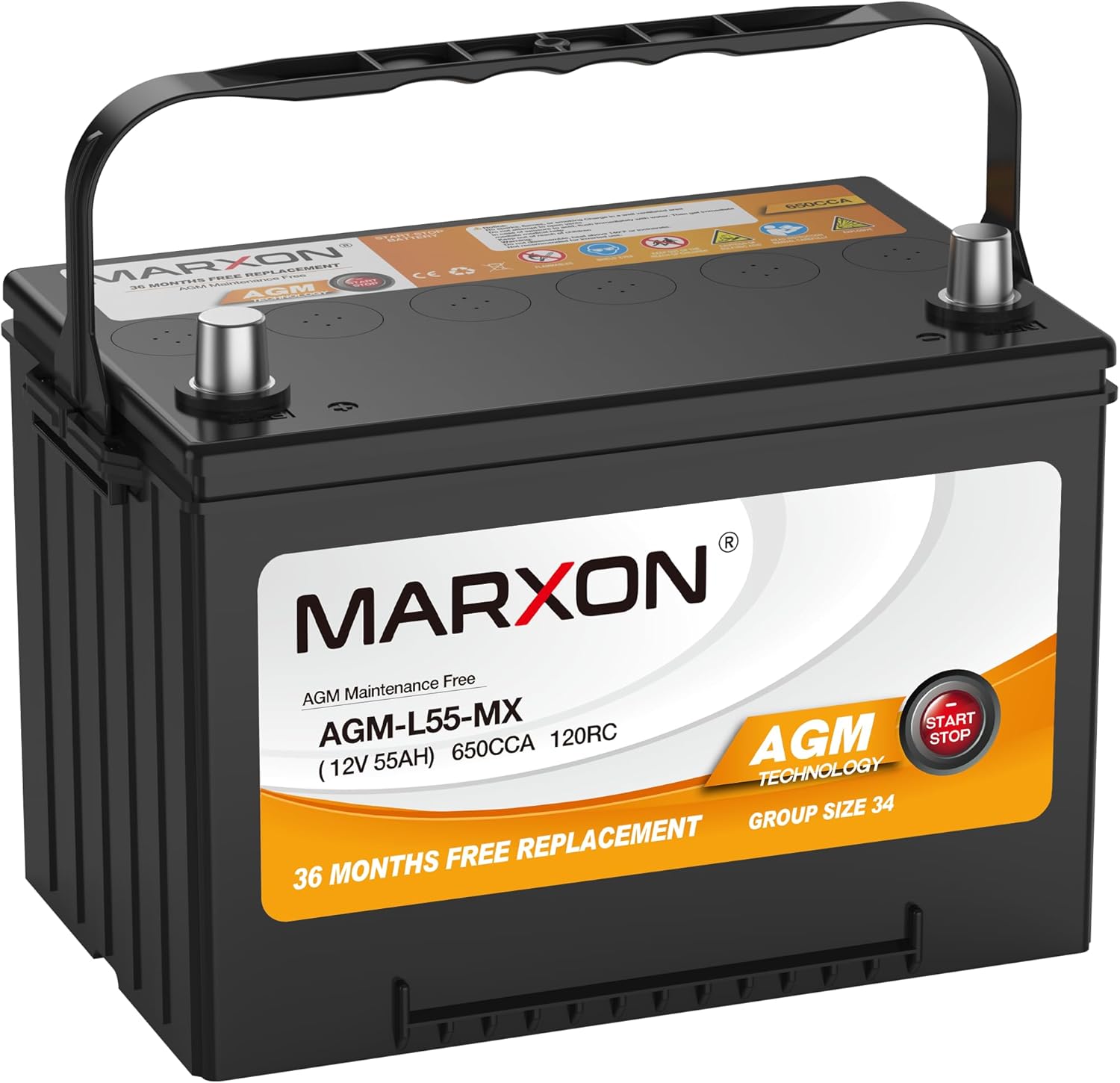
| Voltage | 12V |
|---|---|
| Capacity | 55Ah |
| Cold Cranking Amps | 650CCA |
| Battery Type | AGM (maintenance-free) |
This MARXON Group 34 AGM battery is a 12V, 55Ah start-stop replacement intended for vehicles that use Group 34 sizing and require reliable cranking and reserve power. As an AGM battery it is sealed and maintenance-free so there is no need to add water, and the manufacturer highlights faster charge acceptance and improved corrosion resistance compared with conventional flooded batteries. In everyday use it performs like other AGM replacements: it accepts charge quickly, holds reserve capacity for repeated starts, and supports stop-start operation on compatible cars. Practical benefits for a Civic include stronger cold cranking and reduced risk of acid leakage or maintenance. Important limitations are that fitment must match the Civic model year and trim that takes a Group 34 battery and that charging systems vary by vehicle so full capacity may require an alternator or charger set to AGM-compatible voltages. Warranty support and dealer assistance are available from the brand in the US, but long-term lifespan will depend on usage and charging conditions.
Best for: Budget-conscious buyers who want a lower-cost AGM replacement that supports start-stop use and reduced maintenance for daily-driven Civic models that accept Group 34 batteries.
Less Ideal for: Owners who need a different group size or who prefer batteries with long proven service records from legacy OEM brands should consider other options.
- AGM construction is sealed and maintenance-free, avoiding the need to add water
- Specified for start-stop systems so it supports repeated engine restarts
- Faster charge acceptance than standard SLA batteries for quicker recovery after use
- Manufacturer cites improved corrosion resistance for longer terminal life
- Requires verifying Group 34 fitment for your Civic since not all Civic years use this group
- Full AGM capacity may need an AGM-capable charging profile from the alternator or charger
Verdict: A cost-conscious AGM replacement that brings start-stop compatibility and low maintenance for Civics that accept Group 34 batteries, provided your car’s charging system supports AGM charging.
1AUTODEPOT Group 47 (H5) AGM Car Battery, 12V 60Ah, 680 CCA

| BCI Group Size | 47 |
|---|---|
| Voltage | 12V |
| Rated capacity | 60Ah |
| Cold Cranking Amps (CCA) | 680 |
| Reserve Capacity (RC) | 100 |
This Group 47 (H5) AGM battery is built as a maintenance-free, high-performance replacement for cars that accept that size and terminal layout. It supplies 12 volts with a 60Ah rated capacity and 680 cold cranking amps, so it delivers strong starting power in cold weather and steady electrical support for accessories. The AGM construction is non-spillable, vibration resistant, and designed for vehicles with start-stop systems or higher electrical demand. Typical use is a direct swap into the Civic battery tray when Group 47 is the correct fit and terminal orientation matches, giving quicker starts, lower self-discharge for cars stored between drives, and fewer corrosion concerns than flooded batteries. Practical benefits include higher cycle life than conventional batteries and better tolerance of temperature extremes. Important limitations are that fitment must be confirmed for the specific Civic model and year because dimensions and terminal placement differ across model years, and some Civics require a battery registration or specific charging profile that professional installation or a compatible charger should address.
Best for: A reliability-focused buyer who prioritizes consistent starting power and low maintenance for a Civic that accepts Group 47 batteries and who values longer service life over initial cost savings.
Less Ideal for: Drivers whose Civic requires a different group size or whose vehicle documentation specifies a flooded battery or factory-specific battery that must be matched exactly; choose a model-specific factory-quality replacement instead.
- AGM design provides maintenance-free, non-spillable construction and greater vibration resistance.
- 680 CCA offers reliable cold-start performance for colder climates.
- Low self-discharge helps preserve charge during long storage periods.
- Designed for higher cycle life and to support vehicles with start-stop systems.
- Requires verifying Group 47 (H5) fit and terminal orientation for the specific Honda Civic model before purchase.
- May need battery registration or charging-profile checks on some Civic model years to avoid electrical system warnings.
Verdict: A durable, maintenance-free AGM option for Honda Civics that accept Group 47 batteries and need dependable cold-starting and longer cycle life.
Mighty Max Battery MM-H6 Group 48 12V 70Ah AGM Car Battery
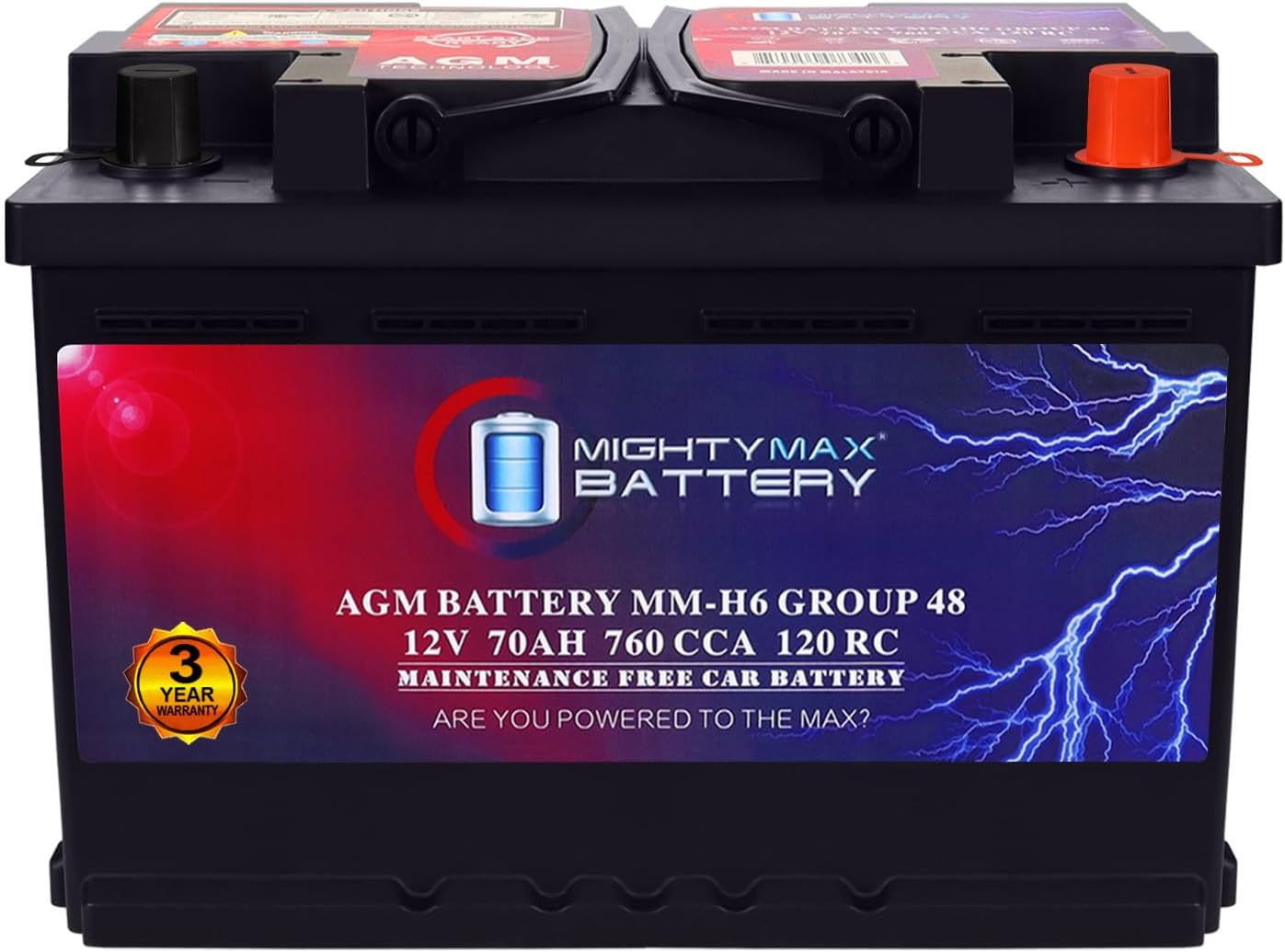
| Voltage | 12V |
|---|---|
| Capacity | 70 Amp Hours |
| Cold Cranking Amps | 760 CCA |
| Reserve Capacity | 120 minutes |
| Terminal | Stud Terminal |
This Mighty Max MM-H6 is a sealed absorbent glass mat (AGM) replacement battery built for dependable starts and longer service life than standard flooded batteries. It supplies 760 cold cranking amps and a 70 Ah capacity, so it handles frequent starts and modest accessory loads without rapid voltage sag. The sealed, spill-proof construction and stud terminals make it straightforward to install in the Honda Civic battery tray where Group 48 fitment is required, and the battery’s vibration-resistant design helps in everyday driving conditions. Notable practical benefits include strong cold-weather starting, a 120-minute reserve capacity for short accessory use with the engine off, and mounting flexibility except upside down. Limitations to consider are that installation may need attention to terminal orientation and clearance under some Civic battery covers, and warranty/aftercare experiences in reviews are mixed so document installation and registration if you need coverage. This is a value-oriented AGM option for drivers who want factory-quality performance without premium branding.
Best for: Practical, risk-averse Honda Civic owners who prioritize a reliable, low-maintenance battery that mimics factory-quality performance without paying premium brand prices.
Less Ideal for: Buyers wanting dealer-level warranty service or concierge replacements should consider dealer or national-brand batteries with local support networks instead.
- AGM sealed design prevents spills and reduces maintenance.
- High 760 CCA rating for reliable cold starts.
- 120-minute reserve capacity for extra accessory run-time.
- Vibration-resistant construction suited to daily driving.
- May require minor modifications or verification of clearance with some Civic battery covers.
- Customer reports indicate inconsistent warranty or after-sales experiences.
Verdict: A cost-conscious AGM replacement for Civic owners seeking strong starting power and maintenance-free operation, but check clearance and warranty support before buying.
Choosing the Right Honda Civic Car Battery: Key Factors to Consider
Cold-Cranking Amps (CCA)
Cold-cranking amps measure the battery's ability to start your Civic in cold conditions. Higher CCA ratings generally improve starting performance during winter or after long periods of inactivity.
Selecting a battery with adequate CCA helps prevent slow cranking and reduces strain on the starter and charging system. Match or slightly exceed the vehicle manufacturer's recommended CCA to ensure dependable starts without overspecifying for normal climates.
Physical Group Size and Terminal Layout
The battery group size determines physical dimensions and terminal placement, which must match the Civic's battery tray and cable reach. A battery that is too large may not fit or could stress hold-downs; one that is too small can shift and cause connection issues.
Confirm terminal polarity and position so cables connect without stretching or requiring adapters. Correct fit simplifies installation and reduces the risk of electrical problems from loose or reversed connections.
Reserve Capacity and Accessory Load
Reserve capacity indicates how long a battery can supply key electrical systems if the alternator fails or during extended accessory use. For Civics with aftermarket audio, frequent short trips, or heavy accessory use, higher reserve capacity provides a buffer against voltage drops.
Choosing a battery with suitable reserve capacity helps maintain electronics and avoids being stranded during alternator issues or accessory-heavy operation.
Battery Type and Maintenance Needs
Different constructions, such as flooded lead-acid, absorbed glass mat (AGM), and enhanced flooded designs, have distinct maintenance and performance profiles. Maintenance-free AGM batteries often resist vibration and have lower self-discharge, while conventional flooded batteries may require periodic electrolyte checks.
Consider whether you prefer a maintenance-free option for convenience or a serviceable battery if you are comfortable with routine checks. Maintenance needs also influence long-term ownership tasks and suitability for various climates.
Expected Service Life and Warranty
Projected service life and warranty length give insight into long-term value and manufacturer confidence. Longer rated life and comprehensive warranty terms can offset higher upfront costs by reducing the frequency of replacements.
Look for warranties that clearly state prorated and replacement periods, as well as any requirements for proper installation and maintenance to keep coverage valid. Balancing expected longevity with warranty support helps manage overall ownership costs.
Cold-Weather Performance and Heat Tolerance
Climate affects battery performance: cold reduces available cranking power while heat accelerates internal degradation. A battery with strong cold-weather characteristics and good heat tolerance will be more reliable across seasons.
If you live in extreme climates, prioritize batteries rated for the temperatures you expect, since thermal stress and repeated cold starts both influence service life and dependability.
Why the Right Honda Civic Car Battery Matters
The battery is the backbone of your Honda Civic electrical system. A properly chosen Honda Civic car battery ensures reliable starts, steady power for electronics, and consistent performance in daily driving and seasonal shifts.
Choosing a battery that matches your Civic's usage pattern helps avoid unexpected breakdowns. Whether you use your Civic for short commutes, long drives, or as a mobile office with many accessories, the right battery affects starting consistency and overall vehicle reliability.
- Reduces chance of no-start situations
- Supports lighting, infotainment, and safety electronics
- Improves resilience to temperature swings and occasional deep draw
Understanding Electrical Demands of Different Civic Trims
Honda Civic models can vary in accessory load depending on trim level and factory options. Higher trim packages and added aftermarket devices increase the draw on the charging system and battery. Consider how you actually use the car when evaluating replacement options.
A Civic with more electrical accessories or frequent short trips places greater stress on the battery and may benefit from a unit with higher reserve capacity or a design that recovers quickly between starts.
- Base trims with minimal electronics typically need standard capacity
- Trims with premium audio, heated seats, or remote electronics may require more robust capacity
Practical Tips for Honda Civic Car Battery Installation
Proper installation improves safety and lifespan. Park on level ground, turn off all loads, and follow the vehicle manual for jack and hood support. When replacing the battery, disconnect the negative terminal first and reconnect it last to reduce short risk.
Use the correct terminal orientation and secure the battery hold-down to prevent movement. After installation, start the engine and let the alternator charge the new battery for a few minutes. If your Civic has battery management or memory features, be prepared to reset clocks, radio presets, and other settings.
- Always wear eye protection and gloves
- Ensure clean, tight cable connections
- Confirm correct battery polarity before final tightening
How to Test and Diagnose a Civic Battery
Quick tests can indicate whether the battery is the source of a starting problem. A handheld battery tester or a multimeter can check resting voltage. A healthy, fully charged 12-volt battery should read around 12.6 volts at rest. Lower readings suggest a weak or discharged battery.
For a more complete diagnosis, perform a load or cranking test and check charging system output. If the battery drops significantly during cranking or the alternator does not maintain voltage while the engine runs, the problem may be the battery, the alternator, or electrical drains.
- Resting voltage around 12.6 V indicates good state of charge
- Voltage under 12.0 V usually means recharge or further testing
- Have load or cranking tests done if simple voltage checks are inconclusive
Extend Car Battery Life in Your Honda Civic
Routine maintenance and care can add months or years to a battery's usable life. Keep terminals clean and tight, minimize long periods of inactivity, and avoid deep discharges from heavy accessory use without the engine running.
If you frequently take short trips, occasionally drive the car longer to allow the charging system to fully replenish the battery. For seasonal storage, consider a battery maintainer to prevent slow discharge and sulfation.
- Clean corrosion with a proper cleaner and brush
- Reduce parasitic draws by disconnecting accessories when parked long-term
- Use a maintainer on infrequently driven vehicles
Planning Replacements and Balancing Cost with Value
When it is time to replace the battery, balance upfront cost with expected longevity and warranty coverage. A cheap car battery may save money initially but could require earlier replacement. Prioritize known compatibility and sufficient capacity for your Civic use case.
Recycling the old battery responsibly is important. Many service locations provide recycling options. Keep records of the installation date and any warranty documents to make future ownership decisions easier.
- Compare warranty terms and typical service life estimates
- Keep installation date recorded to track expected replacement interval
- Ensure proper recycling or disposal of the old battery
How We Chose the Best Honda Civic Car Battery
We shortlisted batteries that meet the specific electrical and physical demands common to Honda Civic models. Key evaluation criteria included required cold-cranking amps to ensure reliable starting in varied temperatures, physical group size and terminal layout for correct fit in the Civic battery tray, and reserve capacity to support accessories and short idle periods.We also considered expected cycle and calendar life based on manufacturer specifications and typical usage patterns, warranty length and coverage terms as an indicator of expected reliability, and maintenance needs such as whether the design is maintenance-free or requires periodic topping-up. Exclusions included batteries intended solely for heavy-duty commercial vehicles, non-automotive battery types, and options that do not match standard Civic group sizes or terminal configurations.These filters ensured the list focuses on batteries that fit correctly, provide dependable starting power, and suit common Civic driving conditions.
Our full evaluation process is outlined in our review methodology.
FAQ
How do I know which battery group size fits my Honda Civic?
Check your owner's manual or inspect the existing battery for a group size label to confirm the correct dimensions and terminal layout. Group size ensures the battery sits securely in the tray and that cables reach without strain. If uncertain, measure the tray and cable positions to match a replacement that fits those specifications.
What is the easiest way to test a car battery at home?
A basic test is to measure the battery voltage with a multimeter; a fully charged automotive battery typically reads around 12.6 volts at rest. Load testing or using a dedicated battery tester gives more reliable information about cranking ability and internal resistance. For borderline results, have the charging system and starter also checked to isolate the issue.
Should I prioritize cold-cranking amps or reserve capacity?
Prioritize cold-cranking amps if reliable starting in low temperatures is your main concern, since CCA directly affects cranking power. If you often run accessories with the engine off or face potential alternator issues, reserve capacity becomes more important. Many buyers balance both by choosing a battery that meets recommended CCA and offers adequate reserve minutes.
Can I install a new battery in my Civic myself?
Many Civic owners can perform a battery installation with basic tools by disconnecting the negative terminal first and observing polarity during replacement. However, follow safety precautions to avoid short circuits and consult the manual for any vehicle-specific steps. If you are unsure about terminals, hold-downs, or battery registration procedures, professional installation is a safe option.
How often should a car battery be replaced in a Honda Civic?
Battery life depends on climate, usage patterns, and maintenance, but automotive batteries often last several years under normal conditions. Regular checks of voltage and visual inspection for corrosion or swelling can identify declining performance early. Replace the battery when it fails to hold charge, shows repeated weak starts, or when testing indicates significant loss of capacity.
Final Verdict
Picking the best battery for a Honda Civic means balancing starting power, correct physical fit, and longevity. Focus first on meeting the manufacturer's recommended group size and CCA, then weigh reserve capacity, maintenance preferences, and warranty terms based on your climate and driving habits.Accept tradeoffs between highest performance and long-term value by prioritizing the factors that matter most to your use case. With the right priorities, you can choose a battery that delivers reliable starts and predictable service life for your Civic.
Explore More:
- Check out all Honda Civic parts & accessories
- Explore Car Batteries Maintenance & Repair Guides
- Explore Electrical System
- Browse all Auto Parts
