

Note: This article contains affiliate links. If you click on these links and make a purchase, I may earn a small commission at no extra cost to you. This helps support my research and content. Read my full affiliate disclosure here.
If you own a 2010-2014 Subaru Legacy, worn pads and scored rotors can mean longer stopping distances, vibration, and brake noise. Replacing both pads and rotors together is often the most efficient way to restore smooth, reliable braking and avoid repeat labor. This guide presents the top five brake pad & rotor kits specifically selected for the 2010-2014 Legacy and explains the practical tradeoffs you should expect.We shortlisted kits based on braking performance, rotor durability, material choice, and fitment ease for the Legacy. Read on for what matters when picking a front or rear kit and for straightforward guidance on installation, common noises, and performance priorities.
Looking for other parts? See all Subaru Legacy parts & accessories.
Top Picks at a Glance
| Best Overall The best all-around choice for most situations | Max Advanced Brakes ValueMAX Front & Rear Brake Kit for 2010–2014 Subaru Outback/Legacy/Forester/Impreza/WRX |  |
| Best Quality Built to a higher standard if you want something more solid | R1 Concepts Front and Rear Brake Kit with Drilled Slotted Rotors and Ceramic Pads |  |
| Best Value The sweet spot between price and what you get | PowerStop Z17 Ceramic Brake Pad and Rotor Kit (Front & Rear) KOE6083 |  |
| Highest Rated A top-rated pick with lots of positive feedback | Detroit Axle Front and Rear Brake Kit with Ceramic Pads and Rotors for 2010–2014 Subaru Legacy/Outback (select 2.5GT, 3.6R) |  |
| Most Popular A crowd favorite that many people choose with confidence | Detroit Axle Front and Rear Brake Kit with Ceramic Pads and Rotors |  |
1. Max Advanced Brakes ValueMAX Front & Rear Brake Kit for 2010–2014 Subaru Outback/Legacy/Forester/Impreza/WRX
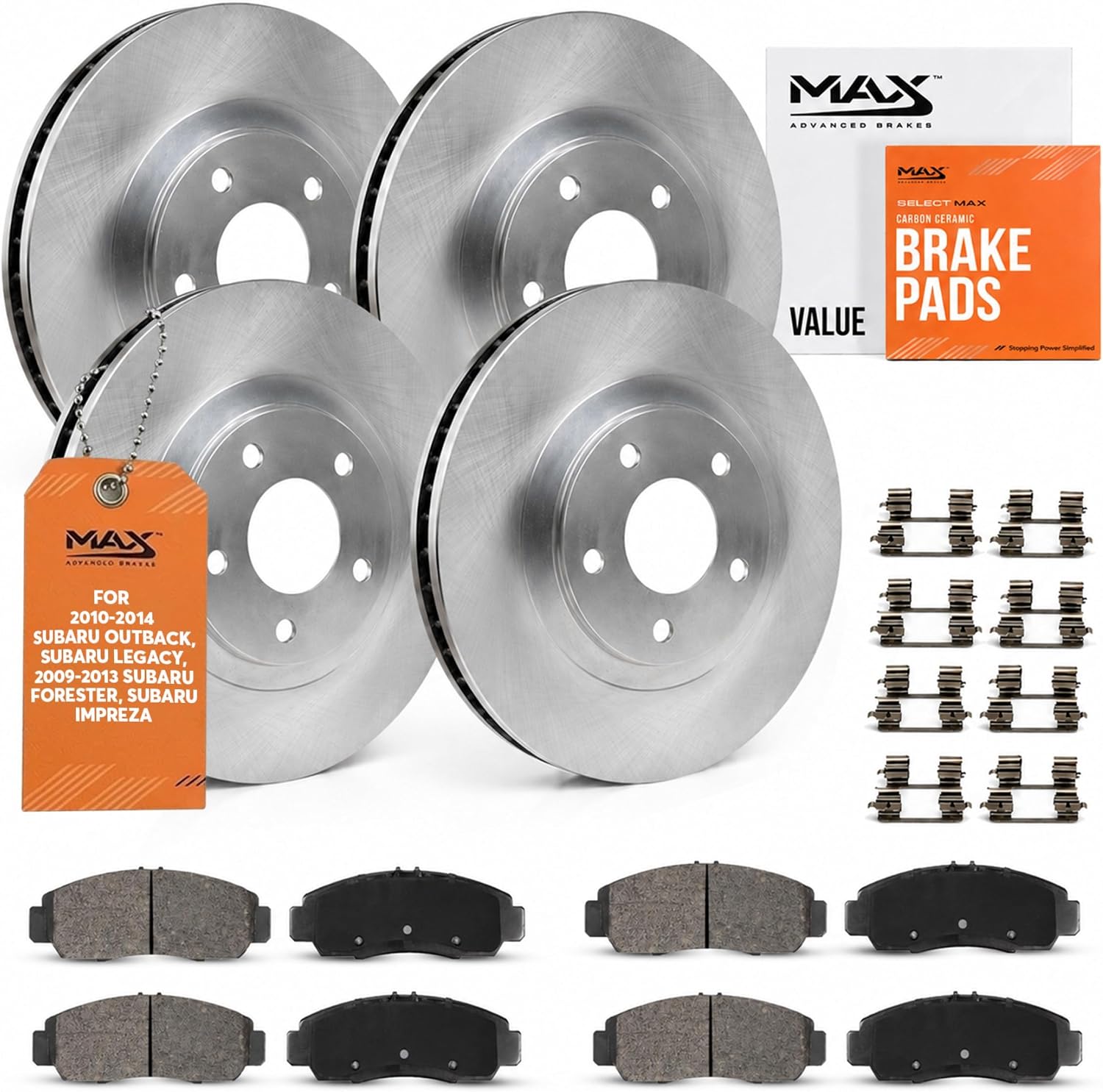
| Included Components | Brake Rotors, Brake Pads, Hardware |
|---|---|
| Automotive Fit Type | Vehicle Specific Fit |
| Model Year | 2011 |
| OEM Equivalent Part Number | 1539 34203 980141 1114 31509 980634 |
This ValueMAX kit supplies everything needed to replace both front and rear rotors and pads on the 2010–2014 Subaru Legacy/Outback and compatible Subaru models. The kit pairs precision-machined cast-iron rotors with copper-free carbon ceramic pads meant for low dust and quieter stops, and it includes the necessary hardware for a straightforward bolt-on swap. In normal commuting and light highway use the rotors are engineered to reduce vibration and speed bedding-in while the ceramic pads deliver consistent braking feel and less wheel soiling. Expect a factory-style replacement rather than performance gains; the emphasis is on dependable, low-noise daily braking and longevity rather than track duty. Warranty options vary by component, so check coverage for combined kits versus single parts. Installation is suitable for DIYers with basic tools but confirm fitment for your exact year and engine before buying.
Best for: Buyers who want a straightforward, factory-quality replacement kit that restores reliable, quiet braking for daily commuting and light highway use on the specified Subaru models.
Less Ideal for: Drivers seeking upgraded track-focused stopping power or aggressive performance compounds should consider performance-oriented brake kits instead.
- Complete front-and-rear kit includes rotors, pads, and installation hardware for a single service interval
- Precision-machined cast-iron rotors aimed at reduced vibration and faster bedding
- Carbon ceramic pads formulated for low dust and quieter stopping
- Vehicle-specific fitment for the listed Subaru models simplifies selection and installation
- Designed for everyday driving and light duty rather than high-performance or track applications
Verdict: A complete, vehicle-specific front-and-rear replacement kit that prioritizes quiet, low-dust daily braking and easy installation for 2010–2014 Subaru models.
2. R1 Concepts Front and Rear Brake Kit with Drilled Slotted Rotors and Ceramic Pads

| Front rotor diameter | 12.5" |
|---|---|
| Rear rotor diameter | 11.4" |
| Included components | 4 eLine rotors, 8 ceramic pads, hardware |
| Material Type | Cast Iron |
| Finish | Silver Zinc Plated |
This R1 Concepts kit supplies a complete front-and-rear brake replacement for compatible 2010–2014 Subaru Legacy and Outback 3.6R/2.5GT applications. It pairs cross-drilled, diamond-slotted cast-iron rotors with ceramic low-dust pads and includes hardware so you can replace rotors and pads together for consistent feel and performance. The drilled and slotted rotor design helps evacuate gases and water for stronger initial bite and better fade resistance during spirited street driving, while the ceramic pads prioritize quiet operation and reduced wheel dust for daily-driven cars. Installation is intended to be a direct fit with factory-style mounting, so a competent DIYer or tech can swap the whole axle set without modification. Limitations to consider are the kit is cast-iron and focused on street performance rather than track abuse, and ceramic pads typically provide less ultimate friction than aggressive metallic compounds under high heat. Expect improved braking feel for performance-oriented commuters but consider more aggressive compounds if you plan aggressive track use.
Best for: Buyers who want a matched rotor-and-pad replacement that improves street braking feel and reduces dust and noise on daily-driven performance-oriented Subaru Legacy or Outback cars.
Less Ideal for: Drivers planning frequent track days or heavy, repeated high-temperature braking should choose a kit with high-friction metallic pads and track-rated rotors instead.
- Complete front-and-rear kit includes rotors, ceramic low-dust pads, and hardware for matched replacement
- Drilled and diamond-slotted rotor surfaces help clear gases and water for stronger initial bite and reduced fade in spirited driving
- Ceramic pads reduce wheel dust and noise for cleaner wheels and quieter daily driving
- Ceramic pad compound is not optimized for heavy track or repeated high-temperature use compared with metallic racing pads
Verdict: A matched rotor-and-ceramic-pad kit that sharpens street braking performance and cuts dust and noise for performance-minded daily drivers.
3. PowerStop Z17 Ceramic Brake Pad and Rotor Kit (Front & Rear) KOE6083

| Brand | PowerStop |
|---|---|
| Model | KOE6083 |
| Exterior | Milled |
| Position | Rear |
This PowerStop Z17 kit supplies both front and rear ceramic brake pads plus OE-style replacement rotors and stainless steel hardware for a complete bolt-on refresh. It is designed for daily driving, offering low-dust ceramic pads that are chamfered and slotted to reduce noise and help with quick bedding in, while the mill-balanced rotors aim to restore smooth braking feel. Installation is straightforward because the kit includes necessary hardware and requires no modifications. The package targets practical owners who want a cleaner-running, quieter replacement that improves on generic aftermarket pads without moving into aggressive performance territory. Limitations are that this is not a high-performance or track-oriented compound and the rotors are non-coated, so they will show surface wear over time; buyers seeking heavy-duty or extreme-temperature braking should look at more performance-focused options.
Best for: Buyers who prioritize a practical, quiet, and low-maintenance brake refresh for regular street driving on a 2010–2014 Subaru Legacy and want a single kit that includes everything needed for installation.
Less Ideal for: Drivers who frequently tow, carry heavy loads, or push their car on track sessions should choose a more aggressive or heavy-duty braking solution tailored to extreme use.
- Complete kit includes front and rear pads, rotors, rubberized shims, and stainless steel installation hardware for a single purchase
- Low-dust Z17 ceramic pads reduce wheel soiling and run quietly in everyday driving
- Mill-balanced rotors restore smooth pedal feel and reduce vibration compared with worn rotors
- Bolt-on fitment for the specified Subaru model years makes installation straightforward with no modifications
- Rotors are non-coated and may show surface corrosion over time
- Compound is tuned for daily driving rather than track or heavy towing use
Verdict: A practical, all-in-one ceramic pad and rotor kit that delivers quiet, low-dust daily driving braking and a straightforward bolt-on installation for 2010–2014 Subaru Legacy owners.
4. Detroit Axle Front and Rear Brake Kit with Ceramic Pads and Rotors for 2010–2014 Subaru Legacy/Outback (select 2.5GT, 3.6R)
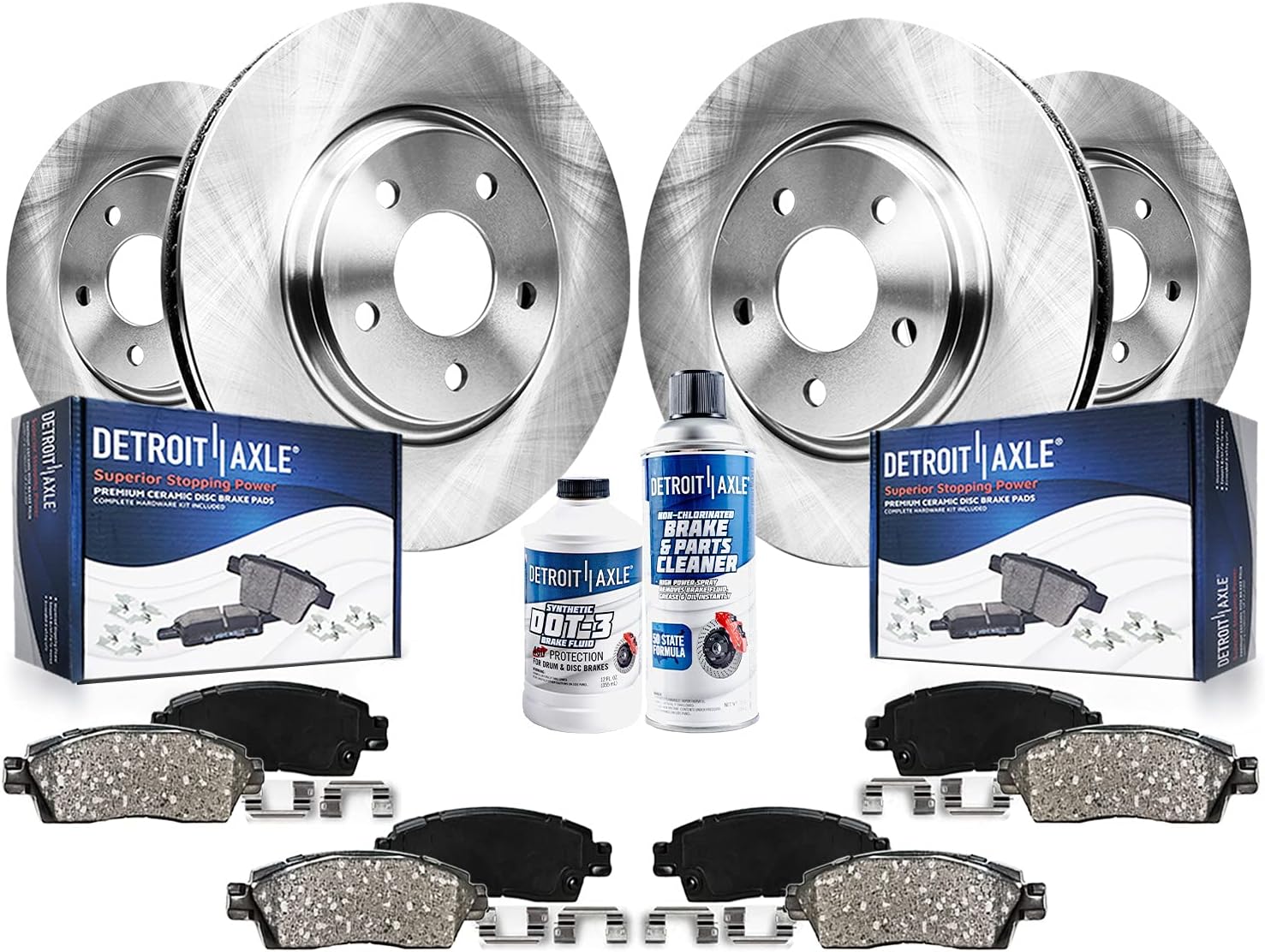
| Compatible years | 2010-2014 |
|---|---|
| Pad material | 100% Ceramic |
| Includes | 4 rotors, front and rear pads, hardware, cleaner & fluid |
| Orientation | Dual |
This Detroit Axle kit supplies everything needed to refresh the front and rear braking system on covered 2010–2014 Subaru Legacy and Outback 2.5GT and 3.6R variants. It pairs four replacement disc rotors with 100% ceramic front and rear pads, plus small items such as installation hardware and a brake cleaner and fluid sample. The ceramic pads offer quiet operation, low dust, and are well suited to daily driving and light towing, while the rotors are described as meeting or exceeding factory specifications for fit and finish to restore stopping feel. Installation is straightforward for a competent DIYer or a shop because the kit is complete for the axle sets. Limitations to note are that ceramic pads prioritize low noise and dust over aggressive track stopping and the kit is designated for specific Subaru engine/configurations so fitment must be confirmed; high-performance or heavy-duty users may prefer metallic or upgraded rotors and pads. For routine maintenance and reliable on-road braking this kit is a convenient all-in-one replacement.
Best for: Buyers who prioritize dependable, low-maintenance braking for daily driving and want a single kit to replace all rotors and pads on covered Subaru Legacy/Outback configurations.
Less Ideal for: Drivers who push brakes hard on track, require heavy towing performance, or need a performance-oriented metallic compound should look at performance brake pads and rotors instead.
- Complete axle-set kit including front and rear rotors plus ceramic pads and basic hardware
- 100% ceramic pads provide low brake dust and quieter operation during normal driving
- Rotors built to meet or exceed factory fit and finish for direct replacement
- Includes brake cleaner and fluid to simplify a single-service refresh
- Ceramic pads are not optimized for aggressive track use or heavy-duty towing scenarios
Verdict: A convenient, reliability-minded all-in-one brake refresh kit that restores quiet, low-dust stopping for 2010–2014 Subaru Legacy and Outback models in the specified configurations.
5. Detroit Axle Front and Rear Brake Kit with Ceramic Pads and Rotors
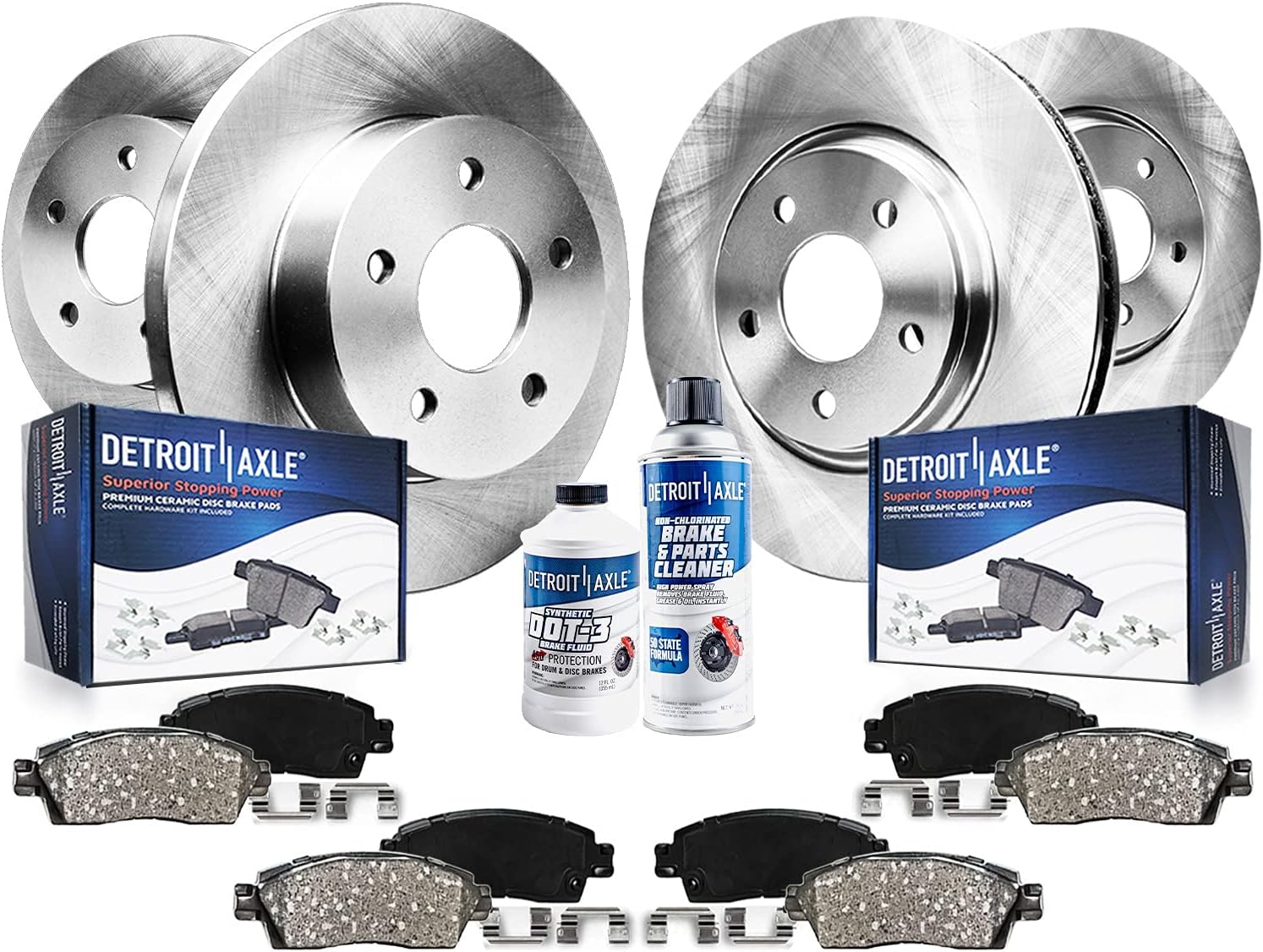
| Fitment measurement | 11.54 inch front, 11.26 inch rear |
|---|---|
| Pad type | Ceramic brake pads |
| Kit contents | 2 front rotors, 2 rear rotors, front and rear pads, brake cleaner, brake fluid |
| Manufacturer | Detroit Axle |
| Manufacturer part number | 10PR2200130 |
This Detroit Axle kit supplies both front and rear rotors plus ceramic pads and basic fluids so you can replace the entire brake set in one job for covered Subaru models. It includes two front and two rear disc rotors built to meet or exceed factory fit and finish, plus front and rear ceramic pads designed for quieter operation and reduced dust compared with semi-metallic compounds. The kit also bundles brake cleaner and fluid to simplify installation. For routine street driving and light-duty daily use this gives a convenient single-purchase solution and reduces parts-matching mistakes. Expect factory-style stopping feel once bed-in is complete, and the drilled/slotted rotors in some listings improve heat dissipation under heavier braking. This is an aftermarket replacement approach rather than an upgraded racing setup, so drivers seeking extreme track performance or aggressive high-temperature pads should consider performance-specific rotors and compounds instead.
Best for: A buyer who wants a single, factory-style replacement kit that removes guesswork and delivers quieter, lower-dust braking for everyday driving on a 2010–2012 Subaru Legacy/Outback (2.5i) or compatible Impreza/Forester fitments.
Less Ideal for: Drivers who prioritize track performance, aggressive braking under repeated high-heat conditions, or those who want premium performance compounds and rotors tuned for motorsport use.
- Complete kit includes front and rear rotors plus matching ceramic pads to avoid fitment or compatibility errors.
- Rotors marketed to meet or exceed factory fit and finish for straightforward installation on specified Subaru models.
- Ceramic pads offer lower dust and quieter operation compared with many semi-metallic pads.
- Includes brake cleaner and fluid so installers have basic consumables on hand for a single-job replacement.
- Not tuned for track use or heavy towing; pad compound and rotor design prioritize street comfort over extreme heat resistance.
- Limited to the specified Subaru fitments; does not address multi-vehicle compatibility or alternative rotor/pad compound options.
Verdict: An all-in-one, factory-style brake kit that makes replacing front and rear brakes on the covered Subaru models straightforward and tidy for everyday drivers.
Choosing the Right 2010-2014 Subaru Legacy Brake Pad & Rotor Kit: Key Factors to Consider
Pad Compound and Performance
Pad compound determines bite, noise, dust, and service life. Ceramic-style formulations usually produce less dust and quieter operation during routine suburban driving, while semi-metallic or metallic blends offer stronger initial bite and higher heat tolerance for spirited driving or heavier loads. Consider how you drive the Legacy: commuter miles and light highway use favor low-dust, quiet compounds; frequent towing, steep descents, or aggressive driving benefit from higher-friction materials.
Compound choice also affects pedal feel and fade resistance. Higher metallic content typically improves fade resistance at the cost of increased noise and rotor wear. Make sure the compound you choose has a performance profile that aligns with the Legacy's typical use to avoid premature rotor scoring or excessive brake dust.
Rotor Type and Thermal Management
Rotor design affects heat dispersion, longevity, and susceptibility to warping. Solid rotors are adequate for standard daily driving, while slotted or drilled designs can aid cooling and gas evacuation during heavier use. However, drilled rotors may crack under extreme thermal cycling, so slotted patterns are often a safer choice for balanced durability and performance on the Legacy.
Also consider rotor construction and protective coatings. Two-piece or heavier-gauge rotors may resist distortion better but add unsprung weight. Corrosion-resistant coatings on the hat and inner faces help prevent rust at the mounting surfaces, which preserves fitment and eases future service on the 2010-2014 Legacy.
Fitment Accuracy and Included Hardware
Accurate fitment is essential to avoid noise, uneven wear, and installation delays. Kits that list explicit compatibility with the 2010-2014 Subaru Legacy and include model-year-specific hardware reduce the chance of surprises at install. Check whether the kit includes new anti-rattle clips, abutment hardware, and any necessary shims or sensors for ABS and wear indicators.
Lack of correct hardware often forces reuse of worn components that degrade braking performance. For front and rear applications on the Legacy, a kit that provides all the small parts needed for a clean swap will save time and help ensure the system performs as intended.
Rotor Finish and Corrosion Resistance
Rust and corrosion on rotors and hats lead to reduced service life and fitment problems. Many rotors come with protective coatings on non-friction surfaces to inhibit rust. Choosing rotors with durable finishing reduces surface corrosion and helps maintain consistent rotor thickness and balance over time.
For Legacy owners in areas with salted roads or heavy moisture, prioritizing corrosion-resistant finishes will reduce the frequency of replacements and make future removal easier. Consider also whether the finish affects the warranty or installation requirements.
Noise Control and Vibration
Noise and vibration are common concerns after brake service. The right combination of pad compound, proper bedding-in, and correct hardware can minimize squeal and shudder. Look for kits that include anti-squeal shims, chamfered edges, and well-matched pad compounds to reduce the chance of high-frequency noise on the Legacy.
Installation technique matters as well. Properly torqued caliper bolts, clean mounting surfaces, and adherence to break-in procedures will greatly decrease the likelihood of persistent brake noise after replacement.
Serviceability and Long-Term Cost
Consider the ease of future service and the expected life of both pads and rotors. Thicker, well-machined rotors and higher-capacity pad materials may cost more initially but can extend service intervals. Also evaluate whether the kit uses standard-size rotors that can be resurfaced if within thickness limits or whether replacement is the only option.
Factor in common maintenance tasks for the 2010-2014 Legacy such as caliper slide cleaning, brake fluid condition, and parking brake adjustment, since these influence overall brake system longevity. A kit that simplifies routine service will reduce total ownership cost over time.
Front Versus Rear Kits: How Their Roles Differ
The front brakes on the 2010-2014 Legacy handle the majority of kinetic energy during stops, so front kits usually emphasize compound grip and thermal stability. Rear kits are often smaller and focus on modulation and parking brake integration when applicable.
When replacing both axles, balance the front pad compound with the rear to maintain consistent pedal feel and avoid abrupt bite differences. Some rear rotors incorporate internal parking brake components or specific mounting features that matter during selection.
- Front kits: prioritize initial bite, heat tolerance, and consistent pedal feel.
- Rear kits: prioritize modulation, noise control, and parking brake compatibility.
- Replacing both axles at once reduces the chance of uneven wear and inconsistent braking.
Installation Tips for a Smooth Swap
Prepare the vehicle safely using jack stands and wheel chocks. Clean mating surfaces on the hub and caliper bracket to ensure even rotor seating. Use a torque wrench and follow factory torque specs for lug nuts and caliper hardware to avoid rotor warping or wheel vibration.
Replace or clean hardware and apply high-temperature brake grease only where recommended. After installation, follow a controlled bedding procedure to mate pads and rotors properly—this often involves sets of moderate stops from varying speeds to build an even transfer layer.
- Inspect caliper slides and lubricate with appropriate grease.
- Torque lug nuts in a star pattern to the correct spec.
- Perform a bedding-in routine to reduce noise and optimize stopping power.
Common Post-Installation Issues and Fixes
Brake noise after replacement can result from poor bedding, missing shims, contaminated pad surfaces, or uneven rotor surfaces. Address these issues by ensuring hardware is present, pads were installed cleanly, and rotors were properly torqued and free of runout.
Vibration or pulsing often indicates rotor lateral runout or uneven material transfer. If runout is suspected, verify hub face cleanliness and correct wheel torque. Light resurfacing can sometimes restore smooth operation if the rotor meets minimum thickness, but replacement may be necessary for severely worn or heat-damaged rotors.
- Squeal: check shims, pad bedding, and mounting hardware.
- Pulsing: inspect for rotor runout and ensure proper wheel torque.
- Premature wear: confirm pad compound suitability for driving style.
Ceramic Versus Metallic Pads: Choosing for the Legacy
Ceramic pads typically offer quieter operation and lower dust levels, which suits everyday driving and reduces wheel cleaning. They tend to feel smoother at normal temperatures but may offer less aggressive initial bite compared with metallic blends.
Metallic or semi-metallic pads provide stronger bite and better heat tolerance, making them preferable for drivers who demand harsher stops or carry heavier loads. The tradeoff is increased dust and potential for higher rotor wear over time.
- Ceramic: quieter, low dust, comfortable modulation for daily use.
- Semi-metallic: stronger bite, better heat resistance, increased dust.
When to Resurface Rotors Instead of Replacing
Resurfacing rotors can be cost-effective if there is minor scoring and the rotor remains above the manufacturer minimum thickness. Confirm rotor thickness and check for thermal cracking or severe runout before choosing to resurface for the 2010-2014 Legacy.
If rotors show uneven wear, deep grooves, or heat-related damage, replacement is the safer long-term option. Always check machining tolerances and follow vehicle-specific minimum thickness specs to maintain braking performance and safety.
- Resurface when minimal scoring and thickness permit.
- Replace when there is heat cracking, severe grooving, or out-of-spec thickness.
Still looking for the perfect fit?
Select your Subaru Legacy configuration to see the most relevant Brake Pad & Rotor Kits recommendations
How We Chose the Best 2010-2014 Subaru Legacy Brake Pad & Rotor Kit
We evaluated candidate brake pad and rotor kits for the 2010-2014 Subaru Legacy using a focused set of vehicle-specific criteria intended to reflect real-world ownership needs. Primary evaluation factors included braking performance under typical driving and emergency stops, measured by pedal feel, initial bite, and fade resistance; rotor construction and resistance to warping or uneven wear; pad compound composition and expected life; and fitment accuracy for the Legacy suspension and caliper geometry.Additional filters included the ease of installation for DIY owners and independent shops, availability of hardware and instructions in the kit, and compatibility with factory parking brake configurations where applicable. We excluded kits that required vehicle modifications, non-standard machining, or custom calibration. We also omitted options with unclear fitment or missing essential components like anti-rattle clips or new lug bolts when those are commonly needed.The final selection prioritized kits that balance noise control, longevity, and braking consistency for the driving patterns common to Legacy owners. Where appropriate, we favored rotors with better thermal management or protective finishes to reduce corrosion and extend service intervals.
Our full evaluation process is outlined in our review methodology.
FAQ
How often should I replace the brake pads and rotors on a 2010-2014 Legacy?
Replacement intervals vary by driving style and conditions. Pads often last between 25,000 and 60,000 miles depending on compound and use. Rotors can last longer if not damaged, but inspect them at each pad change for thickness and runout.
Can I resurface my Legacy's rotors instead of installing a new kit?
You can resurface if the rotor thickness exceeds the vehicle's minimum spec and there are no cracks. Light machining can correct minor scoring, but deep grooves or heat damage typically require replacement.
Will switching to ceramic pads reduce brake noise and dust?
Ceramic pads usually produce less dust and run quieter during normal driving. However, noise can still occur if hardware is missing, bedding is improper, or there is rotor runout. Proper installation and bedding are essential.
Do I need to replace hardware like clips and shims when installing a kit?
Replacing or renewing mounting hardware and shims is recommended. Worn or corroded hardware can cause noise and uneven pad wear, so a complete kit that includes these parts simplifies installation and helps ensure proper performance.
How should I bed new pads and rotors on my Legacy?
Perform several controlled stops from moderate speeds without coming to a full stop on the pad during the bedding sequence. This builds an even transfer layer on the rotor. Follow any manufacturer-specific bedding instructions supplied with the kit.
What causes a pulsation in the brake pedal after replacement?
Pulsation often indicates rotor lateral runout or uneven material transfer. It can result from improper mounting surface cleanliness, loose wheel lug torque, or warped rotors. Rechecking hub surfaces and correct torque values usually resolves the issue.
Final Verdict
When selecting a brake pad & rotor kit for the 2010-2014 Subaru Legacy, prioritize a balance between pad compound, rotor durability, and included hardware. Choose pads that match your driving style to avoid premature wear or excess dust, and select rotors with good thermal characteristics and protective finishes for longevity.Replacing both pads and rotors together and using a kit with complete hardware reduces the chance of installation issues and unexpected noise. Focus on fitment accuracy, proper bedding, and correct installation torque to restore safe, quiet braking and extend service intervals.
Explore More:
- Check out all Subaru Legacy parts & accessories
- Explore Brake Pad & Rotor Kits Maintenance & Repair Guides
- Explore Brake System
- Browse all Auto Parts
