

Note: This article contains affiliate links. If you click on these links and make a purchase, I may earn a small commission at no extra cost to you. This helps support my research and content. Read my full affiliate disclosure here.
If you drive a 2015-2019 Subaru Legacy, worn or damaged rotors can undermine braking performance, increase noise, and shorten the life of pads. Choosing the right brake rotors matters because they directly affect pedal feel, stopping distance, and heat management under everyday commuting and occasional spirited driving.This guide covers the top shortlisted brake rotors for the Legacy, explaining why each type made the cut and how they perform against key criteria like fitment, durability, and thermal resistance. Use the checklist and explanations below to match the correct rotor style to how you drive and maintain your car.
Looking for other parts? See all Subaru Legacy parts & accessories.
Top Picks at a Glance
| Best Overall The best all-around choice for most situations | Detroit Axle 8-piece Brake Kit for 2015 Subaru Legacy 2.5L (Drilled & Slotted Rotors with Ceramic Pads) |  |
| Best Quality Built to a higher standard if you want something more solid | PowerStop Z26 Street Warrior Brake Pad and Drilled/Slotted Rotor Kit (Front & Rear) |  |
| Best Value The sweet spot between price and what you get | Detroit Axle Drilled & Slotted Front and Rear Brake Rotor Kit for 2015–2019 Subaru Legacy (2.5L) |  |
| Best Budget The cheapest option that still gets the job done reliably | Detroit Axle Front Disc Brake Rotors (pair) for 2015–2019 Subaru Legacy — 11.54" |  |
| Highest Rated A top-rated pick with lots of positive feedback | MAX Advanced Brakes Front Brake Kit with Carbon Ceramic Pads |  |
1. Detroit Axle 8-piece Brake Kit for 2015 Subaru Legacy 2.5L (Drilled & Slotted Rotors with Ceramic Pads)

| Fitment rotor sizes | Front 11.54 inch / Rear 11.81 inch |
|---|---|
| Kit contents | 2 front rotors, 2 rear rotors, front and rear ceramic pads with hardware |
| Brake type | Drilled and slotted rotors with ceramic pads |
| Manufacturer | Detroit Axle |
This Detroit Axle brake kit supplies everything needed to refresh the front and rear braking on a 2015 Subaru Legacy 2.5L that uses 11.54 inch front and 11.81 inch rear rotors. The kit includes drilled and slotted rotors for improved heat dissipation and ceramic pads with hardware for quieter, lower-dust operation compared with semi-metallic compounds. It is intended as a direct replacement built to exceed factory fit and finish and is suitable for routine street driving and occasional spirited use. The drilled and slotted surfaces help reduce fade under repeated stops, while the ceramic pads preserve rotors and cut dust, making maintenance easier. Buyers should note drilled rotors can be slightly more prone to cracking under extreme track use compared with plain or slotted-only rotors, and ceramic pads trade some ultimate high-heat bite for noise and cleanliness. Installation will require matching the specified rotor sizes to your vehicle and basic brake-handling skills or a shop service.
Best for: Buyers who want a balanced, all-around replacement kit that improves cooling and reduces dust for daily driving and occasional spirited use while keeping installation straightforward.
Less Ideal for: Drivers who plan sustained track use, heavy towing, or frequent high-speed repeated braking should consider dedicated performance or racing braking components instead.
- Complete kit includes front and rear drilled and slotted rotors plus ceramic pads and mounting hardware
- Drilled and slotted rotor design improves heat dissipation and helps resist brake fade during repeated stops
- Ceramic brake pads produce lower dust and quieter operation than many semi-metallic pads
- Manufactured and tested to meet or exceed factory fit and finish for direct replacement
- Drilled rotors can be more vulnerable to cracking under extreme high-heat track conditions compared with non-drilled options
- Ceramic pads sacrifice some high-temperature initial bite compared with performance-oriented semi-metallic pads
Verdict: A ready-to-install, balanced replacement kit that upgrades cooling and reduces dust for 2015 Subaru Legacy drivers wanting improved everyday braking without complicated upgrades.
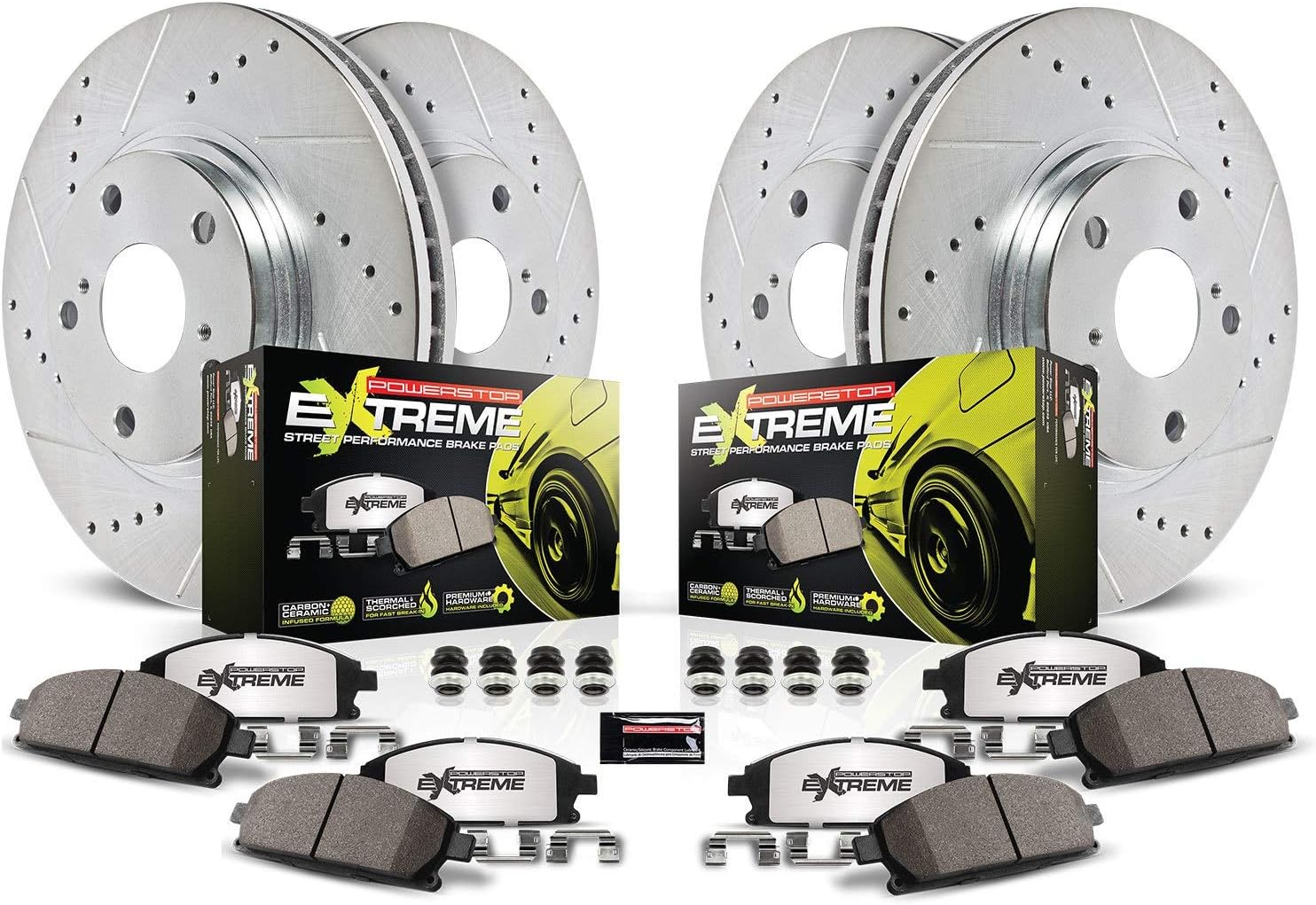
2. PowerStop Z26 Street Warrior Brake Pad and Drilled/Slotted Rotor Kit (Front & Rear)
| Manufacturer Part Number | K7028-26 |
|---|---|
| Included Components | Front & rear Z26 pads, drilled and slotted rotors, installation hardware |
| Manufacturer Warranty Description | 36 Month / 36,000 Mile Limited Warranty |
| Compatible with Vehicle Type | Car, Truck, Van |
This PowerStop Z26 kit replaces both front and rear pads and rotors with a bolt-on upgrade aimed at spirited street driving. The Z26 carbon-fiber ceramic pads deliver stronger initial bite than factory pads while producing less wheel dust, and stainless-steel shims plus premium hardware help keep noise down and installation straightforward. The drilled and slotted rotors are cast to tight tolerances, plated to resist corrosion, and designed to vent heat and clear gases and debris for more consistent braking under repeated hard stops. The kit includes all necessary hardware so a competent DIYer or a shop can complete the swap without modifications. Expect better thermal stability and shorter stopping distances on high-horsepower or big-wheel setups, but note this is engineered for street and extreme-street use rather than track-only abuse; heavy track use will outpace the benefits of a street-oriented compound. Fitment is vehicle-specific so confirm the kit matches your Legacy/Outback/WRX variant before buying.
Best for: Drivers who upgrade for sharper street braking on higher-power or modified Subarus and want a complete bolt-on kit that balances performance and everyday drivability.
Less Ideal for: Drivers who primarily run frequent track sessions or need race-spec endurance brakes should consider track-focused pads and rotors instead.
- Carbon-fiber reinforced ceramic pads offer strong bite with reduced wheel dust
- Drilled and slotted rotors improve cooling and help maintain consistent pad contact under heavy use
- Plated rotors resist corrosion for better appearance and longer surface life
- Includes stainless-steel shims and full hardware for a direct-fit, straightforward installation
- Compound and construction are optimized for street and extreme-street use and may wear faster under dedicated track conditions
Verdict: A complete bolt-on front-and-rear upgrade that gives 2015–2019 Subaru drivers stronger street braking, better heat control, and lower dust in one package.
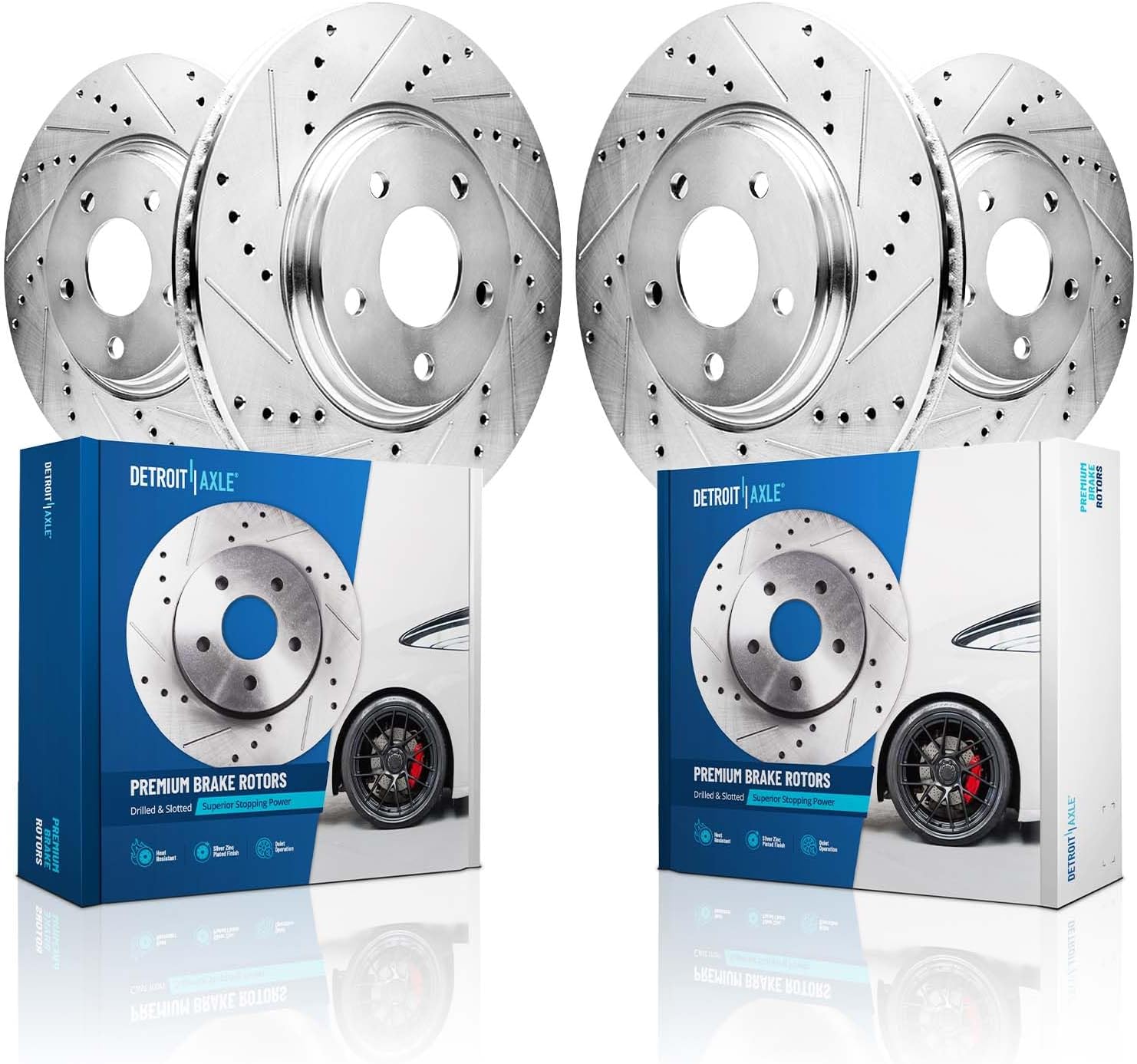
3. Detroit Axle Drilled & Slotted Front and Rear Brake Rotor Kit for 2015–2019 Subaru Legacy (2.5L)
| Fitment | 2015-2019 Subaru Legacy (2.5L) with 11.54" front / 11.81" rear rotors |
|---|---|
| Kit includes | 2 front drilled & slotted rotors, 2 rear drilled & slotted rotors |
| Orientation | Dual |
| Part interchange | S-800072 S-800073 |
| Manufacturer warranty | 10-Year |
This Detroit Axle kit supplies two drilled and slotted front rotors and two drilled and slotted rear rotors sized to fit 2015–2019 Subaru Legacy 2.5L cars with 11.54" front and 11.81" rear rotors. The drilled and slotted surfaces help dissipate heat and shed water and brake dust, which can reduce fade during spirited driving or repeated stops. Zinc plating on the hat area improves corrosion resistance and keeps the visible rotor surface cleaner under typical road conditions. Machined locating holes aim to match factory fitment so installation should be straightforward for anyone swapping rotors without needing modifications. Expect lower noise and good pad contact when paired with compatible brake pads, but drilled rotors can be less durable than plain or slotted-only designs under extreme track use and may collect debris in the holes over time. This kit is a practical OEM-style replacement that balances improved cooling and appearance while keeping installation and compatibility simple for routine service on the specified Legacy models.
Best for: Buyers who want a practical, direct-fit replacement that improves brake cooling and appearance without complicated installation or vehicle modifications.
Less Ideal for: Drivers seeking maximum durability for regular track use or heavy-duty towing should consider non-drilled heavy-duty or performance-specific rotors instead.
- Complete front and rear four-piece kit sized for the specified Legacy 2.5L fitment
- Drilled and slotted faces improve heat dissipation and help clear water and dust
- Zinc plating reduces visible corrosion and wheel dust on the rotor hat
- Machined locating holes for straightforward, factory-quality alignment and installation
- Drilled rotors can be more prone to cracking under sustained track or high-heat abuse compared with plain or slotted-only rotors
Verdict: A practical, direct-fit four-piece drilled-and-slotted rotor kit that upgrades cooling and curb appearance while remaining easy to install on 2015–2019 Subaru Legacy 2.5L models.
4. Detroit Axle Front Disc Brake Rotors (pair) for 2015–2019 Subaru Legacy — 11.54"

| Fitment rotor size | 11.54 inch (293mm) |
|---|---|
| Kit contents | 2x Front Disc Brake Rotors |
| Fitment years | 2015–2019 Subaru Legacy (2.5L) |
| Finish | Zinc plated |
These Detroit Axle front rotors replace both driver and passenger side rotors on 2015–2019 Subaru Legacy models that use the 11.54-inch rotor size. They are vented for improved heat dissipation and feature a silver zinc plating intended to resist corrosion and reduce visible wheel dust. Machined locating holes and factory-style fitment mean they install without modification, so a typical DIYer or shop can swap the pair during a standard front brake job. The vents and machining aim to keep braking consistent under repeated stops while the plating helps them stay cleaner-looking in wet climates. Expect the stopping feel to match factory performance for everyday driving, highway commuting, and light spirited use. These are conventional replacement rotors rather than a premium drilled or slotted performance option, so drivers who want aggressive cooling, track use durability, or a different aesthetic should consider other rotor types.
Best for: Drivers who want an affordable, direct-fit replacement that restores factory braking performance for daily driving and commuting on a Subaru Legacy.
Less Ideal for: Enthusiasts who frequently track their car, tow regularly, or want high-performance slotted/drilled rotors for aggressive cooling and pad bite.
- Vented design helps dissipate heat for more consistent braking under repeated stops.
- Zinc plating reduces visible corrosion and wheel dust buildup compared with uncoated rotors.
- Machined locating holes and factory-style fit allow direct fitment without modification.
- Sold as a matched pair so both front rotors are replaced at once.
- Conventional drilled and slotted options are not provided, so cooling and pad bite for aggressive use are limited.
Verdict: If you need a budget-friendly, direct-fit pair to restore reliable, factory-quality front braking on a 2015–2019 Subaru Legacy, these rotors are a practical choice.
5. MAX Advanced Brakes Front Brake Kit with Carbon Ceramic Pads

| Included Components | Brake Rotors, Brake Pads, Hardware |
|---|---|
| Automotive Fit Type | Vehicle Specific Fit |
| Orientation | Front |
| OEM Equivalent Part Number | 1078 31414 980377 |
This MAX Advanced Brakes front kit combines two precision-machined cast iron rotors with carbon-infused ceramic pads and the necessary hardware to deliver a direct bolt-on replacement for compatible Subaru models. It is intended for everyday driving and commuting, providing predictable pedal feel and smooth bedding thanks to the machined rotor surfaces and matched pad formulation. The carbon ceramic pads are formulated to cut brake dust and reduce low-speed noise while maintaining stable friction, which helps keep wheels cleaner and reduces minor vibration. The kit is sold as an integrated system so the pads and rotors are matched for more consistent stopping and longer component life under normal use. Limitations are that this is a value-oriented replacement geared to daily driving rather than heavy track use or aggressive towing, and the warranty terms vary by component type which may be shorter for individual parts than for combined kits.
Best for: Drivers who prioritize reliable, low-maintenance braking for daily commuting and family use and want a direct-fit front kit that keeps wheels cleaner and delivers consistent pedal feel.
Less Ideal for: Enthusiasts who plan frequent high-speed track sessions or heavy towing should choose performance-oriented rotors and pads instead.
- Direct vehicle-specific fit for front axle with matched rotors and pads for consistent braking
- Precision-machined cast iron rotors for smooth pad bedding and stable pedal response
- Carbon-infused ceramic pads that significantly reduce brake dust and lower low-speed noise
- Includes rotors, pads, and installation hardware for a complete front axle replacement
- Designed for everyday driving rather than heavy-duty or track performance
Verdict: A practical, matched front rotor and carbon ceramic pad kit that delivers dependable, low-dust braking for everyday Subaru driving.
Choosing the Right 2015-2019 Subaru Legacy Brake Rotors: Key Factors to Consider
Fitment and Spec Match
Correct fitment is the single most important factor for 2015-2019 Subaru Legacy brake rotors. Rotors must match rotor diameter, thickness, hat height, center bore, and bolt pattern spec for the specific model and trim. A rotor that looks similar may still differ by a fraction of a millimeter on hat height or bore size, which can create caliper alignment issues or require extra machining.
Confirming factory dimensions also ensures you retain correct caliper clearance and ABS sensor operation. When replacing rotors, cross-check the vehicle's year and trim and use measurements rather than assumptions. Properly matched rotors reduce the risk of vibration, uneven pad wear, and premature failure, and they simplify installation and braking system diagnostics.
Material and Manufacturing Quality
Rotor metallurgy and casting precision affect longevity and thermal stability. Higher-quality castings and balanced assemblies resist warpage and maintain flatness across the braking surface. Look for consistent surface finish and tight machining tolerances, because imprecision amplifies pedal pulsation and noise.
Manufacturing controls such as cryogenic treatment or stress-relief processes are relevant for drivers who rack up high-mileage or frequently tow. Even on everyday street-driven Legacy models, better metallurgy translates into fewer service events and steadier braking performance over time.
Thermal Design and Heat Management
Rotors must dissipate heat generated during braking to avoid fade and glazing. For the Legacy, vented rotors are standard because they allow airflow through vanes to shed heat quickly. Some rotors add directional vents, slots, or drilled patterns to increase cooling or help evacuate gases and debris.
Consider your driving style when weighing thermal features. Regular commuting and highway driving do not produce the same heat loads as repeated hard stops or hilly routes. Rotors designed with efficient venting reduce the chance of overheating and preserve pad life, which is especially important if you occasionally carry heavier loads.
Surface Design: Slotted, Drilled, or Smooth
The rotor surface finish affects pad bedding, debris evacuation, noise, and wet-weather response. Slotted rotors improve pad bite and clear gases, which can enhance initial bite under hard braking. Drilled rotors help with quick gas and water evacuation but can concentrate stress and sometimes reduce structural strength compared with solid or slotted patterns.
For most Legacy owners, slotted or specifically engineered vent patterns offer a practical balance of improved performance without substantially increasing noise or risk of cracks. Smooth, precision-machined surfaces remain a solid choice for lower-noise, long-life service when heat loads are modest.
Serviceability and Resurfacing Considerations
Knowing when a rotor can be resurfaced versus replaced is important for maintenance cost and safety. Each rotor has a minimum thickness specification; machining below that limit compromises structural integrity and braking performance. For the Legacy, measure rotor thickness accurately and compare it to the vehicle's service manual values.
If a rotor is within allowable limits and runout is low, resurfacing can restore a smooth contact face. However, repeated machining reduces thickness and shortens lifecycle. Consider replacement when rotors approach minimum thickness, show heat cracking, or exhibit deep grooves that would unacceptably reduce thickness after resurfacing.
Noise, Vibration and Harshness (NVH)
Rotor design and runout tolerance directly influence NVH. Imbalances or uneven thickness cause pulsation at the brake pedal and steering wheel, which is both uncomfortable and a maintenance concern. Features like chamfers, precision machining, and coating for corrosion resistance can reduce squeal and surface rust that causes noise.
If you prioritize a quiet daily driver experience for your Legacy, favor rotors with balanced machining tolerances and corrosion-resistant finishes. For drivers who accept a bit more noise for stronger initial bite, certain surface patterns will be acceptable, but be aware of the NVH tradeoffs.
Understanding Rotor Types and Which Suits the Legacy
Rotors come in solid, vented, slotted, and drilled variations, and each design responds differently to heat and wear. For the 2015-2019 Subaru Legacy, vented rotors are typical for front and rear applications because they promote airflow and cooling during repeated stops.
If you do mainly city and highway driving, precision-machined smooth or lightly slotted rotors provide steady performance with low noise. If you require improved initial bite or frequently encounter wet or dirty roads, consider slotted designs for better debris and gas evacuation.
- Vented rotors: Best for heat dissipation and daily driving under mixed loads.
- Slotted rotors: Improve pad cleaning and bite during aggressive braking.
- Drilled rotors: Aid rapid water evacuation but can be more prone to cracking under extreme stress.
- Solid rotors: Typically found only on some rear applications or lightweight configurations.
Maintenance Intervals and When To Inspect Rotors
Inspect rotors at every pad change and during routine service intervals. Look for scoring, excessive rust buildup, visible heat spots, and measuring thickness to confirm they are above the minimum specification.
Common inspection points include checking lateral runout with a dial indicator and verifying even pad contact across the rotor face. Address vibration or pulsation promptly because those symptoms can accelerate wear on pads and suspension components.
- Check rotor thickness during every brake pad replacement.
- Measure runout if you feel pedal pulsation or steering vibration.
- Look for blue discoloration or heat spots after heavy braking sessions.
Measuring and Documenting Rotor Thickness
Accurate measurement of rotor thickness requires a micrometer or vernier caliper. Measure at several points around the rotor face and compare the values to the vehicle's minimum thickness specification. Record measurements in the service log to track wear rate over time.
If measurements approach the minimum thickness or show uneven wear, replacement is the safer option. When resurfacing, subtract estimated removed material from current thickness to ensure the rotor will remain above the minimum after machining.
- Use a calibrated micrometer for best accuracy.
- Measure at multiple radial points to detect taper.
- Document readings to identify accelerated wear trends.
Brake Bedding and Initial Break-In Procedures
Proper bedding helps mate the pad material to the rotor surface and establishes uniform transfer layers for predictable braking. For the Legacy, follow a staged approach of progressive stops from moderate speeds to firm stops, allowing short cool-down intervals between sequences.
Avoid repeated hard stops from high speed until the bedding process is complete, because excessive heat during bedding can create uneven transfer and glazing. After bedding, recheck torque on wheel fasteners and inspect the rotor surface for even coloration and absence of hot spots.
- Use repeated controlled stops rather than a single hard stop approach.
- Allow cooling periods to prevent heat soak.
- Inspect rotor surface after bedding for uniform contact.
Corrosion Protection and Coatings
Coatings and protective finishes help slow rust formation on rotor hats and non-friction surfaces, preserving appearance and reducing noise caused by rust flakes. For regions with salted roads, consider rotors with corrosion-resistant coatings on the hub area while keeping the braking surface machined to specification.
Note that some coatings are only on non-contact areas and can be removed on the hat or mounting face during installation. Proper surface mating between the rotor hub and wheel hub is essential to avoid runout introduced by corrosion debris.
- Coatings reduce surface rust and help preserve fitment tolerances.
- Ensure contact surfaces are clean during installation to avoid induced runout.
- Coated hats are useful in climates with road salt or heavy moisture.
Still looking for the perfect fit?
Select your Subaru Legacy configuration to see the most relevant Brake Rotors recommendations
How We Chose the Best 2015-2019 Subaru Legacy Brake Rotors
We evaluated candidate brake rotors for the 2015-2019 Subaru Legacy using a focused set of criteria that matter to owners of this generation. Fitment and bolt pattern accuracy were primary filters because proper mounting, rotor diameter, thickness, and hat height determine whether a rotor will install without modification. We also prioritized material and manufacturing quality, including cast metallurgy and balancing, because those factors influence vibration, warp resistance, and long-term surface durability.Thermal performance and design were assessed next, covering venting, slotting or drilling patterns, and mass distribution to judge heat rejection and fade resistance under repeated stops. We examined serviceability and maintainability factors such as minimum thickness specifications, directionality for directional rotors, and whether a rotor is easily resurfaced. Noise and vibration tendencies were considered through design attributes like surface finish and runout tolerances.Excluded items included rotors that did not list explicit fitment for the 2015-2019 Legacy, any aftermarket pieces that required hub or caliper modification, and specialty race-only components that sacrifice street durability. The final list balances real-world durability, thermal control, and ease of installation for typical Legacy owners.
Our full evaluation process is outlined in our review methodology.
FAQ
How do I know when the rotors on my 2015-2019 Legacy need replacement?
Rotors should be replaced when thickness measurements approach the manufacturer minimum, if there are visible heat cracks, or if you experience pedal pulsation that measuring runout confirms. Deep grooves or heavy corrosion that would leave the rotor below minimum thickness after resurfacing are also reasons to replace.
Can I resurface Legacy rotors instead of replacing them?
Often you can resurface rotors if they have enough excess thickness and no structural cracking. Resurfacing removes material, so confirm the post-machine thickness will exceed the minimum. Frequent resurfacing shortens rotor life, so replacement is preferable when margins are small.
Are slotted or drilled rotors worth it for daily driving in a Legacy?
For normal commuting, slotted rotors offer cleaner pad contact and modest performance benefits without significantly increased risk. Drilled rotors are more specialized; they help with water evacuation but can be less durable under extreme heat. Match the rotor style to your driving and expected heat load.
How should I measure rotor runout if I feel vibration?
Use a dial indicator mounted against the rotor edge to measure lateral runout while rotating the hub by hand. Compare measured values to the vehicle specification. Small amounts of runout can sometimes be corrected by cleaning mating surfaces or by replacing worn hub-centric hardware.
Will replacing rotors reduce brake noise on my Legacy?
Replacing excessively worn or warped rotors often reduces squeal and vibration-related noise. However, noise can also stem from pads, caliper hardware, or mounting issues, so address all components and use proper anti-squeal hardware and bedding procedures.
Do I need special bolts or hardware when installing new rotors on the Legacy?
Typically the factory wheel studs and caliper mounting hardware suffice, but inspect fasteners for corrosion or thread damage and replace any compromised pieces. Some rotor designs include new retaining screws or hardware; follow the installation instructions provided with the parts.
Final Verdict
When selecting brake rotors for a 2015-2019 Subaru Legacy, prioritize correct fitment, sufficient thickness margin, and a thermal design suited to your driving style. Balance surface design and NVH expectations against the heat rejection you need for daily driving or occasional spirited use.Make decisions based on measured rotor condition and the vehicle's specifications rather than aesthetics alone. Prioritizing fitment, material quality, and proper serviceability will give you the most reliable braking performance and the fewest maintenance surprises.
Explore More:
- Check out all Subaru Legacy parts & accessories
- Explore Brake Rotors Maintenance & Repair Guides
- Explore Brake System
- Browse all Auto Parts
