

Note: This article contains affiliate links. If you click on these links and make a purchase, I may earn a small commission at no extra cost to you. This helps support my research and content. Read my full affiliate disclosure here.
Upgrading to an aluminum radiator can make a noticeable difference in cooling consistency and long-term durability for your Chevrolet S-10. Whether you use the truck for towing, daily driving, or weekend projects, a radiator that sustains steady engine temperatures reduces wear and the risk of overheating-related damage.This guide covers the top shortlisted aluminum radiators chosen for fitment, cooling capacity, and build quality. We evaluate core design, materials, and compatibility so you can pick the right replacement with confidence. Read on for the criteria we used and practical tips for installation and maintenance before you buy.
Top Picks at a Glance
| Best Overall The best all-around choice for most situations | KUUHLERSAT 3-Row All-Aluminum Radiator for 1982–2002 Chevy S10 / 1984–1990 Corvette V8 Conversion |  |
| Best Quality Built to a higher standard if you want something more solid | Prime Cooling 3-Row Aluminum Radiator with Dual 12" Fans and Shroud |  |
| Best Value The sweet spot between price and what you get | Smileracing 3-Row AA5052 Aluminum Racing Core Radiator with 12" Slim Push/Pull Fan Kit |  |
| Best Budget The cheapest option that still gets the job done reliably | ECCPP 1531 Aluminum Radiator for Chevrolet S10 / GMC Sonoma 2.2L (1994–2003) |  |
| Highest Rated A top-rated pick with lots of positive feedback | AParts Aluminum Engine Radiator for Chevrolet S10 and Blazer |  |
| Most Popular A crowd favorite that many people choose with confidence | DNA Motoring Aluminum Cooling Radiator OEM-RA-681 |  |
| Best Seller A high-volume bestseller chosen again and again | DWVO Complete Aluminum Radiator for Chevy S10/Blazer 4.3L (DWRD1012) |  |
1. KUUHLERSAT 3-Row All-Aluminum Radiator for 1982–2002 Chevy S10 / 1984–1990 Corvette V8 Conversion

| Core | 3-row crossflow |
|---|---|
| Material | Aluminum |
| Included | Cap |
| Fitment type | Direct replacement |
| Performance claim | Up to 30%-45% cooling improvement |
This KUUHLERSAT all-aluminum radiator is a 3-row crossflow unit built to replace the factory radiator on V8-converted Chevy S10 trucks and select 1984–1990 Corvette 5.7L V8 setups. It uses a brazed, tube-and-fin design with multi-louvered fins and larger coolant capacity to increase heat dissipation compared with many stock units. Typical use is as a direct bolt-in replacement during an engine swap or when upgrading cooling for towing, spirited driving, or track use; the seller notes no drilling or modification is required for installation. Notable features include full aluminum construction with TIG welding and pressure/leak testing, a supplied cap, and claims of substantially higher cooling efficiency. In practice this should reduce temperature spikes under load and improve system resilience during heavy-duty operation. Limitations are that fitment is specified for V8 conversion models only and some measurements are nonstandard, so confirm hose and transmission cooler fittings match before buying. The radiator is focused on cooling performance rather than maintaining original appearance or factory-specific plumbing.
Best for: Buyers who want a dependable cooling upgrade for a V8-converted S10 or period Corvette and prioritize improved temperature control during towing, performance driving, or heavy use.
Less Ideal for: People keeping a stock 4-cylinder or V6 S10, or buyers who need an exact factory-replacement plumbing match without verifying fittings should consider other options.
- Full aluminum 3-row brazed core increases heat transfer compared with typical stock radiators
- Direct bolt-on fit for V8 conversion S10/Corvette applications with no drilling required
- Pressure and leak tested construction with TIG welding for durability
- Higher coolant capacity helps resist temperature surges during heavy loads
- Fitment limited to V8 conversion models so not suitable for stock 4-cylinder or V6 S10 configurations
- Transmission cooler and hose dimensions must be verified for compatibility before installation
Verdict: Choose this radiator if you need a stout, high-capacity aluminum cooling upgrade for a V8-converted Chevy S10 that improves temperature control under heavy use.
2. Prime Cooling 3-Row Aluminum Radiator with Dual 12" Fans and Shroud

| Core | 3 Row |
|---|---|
| Material | Full Aluminum |
| Fan maximum CFM | 1730 cfm |
| Fan diameter | 12.05 in |
| Amp draw | 12.70 amps |
This Prime Cooling kit replaces the factory radiator with a full AA5052 aluminum 3-row core and ships with two 12-inch electric fans, an aluminum shroud, a CNC-machined cap, and a thermostat relay kit. It is typically used as a coolant-system upgrade or factory replacement on classic Chevrolet and GMC trucks where improved cooling capacity and reliability are desired. The three-row core and all-aluminum tanks provide better heat dissipation than many stock copper-brass units, and the included fans rated to about 1730 CFM help maintain airflow at low speeds or during towing. Installation requires basic to advanced mechanical skills and the kit does not include step-by-step instructions, so professional installation is recommended for a clean fit and correct fan wiring. Practical benefits include corrosion-resistant aluminum construction, pressure testing to reduce leak risk, and a complete fan/relay package so you do not need to source separate components. The main compromises are the need for careful fitment and wiring on older trucks and a raw aluminum finish that may require coating to match engine-bay aesthetics.
Best for: Buyers focused on performance cooling for older Chevrolet and GMC trucks who want a durable, higher-capacity aluminum radiator and a ready-made electric fan solution to improve low-speed and towing cooling.
Less Ideal for: People looking for a plug-and-play painted or show-quality finish or those unwilling to handle wiring or have limited access to professional installation.
- Full AA5052 aluminum core and tanks for improved heat transfer and corrosion resistance
- Complete kit includes dual 12" electric fans, aluminum shroud, CNC radiator cap, and thermostat relay
- Pressure tested at the factory to minimize leak risk and shipped with protective packaging
- Fans provide high airflow (about 1730 CFM) and include mounting tabs for simple zip-tie installation
- No detailed fitting instructions included so installation and correct fan wiring can be challenging for DIYers
Verdict: If you need a durable, higher-capacity aluminum radiator package with fans for improved cooling on classic Chevy/GMC trucks, this complete kit delivers ready-to-install performance.
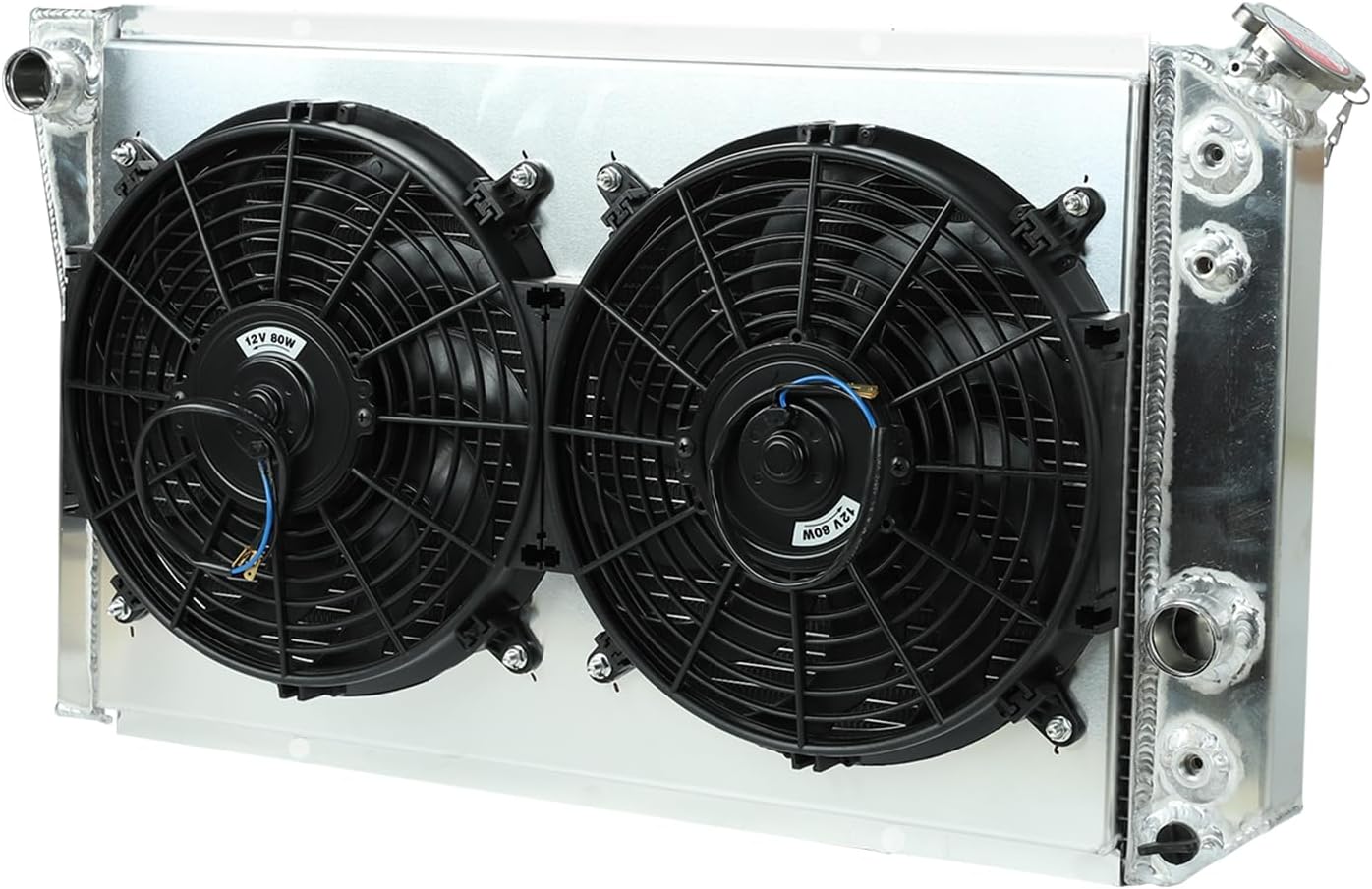
3. Smileracing 3-Row AA5052 Aluminum Racing Core Radiator with 12" Slim Push/Pull Fan Kit
| Core | 3-Row AA5052 Aluminum |
|---|---|
| Core size | 602 x 378 x 44mm |
| Inlet/Outlet | 1.38" / 1.38" |
| Includes | Fan shroud and 2x 12" slim push fans |
| Position | Front |
This Smileracing kit combines a 3-row AA5052 aluminum racing core with a full shroud and two 12" slim push fans to provide a higher-capacity cooling solution for S-10 V8 conversions and compatible Corvettes. It is a direct bolt-on replacement intended to increase coolant capacity and improve heat dissipation over stock units, with TIG-welded construction and a polished finish. The slim fans make the package suitable for tighter engine bays while offering forced airflow at low speeds or when idling. In practice this radiator is useful for owners who tow, haul, or run hotter V8 swaps and need more cooling headroom; the larger core and aluminum construction should reduce operating temperatures and resist corrosion compared with older faulty units. Limitations to note are that fitment is specific to the listed vehicle conversions and the slim fans may move less air than larger single fans, so high-demand track use may require supplemental cooling or different fan choices.
Best for: Buyers who want a practical, higher-capacity cooling upgrade for a V8-converted S10 or the specified Corvette years and prioritize reliable, straightforward replacements over custom plumbing.
Less Ideal for: Those building dedicated race cars or running extreme-duty towing schedules who need maximum airflow or a custom cooling setup should consider purpose-built race radiators or larger fan solutions.
- 3-row AA5052 aluminum core offers higher coolant capacity and improved heat dissipation versus typical stock radiators
- Includes full fan shroud plus two 12" slim push fans for better airflow in confined engine bays
- TIG-welded construction and polished finish for durability and corrosion resistance
- Direct bolt-on fitment for the listed S10 V8 conversion and specified Corvette years, simplifying installation
- Slim 12" fans may provide less peak airflow than larger single fans for extreme track or heavy towing applications
- Fitment is limited to the listed vehicle conversions and may not suit other S-10 or Corvette configurations without modification
Verdict: A ready-to-install, higher-capacity aluminum radiator kit that gives S-10 V8 conversions noticeably better cooling with minimal fitment hassle.
4. ECCPP 1531 Aluminum Radiator for Chevrolet S10 / GMC Sonoma 2.2L (1994–2003)

| Compatible vehicles | 1994-2003 Chevrolet S10 / GMC Sonoma 2.2L |
|---|---|
| Core material | Aluminum |
| Manufacturer | ECCPP |
| Leak testing | Each unit inspected prior to sale |
This ECCPP 1531 radiator is a factory-style aluminum replacement intended as a drop-in cooling upgrade for 2.2L Chevrolet S10 and GMC Sonoma trucks from 1994 to 2003. It uses an aluminum core with high-density fins and reinforced plastic end tanks to improve heat transfer and resist leaks; the listing notes each unit is leak-tested and comes with OE-style mounting points so no drilling or modification should be necessary. In practice this radiator is suited for everyday drivers and DIY mechanics who need to replace a failed or corroded unit and want a straightforward installation. The higher fin density helps maintain operating temperature under normal driving and light towing, while the thermal-shocked gaskets aim to reduce cracking in cold weather. Limitations include basic aftermarket construction compared with premium branded cores and plastic tanks that may not match the longevity of all-metal designs, so buyers seeking maximum durability under heavy commercial use may prefer a heavier-duty option.
Best for: Drivers replacing a failed or leaking radiator who prioritize a low-cost, easy-to-install replacement that restores normal cooling performance for older S-10/Sonoma trucks.
Less Ideal for: Heavy-duty users who regularly tow large loads, operate in extreme conditions, or who want a heavy-alloy or performance-grade radiator for higher longevity and cooling capacity.
- Direct-fit design for 1994–2003 Chevrolet S10 and GMC Sonoma 2.2L for straightforward drop-in installation
- Aluminum core with high-density fins improves cooling efficiency over worn factory radiators
- Leak-tested units and thermal-shocked gaskets reduce early failures from assembly defects
- Compatible mounting points remove the need for drilling or modification
- Plastic end tanks rather than full-metal construction may have shorter service life under heavy use
Verdict: A budget-focused, direct-fit aluminum radiator that restores reliable cooling for 2.2L S-10 and Sonoma trucks with simple drop-in installation.
5. AParts Aluminum Engine Radiator for Chevrolet S10 and Blazer

| Manufacturer | AParts |
|---|---|
| Manufacturer Part Number | Radiator-AP-41-744-0415 |
| Fitment | Chevrolet S10/Blazer and GMC S15/Sonoma 2.2L–3.1L (listed years) |
This aluminum radiator is a direct bolt-in replacement for a range of Chevrolet S10, Blazer and related GMC models and is intended to restore factory cooling capacity. It uses a high-density multi-louvered aluminum core and TIG-welded joints, which improve airflow and cooling efficiency while reducing leak points compared with inexpensive pressed cores. Molded PA66 GF30 inlet and outlet tanks and an integrated transmission oil cooler make it a practical one-piece swap for vehicles that had a combined cooler. Installation is straightforward for a competent DIYer or technician because it follows the original mounting points and plumbing. The reinforced structure and described sealing methods aim to improve longevity and reduce corrosion and leak risk, supporting reliability-focused buyers. Important limitations are that fitment is limited to the listed model years and engine displacements and that long-term durability depends on proper coolant maintenance and mounting hardware condition.
Best for: Drivers who prioritize a reliable, factory-style cooling replacement for an aging Chevrolet S10 or related GMC truck and want a durable aluminum core that restores cooling performance with minimal modification.
Less Ideal for: Buyers looking for universal-fit radiators, performance uprated cores for racing, or parts for vehicles outside the listed model years and engine choices should consider other options.
- High-density multi-louvered aluminum core improves airflow and cooling efficiency
- TIG-welded aluminum core reduces leak points compared with crimped cores
- Integrated transmission oil cooler eliminates need for a separate unit on equipped vehicles
- Direct bolt-on design matches factory mounting points for easier installation
- Compatibility limited to specific S10/Blazer/GMC model years and engine sizes
Verdict: A direct-fit aluminum replacement radiator that restores reliable cooling for listed Chevrolet S10 and related GMC applications.
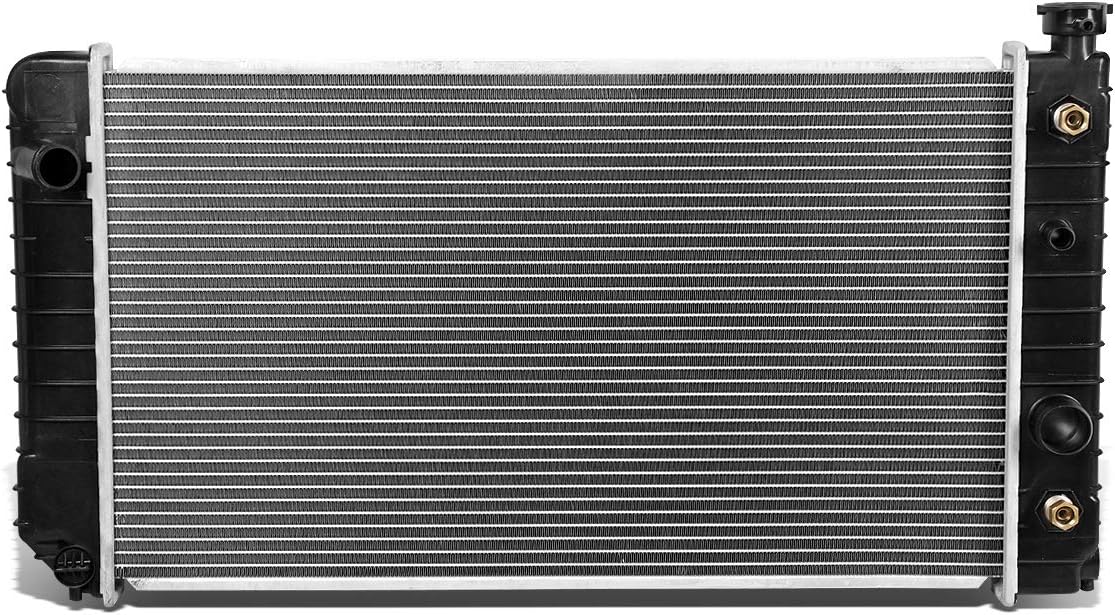
6. DNA Motoring Aluminum Cooling Radiator OEM-RA-681
| Brand | DNA MOTORING |
|---|---|
| Model | OEM-RA-681 |
| Position | Front |
| Material | T-6061 Aluminum |
This DNA Motoring OEM-RA-681 is a full T-6061 aluminum replacement radiator built as a direct bolt-in for 1988–1994 Chevy S10 Blazer and 1988–1993 S10 pickup applications and compatible GMC/Olds variants. It uses a tube-and-fin core to increase surface area and improve heat dissipation compared with many stock units, which helps reduce operating temperature and the risk of overheating. Typical use is as a factory-style replacement during an engine cooling refresh or after a failure; installation is intended to be straightforward for technicians because it matches factory mounting points for automatic-transmission, 4.3L engines without an external oil cooler. The lightweight aluminum construction improves thermal transfer and resists corrosion better than older brass cores, and the 2-row core thickness keeps fitment within the original radiator space. Limitations are that it is specified for specific engine and transmission configurations only and does not include additional features like integrated oil cooling or upgraded fan shrouds, so buyers needing those should plan complementary parts or professional installation.
Best for: Buyers who want a tested, factory-style aluminum replacement to reliably restore cooling on an S-10 family truck and prioritize products with positive owner feedback and reduced overheating risk.
Less Ideal for: Do not choose this if you need an upgraded heavy-duty cooling solution with integrated oil cooling or if your vehicle has a different engine/transmission configuration than listed.
- Full T-6061 aluminum core improves heat transfer and reduces corrosion risk compared with older copper/brass cores
- Tube-and-fin design increases surface area for more efficient cooling
- Direct bolt-on fit for specified S-10/Blazer/Jimmy models simplifies installation for professional installers
- Lighter than stock units which makes handling and installation easier
- Fitment is limited to specific 4.3L automatic-transmission models without an external oil cooler
- Does not include integrated oil cooler or fan shroud adapters, so additional parts may be needed for full system upgrades
Verdict: A straightforward, full-aluminum replacement radiator that restores cooling reliability for the specified S-10/Blazer/Jimmy models with factory-style fitment.
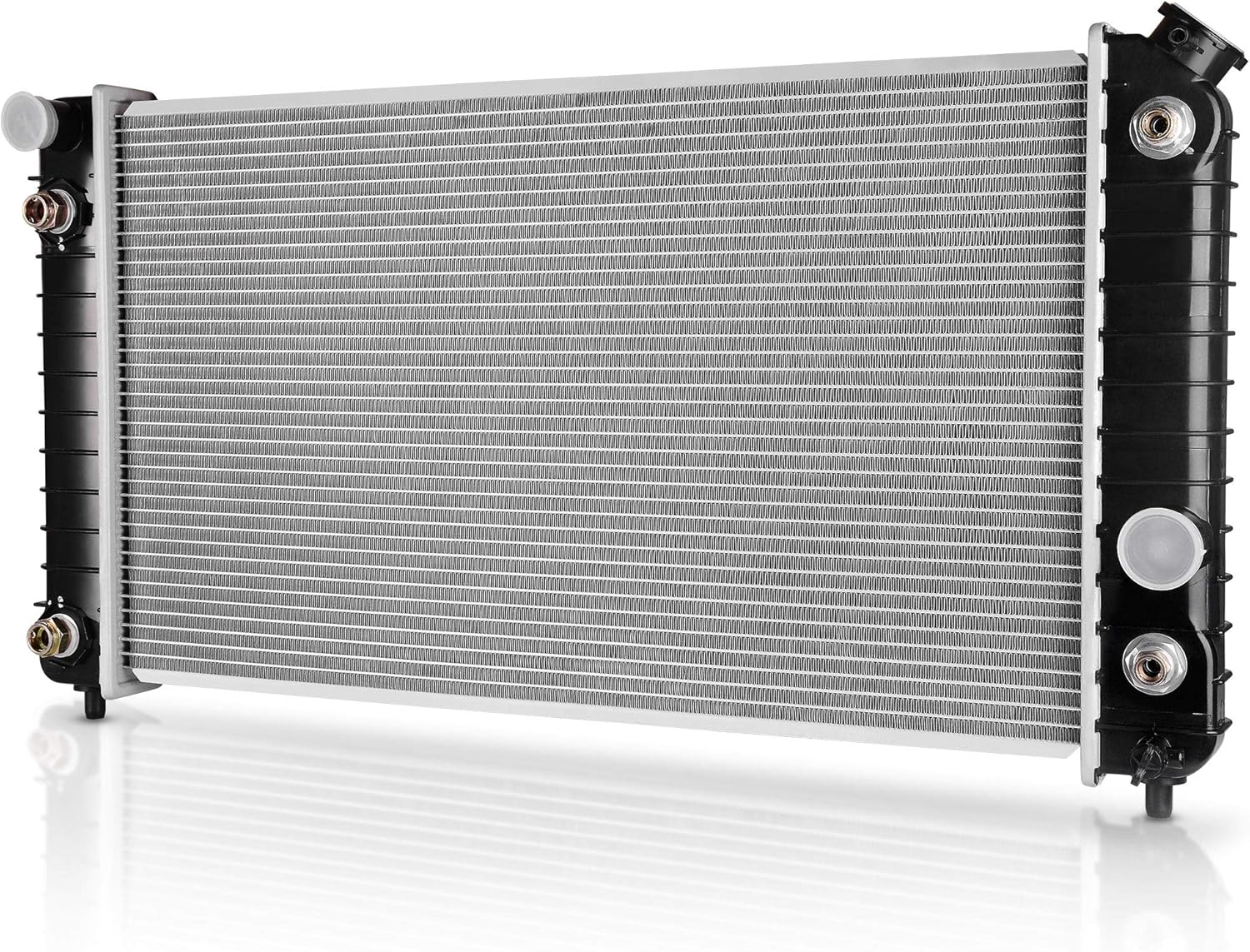
7. DWVO Complete Aluminum Radiator for Chevy S10/Blazer 4.3L (DWRD1012)
| Core size | 26.2" x 14.9" |
|---|---|
| Compatible engines | 4.3L V6 (listed vehicle fitments) |
| Manufacturer part number | DWRD1012 |
| OEM part numbers | 89018542; 52493406; 52406435; 52455644; 52472964; 52472963 |
This DWVO complete radiator is a direct replacement built to fit 4.3L Chevy S10, Blazer, GMC Jimmy, Sonoma and related models from the late 1990s and early 2000s. It uses a TIG-welded aluminum core with multi-louvered fins and reinforced inlet/outlet tanks to restore cooling capacity and resist leaks. The unit includes a brass transmission oil cooler and comes pretreated with a protective coating; foam corner supports in the package help prevent shipping damage. Installation is typical of a full radiator swap and the manufacturer recommends professional installation and replacing the thermostat when servicing the cooling system. For cautious buyers this radiator offers factory-matching fitment and construction aimed at durability and efficient heat dissipation, though it ships without a radiator cap and you should verify OEM part numbers against your vehicle before ordering. Regular coolant maintenance and correct grounding are still essential to avoid electrolysis or premature corrosion.
Best for: Buyers who want a conservative, factory-style aluminum replacement that prioritizes correct fit and reliable cooling performance for routine driving and light towing.
Less Ideal for: This is not aimed at performance builds or extreme-duty applications that require uprated cores, custom plumbing, or higher-capacity aftermarket intercoolers.
- Direct-fit replacement for 4.3L S10/Blazer family so fewer fitment issues
- Aluminum core with TIG-welded tanks and multi-louvered fins for improved heat dissipation
- Includes brass transmission oil cooler integrated into the unit
- Protective coating and foam corner packing to reduce shipping damage risk
- Radiator cap is not included so buyer must supply or reuse the factory cap
Verdict: A straightforward, factory-matched aluminum radiator replacement that restores reliable cooling for 4.3L Chevy S10/Blazer family vehicles.
Choosing the Right Chevrolet S-10 Aluminum Radiator: Key Factors to Consider
Cooling Capacity and Core Design
Cooling capacity determines how effectively the radiator moves heat away from the engine. For the Chevrolet S-10, core thickness, number of rows, tube design, and fin density affect how much heat is rejected under load and in stop-and-go traffic.
A thicker or multi-row core often improves heat rejection but can reduce airflow if the fan or shroud does not accommodate the extra depth. Consider your typical driving: towing or heavy load use benefits from higher-capacity cores, while mild daily driving may not require the thickest cores. Also note that higher fin density improves surface area but can clog faster in dusty environments, so maintenance needs should factor into your choice.
Fitment and Mounting Accuracy
Correct fitment is critical to a straightforward replacement. For the S-10, mounting ear alignment, inlet and outlet locations, and transmission cooler ports (if applicable) must match factory positions to avoid modification.
A radiator that matches OE mounting points significantly reduces installation time and eliminates the need for custom brackets, hose extensions, or adapter fittings. When fitment is off by even a small amount it can lead to stress on hoses or improper fan clearance. Always verify measured dimensions and mounting layouts before purchase.
Material Quality and Corrosion Resistance
Aluminum radiators vary in material thickness and tank construction methods. A fully aluminum core with welded or brazed seams typically offers better thermal transfer and long-term corrosion resistance compared with mixed-material designs.
Check for quality brazing on joints and protective coatings on tanks and cores. Vehicles in climates with road salt or heavy humidity require more robust corrosion protection. Poor material quality often manifests as early leaks or reduced thermal performance over time.
Transmission Cooler Integration
If your S-10 is equipped with an automatic transmission, the radiator may include internal transmission cooler passages or external ports. Proper integration ensures the transmission fluid stays within safe temperature ranges during towing or prolonged high-load use.
Confirm whether the radiator supports transmission fluid lines directly, and that those ports align with the vehicle's hose routing. Poor integration can necessitate aftermarket cooler lines or an auxiliary cooler, adding complexity and cost.
Ease of Installation and Serviceability
Some radiators are built with owner installation in mind. Features such as factory-style mounting points, pre-drilled holes for sensors or fan switches, and threaded fittings for bleeder screws make installation simpler.
Consider whether you plan DIY installation or will use a shop. Units that retain original fan shroud compatibility, or include clear instructions and hardware, reduce labor time and the chance of errors. Also factor in accessibility for future maintenance tasks like coolant changes or leak repairs.
Warranty and Manufacturer Support
Warranty terms reflect confidence in manufacturing quality and provide protection against early failures. Look for clear warranty coverage length and what it specifically covers, such as leaks or structural defects.
Manufacturer support includes documentation, replacement parts availability, and technical guidance. A solid warranty paired with accessible support reduces long-term ownership risk and can offset a slightly higher upfront cost.
Signs Your S-10 Needs a Radiator Replacement
Recognizing the early signs of radiator trouble helps you address issues before they cause engine overheating or head gasket failure. Watch for coolant loss without visible external leaks, frequent need to top off coolant, or a persistent sweet smell in the engine bay.
Other common indicators include engine temperature spikes, visible corrosion or discoloration on the radiator surface, and coolant contamination that looks oily or rusty. If you notice steam from the hood during idling or after heavy load, the radiator's heat rejection capacity may be compromised.
Addressing these symptoms quickly can prevent collateral engine damage. A proper diagnosis first confirms if the radiator is the source by pressure-testing the cooling system and inspecting hoses, clamps, and the water pump.
- Low coolant level without obvious external drip
- Intermittent overheating on idle or slow climbs
- Visible damage, dents, or corrosion on radiator core
- Discolored or contaminated coolant
Preparing Your S-10 for Radiator Installation
Preparation simplifies the swap and reduces installation time. Park on a level surface, let the engine fully cool, and disconnect the battery. Drain coolant into a clean container and dispose or recycle according to local regulations.
Inspect associated components like hoses, clamps, the thermostat, and the water pump. Replacing worn hoses or a failing thermostat while changing the radiator prevents repeated labor later. Have the correct coolant type and quantity on hand for refilling and bleeding the system after installation.
- Ensure correct coolant type recommended for the vehicle
- Inspect and replace old radiator hoses and clamps
- Keep tools and replacement gaskets or O-rings ready
- Have a coolant catch pan and funnel for safe refilling
Compatibility Tips: Checking Radiator Fitment
Avoid assumptions about fitment. Match the radiator's overall dimensions, mounting ear locations, inlet and outlet diameters, and transmission cooler provision to your S-10's specification. Measure the OEM radiator if necessary and compare to product specs before purchase.
Pay attention to fan and shroud clearance. Some higher-capacity cores sit deeper and can interfere with the factory fan or shroud. If the radiator includes fan mounts, verify alignment so the fan can operate without contact at full RPM.
- Measure core height, width, and depth against OEM unit
- Compare inlet/outlet positions and hose diameters
- Confirm transmission cooler ports alignment if applicable
- Check fan shroud mounting compatibility
Maintaining an Aluminum Radiator for Longevity
Routine maintenance extends service life. Flush the cooling system periodically to remove sediment and contaminants that reduce thermal transfer and accelerate corrosion. Use the correct coolant formulation and change it at manufacturer-recommended intervals or sooner if contamination is detected.
Inspect the radiator and hoses during oil changes or seasonal checks for signs of leaks or corrosion. Keep the exterior fins free of debris and bent fins straightened carefully to maintain airflow. Promptly address small leaks or seepage before they become major failures.
- Perform a coolant flush as recommended or when contamination is present
- Check for external debris and clean fins with low-pressure water
- Replace cooling hoses on visible wear or softness
- Monitor coolant level and color monthly
When to Consider an External Transmission Cooler
If you frequently tow heavy loads or subject the S-10 to high engine and transmission demands, an external transmission cooler can supplement an integrated radiator cooler. This reduces transmission fluid temperatures and offloads heat rejection from the radiator core.
An auxiliary cooler is also useful if you plan sustained highway towing or operate in hot climates. When adding an external cooler, ensure routing avoids sharp bends and secures lines properly to prevent chafing.
- Consider an external cooler for heavy towing or hot climates
- Mount the cooler where it receives good airflow
- Use quality fittings and secure routing to avoid leaks
- Check for compatibility with existing transmission lines
Still looking for the perfect fit?
Select your Chevrolet S-10 configuration to see the most relevant Radiators recommendations
How We Chose the Best Chevrolet S-10 Aluminum Radiator
We focused on attributes that matter for replacing the radiator on a Chevrolet S-10 and applied filters to ensure every shortlisted unit offers reliable service life and correct fitment. Our evaluation emphasized cooling efficiency, mechanical compatibility, build materials and corrosion resistance, and ease of installation for owners or independent shops. Cooling efficiency means core design, tube and fin density, and overall heat rejection capacity appropriate for the S-10 engine bay and typical duty cycles like towing or city traffic. Mechanical compatibility covers mounting points, inlet and outlet positions, transmission cooler provisions where applicable, and hose alignment to avoid trimming or adaptor work.Durability criteria included aluminum core and tank construction, brazing quality, and protective treatments to resist corrosion. Serviceability and installation were assessed by the presence of threaded fittings, mounting brackets, and whether the unit supports original accessories such as fans and shrouds. We also considered warranty coverage and documented manufacturing standards as an indicator of quality control. Exclusions in our shortlist removed radiators lacking clear fitment specifications for the Chevrolet S-10, units with unknown cooling capacity, or products that require significant vehicle modification to install. The result is a set of options that balance performance, fitment accuracy, and long-term reliability.
Our full evaluation process is outlined in our review methodology.
FAQ
How do I confirm my S-10 radiator is the source of coolant loss?
Often a pressure test of the cooling system reveals whether the radiator holds pressure or leaks. Inspect for visible wetness, white crust, or dried coolant around the radiator seams, hoses, and fittings. If no external leak is obvious, check the heater core and intake gasket as alternative sources.
Can I install an aluminum radiator myself on the S-10?
Many owners can perform the swap with basic tools and a vehicle lift or jack stands. The job requires draining coolant, disconnecting hoses, and transferring any sensors or shrouds. If you are uncomfortable with coolant bleeding or transmission line handling, seek professional help.
How often should I flush the radiator coolant in my S-10?
It typically depends on coolant type and driving conditions, but flushing every two to five years is common. If you notice discolored coolant, rust, or debris, perform a flush sooner. Regular monitoring of coolant condition helps determine the right interval.
Will an aluminum radiator reduce overheating compared with the stock unit?
An aluminum radiator with a correctly sized core and good airflow often improves cooling capacity and can reduce overheating under load. The actual result depends on core design, fan performance, and overall system condition.
Do aluminum radiators require special coolant or additives?
Aluminum radiators do not usually need special additives beyond the recommended coolant formulation for the vehicle. Use the proper coolant type and corrosion inhibitors specified for the S-10, and avoid mixing incompatible coolant chemistries.
What should I check if the new radiator still overheats?
Verify fan operation, thermostat function, and that the cooling system is properly bled of air. Ensure there are no blockages in the hoses or heater core and that the water pump is circulating correctly. Improper fan shroud fitment or incorrect core orientation can also reduce performance.
Final Verdict
When selecting an aluminum radiator for your Chevrolet S-10, prioritize correct fitment and the right cooling capacity for how you use the truck. A properly sized core, accurate mounting points, and solid material construction will deliver the best balance of temperature control and long-term durability.Weigh the tradeoffs between thicker cores and airflow limitations, and address related parts like hoses or the thermostat during the swap. With careful selection and proper installation, you can confidently improve cooling performance and reduce the risk of overheating on the road.
