

Note: This article contains affiliate links. If you click on these links and make a purchase, I may earn a small commission at no extra cost to you. This helps support my research and content. Read my full affiliate disclosure here.
An air compressor can turn a home garage into a far more capable workspace. For DIY mechanics, it powers tasks that are difficult or slow by hand, from inflating tires and blowing out debris to running impact wrenches, ratchets, and other pneumatic tools. But the wrong compressor can be frustrating fast, especially if it struggles to keep up with airflow demand or takes too long to recover.The best air compressor for DIY mechanics depends on how you work, how much space you have, and which tools you plan to run most often. The picks that follow are aimed at helping you compare the most important differences so you can choose a setup that feels practical, dependable, and well matched to your garage.
Top Picks at a Glance
| Best Overall Air Compressor for DIY Mechanics A versatile, balanced unit suitable for most garage tasks and tools | DEWALT 6 Gallon 165 PSI Pancake Air Compressor (DWFP55126) |  |
| Best Budget Air Compressor for DIY Mechanics Affordable, no-frills model for occasional use and simple inflation tasks | Ziweo Portable Tire Inflator PL01 — Cordless 12V Air Compressor with Digital Gauge |  |
| Best Portable Air Compressor Compact, easy-to-carry compressor for on-the-go pumping and light tool work | DEWALT 20V MAX Corded/Cordless Tire Inflator (DCC020IB) |  |
| Best Stationary Workshop Compressor Floor-mounted, larger-tank unit built for continuous shop tool operation | VEVOR 80-Gallon 6.5 HP Oil-Free Stationary Air Compressor (220V) |  |
| Best Oil-Free Air Compressor Low-maintenance oil-free pump that reduces servicing and contamination risk | California Air Tools 8010 1.0 HP Ultra Quiet Oil-Free Air Compressor, 8 Gallon |  |
| Best High-CFM Air Compressor High-flow compressor focused on sustained airflow for heavy pneumatic tools | VEVOR 80-Gallon 6.5 HP Oil-Free Stationary Air Compressor (220V) | |
| Best Premium Air Compressor Top-tier build quality, quieter operation, and longer duty cycles expected | Ingersoll Rand 2340N5‑V 5 HP two‑stage 80‑gal air compressor (230V) |  |
DEWALT 6 Gallon 165 PSI Pancake Air Compressor (DWFP55126)
Best Overall Air Compressor for DIY Mechanics

| Capacity | 6 Gallons |
|---|---|
| Maximum Pressure | 165 PSI |
| Air Flow Capacity | 2.6 SCFM @ 90 PSI |
| Power Source | Corded Electric |
| Noise | 75.5 Decibels |
The DEWALT 6 gallon pancake compressor is a portable, corded electric unit aimed at supporting nailers, impact tools, tire inflation, and light spraying. Its oil-free pump and 2.6 SCFM at 90 PSI provide respectable run time and quick recovery for intermittent tool use while the 165 PSI maximum gives headroom for higher-pressure applications. A high-efficiency motor helps with cold starts and makes the compressor tolerant of typical extension cord setups. Practical touches include a console cover that protects controls, two universal couplers to run two tools at once, a ball drain valve for easy tank flushing, and cord wrap for tidy storage. Noise is moderate for a jobsite tool but not whisper-quiet. The 6 gallon tank limits long continuous use with high-demand tools, so expect more frequent motor cycles under heavy loads. This unit is best for DIYers who need reliable, portable compressed air for a variety of garage tasks rather than continuous professional production runs.
Best for: DIY mechanics who want a reliable, portable compressor that balances tank size, usable airflow, and quick recovery for common home automotive tasks like tire inflation, impact wrench use, and spray or air-tool jobs, without sacrificing easy transport or workshop storage.
Less Ideal for: Users needing long continuous run times for production work or multiple high-demand tools should consider larger vertical or twin-cylinder compressors with greater tank capacity and CFM.
- Oil-free pump for low maintenance and long service life
- 2.6 SCFM at 90 PSI with 165 PSI max for solid tool compatibility
- Two universal couplers let two users or tools run simultaneously
- High-efficiency motor designed for easier starts in cold weather or on extension cords
- Compact pancake layout and cord wrap for easy transport and storage
- 6 gallon tank limits continuous high-demand tool operation and requires more frequent motor cycling
- Noise level is noticeable during use compared with quieter shop compressors
Verdict: The best all-around air compressor that balances tank size, CFM, duty cycle, portability, and price for typical home automotive projects.
Ziweo Portable Tire Inflator PL01 — Cordless 12V Air Compressor with Digital Gauge
Best Budget Air Compressor for DIY Mechanics
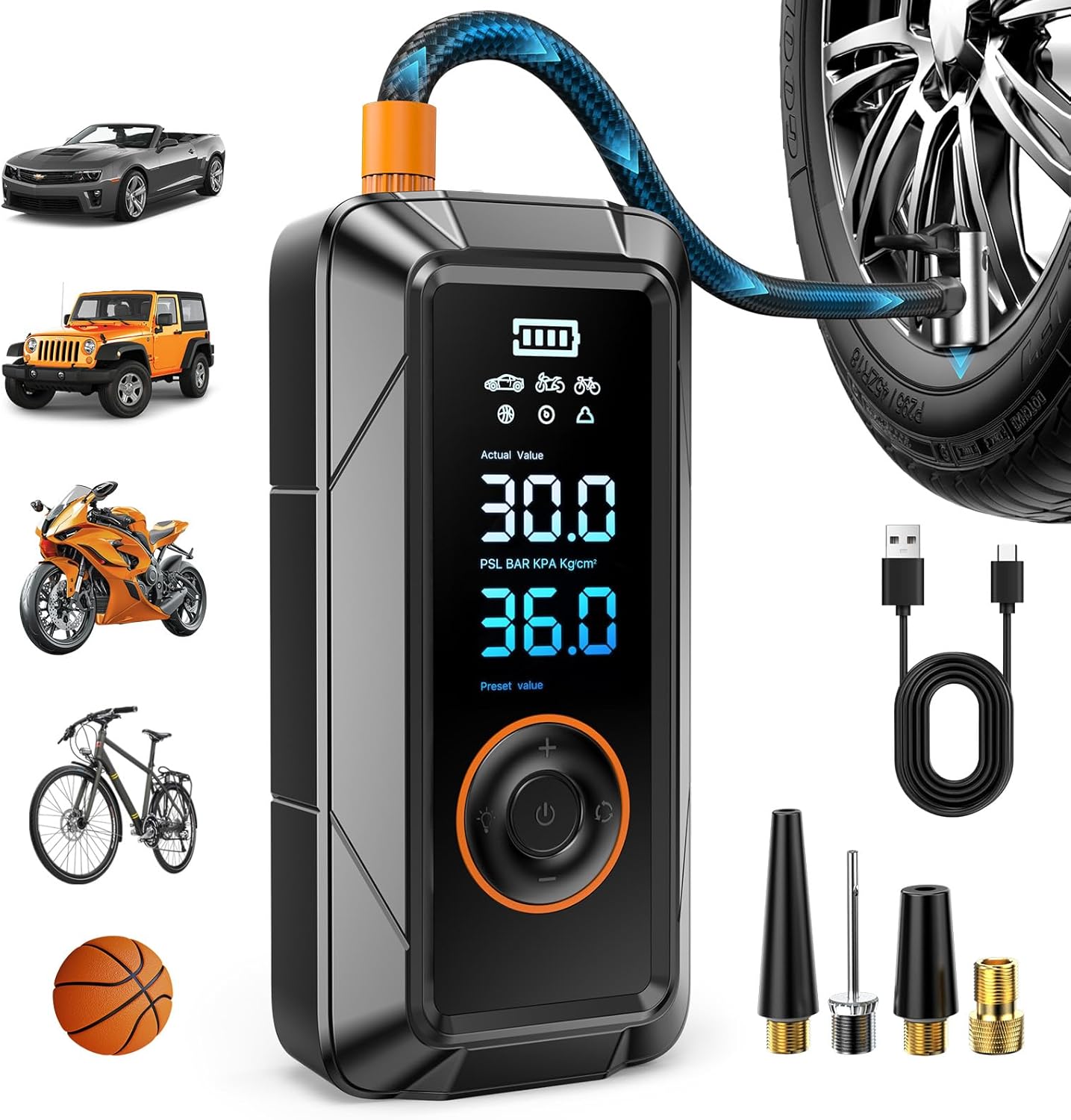
| Power Source | Battery Powered |
|---|---|
| Additional Features | Automatic Shut-Off, Built-In Gauge, Cordless & Wired Inflation, LED Light |
| Recommended Uses For Product | Bike inflation, Motorcycle Inflation, Tire Inflation |
| Maximum Pressure | 150 Bars |
The Ziweo PL01 is a small, battery-powered tire inflator designed for quick on-demand inflation at home or on the road. It runs cordless from its internal battery for quick top-offs and also accepts 12V DC power for longer jobs, which makes it useful for inflating multiple tires without interruption. The built-in digital pressure gauge and automatic shut-off let you set a target PSI and walk away while the unit stops at the preset pressure, reducing the risk of overinflation. Included nozzles and adapters extend use to bikes and sports balls, and an integrated LED helps with roadside or low-light use. Expect fast inflation for passenger tires up to typical car pressures, but this is not intended for large truck or RV tires or professional continuous-duty work. The plastic construction keeps weight down and storage simple, though frequent heavy use may reveal thermal limits compared with larger compressors. For DIY mechanics who want a budget, grab-and-go inflator, the PL01 covers routine maintenance and emergency top-offs without complex setup.
Best for: Budget-conscious DIY mechanics who need a compact, portable inflator for routine garage tasks and occasional tire top-ups rather than heavy-duty continuous use.
Less Ideal for: Users who need a shop-grade, continuous-duty compressor for frequent heavy inflations, large truck or RV tires, or professional repair work should choose a larger dedicated compressor.
- Cordless operation with built-in rechargeable battery for quick top-offs without needing the vehicle
- 12V DC input option for extended use when inflating multiple tires
- Digital pressure gauge with automatic shut-off for set-and-forget inflation
- Includes multiple nozzles and adapters for bikes and sports equipment
- Integrated LED light for roadside or low-light use
- Plastic housing and compact motor limit continuous heavy-duty use compared with larger compressors
- Maximum pressure listed at 150 Bars is unusually high for consumer inflators and may not reflect practical sustained output for large tires
Verdict: The best low-cost air compressor that delivers adequate pressure and intermittent CFM for common garage tasks without breaking the bank.
DEWALT 20V MAX Corded/Cordless Tire Inflator (DCC020IB)
Best Portable Air Compressor
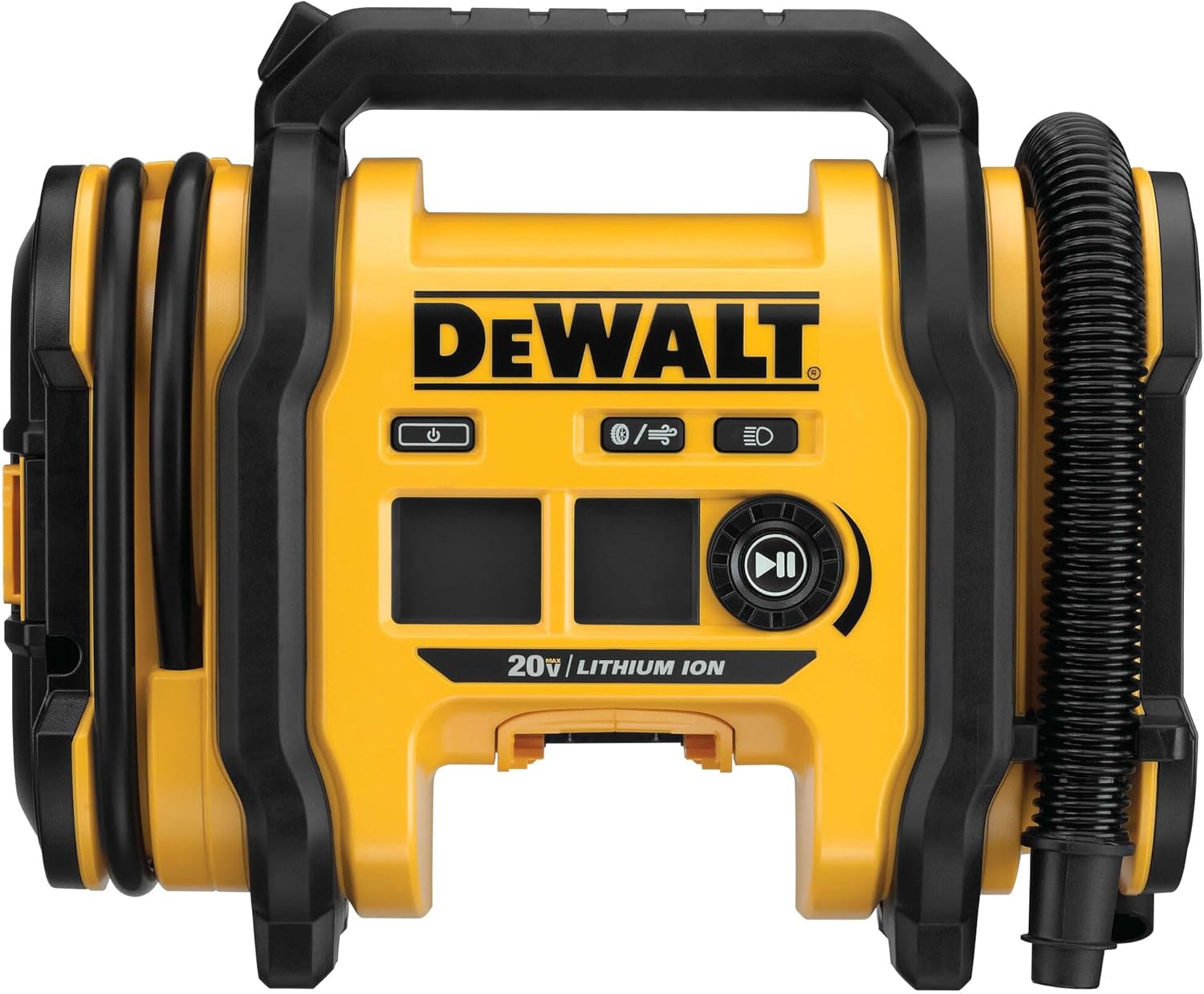
| Power Source | Battery Powered |
|---|---|
| Maximum Pressure | 80 Pound per Square Inch |
| Voltage | 20 Volts |
| Battery Type | Lithium-Ion |
This DEWALT inflator is a multi-power portable compressor designed for quick tire inflation and general inflating tasks around the garage or on the road. It accepts a 20V MAX battery or runs from a vehicle 12V outlet or household 110V, so you can use it on the job, at home, or during travel. The unit features a digital pressure gauge with an automatic shutoff to hit target PSI without overinflating, a threaded chuck for a secure valve connection, and onboard accessory storage for common nozzles and adapters. It also offers a high-volume mode for inflatables and a deflation port for faster take down. Practical advantages include its portability, multiple power options, and simple one-button inflation control, while limitations are that batteries and charger are sold separately and the built-in pump is aimed at convenience rather than high-duty continuous compressor work. Expect it to be a reliable, easy-to-use tool for routine tire maintenance and occasional larger inflatables, but not a substitute for a shop-grade compressor for heavy, continuous use.
Best for: DIYers and weekend mechanics who need a truly portable inflator for quick tire top-ups, occasional small inflatables, and light pneumatic tasks while working in the driveway or on the road; ideal if you value cordless flexibility and easy storage.
Less Ideal for: Users who need a high-capacity, continuous-duty compressor for professional shop use or repeated heavy inflation sessions should choose a larger stationary compressor instead.
- Runs from three power sources (20V battery, 12V DC, 110V AC) for flexible use
- Digital gauge with auto-shutoff for accurate, hands-free inflation
- Onboard storage and included adapters keep accessories organized and ready
- High-volume mode and a deflation port speed up inflating and deflating large items
- Battery, charger, and AC adapter are sold separately so out-of-box readiness may be limited
- Not designed for heavy continuous workshop duty compared with larger stationary compressors
Verdict: A lightweight, compact compressor designed for easy transport and quick on-car inflation or small pneumatic tool use in the driveway or on the go.
California Air Tools 8010 1.0 HP Ultra Quiet Oil-Free Air Compressor, 8 Gallon
Best Oil-Free Air Compressor

| Power Source | Corded Electric |
|---|---|
| Noise | 60 Decibels |
| Capacity | 8 Gallons |
| Maximum Pressure | 120 Pound per Square Inch |
| Air Flow Capacity | 3 Cubic Feet Per Minute |
The California Air Tools 8010 is a lightweight, oil-free portable compressor built for garage and workshop tasks where noise and low maintenance matter. Its 1.0 HP motor and dual piston oil-free pump deliver usable airflow for brad nailing, air ratchets, and light paint touch-ups while keeping operation quiet at about 60 dBA. The 8 gallon steel tank provides short bursts of air and the unit refills quickly from 90 to 120 PSI in roughly 60 seconds, so downtime between jobs is minimal. Practical features include two pressure gauges, push-to-connect quick connectors, an automatic shut-off and a wheel kit for easy positioning. Because it is oil-free and operates at a lower RPM the pump requires less routine servicing and tolerates a range of temperatures. The compressor is not intended for continuous heavy-duty use or running large pneumatic sanders for extended periods since airflow (about 3 CFM at 40 PSI) is modest compared with larger shop compressors. For DIY mechanics who value quiet, portability and low upkeep, this model is a strong fit; those needing sustained high CFM should look at larger units.
Best for: DIY mechanics who want a low-maintenance, oil-free compressor for garage projects and light automotive tasks where quiet operation, portability, and reduced servicing matter more than industrial continuous-duty performance.
Less Ideal for: Users who need continuous high-CFM output for heavy-duty pneumatic tools or professional shop environments should consider a larger, higher-capacity compressor.
- Very low noise level around 60 dBA suitable for indoor use
- Oil-free dual piston pump reduces maintenance and provides long life expectancy
- Compact 8 gallon tank with fast recovery times minimizes wait between short jobs
- Lightweight with wheel kit makes it easy to move and position in a home garage
- Push-to-connect fittings and dual gauges simplify hookup and pressure monitoring
- Modest airflow (approx 3 CFM at 40 PSI) limits use with high-demand pneumatic tools
- 8 gallon tank and 1.0 HP motor are not suited for long continuous runs or heavy shop use
Verdict: A low-maintenance compressor with an oil-free pump that minimizes servicing and oil contamination risk for general DIY automotive work.
VEVOR 80-Gallon 6.5 HP Oil-Free Stationary Air Compressor (220V)
Best High-CFM Air Compressor

| Maximum Pressure | 145 Pound per Square Inch |
|---|---|
| Air Flow Capacity | 15.5 Cubic Feet Per Minute |
| Capacity | 80 Gallons |
| Power Source | Corded Electric |
| Voltage | 220 Volts |
This VEVOR 80-gallon stationary compressor is built to supply steady air for demanding workshop tasks. Its 6.5 HP motor delivers up to 15.5 SCFM at 90 PSI and a 145 PSI maximum, so it can run nailers, spray guns, and impact tools with less frequent pump cycles thanks to the big tank. The unit is oil-free, which reduces maintenance and eliminates oil contamination in air lines, and the manufacturer highlights a heavy cold-rolled steel tank for durability. It runs on single-phase 220V power and is described as relatively quiet for its class at 86 dB, which helps in shared shop spaces. Practical limitations are its large size and weight that require a permanent location and 220V supply, and oil-free designs may run hotter and wear faster than lubricated compressors under continuous heavy use. For DIY mechanics needing a long-duration air source for painting, nailing, and tire work, this model offers strong capacity and low upkeep, but it is best where a fixed 220V circuit and floor space are available.
Best for: DIY mechanics and small-shop technicians who need sustained high airflow to run impact wrenches, grinders, and other demanding pneumatic tools without frequent recovery pauses; best for users who prioritize continuous jobsite productivity over portable convenience.
Less Ideal for: If you need a portable or 120V-friendly compressor for occasional light tasks or if you lack space or a 220V supply, choose a smaller portable unit instead.
- Very large 80 gallon tank provides long-duration steady air between pump cycles
- 6.5 HP motor and 15.5 SCFM@90 PSI supports common workshop tools like spray guns and nailers
- Oil-free design reduces routine maintenance and prevents oil carryover into pneumatic tools
- Built with cold-rolled steel tank intended for durability in workshop environments
- Requires a dedicated 220V single-phase circuit and floor space for stationary installation
- At 86 dB it is not silent and still produces significant noise typical of large compressors
Verdict: A compressor that delivers elevated continuous airflow for running air impact wrenches, grinders, and other high-demand pneumatic tools without bogging down.
VEVOR 80-Gallon 6.5 HP Oil-Free Stationary Air Compressor (220V)
Best High-CFM Air Compressor
| Maximum Pressure | 145 Pound per Square Inch |
|---|---|
| Air Flow Capacity | 15.5 Cubic Feet Per Minute |
| Capacity | 80 Gallons |
| Power Source | Corded Electric |
| Voltage | 220 Volts |
This VEVOR 80-gallon stationary compressor is built to supply steady air for demanding workshop tasks. Its 6.5 HP motor delivers up to 15.5 SCFM at 90 PSI and a 145 PSI maximum, so it can run nailers, spray guns, and impact tools with less frequent pump cycles thanks to the big tank. The unit is oil-free, which reduces maintenance and eliminates oil contamination in air lines, and the manufacturer highlights a heavy cold-rolled steel tank for durability. It runs on single-phase 220V power and is described as relatively quiet for its class at 86 dB, which helps in shared shop spaces. Practical limitations are its large size and weight that require a permanent location and 220V supply, and oil-free designs may run hotter and wear faster than lubricated compressors under continuous heavy use. For DIY mechanics needing a long-duration air source for painting, nailing, and tire work, this model offers strong capacity and low upkeep, but it is best where a fixed 220V circuit and floor space are available.
Best for: DIY mechanics and small-shop technicians who need sustained high airflow to run impact wrenches, grinders, and other demanding pneumatic tools without frequent recovery pauses; best for users who prioritize continuous jobsite productivity over portable convenience.
Less Ideal for: If you need a portable or 120V-friendly compressor for occasional light tasks or if you lack space or a 220V supply, choose a smaller portable unit instead.
- Very large 80 gallon tank provides long-duration steady air between pump cycles
- 6.5 HP motor and 15.5 SCFM@90 PSI supports common workshop tools like spray guns and nailers
- Oil-free design reduces routine maintenance and prevents oil carryover into pneumatic tools
- Built with cold-rolled steel tank intended for durability in workshop environments
- Requires a dedicated 220V single-phase circuit and floor space for stationary installation
- At 86 dB it is not silent and still produces significant noise typical of large compressors
Verdict: A compressor that delivers elevated continuous airflow for running air impact wrenches, grinders, and other high-demand pneumatic tools without bogging down.
Ingersoll Rand 2340N5‑V 5 HP two‑stage 80‑gal air compressor (230V)
Best Premium Air Compressor

| Voltage | 230 Volts |
|---|---|
| Air Flow Capacity | 14.3 Cubic Feet Per Minute |
| Tank Volume | 80 Gallons |
| Maximum Pressure | 175 Pound per Square Inch |
| Maximum Power | 5 Horsepower |
The Ingersoll Rand 2340N5‑V is a shop‑grade, two‑stage stationary compressor designed to supply continuous compressed air for heavy automotive and industrial tasks. It delivers about 14.3 CFM at 90 PSI with a 5 HP motor and an 80‑gallon ASME receiver, so it keeps tools running without frequent unload cycles. Typical uses are air impact wrenches, sanding and painting operations, and multiple simultaneous tool runs in a busy garage. The cast iron pump and overhung crank design emphasize durability and simplified service, and the unit includes an automatic shut‑off for safe operation. Expect a loud 85 dB operating level and the need for dedicated 230V, 22.5 A electrical service and professional installation. This is a heavy, permanent piece of equipment that rewards users who need continuous duty performance and minimal downtime rather than portability or low upfront complexity.
Best for: Serious DIY mechanics and small-shop owners who need a durable, high-capacity compressor for frequent heavy-duty tasks like pneumatic tools, spray painting, and shop maintenance and who prioritize long duty cycles and rugged construction over portability.
Less Ideal for: People seeking a portable, lightweight, or plug‑and‑play compressor for occasional home tasks should consider smaller, quieter portable models instead.
- Designed for continuous duty with two‑stage pump and cast iron construction for long service life
- Delivers 14.3 CFM at 90 PSI and up to 175 PSI for demanding pneumatic tools and simultaneous use
- Large 80‑gallon receiver reduces motor cycling and maintains stable pressure during heavy loads
- Automatic shut‑off and industrial motor hardware simplify operation and reduce manual intervention
- Requires 230V single‑phase, high‑amp dedicated circuit and professional installation
- High noise level around 85 dB makes it unsuitable for noise‑sensitive locations
- Very heavy and stationary so it is not portable and needs significant floor space
Verdict: A higher-end compressor offering superior build quality, longer duty cycles, quieter operation, and more robust components for serious home mechanics.
How We Chose the Best Air Compressor
We focused on air compressors that make sense for real DIY mechanic use rather than light household inflation alone or full commercial shop duty. The main filters were airflow output in CFM, maximum PSI, tank size, recovery time, and duty cycle, because those factors determine whether a compressor can keep up with common garage tools. We also looked closely at motor style, startup behavior on standard household power, portability, wheel and handle design, drain access, regulator layout, and overall ease of use in a home garage.For this category, we gave extra weight to performance with impact tools, ratchets, blow guns, and tire work, since those are the jobs most home mechanics care about. Noise level and maintenance demands also mattered, especially for users working in attached garages or tighter spaces. We excluded units aimed only at occasional inflating, as well as oversized shop compressors that are impractical for most home setups. The goal was to highlight options that balance usable air delivery, manageable size, and day to day convenience for DIY mechanic tasks.
Our full evaluation process is outlined in our review methodology.
What DIY Mechanics Should Look For First
Start with the tools you expect to run most often, because an air compressor that is perfect for tire service may not be enough for impact work or continuous grinding. DIY mechanics usually need a machine that can handle short bursts of high demand without constant waiting for the tank to refill. That means airflow matters more than headline pressure numbers alone.
If you only compare maximum PSI, you can end up with a compressor that sounds powerful on paper but feels limited in practice. A better approach is to match the compressor's usable output to your actual garage routine, then check whether its size, noise, and power requirements fit your space.
- Prioritize CFM before focusing on maximum PSI
- Match tank size to how long your tools run at a time
- Consider noise, footprint, and household power compatibility
- Think about how often you will move the unit around the garage
Why CFM Matters More Than PSI
PSI tells you the pressure a compressor can produce, but CFM tells you how much air it can actually deliver. For DIY mechanic work, that airflow number is usually the deciding factor. Impact wrenches, air ratchets, and blow guns often work best when the compressor can supply air steadily enough that pressure does not drop too quickly during use.
A compressor with strong PSI but weak CFM may still inflate tires and handle brief bursts, yet struggle when you move into longer or repeated tool use. If you want smoother performance and less downtime between tasks, look for airflow that meets or exceeds the needs of your most demanding tool.
- Use tool airflow requirements as your baseline
- Leave some airflow headroom for more consistent performance
- Remember that continuous-use tools demand more than occasional burst tools
Choosing the Right Tank Size for a Home Garage
Tank size affects how much stored air you have available before the motor needs to cycle back on. A smaller tank can work well for inflating tires, cleaning parts, and occasional tool use, especially if the compressor has decent recovery speed. For more involved mechanic jobs, a larger tank helps reduce waiting and gives air tools a more stable feel during use.
That does not mean bigger is always better. Large tanks take up more floor space, weigh more, and can be harder to move. In a compact garage, the best balance is often a tank large enough to support your typical jobs without turning the compressor into a storage problem.
- Smaller tanks suit lighter and more occasional jobs
- Mid-size tanks often fit general DIY mechanic needs best
- Larger tanks help when tools are used repeatedly or for longer sessions
Portable Vs Stationary Air Compressor Setups
Portable compressors are easier to roll around the garage, take to the driveway, or store when not in use. They make sense for DIY mechanics who need flexibility, work in shared spaces, or do not want a permanent equipment footprint. A good portable design should have sturdy wheels, a comfortable handle, and controls that are easy to reach without awkward bending.
A more stationary setup can make sense if your compressor stays in one place and supports a wider range of garage work. These units often favor capacity and output over mobility. The tradeoff is that they need more room, may be louder, and usually feel less convenient if you frequently change work areas.
- Choose portable if storage and mobility matter most
- Choose more stationary capacity if airflow and runtime are bigger priorities
- Check weight and handle design, not just wheel presence
Noise, Power, and Garage Practicality
Noise level can make a major difference, especially in attached garages, smaller workshops, or neighborhoods where loud equipment is a concern. A quieter air compressor is easier to live with during regular maintenance sessions and can make the whole garage feel less fatiguing. If you work indoors for longer stretches, this factor deserves more attention than many buyers initially give it.
Power requirements also matter. Many DIY mechanics want a compressor that starts reliably on common household circuits without special wiring. It is worth checking whether the unit fits your electrical setup and whether startup draw could be an issue when other garage equipment is running at the same time.
- Quieter units are easier to use in attached garages
- Household power compatibility can simplify setup
- A practical compressor should fit both your space and your electrical limits
Maintenance and Long-Term Reliability
An air compressor is easier to keep when routine maintenance is simple. For garage users, that means paying attention to tank draining, regulator durability, hose connection quality, and how accessible the controls are during normal use. A machine that is awkward to maintain is more likely to be neglected, and that can shorten its useful life.
Oil-free designs are often attractive for DIY mechanics because they reduce routine upkeep and keep ownership simple. Other users may be willing to do more maintenance if they value a certain performance profile. Either way, reliability usually comes down to using the compressor within its intended duty cycle, draining moisture consistently, and avoiding airflow demands that exceed its design.
- Drain the tank regularly to manage moisture
- Do not ignore duty cycle limits during longer jobs
- Simple maintenance access often leads to better long-term care
Matching the Compressor to Common Mechanic Tasks
Not every garage task needs the same kind of air delivery. Tire inflation, cleaning parts, and running a blow gun place relatively modest demands on a compressor. Lug nut removal, air ratchet work, and repeated fastening need more stored air and better recovery. Paint spraying, cutoff tools, and grinders can push demand even higher and quickly expose an undersized setup.
That is why the best buying decision starts with honest expectations. If your compressor will mostly handle tires and occasional fastener work, a smaller and more compact option may be enough. If you expect to use air tools regularly, stepping up in airflow and tank capacity can save a lot of frustration later.
- Light tasks need less airflow and tank reserve
- Fastening tools benefit from stronger recovery
- Continuous-demand tools require more compressor than many buyers expect
FAQ
What size air compressor is best for DIY mechanics?
The right size depends on the tools you plan to use, not just the type of work you do. For basic tire service and cleanup, a smaller unit may be enough. If you want to run impact tools or work longer without frequent pauses, look for more CFM and a tank that can better support repeated use.
Can a small air compressor run an impact wrench?
It can, but results vary depending on the impact wrench and how long you use it at a time. Some smaller compressors can handle short bursts, especially for lighter tasks, but they may struggle to keep up during repeated lug nut work or stubborn fasteners. For more reliable performance, airflow headroom is important.
Is oil-free or oil-lubricated better for a home garage?
Oil-free compressors are often the easier choice for DIY mechanics because they require less routine maintenance and are simple to live with. Oil-lubricated designs may appeal to users who are comfortable with upkeep and want a different performance or longevity profile. The better option depends on how much maintenance you want to handle and how often you use the compressor.
How much PSI do I need for mechanic work?
Many garage tools operate within a similar pressure range, so extremely high PSI is usually less important than buyers expect. The more meaningful number is whether the compressor can maintain enough airflow while delivering that pressure. In most cases, choosing strong CFM for your tools matters more than chasing the highest PSI figure.
Do DIY mechanics need a quiet air compressor?
Not everyone does, but it can make a big difference in day to day use. A quieter compressor is easier to tolerate in attached garages, residential areas, and longer work sessions. If noise has ever kept you from using your tools when you wanted to, it should be part of your decision.
What maintenance does an air compressor need?
Most compressors need regular tank draining to remove moisture and basic checks of fittings, hoses, and controls. You should also avoid pushing the unit beyond its duty cycle, because excessive heat and overuse can shorten its life. Following the maintenance guidance for the specific design will help keep performance consistent.
Final Verdict
The best air compressor for DIY mechanics is the one that matches your actual tool use, garage space, and tolerance for noise, weight, and maintenance. CFM, tank size, and recovery speed usually matter more than chasing the highest PSI rating, especially if you plan to run air tools instead of handling inflation alone.If you want to choose confidently, start with your most demanding mechanic task and buy around that need with a little headroom. A compressor that fits your workflow will feel more useful, more reliable, and far less frustrating every time you roll it out in the garage.
