

Note: This article contains affiliate links. If you click on these links and make a purchase, I may earn a small commission at no extra cost to you. This helps support my research and content. Read my full affiliate disclosure here.
If you drive a 2008-2013 Nissan Rogue, picking the right brake fluid matters more than you might think. Brake fluid condition affects pedal feel, stopping consistency, and corrosion inside the master cylinder and ABS components. Old or incorrect fluid can lead to spongy brakes and premature component wear.This guide highlights seven top brake fluids suited to the 2008-2013 Nissan Rogue, shortlisted for properties that matter most on this vehicle. We focus on boiling point, hygroscopic behavior, material compatibility, and long-term corrosion protection so you can choose the right option for normal commuting, towing, or occasional spirited driving. Read on for the evaluation criteria and practical installation and maintenance notes that apply to your Rogue.
Looking for other parts? See all Nissan Rogue parts & accessories.
Top Picks at a Glance
| Best Overall Brake Fluid A balanced DOT formula with proven performance and corrosion protection | Valvoline DOT 3 & 4 Synthetic Brake Fluid, 32 oz |  |
| Best Budget Brake Fluid A low-cost DOT fluid that handles basic maintenance and topping off | Quicksilver DOT 4 Brake Fluid, 12 oz |  |
| Best DOT 4 Brake Fluid A DOT‑4 formulation for higher boiling point and modern ABS systems | Bosch ESI6 Low Viscosity Extended Life Brake Fluid, 1 Quart |  |
| Best DOT 3 Brake Fluid A DOT‑3 formula for older systems or basic braking requirements | Prestone AS401 DOT 3 Synthetic Brake Fluid, 32 oz |  |
| Best DOT 5.1 Brake Fluid A high-performance glycol-based DOT‑5.1 fluid for high boiling points | Liqui Moly Brake Fluid DOT 5.1, 250 ml |  |
| Best High-Temperature Brake Fluid A racing-grade or high‑boiling synthetic fluid for extreme heat resistance | Motul RBF 700 Factory Line Racing Brake Fluid DOT 4, 500 ml |  |
1. Valvoline DOT 3 & 4 Synthetic Brake Fluid, 32 oz
Best Overall Brake Fluid

| Unit Count | 32.0 Fluid Ounces |
|---|---|
| Liquid Volume | 0.92 Liters |
| Recommended Uses For Product | Automotive |
| Specific Uses For Product | Vehicle Brake Systems |
Valvoline DOT 3 & 4 Synthetic Brake Fluid is a multi-spec fluid designed for routine brake system maintenance and DIY brake service. It mixes with conventional fluids and covers both DOT 3 and DOT 4 applications, so you can top off or refill hydraulic, disc and drum brakes without hunting for a specific DOT rating. The formula emphasizes a high boiling point and low moisture uptake to reduce vapor lock risk under heavy braking, while corrosion inhibitors help protect internal components and ABS systems. Its 32 oz bottle is sized for bleeding a single axle or topping a full system during a fluid change. Limitations are that it is not a long-term performance racing fluid and DOT 5 silicone-type systems are not compatible, so it is best used as a reliable service fluid rather than a specialty high-temperature product.
Best for: DIY mechanics seeking a single, dependable service fluid that balances boiling performance, corrosion protection, and flexible DOT compatibility for routine brake maintenance.
Less Ideal for: Drivers needing a specialized high-temperature racing fluid or those running silicone-based DOT 5 systems should choose a product formulated for those specific demands.
- Covers DOT 3 and DOT 4 applications for broad compatibility
- High boiling point and low-moisture formula reduce vapor lock risk
- Contains corrosion inhibitors for better protection of brake components
- Mixes with conventional brake fluids for easy top-offs and servicing
- Not intended for DOT 5 silicone systems or extreme motorsport use
Verdict: The all-around choice for most DIY mechanics who want a reliable brake fluid that balances wet/dry boiling points, corrosion inhibitors, and broad DOT compatibility.
2. Quicksilver DOT 4 Brake Fluid, 12 oz
Best Budget Brake Fluid

| Type | DOT 4 |
|---|---|
| Volume | 12 Ounce |
| Compatibility | Compatible with DOT 3 and DOT 4 |
| Wet boil point | 336°F |
| Dry boil point | 521°F |
This 12-ounce bottle of Quicksilver DOT 4 is a basic, factory-quality brake fluid intended for routine service on vehicles that call for DOT 4 or compatible DOT 3 fluids. It is used for topping off reservoirs and performing standard brake system flushes; the higher wet and dry boil points help maintain consistent braking under typical driving conditions. The formula advertises corrosion protection for internal brake components, and the product is presented as meeting manufacturer recommendations so it will not void warranties. Because it is a single small bottle, it is convenient for one or two minor maintenance jobs but not for full multi-vehicle shop use. There are no specialty additives for extreme track or heavy towing duty, so drivers needing higher-performance fluids should select a specialty product instead. For 2008–2013 Nissan Rogue owners doing routine flushes or topping off brake fluid, this is a straightforward, affordable option that follows DOT 4 compatibility requirements.
Best for: Owners of 2008–2013 Nissan Rogue seeking an affordable, factory-style DOT 4 fluid for routine brake reservoir top-offs and standard flushes who prioritize cost and OEM-compatible performance.
Less Ideal for: Drivers who regularly subject brakes to track use, heavy towing, or extreme-duty conditions should choose a high-performance or specialty brake fluid designed for elevated thermal stress.
- Compatible with DOT 3 and DOT 4 systems so it can be used where either spec is accepted
- Higher wet and dry boil points compared with lower-spec fluids for stable braking
- Advertised corrosion protection for brake system components
- Factory-validated formulation intended to match manufacturer recommendations
- Small 12-ounce bottle limits quantity for full system flushes on multiple vehicles or heavy applications
Verdict: Choose this economical bottle when you need a safe, affordable DOT brake fluid for routine flushes or topping off without paying for specialty performance features.
3. Bosch ESI6 Low Viscosity Extended Life Brake Fluid, 1 Quart
Best DOT 4 Brake Fluid

| Unit Count | 32 Fluid Ounces |
|---|---|
| Viscosity | 5w |
| Container Type | Can |
Bosch ESI6 is designed as a next-generation brake fluid that pairs a high wet boiling point with relatively low cold-temperature viscosity to support modern ESP and ABS systems. For a 2008–2013 Nissan Rogue, it can be used where the manufacturer allows DOT 4 or compatible fluids and is intended as either a top-off or a full-system replacement when the brake spec permits. The formula emphasizes longer service intervals and improved lubricity to reduce component wear and brake noise, and Bosch claims it resists corrosion and maintains performance under pressure because of its high wet boiling point (about 365°F). Practical benefits include fewer fluid changes and smoother ABS/ESP response in cold conditions due to lower viscosity. Important limitations are that it is not compatible with silicone DOT 5 systems and optimal results require a complete fluid flush rather than mixing for best performance. Multiple quarts are needed to fully flush and bleed the Rogue’s system during a full change.
Best for: Buyers who need a DOT 4‑level fluid for a 2008–2013 Nissan Rogue and value higher boiling point, improved ABS/ESP response, and longer drain intervals.
Less Ideal for: Drivers whose Rogue specifically requires DOT 5 silicone fluid or technicians looking to avoid a full-system flush when switching fluid types.
- High wet boiling point helps resist vapor lock under heavy braking.
- Low viscosity improves ABS/ESP response at low temperatures.
- Extended service life reduces how often you need to replace fluid.
- Good lubricity to help limit wear and reduce brake noise.
- Not compatible with silicone-based DOT 5 systems so cannot be used where DOT 5 is required.
Verdict: Pick a DOT 4 fluid when you need a higher boiling point and compatibility with ABS-equipped systems or when the vehicle spec calls for DOT 4.
4. Prestone AS401 DOT 3 Synthetic Brake Fluid, 32 oz
Best DOT 3 Brake Fluid

| Liquid Volume | 32 Fluid Ounces |
|---|---|
| Minimum Dry Boiling Point | 238 Degrees Celsius |
| Minimum Wet Boiling Point | 140 Degrees Celsius |
| Recommended Uses | Standard vehicle braking systems |
| Item Form | Liquid |
Prestone AS401 is a DOT 3 synthetic brake fluid sold in a 32 oz bottle intended to maintain braking performance under heat and prevent vapor lock. It is typically used as a direct replacement where DOT 3 is specified, supporting disc, drum and ABS systems. The formula uses polyglycol ethers and an inhibitor package to raise dry and wet boiling points well above minimum standards, which helps preserve pedal feel during heavy use and protect internal metals from corrosion. Practical benefits include broad compatibility with conventional brake systems and a familiar bottle format that makes topping off or full fluid changes straightforward. The product is focused on standard service rather than extreme performance; drivers who need higher wet-boiling resistance for track or heavy towing should choose a DOT 4 or DOT 5.1 fluid. Overall, this is a dependable, widely available DOT 3 option for routine maintenance when the vehicle manufacturer calls for DOT 3.
Best for: Drivers who need a reliable, factory‑recommended DOT 3 fluid for routine maintenance and safe everyday braking performance on standard passenger vehicles.
Less Ideal for: Enthusiasts who frequently track, tow heavy loads, or require higher-temperature wet boiling protection should consider DOT 4 or DOT 5.1 alternatives.
- High minimum dry boiling point (460°F / 238°C) reduces risk of vapor formation under heat
- Inhibitor package protects brake system metals from corrosion
- Suitable for ABS, disc and drum brake systems
- 32 oz bottle is convenient for topping off or a full fluid change
- DOT 3 chemistry has lower wet boiling performance than DOT 4 or DOT 5.1 for heavy-duty or track use
Verdict: Opt for DOT 3 if the vehicle calls for it or for basic brake systems where a standard, lower‑cost DOT 3 fluid meets manufacturer recommendations.
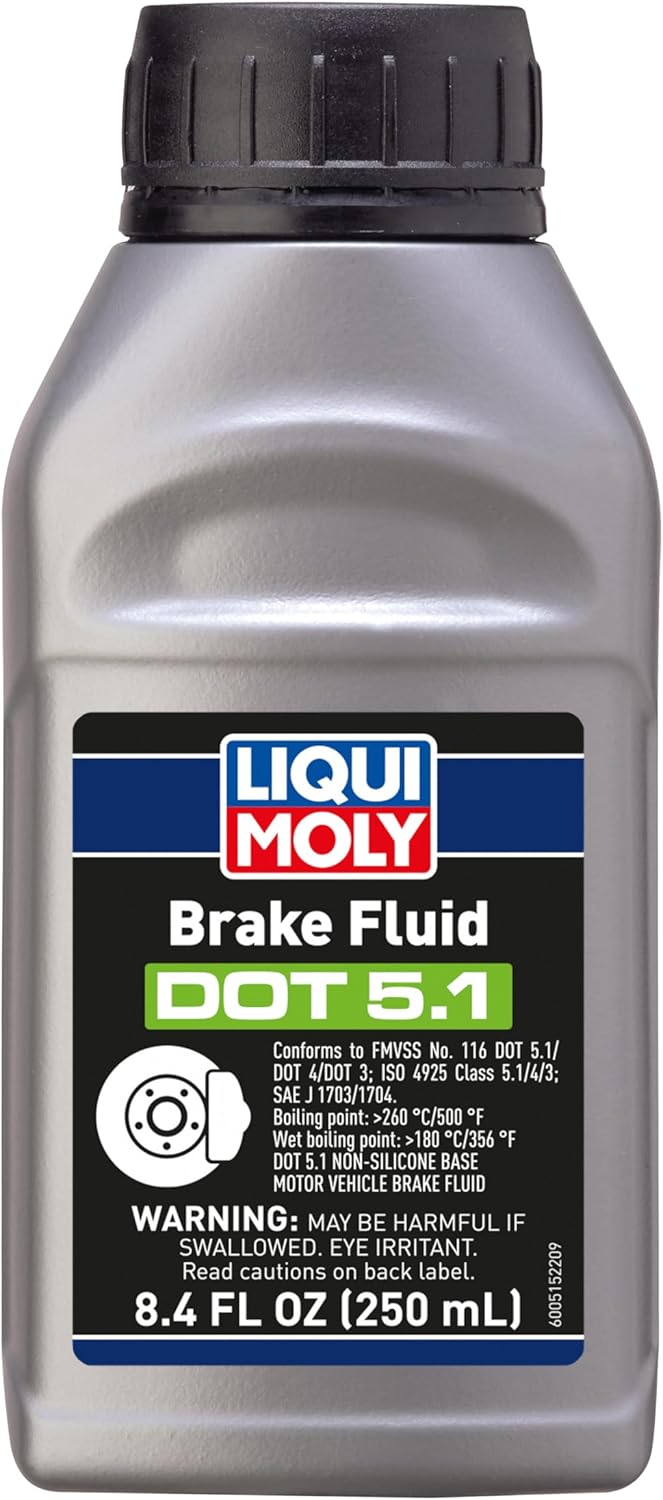
5. Liqui Moly Brake Fluid DOT 5.1, 250 ml
Best DOT 5.1 Brake Fluid
| Liquid Volume | 250 Milliliters |
|---|---|
| Material | Plastic bottle |
| Item Form | Liquid |
| Recommended Uses For Product | Automotive |
| Manufacturer | Liqui Moly |
This Liqui Moly DOT 5.1 brake fluid is a synthetic glycol-based formula designed for brakes that see higher temperatures or heavier use. It mixes with other high-quality synthetic brake fluids and is intended to maintain braking performance under stress thanks to elevated wet and dry boiling points and corrosion inhibitors. Typical use is topping off or replacing brake fluid in vehicles that call for DOT 5.1 to reduce vapor lock risk during heavy braking, track days, or towing. The product's scavengers help limit steam formation as moisture increases, and its lubricity helps protect moving components in the hydraulic circuit. The small 250 ml bottle is convenient for minor service tasks or topping up, but it is not a full system refill for most cars so plan accordingly. Handle with care and use proper PPE because the fluid can irritate eyes and has health warnings on fertility risks.
Best for: Drivers who need a glycol-based DOT 5.1 fluid for higher-temperature braking situations and want a synthetic, factory-quality replacement for topping off or partial service.
Less Ideal for: Anyone needing a full-system refill for a complete brake fluid flush should buy larger quantities or multiple bottles instead of relying on this single 250 ml unit.
- High wet and dry boiling points reduce vapor lock risk under high-temperature braking
- Compatible and miscible with other high-quality synthetic brake fluids
- Contains corrosion and oxidation inhibitors to protect hydraulic components
- Small 250 ml bottle is handy for topping off or small maintenance tasks
- 250 ml volume may be insufficient for a complete system flush on most vehicles
Verdict: Select DOT 5.1 when you want a glycol-based fluid with very high wet/dry boiling points for heavy-duty driving or elevated-temperature conditions while maintaining DOT compatibility.
6. Motul RBF 700 Factory Line Racing Brake Fluid DOT 4, 500 ml
Best High-Temperature Brake Fluid

| Viscosity | 2.1 mm2/s at 100°C |
|---|---|
| Dry boiling point | 336°C |
| Lower temperature rating | 205°C |
| SAE J300 grade | 0W |
| Unit count | 500 Milliliters |
Motul RBF 700 is a 100% synthetic DOT 4 brake fluid designed to resist vapor lock and maintain braking power at very high temperatures. It is typically used in high‑performance and racing contexts but is also suitable for road vehicles that experience repeated heavy braking, spirited driving, or towing. The standout feature is its very high dry boiling point (336°C / 637°F), which reduces the chance of fluid vaporization and brake fade during sustained heavy use. Its low viscosity at 100°C helps preserve hydraulic responsiveness in hot conditions, and the formula is compatible with conventional steel disc brakes and clutch actuators. Important practical notes: avoid mixing it with silicone or mineral fluids and follow recommended flushing procedures because moisture absorption can lower boiling performance. Also take precautions to prevent skin or paint contact and store the bottle sealed to limit moisture pickup. For a Nissan Rogue (2008–2013) that sees aggressive driving or heavy-duty use, this fluid provides a safety margin against overheating compared with standard DOT 4 fluids.
Best for: Drivers of 2008–2013 Nissan Rogue who push their vehicle with repeated heavy braking, spirited driving, or towing and want a brake fluid that resists vapor lock and fade.
Less Ideal for: Owners who perform only light, everyday driving and never experience sustained heavy braking may not need the extreme temperature capability and could opt for a standard factory‑grade fluid.
- Very high dry boiling point (336°C / 637°F) reduces vapor lock and fade under extreme heat
- 100% synthetic formulation for consistent performance during repeated heavy braking
- Low viscosity at 100°C (2.1 mm2/s) helps maintain hydraulic response in hot conditions
- Compatible with hydraulic clutch systems as well as brake systems
- Not compatible with silicone or mineral brake fluids so system must be flushed before use
- Requires careful storage and handling to avoid moisture contamination and safety hazards
Verdict: Choose this high‑temperature, synthetic brake fluid if you need extra resistance to vapor lock and fade during spirited driving, towing, or repeated heavy braking.
Choosing the Right 2008-2013 Nissan Rogue Brake Fluid: Key Factors to Consider
DOT Specification and Compatibility
DOT specifications define the chemical makeup and minimum performance thresholds for brake fluids. For the 2008-2013 Nissan Rogue, confirm the DOT rating recommended in the owner's manual before choosing a fluid. Using a fluid with the wrong DOT spec can cause seal swelling, degraded rubber components, or incompatibility with the ABS system.
DOT 3 and DOT 4 are common passenger-vehicle specifications, each with different minimum boiling points and glycol-ether compositions. DOT 5 (silicone) is not compatible with systems designed for glycol-based fluids and should be avoided unless the vehicle has been specifically converted. Matching the DOT spec preserves seal life and ensures reliable ABS/traction control module operation on the Rogue.
Boiling Point and Performance Under Heat
Boiling point is crucial because when brake fluid boils it creates compressible vapor, which leads to a spongy pedal or loss of braking effectiveness. Two values matter: the dry boiling point for fresh fluid and the wet boiling point after the fluid absorbs moisture. For city and highway driving in the Rogue, a higher wet boiling point reduces the chance of vapor formation during heavy or repeated braking.
If you tow, repeatedly descend long grades, or drive more aggressively, favor fluids with higher dry and wet boiling points. Those higher-spec fluids provide additional safety margin, though they may absorb moisture at similar rates. Regular testing or scheduled fluid changes remain important to maintain those thermal properties.
Hygroscopic Behavior and Service Interval
Most common brake fluids are hygroscopic, meaning they absorb water from the air over time. Water reduces boiling point and accelerates internal corrosion. For the 2008-2013 Nissan Rogue, consider fluids formulated to resist rapid moisture uptake or those that specify longer recommended service intervals.
Even with better formulations, plan on periodic flushes or replacements as part of routine maintenance. A brake fluid tester can help determine when moisture content has reached a level that compromises boiling performance. Choosing a fluid with slower hygroscopic degradation can extend safe service life between flushes, but it does not eliminate the need for scheduled maintenance.
Corrosion Inhibitors and Material Compatibility
Brake systems contain a mix of steel, aluminum, and rubber components that react differently to fluid chemistries. Fluids with effective corrosion inhibitors help protect steel lines, calipers, master cylinders, and ABS modules against pitting and internal rust. For the Rogue, which uses a standard mix of metals and seals, a fluid that balances inhibitor strength without attacking seal materials is ideal.
Inhibitors also influence the lifespan of ABS solenoids and internal valves. Choose a fluid with clear compatibility information indicating it is safe for use with the Rogue's materials to avoid premature part failure and maintain system reliability.
Foaming Resistance and Brake Feel
Foaming reduces braking power because air bubbles are compressible. Brake fluids that resist foaming maintain firmer and more consistent pedal feel, which matters in daily driving and emergency stops. This is particularly relevant if you frequently stop-and-go in urban traffic with a 2008-2013 Nissan Rogue, where repeated actuation can introduce turbulence that encourages foaming.
Look for fluid specifications or lab data that address foaming tendency. Stable fluids preserve pedal feel and provide predictable modulation, which improves driver confidence and overall braking performance on the Rogue.
Ease of Maintenance and Packaging
Practical considerations include packaging that is easy to pour without contamination and clear labeling of DOT rating and service guidance. For owners doing a brake fluid flush on their Rogue, a container with a controlled pour spout reduces the chance of introducing moisture or debris into the reservoir. Some suppliers also provide pre-measured kits for full-system flushes, which can simplify DIY service.
Additionally, consider whether the fluid is readily available in sizes suited to a full system flush. Having enough volume on hand avoids mid-job substitutions that risk mixing incompatible fluids or introducing contaminants to the system.
Which DOT Rating Is Right for Your Rogue
The common choices for a 2008-2013 Nissan Rogue are DOT 3 or DOT 4. DOT 4 typically offers higher boiling points, which can help in heavier-duty use, while DOT 3 meets basic performance needs for everyday commuting. Check the vehicle's service documentation for the manufacturer recommendation before making a change.
If you switch between DOT ratings, ensure the new fluid is compatible and that the system is fully flushed. Mixing different DOT types is possible in many cases, but proper flushing prevents cross-contamination and preserves brake system longevity.
- DOT 3: Adequate for light-duty, typical commuting.
- DOT 4: Higher thermal performance for towing or spirited driving.
- Always verify the recommended DOT rating for your Rogue before service.
Signs Your Brake Fluid Needs Replacement
Watch for a soft or spongy pedal, longer stopping distances, or a change in brake response as indicators that fluid condition has degraded. Dashboard ABS warning lights can also indicate fluid or system issues that require inspection.
Visual checks of the reservoir can help: dark or opaque fluid often signals contamination or heavy moisture absorption. Even if the fluid appears acceptable, rely on service intervals and periodic testing of moisture content to make replacement decisions.
- Spongy pedal or increased travel
- ABS/traction control warning light
- Dark or cloudy reservoir fluid
- Long time since last fluid flush
DIY Fluid Change and Flush Considerations
A full system flush replaces old fluid throughout the master cylinder, lines, calipers, and ABS module. For the 2008-2013 Nissan Rogue, a proper flush is preferred over a simple reservoir top-off because it removes water-laden fluid from the entire system. Follow a safe bleeding sequence to avoid trapping air in the ABS unit.
If you plan a DIY job, gather the right tools and use a brake fluid rated for your Rogue. Dispose of used fluid responsibly and avoid contaminating the reservoir with dirt or moisture. If you are unsure about bleeding the ABS module properly, have a shop perform the flush to ensure complete evacuation.
- Full flush recommended over top-off
- Use correct DOT-rated fluid
- Follow correct bleeding order and torque specs
When to Consider Higher-Performance Fluids
Higher-performance fluids with elevated boiling points can be beneficial if you regularly tow, drive in hilly terrain, or engage in aggressive driving. These fluids offer extra thermal margin and reduce the risk of vapor lock during prolonged heavy braking.
Keep in mind that higher-performance fluids may have different hygroscopic characteristics and could require more frequent changes in some conditions. Balance the need for thermal performance with the recommended maintenance schedule for best results on the Rogue.
- Useful for towing and repeated heavy braking
- Provides extra safety margin against boiling
- May affect service interval expectations
Compatibility with ABS and Traction Control Systems
The Rogue's ABS and traction systems rely on fluid that preserves hydraulic properties and does not attack internal valves or seals. Choose a fluid that explicitly states compatibility with ABS-equipped passenger vehicles and avoids chemistry that can create deposits or degrade solenoid function.
When flushing the system, ensure that the ABS unit is properly purged of old fluid. Incomplete flushing can leave contaminated fluid in the ABS module, negating the benefits of a fresh fluid replacement.
- Select fluids labeled safe for ABS systems
- Ensure full ABS module purging during a flush
- Avoid specialty fluids not intended for ABS-equipped passenger cars
Still looking for the perfect fit?
Select your Nissan Rogue configuration to see the most relevant Brake Fluids recommendations
How We Chose the Best 2008-2013 Nissan Rogue Brake Fluid
We selected fluids based on vehicle-specific performance needs and long-term system health for the 2008-2013 Nissan Rogue. Our editorial filters prioritized boiling point performance under repeated heat cycles, hygroscopic behavior and recommended service intervals, compatibility with Nissan rubber seals and ABS components, and formulated corrosion inhibitors to protect steel and aluminum braking components.Concrete criteria we used include minimum dry and wet boiling points, DOT specification compliance, compatibility with common OEM seal materials, and manufacturer guidance on service interval or recommended fluid life. We also considered ease of use for a DIY or shop flush, such as available packaging and clarity of labeling, and whether the fluid is formulated to reduce foam and resist vapor lock.We excluded fluids that are formulated for racing only or require specialized hardware not suitable for regular service on the Rogue. We did not consider product pricing or brand popularity as primary filters. The resulting list focuses on fluids that balance safe thermal performance, corrosion control, and compatibility with the Rogue's braking system.
Our full evaluation process is outlined in our review methodology.
FAQ
How often should I flush the brake fluid on a 2008-2013 Nissan Rogue?
Service intervals vary, but many technicians recommend a flush every two years for glycol-based fluids. Factors like local climate, driving patterns, and towing increase moisture uptake and may require more frequent service.
Can I mix DOT 3 and DOT 4 fluid in my Rogue in an emergency?
Mixing DOT 3 and DOT 4 is possible because both are glycol-based, but it reduces the overall system performance to the lower-rated characteristics. If you must top off, plan a full flush as soon as possible to restore proper fluid properties.
Will switching to a higher boiling-point fluid change my brake feel?
You may notice a firmer pedal under heavy braking due to reduced vapor formation, but normal daily brake feel should remain similar. Any perceived change is usually subtle unless you frequently subject the brakes to extreme thermal loads.
Is synthetic brake fluid necessary for a Nissan Rogue?
Most commonly used brake fluids for the Rogue are glycol-ether based and perform well for everyday use. Specialty synthetic formulations with higher boiling points can be useful for demanding driving, but they are not required for typical commuting.
Can I perform a brake fluid flush myself on the Rogue?
Owners with basic mechanical skills can perform a flush, provided they follow the correct bleeding sequence and use compatible fluid. If you are unsure about purging the ABS module or bleeding without introducing air, have a professional complete the service.
What are the risks of leaving old brake fluid in the system?
Old fluid absorbs moisture, which lowers boiling point and increases corrosion risk inside lines, calipers, and ABS components. Over time this can lead to reduced braking performance and premature part failure.
Final Verdict
Prioritize DOT compatibility and boiling-point performance when selecting brake fluid for a 2008-2013 Nissan Rogue. For everyday driving, a DOT-rated fluid meeting the manufacturer's specification and with adequate wet boiling resistance will keep pedal feel consistent and protect internal components. If you tow, drive in hilly terrain, or subject the brakes to heavy use, favor fluids with higher boiling points while maintaining compatibility with seals and ABS components.Maintain a regular flushing schedule and use proper bleeding procedures to get the full benefit of any chosen fluid. Balancing thermal performance, corrosion protection, and maintenance practicality will help you select the right brake fluid and keep your Rogue stopping reliably.
Explore More:
- Check out all Nissan Rogue parts & accessories
- Explore Fluids & Chemicals
- Browse all Accessories
