

Note: This article contains affiliate links. If you click on these links and make a purchase, I may earn a small commission at no extra cost to you. This helps support my research and content. Read my full affiliate disclosure here.
Picking the right synthetic engine oil for a Nissan Rogue matters for day-to-day reliability, fuel economy, and long-term engine health. The wrong viscosity or spec can increase wear, reduce efficiency, or shorten drain intervals. This guide focuses on top synthetic engine oils suited to the Rogue and explains the key reasons each oil style is chosen for this vehicle.Below you will find our shortlisted synthetic oils evaluated for viscosity compatibility, wear protection, and longevity. Read on to understand how we assessed these options and what to consider before your next oil change.
Looking for other parts? See all Nissan Rogue parts & accessories.
Top Picks at a Glance
| Best Overall Engine Oil Top-performing full synthetic with broad protection and long service life | Mobil 1 Extended Performance Full Synthetic Motor Oil 0W-20, 5 Quart |  |
| Best Budget Engine Oil Affordable full-synthetic option that still meets modern API/ILSAC standards | Castrol EDGE 0W-20 Full Synthetic Motor Oil, 5 Quart Jug |  |
| Best 0W-20 Engine Oil Low-viscosity synthetic suited for newer engines and cold starts | Nissan Genuine Synthetic 0W-20 Motor Oil (6-Quart Pack) |  |
| Best 5W-30 Engine Oil Versatile synthetic grade for higher-temperature stability and broader fitment | Valvoline Advanced Full Synthetic 5W-30 Motor Oil, 5 qt |  |
| Best Extended-Drain Engine Oil Formulated for longer mileage intervals and extra oxidation resistance | Castrol EDGE Extended Performance 0W-20 Full Synthetic Motor Oil, 5 Quart |  |
| Best High-Mileage Engine Oil Additive-rich synthetic for older engines with seals and consumption concerns | Castrol EDGE High Mileage 0W-20 Full Synthetic Motor Oil, 5 Quart |  |
| Best Genuine OEM Engine Oil Manufacturer-formulated synthetic sold as OEM jugs or kits for correct spec | Nissan Genuine 0W-20 Oil Change Kit with Oil Filter |  |
1. Mobil 1 Extended Performance Full Synthetic Motor Oil 0W-20, 5 Quart
Best Overall Engine Oil

| SAE J300 Viscosity Grade | 0W-20 |
|---|---|
| Container Type | Bottle |
| Compatible with Vehicle Type | Car |
| Liquid Volume | 5 Quarts |
| Item Type Name | Full Synthetic Motor Oil |
Mobil 1 Extended Performance 0W-20 is a full-synthetic motor oil formulated to protect engines for extended oil-change intervals while keeping internal parts clean. It is typically used in routine DIY oil changes for modern passenger cars where a 0W-20 grade is recommended. The formula advertises extended protection up to 20,000 miles or one year and uses Mobil 1’s Triple Action+ chemistry to reduce friction, control oxidation, and help prevent sludge and deposit buildup. Notable features include broad temperature protection down to -40 degrees Fahrenheit and heat resistance up to 500 degrees Fahrenheit, plus industry GF-6 coverage for LSPI and timing chain wear protection. In practice this oil supports quick cold starts, steady viscosity at operating temperatures, and potential fuel economy benefits versus heavier grades. The main trade-offs are that extended-interval claims require following manufacturer guidance and monitoring oil condition, and 0W-20 is only appropriate where the vehicle manufacturer specifies that viscosity.
Best for: Drivers who perform regular DIY oil changes and want a dependable, factory-quality synthetic that balances protection, cleanliness, and compatibility for routine use.
Less Ideal for: Drivers whose vehicle does not call for 0W-20 viscosity or who prefer strictly short, conservative oil-change intervals regardless of manufacturer recommendations.
- Full-synthetic formulation for strong wear protection and oxidation control
- Meets ILSAC GF-6 standards for modern engine protection including LSPI mitigation
- Wide temperature range with good cold-start protection down to -40°F
- Manufacturer claims support up to 20,000 miles or one year between changes when following recommendations
- Extended change interval claims require adherence to vehicle manufacturer guidance and periodic oil checks
Verdict: The all-around best synthetic motor oil here balances wear protection, cleanliness, and compatibility for routine DIY oil changes.
2. Castrol EDGE 0W-20 Full Synthetic Motor Oil, 5 Quart Jug
Best Budget Engine Oil

| Viscosity | 0W-20 |
|---|---|
| Liquid Volume | 5 Quarts |
| Automotive Fit Type | Universal Fit |
| Compatible with Vehicle Type | Car, Hybrids, Truck |
| Meets Specifications | API SP / ILSAC GF-7 |
Castrol EDGE 0W-20 is a full synthetic motor oil designed to protect modern gasoline engines during normal driving and highway use. It is typically used for routine maintenance oil changes and is suitable where 0W-20 viscosity is recommended. The formula emphasizes high temperature stability, sludge control, and reduced friction to help preserve engine parts and support fuel economy. Castrol claims extended oil life and strong wear protection, which translates to confidence during longer drain intervals when following manufacturer guidance. It carries industry licenses including API SP and ILSAC GF-7, so it meets current performance requirements for many late-model vehicles. The main limitation for Nissan Rogue owners is selecting the correct viscosity and meeting your model year service spec; some Rogue engines or specific driving conditions may call for a different viscosity or approved fluid, so confirm your owner manual before switching. The product comes in a 5 quart jug which covers most single oil changes for a typical four-cylinder Rogue with filter change.
Best for: Budget-minded Nissan Rogue owners who want a factory-quality synthetic for routine maintenance and value longer drain intervals while keeping operating costs low.
Less Ideal for: Owners who drive heavily loaded, tow, or operate in unusually hot climates should consider a different viscosity or a product specified for severe-duty service.
- Full synthetic formula for improved high-temperature stability and sludge control
- Meets current industry specs including API SP and ILSAC GF-7
- Formulated to reduce friction which can aid fuel economy
- 5 quart jug size is convenient for a complete oil change
- Viscosity limited to 0W-20 so it is only appropriate where that grade is specified
Verdict: A cost-conscious synthetic that provides manufacturer-grade protection for routine maintenance without inflating your parts budget.
3. Nissan Genuine Synthetic 0W-20 Motor Oil (6-Quart Pack)
Best 0W-20 Engine Oil

| SAE J300 Viscosity Grade | 0W-20 |
|---|---|
| Container Type | Bottle |
| Compatible with Vehicle Type | Car |
| Liquid Volume | 6 Quarts |
| Meets | ILSAC GF-5, API SN |
This Nissan Genuine Synthetic 0W-20 is a factory-branded full synthetic motor oil packaged as six quarts for routine service. It is designed for engines that specify 0W-20 and focuses on improved cold-start flow and fuel efficiency compared with heavier oils. The formulation meets ILSAC GF-5 and API SN standards and is manufactured by ExxonMobil, so it offers high-temperature protection and detergent performance suited to modern gasoline engines. Typical use is as a direct fill or service oil change for vehicles requiring 0W-20, where buyers will appreciate easier starts in cold weather and modest gains in economy. The six-quart pack covers a single change plus a reserve on many compact SUVs. Limitations are that it is a single-viscosity grade so it is not appropriate for engines requiring other weights, and it does not replace a manufacturer-specified extended-life or specialty fluid where those are recommended. Packaging is simple retail bottles without added service accessories.
Best for: Buyers who prioritize using the manufacturer-recommended 0W-20 viscosity for routine maintenance and who want improved cold-start performance and modest fuel-economy benefits.
Less Ideal for: Drivers who need a different oil viscosity, require a specialty or extended-life formulation, or who prefer bulk commercial packaging for frequent servicing.
- Factory-branded formulation meeting ILSAC GF-5 and API SN standards
- Full synthetic base offers improved cold-flow and high-temperature protection
- Six-quart pack convenient for a full service and a partial spare
- Manufactured by ExxonMobil, indicating consistent refining and additive package
- Only available in a single SAE grade (0W-20), so not suitable for engines needing different viscosities
Verdict: Choose this low-viscosity 0W-20 synthetic when you want improved cold-flow, fuel economy, and OEM-recommended viscosity for compatible engines.
4. Valvoline Advanced Full Synthetic 5W-30 Motor Oil, 5 qt
Best 5W-30 Engine Oil

| SAE J300 Viscosity Grade | 5W-30 |
|---|---|
| Compatible Vehicle Type | Car, Truck |
| Liquid Volume | 5 Quarts |
| Flash Point | 394 Degrees Fahrenheit |
Valvoline Advanced Full Synthetic 5W-30 is a full synthetic motor oil designed to protect modern gasoline engines during everyday and severe driving. It is typically used as a direct replacement oil at recommended service intervals and is suitable for passenger cars and trucks that call for a 5W-30 grade. The formula emphasizes wear reduction and thermal stability, claiming stronger wear protection, improved deposit control, and enhanced heat resistance versus industry baselines. That combination helps keep engines cleaner, reduces metal-to-metal contact at cold starts, and can modestly improve fuel economy. It meets current industry API and ILSAC specifications and several manufacturer requirements, so it fits a wide range of modern engines. Limitations are minimal for vehicles requiring 5W-30, but drivers who need a different viscosity grade or a product targeted specifically at very high-mileage engines should consider dedicated formulations instead.
Best for: Buyers who want a thermally stable, slightly thicker synthetic 5W-30 that provides broad protection for modern gasoline engines and fits factory service intervals.
Less Ideal for: Drivers looking for a specialty oil for very high-mileage engines or those who require a different viscosity grade should choose a product matched to those needs.
- Full synthetic base oils for stronger wear protection than conventional oils
- Improved deposit control and heat protection to help keep engines clean
- Good low-temperature flow to reduce wear at cold starts
- Meets ILSAC and API specifications and several manufacturer requirements
- Available in a convenient 5 quart jug for a standard oil change
- Not formulated specifically for very high-mileage engines with seal-conditioning additives
Verdict: Pick this 5W-30 synthetic when you need a slightly thicker, thermally stable oil that fits a wide range of modern engines.
5. Castrol EDGE Extended Performance 0W-20 Full Synthetic Motor Oil, 5 Quart
Best Extended-Drain Engine Oil

| SAE J300 Viscosity Grade | 0W-20 |
|---|---|
| Liquid Volume | 160 Fluid Ounces |
| Compatible with Vehicle Type | Car, Gasoline and Light Duty Diesel, Hybrids, Truck |
Castrol EDGE Extended Performance 0W-20 is a full synthetic motor oil engineered to resist breakdown and protect engines over long drain intervals. It is typically used by drivers who want to stretch service intervals while keeping wear and high-temperature deposits under control. The formula meets modern industry specs and dexos1 Gen 3 approval, and Castrol highlights improved thermal stability, stronger film strength, and deposit control compared with standard synthetics. For a Nissan Rogue running a 0W-20 viscosity, this oil provides robust wear protection and helps maintain engine cleanliness and fuel economy during extended service schedules. The selling point is the ability to support up to 25,000 miles between oil changes per manufacturer claims, which suits DIYers who prefer fewer oil swaps. Practical limitations are that you must confirm Nissan's maintenance recommendations and warranty requirements before adopting such long drains, and some drivers may prefer shorter intervals in severe use conditions like heavy towing or extended idling.
Best for: DIY owners who want to reduce the frequency of oil changes and need a 0W-20 synthetic that emphasizes long-life stability and wear protection for routine driving in a Nissan Rogue.
Less Ideal for: Drivers who follow strict dealer service intervals, operate the vehicle in severe conditions, or prefer conservative, shorter oil change schedules should choose conventional intervals or oils specified for frequent changes.
- Formulated for extended drain intervals with claimed support up to 25,000 miles
- Meets dexos1 Gen 3 and multiple modern industry specifications for compatibility
- Designed for high-temperature stability to resist breakdown and reduce deposits
- Full synthetic 0W-20 viscosity suitable for improved cold-start flow and fuel economy
- Extended drain recommendation may conflict with Nissan service or warranty rules
- Manufacturer claims on mileages are conditional and may not reflect severe driving
Verdict: This extended-drain synthetic is for DIYers who prefer fewer oil changes and need an oil designed to resist breakdown over longer intervals.
6. Castrol EDGE High Mileage 0W-20 Full Synthetic Motor Oil, 5 Quart
Best High-Mileage Engine Oil
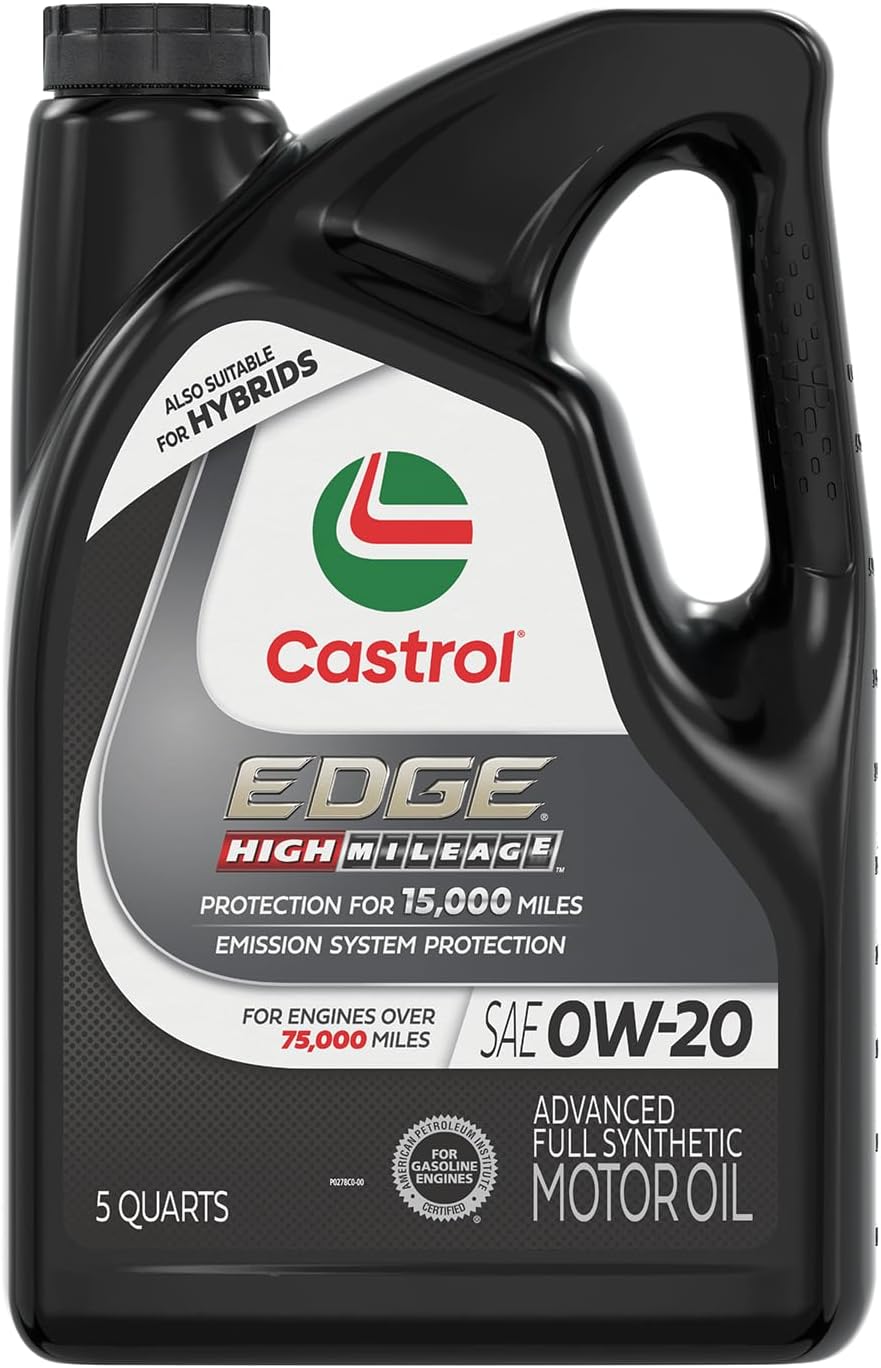
| SAE J300 Viscosity Grade | 0W-20 |
|---|---|
| Compatible with Vehicle Type | For vehicles with over 75,000 miles |
| Liquid Volume | 5 Quarts |
| Unit Count | 160.0 Fluid Ounces |
Castrol EDGE High Mileage 0W-20 is a full synthetic motor oil formulated for vehicles with more than 75,000 miles to help protect aging engines. In use it replaces conventional oil with a low-viscosity 0W-20 base to aid cold starts while including seal conditioners that can reduce leaks and additives aimed at controlling sludge and combustion deposits. The formula also advertises reduced oil burnoff and a phosphorus replacement technology intended to protect the emission system and catalytic converter. It is suitable for extended drain intervals up to 15,000 miles or one year when service requirements and vehicle manufacturer approvals allow. Limitations include the low viscosity choice, which may not suit older engines that prefer thicker oils, and extended change intervals should only be used when compatible with Nissan Rogue owner manual guidance and local driving conditions.
Best for: Buyers of a Nissan Rogue with high mileage who prioritize protecting seals, reducing oil consumption, and minimizing sludge for continued engine life. This is for owners willing to follow Nissan guidance on viscosity and drain intervals while seeking a specialized high-mileage formulation.
Less Ideal for: Drivers who prefer a thicker oil for older engines or those who follow Nissan service schedules that mandate different viscosity grades or shorter change intervals.
- Designed specifically for high-mileage engines with over 75,000 miles
- Seal conditioners help reduce leaks and oil seepage in aging engines
- Formulation targets sludge and deposit control to maintain engine cleanliness
- Phosphorus replacement technology to help protect the emission system and catalytic converter
- Low 0W-20 viscosity may be too thin for some high-mileage engines that run better on thicker oils
Verdict: Choose this high-mileage synthetic if your engine has significant mileage and you want seal conditioners, deposit control, and reduced oil consumption.
7. Nissan Genuine 0W-20 Oil Change Kit with Oil Filter
Best Genuine OEM Engine Oil

| SAE J300 Viscosity Grade | 0W |
|---|---|
| Viscosity Level | Low to Medium |
| Container Type | Bottle |
| Liquid Volume | 5 Quarts |
| Automotive Fit Type | Vehicle Specific Fit |
This Nissan genuine oil change kit supplies everything needed for a correct DIY service: five quarts of factory-formulated 0W-20 synthetic motor oil, a Nissan oil filter (15208-65F0E), and the copper drain washer. The 0W-20 grade meets ILSAC GF-5 and API SN specifications and is intended for modern Nissan cars that call for low-viscosity, fuel-efficient oil. Using the kit simplifies maintenance by matching Nissan's published specification and providing an OEM filter sized for their engines, which reduces compatibility guessing and the need to source parts separately. The oil's low-to-medium viscosity helps cold starts and can improve highway fuel economy in recommended engines, while the included filter and washer make the drain and filter change straightforward. Limitations are minimal for owners who require a different viscosity or aftermarket performance additives, since this is a factory-spec oil intended for standard service rather than racing or heavily modified engines.
Best for: DIY owners who prioritize using factory-specified fluids and want a single kit that supplies the correct oil, filter, and drain washer for a proper Nissan service.
Less Ideal for: Drivers seeking specialized performance oils, higher viscosity grades, or aftermarket additive packages should choose a different product tailored to those needs.
- Complete kit includes 5 quarts of 0W-20 oil, factory Nissan oil filter, and copper drain washer
- Oil meets ILSAC GF-5 and API SN specifications for modern Nissan engines
- Factory-formulated oil ensures compatibility with Nissan service requirements
- Low-viscosity 0W-20 helps cold-start protection and can aid highway fuel economy
- Not formulated for high-performance, racing, or heavily modified engines
Verdict: This genuine OEM synthetic is the pick for DIYers who want factory-specified oil and a complete oil-change kit for a correct service.
Choosing the Right Nissan Rogue Synthetic Engine Oil: Key Factors to Consider
Viscosity and Manufacturer Recommendations
Viscosity determines how the oil flows at cold start and under operating temperature and directly affects engine protection. For the Nissan Rogue, use the manufacturer-recommended viscosities as your starting point; selecting a mismatched weight can harm cold-start lubrication or increase friction at operating temperature. Thinner oils help fuel economy and cold flow but may offer less film strength under heavy loads, while thicker oils can protect against wear in high-temperature or high-mileage engines but might reduce efficiency.
When picking a synthetic oil, confirm the viscosity rating meets the Rogue's specs and the driving conditions you typically encounter. If you drive in very cold climates, prioritize low-temperature pumpability. For frequent highway driving or heavy loads, ensure the chosen viscosity maintains a robust lubricating film at high temperatures.
API and OEM Specifications
Industry and manufacturer specifications are the baseline for compatibility and warranty considerations. Look for oils that meet the relevant API service category and any Nissan-specific approvals referenced in the owner manual. These specs indicate the oil's basic performance level for wear protection, oxidation resistance, and deposit control.
Using an oil that lacks appropriate API or OEM ratings can leave an engine vulnerable to premature wear or sludge. For the Rogue, prefer oils that explicitly list compliance with modern API categories and note any approvals for Nissan engines or equivalent passenger-car specifications.
Base Oil Technology and Additive Package
Synthetic base stocks and the additive package determine an oil's resistance to oxidation, thermal breakdown, and deposit formation. Full synthetics typically offer superior high-temperature stability and lower volatility compared with conventional oils, which helps maintain performance over longer drain intervals. Additives such as detergents, dispersants, anti-wear agents, and friction modifiers affect how the oil protects bearings, pistons, and rings.
For the Rogue, favor oils with robust additive chemistry that emphasizes wear protection and deposit control while preserving seal compatibility. Also consider the oil's Total Base Number or similar indicators when selecting options for higher-mileage engines.
Cold-Start Performance
Cold-start protection is important for minimizing wear during the critical moments after engine start when oil is cold and has not yet circulated fully. Viscosity at low temperatures and how quickly the oil pumps through galleries affect this protection. Low-temperature performance matters more in colder climates, where thicker oils can delay lubrication.
Choose a synthetic that demonstrates strong low-temperature fluidity if you operate your Rogue in winter conditions or make many short trips. Improved cold-flow properties reduce metal-on-metal contact during warm-up and extend component life.
High-Temperature Stability and Oxidation Resistance
Engines run hot during highway driving and under load; oils that resist thermal breakdown and oxidation maintain lubricant film strength and avoid thickening or varnish formation. For a Nissan Rogue, which may spend significant time both in stop-and-go traffic and on open roads, oil that tolerates temperature swings preserves engine cleanliness and performance.
Select oils with proven thermal and oxidative stability to reduce sludge and varnish risk, which helps maintain compression and fuel efficiency over time.
Service Interval and Drain Recommendations
Different synthetic oils support different drain intervals based on their stability and contaminant-handling ability. While some full synthetics are formulated for extended drains, service schedules may still be constrained by driving style and operating conditions. For the Rogue owner, matching oil choice to realistic service intervals ensures protection without unnecessary risk.
Follow Nissan's recommended intervals as the baseline and consider extended-drain oils only if they meet the necessary specs and your driving patterns align with longer service intervals. Remember that severe-duty driving, frequent short trips, towing, or heavy urban traffic may call for shorter drains regardless of oil formulation.
Understanding Viscosity Labels for the Rogue
Viscosity numbers such as 0W-20 or 5W-30 describe how an oil behaves at cold start and at operating temperature. The first number with the W indicates low-temperature flow, which affects pumpability and cold-start protection. The second number reflects high-temperature viscosity, which relates to film strength when the engine is hot.
For Nissan Rogue engines, consult the owner manual to confirm acceptable viscosity ranges. Many owners balance fuel economy and protection by choosing the lower-viscosity oils recommended for modern engines, while others select slightly thicker options for higher-mileage engines.
- 0W-20: excellent cold-start flow and fuel economy
- 5W-30: better high-temperature film strength under load
Synthetic Oil Benefits for Everyday Driving
Synthetic oils offer more consistent molecular structure than conventional oils, which typically improves thermal stability and reduces volatility. For Nissan Rogue drivers who do a mix of city and highway driving, synthetics can reduce deposit formation and preserve engine performance over time.
Other practical benefits include better cold-start lubrication and often longer useful life between changes, though you should still follow service recommendations based on your driving conditions.
- Improved cold pumping
- Reduced sludge and varnish
- More stable viscosity over time
Choosing Oils for High-Mileage Rogues
High-mileage Rogues may show increased oil consumption, seal wear, and clearances that affect oil pressure. Oils formulated for higher-mileage engines typically include conditioners that help preserve seals and reduce leaks while providing stronger wear protection.
If your Rogue has substantial mileage, prioritize an oil that emphasizes seal compatibility and sustained film strength. Monitor consumption and leaks after switching oils and adjust service intervals accordingly.
- Look for seal conditioners and anti-wear additives
- Expect slightly different consumption characteristics
Oil and Fuel Economy Tradeoffs
Choosing a lower-viscosity synthetic can improve fuel economy by reducing internal friction, which is attractive for daily commuting in a Rogue. However, the lowest-viscosity oils may sacrifice some high-temperature film strength, potentially affecting protection under sustained high-load driving.
Balance your priorities: if maximizing miles per gallon is the main goal, use the lower viscosity recommended by Nissan. If you frequently drive at higher speeds or carry heavier loads, consider an oil that offers a stronger high-temperature film.
- Lower viscosity increases fuel efficiency
- Higher viscosity improves high-temp protection
Preparing for an Oil Change on a Rogue
Before an oil change, verify the correct oil viscosity and API ratings for your Rogue's engine. Use a new filter matched to the vehicle and follow the manufacturer torque specs for drain plug and filter installation to avoid leaks. Dispose of drained oil responsibly according to local regulations.
Record the date and mileage at each change to maintain a dependable maintenance history. If you change oil yourself, warm the engine slightly for easier draining but avoid working on a hot engine to reduce burn risk.
- Confirm viscosity and spec compliance
- Use a proper filter and follow torque specs
- Log service date and mileage
Still looking for the perfect fit?
Select your Nissan Rogue configuration to see the most relevant Engine Oils recommendations
How We Chose the Best Nissan Rogue Synthetic Engine Oil
We shortlisted oils that meet Nissan Rogue factory specifications and real-world owner needs, then applied editorial filters to narrow the list to the seven top choices. Selection criteria included viscosity fit for typical Rogue engines, API and OEM specs compliance, base oil type and additive chemistry, protection against wear and deposits, cold-start flow and high-temperature stability, and suitability for extended drain intervals or high-mileage use.We prioritized oils that offer demonstrable film strength and deposit control relevant to the Rogue's variable driving patterns, including city commuting and highway cruising. Another key filter was compatibility with common service intervals and recommended viscosities for the Rogue's engines. Oils that rely on ambiguous or proprietary claims without clear spec backing were excluded. We also excluded conventional-only formulations and products lacking performance claims tied to recognized industry standards.In short, our picks reflect a balance of spec compliance, thermal and shear stability, friction control, and real-world serviceability for Nissan Rogue owners.
Our full evaluation process is outlined in our review methodology.
FAQ
Can I switch between 0W-20 and 5W-30 in my Nissan Rogue?
It depends on the engine and the owner's manual recommendations. Switching can be acceptable if both viscosities are listed as approved, but consider climate and operating conditions because thicker oils perform differently at cold start and high temperature.
How often should I change synthetic oil in a Rogue?
Follow Nissan's recommended intervals as your baseline. Many synthetic oils safely extend intervals, but driving conditions like frequent short trips or heavy traffic often require shorter service intervals regardless of oil type.
Is synthetic oil better for high-mileage Rogue engines?
Synthetic oils generally offer better stability and deposit control, which can benefit higher-mileage engines. Consider formulations labeled for high mileage for added seal conditioning and wear protection.
Will using synthetic oil affect my fuel economy?
Yes, using a lower-viscosity synthetic often reduces internal friction and can improve fuel economy. The effect is modest but measurable, especially if you switch from a heavier conventional oil to a modern synthetic.
Are there any risks to using synthetic oil in a Rogue?
Risks are low when using oils that meet the proper API and manufacturer specifications. Problems arise when using incorrect viscosities or oils that lack necessary performance approvals, which can increase wear or lead to leaks in older engines.
Can I extend drain intervals after switching to synthetic oil?
Some synthetic oils are formulated for longer drains, but extending intervals should be based on oil specifications, driving habits, and Nissan's guidance. Heavy-duty operating conditions usually warrant standard intervals regardless of oil type.
Final Verdict
Prioritize oils that meet Nissan's viscosity and specification requirements while balancing cold-start performance, high-temperature protection, and service interval expectations. For most Rogue owners, a modern full synthetic that matches the recommended viscosity will offer the best mix of protection and efficiency. If your Rogue has high mileage or you drive in extreme temperatures, select a formulation that emphasizes seal care or low-temperature flow accordingly.
Explore More:
- Check out all Nissan Rogue parts & accessories
- Explore Fluids & Chemicals
- Browse all Accessories
