

Note: This article contains affiliate links. If you click on these links and make a purchase, I may earn a small commission at no extra cost to you. This helps support my research and content. Read my full affiliate disclosure here.
If you own a 1996-2000 Honda Civic, selecting the right brake calipers matters for safety, pedal feel, and long-term reliability. Worn or leaking calipers can cause uneven pad wear, pulling, and reduced braking power, so choosing replacements built to the correct specifications keeps the car predictable on the street.This guide covers seven top caliper options that match the 1996-2000 (EJ, EK, and EM) Civic chassis fitment and mounting geometry. We shortlisted units that address fit accuracy, corrosion resistance, and hydraulic performance, and we evaluate bleedability and rebuild potential as part of the selection. Read on to see which types of calipers and service approaches best suit your Civic and driving priorities.
Looking for other parts? See all Honda Civic parts & accessories.
Top Picks at a Glance
| Best Overall The best all-around choice for most situations | Vipcar Front Disc Brake Caliper Pair with Bracket (No Pads) |  |
| Best Quality Built to a higher standard if you want something more solid | PowerStop Front Red Powder-Coated Brake Caliper Pair (S1379) |  |
| Best Value The sweet spot between price and what you get | Torchbeam Front Brake Caliper Set (left and right) for 1996–2011 Honda Civic and select Insights |  |
| Best Budget The cheapest option that still gets the job done reliably | SCITOO Front Disc Brake Caliper (Front Right) — Replacement for Honda/Acura Fitments |  |
| Highest Rated A top-rated pick with lots of positive feedback | KAX Disc Brake Caliper Assembly for Honda Civic (Front Right) |  |
| Most Popular A crowd favorite that many people choose with confidence | Detroit Axle Front Disc Brake Calipers with Brackets — 2‑Piece Set |  |
| Best Seller A high-volume bestseller chosen again and again | Detroit Axle Front Brake Calipers with Brackets, 2-Pack | |
1. Vipcar Front Disc Brake Caliper Pair with Bracket (No Pads)

| Fitment | Acura EL 1997–2000; Honda Civic 1996–2011; Insight 2010–2014 |
|---|---|
| Caliper Type | Floating, cast iron |
| Piston | 1 piston, 53.9 mm diameter |
| Bleeder Screw | M10 × 1 |
| Bracket Hole Size | 12 mm, thread pitch 1.25 mm |
These Vipcar front brake calipers are a direct-replacement, two-piece set intended to restore front braking on compatible Acura and Honda cars. They are cast iron, single-piston floating calipers supplied with mounting brackets and use a 53.9 mm piston for conventional hydraulic braking. Typical use is straightforward: swap the old, seized, or damaged calipers for these units, bleed the system, and reuse or replace brake pads separately. Notable features include a precision piston design aimed at even braking force and bracket-matched mounting holes that simplify installation. The calipers are semi-loaded, so buyers must budget for pads and possible hardware. Materials and machining promise durability and stable braking, but the kit does not include pads or specific hardware like new bleeder caps or guide pins, so expect a short additional parts list and some installation time. For a balanced buyer looking to fix front brakes without upgrading to performance calipers, this set offers a practical, factory-style replacement that focuses on reliability rather than performance enhancements.
Best for: Buyers who want a straightforward, factory-style front caliper replacement to restore consistent braking on older Civics and similar Hondas without moving to performance parts.
Less Ideal for: Do not choose this if you want a performance upgrade, a full rebuild kit with pads and hardware included, or a lightweight alloy competition caliper.
- Cast iron floating design matches standard factory braking behavior
- Includes driver and passenger calipers plus mounting brackets for direct replacement
- Precision 53.9 mm piston aiming for even force distribution and reduced vibration
- Brake pads and some small hardware are not included so additional purchases may be required
Verdict: A reliable, factory-style front caliper pair that restores consistent braking on compatible older Honda and Acura models when you need a balanced, no-frills replacement.
2. PowerStop Front Red Powder-Coated Brake Caliper Pair (S1379)

| Fits | Honda CRX 1990-1991; Civic 1990-2000; Civic del Sol 1993-1997 |
|---|---|
| Orientation | Front |
| Included Components | Set of Calipers, Hardware |
| Manufacturer Warranty | 90 Day / 3,000 Mile Warranty |
These PowerStop front calipers are a bolt-on upgrade aimed at Civic-era Hondas that need either a direct replacement or a visual performance boost. They arrive pressure tested with seals, guide pins, dust boots, bleeder screws, mounting brackets, and pad attachment hardware so a single purchase covers the main installation needs. The red high-temperature powder coat resists rust and keeps the calipers looking fresh under wheel exposure, and several user reports note improved pedal feel after installation. Fitment is vehicle-specific for 1990–2000 Civics, CRX, and del Sol, so no modification is typically required. Quality control appears mixed: many buyers had straightforward installs, but others reported bracket fit issues, paint chipping from shipping, or a stuck piston that required attention. PowerStop includes a 90-day/3,000-mile warranty and targets drivers who want a combination of refreshed stopping performance and upgraded looks rather than a race-only caliper. Have a professional perform installation and bleeding if you are not experienced, and inspect brackets and pistons on receipt to avoid fitment surprises.
Best for: Buyers who want a direct-fit front caliper replacement for 1996–2000 Civic platforms that also improves the car's appearance and pedal response, prioritizing a practical performance upgrade over track-only hardware.
Less Ideal for: Those seeking heavy-duty racing calipers or a full big-brake conversion should look at purpose-built performance kits and motorsport-grade components instead.
- Direct bolt-on fit for 1990–2000 Honda Civic, CRX, and del Sol applications
- Comes with complete caliper hardware to simplify installation
- High-temp red powder coat improves corrosion resistance and appearance
- Calipers are pressure tested and inspected before shipping
- Some customers reported inconsistent fitment or bracket machining issues requiring modification
- Occasional cosmetic chipping from shipping and at least one report of a stuck piston on delivery
Verdict: A complete, vehicle-specific front caliper pair that gives 1996–2000 Civics a direct-fit braking upgrade with improved looks and straightforward installation.
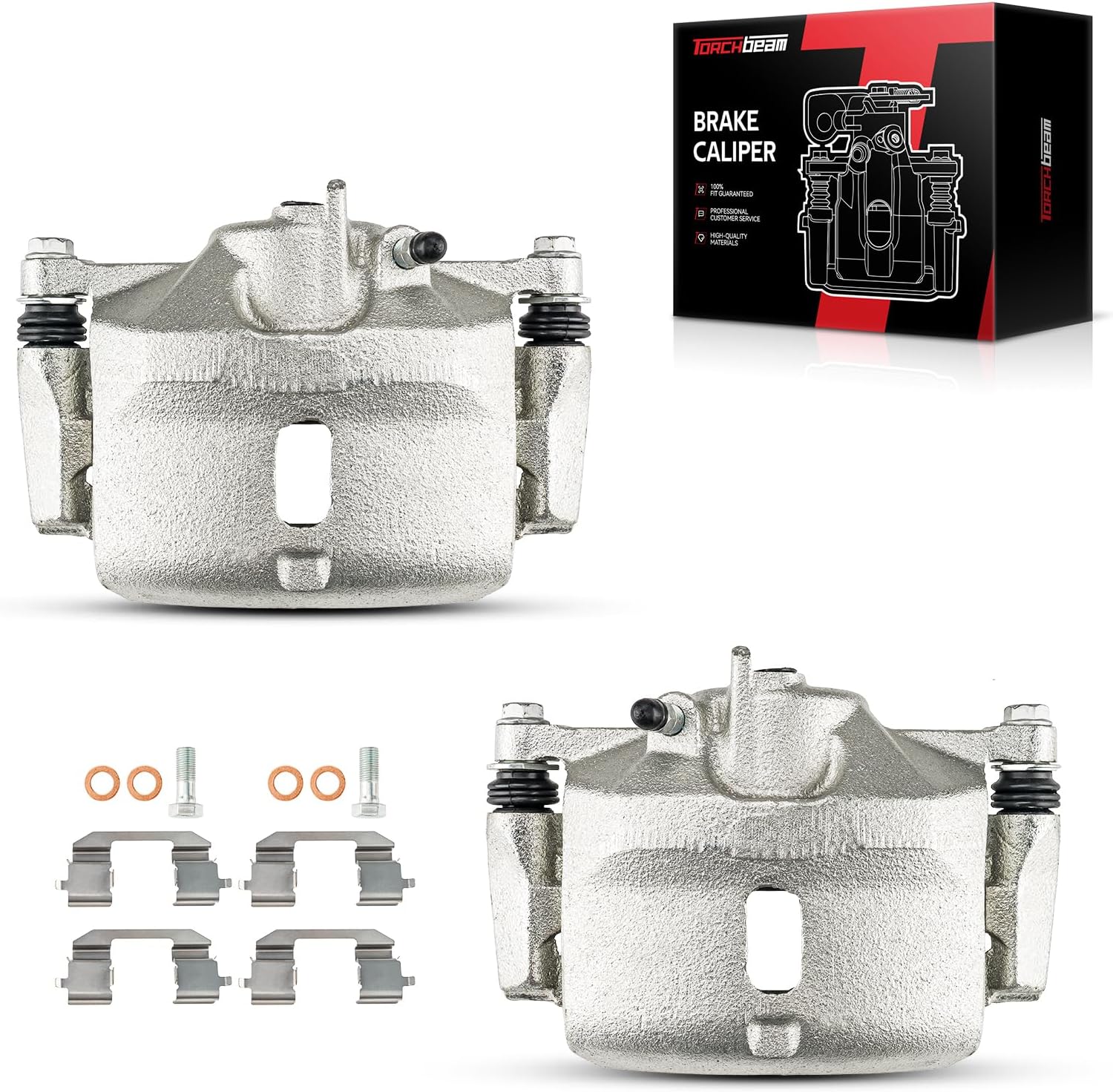
3. Torchbeam Front Brake Caliper Set (left and right) for 1996–2011 Honda Civic and select Insights
| Position | Front |
|---|---|
| Piston material | Steel |
| Number of pistons | 1 |
| Exhaust port size | M10x1.0 |
| Piston OD-IN | 2.12 |
This Torchbeam caliper set replaces the front left and right calipers on compatible Honda Civic and Insight years and is sold as a complete assembly with brackets and mounting hardware. It uses a single steel piston design with a 2.12 inch piston diameter and M10x1.0 bleed port, so installation is straightforward for a routine brake rebuild or axle-side caliper replacement. The package includes mounting hardware and metal pistons which helps speed installation and avoids sourcing extra parts. In practice the polished finish looks factory-quality and the construction appears aimed at everyday driving rather than performance braking. Buyers should note it is a single-piston, non-upgrade design, so it matches factory stopping force but will not improve heat tolerance or pedal feel compared with multi-piston performance calipers. Torchbeam offers a one-year unlimited-mileage guarantee which provides reassurance for a practical repair. Expect this set to be a direct, budget-friendly replacement when restoring stock braking function on older Civics and Insights.
Best for: Buyers who want a straightforward, cost-conscious replacement to restore factory braking on older Honda Civics or Insights and prefer assemblies that include hardware to simplify installation.
Less Ideal for: Drivers seeking upgraded stopping power, track use durability, or multi-piston performance calipers should consider performance-oriented options instead.
- Sold as complete left and right front caliper assemblies with brackets and mounting hardware included
- Single steel piston with 2.12 inch piston diameter matches factory-style operation
- Includes metal piston and M10x1.0 bleed port for standard brake-bleeding and compatibility
- Polished finish and full assemblies simplify a like-for-like brake repair
- Single-piston design does not offer performance improvement over factory multi-piston upgrades
Verdict: A practical, budget-friendly pair of front replacement calipers that restores factory braking with included hardware for an easy, like-for-like repair.
4. SCITOO Front Disc Brake Caliper (Front Right) — Replacement for Honda/Acura Fitments

| OEM Part Number | 19B1833 |
|---|---|
| Bleeder Port Size | M10 x 1-6H |
| Inlet Port Size | M10 x 1-6H |
| Piston Count | 1 Piston |
| Piston Material | Iron |
This SCITOO front right disc brake caliper is a direct-fit replacement made to match factory mounting and hydraulic ports for compatible Acura and Honda Civic years. It installs like a standard caliper during a brake job and is used to clamp pads against the rotor to stop the vehicle. Notable features include a single iron piston, M10 inlet and bleeder ports, a zinc high-temperature coating to resist corrosion, and an included bracket for bolt-on installation. For a budget repair this caliper offers practical value: the factory-style piston and coating aim to deliver several seasons of reliable braking at a low cost, and the preinstalled slide-pin boots and seals are intended to reduce squeal and sticking. Limitations are typical of economy aftermarket parts: surface finish and dimensional tolerances can vary so careful inspection and test-fit are recommended, and professional installation or proper bleeding is important to restore safe braking feel. This is a sensible replacement when you need an affordable, functional caliper for routine maintenance or repair.
Best for: Buyers repairing a compatible Honda or Acura on a limited budget who want a low-cost, factory-style replacement that restores braking function without upgrading components.
Less Ideal for: Drivers seeking high-performance or heavy-duty calipers for track use or towing should consider premium or performance-oriented options instead.
- Direct-fit design with bracket and M10 inlet/bleeder ports for straightforward bolt-on replacement
- Zinc high-temperature coating to reduce corrosion and extend service life
- Factory-style single iron piston construction for predictable braking feel
- Includes preassembled slide-pin boots and seals to help prevent piston sticking and reduce noise
- As an economy aftermarket part, finish and tolerances may vary so pieces should be inspected before installation
- Sold as a single caliper so buyers replacing both sides will need to purchase two units
Verdict: A straightforward, budget-friendly front right replacement caliper that restores factory braking function for compatible Honda and Acura models.
5. KAX Disc Brake Caliper Assembly for Honda Civic (Front Right)

| Position | Front Right |
|---|---|
| Model | 6DBC2150 |
| Manufacturer Part Number | 7997DBC2151US |
| OEM Part Number | 45018S01A00, 45018SNAA60, 45018SNEA10, 19B1833, 45022S01A01, 45022S01A02, 45022S5DA00 |
This KAX disc brake caliper assembly is a direct replacement designed to match factory fit and restore braking performance on the specified Honda Civic and Insight models. It ships as a complete caliper assembly with a phenolic piston and installation hardware so hobbyists and mechanics can swap it in without sourcing extra parts. The unit is pressure tested during manufacturing, which suggests reliable sealing and reduced chance of leaks after installation. In real-world use it should bring back firm pedal feel and normal rotor contact when paired with proper pads and a clean brake system. The caliper is offered for a specific front side and comes with a polished exterior finish, so it looks tidy under the wheel. Keep in mind this listing is a caliper without pads installed, so you will need pads and possibly a brake fluid bleed to complete the job. Also confirm exact side and reference numbers against your vehicle before ordering to avoid fitment errors.
Best for: Buyers who prioritize long-term, factory-style replacements and want a pressure-tested caliper that restores original braking feel on the covered Honda Civic and Insight years.
Less Ideal for: If you need a full brake service kit with pads, rotors, or prefer performance-upgrade calipers, this single replacement caliper is not the complete solution.
- Complete caliper assembly includes phenolic piston and installation hardware for easier swap-in
- Manufacturing pressure testing reduces risk of leaks and improves initial reliability
- Engineered to match original fitment references for direct replacement on listed Honda Civics
- Does not include brake pads so pads must be purchased separately
Verdict: Choose this pressure-tested, factory-match caliper when you want a dependable, direct replacement to restore braking performance on the covered Honda Civic years.
6. Detroit Axle Front Disc Brake Calipers with Brackets — 2‑Piece Set

| Position | Front Left & Right |
|---|---|
| Piston Size | 2.12 inch (53.85 mm) |
| Piston Material | Steel |
| Brake Caliper Bracket Included | Yes |
These Detroit Axle front calipers are a full replacement pair supplied with brackets for direct swap-in on the Civic model years listed. Each unit uses a single 2.12 inch steel piston and arrives with mounting hardware so you can replace both left and right calipers at once. In practice they install like factory-style components and reviewers report OEM-like fit and smooth, powerful braking after installation. The included brackets simplify a rotor-and-pad refresh because you do not need to transfer parts from the old assembly. Expect standard work during installation: unbolt the old calipers, mount the new brackets and calipers, then bleed the system thoroughly to remove air and ensure ABS operation. A small number of buyers noted bracket fitment issues on non-listed vehicles and occasional differences in bleeder screw sizes, so double-check fitment and have common brake tools on hand. For routine brake replacement on the listed Civic years these calipers offer a near-factory replacement without needing reman units.
Best for: Buyers who prioritize verified fitment and peer-reviewed reliability for a straightforward front-caliper refresh on the specified Honda Civic years and want a complete pair with brackets included.
Less Ideal for: Drivers who need a custom or performance-calibrated caliper or who are working on vehicles not explicitly listed should look for application-specific parts or consult a parts specialist.
- Comes as a matched left and right pair with mounting brackets and hardware for a complete front caliper replacement
- Uses a 2.12 inch steel piston designed to deliver strong, factory-style stopping power
- Many users report OEM-like fit and smooth operation after installation
- Undergoes impact, wear, and fatigue testing and includes a long warranty period
- Bracket fit may not be correct for vehicles outside the listed compatibility and could require re-using original brackets
- Bleeder screw sizes can differ between left and right units compared to some factory calipers
Verdict: A complete, reviewed replacement pair that closely matches factory performance and fit for the listed Honda Civic front brake applications.
7. Detroit Axle Front Brake Calipers with Brackets, 2-Pack
| Position | Front Left and Right |
|---|---|
| Piston Size | 53.8 mm (2.12 in.) |
| Piston Material | Steel |
| Quantity Included | 2 calipers with brackets |
These Detroit Axle front brake calipers are a direct replacement set sold as two units with mounting brackets, intended for specified Honda Civic model years and the Insight. They use a single 53.8 mm steel piston per caliper and include the caliper brackets so installation replaces both the caliper and carrier hardware in one job. In real-world use this kit returns braking function after a seized or leaking caliper and is suited to routine repairs on daily drivers. The steel piston suggests good heat resistance and the included brackets save time sourcing separate carriers. Expect standard bolt-on installation using common hand tools and a brake bleed afterward. Limitations: the calipers come without pads or hoses so you must transfer or buy those separately, and steel pistons can be heavier than aluminum options. For a buyer focused on a reliable, factory-style replacement, these calipers cover the basic needs without performance upgrades.
Best for: Drivers seeking a dependable, factory-style replacement caliper set for routine maintenance or to repair a leaking or seized front caliper on the listed Civic and Insight years.
Less Ideal for: Shoppers wanting lightweight performance upgrades, a complete brake refresh including pads and hoses, or a caliper engineered specifically for track use should look elsewhere.
- Sold as a matched pair with brackets for both front wheels, simplifying replacement.
- Single 53.8 mm steel piston per caliper offers durable, heat-resistant operation.
- Includes caliper brackets so you can replace carrier hardware in one service visit.
- Fits the specified Honda Civic model years and Insight models listed, making fitment straightforward.
- Does not include brake pads or hoses, so additional parts may be required.
- Steel pistons are heavier than some aftermarket aluminum options, which may slightly increase unsprung weight.
Verdict: A straightforward, factory-style paired front caliper kit that restores reliable braking for the listed Honda Civic and Insight models.
Choosing the Right 1996-2000 Honda Civic Brake Calipers: Key Factors to Consider
Fitment and Mounting Geometry
Exact fit matters more than marketing claims. For the 1996-2000 Civic, caliper bolt spacing, bracket interface, and piston diameter must match the chassis to maintain proper pad contact and parking brake linkage function.
If a caliper uses different mounting ears or piston size, it can change pad sweep and braking balance, leading to uneven wear or pulling. Verify OEM-style mounting points and hose inlet orientation to avoid clearance issues with suspension components or dust shields.
Piston Type and Seal Design
The piston material and seal architecture influence responsiveness and leak resistance. Single-piece steel pistons resist high heat but can corrode; aluminum pistons reduce weight but require robust sealing.
Seal design determines how well a caliper recovers after travel and resists contamination. Look for calipers with two-stage dust boots and reliable primary seals to minimize the chance of leaks and sticking, which are common symptoms on older Civics.
Corrosion Resistance and Surface Treatment
Exposure to moisture and road chemicals accelerates surface corrosion, which can seize slide pins or freeze pistons. Calipers with zinc plating, ceramic coatings, or high-quality paint finishes will maintain function longer on a 1996-2000 Civic.
Corrosion resistance also affects bolt threads and bleeder valves. Better-treated units reduce the risk of rounded bleeders and make future maintenance, like pad changes or brake fluid flushes, easier.
Rebuildability and Parts Availability
For an older vehicle, the ability to rebuild a caliper can be more economical than repeated replacements. Check whether standard rebuild kits for the Civic are available, including seals, dust boots, guide pins, and bleeder screws.
Accessibility of replacement parts affects long-term ownership costs and downtime. Calipers designed to accept widely available rebuild kits simplify maintenance and extend service life on the EJ, EK, and EM chassis.
Hydraulic Performance and Bleedability
How easily a caliper bleeds and how it responds to pressure matter for pedal feel and brake system health. Units with well-placed bleeder valves and clear fluid channels are less likely to trap air and cause spongy brakes.
Evaluate caliper design for even piston retraction and consistent pressure distribution across the pad face. Poor hydraulic flow can produce grabby or inconsistent braking, which affects stopping confidence.
Mounting Hardware and Brake Line Compatibility
Inclusive mounting hardware and compatible brake line fittings reduce installation complexity. Confirm whether the caliper comes with guide pins, anti-rattle clips, and correct banjo bolt or hose fittings for the 1996-2000 Civic.
Using incorrect hardware can introduce alignment problems or leaks. Matching the original hose fitting and torque specifications helps maintain a safe, leak-free brake system.
Front Versus Rear Caliper Considerations
Front and rear calipers serve different roles on the Civic. Front calipers handle most of the braking load and are typically larger, so material and cooling characteristics are more critical up front. Rear calipers often integrate parking brake mechanisms, so pay attention to lever geometry and cable attachment if applicable.
When replacing calipers, treating front and rear sets differently makes sense only if the other axle is known to be in good condition. Mismatched caliper response between axles can change pedal travel and ABS behavior, so matching build quality between front and rear helps maintain balanced stops.
- Front calipers: prioritize piston size, pad contact area, and heat dissipation.
- Rear calipers: verify parking brake linkage compatibility and lever return action.
- Replace mounting hardware when corroded to ensure smooth slide pin movement.
Remanufactured Units Versus New-Production Calipers
Remanufactured calipers can be a cost-effective route for a 1996-2000 Civic when the core was properly restored. Look for remanufactured units that replace seals, pistons if needed, and recoat surfaces to resist corrosion. Quality remanufacturing restores original dimensions and often uses updated materials for longevity.
New-production calipers eliminate unknown wear on the core but vary in manufacturing quality. Inspect finish, machining tolerances, and whether the unit includes modern protections such as improved plating. Either option can be appropriate provided fitment and rebuild parts are verified.
- Remanufactured: check for replaced seals, new bleeders, and a durable finish.
- New-production: verify machining quality and included hardware.
Signs You Need Caliper Service or Replacement
Recognizing caliper symptoms early can prevent rotor or pad damage. Common signs include uneven pad wear, dragging or reduced fuel economy from a sticking caliper, brake fluid leaks near the wheel, and a soft or spongy pedal after sitting. Thermal discoloration on the rotor after a short drive can indicate a seized piston or slide pin.
Addressing symptoms promptly on a 1996-2000 Civic helps avoid more expensive repairs. Sometimes a rebuild with seals and pins corrects problems, while in other cases a full caliper replacement is the safer long-term choice.
- Uneven pad wear across the surface
- Car pulls to one side during braking
- Brake fluid pooling or visible leaks near caliper
- High or uneven rotor temperatures after light driving
Installation Tips Specific to 1996-2000 Civic (EJ, EK, and EM)
When installing calipers on the EJ, EK, and EM chassis, clean the mounting surface and inspect guide pin bores for corrosion. Replace rubber boots and slide pins if they show pitting. Use the correct torque on caliper mounting bolts and bleeder screws to avoid thread damage.
Bleed the system starting at the caliper farthest from the master cylinder and use a firm partner or a pressure bleeder. Check hose orientation and ensure no hose twisting or kinking occurs during suspension travel. After installation, bed-in new pads with progressive stops to seat material evenly.
- Clean mounting faces and apply anti-seize sparingly where specified
- Replace guide pin boots and lubricate pins with high-temp brake grease
- Bleed brakes thoroughly and torque bleeders to spec
Maintenance Practices to Extend Caliper Life
Regular brake fluid changes and periodic inspection of slide pins reduce the likelihood of stuck calipers. Every brake service, remove and inspect calipers for leaks, degraded dust boots, and smooth piston movement. Keep bleeder valves free of rust and replace any corroded hardware.
Storing the vehicle for extended periods benefits from a brake exercise routine to prevent corrosion buildup. In corrosive climates, consider corrosion-resistant coatings and perform inspections more frequently to catch issues early.
- Flush brake fluid at manufacturer-recommended intervals
- Inspect dust boots and guide pins during pad changes
- Address surface rust quickly to prevent seizure
Still looking for the perfect fit?
Select your Honda Civic configuration to see the most relevant Brake Calipers recommendations
How We Chose the Best 1996-2000 Honda Civic Brake Calipers
We focused on practical, vehicle-specific criteria that matter to owners of 1996-2000 Honda Civic models. First, fitment accuracy and mounting geometry were prioritized to ensure bolt pattern, piston size, and hose inlet location match the EJ, EK, and EM chassis specifications. Second, materials and corrosion protection were evaluated to assess long-term serviceability in regions with road salt or humid climates. Third, piston and seal design were considered since these affect pedal feel, leakage risk, and ease of bleeding. Fourth, rebuildability and parts availability were weighed, including whether common seal kits and hardware are accessible. Fifth, we looked at warranty and manufacturing controls as proxies for quality assurance.We excluded options that required nonstandard vehicle modifications, bracket changes, or adapter kits because they complicate installation and can affect brake balance. Units that lacked clear replacement parts or had inconsistent documentation were also filtered out. The end result is a group of caliper choices that balance correct fitment, durability, and serviceability for the 1996-2000 Civic.
Our full evaluation process is outlined in our review methodology.
FAQ
How do I tell if a caliper is sticking on my Civic?
Common indicators include uneven pad wear, a dragging sensation while driving, higher-than-normal rotor temperatures, or the car pulling to one side when braking. You may also notice reduced fuel economy if a caliper stays slightly engaged.
Can I rebuild a seized caliper on a 1996-2000 Civic?
Often you can rebuild a seized caliper if the piston and bore are not severely corroded. Rebuild kits with seals, dust boots, and hardware are commonly available, but replacement is preferable when the bore is pitted or machining tolerances are compromised.
Should I replace front and rear calipers at the same time?
It depends on condition. If only one caliper shows symptoms and the opposite side components are in good shape, you may replace just the failed unit. However, replacing matched axles at the same time helps maintain balanced braking and consistent pedal feel.
What are the typical causes of brake fluid leaks at the caliper?
Leaks are usually due to failed piston seals, damaged bleeder screws, or compromised hose fittings. Corrosion around the piston bore or worn seals from old fluid also contribute. Regular inspection and timely fluid changes reduce leak risk.
Is a remanufactured caliper a safe option for an older Civic?
Yes, remanufactured calipers can be safe if the reman process replaces seals, bleeders, and any worn components and applies corrosion protection. Confirm that a reputable remanufacturer restored critical dimensions and included necessary hardware.
How often should I inspect calipers on a 1996-2000 Civic?
Inspect calipers at every pad change or at least once a year. Pay particular attention to dust boots, slide pins, and signs of leakage. In regions with heavy road salt, increase inspection frequency to catch corrosion early.
Final Verdict
When choosing brake calipers for a 1996-2000 Honda Civic, prioritize correct fitment and corrosion resistance to preserve braking balance and reduce future maintenance. Decide between rebuilding a well-preserved core or installing a new or remanufactured unit based on bore condition and parts availability. Finally, factor in bleedability and hardware completeness to avoid installation headaches.Focus on matching piston size and mounting geometry for the EJ, EK, and EM chassis, and keep a routine maintenance plan to catch early symptoms. That approach will deliver predictable braking performance and minimize surprise repairs.
Explore More:
- Check out all Honda Civic parts & accessories
- Explore Brake Calipers Maintenance & Repair Guides
- Explore Brake System
- Browse all Auto Parts
