

Note: This article contains affiliate links. If you click on these links and make a purchase, I may earn a small commission at no extra cost to you. This helps support my research and content. Read my full affiliate disclosure here.
If you drive a 2009–2014 Ford F-150, a failing catalytic converter affects emissions, drivability, and can trigger a persistent check engine light. Picking the right replacement matters because fitment, substrate type, and emission performance determine whether the truck returns to reliable operation and legal exhaust standards. This guide focuses on direct-fit catalytic converters sized and routed for the 2009–2014 F-150 chassis, and it covers the top shortlisted options that meet common owner needs.Below you will find the selected converters and a clear explanation of how we evaluated fit, emissions effectiveness, durability, and installation considerations. Use the sections that follow to match a converter to how you use your truck and to prepare for replacement or inspection.
Looking for other parts? See all Ford F-150 parts & accessories.
Top Picks at a Glance
| Best Overall The best all-around choice for most situations | Walker Ultra Direct-Fit Catalytic Converter 53904 |  |
| Best Quality Built to a higher standard if you want something more solid | MagnaFlow OEM Grade Direct-Fit Catalytic Converter (Right) 52418 |  |
| Best Value The sweet spot between price and what you get | ABysmauto Direct-Fit Catalytic Converter for 5.4L Ford F-150 / Expedition / Lincoln Navigator |  |
| Best Budget The cheapest option that still gets the job done reliably | Auto Dynasty Left-Side Front Catalytic Converter Exhaust Manifold (EPA Compliant) |  |
| Highest Rated A top-rated pick with lots of positive feedback | Walker Ultra 50567 Direct-Fit Catalytic Converter for 2009-2014 Ford F-150 |  |
| Most Popular A crowd favorite that many people choose with confidence | KAX Stainless Steel High-Flow Catalytic Converter for F-150 2009–2010 (5.4L) |  |
Walker Ultra Direct-Fit Catalytic Converter 53904

| Fits | 2009-2014 Ford F-150, Expedition, Lincoln Navigator |
|---|---|
| Inlet/Outlet | 3" inlet 2.5" outlet |
| Vehicle type | OBDII 1996 and newer compatibility |
| Part number | 53904 |
The Walker Ultra 53904 is a direct-fit catalytic converter built to replace the factory unit without welding or heavy modification. It is intended for 2009–2014 Ford F-150, Expedition and Lincoln Navigator applications and installs using OE-style hangers, flanges and heat shields for a near-factory fit. Walker specifies an EPA-compliant catalyst with a factory-style washcoat and precious metal load to restore emissions control and clear check-engine codes on compatible OBDII vehicles. Durable-feeling flanges, brackets and aluminized heat shields help protect underbody components and simplify installation. Several owners report straightforward fitment and resolved emissions faults, though long-term durability appears mixed in some reviews. Expect a practical, lower-cost replacement that returns emissions performance and fitment close to factory; if absolute longevity is your top priority, monitor condition and source professional installation to ensure proper exhaust sealing.
Best for: Buyers wanting a straightforward, factory-replacement style converter that restores emissions function and fitment without fabrication, prioritizing reliable fit and emissions compliance over an OEM-branded price tag.
Less Ideal for: If you need a long-term high-mileage factory lifetime solution for intensive commercial use or extreme offroad conditions, consider higher-end or dealer-sourced alternatives and specialist installations.
- Direct-fit design with OE-style hangers and flanges for bolt-on installation
- EPA-compliant catalyst formulation aimed at meeting emissions requirements on OBDII vehicles
- Aluminized heat shields and reinforced brackets for improved underbody protection and installation strength
- Factory-style washcoat and precious metal loading to restore emissions control and clear related fault codes
- Some customers report limited longevity, so lifespan may vary compared with dealer parts
Verdict: A practical, EPA-compliant direct-fit replacement that restores emissions control and fitment for 2009–2014 Ford trucks without fabrication.
MagnaFlow OEM Grade Direct-Fit Catalytic Converter (Right) 52418

| Material | Stainless Steel |
|---|---|
| Main Piping Diameter | 3" |
| Type | Direct-Fit |
| Oxygen Sensor Location | Pre-Converter and Midbed |
| Series | OEM Grade |
This MagnaFlow OEM Grade direct-fit catalytic converter replaces the factory unit on right-side exhausts for compatible Ford trucks and is built to meet Federal EPA emissions standards. It uses a spun stainless steel body, mandrel-bent 3" piping, and factory-style O2 sensor ports so installation can be bolt-on with the included hardware and without cutting or welding. The ceramic substrate and OEM-grade construction are intended to maintain emissions compliance while offering a lower-mass design for improved thermal efficiency. For a performance-minded buyer the free-flowing internal design helps reduce backpressure compared with many restrictive factory converters, which can free up a modest amount of low-end response when combined with other exhaust upgrades. Note that this unit is not legal for sale in some states and is sold specifically as a federal/EPA compliant replacement, so check local regulations. The direct-fit approach makes it suitable for DIY installation when you have basic tools and a lift or jack stands.
Best for: Buyers focused on restoring or improving exhaust flow on compatible Ford trucks who want a factory-quality direct replacement that maintains emissions compliance while allowing modest performance gains when paired with other exhaust upgrades.
Less Ideal for: Drivers in states with stricter emissions rules or anyone needing a California-compliant converter should look for a certified local option instead.
- Direct-fit design with factory-style O2 ports and included hardware for bolt-on installation
- Stainless steel spun body and mandrel-bent 3" piping for corrosion resistance and improved flow
- Federal EPA compliant construction to meet emissions requirements outside restricted states
- OEM-grade manufacturing from 3D scanning for close fit and reduced leak risk
- Not legal for use or sale in California, Colorado, and New York
- Only the right-side converter is provided, so full exhaust replacements require purchasing additional pieces
Verdict: A factory-quality direct-fit replacement that restores emissions compliance while improving exhaust flow for performance-focused F-150 owners outside restricted states.
ABysmauto Direct-Fit Catalytic Converter for 5.4L Ford F-150 / Expedition / Lincoln Navigator

| Brand | ABysmauto |
|---|---|
| Manufacturer Part Number | FDED018Y-019Y |
| Fits Engines | 5.4L |
| Vehicle Fitment | Ford Expedition 2007-2014, F-150 2009-2010, Lincoln Navigator 2007-2014 |
| Compliance | EPA compliant (not CARB) |
This ABysmauto catalytic converter is a direct-fit replacement built from stainless steel with a high-flow substrate and EPA compliance for most states. It installs in place of the factory unit with no drilling and is aimed at restoring emissions function and clearing catalyst-related trouble codes. Typical use is as a bolt-in repair for vehicles with a failing converter or P0420/P0430 codes; buyers report straightforward installs and improved engine smoothness after fitment. The converter’s high-flow design can modestly improve breathing compared with a clogged unit while the painted exterior and stainless construction help resist corrosion. Important limitations are state-level compliance and hardware: the part is not CARB approved and cannot be used in California, Colorado, Maine, or New York registered vehicles, and some buyers noted the included clamps or oxygen sensor ports may require extra gaskets or adjustment. Warranty and long-term durability appear mixed across reviews, so expect to verify fit and sensor compatibility before installation.
Best for: A practical buyer who needs a straightforward, cost-conscious direct replacement to clear emissions faults and get a 5.4L Ford back on the road with minimal modification.
Less Ideal for: Drivers in states that require CARB-compliant parts or owners seeking a long-term OEM-level warranty and support should consider alternatives.
- Direct-fit design intended for bolt-in replacement with no drilling
- Stainless steel construction for improved high-temperature and corrosion resistance
- EPA compliant for use in most states outside CARB jurisdictions
- High-flow substrate aimed at restoring performance and reducing catalyst-related fault codes
- Not CARB approved and therefore not legal for use in California, Colorado, Maine, or New York registered vehicles
- Some installations may require extra gaskets or non-supplied hardware and clamps of variable quality
- Mixed reports on long-term durability and warranty responsiveness
Verdict: Choose this ABysmauto direct-fit catalytic converter if you want an affordable, bolt-in fix to clear catalyst faults and restore emissions function on 5.4L Ford vehicles outside CARB states.
Auto Dynasty Left-Side Front Catalytic Converter Exhaust Manifold (EPA Compliant)

| Position | Front, left side |
|---|---|
| Engine fit | 5.0L F-150 and 5.4L Expedition/Navigator |
| Material | Stainless steel |
| Includes | Hardware and gaskets |
| EPA status | OBD-II approved; not for sale/use in CA NY CO ME |
This Auto Dynasty left-side front catalytic converter is a direct-fit replacement intended for 5.0L F-150 and 5.4L Expedition and Navigator models from the 2007–2014 era. It combines the catalytic converter and exhaust manifold into one OEM-style unit with an oxygen sensor plug, so installation is typically bolt-on with no drilling or modification required when matching the specified left-side engine configuration. The unit is described as stainless steel with mandrel bends and TIG welding to resist corrosion and hold up to exhaust pressure, which should help restore emission control and clear OBD-II checks on compliant vehicles outside restricted states. It ships with hardware and gaskets for a single-side swap. Limitations to note are regulatory: it is not legal for sale or use in California, New York, Colorado, or Maine, and fitment is narrow to left-side 5.0L/5.4L applications only, so verify engine and side before buying. For a budget replacement this offers a straightforward way to replace a rusted or failed factory unit with a unit that mirrors factory fit and function.
Best for: Buyers looking for an affordable, factory-style replacement to restore emissions control and pass OBD-II checks on left-side 5.0L and 5.4L Ford/Lincoln vehicles who prioritize cost and straightforward installation.
Less Ideal for: People in states with stricter emissions laws or those who need a universal or multi-vehicle solution should look for federally certified or state-legal alternatives.
- Direct-fit design with oxygen sensor plug for straightforward bolt-on installation on left-side 5.0L/5.4L engines
- Stainless steel construction with mandrel bends and TIG welds aims to resist corrosion and maintain exhaust flow
- Includes hardware and gaskets to complete the replacement without sourcing extra parts
- Not legal for sale or use in California, New York, Colorado, or Maine which restricts use in regulated states
- Fitment is limited to the driver left-side 5.0L and 5.4L configurations and will not fit other engines or sides
Verdict: A cost-conscious, bolt-on replacement that restores emissions hardware and OBD-II compliance for left-side 5.0L/5.4L Ford/Lincoln trucks outside strict-emission states.
Walker Ultra 50567 Direct-Fit Catalytic Converter for 2009-2014 Ford F-150

| Compatible vehicles | 2009-2014 Ford F-150 |
|---|---|
| EPA status | EPA compliant for OBDII vehicles |
| Design | Direct-fit bolt-on |
| Material | Stainless-steel body |
The Walker Ultra 50567 is a direct-fit catalytic converter built for emissions compliance on 2009-2014 Ford F-150 trucks. It installs as a bolt-on replacement using OE-style hangers, flanges, brackets and heat shields so professional technicians can fit it without cutting or welding. The stainless-steel body and thick OE-style flanges improve durability compared with thin aftermarket pipes, while Walker's washcoat and precious metal loading are tuned to reduce tailpipe emissions to required levels on OBDII systems. Real-world buyers report straightforward fitment on 5.0L and other F-150 engines with no check-engine light when installed correctly. Expect easier installation and regulatory-friendly performance compared with universal or fabricator-style converters, but note the part does not include clamps and some users needed minor hanger or alignment tweaks during installation. For owners prioritizing a reliable, factory-style replacement that keeps emissions systems functioning, the Walker Ultra is a practical professional-grade option.
Best for: Buyers who need a dependable, factory-quality replacement catalytic converter for a 2009–2014 Ford F-150 and prioritize emissions compliance and straightforward installation by a mechanic.
Less Ideal for: People looking for a universal or custom performance converter or those who prefer a complete hardware kit included with the part should consider alternatives.
- Direct-fit design with OE-style hangers and flanges for bolt-on installation
- Engineered to meet EPA standards for OBDII vehicles, supporting emissions compliance
- Stainless-steel body and thick flanges for improved durability in demanding conditions
- Factory-style heat shields where originally equipped to protect undercarriage
- Does not include exhaust clamps, which may be needed during installation
- Occasional minor fitment adjustments reported such as hanger bending or short pipe length
Verdict: Choose the Walker Ultra 50567 when you want a factory-style, EPA-compliant catalytic converter that installs as a reliable bolt-on replacement for a 2009–2014 Ford F-150.
KAX Stainless Steel High-Flow Catalytic Converter for F-150 2009–2010 (5.4L)
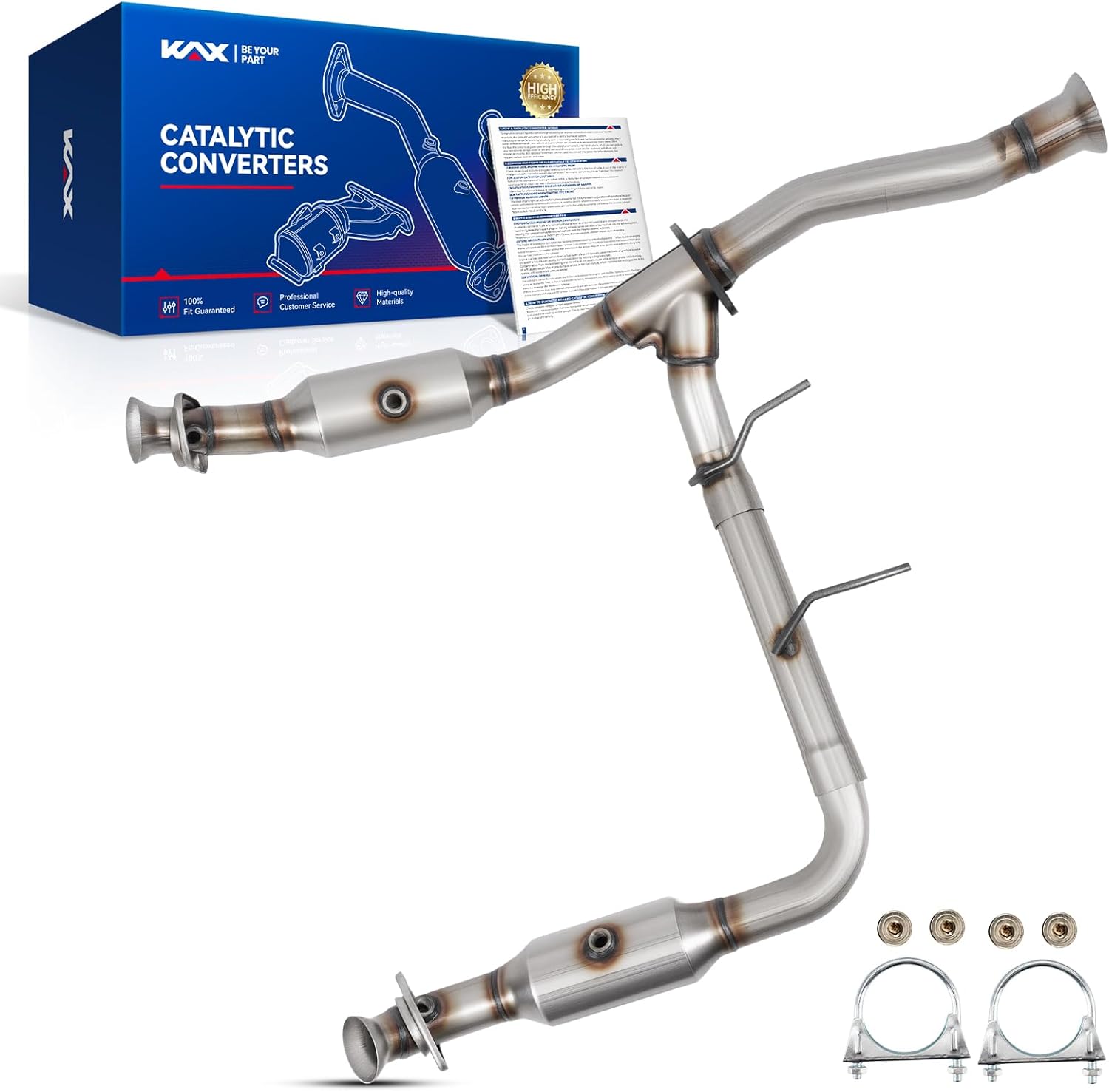
| Compatible engines | 5.4L |
|---|---|
| Fitment years | 2009-2010 F-150 |
| Position | Left, Right |
| Manufacturer | KAX |
This KAX catalytic converter is a direct-replacement style unit intended for the left or right side of 2009–2010 F-150 5.4L engines and like-model 5.4L Expeditions and Navigators. It uses a ceramic honeycomb substrate treated with a rare-earth stabilizer to increase heat resistance and catalytic surface activity while the stainless steel shell resists corrosion. Typical use is to replace a clogged or damaged factory converter to restore exhaust flow, stop rattling, clear emissions-related driveability issues, and reduce backpressure for smoother throttle response. The listing notes OE-style gaskets and hardware for bolt-on installation that most experienced DIYers and independent shops can fit in a few hours, though some buyers needed to use clamps, cut and sleeve the pipe, or modify flanges to get a good fit. It meets federal EPA/OBD2 requirements but is not CARB-compliant so it is not legal in states that require California-certified parts. Build quality reports are mixed: many users get a solid, functional replacement and improved performance while others found poor flange alignment and rough welds requiring extra work during installation.
Best for: Buyers who need an affordable, direct-replacement catalytic converter to resolve a clogged or damaged unit on a 2009–2010 F-150 5.4L and who are comfortable verifying fit and doing light exhaust work or hiring a local shop.
Less Ideal for: Drivers in states that require California emissions-approved parts or those who want a guaranteed perfect factory-fit unit without any potential adjustment during install.
- High-flow ceramic honeycomb substrate with rare-earth stabilizer to improve catalytic efficiency and heat resistance
- Stainless steel housing improves corrosion resistance compared with cheaper materials
- Supplied with OE-style gaskets and hardware for bolt-on installation in most cases
- Designed to reduce backpressure, which can restore throttle response and reduce exhaust noise from a failing converter
- Not CARB-compliant and therefore illegal for use in states that require California-certified parts
- Fitment and flange alignment vary by unit so some buyers must modify pipes, clamps, or mounting points during installation
- Mixed build-quality reports include rough welds and incorrect hardware for some vehicles
Verdict: A cost-conscious, high-flow replacement for 2009–2010 F-150 5.4L owners who need to restore exhaust flow and fix emissions-related drivability, provided they accept possible fitment tweaks and that CARB rules do not apply.
Choosing the Right 2009-2014 Ford F-150 Catalytic Converter: Key Factors to Consider
Fitment and Pipe Orientation
Correct fitment is the most important practical factor for a 2009–2014 Ford F-150. The factory exhaust routing and hanger placements vary with cab and bed configurations and model years, so a direct-fit converter with matching inlet and outlet diameters, correct bend geometry, and properly placed mounting flanges reduces installation time and avoids exhaust leaks.
If a converter forces you to cut and re-weld sections, labor and alignment issues can introduce leaks or hanger stress. Confirming the oxygen sensor boss location and thread size is part of fitment. Even small offsets can cause sensor harness strain or inaccurate readings, so choose a unit that reproduces factory sensor port positions whenever possible.
Emissions Performance and Substrate Type
Catalytic converters differ by substrate composition and washcoat loading, which affects conversion efficiency for hydrocarbons, carbon monoxide, and nitrogen oxides. For a 2009–2014 F-150, prioritize converters that specify high washcoat loading and three-way catalytic performance suited for gasoline engines. Better substrate formulations maintain conversion efficiency longer and reduce the risk of repeated codes or failed emissions inspections.
Durable substrates are also less prone to thermal breakdown from frequent towing or high-load operation. While exact conversion percentages may not be published for every unit, product documentation that details substrate type and washcoat quantity is a strong indicator of emissions capability.
Oxygen Sensor Compatibility
Oxygen sensors monitor downstream and upstream catalyst performance and feed data to the engine control module. For the F-150, the correct sensor boss locations and thread sizes are essential to avoid persistent check-engine codes related to catalyst efficiency. A replacement that retains the factory sensor mounting positions minimizes the risk of incorrect sensor readings or sensor harness interference.
If a unit requires relocating sensors or using extension harnesses, factor in additional parts and potential troubleshooting. Proper sensor placement also affects how the engine adapts fuel trim under different loads and can influence fuel economy and behavior under acceleration.
Durability and Corrosion Resistance
Road salt, water exposure, and the thermal cycling of typical pickup use demand a converter shell and welds that resist corrosion. Look for heavy-gauge housings, robust seam welding, and surface treatments that delay rust in climates where winter road chemicals are common. Durability matters for owners who tow, haul, or operate off-road, since extra heat and vibration speed wear.
A converter that fails prematurely can lead to rattles, leaks, and a return of emissions codes. Evaluate construction details and warranty terms as proxies for longevity when direct durability testing data is not available.
Backpressure and Engine Performance
Catalytic converters add restriction to the exhaust path. For a 2009–2014 F-150, excessive backpressure can reduce throttle response and torque, particularly on models with larger displacement engines or added performance demands like towing. Opt for converters engineered to balance emissions conversion with minimal flow restriction through optimized cell density and larger internal passages where appropriate.
Consider how you use the truck: frequent towing or sustained highway loads may benefit from a converter that offers better flow characteristics without sacrificing emissions compliance. If the converter increases backpressure too much, you may notice reduced low-end torque or increased exhaust heat.
Installation Complexity and Hardware
Some converters are true direct-fit replacements while others need clamps, gaskets, or welding. For many owners, minimizing downtime and avoiding exhaust shop labor is a priority. Check whether the replacement includes correct flanges, gaskets, and hangers for the 2009–2014 F-150, and whether it preserves factory oxygen sensor ports.
Availability of clear fitment documentation and included hardware reduces the chance of improper installation. Also consider the weight and size of the unit for jack and lift clearances during DIY replacement.
Confirming Fit for Your F-150 Configuration
The 2009–2014 Ford F-150 covers multiple cab and bed combinations and exhaust routing variations. Before ordering a converter, identify your truck's cab type and bed length and compare inlet/outlet diameters and hanger placements against your stock component.
Measure pipe diameters and flange bolt patterns and note oxygen sensor locations. If the replacement reproduces these details, installation is straightforward. If not, plan for additional parts or shop labor.
- Record the OEM pipe diameter at both ends of the converter.
- Note the number and spacing of flange bolts if applicable.
- Mark oxygen sensor boss positions relative to exhaust manifolds or mid-pipe joints.
How Emissions Certification Affects Inspections
Local emissions testing often checks for visible tampering and catalyst efficiency. A converter that restores correct catalyst function reduces the chance of failing an inspection and getting emissions-related codes.
Ensure any replacement claims compliance with relevant state or regional regulations and retains the necessary sensor functions. Documentation that indicates emissions compliance or OEM-equivalent function helps with inspection scenarios.
- Keep purchase and fitment documentation for inspection centers.
- Confirm sensor ports are accessible for testing equipment.
Preparing for a DIY Replacement
If you plan to replace the converter yourself, prepare the vehicle and tools, and allow extra time for rusted bolts if the truck has high mileage or exposure to salt. Lift the truck securely, support it on stands, and have replacement gaskets, anti-seize compound for sensor threads, and proper torque tools on hand.
Expect to remove heat shields or brackets to gain access. Have a plan for handling the weight of the converter when lowering it from the vehicle, and inspect adjacent exhaust joints and sensors while the system is apart.
- Use anti-seize on oxygen sensor threads to prevent future seizure.
- Replace gaskets and clamps when reassembling to avoid leaks.
- Inspect hangers and replace any brittle or damaged mounts.
Signs Your F-150 Needs a New Converter
Several symptoms suggest the catalytic converter is compromised: a persistent check engine light with catalyst efficiency codes, reduced acceleration or power, a sulfur or rotten-egg smell from the exhaust, or rattling noises indicating a broken substrate. These symptoms often appear gradually and can be more noticeable under load or during cold starts.
A simple diagnostic scan that returns catalyst-related trouble codes is a common starting point, but visual inspection for external damage or internal rattling provides additional confirmation.
- Persistent check engine light with O2 or catalyst efficiency codes.
- Noticeable loss of power or poor throttle response.
- Distinct sulfur-like exhaust odor or internal rattling sounds.
Maintaining Converter Health After Installation
Once a new converter is installed, protect it by addressing upstream issues that cause premature failure. Regular spark plug and ignition system maintenance, a correctly functioning fuel system, and timely oil and coolant leak repairs prevent contamination of the substrate.
Avoid long-term idling or rich-running conditions that can overheat and damage the catalyst. Periodic checks of sensor function and exhaust leaks will prolong the life of the converter.
- Replace fouled spark plugs and correct ignition timing as needed.
- Fix oil or coolant leaks that can contaminate the catalyst.
- Address persistent rich-running conditions to prevent thermal damage.
Still looking for the perfect fit?
Select your Ford F-150 configuration to see the most relevant Catalytic Converters recommendations
How We Chose the Best 2009-2014 Ford F-150 Catalytic Converter
We prioritized parts that restore emissions control, fit the 2009–2014 Ford F-150 exhaust layout, and offer durable substrates and housings. Primary evaluation criteria included precise inlet/outlet dimensions and pipe orientation to ensure direct-fit installation without extensive modification; catalyst substrate type and washcoat loading as measures of expected emissions performance; and construction materials and weld quality for corrosion resistance on vehicles exposed to road salt and rough use.We also weighed thermal durability under repeated exhaust heat cycles, mounting bracket locations and compatibility with stock hangers, and whether the unit retains the oxygen sensor ports in the correct positions. We excluded universal, short-pipe, or highly modified converters that require custom cutting or major fabrication. Units lacking clear emissions performance data, poor welds, or incompatible sensor port locations were not considered. The goal was to surface direct-fit options that minimize installation time while meeting regulatory and durability expectations for this F-150 model range.
Our full evaluation process is outlined in our review methodology.
FAQ
What are common catalytic converter symptoms on a 2009–2014 F-150?
Common symptoms include a persistent check engine light with catalyst efficiency codes, reduced acceleration or throttle response, a sulfur-like exhaust odor, and rattling noises from a damaged substrate. These signs often become more apparent under load or during cold starts.
Will replacing the catalytic converter clear the check engine light?
Replacing a failed converter often clears catalyst-related codes, but the engine control module may need several drive cycles to adapt and verify the new unit. If upstream issues like bad sensors or fuel system problems remain, codes can reappear.
Can I install a direct-fit converter myself on the F-150?
Many owners can perform a direct-fit replacement with basic tools, proper vehicle support, and a torque wrench. Rusted fasteners or seized sensors can complicate the job, so have penetrating oil, replacement gaskets, and anti-seize on hand, and allow extra time if the truck has high mileage.
How does a failing catalytic converter affect emissions testing?
A failing converter reduces catalytic efficiency and can cause emissions test failures due to elevated hydrocarbons or carbon monoxide. Visible tampering or missing catalyst components will also cause inspection failures in many jurisdictions.
What should I check before buying a replacement catalytic converter?
Verify inlet and outlet diameters, flange bolt patterns, oxygen sensor boss locations, and hanger placements to ensure a direct fit. Also check construction quality and whether the unit provides documentation of emissions performance or compliance.
How long do catalytic converters typically last on an F-150?
Lifespan depends on driving conditions and maintenance. Properly maintained trucks often get many years of service from a converter, but contamination from oil or coolant leaks, repeated thermal stress, or physical damage can shorten life. Regular inspections help spot early issues.
Will towing or heavy use shorten the converter's life?
Towing and heavy loads increase exhaust temperatures and thermal cycling, which can accelerate substrate wear or heat-related damage. If you frequently tow, choose a unit with robust substrate specifications and monitor for signs of overheating or reduced conversion performance.
Final Verdict
For the 2009–2014 Ford F-150, prioritize a direct-fit catalytic converter that matches pipe diameters, sensor locations, and hanger placements while offering durable construction and proven emissions performance. Balance flow characteristics against conversion efficiency based on whether you use the truck for daily driving or heavy-duty work like towing. Address upstream engine issues and sensor function before installation to protect the new converter and avoid recurring problems.
Explore More:
- Check out all Ford F-150 parts & accessories
- Explore Catalytic Converters Maintenance & Repair Guides
- Explore Exhaust & Emissions
- Browse all Auto Parts
