

Note: This article contains affiliate links. If you click on these links and make a purchase, I may earn a small commission at no extra cost to you. This helps support my research and content. Read my full affiliate disclosure here.
If your Toyota Camry SE is showing signs of overheating or slow warm-up, choosing the right radiator matters for everyday reliability. A correctly sized radiator restores proper engine temperature control, prevents recurring coolant loss, and reduces the risk of head gasket damage.This guide covers seven shortlisted radiators that fit the Toyota Camry SE and focuses on cooling performance, build quality, and correct fitment. You will get practical guidance on what to look for, likely symptoms that indicate a failing radiator, and the factors that split dependable replacements from short-lived fixes. Read on to compare the top options and learn what matters most when you replace the radiator on your Camry SE.
Looking for other parts? See all Toyota Camry parts & accessories.
Top Picks at a Glance
| Best Overall The best all-around choice for most situations | SCITOO Radiator and Cooling Fan Assembly for Toyota Camry 2.5L (2012–2017) |  |
| Best Quality Built to a higher standard if you want something more solid | PHILTOP Aluminum Replacement Radiator (CU13670) |  |
| Best Value The sweet spot between price and what you get | Torchbeam Replacement Radiator for Camry 2.5L (CU13269) |  |
| Best Budget The cheapest option that still gets the job done reliably | DWVO Radiator Compatible with 1997–2001 Toyota Camry 2.2L L4 |  |
| Highest Rated A top-rated pick with lots of positive feedback | SCITOO Radiator Assembly for Toyota Camry 2010–2011 2.5L |  |
| Most Popular A crowd favorite that many people choose with confidence | DWVO Radiator Compatible with 2007–2011 Toyota Camry L4 2.4L / 2010–2011 Camry 2.5L |  |
| Best Seller A high-volume bestseller chosen again and again | DWVO Complete Radiator for 2002–2006 Toyota Camry & 2005–2008 Toyota Solara 2.4L |  |
SCITOO Radiator and Cooling Fan Assembly for Toyota Camry 2.5L (2012–2017)

| Compatible vehicles | 2012–2017 Toyota Camry 2.5L |
|---|---|
| Core rows | 1 Row |
| Inlet diameter | 1.38 in. |
| Outlet diameter | 1.38 in. |
This SCITOO radiator assembly ships with a matched cooling fan and is marketed to fit 2012–2017 Toyota Camry 2.5L trims. It replaces the factory radiator and fan as a single assembly, simplifying installation compared with sourcing parts separately. The product lists a one-row core with specified inlet and outlet diameters and includes the fan assembly so you get a ready-to-install cooling package. In use it should restore proper engine cooling and fan operation for street driving, commuting, and light load conditions. Practical benefits include consolidated parts, claimed vehicle-specific fitment for Camry L, LE, SE, XLE, XSE and related trims, and technical support from the seller for installation questions. Important limitations are that the core is a single-row design which may not match heavy-duty cooling needs, and buyers should confirm exact trim and year compatibility before purchase since fitment varies by model configuration.
Best for: Drivers who want a straightforward, consolidated replacement that restores factory-style cooling for everyday driving and typical Camry use without upgrading to performance cooling.
Less Ideal for: Owners planning heavy towing, high-performance modifications, or aggressive track use should choose a thicker multi-row or performance radiator instead.
- Includes both radiator and matched cooling fan for a single replacement package
- Model-specific fitment claimed for 2012–2017 Camry 2.5L trims to simplify selection
- Seller offers technical support for installation questions
- Preassembled combination reduces time and effort compared with sourcing parts separately
- Single-row core may offer less cooling capacity than multi-row or performance radiators
- Spec sheet lists dimensions and part numbers that require verification against your vehicle before purchase
Verdict: A ready-to-install radiator plus cooling fan assembly for 2012–2017 Camry 2.5L owners seeking an easy factory-replacement cooling solution.
PHILTOP Aluminum Replacement Radiator (CU13670)
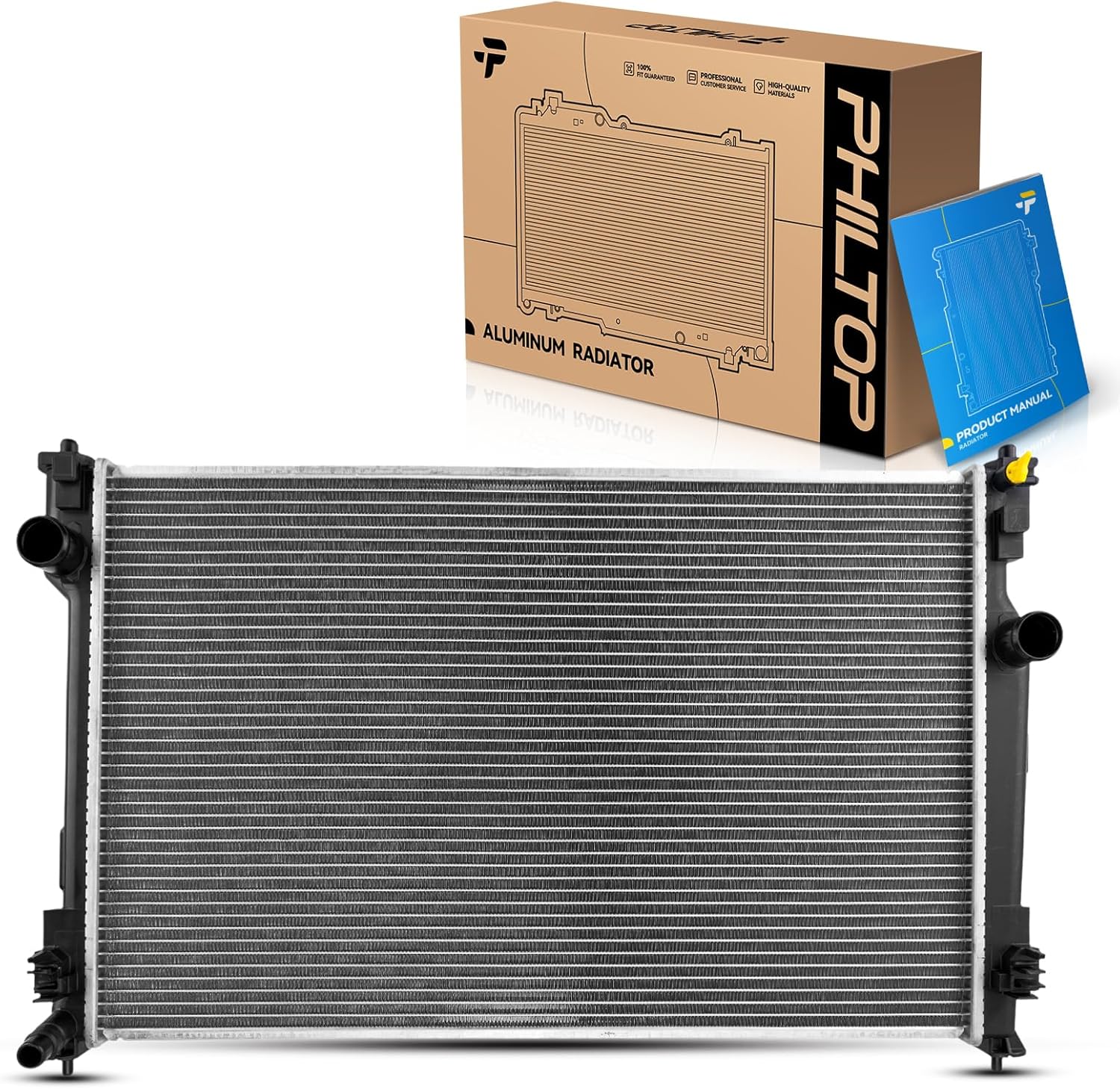
| Compatible vehicles | 2018-2024 Camry 2.5L and selected Toyota models listed |
|---|---|
| Item model number | CU13670 |
| Manufacturer part number | 8198CFK116GUS |
| Core thickness | 5/8 in |
| Certification | IATF16949 |
This PHILTOP aluminum radiator is a direct-fit replacement built to match factory cooling performance for specified Camry and related Toyota models. It installs like a stock unit with matching inlet/outlet placements and fan mounts, so most DIYers or shops can swap it in without modifying lines or brackets. The radiator uses an aluminum core and machined exterior and comes packaged with foam corner supports to reduce transit damage. Reviewers report solid cooling performance and good fitment while a few noted issues with minor mismatches at overflow or delicate fittings that require gentle clamp torque. This unit is aimed at restoring proper engine temperature control after a failed radiator and offers an economical alternative to dealership parts while keeping factory-style routing and fan compatibility. Buyers should expect typical replacement-radiator durability and to double-check hose/overflow connections during install to avoid leaks.
Best for: Drivers who want to restore or maintain strong, factory-like cooling on a performance-minded Camry without paying dealer prices, and who are comfortable checking fittings during installation.
Less Ideal for: Buyers seeking an upgraded high-capacity or race-focused radiator with larger cores or specialized cooling features should consider performance-specific alternatives.
- Direct-fit design with matching inlet/outlet locations for straightforward installation
- Aluminum core and machined exterior intended to provide factory-style cooling performance
- Packaged with foam corner supports to reduce shipping damage and bending
- Compatible fan and mounting points allow reuse of factory fan assemblies
- Some reviewers reported delicate overflow/fitting areas that need careful clamping to avoid cracks or leaks
- Quality control appears inconsistent in a small number of units
Verdict: A direct-fit aluminum replacement that restores factory cooling performance for Camry owners looking for a cost-effective, performance-conscious swap.
Torchbeam Replacement Radiator for Camry 2.5L (CU13269)

| Model | 1x Radiator – CU13269 |
|---|---|
| Manufacturer | Torchbeam |
| OEM Part Numbers | 164000V110, 13270, CU13269 |
This Torchbeam radiator is a full replacement unit designed to bring a Camry 2.5L cooling system back to factory-level operation. It uses a high-density aluminum core with multi-layer fins to improve heat dissipation and is 100% leak tested before shipping. The unit arrives as a complete radiator with foam corner protection and mounting points intended to match factory locations, so installation is familiar to anyone replacing a stock radiator. In practice the radiator provides efficient cooling and a straightforward swap for vehicles in the specified model years, though a few owners report minor fitment alignment and fastener issues that may require checking mount locations and retightening transmission cooler fittings after installation. For DIYers the included instructions and conventional mounting make the job accessible, while shops will appreciate the standard configuration and full replacement design.
Best for: Buyers who want a practical, no-frills replacement radiator to restore reliable cooling on a Camry 2.5L and prefer a product that balances performance with straightforward installability.
Less Ideal for: Consumers seeking an upgraded performance or oversized cooling solution for heavy towing or track use should consider purpose-built performance radiators instead.
- High-density aluminum core and multi-layer cooling fins for improved heat dissipation
- 100% leak tested to reduce the risk of coolant loss on arrival
- Designed as a complete replacement with factory-style mounting for a familiar install
- Packed with foam corner protection to minimize shipping damage
- Some customers reported minor fitment or fastener alignment issues that required adjustments
- Transmission cooler line fittings may need rechecking to prevent leaks after installation
Verdict: A cost-effective, factory-style replacement radiator that restores cooling reliability for 2012–2016 Camry 2.5L engines.
DWVO Radiator Compatible with 1997–2001 Toyota Camry 2.2L L4

| Core Size | 28.6" x 15.7" |
|---|---|
| Compatible Engines | Camry 2.2L L4 (1997–2001), Solara 2.2L (1999–2001) |
| Manufacturer Part Number | DWRD1017 |
| OEM Part Numbers | 16410YZZAA, 1640003140, 1640003142, 1640003150, 1640003151 |
This DWVO complete radiator is a budget-focused, direct-fit replacement for 1997–2001 Toyota Camry 2.2L engines and installs like a factory-style unit. It is built with an aluminum core and TIG-welded inlet/outlet tanks, and includes an aluminum transmission oil cooler and drain plug; the package does not include a radiator cap or AT sensor. In use it restores cooling capacity for an aging or failed radiator and matches factory mounting points so most DIYers can swap it without modification. Customers report secure packaging and good fitment, though some note plastic tank durability and potential leaks at cooler line fittings on long-term use. The radiator is practical for routine repair or restoration where keeping costs low is the priority, but buyers should plan to reuse or replace the cap and sensors and inspect cooler line fittings during installation. Professional installation is recommended if you are not comfortable bleeding the system or handling transmission cooler connections.
Best for: Buyers who need an affordable, ready-to-install replacement to get an older Camry back on the road without spending on an OE-priced unit; ideal for hands-on owners tackling a routine radiator swap.
Less Ideal for: Drivers seeking a long-term high-end upgrade or heavy-duty solution who prefer metal tanks and factory-equivalent longevity should consider higher-tier radiators or professional-grade units instead.
- Direct-fit design for 1997–2001 Camry 2.2L which simplifies installation
- Aluminum core with TIG-welded tanks and multi-louvered fins intended to improve cooling efficiency
- Includes transmission oil cooler and drain plug for simpler hookup and service
- Secure packaging reduces risk of shipping damage and preserves fin condition
- Plastic inlet/outlet tanks may be less durable long-term compared with all-metal radiators
- Radiator cap and transmission sensor are not included so additional parts may be required during install
- Some users report leaks at cooler line fittings or welds over extended use
Verdict: A cost-conscious, direct-fit radiator that restores cooling on 1997–2001 Camry 2.2L models while keeping repair costs low.
SCITOO Radiator Assembly for Toyota Camry 2010–2011 2.5L

| Vehicle fitment | Toyota Camry 2010-2011 L4 2.5L |
|---|---|
| Core rows | 1 Row |
| Inlet diameter | 1.37in |
| Outlet diameter | 1.37in |
| Model | 127730 |
This SCITOO radiator is a model-specific replacement for Toyota Camry 2010–2011 2.5L engines and is built as an aluminum, single-row core intended to restore cooling performance. It installs in place of part number 13368 and keeps the factory cooling layout with matching inlet and outlet diameters, so it is typically used when an original radiator fails from leaks, corrosion, or impact damage. Notable features include a one-row core and full-length core dimensions that mirror the factory unit, which help maintain cooling flow and simplify fitment. Practical benefits are straightforward: it returns a warm Camry to reliable operating temperature, supports routine driving and light towing, and reduces the need for custom modifications. Limitations are that it does not include transmission or engine oil coolers, so vehicles that rely on an integrated cooler will need those components separately, and the single-row core offers less cooling margin than multi-row performance radiators under sustained heavy loads. Expect a fairly direct swap with standard mounting and hose connections but plan for coolant flushing and proper bleeding after installation.
Best for: Buyers who prioritize restoring dependable, factory-like cooling on a 2010–2011 Camry and want a straightforward replacement rather than performance upgrades.
Less Ideal for: Drivers who frequently tow, run sustained high-load driving, or want increased cooling headroom should consider a multi-row or performance radiator option.
- Model-specific design for 2010–2011 Camry 2.5L for easier fitment
- Aluminum construction for improved corrosion resistance compared with older units
- Matching inlet and outlet diameters for simple hose connections
- Single-row core reduces bulk and simplifies installation in tight engine bays
- Does not include transmission or engine oil cooler functionality
- Single-row core provides less cooling capacity than multi-row or performance radiators
Verdict: A direct-fit aluminum replacement radiator that restores reliable, factory-style cooling for 2010–2011 Toyota Camry 2.5L owners.
DWVO Radiator Compatible with 2007–2011 Toyota Camry L4 2.4L / 2010–2011 Camry 2.5L

| Compatible models | 2007–2011 Camry L4 2.4L; 2010–2011 Camry 2.5L 4CYL |
|---|---|
| Manufacturer part number | DWRD1081 |
| OEM part numbers | 164000H210,164000H240,164000H310,164000V070,1640028550,1640036070 |
| Core construction | Aluminum core with TIG-welded joints |
| Includes | Integrated transmission oil cooler |
This DWVO complete radiator is a direct replacement designed for 2007–2011 Toyota Camry four-cylinder engines and includes an integrated aluminum transmission oil cooler. It installs like a factory unit using the existing mounting points and hardware and is typically used to restore proper engine cooling after a leak or failure of the original radiator. The core uses high-density multi-louvered fins for improved heat dissipation while TIG-welded aluminum and reinforced inlet/outlet tanks aim to resist leaks. Buyers will appreciate that the unit ships with foam protection and a user manual and that it matches common OEM part numbers for straightforward fitment. Expect a low-cost, practical fix that restores operating temperature control, though some buyers report occasional fitment tweaks around fan shrouds and variability in plastic tank thickness compared with factory parts. The radiator does not include a cap or temperature sensor, and professional installation is recommended if you are not comfortable reusing old mounting hardware and bleeding the cooling system correctly.
Best for: Buyers who want an affordable, tested replacement that restores cooling performance and prefer products backed by many positive owner experiences. This suits owners prioritizing a cost-effective, practical repair that gets the Camry back on the road quickly.
Less Ideal for: If you need an exact factory-feel finish, longest-term durability, or a radiator that includes every accessory, this budget aftermarket option is not the best choice; consider a dealer or premium aftermarket unit instead.
- Direct-fit replacement for listed 2007–2011 Camry four-cylinder models using OEM part numbers
- Integrated aluminum transmission oil cooler included
- High-density multi-louvered fins and TIG-welded core for improved cooling and leak resistance
- Secure packaging with foam protection and user manual for safer delivery and easier installation
- Radiator cap and temperature sensor are not included
- Some units may require minor adjustments to the fan shroud or reuse of old mounting hardware for a perfect fit
- Plastic inlet/outlet tanks may feel less robust than factory parts
Verdict: A budget-friendly, direct-fit replacement radiator that restores reliable cooling for the specified Camry four-cylinder models without the premium price.
DWVO Complete Radiator for 2002–2006 Toyota Camry & 2005–2008 Toyota Solara 2.4L

| Manufacturer | DWVO |
|---|---|
| Manufacturer Part Number | DG1001D037 |
| OEM Part Number | 164000H200,16410YZZAF |
| Exterior | Machined |
This DWVO complete radiator is a direct replacement intended for 2002–2006 Toyota Camry and 2005–2008 Solara 2.4L applications and is built to restore cooling system performance after a failed core or cracked tank. It installs using existing mounting points and the package includes a TIG-welded aluminum core, plastic inlet/outlet tanks, a stainless steel transmission oil cooler, and basic corner foam protection. In practice the high-density fins and welded construction offer solid cooling capacity and many buyers report straightforward DIY installation with reused mounting hardware and sensor fittings. The radiator does not include a cap or some small fittings so you should plan to transfer those from the old unit and expect a professional install if you prefer. While a large number of owners report good fit and reliable temperature control, some customers have received units with weak plastic tanks or leaking cooler fittings, so careful pre-install inspection and proper tightening of the ATF cooler connections are recommended. For a budget-focused replacement this radiator balances performance and value if you accept occasional variability in build quality.
Best for: Buyers who want an affordable, factory-replacement style radiator that restores cooling quickly and are comfortable inspecting the part and using existing hardware or arranging basic installation support.
Less Ideal for: Those seeking a lifetime-upgrade or heavy-duty racing solution or buyers who need guaranteed premium fitment without any part transfer should consider higher-end or OEM options instead.
- Direct-fit design for specified Camry and Solara 2.4L models using factory mounting points
- Aluminum core with multi-louvered fins for improved cooling efficiency
- TIG-welded construction and stainless steel transmission oil cooler for durability
- Packaged with foam protection to reduce shipping damage and simplify handling
- Plastic inlet/outlet tanks can feel thinner than factory parts and may be less durable long term
- Does not include radiator cap or some small sensors and fittings which must be reused or sourced separately
Verdict: A budget-friendly, direct-fit replacement radiator that restores factory cooling for 2002–2006 Camry and 2005–2008 Solara 2.4L models without complicated modification.
Choosing the Right Toyota Camry SE Radiator: Key Factors to Consider
Cooling Capacity and Core Design
Cooling capacity determines how effectively the radiator removes heat from the engine coolant. A larger or more efficient core with more cooling rows and greater surface area improves heat dissipation, which matters if you drive in hot climates, tow light loads, or sit in stop-and-go traffic. Core thickness and tube count influence flow resistance and heat transfer balance, so choose a design that matches the Camry SE's engine cooling demands without causing excessive backpressure.
Different core constructions—such as multi-row parallel flow versus single-row—affect recovery after high-load operation. For a Camry SE, a radiator that maintains stable temperatures under typical commuting and highway driving reduces stress on the thermostat, water pump, and head gasket over time.
Fitment and Mounting Accuracy
Accurate fitment is essential to avoid fabrication or modification during installation. The radiator must match the Camry SE's mounting points, fan shroud interface, and inlet/outlet locations so hoses and sensors connect without forcing or re-routing. Misaligned fittings can cause installation delays, leaks, or stress on hoses and clamps.
Check that the replacement provides the same transmission cooler ports if the vehicle uses an integrated transmission oil cooler circuit. Properly positioned mounting tabs and baffles also reduce vibration and chafing, helping prevent premature failures.
Material Quality and Corrosion Resistance
Radiator tanks and cores are commonly made from aluminum, plastic, or a combination. Aluminum cores with brazed joints tend to resist corrosion and handle heat better than some plastic tank designs, but modern plastic-tank radiators can be serviceable if the plastic is reinforced and the seals are high quality. Corrosion resistance matters because coolant chemistry and local water quality influence how quickly internal passages and fins degrade.
Consider radiators with treated fins or corrosion-resistant coatings, and ensure compatibility with the Camry SE's recommended coolant type. Higher-quality materials typically provide longer service life and fewer leaks over the years.
Pressure Rating and Cap Compatibility
A radiator must match the vehicle's cooling system pressure profile to maintain proper boiling point elevation and avoid seal failures. Check that the replacement supports the Camry SE's specified system pressure and that the filler neck accepts the factory-style radiator cap. Incorrect pressure ratings can lead to premature coolant loss, overheating under load, or burst hoses.
Also verify the radiator cap seating and neck design to ensure a proper seal; some aftermarket radiators use different neck geometries that need adaptors or could compromise pressure integrity.
Transmission Cooler and Accessory Integration
If your Camry SE has an automatic transmission that uses the radiator for cooling, confirm the replacement includes properly located transmission cooler ports and correct line fittings. Mismatched ports can require extra adapters and increase leak risk. Even on manual-transmission vehicles, confirm there are no unnecessary ports that introduce failure points.
Also review whether the radiator supports existing sensors or mounts for shrouds, horns, and A/C condenser clearance. A radiator that integrates cleanly with adjacent components reduces installation time and potential interference.
Serviceability and Included Hardware
Ease of service affects long-term ownership. Radiators that include drain plugs, mounting bushings, and needed fittings simplify maintenance and reduce the chance of missing small parts. Consider how easy it is to access the drain and bleed points for a coolant change on the Camry SE; a well-designed radiator speeds bleeding air from the system and lowers mess.
Also evaluate whether the radiator permits straightforward fan and shroud transfer from the old unit or requires new brackets. Units that minimize additional parts or special tools reduce overall installation complexity.
Common Radiator Symptoms on a Camry SE
Recognizing early radiator problems helps you act before engine damage occurs. Common symptoms on a Toyota Camry SE include persistent high temperature gauge readings, steam or a sweet, syrupy smell from the engine bay, and visible coolant puddles or wet spots under the front of the car. Intermittent overheating during idling or slow traffic often points to reduced core flow or a failing fan circuit rather than the thermostat alone.
Other signs include low coolant levels without obvious external leaks, which suggests internal leaks or pressure-related loss, and discolored or sludgy coolant that indicates contamination or internal breakdown. Addressing these symptoms quickly limits the risk of head gasket failure or warped heads.
- High or fluctuating engine temperature
- Visible coolant leaks or white residue on the radiator
- Sweet smell from engine bay or steam
- Poor heater performance in cold weather
- Milky or sludgy coolant indicating contamination
When to Repair Versus Replace the Radiator
Small, external leaks from replaceable hoses, clamps, or fittings can often be repaired without replacing the entire radiator. However, when leaks originate from the core, tanks show cracking, or corrosion has breached passages, replacement is usually the safer long-term choice. For the Camry SE, factor in the age of the vehicle and prior service history when deciding.
If the radiator has multiple compromised sections, recurring leaks, or damaged mounting points that affect alignment, replacement prevents repeat downtime. Also consider the labor involved: repairs that require removing and refitting the radiator can approach replacement costs when accounting for parts and effort.
- Repair suitable for small hose or clamp issues
- Replace when core or tank integrity is compromised
- Consider vehicle age and prior repairs when deciding
- Multiple leak sites favor replacement over patching
Preparing for Radiator Installation on a Camry SE
Preparation reduces installation time and helps avoid mistakes. Before you begin, confirm you have the correct replacement radiator that matches Camry SE inlet/outlet locations and any transmission cooler fittings. Gather new hoses, clamps, a compatible radiator cap if needed, and the recommended coolant and bleed tools.
Work on a cooled engine and drain the system into a suitable container. Keep a torque wrench handy for clamps and fasteners and inspect fan shrouds, mounting brackets, and adjacent cooling system components so you can transfer or replace them as needed. Proper preparation ensures a clean coolant fill and minimizes trapped air in the system.
- Verify inlet/outlet orientation and transmission cooler ports
- Have new clamps and coolant on hand
- Work only on a fully cooled engine
- Inspect and transfer fan shroud and mounts if needed
- Bleed the system according to Toyota procedures after install
Maintaining the Cooling System After Replacement
After installing a new radiator, follow a maintenance plan to extend its life. Use the manufacturer-recommended coolant type and maintain the correct mixture ratio to protect against corrosion and boiling. Regular coolant level checks and periodic coolant changes prevent contamination that reduces heat transfer efficiency.
Inspect for external damage or debris buildup in front of the core, and keep the condenser and radiator fins clean to preserve airflow. Monitor temperature readings and address any early signs of leak or overheating quickly to avoid compounding damage.
- Use recommended coolant and correct dilution
- Check coolant levels regularly and top up as needed
- Clean fins and condenser area to maintain airflow
- Inspect hoses and clamps at every oil change
- Perform periodic coolant flushes per Toyota intervals
DIY Considerations and When to Seek Help
Replacing a radiator on the Camry SE is a manageable job for many DIYers with basic mechanical skills, but it requires careful attention to fitment, bleeding procedures, and safe coolant handling. If the replacement radiator includes matching mounting points and accessory fittings, the process often involves draining the system, disconnecting hoses and lines, swapping the unit, and refilling and bleeding the cooling system.
Seek professional help if the vehicle shows signs of head gasket issues, if transmission cooler lines must be modified, or if there is significant corrosion around mounting structures. A pro can also pressure-test the system to confirm leak-free operation under load.
- DIY feasible with correct parts and basic tools
- Confirm fitment to avoid unexpected modifications
- Professional service advised for internal engine contamination or transmission line issues
- Pressure testing helps verify repair integrity
Still looking for the perfect fit?
Select your Toyota Camry configuration to see the most relevant Radiators recommendations
How We Chose the Best Toyota Camry SE Radiator
We applied a practical set of filters to identify radiators suitable for the Toyota Camry SE, prioritizing real-world durability and correct vehicle fitment. Core evaluation criteria included cooling capacity and core design, because heat rejection efficiency affects engine temperature under load and in traffic. We looked at construction materials and corrosion resistance to judge long-term service life, and examined mounting point accuracy and inlet/outlet orientation to ensure one-to-one fitment with the Camry SE's factory connections.Additional criteria covered pressure tolerance and OEM-spec hose compatibility, which influence how the radiator handles system pressure and joins to existing plumbing. Ease of installation and accessory completeness were considered, focusing on whether the unit includes necessary fittings, drain plugs, and transmission cooler lines when applicable. We excluded radiators that required structural modifications or had inconsistent fitment reports. Units that lacked documented cooling performance or used substandard tank materials were not considered. The result is a selection that balances cooling performance, longevity, and straightforward installation for Camry SE owners.
Our full evaluation process is outlined in our review methodology.
FAQ
What are the most common causes of radiator leaks on a Camry SE?
Leaks often result from corrosion in the core, cracked plastic end tanks, damaged fins from road debris, or degraded hose connections. Age and contaminated coolant accelerate internal corrosion, while impact or vibration can crack tanks or loosen fittings.
How can I tell if my radiator is the reason my Camry SE is overheating?
Look for persistent high temperature readings, visible coolant loss, steam, or poor heater output. If the thermostat and fan are functioning and the system holds pressure poorly, the radiator core or internal passages are likely compromised.
Is it necessary to replace transmission cooler lines when installing a new radiator?
Not always. If the new radiator has correctly located transmission cooler ports and the existing lines are in good condition, you can reuse them. Replace lines if they show wear, corrosion, or do not align with the replacement unit's fittings.
How often should I flush the coolant after installing a new radiator?
Typically, follow Toyota's recommended intervals for coolant changes, which depend on the coolant type and vehicle age. Many owners perform an initial flush and refill after installation, then adhere to scheduled service intervals to prevent contamination.
Can a DIY owner install a radiator on a Camry SE without professional tools?
Yes, many DIY owners can install a radiator using standard hand tools, proper safety precautions, and correct replacement parts. However, ensure you can properly bleed the cooling system and handle coolant disposal safely; consult a professional if you lack experience with system bleeding or pressure testing.
Will switching to a higher-capacity radiator require other cooling system changes?
A larger-capacity radiator may improve heat rejection but can change flow characteristics. You should verify compatibility with the Camry SE's fan, shroud, and hose routing. In most cases, a correctly sized, vehicle-specific unit installs without further system changes.
Final Verdict
When replacing the radiator on a Toyota Camry SE, prioritize correct fitment, durable materials, and adequate cooling capacity for your driving conditions. Evaluate how the unit integrates with transmission cooler lines and mounting points to reduce installation surprises. Expect tradeoffs between cost and long-term durability; choosing a radiator that matches the Camry SE's pressure and hose layout minimizes the chance of leaks or rework.Focus on restoring reliable temperature control and sealing integrity. With the factors discussed above in mind, you can select a replacement that balances performance, longevity, and straightforward installation for everyday driving.
Explore More:
- Check out all Toyota Camry parts & accessories
- Explore Radiators Maintenance & Repair Guides
- Explore Cooling System
- Browse all Auto Parts
