

Note: This article contains affiliate links. If you click on these links and make a purchase, I may earn a small commission at no extra cost to you. This helps support my research and content. Read my full affiliate disclosure here.
A good battery load tester helps you answer a basic but important question before you start chasing electrical problems: is the battery actually healthy under load, or just showing surface voltage? For DIY mechanics, that matters when a car cranks slowly, sits for long periods, or seems to have charging issues that are hard to pin down.The right tester can save time, prevent unnecessary parts swapping, and make routine battery checks much more reliable. Some tools are better for quick driveway checks, while others offer deeper information on cranking performance, battery condition, and charging system behavior. The picks below are aimed at home garage users who want dependable testing without stepping into overly complicated shop-only equipment.
Top Picks at a Glance
| Best Overall Battery Load Tester for DIY Mechanics Reliable, easy-to-use all‑round tester for most garage diagnostics | TOPDON BT100 12V Car Battery Load Tester |  |
| Best Budget Battery Load Tester for DIY Mechanics Affordable, no-frills tester for occasional checks and basic diagnostics | Yaegoo 6V/12V Battery Load Tester (100A/50A) |  |
| Best Compact Battery Load Tester Pocketable, space-saving tester for quick inspections and storage | MOTOPOWER MP0514A 12V Digital Battery and Alternator Tester |  |
| Best Professional-Grade Battery Load Tester Rugged, shop-ready unit built for frequent, heavy-duty diagnostic use | Clore Automotive Solar 1876 1000A Carbon Pile Battery Load Tester |  |
| Best Digital Battery Load Tester Clear digital readouts and precise measurements for confident diagnostics | ANCEL BA101 12V Digital Car Battery Load Tester |  |
| Best High-Capacity Load Battery Tester High-current capable tester for evaluating large batteries and CCA | Clore Automotive Solar 1874 500A Carbon Pile Battery Load Tester |  |
| Best Premium Battery Load Tester Feature-rich, durable tester with advanced diagnostics and professional features | FOXWELL BT780 Professional 6V/12V/24V Battery Load Tester with Built-in Printer |  |
TOPDON BT100 12V Car Battery Load Tester
Best Overall Battery Load Tester for DIY Mechanics

| Power Source | Battery Powered |
|---|---|
| Minimum Operating Voltage | 12 |
| Upper Temperature Rating | 140 Degrees Fahrenheit |
| Measurement Type | Voltmeter |
| Compatible Devices | Cars, Trucks, Motorcycles, Boats, ATVs, SUVs, Golf Carts |
The TOPDON BT100 is a pocketable 12V battery load tester aimed at DIYers and small shops for quick on-vehicle checks. It measures state of health (SOH), state of charge (SOC), voltage and cranking performance, and runs a charging/alternator test so you can tell whether a battery needs replacement, a jump, or if the charging system is at fault. The unit supports 100–2000 CCA battery types including flooded, AGM, EFB and gel and uses a simple menu plus three-color LED indicators for fast pass/fail style readouts. Copper clamps with spark-proof and polarity-reverse protection make connection safer, and the tester is compact enough to store in a glovebox. Limitations include its 12V-only design so it will not test 24V systems and its basic display and controls are less detailed than higher-end analyzers that log data or provide advanced diagnostics. For routine checks and troubleshooting on typical passenger vehicles this tester gives actionable results without complexity.
Best for: Practical DIY mechanics and home users who want a compact, easy-to-use 12V battery load tester that gives clear health, charge, and charging-system checks for routine maintenance and troubleshooting.
Less Ideal for: Professional shops or users who need 24V support, advanced data logging, or more detailed diagnostic reports should choose a higher-end commercial analyzer.
- Compact, glovebox-friendly form factor for easy storage and transport
- Provides SOH, SOC, voltage and cranking/charging tests for practical go/no-go decisions
- Wide CCA range (100–2000) compatible with common flooded, AGM, EFB and gel batteries
- Spark-proof, polarity-reverse protected copper clamps improve safety during connections
- Only supports 12V systems so it cannot test 24V batteries or heavy equipment directly
- Basic display and menu offer less detailed data logging or advanced diagnostics compared with professional analyzers
Verdict: The best all-around battery load tester that balances accurate diagnostics, ease of use, durability, and value for typical DIY automotive maintenance and troubleshooting.
Yaegoo 6V/12V Battery Load Tester (100A/50A)
Best Budget Battery Load Tester for DIY Mechanics
| Power Source | Battery Powered |
|---|---|
| Minimum Operating Voltage | 6 Volts |
| Measurement Type | Ammeter |
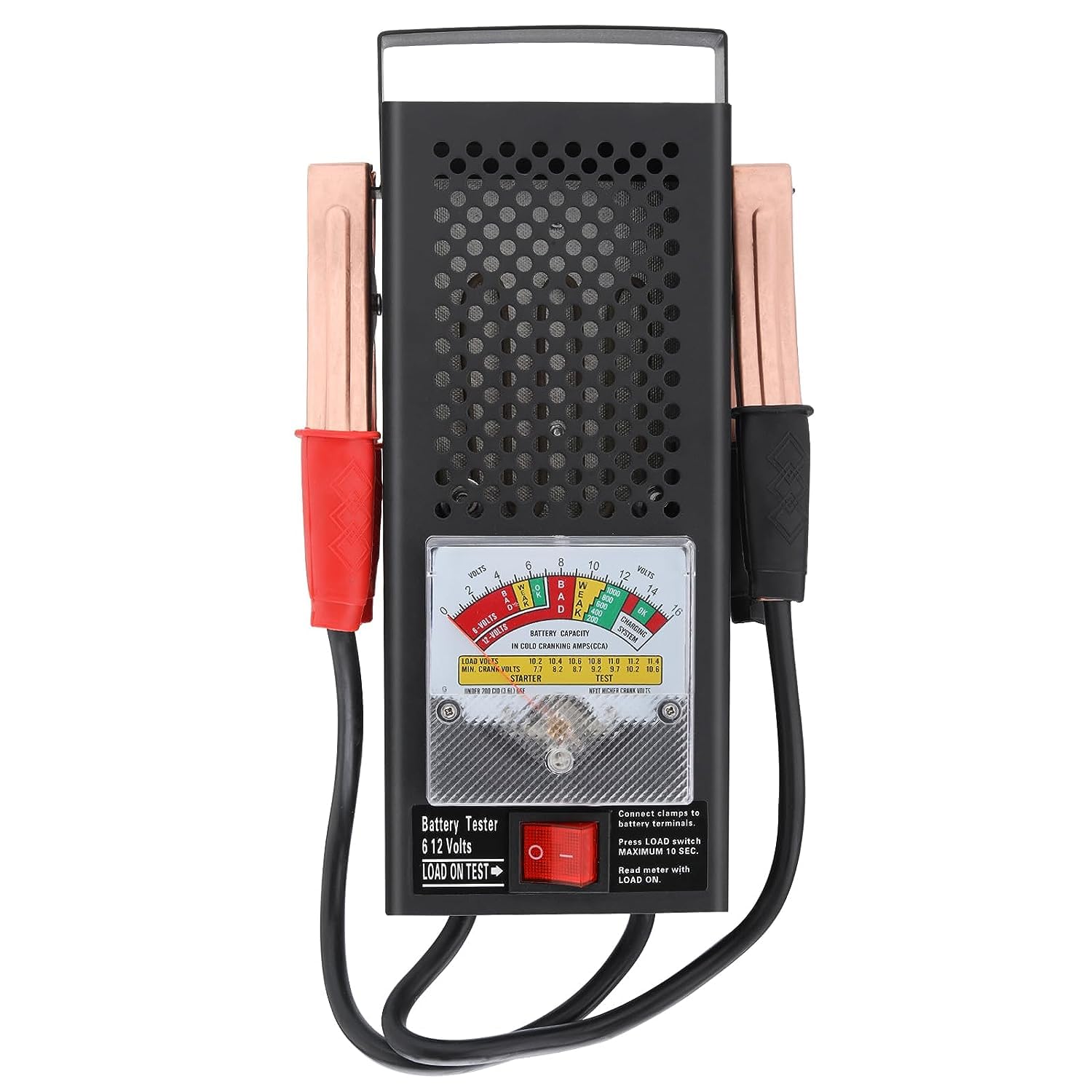
The Yaegoo battery load tester is a handheld tool for quickly checking 6V and 12V lead-acid batteries and basic charging system health. You connect the insulated clamps to the battery and read voltage and load response as the unit applies a 50 amp load to 6V batteries or a 100 amp load to 12V batteries, which helps you judge battery condition and starter draw without specialist equipment. Its perforated metal housing improves heat dissipation and the insulated carry handle and rubber-grip clamps make it straightforward to use in a home garage. The tester claims voltage accuracy of ±0.2V and covers batteries up to about 1000 CCA, so it is suitable for typical car, truck, motorcycle, RV, and marine batteries for routine checks. Limitations are the basic ammeter-style display and lack of advanced digital diagnostics, so it gives practical pass/fail and load-response info but not detailed battery health metrics or graphing. For DIYers who want a rugged, low-complexity load checker, this is a usable budget option; those needing lab-grade precision or modern digital readouts should consider more advanced instruments.
Best for: Home mechanics and hobbyist DIYers who want an affordable, no-frills battery load tester for occasional garage use to quickly verify 6V and 12V battery condition and charging system health with simple controls and durable construction.
Less Ideal for: Technicians or hobbyists who require detailed digital diagnostics, data logging, or lab-grade accuracy should choose a more advanced digital tester instead.
- Works with both 6V and 12V batteries and supports up to 1000 CCA so it fits common vehicle batteries
- Built-in load capability (50A for 6V, 100A for 12V) lets you perform starter and load tests without additional gear
- Insulated carry handle and rubber-grip clamps improve safety and ease of handling
- Perforated housing for heat dissipation supports repeated or heavy-duty use
- Analog-style readout and limited diagnostics compared with modern digital testers
- No included advanced accessories or detailed measurement logging
Verdict: The best low-cost tester that provides reliable pass/fail battery and charging checks with simple controls and durable enough construction for occasional garage use.
MOTOPOWER MP0514A 12V Digital Battery and Alternator Tester
Best Compact Battery Load Tester

| Measurement Type | Voltmeter |
|---|---|
| Minimum Operating Voltage | 4 Volts (DC) |
| Compatible Devices | Vehicles with 12V batteries |
| Power Source | Battery Powered |
The MOTOPOWER MP0514A is a simple handheld tester for quick diagnostics of 12V car batteries and charging systems. You attach the 30A alligator clamps to the battery, read the 4-digit LCD for an accurate voltage result and use the eight colored LEDs to interpret battery and alternator condition. It is battery-powered by the tested battery so there is no internal cell to charge and it includes reverse-connection and over-voltage protection to reduce user errors. The compact rubber-finish housing and 20 inch cable make it easy to carry in a toolbox or glovebox for routine checks and jump-or-replace decisions. Limitations are its basic scope it measures voltage and alternator output only and cannot perform capacity or load tests that simulate engine cranking, and the LCD will display LO or HI outside the 4–20V range. For DIY mechanics who want a fast, inexpensive way to verify battery health and alternator function before deeper troubleshooting, this is a practical pick; professionals needing full load testing or detailed battery health reports will need a more advanced unit.
Best for: DIY mechanics and car owners who need a compact, lightweight tester that fits in a glove box or toolbox for quick voltage and basic load checks during routine inspections or roadside troubleshooting.
Less Ideal for: Technicians who require professional load testing, battery conductance analysis, or detailed health reports should choose a dedicated load tester or shop-grade diagnostic tool instead.
- Plug-and-test operation for fast on-vehicle checks with no setup required
- 4-digit LCD with 0.01V resolution gives precise voltage readings
- Eight colored LED indicators make battery and alternator status easy to interpret at a glance
- Reverse-connection and over-voltage protection reduce user error and protect the tester
- Does not perform true load or cranking tests that measure starting capability
- Limited to voltage measurements and alternator output diagnostics only
Verdict: A small, lightweight tester that fits in a toolbox or glove box and offers basic load and voltage checks for quick inspections and limited storage space.
Clore Automotive Solar 1876 1000A Carbon Pile Battery Load Tester
Best Professional-Grade Battery Load Tester

| Measurement Type | Ammeter |
|---|---|
| Minimum Operating Voltage | 6 Volts |
| Compatible Devices | 6V, 12V, 24V batteries (up to 2000 CCA) |
| Power Source | Hand Powered |
The Clore Automotive Solar 1876 is a bench-style carbon pile load tester aimed at professional and serious DIY use. It applies a controlled variable load up to 1000 amps to test 6V, 12V, and 24V batteries (rated to 2000 CCA) and includes dual analog gauges for monitoring both test current and battery voltage during a load. Technicians will use it to verify battery capacity, simulate starter draw, and quickly check alternator and starter system performance. Notable practical features are heavy-duty clamps for reliable terminal contact, smooth load control for repeatable tests, and clear gauges that make results easy to read without electronics. The tester is hand powered and built for garage environments, but it is bulky compared with handheld electronic testers and requires care when applying high loads. It provides definitive pass/fail-style testing and good durability, but it does not store results or provide digital readouts, so recording and trend tracking must be done separately.
Best for: Professional DIYers and small-shop technicians who need a durable, repeatable battery load tester for frequent use and reliable assessment of 6V, 12V, and 24V batteries as well as starter and alternator diagnostics.
Less Ideal for: Casual users who want a compact, plug-and-play digital meter or anyone needing built-in data storage and reporting tools.
- Variable carbon-pile load up to 1000 amps for realistic starter simulation
- Dual gauges let you watch current and voltage in real time for clear diagnostic decisions
- Compatible with 6V, 12V, and 24V batteries and batteries rated to 2000 CCA
- Heavy-duty clamps and robust construction suited to frequent garage use
- Analog-only display with no data logging or digital capture
- Relatively large and heavier than handheld electronic testers
Verdict: A heavy-duty, rugged tester built to withstand frequent shop use and deliver highly repeatable, accurate load and cold-cranking amp measurements for serious DIYers.
ANCEL BA101 12V Digital Car Battery Load Tester
Best Digital Battery Load Tester

| Power Source | Battery Powered (vehicle battery) |
|---|---|
| Minimum Operating Voltage | 12 Volts |
| Measurement Type | Battery Capacity and Performance |
| Upper Temperature Rating | 140 Degrees Fahrenheit |
The ANCEL BA101 is a compact handheld analyzer for 12V lead-acid batteries that runs battery health (SOH), state of charge (SOC), cranking, and charging system tests without removing the battery from the vehicle. It is typically used by DIY mechanics to verify battery capacity, check starter draw during cranking tests, and evaluate alternator charging and ripple. The unit guides you to enter battery type and CCA/Ah ratings, displays clear black-and-white results with adjustable contrast, and includes safety protections such as reverse polarity and overcurrent protection. Because it draws power directly from the vehicle battery there is no internal battery to charge, and the reinforced housing plus heavy-duty clamps make it durable for garage use. Important limitations are strict 12V lead-acid compatibility only and a minimum recommended battery size (about 30Ah), so it will not test many small motorcycle or lithium batteries and it requires correct input parameters for accurate readings.
Best for: DIY mechanics and home garage owners who need a compact, easy-to-read digital load tester that gives clear, actionable readings of battery health, cranking performance, and charging system condition for routine maintenance and troubleshooting.
Less Ideal for: People who need to test lithium batteries, 6V or 24V systems, or very small motorcycle batteries under 30Ah should look for a tester that explicitly supports those voltages and chemistries.
- Performs multiple diagnostics: quick battery health, cranking, and charging system tests in one tool.
- Clear, adjustable display with one-handed operation for easy readings in bright or low light.
- Built-in safety features including reverse polarity, overcurrent, and short-circuit protection.
- Durable design with reinforced ABS housing and heavy-duty clamps suitable for repeated garage use.
- Only supports 12V lead-acid batteries and requires battery AH/CCA input, so it cannot test lithium or small-capacity batteries.
- No internal power source so it must be connected to the vehicle battery to operate.
Verdict: A tester with a clear digital display and precision readouts that helps DIY mechanics interpret voltage, internal resistance, and load results quickly and accurately.
Clore Automotive Solar 1874 500A Carbon Pile Battery Load Tester
Best High-Capacity Load Battery Tester

| Power Source | Corded Electric |
|---|---|
| Minimum Operating Voltage | 12 Volts |
| Measurement Type | Ammeter |
| Style Name | 500 Amp |
| Upper Temperature Rating | 125 Degrees Celsius |
The Clore Automotive Solar 1874 is a bench-style, corded load tester that uses a carbon-pile load to apply controlled current for diagnosing 12V batteries, starters, and alternators. You connect the heavy-duty clamps to the battery, use the knob to dial in load, and read results on the dual analog gauges for load current and voltage. The variable load up to 500 amps covers most automotive and marine testing needs and the unit claims capacity to test batteries up to 1000 CCA. Practical benefits include smooth load control for repeatable tests, large easy-to-read gauges for quick interpretation, and clamps designed to bite through corrosion for reliable contact. Limitations are that it is an analog, corded tool which requires a safe workspace and familiarity with load testing procedures, and it does not provide digital readouts or data logging that some modern testers offer. It is a straightforward, heavy-duty tool for DIYers who prefer hands-on diagnostic checks rather than plug-and-play electronic analyzers.
Best for: DIY mechanics and small-shop technicians who need a high-capacity, reliable load tester to diagnose heavy-duty or high-CCA 12V batteries and to check starter and alternator performance under realistic load conditions.
Less Ideal for: Users who prefer plug-and-play digital analyzers with automatic test sequences or those needing compact, battery-powered portable testers for field work.
- Variable carbon-pile load control up to 500 amps for flexible, real-world testing
- Dual large analog gauges make it easy to read voltage and load under stress
- Heavy-duty clamps designed to penetrate corrosion and maintain good contact
- Can be used to evaluate starter and alternator performance as well as batteries
- Analog-only display with no digital readout or data logging
- Requires a corded power source and a stable work area for safe use
Verdict: A tester designed to apply higher load currents and evaluate large batteries and CCA ratings, suitable for testing heavy-duty or high-capacity automotive batteries.
FOXWELL BT780 Professional 6V/12V/24V Battery Load Tester with Built-in Printer
Best Premium Battery Load Tester

| Measurement Type | Battery Tester |
|---|---|
| Minimum Operating Voltage | 5 Volts |
| Upper Temperature Rating | 60 Degrees Celsius |
| Power Source | Battery Powered |
The FOXWELL BT780 is a shop-focused battery analyzer designed for DIY mechanics who want pro-level diagnostics without complex setup. It performs conductance-based tests across 100–2000 CCA batteries, measures voltage, internal resistance, state of charge and health, and includes cranking and charging system checks to help isolate battery, starter, or alternator faults. A built-in rechargeable battery powers the unit for stable readings on weak batteries and lets you review saved results away from the vehicle. The integrated thermal printer produces clear, jam-free reports with customizable headers and user profiles, which is useful for tracking work on multiple vehicles. Practical features for garage use include a large 3.2-inch LCD, long 6.5 ft reinforced cables, heavy-duty clamps, and a hard carrying case. The main compromises are the device size and pro-focused feature set that may be more than needed for occasional home use, and it requires following the manufacturer test precautions for accurate results.
Best for: Enthusiast mechanics and mobile technicians who demand a professional-grade, all-in-one battery and charging system tester with reliable long-term performance, clear printed reports, and features for tracking multiple batteries and users during frequent shop or field use.
Less Ideal for: Users who only need occasional basic voltage checks or a compact handheld tester should consider simpler, lower-cost alternatives.
- Professional conductance testing across 100–2000 CCA battery range for broad compatibility
- Built-in battery allows testing and result review without connecting to the vehicle battery
- Integrated thermal printer with jam-free printing and customizable report headers
- Long 6.5 ft reinforced cable, large LCD, heavy-duty clamps and hard case support daily shop use
- Designed for professional workflows so some features are unnecessary for casual users
Verdict: A top-tier tester that combines superior build quality, advanced diagnostics, extra features like data logging or multi-mode testing, and longer-term reliability for enthusiasts who want the best.
How We Chose the Best Battery Load Tester
We focused on battery load testers that make sense for DIY mechanics working on passenger vehicles, light trucks, motorcycles, and common garage batteries. The most important filter was test usefulness in real-world troubleshooting, not just a long feature list. We looked for tools that can deliver consistent readings, guide users through proper testing steps, and handle the battery types most home users actually see.Our evaluation centered on six category-specific criteria: supported battery chemistry, usable CCA range, test clarity on the display, ease of clamp connection, build quality of leads and housing, and whether the tool can assess battery condition without requiring complicated setup. We also considered practical garage details like polarity protection, charging system checks, and whether results are presented in a way that helps a non-professional make a sound decision.We excluded overly basic tools that only show a rough voltage reading, as well as heavy shop equipment that is unnecessarily bulky, expensive, or complex for occasional home use. Models with unclear test logic, flimsy clamps, or limited battery compatibility were also left out.
Our full evaluation process is outlined in our review methodology.
What a Battery Load Tester Actually Tells You
A battery load tester does more than read standing voltage. Voltage alone can be misleading because a weak battery may still show a normal surface charge after resting or after the engine has been running. A proper test places the battery under a simulated demand or uses conductance-based analysis to estimate how well it can deliver current when the starter needs it most.
For DIY diagnostics, this matters because many no-start and slow-crank complaints come down to battery performance under load, not just whether the battery is technically charged. A useful tester helps you distinguish between a battery that needs charging, a battery that is aging and losing capacity, and a battery that is likely still serviceable while the real problem lies elsewhere in the starting or charging system.
- Voltage checks state of charge, not full cranking ability
- Load or conductance testing helps reveal hidden weakness
- Better testers reduce guesswork during no-start diagnosis
Manual Load Testers Vs Conductance Testers
Most home users will end up choosing between a traditional load tester and a digital conductance tester. A manual load tester uses a controlled load to see how voltage responds during a short, heavier draw. This approach is straightforward and can be very informative, but the tool is usually bulkier and may generate heat during testing.
Conductance testers are more compact and easier for frequent garage use. They estimate battery condition by analyzing internal resistance and related electrical behavior. For many DIY mechanics, that means faster testing, less strain on the battery, and clearer on-screen guidance. The trade-off is that results depend heavily on proper battery type selection and accurate input values such as CCA. If you want a quick, repeatable workflow, conductance tools are often easier to live with. If you prefer a more direct loaded evaluation, a manual design may still appeal.
- Manual load testers use an actual applied load
- Conductance testers are typically faster and easier to store
- Digital models often provide battery, cranking, and charging checks in one tool
Key Features That Matter for DIY Garage Use
The best battery load tester for a home garage is not always the one with the longest spec sheet. Start with battery compatibility. If you work on standard flooded lead-acid batteries, many tools will fit your needs. If you also service AGM, gel, start-stop, lawn equipment, or powersports batteries, broader chemistry support becomes more valuable.
Display clarity is another big factor. A tester that walks you through battery type, rating input, and results is easier to trust than one that leaves you guessing. Clamp quality matters too. Poor clamps can create unstable contact, which leads to confusing readings. Also pay attention to lead length, protective housing, and whether the tester includes reverse-polarity protection or warnings when battery charge is too low for accurate analysis.
- Battery chemistry support should match the vehicles you service
- A clear display reduces user error
- Strong clamps and durable leads improve reading consistency
- Protective features are useful for occasional users
How to Match the Tester to Your Vehicles
Think about the range of batteries in your driveway rather than buying for one car alone. If you only maintain a compact gas car and maybe a seasonal battery, a simple 12V-focused tester may be enough. If your garage includes larger trucks, diesel applications, or multiple battery styles, choose a tool with a wider CCA range and broader chemistry support.
It is also smart to match the tester to your diagnostic habits. If you mainly want fast health checks before winter, convenience may matter most. If you regularly troubleshoot charging issues, look for a tool that can also evaluate cranking and alternator output. The more varied your vehicle mix, the more worthwhile it becomes to choose a tester that can handle both routine maintenance and problem diagnosis.
- Small mixed fleets benefit from wider compatibility
- Higher CCA coverage matters for larger engines
- Charging system checks add value if you troubleshoot often
Common Testing Mistakes to Avoid
Many inaccurate results come from poor test conditions rather than a bad tool. The first mistake is testing immediately after charging or driving without accounting for surface charge. That can make a weak battery look healthier than it really is. Another common problem is entering the wrong battery rating or choosing the wrong battery type in the tool menu.
Connection quality is just as important. Dirty terminals, loose clamps, or testing through corrosion can distort readings. It is also easy to misread a battery that is simply discharged as permanently failed. In some cases, a battery should be charged first and then retested after it stabilizes. Following the tester instructions carefully matters because even a capable tool can only provide good information when the setup is correct.
- Remove surface charge concerns before judging battery health
- Verify battery type and rating before starting the test
- Clean terminals and ensure firm clamp contact
- Retest after charging when results are borderline
When a Battery Tester Helps Diagnose More Than the Battery
A battery load tester is often the first tool that clarifies whether you have a battery issue or a larger electrical problem. If the battery tests healthy but the engine still cranks poorly, attention can shift toward starter draw, cable resistance, grounds, or voltage drop elsewhere in the circuit. That helps prevent replacing a battery when the real fault is in the starting system.
Likewise, if a tester includes cranking and charging checks, it can help you spot signs of undercharging, overcharging, or inconsistent alternator output. While it is not a substitute for a full electrical diagnostic routine, it can quickly narrow the path. For DIY mechanics, that means less wasted time and a better chance of fixing the right problem first.
- A good battery result points you toward starter or cable issues
- Charging checks can reveal alternator-related problems
- The tool is most effective as part of a basic diagnostic process
FAQ
Is a battery load tester better than a standard multimeter?
For checking battery health under starting conditions, yes. A multimeter is excellent for measuring voltage, but voltage alone does not always show whether a battery can deliver enough current when the engine is cranked. A battery load tester provides a more useful picture of real-world battery condition.
Can I use a battery load tester on AGM batteries?
Many modern testers can handle AGM batteries, but not all of them do. You need to confirm that the tool supports the battery chemistry you plan to test and that you select the correct mode during use. Using the wrong battery type setting can lead to misleading results.
Do I need to fully charge the battery before testing it?
In many cases, yes, especially if you want the most reliable health assessment. A deeply discharged battery can test poorly even if it may recover after proper charging. If a tester reports low charge or gives an uncertain result, charging first and retesting is usually the right next step.
What CCA range should a DIY mechanic look for?
Choose a tester that comfortably covers the batteries in your vehicles, not just the one you drive most often. Smaller gas vehicles usually need less range than trucks or larger engines. If you maintain multiple vehicles, wider CCA coverage gives you more flexibility and longer-term usefulness.
Can a battery load tester tell me if the alternator is bad?
Some testers include basic charging system checks, which can point to overcharging, undercharging, or unstable output. That can be very helpful, but it is still a screening step rather than a complete charging-system diagnosis. If results look abnormal, follow up with additional voltage and wiring checks.
How often should I test a car battery in a home garage?
A practical schedule is before winter, before summer in very hot climates, and anytime you notice slower cranking or repeated low-battery symptoms. It also makes sense to test batteries on vehicles that sit for long periods. Routine checks can catch declining performance before a no-start happens.
Final Verdict
Choosing the right battery load tester comes down to how you work, what you maintain, and how much diagnostic detail you actually need. The main trade-offs are simplicity versus depth, manual loading versus digital convenience, and narrow single-vehicle use versus broader battery compatibility for a mixed home garage.For most DIY mechanics, the best choice is a tester that is easy to connect, supports the battery types you already own, and delivers clear results you can act on without second-guessing. If you focus on those fundamentals, you can buy with confidence and make battery and charging-system diagnosis much more straightforward.
