

Note: This article contains affiliate links. If you click on these links and make a purchase, I may earn a small commission at no extra cost to you. This helps support my research and content. Read my full affiliate disclosure here.
An engine stand turns a heavy, awkward engine block into something you can inspect, clean, assemble, and service with far better control. For DIY mechanics, that means safer handling, easier access to all sides of the engine, and less frustration during long rebuilds or repairs.The right engine stand is not just about holding weight. It also affects how smoothly the engine rotates, how stable it feels when loaded, how easily it moves around the garage, and whether it fits your available floor space when not in use. The picks that follow are designed to help you compare the most important trade offs before choosing the best option for your shop setup and the kind of engine work you actually do.
Top Picks at a Glance
| Best Overall Engine Stand for DIY Mechanics Balanced, reliable stand for most DIY engine jobs | BIG RED AT23401BR Steel Rotating Engine Stand (3/8 Ton, 750 lb capacity) |  |
| Best Budget Engine Stand for DIY Mechanics Affordable, no-frills stand for occasional engine removal and work | JY PERFORMANCE Rolling Engine Cradle Stand for Chevy Small Block and Big Block, 750 lb Capacity |  |
| Best Heavy-Duty Engine Stand Reinforced steel stand designed for large engines and frequent use | Vigorighter 3000 lb Foldable Engine Stand with 360° Rotating Head |  |
| Best Compact Engine Stand Space-saving stand with sufficient capacity for tight garage spaces | JY PERFORMANCE LS Engine Cradle Rolling Stand for GM Chevy V8 LSx Engines |  |
| Best Folding/Portable Engine Stand Quick-folding, transportable stand for easy storage and garage mobility | Sunex Tools 8300GB Foldable 1/2-Ton Engine Stand |  |
| Best High-Capacity Engine Stand Extra high-rated stand built to support very heavy engine assemblies | KAFLLA 3000 lb Folding Engine Stand with 360° Rotating Head |  |
| Best Premium Engine Stand Precision-built stand with upgraded materials, smoother rotation, and extras | OTC 1750A Revolver Diesel Engine Stand with Universal Adapter |  |
BIG RED AT23401BR Steel Rotating Engine Stand (3/8 Ton, 750 lb capacity)
Best Overall Engine Stand for DIY Mechanics

| Load Capacity | 750 Pounds |
|---|---|
| Compatible with Vehicle Type | Car, Sport Utility Vehicle, Truck, Van |
| Material Type | Alloy Steel |
The BIG RED AT23401BR is a shop-style engine stand built for routine engine removal, teardown, and reassembly. It holds most domestic and foreign engine blocks and uses a four-arm adjustable mounting head that rotates 360 degrees so you can position the engine for access while the fixed handle and pin let you lock the work angle. The wide steel base and two fixed casters plus a swivel caster make it stable yet mobile on a flat garage floor. Powder-coating helps resist rust and the alloy steel construction feels solid under load. Expect typical DIY use like engine cleaning, component replacement, gasket work, and light machining. Limitations are its 750 lb capacity, which rules out very large V8s or heavily dressed engines, and the stand is fairly heavy and takes up floor space. Assembly and leveling take some time but once set up it provides a secure, rotatable platform for most home mechanic projects.
Best for: Home mechanics and DIY enthusiasts who need a stable, easy-to-use engine stand for routine engine work and rebuilds and want a reliable, good-value tool that handles most passenger car and light truck engines.
Less Ideal for: Shoppers who regularly handle very large V8s, industrial engines, or need a lighter portable option for tight spaces should consider higher-capacity or compact alternatives.
- 360-degree rotating head with four adjustable arms for flexible engine positioning
- Wide base and mixed casters provide stability plus maneuverability in a garage
- Powder-coated alloy steel construction for durability and rust resistance
- 750 lb load limit may be insufficient for larger or heavily modified engines
- Relatively heavy and bulky, requiring floor space and effort to assemble
Verdict: The all-around best engine stand that balances stability, capacity, ease of use, and value for most home mechanics working on typical automotive engines.
JY PERFORMANCE Rolling Engine Cradle Stand for Chevy Small Block and Big Block, 750 lb Capacity
Best Budget Engine Stand for DIY Mechanics
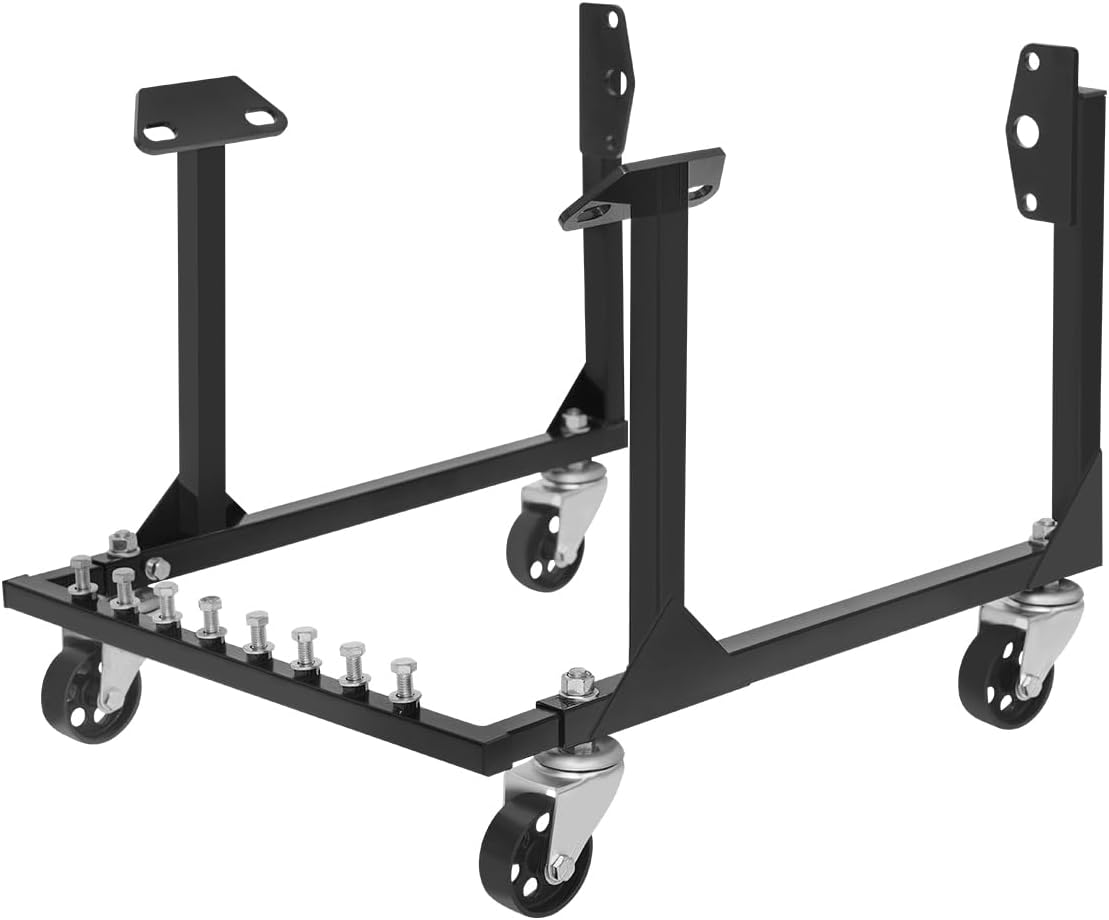
| Compatibility | Chevy Small Block and Big Block (not LS) |
|---|---|
| Material | Heavy-duty steel |
| Finish | Black powder-coated |
| Capacity | 750 LBS |
| Mobility | 3-inch swivel casters |
This rolling engine cradle is a straightforward shop aid for anyone working on Chevy small block or big block engines. It bolts together quickly and sits on three-inch swivel casters so you can roll an engine around the garage for disassembly, rebuilds, or short-term storage. The heavy-duty steel frame with a black powder coat provides rust resistance and the stand is rated to support up to 750 pounds, which covers most small- and big-block Chevy units. The design is not compatible with GM LS engines, so fitment is limited to the specified engine families. Assembly is basic and hardware is included, making it usable with common hand tools. Expect a stable platform for routine engine work and easy repositioning on a flat shop floor, but it lacks the broader adapter flexibility found on more expensive universal stands. For a budget-oriented DIYer who needs a Chevy-specific rolling cradle, this delivers solid function without extra features.
Best for: Budget-conscious DIY mechanics and hobbyists who need a simple, mobile engine cradle for occasional rebuilds and repairs and prioritize affordability and basic load capacity over professional features.
Less Ideal for: Shops or builders who need a universal stand for multiple engine families or compatibility with GM LS engines should consider a different model.
- Designed specifically for Chevy small block and big block engines for straightforward fitment
- Steel construction with powder-coat finish resists rust and offers durable support
- 750 lb capacity covers the weight of most small- and big-block Chevy engines
- Three-inch swivel casters provide full 360-degree mobility for easy positioning
- Includes hardware and simple bolt-on assembly for quick setup with basic tools
- Not compatible with GM LS engines so it will not fit those engine families
- Limited adapter options compared with universal engine stands that accept multiple engine types
Verdict: A low-cost engine stand that delivers acceptable load capacity and basic stability for occasional DIY engine work without unnecessary features.
Vigorighter 3000 lb Foldable Engine Stand with 360° Rotating Head
Best Heavy-Duty Engine Stand

| Brand | Vigorighter |
|---|---|
| Model | 3000 LBS Engine Stand |
| Capacity | 3000 lb |
| Mounting | 360° rotating head with 4 adjustable arms |
| Mobility | 6 swivel lockable casters |
The Vigorighter 3000 lb engine stand is built to hold large powerplants securely while you work. Its steel frame and powder-coated finish give the stand durability for regular shop use, and the foldable design makes it easy to store when not in use. The four adjustable arms and fully rotating head let you mount and position engines for access to all sides, which is helpful for disassembly, machining, and detailed repairs. Six swivel casters provide smooth movement across a garage floor and the lockable wheels keep the stand stable while you turn or work on the engine. Assembly and initial positioning require typical shop tools and at least two people for safety with heavier engines. The stand is sizable and designed for heavy engines, so it is less convenient for light, occasional tasks in tight spaces. For DIY mechanics who regularly handle big engines and need a stable, mobile stand that stores compactly, this model covers the essentials; if you only need occasional light-duty support, a smaller, lighter option may be easier to manage.
Best for: DIY mechanics and small-shop technicians who need a rugged, high-capacity engine stand for frequent heavy-duty jobs and want a stable, movable platform that resists flex under larger engines.
Less Ideal for: Casual hobbyists who only work on small engines or have limited garage space should consider a lighter, simpler stand instead.
- High 3000 lb rated capacity for heavy engines
- 360 degree rotating head and 4 adjustable arms for full access during repairs
- Six swivel casters with locks enable easy positioning and secure holding
- Foldable design saves floor space when stored
- Large and heavy to move without assistance
- Assembly and mounting heavier engines typically requires two people
Verdict: A beefy, high-capacity engine stand built with thicker steel and reinforced welds to handle larger engines and frequent shop use with minimal flex.
JY PERFORMANCE LS Engine Cradle Rolling Stand for GM Chevy V8 LSx Engines
Best Compact Engine Stand

| Applicable engines | GM Chevy V8 LSx series (LS1, LS2, LS3, LS6, LS7, LSX) |
|---|---|
| Wheels | 3 inch swivel caster wheels |
| Assembly required | No (includes mounting hardware) |
This LS engine cradle is a compact, wheeled support designed specifically for GM Chevy V8 LSx engines such as LS1 through LS7 and LSX variants. Built from high-strength steel, it functions as a rolling storage and service platform that secures the engine and transmission for work, transport around the shop, or longer-term storage. The four 3 inch swivel caster wheels make repositioning easy in tight garages, while the included mounting hardware and straightforward assembly mean you can install an engine to the cradle with minimal fuss. For DIY mechanics doing engine swaps, rebuilds, or performance projects, the cradle provides stable support and mobility without the bulk of a full engine stand. Limitations are that the product is purpose-built for LS-series V8s so it will not work with other engine families and it does not include a powered hoist or lift, so you will still need a separate method to lift the engine into place.
Best for: DIY mechanics and hobbyists with limited garage space who need a compact, mobile cradle for storing, moving, and working on GM Chevy V8 LS-series engines during swaps, rebuilds, or short-term storage.
Less Ideal for: Buyers who need a universal engine stand for multiple engine families or an integrated lifting solution should consider other options.
- Purpose-built fit for GM Chevy LS-series V8 engines for accurate mounting
- High-strength steel construction offers durable support for engine and transmission
- Three-inch swivel caster wheels provide easy mobility in tight shop spaces
- Includes mounting hardware and instructions for quick assembly and setup
- Specifically designed for LS-series V8 engines so not compatible with non-LS engines
- Does not include a lifting mechanism so a hoist or crane is required to load the engine
Verdict: A smaller-footprint engine stand that offers adequate capacity while folding or taking up less garage space for users with limited room.
Sunex Tools 8300GB Foldable 1/2-Ton Engine Stand
Best Folding/Portable Engine Stand

| Load Capacity | 1000 Pounds |
|---|---|
| Material | Metal |
The Sunex 8300GB is a compact, foldable engine stand designed for DIY garages and small shops that need a stable platform for engine work. It mounts to most automotive engines with an adjustable head and adapter fingers, then uses a 63:1 self-locking worm drive gearbox so you can rotate the engine smoothly and lock it in place with the crank. The frame folds for easier storage and the four-wheel base with two locking swivel casters lets you position the engine and then secure the stand during work. Practical benefits include straightforward rotation for access to all sides of the engine and easier movement around the shop compared with fixed stands. The half-ton capacity is suited to most four- and some six-cylinder engines but will not support heavier V8s or long-block assemblies, so buyers should confirm their engine weight before relying on it. Expect basic metal construction with a focus on portability rather than heavy-duty commercial use.
Best for: A DIYer who needs a compact, mobile engine stand for home garage projects—someone who values easy storage and safe, adjustable engine positioning for occasional to moderate engine repair and maintenance.
Less Ideal for: Professional shops or enthusiasts who frequently work on heavy V8s, full long-block rebuilds, or need a very high-capacity, heavy-duty stand.
- Self-locking worm drive gearbox allows controlled rotation and positive locking of the engine position
- Foldable design saves floor space and makes storage easier when not in use
- Adjustable mounting head and adapter fingers accommodate a range of engine flange patterns
- Two locking swivel casters provide maneuverability and the ability to secure the stand during work
- 1000 pound capacity limits use to lighter engines and excludes many V8s and high-displacement units
- Construction is optimized for portability rather than heavy commercial workloads
Verdict: A portable, easy-to-move engine stand that folds or disassembles quickly for storage or transport while still providing safe support for engine work.
KAFLLA 3000 lb Folding Engine Stand with 360° Rotating Head
Best High-Capacity Engine Stand

| Capacity | 3000 lbs |
|---|---|
| Rotation | 360° rotating head |
| Arms | 4 adjustable arms |
| Wheels | 6 casters |
This KAFLLA engine stand is built to hold very heavy engines in a home or small shop setting. It mounts engines on a four-arm plate that rotates a full 360 degrees, giving clear access to any side of the block for disassembly, cleaning, or rebuild work. The stand uses heavy steel construction and a powder-coated finish for corrosion resistance, and its six casters make it easier to move a loaded engine around the garage. When not in use the legs fold for compact storage, which helps save floor space in tighter workshops. Practical benefits include high load capacity that accommodates most automotive engines and a lever/rotation setup that improves access and ergonomics while you work. Important limitations are that a heavy engine still requires careful rigging and an appropriate hoist to transfer onto the stand, and the product may require assembly and regular inspection of fasteners and casters under heavy loads.
Best for: Home mechanics and small shop owners who regularly handle large engines or long-block rebuilds and need a beefy, stable stand that tolerates very heavy loads while remaining movable and foldable for storage.
Less Ideal for: Small hobbyists with only light engine work or those without any lifting equipment should consider lighter, simpler stands or complete hoist-and-stand kits instead.
- 3000 lb rated capacity supports large engines for full teardown and rebuilds
- 360° rotating head with four adjustable arms gives access to all sides of the engine
- Six casters provide smoother movement and easier positioning of a loaded engine
- Foldable frame saves workshop floor space when the stand is not in use
- Requires a separate hoist or crane to lift and mount heavy engines onto the stand
- Heavy-duty assembly and periodic maintenance of bolts and casters are necessary for safe long-term use
Verdict: An engine stand rated for very heavy loads, suitable for long-blocks, V8s, or engines with heavy accessories where higher weight tolerance is required.
OTC 1750A Revolver Diesel Engine Stand with Universal Adapter
Best Premium Engine Stand

| Load Capacity | 12 tons |
|---|---|
| Included Components | Universal Engine Adapter Assembly |
| Required Assembly | No |
The OTC 1750A is a shop-grade engine stand engineered to support heavy truck diesel engines and transmissions during rebuilds and service. It features a worm-and-gear 96:1 revolver head that lets you rotate the mounted unit a full 360 degrees and lock the crank handle at any position for hands-free access. A built-in 12-ton jack raises the engine to provide clearance for rotation while two large front wheels and two rear casters let you reposition the stand in a busy bay. The included universal adapter assembly accepts a range of mounting plates used on heavy-duty engines, so you can mount varied diesel blocks without fabricating custom brackets. Practical benefits include stable support for large assemblies, straightforward rotation for bottom-end work, and on-stand lift capability that reduces the need for separate lifting equipment. Limitations are that it is a specialized heavy-duty tool that is bulky and requires substantial floor space and a capable floor surface, and mounting plates are not included so you may need additional adapters for some engines.
Best for: Experienced DIY mechanics and small-shop technicians who need a heavy-duty, long-lasting engine stand for rebuilding large diesel engines and transmissions and who prioritize precise, smooth rotation and built-in lifting convenience for frequent, professional-level work.
Less Ideal for: Casual hobbyists with limited garage space or those who only work on small gasoline engines should consider a smaller, more compact stand instead.
- Full 360-degree worm-and-gear revolver head with lockable crank for precise positioning
- Built-in 12-ton jack provides on-stand lift for rotation clearance without extra equipment
- Universal engine adapter assembly increases compatibility with a range of heavy-duty engines
- Large front wheels and rear casters allow maneuvering a loaded stand around the shop
- Designed for heavy-duty diesel applications so it is large and requires significant floor space
- Mounting plates are not included which may require purchasing or fabricating additional adapters
Verdict: A top-tier engine stand offering superior materials, precise fitment, smoother rotation, and extra features aimed at mechanics who prioritize long-term durability and convenience.
How We Chose the Best Engine Stand
We selected these engine stand picks by focusing on the needs of DIY mechanics working in home garages, not full time production shops. The main filters were load capacity, mounting head design, rotational control, base stability, caster layout, and storage footprint. We also looked closely at frame construction, weld quality, hardware layout, and whether the stand appeared easy to assemble and maneuver when loaded.For this category, the most important specs are realistic engine weight support, how securely the mounting arms adjust to different block patterns, and whether the rotating head locks positively in multiple positions. We gave extra credit to stands with wide, confidence inspiring bases, smooth rolling casters, and designs that leave enough access around the oil pan and lower block areas.We excluded units with vague capacity claims, cramped mounting designs, weak looking locking mechanisms, or layouts that seemed better suited to very light engines only. We also filtered out bulky options that take up too much space for typical home garage use unless they offered a clear stability advantage.
Our full evaluation process is outlined in our review methodology.
What Size Engine Stand Do DIY Mechanics Usually Need?
For most home garage projects, the right capacity depends on the type of engine you plan to mount and how complete it will be while on the stand. A bare four cylinder or small V6 places very different demands on a stand than a fully dressed iron block V8. That is why capacity should be treated as a working safety margin, not a number to match exactly. Choosing a stand with extra headroom usually improves confidence, stability, and long term durability.
bullets can help compare common use cases. If you mainly rebuild compact or mid size engines, a lighter duty stand may be enough. If you work on truck engines, older cast iron blocks, or occasionally leave more components attached, stepping up in capacity is the safer move. It also makes sense to think about future projects instead of buying only for the engine currently in your garage.
- Use a comfortable safety margin instead of matching stand capacity to engine weight exactly
- Bare long blocks are easier to support than engines with heavy accessories still attached
- Heavier capacity stands often bring stronger frames and a more stable base
- If you plan to work on multiple engine types, buy for the heaviest realistic project
Why Rotating Head Design Matters More than Many Buyers Expect
One of the biggest advantages of an engine stand is the ability to rotate the engine so you can reach different surfaces without awkward lifting or risky repositioning. A good rotating head should turn predictably, lock positively, and hold the engine where you put it. For DIY work, this matters when checking bearing surfaces, installing internal parts, cleaning gasket areas, and working on the bottom end without crawling around the stand.
The mounting head also affects how easily the engine lines up during installation. Adjustable arms are especially important because bellhousing bolt patterns vary. A cramped or poorly arranged head can make mounting more difficult and may limit your access once the engine is in place. When comparing stands, look beyond the headline capacity and pay close attention to how the head locks, how many positions it supports, and whether the arm adjustment range looks practical for the engines you expect to handle.
- Look for a locking mechanism that engages clearly and feels secure
- Adjustable mounting arms should allow good bolt pattern coverage
- Rotation should be smooth enough to control without sudden movement
- The stand should keep useful access to the lower block and rear mounting area
Base Shape, Caster Layout, and Shop Stability
Stability starts at the floor. Even a strong upright section will feel less confidence inspiring if the base is too narrow, poorly balanced, or fitted with small casters that struggle over seams and rough concrete. DIY mechanics often work in shared spaces, tight bays, or garages where the engine stand needs to move around other tools and parked vehicles. That makes the relationship between stability and mobility especially important.
A wider base can help the stand feel planted under load, especially when rotating a heavier engine. At the same time, a stand that is overly bulky may be harder to store and awkward to maneuver. Caster size and placement matter because loaded stands do not move like empty carts. Better rolling behavior reduces effort and helps prevent the sudden stops and jerks that can unsettle a mounted engine. If your floor has cracks, expansion joints, or uneven spots, prioritize caster quality and frame rigidity over compactness alone.
- Wide bases generally improve loaded stability
- Caster quality matters on typical garage floors
- Frame rigidity helps the stand feel more predictable during rotation
- Compact designs are easier to store but should not sacrifice balance
Folding Versus Fixed Frame Engine Stands
A folding engine stand can be very appealing in a home garage because it takes up less space when the project is done. If storage is a major issue, this style can make ownership much more practical. However, the folding mechanism adds another design element that needs to be sturdy and well executed. A stand that stores neatly is only useful if it still feels solid during actual engine work.
Fixed frame stands are often simpler and may inspire more confidence because there are fewer joints and moving frame sections involved. They can be a better match for mechanics who regularly rebuild engines or want a dedicated station in the shop. The real choice comes down to how often you use the stand, how much open floor area you have, and whether quick storage is a priority after each project. Neither style is automatically better. The best option is the one that fits your workflow without compromising stability.
- Choose folding if storage space is limited and the design still looks robust
- Choose fixed frame if you want a simpler, always ready setup
- Check how easy the stand is to collapse or store when empty
- Do not trade too much stability for a smaller footprint
Features That Make Engine Work Easier in Practice
Some engine stand details seem minor on paper but make a real difference once the engine is mounted. Better handle placement can improve leverage during rotation. Clear locking pin engagement helps you confirm the head is secure before letting go. More usable mounting arm adjustment can save time during setup and reduce frustration when aligning bolt holes. Even the position of crossmembers can affect access while cleaning, painting, or installing parts.
Ease of assembly is also worth considering for DIY mechanics who may only buy one engine stand and expect it to last for years. Hardware that fits cleanly, instructions that are easy to follow, and a design that does not fight you during initial setup all contribute to a better ownership experience. Durability is not only about thick steel. It is also about whether the stand feels thoughtfully designed for real engine service instead of just checking a capacity box on paper.
- Rotation handle length affects control and leverage
- Positive locking pins improve confidence during repositioning
- Mounting arm range can simplify fitment across engine types
- Thoughtful frame layout can improve working access
How to Match an Engine Stand to Your Garage Workflow
Think about the full job, not just the moment the engine is mounted. If you usually strip engines completely before placing them on the stand, your needs may differ from someone who mounts a more complete assembly for teardown. If the stand will spend most of its life tucked against a wall, storage footprint matters. If it will be moved often between work areas, caster performance and maneuverability rise to the top.
Also consider what other equipment you use around it. An engine stand needs room for rotation, room for tools, and enough surrounding space to work safely without tripping over parts. In smaller garages, choosing a stand with a balanced footprint can make the whole workflow easier. A stand that is technically strong enough but frustrating to position or store may not be the right fit. Matching the design to your habits is often what separates a smart purchase from one that only looks good in a spec list.
- Buy for how you actually remove, strip, and rebuild engines
- Measure storage space before choosing a larger frame
- Allow clearance for full rotation and tool access
- Consider how often the stand needs to be moved when loaded
Common Engine Stand Buying Mistakes to Avoid
A common mistake is focusing only on the highest advertised capacity and ignoring everything else. Capacity matters, but it does not tell you how stable the stand feels, how easy the engine is to mount, or whether the rotating head locks securely. Another mistake is underestimating floor space. A stand may fit in theory, yet still be awkward if it blocks your working path or cannot rotate freely in your garage layout.
Buyers also sometimes overlook the importance of realistic project planning. If you know heavier engines are in your future, it is usually better to step up now than replace the stand later. On the other hand, going too large can make storage and handling more annoying than necessary for a small garage. The goal is balance. Choose a stand with enough capacity, good rotational control, and a base design that matches both your engines and your workspace.
- Do not judge by capacity alone
- Do not ignore rotation lock design and mounting arm adjustability
- Do not overlook floor space and storage needs
- Do not buy too light for future engine projects
FAQ
What capacity engine stand is best for most DIY mechanics?
For many home users, the best capacity is one that comfortably exceeds the weight of the heaviest engine they realistically plan to mount. A healthy safety margin is better than choosing a stand that is only barely rated for the load. If you work on larger cast iron engines or leave more components attached, moving up in capacity is the smarter choice.
Are folding engine stands strong enough for engine rebuilds?
A well designed folding engine stand can work very well for DIY rebuilds, especially when garage space is limited. The key is to make sure the folding joints, locking points, and overall frame layout still look robust and stable under load. If maximum rigidity matters more than storage convenience, a fixed frame design may be a better fit.
How important is 360 degree rotation on an engine stand?
Full rotation is very useful because it gives better access to the top, sides, and bottom of the engine during teardown, cleaning, and assembly. What matters most is not the marketing number but how controlled the rotation feels and how securely the head locks in position. Smooth movement and positive locking are more important than rotation range alone.
Can an engine stand hold a complete engine with accessories attached?
That depends on the engine weight, the stand's capacity, and how the load is distributed. Many DIY mechanics remove some accessories first to reduce weight and improve balance before mounting the engine. Even if a stand has the raw capacity, a stripped or partially stripped engine is usually easier and safer to work with.
What should I look for in the mounting arms?
Look for enough adjustability to match different bellhousing bolt patterns and to spread the load securely across the mounting points. Arms should appear sturdy, easy to position, and able to maintain clearance where you need to work. Limited adjustment can make installation harder and reduce overall convenience.
Do caster wheels really make a big difference on an engine stand?
Yes, especially in home garages with rough concrete, cracks, or expansion joints. Better casters help the stand roll more smoothly and reduce the jolts that can happen when moving a loaded engine. Good mobility also makes it easier to position the stand exactly where you want it for safe, efficient work.
Final Verdict
Choosing the right engine stand comes down to more than a simple capacity number. DIY mechanics should weigh engine size, rotating head design, base stability, caster performance, and storage needs together. The best choice is the one that supports your heaviest realistic project while still fitting your garage and your workflow.If you want to choose confidently, start with a safe capacity margin, then focus on secure rotation, practical mounting adjustment, and a base that feels stable on your floor. Once those fundamentals are covered, you can narrow the field based on storage convenience and how often you plan to use the stand.
