

Note: This article contains affiliate links. If you click on these links and make a purchase, I may earn a small commission at no extra cost to you. This helps support my research and content. Read my full affiliate disclosure here.
An automotive test light is one of the simplest ways to check for power, trace wiring faults, and confirm whether a circuit is doing what it should. For DIY mechanics, it can speed up troubleshooting on lighting, fuses, switches, trailers, batteries, and many common no power complaints without the setup time of a larger diagnostic tool.The right test light depends on the vehicles you work on, the circuits you plan to probe, and how much durability you need in the garage. In the picks that follow, you will find options suited to different diagnostic styles, followed by practical guidance to help you choose with confidence.
Top Picks at a Glance
| Best Overall Automotive Test Light for DIY Mechanics Reliable, versatile tester suitable for most common electrical diagnostics | WINAMOO Automotive Test Light with Digital Voltage Display |  |
| Best Budget Automotive Test Light for DIY Mechanics No-frills, dependable tester for basic checks on a tight budget | FEAOXYO Automotive Test Light Circuit Tester 6–24V with Alligator Clip and Steel Probe |  |
| Best Compact Automotive Test Light Slim, pocket-friendly probe built for tight spaces and convenience | OTC 3633 Mini-Coil Cord Circuit Tester |  |
| Best Heavy-Duty Automotive Test Light Durable, impact-resistant unit made for frequent garage and shop use | JASTIND Heavy-Duty 3–65V Backlit Digital LCD Circuit Tester |  |
| Best Digital Automotive Test Light Display-equipped tester offering precise voltage readouts and diagnostic clarity | WINAMOO Digital Automotive Test Light with LED Voltage Display |  |
| Best Multi-Function Automotive Test Light All-in-one diagnostic tool combining voltage, continuity, and polarity checks | TopDiag P60 12V Automotive Power Circuit Probe Tester (6V–30V) |  |
| Best Premium Automotive Test Light Top-tier tester with pro-grade accuracy, materials, and long-term reliability | Autel PowerScan Automotive Circuit Tester (Power Probe) |  |
WINAMOO Automotive Test Light with Digital Voltage Display
Best Overall Automotive Test Light for DIY Mechanics

| Power Source | Corded Electric |
|---|---|
| Minimum Operating Voltage | 3 Volts |
| Maximum Operating Voltage | 48 Volts |
| Measurement Type | Voltmeter |
The WINAMOO Automotive Test Light is a compact voltmeter-style circuit tester designed for quick diagnostics on cars, trucks, SUVs, and small boats. It uses a sharp stainless steel probe and a large alligator clip connected by a long spring cord so you can clip to a ground and probe fuses, sockets, connectors, or battery terminals while reading a 0.1V-resolution LED display. The bidirectional LED indicators show polarity and the numeric readout makes it easy to confirm battery voltage, alternator output, and basic circuit continuity without guessing. Its protective sleeve for the probe and ergonomic ABS body make handheld use safer during routine checks. Limitations include a 3–48V operating range that excludes higher-voltage systems and no advanced functions like resistance or current measurement, so it is not a substitute for a multimeter for detailed troubleshooting. For routine DIY electrical checks it speeds diagnosis and reduces trips to a shop, but advanced diagnostics will still require more specialized tools.
Best for: DIY mechanics who need a reliable, easy-to-read circuit tester for routine automotive electrical troubleshooting and battery/charging checks, and who value a durable, straightforward tool that balances accuracy and affordability.
Less Ideal for: Electronics technicians who need in-depth measurements like resistance or current, or users working on high-voltage systems who require broader measurement ranges and advanced diagnostics.
- Clear digital LED readout with 0.1V resolution for quick, unambiguous voltage checks
- Bidirectional LED polarity indicators to identify positive or negative circuits at a glance
- Long spring wire and large alligator clip allow single-handed testing across a vehicle
- Sharp stainless steel probe with protective sleeve for piercing insulation and safe storage
- Ergonomic ABS handle designed for durable, comfortable use during repeated checks
- Limited to 3–48V systems so it cannot test higher-voltage equipment
- Does not measure resistance or current, so it cannot replace a multimeter for detailed diagnostics
Verdict: The all-around best automotive test light for DIY mechanics that balances accuracy, durability, ease of use, and value for common electrical diagnostics.
FEAOXYO Automotive Test Light Circuit Tester 6–24V with Alligator Clip and Steel Probe
Best Budget Automotive Test Light for DIY Mechanics

| Power Source | Battery Powered |
|---|---|
| Minimum Operating Voltage | 6 Volts |
| Maximum Operating Voltage | 24 Volts |
| Measurement Type | Volts |
| Compatible Devices | Cars, Trucks, SUVs, RVs |
This compact test light is a handheld circuit tester designed for quick electrical checks on 6–24V DC systems in cars, trucks, SUVs and RVs. You clip the alligator lead to a known reference (ground or battery terminal), then touch the stainless steel probe to fuses, wires or connectors; the internal bulb lights to indicate voltage and its brightness changes with voltage level. The non-slip ergonomic handle and long flexible lead make it easy to reach confined areas, while the pointed probe can pierce insulation for direct contact. It is well suited to routine tasks like checking turn signal feeds, headlight circuits, fuses and simple continuity checks. Limitations are its basic incandescent-style indicator rather than a numeric readout and the lack of protection against reverse polarity or higher-voltage systems, so it is not intended for modern higher-voltage diagnostics or precision measurements. For straightforward, low-cost troubleshooting this tool is practical and easy to use, but technicians needing digital accuracy or advanced safety features should consider more capable testers.
Best for: Hobbyist and home mechanics who want an inexpensive, no-frills test light for basic continuity and 6–24V DC voltage checks during routine vehicle diagnostics and small repairs.
Less Ideal for: Professionals or hobbyists who need precision voltage readings, digital diagnostics, or advanced safety features for modern vehicle electrical systems.
- Covers common 6–24V DC automotive circuits for broad entry-level diagnostics
- Bright built-in bulb gives an intuitive visual indication of voltage presence
- Long flexible lead and sharp stainless steel probe reach tight spaces and pierce insulation
- Ergonomic non-slip handle for secure grip during hands-on work
- Simple incandescent indicator provides qualitative rather than numeric voltage readout
- No built-in protections for reverse polarity or higher-voltage systems
Verdict: The best low-cost test light that delivers reliable continuity and voltage checks for hobbyist mechanics without unnecessary features or cost.
OTC 3633 Mini-Coil Cord Circuit Tester
Best Compact Automotive Test Light

| Power Source | Corded Electric |
|---|---|
| Minimum Operating Voltage | 6 Volts |
| Measurement Type | Voltmeter |
| Compatible Devices | Vehicles with electrical circuits |
The OTC 3633 Mini-Coil Cord Circuit Tester is a handheld, corded voltmeter-style tester designed to find shorts, grounds, and open circuits on 6V and 12V vehicle electrical systems. It uses a needlepoint stainless steel probe for back-probing and piercing and includes a threaded probe with a screw-on alligator clip for hands-free connection. A bright replaceable bulb in the slim, clear handle provides visual indication while the 12 foot coiled cord gives reach around an engine bay without excess slack. In practice this tester is used for quick diagnostics on wiring, fuses, switches, and connectors where a simple, direct indication of voltage or continuity is enough to narrow a problem before deeper diagnostics. Its ergonomic slim handle and durable probe make it easy to maneuver into tight spaces, but it does not provide digital readouts or low-impedance circuitry for sensitive electronics, so it is best for basic electrical troubleshooting rather than precise measurements or modern vehicle network diagnostics.
Best for: DIY mechanics who need a pocket-friendly test light for accessing tight spaces and quick electrical checks, prioritizing portability and straightforward, visible indication over advanced diagnostics.
Less Ideal for: Technicians who need precise digital measurements, low-impedance tracers, or tools specifically for modern vehicle network diagnostics should consider more advanced testers.
- Needlepoint stainless steel probe for accurate back-probing and piercing.
- Includes screw-on alligator clip for hands-free connections and versatility.
- Long 12 foot coiled cord for access around the engine bay without excess slack.
- Slim ergonomic handle with a bright replaceable indicator bulb for clear visual feedback.
- Provides a simple bulb indication only and lacks a digital voltage readout.
- Not designed for sensitive low-impedance testing or modern vehicle bus diagnostics.
Verdict: A slim, pocket-friendly test light that prioritizes portability and access to tight spaces while still providing clear indication and basic durability.
JASTIND Heavy-Duty 3–65V Backlit Digital LCD Circuit Tester
Best Heavy-Duty Automotive Test Light

| Power Source | Battery Powered |
|---|---|
| Minimum Operating Voltage | 3 Volts |
| Measurement Type | Voltmeter |
| Compatible Devices | Vehicles with 3-65V DC electrical systems |
This JASTIND circuit tester is a practical diagnostic tool for DIY mechanics working on 12V and small 24V vehicle electrical systems. It measures DC voltage from 3 to 65 volts and shows readings to one decimal on a backlit LCD, so you can quickly verify battery voltage, check headlight and taillight circuits, probe fuses and sockets, and confirm polarity. The 140 inch extended PU spring lead plus a large alligator clip makes one-handed testing in cramped engine bays easier, and the stainless probe with rubber tip helps access tight points while reducing shock risk. The tester draws very little current compared with incandescent test lights, which makes it safer for sensitive electronics and computer-controlled circuits. Accuracy is listed at about ±0.2V and the clear digital readout is usable day or night. Limitations: it is a voltmeter-style tester, so it will not load a circuit like a bulb-based tester for some specific diagnostics, and the body is plastic so very rough shop use could cause wear over long term use. Overall this is a solid, user-friendly tester for routine electrical checks on cars and trucks.
Best for: Hands-on DIY mechanics and small-shop technicians who need a rugged, reliable test light for frequent garage use, rough handling, and a wide range of 3–65V vehicle electrical troubleshooting tasks.
Less Ideal for: Technicians who need load-testing or bulb-illuminating functionality for advanced diagnostics should choose a different tool; likewise, heavy commercial shops that put tools through extreme daily abuse may want a metal-bodied tester built for industrial use.
- Wide 3–65V DC measurement range covers most automotive and light truck electrical systems
- Backlit digital LCD with 0.1V resolution for clear, accurate voltage readings day or night
- Long 140 inch coiled PU spring lead and large alligator clip allow easier access in cramped engine bays
- Sharp stainless probe with insulated rubber tip for safer probing of wires and connectors
- Does not act as a load or bulb substitute so it will not reveal faults that require circuit loading
- Plastic body may show wear under heavy commercial shop use
Verdict: A rugged, well-built test light designed to withstand frequent garage use, drops, and rough handling while maintaining reliable electrical performance.
WINAMOO Digital Automotive Test Light with LED Voltage Display
Best Digital Automotive Test Light
| Power Source | Corded Electric |
|---|---|
| Minimum Operating Voltage | 3 Volts |
| Maximum Operating Voltage | 120 Volts |
| Measurement Type | Voltmeter |
| Compatible Devices | Car, Truck, Boat |
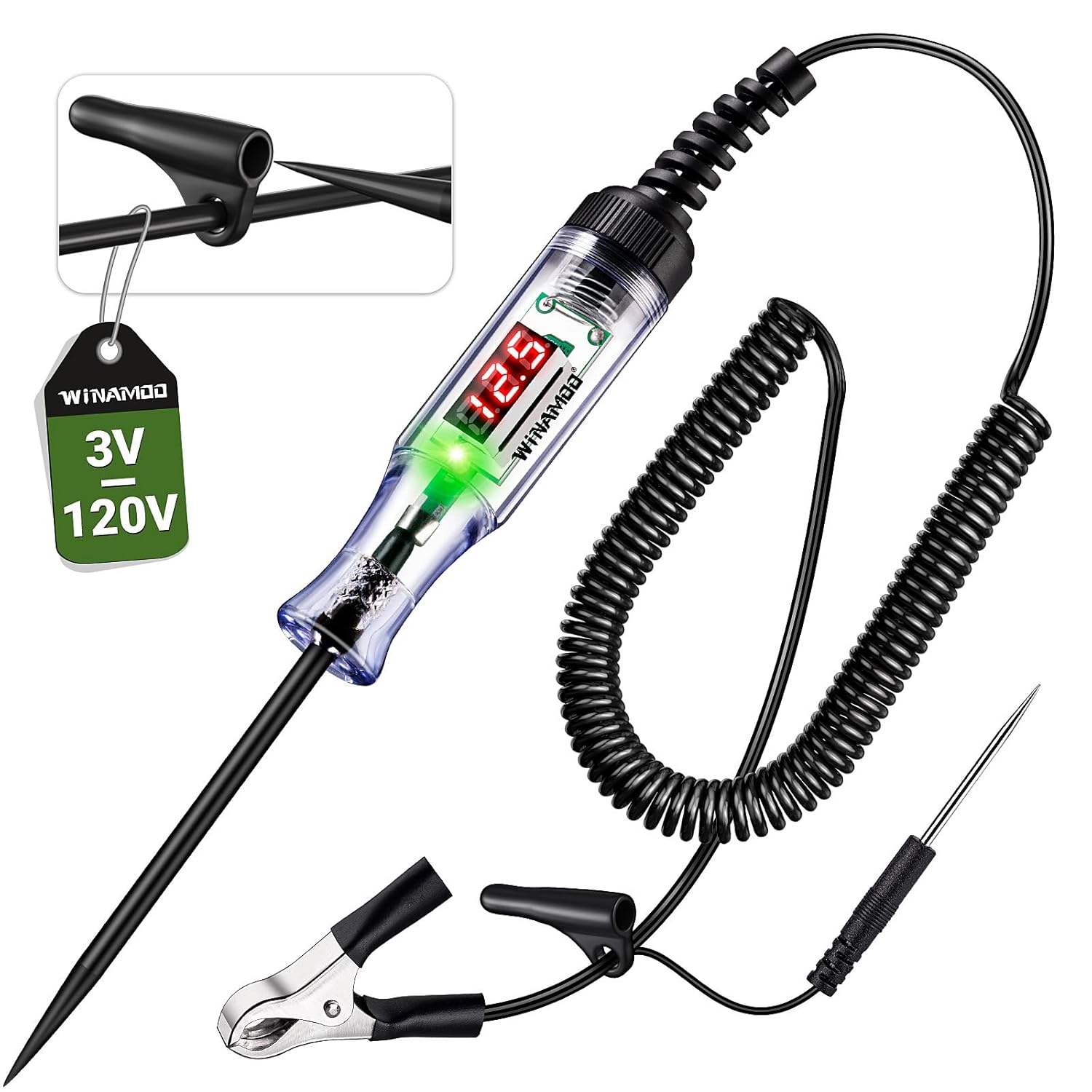
The WINAMOO Digital Automotive Test Light combines a sharp stainless probe, alligator clip and a bright LED voltmeter to quickly check battery and circuit voltage on cars, trucks and boats. You use the clip as a ground and touch the probe to connectors, sockets or wiring; the unit displays voltage to 0.1V resolution and uses dual-color LEDs to show polarity and basic load response. The extra probe on the lead helps reach tight spots when the clip cannot attach, and the protective sleeve keeps the probe safe in storage. Its ergonomic ABS handle and clear numeric readout make it handy for DIY troubleshooting of headlights, turn signals, fuses and alternator charging checks. Limitations are that it is a corded, single-function tester without advanced diagnostics like resistive or current measurements, and it only covers 3–120V systems so it is not suitable for low-voltage electronics testing below 3V. For hands-on home mechanics who need a simple, accurate voltage tester, it provides fast, visible results; those needing deeper electrical analysis should look for a multimeter or specialized diagnostic tool.
Best for: A DIY mechanic or hobbyist who wants a compact, digital test light for quick, accurate voltage checks and basic charging/circuit diagnostics on cars, trucks, SUVs, or boats without needing a full multimeter.
Less Ideal for: Users who need full electrical diagnostics, data logging, or measurements below 3V should consider a digital multimeter or specialized tools instead.
- Digital LED display with 0.1V resolution for clear voltage readings
- Includes large alligator clip plus an extra probe for access in tight areas
- Sharp stainless probe with protective sleeve for piercing insulation and safe storage
- Ergonomic ABS handle and bright indicators for easy one-handed use
- Does not measure current or resistance so it cannot replace a multimeter
- Corded single-range design limits portability compared with battery-powered handheld testers
Verdict: A test light with a digital display or meter that gives more precise voltage readings and diagnostic information than a simple neon or LED probe.
TopDiag P60 12V Automotive Power Circuit Probe Tester (6V–30V)
Best Multi-Function Automotive Test Light

| Power Source | AC, DC |
|---|---|
| Minimum Operating Voltage | 6 Volts (DC) |
| Upper Temperature Rating | 60 Degrees Celsius |
The TopDiag P60 is a compact automotive circuit probe for diagnosing 6–30V vehicle electrical systems. It is used by connecting the probe to a circuit or component to read voltage, verify continuity, activate relays or solenoids, and help locate short or open circuits. The P60 adds diode detection and a grounding test to common probe functions and includes a built-in LED to light work areas. Practical benefits include the ability to backfeed or jump a circuit for component activation, quickly trace shorted wiring, and confirm fuse and ground integrity without needing a bench multimeter for many tasks. Limitations are that it is focused on 6–30V systems only, so it will not cover higher-voltage applications, and its probe-based design requires careful contact and some familiarity with vehicle wiring to avoid accidental shorts. For routine DIY electrical troubleshooting the P60 speeds diagnosis and reduces disassembly compared with basic test lights.
Best for: DIY mechanics and home hobbyists who want one compact tool to diagnose a wide range of 6–30V vehicle electrical issues, from voltage and polarity checks to continuity and short‑circuit tracing, without juggling multiple testers.
Less Ideal for: Professionals who need bench-grade measurement precision or diagnostic coverage beyond 30V should consider more advanced diagnostic tools or dedicated multimeters and oscilloscopes.
- Works across common automotive voltages (6–30V) for most cars, trucks, motorcycles, and small equipment
- Can activate components and backfeed circuits to test relays, solenoids, and actuators without removing them
- Includes diode detection and grounding test functions for more complete electrical troubleshooting
- Built-in LED illumination improves visibility when probing in dark engine bays
- Limited to 6–30V systems and not suitable for higher-voltage or specialized industrial circuits
- Probe operation requires care and wiring knowledge to avoid accidental shorts during testing
Verdict: A test light that combines multiple tools—such as continuity, voltage detection, and polarity indicators—into one unit for broader diagnostic capability.
Autel PowerScan Automotive Circuit Tester (Power Probe)
Best Premium Automotive Test Light

| Operating voltage | 12–24 V |
|---|---|
| DC voltage range | 0–65 V |
| Resistance range | 0–200 kΩ |
| Display | TFT color (160 x 128 dpi) |
The Autel PowerScan is a multifunction automotive circuit probe designed for hands-on troubleshooting of 12V and 24V vehicle electrical systems. It combines voltage and polarity checks, continuity and resistance measurement, tone tracing, component activation and a short-locating mode in a single handheld tool. In practice you clip it to the vehicle battery or cigarette adapter, then use the 20 ft built-in lead and included 20 ft extension to reach connectors and harnesses without moving the vehicle. The color TFT display and LED/beeper polarity indicators make it easy to identify positive, negative and open circuits, while the ability to activate relays, motors and lights helps verify component function without disassembly. The tester also includes an internal circuit breaker for overload protection and a built-in flashlight for dark work. Drawbacks are the reliance on vehicle power rather than an internal battery and the complexity of multiple modes which has a learning curve for casual users. Overall it is a capable, pro-oriented probe that speeds diagnostic work for DIY mechanics comfortable with electrical testing.
Best for: Serious DIY mechanics and professional-minded hobbyists who want a durable, feature-rich test light for in-vehicle electrical diagnosis and component activation, especially when accuracy, long reach, and advanced functions like polarity, continuity, and short-locating are priorities.
Less Ideal for: Buyers who need a very simple plug-and-play test light for occasional use or those who prefer battery-powered handheld tools for off-vehicle testing.
- Combines voltage, polarity, continuity, resistance and tone tracing in one probe for versatile diagnostics
- Ability to activate components on- or off-board to confirm operation without removal
- Long 20 ft lead plus 20 ft extension lets you reach wiring harnesses and trailers easily
- Internal circuit breaker provides overload protection and reduces risk of damage during tests
- Color TFT display and audible/LED indicators make readings and polarity easy to interpret
- Requires vehicle 12V/24V power or cigarette adapter instead of an internal battery
- Multiple modes increase complexity and require reading the manual to use effectively
Verdict: A higher-end test light that offers advanced features, superior build quality, longer lifespan, and professional-grade accuracy for serious DIYers.
How We Chose the Best Automotive Test Light
We focused on the factors that matter most when using an automotive test light in real garage troubleshooting. First, we looked at voltage compatibility, especially whether a tool was clearly suited for typical 6 volt and 12 volt automotive systems or broader use cases. We also considered probe design, including tip sharpness, insulation, and how safely the tool could access tight fuse panels, sockets, and connectors. Lead length and clip quality mattered because a secure ground and enough reach make testing faster and more accurate around engine bays and trailers.Build quality was another key filter. We favored sturdy housings, strain relief at the cord, and designs that hold up to repeated use. We also weighed visibility, such as a bright indicator that is easy to read in daylight or dim under dash spaces, plus handling features like grip comfort and overall balance. We excluded products with vague electrical ratings, flimsy clips, weak cord construction, or designs better suited to household wiring than vehicle diagnostics.
Our full evaluation process is outlined in our review methodology.
What an Automotive Test Light Is Best Used For
A test light is ideal for quick go or no go electrical checks. It helps you confirm the presence of voltage at a fuse, connector, switch, socket, or wire without scrolling through meter settings or reading decimal values. That makes it especially useful when you want to move quickly through a suspected circuit and identify where power stops.
For a DIY mechanic, the most common jobs include checking blown fuse locations, confirming brake light and turn signal power, testing trailer connectors, verifying battery feed to accessories, and tracing basic wiring faults. It is a practical first step tool before you move to a multimeter for deeper measurements.
- Best for fast power checks on vehicle circuits
- Useful around lights, fuses, relays, switches, and trailers
- Less suited to precision voltage measurement than a digital meter
Choose the Right Type for Your Electrical Work
Not every automotive test light works the same way. Traditional incandescent style testers place a small load on the circuit, which can be helpful when checking whether a connection can actually carry current. LED style testers are often brighter, more efficient, and easier to see, but they may react differently on sensitive or low current circuits.
You should also think about the systems you actually service. If you mainly work on older cars, trucks, motorcycles, or trailers, a simple 6 volt and 12 volt compatible light may cover most needs. If your garage work includes newer vehicles with delicate electronics, safety and circuit sensitivity matter more, and careful probe use becomes essential.
- Incandescent styles can help reveal weak connections under light load
- LED styles are often easier to see in bright environments
- Match the tester to the voltage range and circuit sensitivity of your vehicles
Key Features That Matter in Daily Garage Use
Lead length is one of the most overlooked details. A short cord can turn easy checks into awkward stretches across an engine bay, while a longer lead gives you room to reach from a grounded point to fuse boxes, rear lighting, or trailer wiring. The alligator clip should grip securely and stay attached while you reposition the probe.
Probe shape and insulation also matter. A sharp tip can reach into connectors and pierce grime at contact points, but it should still be controlled and well insulated to reduce accidental shorts. A comfortable handle helps when you are working under a dashboard or following a harness one connection at a time. Visibility is equally important, especially if you often work outdoors or in poorly lit garages.
- Long enough lead for engine bay and rear vehicle testing
- Strong ground clip that stays put during repeated checks
- Insulated handle and precise probe tip for controlled access
- Bright indicator for daylight and under dash visibility
When to Use a Test Light Instead of a Multimeter
A test light shines when speed matters more than precision. If you are trying to find out whether power is reaching a component, it gives a clear answer quickly. This is especially helpful when checking fuse panel feeds, confirming switch output, or verifying whether a trailer connector pin is live when a function is activated.
A multimeter is the better tool when you need exact voltage readings, resistance values, or current measurements. It is also better for diagnosing voltage drop and checking sensors or modules where numerical accuracy matters. In many garages, the best approach is to use a test light for initial checks and a meter for confirmation and deeper diagnosis.
- Use a test light for quick power present checks
- Use a multimeter for exact readings and advanced diagnostics
- Together they cover most basic automotive electrical work
Safety Tips for Probing Vehicle Circuits
A test light is simple, but careless use can still damage a circuit or create a short. Always confirm the tester is rated for the system you are working on and avoid probing unknown wires blindly. Start with a solid ground, keep the probe controlled, and stay away from forcing the tip into connectors that are too small or sealed.
Be extra careful around modern electronics, control modules, and communication wiring. Some circuits are not meant to be loaded or back probed aggressively. If the wiring diagram points to a low voltage signal or data line, switch to a meter and use the proper test method instead. Good lighting, steady hand placement, and an organized test sequence will prevent most mistakes.
- Verify system voltage before testing
- Ground the clip securely before probing
- Avoid random probing on sensitive electronic circuits
- Use a multimeter for low voltage signals and module related diagnosis
How to Troubleshoot Faster with a Simple Test Routine
A consistent routine makes a basic circuit tester much more effective. Start at the power source and work downstream. Check the fuse first, then the input and output side of the switch, then the connector closest to the component, and finally the ground side if the component still does not work. This prevents guesswork and helps you narrow the fault quickly.
When testing lighting or accessories, activate the circuit while probing so you know the system should be live. If power is present at one point and missing at the next, the fault usually lies between those two locations. Pair this with a wiring diagram and you can solve many common issues without replacing parts unnecessarily.
- Confirm the complaint before testing
- Check source power before chasing the rest of the circuit
- Move step by step through the wiring path
- Verify grounds when power is present but the component does not operate
Mistakes DIY Mechanics Often Make when Buying One
A common mistake is buying based only on appearance and overlooking electrical rating, cord quality, and clip strength. A tester that looks sturdy but has a weak lead or poor strain relief may become frustrating long before it wears out completely. Another mistake is choosing a tool that is too basic for the range of vehicles and tasks in your garage.
It is also easy to ignore ergonomics until you are deep under a dashboard or reaching around hot engine components. Handle comfort, indicator visibility, and probe control all matter more in real use than they do on a spec list. Think about how and where you actually work, then choose a tool that supports those conditions rather than one that only seems convenient on paper.
- Do not ignore cord durability and strain relief
- Make sure the clip can hold a dependable ground
- Choose visibility and comfort for real world working positions
- Match the tester to the kinds of vehicles you service most often
FAQ
Can an automotive test light replace a multimeter?
No. A test light is excellent for quick checks to see whether power is present, but it does not replace the precision of a multimeter. If you need exact voltage values, resistance readings, or detailed sensor diagnostics, a multimeter is the better tool.
Is an automotive test light safe on newer vehicles?
It can be safe when used correctly on appropriate circuits, but caution is important. Modern vehicles have more sensitive electronics, modules, and communication lines than older systems. Use the wiring diagram, avoid probing data circuits, and switch to a meter when the circuit is low voltage or electronically controlled.
What voltage range should a DIY mechanic look for?
For many home garage tasks, compatibility with common automotive system voltages is the main requirement. Older and standard vehicle electrical work often centers on 6 volt and 12 volt applications. If you work on a wider range of equipment, check that the tool clearly states the systems it is designed to test.
Why does lead length matter so much on a test light?
A longer lead gives you more freedom to ground the tester securely and still reach the area you need to probe. This is especially helpful in engine bays, rear lighting circuits, and trailer connectors. Short leads can make routine checks awkward and may encourage unsafe positioning.
Should I choose an LED or incandescent test light?
That depends on how you use it. LED indicators are usually bright and easy to spot, while incandescent styles can place a small load on the circuit and may reveal weak connections more clearly in some situations. For general DIY troubleshooting, either can work well if the build quality and ratings are solid.
Can I use a test light to check grounds?
Yes, with the correct setup. Instead of clipping to ground and probing for power, you can clip to a known power source and probe the suspected ground side of the circuit. If the light illuminates properly, that usually confirms the ground path is present.
Final Verdict
Choosing the right automotive test light comes down to how you troubleshoot, what kinds of vehicles you work on, and how much durability you expect from a garage tool. Voltage compatibility, lead length, clip strength, probe control, and indicator visibility will affect your day to day experience far more than cosmetic details.If you want the best results, pick a tester that matches your typical circuits and lets you work safely and efficiently in tight spaces. A well chosen test light will not replace every electrical tool, but it can become the fastest and most useful first check in your diagnostic routine.
