

Note: This article contains affiliate links. If you click on these links and make a purchase, I may earn a small commission at no extra cost to you. This helps support my research and content. Read my full affiliate disclosure here.
A good fluid transfer pump can make routine garage work cleaner, faster, and far less frustrating. Whether you are moving engine oil, gear oil, coolant, or other shop fluids, the right pump helps reduce spills, improve control, and reach containers that are awkward to pour by hand. For DIY mechanics, that means less mess on the floor and more confidence during maintenance jobs.Not every fluid transfer pump works equally well for every task. Hose size, seal quality, pump style, flow rate, and fluid compatibility all affect how useful it will be in real-world use. The picks that follow are aimed at practical garage users who want dependable performance and easier fluid handling.
Top Picks at a Glance
| Best Overall Fluid Transfer Pump for DIY Mechanics All-around performer balancing flow, durability, ease, and value | Mityvac MV7201 2.3 Gallon Manual Fluid Evacuator and Dispensing Pump |  |
| Best Budget Fluid Transfer Pump for DIY Mechanics Affordable, reliable option for occasional fluid transfers and maintenance | LOZAGU Multi-Use Siphon Hand Pump (LOZ-SC03) |  |
| Best High-Flow Fluid Transfer Pump High-capacity pump focused on fast bulk fluid movement | VierKate Cordless Fuel Transfer Pump with Auto-Stop and Hand Nozzle (Bare Tool) |  |
| Best Compact Fluid Transfer Pump Space-saving, portable design for tight spots and easy storage | Slippery Pete 5cc Fluid Pump for Quart Bottles |  |
| Best Heavy-Duty Fluid Transfer Pump Built tough for frequent use, heavier fluids, and harsh conditions | Mityvac MV7300 Pneumatic 2.3 Gallon Venturi Fluid Evacuator |  |
| Best Electric Rechargeable Fluid Transfer Pump Cordless, rechargeable convenience with enough runtime for multiple jobs | Milwaukee M12 Stick Transfer Pump |  |
| Best Premium Fluid Transfer Pump Top-tier construction, refined controls, and longer lifespan for pros | Mityvac MVA6852 1.5L Fluid Evacuator and Dispensing Syringe |  |
Mityvac MV7201 2.3 Gallon Manual Fluid Evacuator and Dispensing Pump
Best Overall Fluid Transfer Pump for DIY Mechanics

| Capacity | 2.3 gallons |
|---|---|
| Operation | Manual push-button pump |
| Material | Chemical-resistant polyethylene |
| Features | Automatic overflow prevention, quick-drain spout |
The Mityvac MV7201 is a manual fluid evacuator that combines extraction and dispensing in a single portable unit for routine automotive service tasks. You operate it with a push-button pump to draw oil, coolant, ATF, or other automotive fluids into the 2.3 gallon reservoir, then use the quick-drain spout to dispense or transfer the fluid where needed. Its chemical-resistant polyethylene construction and automatic overflow prevention make it suited to workshop use and messy jobs, while the wide base improves stability during pumping. The manual design gives precise control without requiring air or power, which is convenient for home mechanics working on a variety of vehicles. Limitations are its manual operation for larger volumes and the modest 2.3 gallon capacity, which means more frequent stops when handling bigger jobs, and it lacks powered pumping speed for commercial shops that need faster throughput.
Best for: A practical DIY mechanic wanting a single, reliable pump for routine garage jobs like oil changes, coolant top-offs, and transmission fluid work who values straightforward, portable equipment that balances durability and ease of use.
Less Ideal for: Commercial shops or users who need to move large volumes quickly should choose a powered or higher-capacity evacuator instead.
- Dual-function design handles both fluid extraction and dispensing, reducing the need for separate tools
- Chemical-resistant polyethylene construction tolerates common automotive fluids
- Automatic overflow prevention reduces spills and mess during extraction
- Push-button manual pump provides precise, tool-free control and works without air or power
- Manual pumping is slower and more tiring for large-volume jobs compared with powered evacuators
- 2.3 gallon reservoir requires frequent emptying for multiple or heavy-duty fluid changes
Verdict: The one pump that balances flow rate, durability, ease of use, and price to handle most common garage fluid-transfer tasks for DIY mechanics.
LOZAGU Multi-Use Siphon Hand Pump (LOZ-SC03)
Best Budget Fluid Transfer Pump for DIY Mechanics
| Operation Mode | Manual |
|---|---|
| Gas Type | Gasoline |
| Outlet Connection Type | tube/hose |
| Inlet Connection Type | Hose Barb |
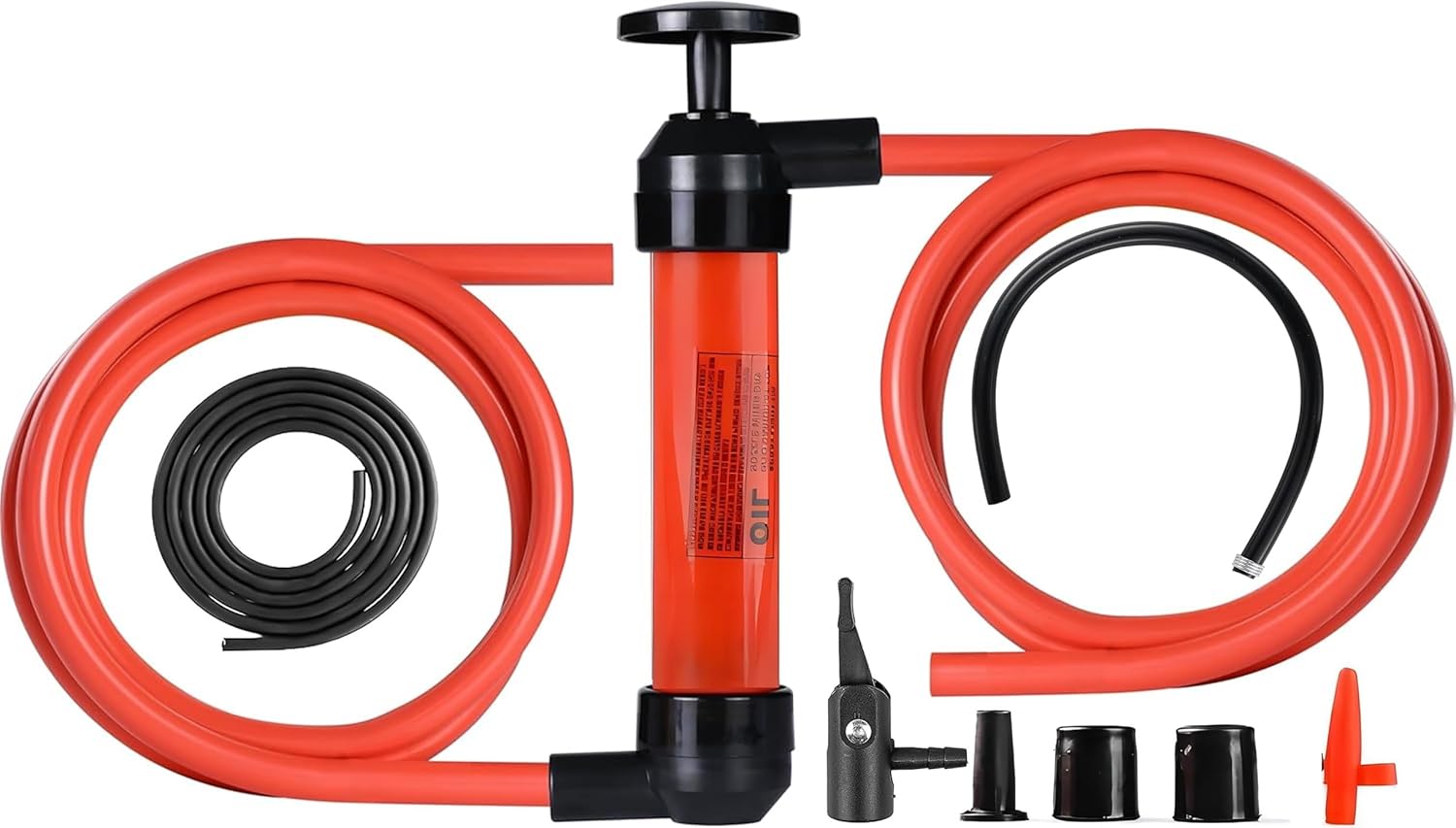
The LOZAGU siphon hand pump is a lightweight, manual fluid-transfer tool designed for occasional fueling, small tank draining, and emergency use. It combines a hand-operated pump, siphon hose, and air adapter so you can move gasoline, oil, and other liquids or inflate small inflatables without power. In use you insert the hose into the source, operate the manual pump to start flow, and then rely on the siphon or pump action to move up to about 3 gallons (12 L) per minute. The pump disassembles without tools for straightforward cleaning and the barbed connectors accept standard tubing for quick hookups. Practical benefits include portability, simple operation in remote situations, and versatility for lawn equipment, generators, jet skis, and small craft. Limitations are the plastic construction, which is less durable than metal under heavy repeated use, and the manual operation that requires effort and is slower than electric pumps for large volumes. It is best kept as a budget, occasional-use solution rather than for commercial or high-frequency fueling tasks.
Best for: Home mechanics and DIYers looking for a low-cost, multipurpose hand siphon to move oil, coolant, gasoline, and other small-tank fluids for occasional maintenance and emergency refills.
Less Ideal for: People who need frequent high-volume transfers or a heavy-duty, long-lasting shop pump should consider a powered or metal alternative.
- Multi-function design combining siphon, pump, and air adapter for inflation tasks
- Disassembles without tools for easy cleaning and maintenance
- Capable of moving up to 3 gallons (12 L) per minute for quick small-tank transfers
- Lightweight and portable for emergency or field use
- Plastic construction may wear faster with heavy or chemical exposure
- Manual operation requires physical effort and is not suited for high-volume jobs
Verdict: A low-cost pump that reliably moves oil, coolant, and other fluids with acceptable flow and build quality for occasional home-mechanic use.
VierKate Cordless Fuel Transfer Pump with Auto-Stop and Hand Nozzle (Bare Tool)
Best High-Flow Fluid Transfer Pump

| Flow rate | 5 GPM (18.9 L/min) |
|---|---|
| Motor speed | 16,500 RPM |
| Operation modes | Automatic and Manual |
| Hose length | 51 Inches |
| Power options | DeWalt 20V, Milwaukee 18V, 12V clamps |
This cordless fuel transfer pump is designed to move gasoline, diesel, oil, or water quickly using common 20V DeWalt or 18V Milwaukee batteries or the included 12V clamps. It pairs a high-speed 16,500 rpm motor with a 5 GPM flow rate so a DIY mechanic can refill tanks or drain fuel lines much faster than hand pumps. The unit combines an auto-stop nozzle for hands-free, overflow-safe filling with a manual hand nozzle for start/stop control, and it ships with four gas-can adapters and intake/outtake hoses for deeper suction and longer reach. Vertical-friendly controls and an LED indicator make battery changes and operation easier on the workbench or at the yard. Limitations include dependence on a compatible battery (batteries not included) and plastic components that may wear faster than metal pumps under heavy commercial use; it is also a bare tool so expect to budget for a battery if you do not already own one. For home garages the pump balances speed and portability for routine transfer and refueling tasks.
Best for: DIY mechanics and small-farm operators who need to move large volumes quickly and value a portable, battery-powered pump for rapid transfers during maintenance, fluid changes, or refueling tasks.
Less Ideal for: Professional shops or heavy commercial users who need metal-bodied, continuously rated pumps and full factory warranties should consider industrial-grade electric or pneumatic units instead.
- High 5 GPM flow rate for fast transfer
- Auto-stop nozzle prevents overfilling for hands-free operation
- Compatible with DeWalt 20V and Milwaukee 18V batteries plus 12V clamps for flexible power options
- Includes multiple gas-can adapters and long hoses for deep suction and extended reach
- Sold as a bare tool so battery is not included
- Plastic construction may be less durable than metal pumps under heavy continuous use
Verdict: A pump that prioritizes maximum flow rate and throughput for quickly moving larger volumes of fluid during maintenance and fluid changes.
Slippery Pete 5cc Fluid Pump for Quart Bottles
Best Compact Fluid Transfer Pump

| Included Components | 2 Suction Straws, 5cc Fluid Pump with Fill Tube |
|---|---|
| Compatible with Vehicle Type | Car, ATV, SUV |
| Material Type | Plastic |
| 1 Pump Stroke Volume | 5cc |
The Slippery Pete 5cc pump is a compact hand-operated fluid transfer tool designed to fit standard quart bottles and move small volumes of oil, transmission fluid, or differential gear oil into tight spaces. It mounts securely on standing quart containers and uses a rigid suction straw plus a 17 to 18.5 inch flexible fill tube so you can reach down into reservoirs or around obstructions without spilling. At roughly 5cc per stroke the pump empties a quart in about five minutes, which makes it useful for topping off gearboxes, small differentials, or trickle-filling components where controlled delivery matters. Construction is plastic and it ships with short and long suction tubes for different bottle depths. Limitations are clear: it will not fit wide-mouth or Red Line quart bottles and the plastic construction is less durable than metal solutions for heavy workshop use. For frequent large-volume transfers a larger capacity or powered pump will save time, but for precise, low-volume DIY jobs this pump offers good control and portability.
Best for: DIY mechanics and home garage hobbyists who need a compact, easy-to-store pump for one-person fluid transfers in tight spaces, where portability and simple, controlled dispensing from standard quart bottles are priorities.
Less Ideal for: Users who need to move large volumes quickly or who perform heavy daily shop use should choose higher-capacity or powered pumps instead.
- Fits standard quart bottles and secures to standing containers for steady pumping.
- Includes both rigid suction and a long flexible fill tube to reach awkward or recessed fill points.
- Delivers a small, repeatable 5cc per stroke for controlled topping and precise fills.
- Comes with short and long suction straws for different bottle depths and a resealable bag for storage.
- Does not fit wide-mouth or Red Line quart containers so compatibility is limited.
- Plastic construction may wear faster than metal pumps under heavy workshop use.
Verdict: A small, easily stowed pump designed for tight workspaces, portability, and simple one-person transfers in a home garage.
Mityvac MV7300 Pneumatic 2.3 Gallon Venturi Fluid Evacuator
Best Heavy-Duty Fluid Transfer Pump

| Model | MV7300 |
|---|---|
| Capacity | 2.3 gallon |
| Pump type | Pneumatic Venturi |
| Construction | Chemical-resistant polyethylene |
The Mityvac MV7300 is a pneumatic Venturi vacuum pump fluid evacuator that uses compressed air to pull fluids into a 2.3 gallon reservoir, making it useful for oil changes, brake fluid service, coolant and transmission fluid extraction. In normal use you hook the air supply to the pump, place the extraction hose into the fluid reservoir and the Venturi action creates a steady suction without an electric motor. Notable features include a chemical-resistant polyethylene tank, an air shut-off valve that stops suction when the job is done, overflow prevention to reduce spills, and a quick-drain spout for tidy disposal. The large base helps keep the unit stable on the shop floor. The main practical benefits are fast hands-free evacuation where shop compressed air is available and durability around aggressive fluids. Limitations are dependence on a compressed air source and the 2.3 gallon tank which means more frequent emptying during larger jobs compared with larger-capacity evacuators.
Best for: DIY mechanics and mobile technicians who need a tough, air-powered evacuator for frequent fluid changes and transfers and prioritize durability and safe, spill-free operation in a garage or shop setting.
Less Ideal for: Casual users without access to compressed air or shops needing high-capacity single-run transfers should consider battery or larger-capacity electric alternatives.
- Venturi pneumatic operation provides consistent suction using shop compressed air without an electric motor
- Chemical-resistant polyethylene tank resists corrosion from brake fluid, oil, coolant, and transmission fluid
- Air shut-off valve and overflow prevention reduce the chance of spills and overfilling
- Quick-drain spout and large stable base make draining and positioning the unit easier
- Requires a compressed air source so it is not useful for users without shop air
- 2.3 gallon reservoir can require frequent emptying on larger vehicles or multiple jobs
Verdict: A rugged pump built with durable materials and heavier-duty components to withstand frequent, demanding use and tougher fluids.
Milwaukee M12 Stick Transfer Pump
Best Electric Rechargeable Fluid Transfer Pump

| Flow Rate | 9 Gallons Per Minute |
|---|---|
| Voltage | 12 Volts |
| Material Type | Stainless Steel |
The Milwaukee M12 Stick Transfer Pump is a battery-powered electric pump designed to move fluids quickly and with minimal effort. It delivers up to 9 gallons per minute and can generate high pressure for rapid transfer, making it useful for draining fuel, antifreeze, oil, or other shop fluids into containers. The stick form factor and 12 inch body make it easy to drop into tanks or jerry cans, and the stainless steel construction with a powder-coated finish helps resist corrosion in workshop environments. Typical use is handheld or mounted in a bucket for pump-out jobs where portability matters more than continuous heavy-duty operation. Limitations include the stick pump format which is optimized for transfer rather than continuous pumping duties and reliance on a 12 volt platform for power, so you need a compatible battery or power source. For routine short- to medium-length fluid transfers it speeds jobs considerably, but it is not a replacement for large-capacity sump or drum pumps used in high-volume industrial settings.
Best for: DIY mechanics who need a cordless, portable pump for routine fluid changes and small transfers around the garage and on the go, prioritizing convenience and quick jobs without access to an outlet.
Less Ideal for: Users needing continuous high-volume pumping for industrial or commercial operations should choose a larger drum or sump pump designed for extended duty cycles.
- High flow rate of 9 gallons per minute for fast transfers
- Produces high pressure for efficient evacuation from tanks
- Compact stick form factor for access into tight openings and easy storage
- Stainless steel construction with powder-coated finish improves durability
- Requires a 12 volt power source or compatible battery platform so not standalone
- Stick design is optimized for transfers and not ideal for continuous industrial pumping
Verdict: A rechargeable, battery-powered pump that offers cordless convenience and enough runtime for multiple fluid transfers without tethering to mains power.
Mityvac MVA6852 1.5L Fluid Evacuator and Dispensing Syringe
Best Premium Fluid Transfer Pump
| Item Volume | 1500 Milliliters |
|---|---|
| Included Components | Fluid Extractor |
| Material | Plastic, Rubber |
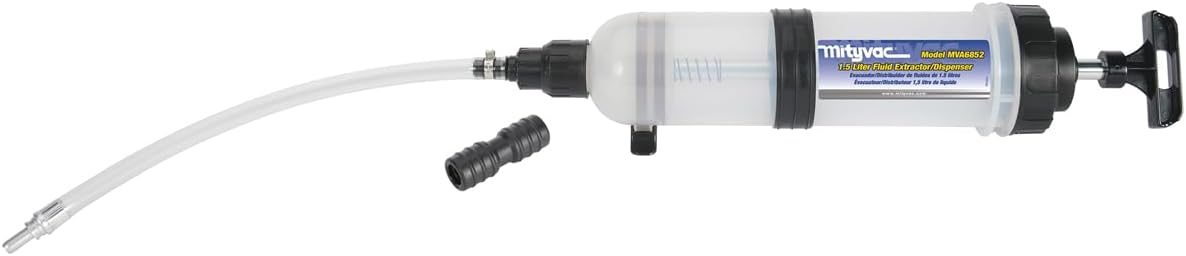
The Mityvac MVA6852 is a syringe-action fluid evacuator with a 1.5 liter reservoir, twist-valve control and a dual-seal piston for stronger suction and smoother dispensing. It is used to extract or top off fluids from master cylinders, power steering and coolant reservoirs, transaxles and other service points where a controlled, hand-operated pump is convenient. The included rubber ATF adapter lets you connect to common refill fittings and the twist-valve provides fine control when you start and stop flow, which reduces spills during delicate refills. The dual-seal piston improves suction efficiency so you can pull thicker fluids without repeated strokes. Because it is manual and compact, it is easy to clean, store and use in tight engine bays, but it is slower than electric or pneumatic evacuators for very large jobs and depends on user effort for long or frequent tasks. For DIY mechanics who need a durable, precise hand tool for occasional medium-volume fluid work, this model balances capacity and control well.
Best for: Mechanics and serious DIYers who prioritize durable, high-capacity fluid handling and precise control for regular shop use, especially when working on brake, transmission, power steering, and coolant systems.
Less Ideal for: Users who regularly handle large-volume fluid changes or need a fast, hands-free solution should consider powered or pneumatic evacuators instead.
- 1.5 liter reservoir reduces refill frequency compared with small syringes
- Twist-valve offers precise start/stop control to minimize spills
- Dual-seal piston increases suction efficiency for thicker fluids
- Includes rubber ATF adapter for direct connection to common refill ports
- Manual operation requires physical effort and is slower than powered evacuators
- Not ideal for very large-volume or continuous shop use
Verdict: A higher-end pump offering superior build quality, refined controls, higher efficiency, and extra features for mechanics wanting top performance and longevity.
How We Chose the Best Fluid Transfer Pump
We selected these fluid transfer pump options with DIY garage use in mind, focusing on the jobs most home mechanics actually handle. Our filters prioritized pumps that can move common automotive fluids with reasonable control, fit typical containers, and stay manageable for occasional to moderate shop use.The most important criteria were fluid compatibility, hose diameter and length, sealing quality, pumping method, and flow control. We also looked closely at whether the pump design supports cleaner starts and stops, since drips and backflow can turn a simple fluid change into a messy job. For this category, ease of priming matters too, especially when working with thicker oils or transferring fluid from low, awkward containers. Build quality was judged by the likely durability of the body, hoses, and connection points rather than by appearance alone.We excluded pumps that appeared too limited in fluid compatibility, lacked practical hose reach, or seemed better suited to very light household use than automotive maintenance. We also filtered out designs that offer poor control during final ounces of transfer, since precision matters when filling or draining small reservoirs.
Our full evaluation process is outlined in our review methodology.
Choose the Right Pump Style for Your Garage Work
Fluid transfer pumps generally fall into a few common styles, and each suits a different kind of job. Simple hand-operated pumps are useful for occasional maintenance, especially when portability and basic control matter more than speed. Squeeze-bulb and plunger styles are often easy to store, while lever and rotary designs can reduce effort during longer transfers. If you handle fluids more often, a powered option may save time, but it also adds complexity and may be less convenient for quick one-off tasks.
The best choice depends on how often you work, what fluids you move, and whether precision or transfer speed matters more. A DIY mechanic topping off gear oil in tight spaces may value control and hose reach more than raw flow rate. Someone transferring larger volumes may prefer a pump that keeps hand fatigue down during repeated use.
- Hand-operated pumps are usually best for occasional maintenance and easy storage
- Powered pumps can speed up larger transfers but may be less convenient for quick jobs
- Precision filling often matters more than maximum speed for small reservoirs and awkward fill points
Fluid Compatibility Matters More Than Many Buyers Expect
Not every pump is suited to every automotive fluid. Engine oil, transmission fluid, gear oil, coolant, and fuel can differ significantly in viscosity and in how they interact with seals, hoses, and pump bodies. Using a pump with the wrong material compatibility can lead to swelling, leaks, stiff operation, or premature wear.
Thicker fluids often need more effort to move, especially in cooler temperatures, so a pump that feels fine with thin liquids may struggle during real garage use. If you plan to use one pump across multiple fluids, pay attention to cleaning demands and cross-contamination risk. Dedicated pumps for specific fluid types can make maintenance cleaner and more predictable over time.
- Check hose and seal materials if you plan to move oil, coolant, or fuel-like fluids
- Thick fluids require better priming and stronger pumping action
- Using separate pumps for different fluids can reduce contamination risk
Hose Length, Diameter, and Fit Affect Real-World Usability
A fluid transfer pump can look capable on paper and still be awkward in practice if the hoses do not fit your containers or work area. Hose length determines whether you can reach into deep jugs, low drain pans, or cramped engine bays without constantly repositioning everything. Diameter matters too, since it influences both flow and access to narrow openings.
For DIY mechanics, hose flexibility is often just as important as hose size. A stiff hose may fight you in tight spaces and can slip out of place at the worst moment. Better control usually comes from a combination of secure hose attachment, manageable stiffness, and enough length to keep the source and destination containers stable during the transfer.
- Longer hoses improve reach but can be harder to control if they are too soft or too stiff
- Smaller diameter hoses can help with narrow openings but may reduce flow
- Secure connections matter because loose hoses can cause sudden spills and lost fluid
How to Keep Transfers Clean and Controlled
Clean fluid handling is not just about convenience. It also helps prevent slips, protects painted surfaces, and makes it easier to measure how much fluid actually went in or came out. A pump with predictable flow is easier to stop at the right moment, which is especially important when filling small reservoirs or topping off systems that do not tolerate overfilling well.
Before you begin, stabilize both containers and route the hoses so they cannot kink or pop free. Prime the pump fully if required, then start slowly to confirm direction and flow. As the destination fills, reduce pumping speed so you can stop cleanly. Keeping absorbent towels nearby and cleaning the pump promptly after use will also reduce mess and extend service life.
- Secure both containers before starting the transfer
- Begin slowly to confirm proper flow direction and hose placement
- Slow the final stage of filling to avoid overflows and drips
When a Manual Pump Is Better Than a Powered One
Powered pumps can be appealing, but they are not automatically the best fit for home mechanics. For smaller jobs, a manual fluid transfer pump often offers better control, simpler cleanup, and fewer parts that can fail or need storage space. If you only transfer fluids during routine maintenance intervals, manual designs are often more practical and easier to keep ready for use.
Manual pumps also make sense when you work in varied locations around the garage or driveway and do not want to depend on batteries or power leads. They are typically easier to dedicate to a single fluid type, and many users prefer the slower, more deliberate control they provide when filling gearboxes, differentials, or compact reservoirs.
- Manual pumps usually offer better low-speed control for careful filling
- They are easier to store and often simpler to clean
- For occasional use, simpler designs are often the most practical choice
Maintenance and Storage Tips for Longer Pump Life
A fluid transfer pump will last longer and work more consistently if it is cleaned soon after use. Residual fluid left in the body or hose can thicken, attract debris, or damage internal seals over time. Even if the pump is compatible with the fluid you used, cleanup still matters because trapped residue can make the next job messier and less accurate.
After use, drain as much remaining fluid as possible, wipe the exterior, and store the pump upright or in a way that keeps hoses from sharply bending. Labeling pumps by fluid type can help prevent accidental mixing. If a hose hardens, cracks, or remains permanently kinked, replace it before the next service job rather than trying to work around it.
- Clean pumps promptly after each use to protect seals and hoses
- Store hoses without tight bends to avoid kinks and splitting
- Consider dedicating one pump to each major fluid type you service
FAQ
What is the best type of fluid transfer pump for DIY mechanics?
For most DIY mechanics, the best type depends on how often the pump will be used and which fluids it needs to handle. A manual pump is usually enough for routine maintenance because it offers good control, simple storage, and fewer parts to worry about. If you move larger volumes often, a higher-output design may be worth considering, but control and compatibility should still come first.
Can one fluid transfer pump be used for oil, coolant, and fuel?
Sometimes, but only if the pump materials are compatible with each fluid and you clean it thoroughly between uses. Even then, cross-contamination can be a problem, especially for sensitive systems. Many DIY mechanics prefer separate pumps for different fluid categories to keep maintenance cleaner and safer.
Why does my fluid transfer pump lose prime or stop flowing?
Loss of prime usually happens because of an air leak, poor hose placement, a loose connection, or a pump design that struggles with thicker fluids. Check that the intake hose stays submerged and that all fittings are seated securely. If the fluid is cold or viscous, slower pumping and better hose sealing can also help maintain flow.
Is a fluid transfer pump better than pouring directly from a bottle?
In many garage situations, yes. A pump gives you more control, reduces spills, and makes it easier to reach awkward fill points that are hard to access with a bottle alone. It is especially helpful when the container is heavy, the opening is small, or the target area is tucked into a tight space.
How do I clean a fluid transfer pump after use?
Start by draining as much leftover fluid as possible from the body and hoses. Wipe down the exterior, then follow the maker guidance for flushing or cleaning based on the fluid type handled. The main goal is to remove residue before it thickens or damages seals, and to store the pump dry enough that it is ready for the next job.
Do thicker automotive fluids need a different pump?
They often benefit from a pump designed for heavier viscosity fluids or at least one with stronger priming and better sealing. A basic pump may work with thin liquids but struggle with gear oil or cold engine oil. If thick fluid transfer is a regular part of your maintenance routine, choose a pump style built for slower, more controlled movement under higher resistance.
Final Verdict
Choosing the right fluid transfer pump comes down to matching the tool to your actual maintenance habits. The key trade-offs are usually speed versus control, multi-fluid versatility versus dedicated use, and compact storage versus easier high-volume transfer. Hose fit, seal quality, and fluid compatibility matter more in daily use than flashy features.If you want to choose confidently, focus first on the fluids you handle most often, the spaces you work in, and how cleanly you need to fill or drain each system. A pump that is easy to control, easy to clean, and well matched to your garage tasks will usually be the smarter long-term pick.
