

Note: This article contains affiliate links. If you click on these links and make a purchase, I may earn a small commission at no extra cost to you. This helps support my research and content. Read my full affiliate disclosure here.
What You’ll Need
A quick look at the tools and supplies commonly used for this job.
Tools
Parts & Supplies
- Replacement sway bar links
- Penetrating oil
- Shop rags
- Touch-up paint marker or chalk
This article is part of our Suspension and Steering Maintenance & Repair Guides.
A bad sway bar link can cause clunking noises, vague handling, and extra body roll, but it is easy to confuse with struts, ball joints, or tie rod problems. The goal is to confirm whether the link itself is worn, loose, or damaged before spending money on parts.
Sway bar links connect the stabilizer bar to the suspension, usually at the strut or control arm. When the joints wear out or the hardware loosens, the bar cannot control side-to-side weight transfer properly, and the suspension may rattle over small bumps.
This guide walks you through the common symptoms, safe inspection steps, hands-on checks, and how to separate a bad sway bar link from other front- or rear-suspension noises.
What Sway Bar Links Do and Why They Fail
The sway bar, also called the stabilizer bar or anti-roll bar, helps reduce body lean when the vehicle turns. The links transfer movement between the suspension and the bar so both sides can resist excessive roll. On many vehicles, the links use small ball-and-socket joints with grease seals or rubber bushings at each end.
Over time, the link joints wear from road shock, water intrusion, rust, and lack of lubrication. Boots can crack and let dirt into the joint. In other designs, bushings compress or split. The retaining nuts can also loosen, especially after prior suspension work if hardware was not torqued correctly.
- Ball-joint style links often fail by developing looseness and making sharp metallic clunks.
- Bushing-style links often fail by cracking, flattening, or allowing the bar to shift and knock.
- Rust accelerates failure, especially in areas with salted winter roads.
- A link can be bad even if the sway bar itself is still fine.
Common Symptoms of Bad Sway Bar Links
Noises Over Small Bumps
The most common complaint is a clunk, rattle, or tapping noise from one corner of the vehicle when driving over potholes, driveway aprons, expansion joints, or rough pavement. The noise is often more noticeable at low speed with the windows down.
Noise That Changes With One-Wheel Movement
Sway bar links are most active when one side of the suspension moves differently from the other. That means the sound may be louder when one wheel hits a bump by itself than when both wheels hit the same bump evenly.
Increased Body Roll or Less Stable Cornering
A failed link can reduce the sway bar’s effectiveness. The vehicle may feel less planted in turns, especially during quick lane changes or freeway ramps. This symptom is usually subtle unless the link is completely disconnected.
Visible Damage
A torn grease boot, rusty joint, bent link, missing bushing material, or shiny metal marks where parts have been moving against each other are all strong clues. On severe failures, the link may hang loose or contact nearby suspension parts.
- Clunking over uneven bumps
- Rattle from the front or rear suspension
- Slightly looser handling in turns
- Visible play, torn boots, or damaged bushings
- Noise that seems to disappear on smooth roads
Tools, Safety, and Setup
You can do the basic diagnosis with simple hand tools and a safe lifting setup. If you hear a suspension noise but are not sure where it is coming from, resist the urge to replace parts first. A five-minute visual inspection can save a lot of guesswork.
Safety Basics
- Park on level ground and set the parking brake.
- Chock the wheels that will stay on the ground.
- Lift the vehicle only at approved jack points.
- Always support the vehicle with jack stands before reaching underneath.
- Wear eye protection when inspecting rusty or dirty suspension parts.
If you are removing a wheel for better access, loosen the lug nuts slightly before raising the vehicle, then finish removing them once the vehicle is safely supported.
Road Test Clues Before You Lift the Vehicle
A short road test helps narrow the problem area before you start inspecting. Listen carefully to when the noise happens and what type of road input triggers it.
What to Listen For
- A light clunk or rattle over repeated small bumps often points to sway bar links or sway bar bushings.
- A heavier thud on large bumps can point more toward struts, control arm bushings, or ball joints.
- A clicking sound while turning under power is more typical of a CV axle than a sway bar link.
- A noise that happens mostly when one side of the vehicle goes over a bump is a strong sway bar clue.
Simple Driving Checks
Drive slowly over a rough parking lot, speed bump edge, or broken pavement. Then compare that with a smooth road at the same speed. If the noise is almost entirely tied to suspension travel rather than engine speed or braking, inspect the links closely.
Do not perform aggressive swerving on public roads. If cornering feels unusually loose, treat that as a warning sign and move on to inspection.
Tools That Make This Job Easier
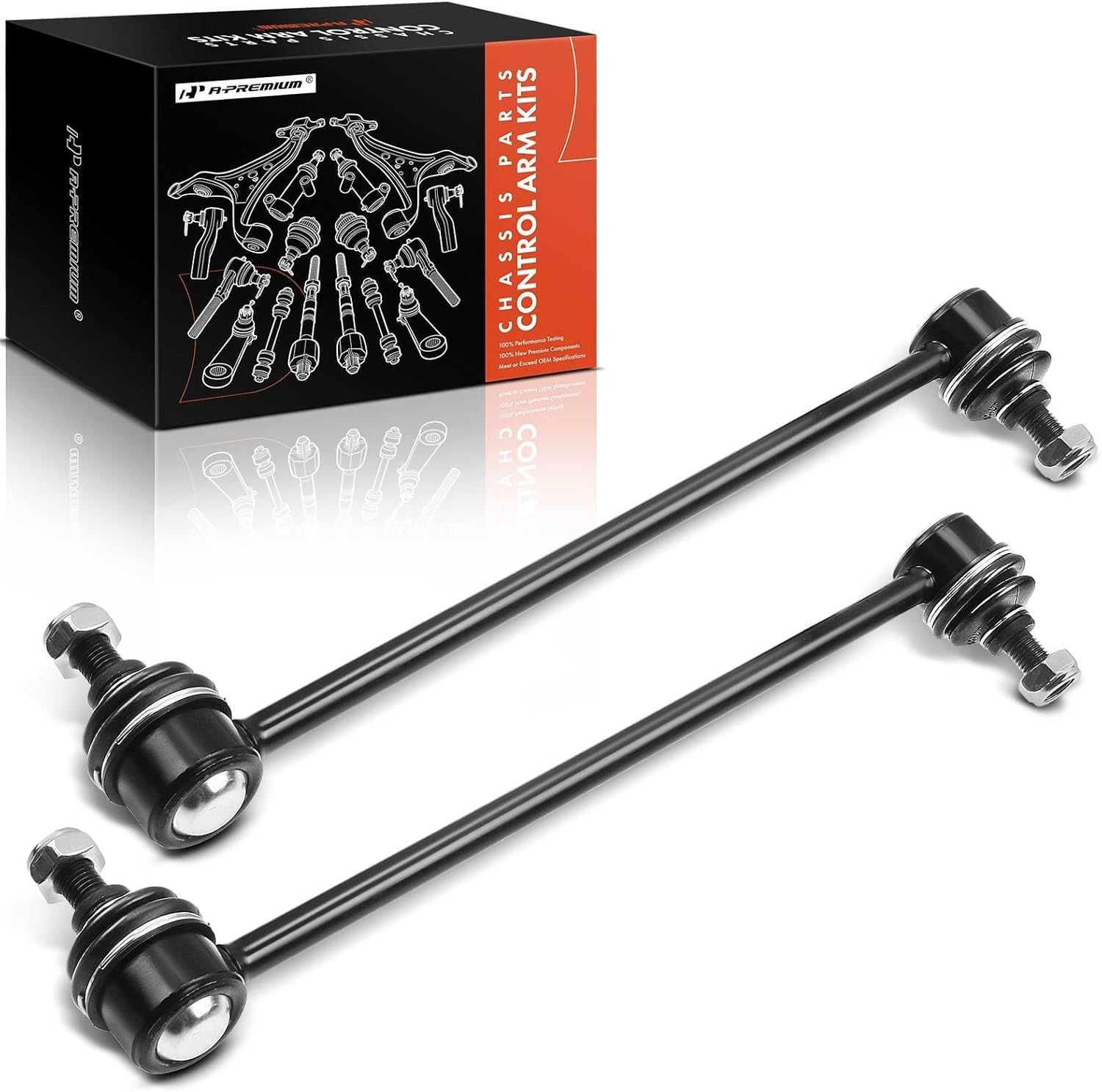


Visual Inspection of the Sway Bar Links
Start with the easiest check: look carefully at both ends of each link on the affected axle. Most vehicles have one link per side, mounted vertically or diagonally between the sway bar and the strut, control arm, or axle housing.
What a Good Link Usually Looks Like
A healthy ball-joint style link should have intact boots, straight studs, and mounting hardware seated firmly against the bracket surfaces. A healthy bushing-style link should have bushings that are centered, not split, and not squeezed flat beyond normal compression.
What to Look For
- Torn or missing dust boots
- Grease leaking from a joint
- Heavy rust around the joint or stud
- Bent link body
- Missing washers, sleeves, or bushings
- Metal-to-metal witness marks where the link has been shifting
- Loose or backed-off nuts
Compare the left and right sides. If one link looks dry, rusty, or crooked while the other side looks intact, that difference is useful evidence. If both links are original and one has failed, replacing both is often the smart move, but diagnosis should still confirm the source first.
Hands-On Checks for Looseness and Play
Once the vehicle is safely lifted, check whether the link moves when it should not. A bad sway bar link often gives itself away with obvious looseness by hand or when lightly loaded with a pry bar.
Hand Movement Test
Grab the sway bar link near the middle and try to move it in and out, up and down, and side to side. A solid link should feel tight. If you can feel clicking, shifting, or free movement in the joint, the link is likely worn.
Pry Bar Test
Use a pry bar gently between the sway bar and a nearby suspension point to apply slight load while watching the link ends. You are not trying to bend anything. You are looking for delayed movement, popping, or a gap opening and closing inside the joint or bushing.
Listen and Feel
If a helper rocks the vehicle side to side while you place a hand on the link, you may feel a small knock transmitted through the part. Any distinct tapping sensation in the link body or stud area is suspicious.
- Any free play in a ball-joint style link usually means replacement.
- Cracked or displaced bushings mean the link or hardware stack needs attention.
- If the nut is loose but the joint is still tight, re-torquing may solve the noise.
- If the stud spins, the internal joint may already be worn or the hardware may be seized.
How to Tell Bad Sway Bar Links From Other Suspension Problems
Suspension noises often overlap, so this step matters. Replacing sway bar links will not fix a worn ball joint, strut mount, tie rod end, or sway bar frame bushing. Use the symptom pattern and inspection results together.
Bad Sway Bar Link Vs. Strut or Strut Mount
Strut problems often produce a deeper thump, bouncing, poor damping, fluid leakage, or noise while steering and compressing the suspension. Sway bar link noise is usually sharper and more rattle-like over quick small bumps.
Bad Sway Bar Link Vs. Ball Joint or Tie Rod End
Ball joints and tie rods affect wheel alignment and steering precision more directly. They may cause uneven tire wear, wandering, steering looseness, or play when the wheel is checked at specific positions. A sway bar link usually does not create steering wheel lash by itself.
Bad Sway Bar Link Vs. Sway Bar Bushings
Worn sway bar frame bushings can also clunk. The difference is location. Frame bushing noise usually comes from where the bar mounts to the chassis, not at the link ends. You may see the bar shifting inside the bushing bracket or notice dried, cracked rubber where the bar passes through.
- Sharp rattle on small uneven bumps suggests links or sway bar bushings.
- Loose steering or tire wear suggests tie rods, ball joints, or alignment issues.
- Bouncy ride or oil on the strut suggests worn struts.
- Noise localized at the link end with visible play strongly confirms the link.
Recommended Tools for This Job


When the Vehicle Is Loaded Matters
Some sway bar link play is easier to detect with the suspension hanging, while other issues show up better with the suspension closer to ride height. If the link seems quiet while fully unloaded, that does not always rule it out.
On certain vehicles, preloaded suspension geometry can mask looseness until the wheels are supporting weight. If your inspection is inconclusive, lightly rocking the vehicle with the wheels on ramps or using a drive-on lift can reveal a knock that was hard to reproduce with the suspension drooping.
DIY owners should not crawl under a vehicle supported only by a jack or improvise with unstable setups. If the diagnosis still is not clear, a professional shop can often isolate the sound quickly with chassis ears or a loaded suspension inspection.
Interpreting Your Results
You Likely Have a Bad Sway Bar Link If
- You hear clunking or rattling over small uneven bumps.
- The noise is strongest when one wheel moves more than the other.
- The link has a torn boot, rust damage, bent body, or missing bushing material.
- You can feel or see play in the joint or bushing stack.
- The sound is localized to the link rather than the strut, tie rod, or frame bushing.
You May Be Dealing With Something Else If
- There is no visible or felt play in the links, but the sway bar frame bushings are worn.
- The vehicle bounces excessively or has leaking struts.
- You find wheel play, steering looseness, or alignment-related tire wear.
- The noise changes mainly with braking, acceleration, or steering angle rather than bumps.
A loose mounting nut alone can mimic a failed link, so check hardware carefully. If tightening the hardware to factory specification removes the play and the joint is not worn, replacement may not be necessary. If the link is noisy, loose, or damaged, replacement is the correct fix.
What to Do Next
If you have confirmed a bad sway bar link, replace it soon. The vehicle may still be drivable in some cases, but handling can be reduced and the noise usually gets worse. A completely separated link can let the bar shift and create more damage or noise.
Replacement Tips
- Replace links in pairs on the same axle when mileage is high or both sides are original.
- Inspect sway bar bushings at the same time since they often wear together.
- Use new hardware if it comes with the replacement links.
- Follow torque specs exactly, especially on bushing-style designs.
- If the stud spins during removal, hold the flats or hex feature on the stud if equipped.
After replacement, test drive the vehicle on the same type of road that produced the noise. If the clunk remains, inspect sway bar bushings, strut mounts, control arm bushings, and ball joints before assuming the new links are defective.
Key Takeaways
- Bad sway bar links usually cause a sharp clunk or rattle over small uneven bumps rather than a constant noise.
- Confirm the problem by checking for torn boots, damaged bushings, loose hardware, and visible play at both link ends.
- Compare left and right sides because one worn link often looks noticeably different from the good side.
- Do not confuse link noise with struts, tie rods, ball joints, or sway bar frame bushings without inspecting each part.
- If the link is loose or worn, replace it promptly and inspect the sway bar bushings at the same time.
FAQ
Can You Drive with a Bad Sway Bar Link?
Usually yes for a short time if the vehicle still feels stable, but it is not ideal. A bad link can increase body roll, create distracting noise, and eventually separate completely. Drive cautiously and repair it soon.
What Does a Bad Sway Bar Link Sound Like?
Most bad sway bar links make a clunk, knock, or light metallic rattle over small bumps, potholes, or uneven pavement. The sound often comes from one corner and is worse at low speed.
Will Bad Sway Bar Links Affect Alignment?
Not directly in most cases. Sway bar links do not usually change alignment angles the way tie rods, ball joints, or control arm bushings can. They affect roll control more than wheel alignment.
Should Sway Bar Links Be Replaced in Pairs?
It is often a good idea, especially if both links are old and one has already failed. The other side may not be far behind, and replacing both can restore more even suspension response.
Can Bad Sway Bar Links Cause Tire Wear?
They are not a common direct cause of tire wear. Uneven tire wear is more often linked to alignment problems, worn ball joints, tie rods, shocks or struts, or improper tire pressure.
How Do I Know if It Is the Sway Bar Bushing Instead of the Link?
Link noise usually comes from the ends where the link attaches to the bar or suspension. Bushing noise comes from the sway bar mounting brackets on the chassis. Look for bar movement or worn rubber at the frame bushings.
Do Bad Sway Bar Links Cause Vibration?
Usually not a steady vibration. They more commonly cause intermittent clunks or rattles. If you feel constant vibration at speed, check tires, wheel balance, wheel bearings, and other suspension components too.
Need Parts for This Repair?
The right parts and supplies vary by vehicle.
Select your make and model to find compatible parts and accessories for your car.
Exact Fit
Parts that fit your make and model
Quality You Can Trust
Top brands and OEM quality options
Fast Shipping
Get the parts you need, delivered fast