

Note: This article contains affiliate links. If you click on these links and make a purchase, I may earn a small commission at no extra cost to you. This helps support my research and content. Read my full affiliate disclosure here.
Wheel chocks are a simple safety tool, but they play a critical role whenever you park on an incline, lift a vehicle, or work around the wheels. Their job is to keep the vehicle from rolling when the parking brake alone is not enough or when extra stability is needed during maintenance.Choosing the right wheel chocks matters because tire size, vehicle weight, surface type, and ramp or jack use all affect how well a chock holds in place. A set that works fine for a small sedan in a flat garage may not inspire the same confidence behind a heavier truck or on a sloped driveway. The picks that follow are designed to help you find the right balance of grip, durability, visibility, and everyday usability.
Top Picks at a Glance
| Best Overall Wheel Chocks for DIY Mechanics Reliable all-around chock offering balanced grip, durability, and ease. | MaxxHaul Solid Rubber Wheel Chock 2-Pack (70472) |  |
| Best Budget Wheel Chocks for DIY Mechanics Affordable, dependable chock for occasional garage use and safe parking. | Camco Standard Wheel Chock (for Tires up to 26") |  |
| Best Heavy-Duty Wheel Chocks Extra-strong, rugged chock built for high loads and long life. | Rhino USA Heavy-Duty Rubber Wheel Chocks with Reflective Stripes and Handling Rope |  |
| Best Compact Wheel Chocks Space-saving chock that's lightweight, portable, and still adequately stable. | Valterra A10-0908 RV Wheel Chock |  |
| Best Rubber Wheel Chocks Molded rubber chock delivering superior grip, vibration damping, and chemical resistance. | MaxxHaul Rubber Wheel Chock 2-Pack with Steel Eyebolt |  |
| Best High-Capacity Wheel Chocks Engineered for very high load ratings with verified strength and durability. | Buyers Products WC1267 Aluminum Wheel Chock with Traction Teeth |  |
| Best Premium Wheel Chocks Top-tier chock with refined features, premium materials, and professional-grade durability. | BAL 28020 Single Axle Tire Chock |  |
MaxxHaul Solid Rubber Wheel Chock 2-Pack (70472)
Best Overall Wheel Chocks for DIY Mechanics

| Material Type | Rubber |
|---|---|
| Included Components | 2 Pieces Solid Rubber Wheel Chocks |
| Is Foldable | No |
| Unit Count | 2.0 Count |
The MaxxHaul Solid Rubber Wheel Chock 2-Pack is a simple, heavy-duty solution for preventing wheel movement while you work on a car or secure a trailer. Each chock is molded from solid rubber for resistance to cracking and weathering, and the textured traction pads grab pavement, gravel, and garage floors to reduce rollaway risk. Built-in handles make placement and removal fast and safe without tools, and the oil- and UV-resistant material keeps them usable in wet or sunny conditions. These chocks are compact enough to store in a trunk or toolbox yet rigid enough to use under cars, trucks, trailers, and RVs for short-term jobs or parking on a slope. The main limitations are that they are a basic, single-purpose safety item and depend on proper placement and surface contact to be effective; they do not replace wheel locks or mechanical lifts for major repairs. For DIY mechanics who need reliable, low-maintenance wheel immobilizers for routine service and parking safety, these deliver durable performance at a practical size.
Best for: Home mechanics who need a reliable, easy-to-use chock for routine car maintenance and light repairs, valuing durable construction and strong traction over the cheapest option.
Less Ideal for: People needing theft prevention, long-term vehicle immobilization, or specialist chocks for very heavy commercial equipment should consider dedicated locking devices or heavy-capacity alternatives.
- Solid molded rubber construction resists cracking and weather damage for long life
- High-traction, non-slip surface grips pavement, gravel, and garage floors
- Built-in molded handle for quick, tool-free placement and removal
- Compact single-piece design offers no mechanical locking or ratcheting feature
Verdict: The top all-around wheel chock that balances secure holding power, durable materials, ease of placement, and value for most home mechanics working on cars.
Camco Standard Wheel Chock (for Tires up to 26")
Best Budget Wheel Chocks for DIY Mechanics

| Manufacturer | Camco |
|---|---|
| Model | 44412 |
| Rim Diameter | 26 Inches |
The Camco Standard Wheel Chock is a simple, no-frills wheel stopper intended to keep trailers and RVs from rolling while parked or during hitching. It is molded from UV-inhibited plastic so it resists sun degradation and stays light enough to carry and position by hand. Typical use is placing the chock snug against a tire to prevent forward or backward movement when re-hitching, leveling, or working near a parked vehicle. The shallow, wedge-shaped profile and textured face help it bite into pavement and gravel, while the molded handle makes retrieval easy. Because it is plastic it will not rust and tolerates regular outdoor exposure, though the manufacturer cautions prolonged sunlight can weaken the material. This chock is not intended as a primary brake replacement and should be paired with parking brakes or other restraints for safety when working under a vehicle. For DIYers needing an affordable, portable chock for routine shop or roadside use, it performs predictably; heavy industrial demands or lifting applications require heavier-duty alternatives.
Best for: Budget-minded DIY mechanics and weekend hobbyists who need an inexpensive, easy-to-handle wheel chock for occasional garage work and light trailer tasks, prioritizing reliable grip and basic durability over heavy-duty professional use.
Less Ideal for: Professionals or users who regularly perform heavy-duty under-vehicle work or need military-grade immobilization should choose a heavier metal or high-capacity chock instead.
- UV-inhibited plastic resists sun damage for longer outdoor use
- Very lightweight and easy to position or store
- Textured wedge profile provides reliable contact with pavement and gravel
- Plastic construction can weaken with prolonged sun exposure and heavy abuse
- Not a substitute for brakes or jack stands when working under a vehicle
Verdict: The best low-cost wheel chock that still provides reliable grip, decent durability, and safe performance for occasional garage use without breaking the bank.
Rhino USA Heavy-Duty Rubber Wheel Chocks with Reflective Stripes and Handling Rope
Best Heavy-Duty Wheel Chocks

| Manufacturer | Rhino USA |
|---|---|
| Brand | Rhino USA |
| Exterior | Black |
| Item Weight | 15.29 pounds |
These Rhino USA wheel chocks are built to keep large vehicles from rolling while parked or during light maintenance. Made from heavy-duty polymer rubber and sized for large tires, the chocks feature non-slip tread and a tri-point profile that increases grip on gravel, dirt, and pavement. High-visibility reflective stripes and a neon rope make them easy to find and position in low light, and the rope helps pull them back out after use. In practice they are straightforward: place one chock on each side of a tire to stabilize the vehicle before working underneath or when parked on a slope. Because they are substantial and weather-resistant, they withstand repeated outdoor use and rough surfaces. The main limitation is their bulk and weight, which makes them less convenient to carry long distances or for frequent repositioning, and they are intended for static parking and light service rather than as a substitute for a jack or axle stands during heavy repairs.
Best for: Buyers who need heavy-duty, long-lasting wheel chocks for securing large vehicles during maintenance or storage—especially those who prioritize strength and durability for trucks, RVs, trailers, and off-road use.
Less Ideal for: Buyers who need lightweight, highly portable chocks for frequent transport or those who require lift equipment for major under-vehicle repairs should look elsewhere.
- Heavy-duty polymer construction resists wear for long outdoor use
- Oversized shape and non-slip profile provide stable stopping power on varied terrain
- Reflective stripes and neon rope improve visibility and ease of handling
- Comes as a pair so you can secure both sides of a tire without buying extras
- Relatively heavy and bulky for carrying long distances
- Designed for parking stability and not as a replacement for jacks or stands during major repairs
Verdict: Robust, thickly built wheel chocks designed for maximum strength and long-term durability when you need higher load capacity and rugged resistance to wear.
Valterra A10-0908 RV Wheel Chock
Best Compact Wheel Chocks
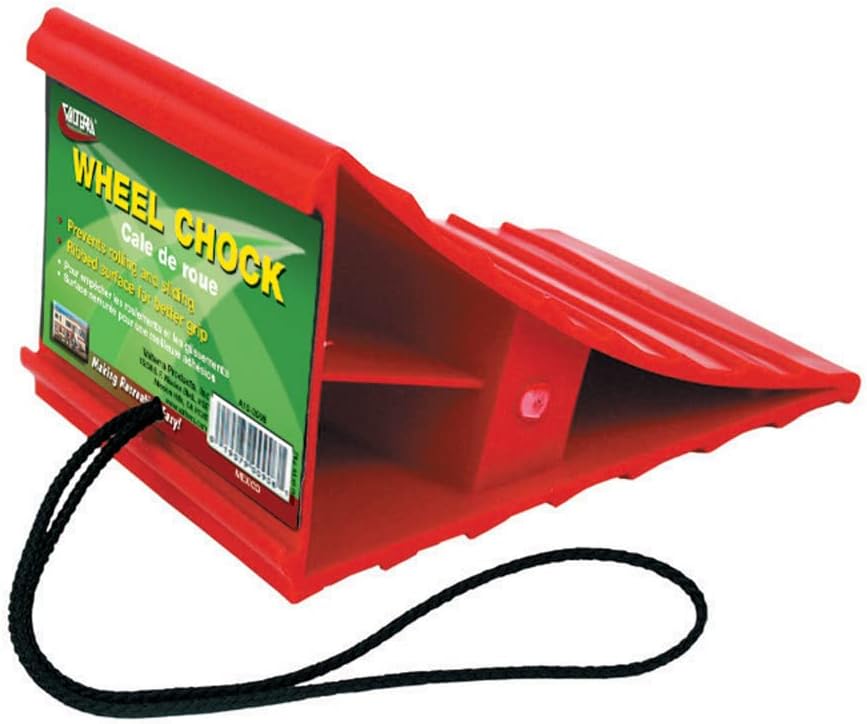
| Compatible with Vehicle Type | RV, Truck, Trailer |
|---|---|
| Automotive Fit Type | Universal Fit |
| Material Type | Polyethylene |
| Unit Count | 1.0 Count |
The Valterra A10-0908 is a simple, compact wheel chock intended to keep an RV, truck, or trailer from rolling when parked or during light maintenance. Made from molded polyethylene, the chock uses integrated grooves to increase tire bite and reduce slippage on paved or packed surfaces. A built-in nylon cord makes it easy to carry and position the chock without touching the tire. Its small footprint and bright finish mean it tucks into an accessory kit and is easy to spot when you need it. Expect durable performance for routine stabilization tasks, but note this is a single chock sold per pack so you will need a pair for two-wheel blocking or heavier-duty applications. Also its plastic construction provides less mass than heavy rubber or metal chocks, which can affect holding power on very steep grades or when used with very large loads.
Best for: Buyers who need a compact, easy-to-store wheel chock for light to moderate jobs on cars, trailers, or small RVs and prioritize portability and simple setup over heavy-duty industrial holding power.
Less Ideal for: Drivers who need heavy-duty stopping power for steep inclines or commercial towing should choose larger, heavier chocks or multiple units for greater security.
- Compact, easy to store in an RV or garage
- Molded grooves provide improved tire grip to reduce slippage
- Lightweight polyethylene resists weathering and is corrosion-free
- Nylon carrying cord simplifies transport and keeps hands clean
- Sold as a single chock rather than a pair
- Less mass than heavy rubber or metal chocks limits holding force on very steep or extreme loads
Verdict: Small, space-saving wheel chocks that are easy to store and carry while still offering adequate bite and stability for light-to-moderate automotive work.
MaxxHaul Rubber Wheel Chock 2-Pack with Steel Eyebolt
Best Rubber Wheel Chocks

| Number of Pieces | 2 |
|---|---|
| Material Type | Rubber |
| Hardware Material | Alloy Steel |
| Fastener Type | Eyebolt |
The MaxxHaul Rubber Wheel Chock 2-Pack is engineered to keep wheels from rolling during parking, maintenance, loading, or long-term storage. Each chock is a large molded rubber block with a textured, non-slip surface that grips pavement, gravel, and garage floors and resists oil and temperature-related degradation. The integrated alloy steel eyebolt lets you attach a chain or rope for secure anchoring or easy retrieval when working around vehicles. In practice these chocks are straightforward to use: place them snug against the tire contact patch and pair them for extra security on slopes or while working under a car. Their dense rubber construction gives a stable, heavy feel compared with lightweight plastic chocks, reducing the chance of shifting under load. The main limitations are their bulk and weight, which make them less convenient to carry for occasional roadside use, and the kit does not include a chain or storage strap. For garage or workshop work where stability and durability matter, these chocks are a practical, long-lasting choice.
Best for: Mechanics and DIYers who need heavy-duty rubber chocks that prioritize strong grip, solvent and oil resistance, and vibration damping when securing cars, trailers, or motorcycles for maintenance or storage.
Less Ideal for: Travelers or riders who need a lightweight, highly portable chock for roadside use should consider smaller, lighter alternatives designed for carry in a pack or saddlebag.
- Heavy, dense rubber construction provides superior grip and compression resistance compared with plastic chocks
- Textured, oil-resistant surface performs reliably in rain, snow, and on oily floors
- Integrated alloy steel eyebolt allows secure tethering or easy retrieval
- Broad base and oversized profile increase stability and reduce tipping during use
- Large size and weight reduce portability for roadside or single-handed use
- Does not include chain or tethering hardware
- Not ideal for very soft surfaces where extra anchoring would be needed
Verdict: Wheel chocks made primarily of molded rubber that excel at grip, vibration dampening, and resistance to solvents and oils common in garages.
Buyers Products WC1267 Aluminum Wheel Chock with Traction Teeth
Best High-Capacity Wheel Chocks

| Load capacity | 55,000 lb |
|---|---|
| Material | Aluminum |
| Design feature | Steep slope with traction teeth |
| Handle | Recessed finger grip |
The Buyers Products WC1267 is a purpose-built aluminum wheel chock for securing large trucks, trailers, and heavy equipment during service, storage, or loading. It uses a steep-angled profile and serrated traction teeth to bite into the tire and ground for strong resistance to roll-back, while a recessed finger grip makes placement and removal less fatiguing. Because it is aluminum the chock is much easier to carry and position than comparable steel blocks, which is useful for technicians who move chocks frequently around a shop or yard. The manufacturer rating of 55,000 lb means it is sized for heavy duty applications rather than passenger cars. Limiting factors are that the single-piece aluminum design relies on surface contact and teeth engagement rather than mass, so it performs best on firm ground and correctly sized tires; soft or uneven terrain will reduce its effectiveness. The WC1267 is a solid safety tool for professional environments where a portable, high-capacity chock is needed, but users should confirm placement and pairing with wheel stops or other restraints for the most demanding situations.
Best for: Commercial operators and heavy-equipment owners who need a high-capacity, easy-to-handle chock for securing trucks, trailers, and large equipment during maintenance or loading tasks; suitable for crews that prioritize verified load ratings and durable, repeatable performance on job sites.
Less Ideal for: If you need wheel chocks primarily for passenger cars, residential driveways, or very soft terrain, a lower-profile rubber or heavier mass chock may be a better match.
- High 55,000 lb rated load capacity suitable for large trucks and heavy equipment
- Steep slope profile and rugged traction teeth increase resistance to rollback
- Lightweight aluminum construction makes it easier to carry and reposition
- Recessed finger grip improves handling and reduces operator fatigue
- Performance depends on firm, even surfaces; effectiveness drops on very soft or irregular ground
- Single chock design requires correct placement and use with additional restraints for maximum safety
Verdict: Wheel chocks specified and tested for the highest load ratings, ideal for users who need verified performance for heavier vehicles or commercial tasks.
BAL 28020 Single Axle Tire Chock
Best Premium Wheel Chocks

| Brand | BAL |
|---|---|
| Model | 28020 |
The BAL 28020 Single Axle Tire Chock is a purpose-built chock for single-axle trailers that locks against the wheel to stop rolling and provide basic stabilization. It installs by extending to fit the wheel and then seats against the tire; its compact, lightweight design makes it easy to carry and store when not in use. The chock is treated with an anti-rust coating for outdoor exposure and has a simple mechanism that requires no tools, which is convenient for quick setup at campsites or work locations. Because it is sized for single-axle applications, it excels at preventing movement on trailers and offers a low-effort way to add safety when hitching, unhitching, or servicing a trailer. Limitations are that it is not intended for heavy-duty commercial use or multi-axle trailers and it does not replace wheel straps or a full jack for lifting; users should pair it with other stabilization practices when doing vehicle maintenance.
Best for: Professionals and serious DIYers who need a durable, refined wheel chock for frequent use on single-axle trailers and who prioritize reliable stabilization and corrosion resistance over basic economy options.
Less Ideal for: Users who need heavy-duty chocking for commercial towing or those who require a chock system for multiple axles should look elsewhere.
- Designed specifically for single-axle trailers to stop wheel roll.
- Lightweight and compact for easy carrying and storage.
- Anti-rust coating improves durability in outdoor conditions.
- Not suitable for multi-axle or heavy commercial trailer use.
- Provides stabilization but does not substitute for lifting or load-bearing equipment.
Verdict: Higher-end wheel chocks that justify a higher price with superior materials, refined design features, and exceptional durability for frequent professional-style use.
How We Chose the Best Wheel Chocks
We focused on wheel chocks that make sense for real garage use, driveway work, trailer parking, and routine maintenance around passenger vehicles. To narrow the field, we looked for designs that matched common tire sizes and that offered dependable contact with both the tire and the ground rather than relying on a steep shape alone.Our evaluation centered on five practical criteria: material traction on concrete, asphalt, and coated garage floors, overall size and wedge profile for secure tire contact, load suitability for typical cars, SUVs, and light trucks, ease of handling and storage, and visibility features that help prevent accidental drive-off or misplacement. We also considered whether paired chocks provided a stable setup for both sides of an axle and whether rope or carry handles improved day-to-day use.We excluded novelty designs, undersized chocks better suited to lightweight equipment, and options with vague load guidance or limited tread contact. We also filtered out shapes that looked easy to kick loose, slide on smooth surfaces, or interfere with normal placement behind the tire.
Our full evaluation process is outlined in our review methodology.
Why Wheel Chocks Matter Even when the Parking Brake Is On
A parking brake is important, but it should not be your only line of defense when you are working on a vehicle. Mechanical systems can wear, rear brakes may not hold evenly, and a slight incline can add enough force for a vehicle to creep. Wheel chocks create a physical stop at the tire, which adds a second layer of protection before you jack up a corner, change brake components, or inspect the underside.
Chocks are especially useful when weight distribution changes during service. As you lift one end of the vehicle, the force on the remaining tires shifts, and that can reduce the security you felt when the car was fully planted on the ground. A good set of wheel chocks helps keep the vehicle settled and predictable while you work.
- Use wheel chocks as a backup to the parking brake, not a replacement
- Place them before lifting the vehicle or starting maintenance
- Use them on the opposite end of the vehicle from the wheels being raised
- Recheck placement if the vehicle position changes during the job
Key Features to Look for in Wheel Chocks
The most important feature is traction. A chock needs to grip the ground and resist sliding as the tire loads against it. Rubber and textured surfaces often perform well on concrete and asphalt, while some harder materials can work if the base design is broad and well treaded. The contact area matters just as much as the material, because a tiny chock can get pushed or tipped under load.
Size is another major factor. A larger tire generally benefits from a taller and longer chock that presents enough face to the tread. If the chock is too small, the tire can ride over it or fail to settle securely against it. Visibility is also worth considering. Bright colors, reflective accents, or tether cords can make wheel chocks easier to spot before you move the vehicle, which is a practical safety detail in a busy garage.
- High-traction base and tire contact surface
- Appropriate height and length for your tire diameter
- Stable wedge shape that resists tipping
- Durable material that will not crack easily in regular use
- Easy-to-grab handle, rope, or carry point
- High visibility for safer setup and removal
Choosing the Right Size for Your Vehicle
Wheel chocks should match the type of vehicle you actually work on most often. A compact car with modest tire diameter does not usually need the same chock dimensions as a full-size SUV, pickup, or loaded trailer. If you drive multiple vehicles, it often makes sense to choose a size that confidently covers the largest one, as long as the chocks still fit easily behind the smaller tires.
Think beyond the vehicle class and consider tire setup. Wider tires may benefit from a broader chock face, while aggressive tread patterns can interact differently with the chock surface than standard street tires. The goal is simple: you want the tire to settle firmly against the chock without climbing it, rocking, or contacting only a narrow point.
- Compact cars usually need less height than trucks and SUVs
- Larger tires benefit from longer, more substantial wedges
- Wider tires often pair better with a broader contact face
- If in doubt, choose for the heaviest and largest tire you regularly use
Best Materials for Grip and Durability
Rubber wheel chocks are popular because they tend to offer strong surface grip and a bit of compliance when the tire presses into them. That combination can help them stay planted on smooth garage floors and uneven outdoor surfaces. Heavy rubber designs also resist skittering when first loaded, which is one reason many home mechanics prefer them for regular service work.
Hard plastic or composite chocks can be easier to carry and less messy to store, and some are durable enough for repeated outdoor use. The trade-off is that lighter materials may depend more heavily on tread design and surface texture to resist movement. If your garage floor is sealed or especially smooth, material choice becomes even more important. In that case, prioritize grip and base design over compactness alone.
- Rubber often offers better grip on smooth surfaces
- Composite options can be lighter and easier to carry
- Heavier chocks tend to stay put better under initial tire load
- Surface texture and base tread are as important as core material
How to Place Wheel Chocks Correctly
Correct placement matters as much as chock quality. On a flat surface, place the chock snugly against the tire so there is little room for the vehicle to roll before the tire loads into it. For basic maintenance, chock the wheels that remain on the ground, usually on the opposite end from where you are lifting. If the vehicle could move in either direction, using a pair provides better control than relying on a single chock.
On an incline, place the chocks to block the most likely direction of travel, and use extra caution before beginning work. Always combine chocks with the parking brake and follow proper jack and jack stand procedures. After placement, gently test that the vehicle is settled and stable before getting under or around it.
- Set the vehicle in park or in gear before placing chocks
- Position chocks tightly against the tire
- Use a pair when possible for added security
- Support lifted vehicles with properly rated jack stands
- Never trust wheel chocks alone for under-vehicle work
Common Mistakes That Reduce Safety
One common mistake is using wheel chocks that are too small for the tire and vehicle weight. A tiny wedge may look convenient, but it can slide, tip, or let the tire climb over it. Another mistake is placing the chock with a gap between the tire and the wedge, which allows the vehicle to build momentum before contact. Even a small amount of rolling can reduce stability during lifting or setup.
Users also run into trouble when they assume any surface is good enough. Dusty concrete, wet asphalt, loose gravel, and painted floors can all change how well a chock grips. Finally, some people forget to remove chocks before driving away, especially if the chocks are dark and blend into the garage floor. Visibility and a consistent routine help prevent that.
- Avoid undersized chocks for large tires or heavier vehicles
- Do not leave space between the tire and chock
- Be extra cautious on slick, dusty, or uneven surfaces
- Build a removal check into your normal startup routine
When You Need Heavier Duty Wheel Chocks
If you regularly work on trucks, larger SUVs, tow vehicles, or trailers, a heavier duty wheel chock is usually the safer choice. Bigger vehicles place more load on the contact point, and they can be harder to stop once movement begins. In those situations, larger dimensions, denser materials, and a broader base are more important than compact storage.
Heavier duty designs can also be worthwhile if you work outdoors, use ramps, or park on a slight slope. The extra mass and footprint may provide more confidence than a light-duty set intended mainly for emergency trunk storage. It is better to buy for your real-world use case than for the smallest vehicle you occasionally touch.
- Choose heavier duty chocks for trucks, SUVs, and trailer use
- Prioritize size and base stability over portability
- Outdoor and sloped use call for stronger grip and more mass
- A garage work setup often benefits from larger chocks than roadside kits
FAQ
Do I need wheel chocks if I already use jack stands?
Yes. Jack stands support the vehicle after it is lifted, while wheel chocks help prevent rolling before and during the lifting process. They work together as part of a safer setup, along with the parking brake and proper lifting points.
Should wheel chocks go in front of or behind the tire?
They should go where they block the likely direction of movement. On flat ground, many users place them on the wheels staying on the ground and use a pair when possible. On an incline, place them so the vehicle cannot roll downhill, and consider chocking both directions if movement is possible either way.
Are rubber wheel chocks better than plastic ones?
Rubber often provides better grip, especially on smooth concrete or asphalt, which makes it a strong choice for garage work. Plastic or composite chocks can still work well if they are properly sized and have a stable treaded base. The better option depends on your vehicle, storage needs, and the surfaces where you use them.
What size wheel chocks do I need for an SUV or truck?
In general, larger tires and heavier vehicles need taller, longer, and broader chocks than compact cars do. Look for a design that presents a substantial face to the tire and does not look undersized once placed. If you work on more than one vehicle, choose a size that safely suits the largest and heaviest one.
Can I use wheel chocks on a sloped driveway?
You can, but extra caution is necessary because slopes increase the force trying to move the vehicle. Use properly sized chocks with strong traction, keep the parking brake engaged, and avoid relying on a single safety measure. For more involved work, a level surface is always the better choice.
How many wheel chocks should I use?
A pair is a smart starting point for most maintenance tasks because it helps control movement more effectively than a single chock. Depending on the job and vehicle position, some users prefer additional chocks for added security. The key is to block the wheels that remain on the ground and account for the direction the vehicle could move.
Final Verdict
The right wheel chocks come down to a few practical decisions: match the chock size to your tire and vehicle weight, prioritize traction on the surfaces where you actually work, and choose a design you will place and remove consistently. Small differences in material, base shape, and visibility can have a real effect on everyday safety.If you mainly work in a home garage, focus on stable grip and easy handling. If you deal with larger vehicles, ramps, or sloped surfaces, step up to a more substantial design with a wider footprint and stronger hold. Choose based on how and where you use your vehicle, and you will be able to work with more confidence every time.
