

Note: This article contains affiliate links. If you click on these links and make a purchase, I may earn a small commission at no extra cost to you. This helps support my research and content. Read my full affiliate disclosure here.
Your Ford F-150 relies on a healthy battery for everyday starts, towing, and electronics. Picking the right charger matters because it affects how quickly you can recover a discharged battery and how well the charger preserves battery life over months of storage. This guide presents our shortlisted top picks for Ford F-150 battery chargers, chosen for real-world use cases such as daily maintenance, seasonal storage, and emergency jump-start readiness. We evaluated each option for charging performance and maintenance capabilities to help you pick the right style and feature set for your truck.Below are the best chargers we shortlisted and why those features matter for F-150 ownership.
Looking for other parts? See all Ford F-150 parts & accessories.
Top Picks at a Glance
| Best Overall The best all-around choice for most situations | Schumacher SC1281 6V/12V 100A Battery Charger and Engine Starter |  |
| Best Quality Built to a higher standard if you want something more solid | PCHH BC-108 12V/24V Heavy-Duty Automatic Battery Charger and Maintainer |  |
| Best Value The sweet spot between price and what you get | NOCO GENIUS2D 2A 12V Direct-Mount Smart Onboard Battery Charger |  |
| Best Budget The cheapest option that still gets the job done reliably | TPE Automatic 6V/12V 1.5A Battery Charger and Maintainer |  |
| Highest Rated A top-rated pick with lots of positive feedback | Battery Tender 3 Amp Charger and Maintainer (6V/12V, Selectable) |  |
| Most Popular A crowd favorite that many people choose with confidence | YONHAN 10-Amp 12V/24V Smart Battery Charger with Repair Mode and Temperature Compensation | 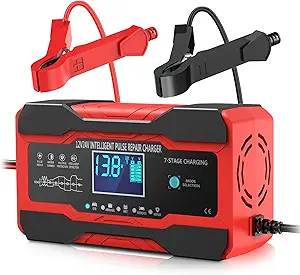 |
| Best Seller A high-volume bestseller chosen again and again | NOCO GENIUS1 1A 6V/12V Smart Battery Charger and Maintainer |  |
Schumacher SC1281 6V/12V 100A Battery Charger and Engine Starter

| Engine start | 100A |
|---|---|
| Boost charge | 30A to 12A |
| Charge/maintain | 6A to 2A |
| Battery types | Standard, AGM, Gel, Deep-cycle |
| Voltage | 6V / 12V |
The Schumacher SC1281 is a full-featured garage charger aimed at owners who want one tool to handle routine maintenance and emergency starts for an F-150. It provides a 100-amp engine start for jump-starting, 30A boost charging down to 12A, and a 6A trickle/2A maintain mode so you can charge a dead battery, fast-charge a weak battery, and keep a truck battery healthy in storage. Built-in diagnostics let you check battery and alternator condition, and an automatic desulfation mode attempts to restore sulfated batteries. The unit is microprocessor-controlled so it selects multi-stage charging and automatically switches to maintain when full. Practical safety features include reverse-polarity protection and automatic shutoff. Trade-offs are its weight and the need to be plugged into AC while in use, and some users report clamp and cable heating under prolonged high-current use, so expect it to be a shop-style, less-portable solution rather than a pocket jump starter for occasional roadside use on an F-150.
Best for: Balanced, all-round Ford F-150 owners who want one dependable garage device to charge, maintain, and diagnose their truck battery and occasionally provide a powerful engine-start boost.
Less Ideal for: Drivers who need a lightweight, battery-powered portable jump starter for roadside use or frequent off-grid starting should consider a compact jump pack instead.
- Supports both 6V and 12V batteries and common battery chemistries used in trucks
- 100A engine start plus 30A boost and 6A trickle modes cover jump-starting, fast charging, and long-term maintenance
- Automatic multi-stage charging and desulfation help recover and extend battery life
- Built-in battery and alternator tester simplifies on-vehicle diagnostics
- Reverse polarity protection and automatic shutoff reduce user error risk
- Requires AC power and does not have an internal battery for off-grid jumps
- Unit is relatively heavy and best suited to garage use rather than carrying for roadside emergencies
- Some reviewers report cable and clamp heating during extended high-current use
Verdict: A robust, garage-focused charger and 100A starter that covers an F-150 owner’s full range of charging, maintenance, and diagnostic needs if you can plug it into AC.
PCHH BC-108 12V/24V Heavy-Duty Automatic Battery Charger and Maintainer

| Input Voltage | 100V-130V AC |
|---|---|
| Output Voltage | 12V 24V |
| Output Current | 0-15A |
| Battery Size | Charge & maintain 4-400Ah |
| Working Temp. | -4°F (-20°C) – 104°F (40°C) |
The PCHH BC-108 is a multi-function battery charger designed to charge and maintain 12V and 24V lead-acid batteries for vehicles like the Ford F-150. It automatically detects battery voltage, offers fast-charge and trickle modes, and includes a repair program intended to revive deeply discharged batteries above 3V. A winter mode and an LCD that shows percentage, current, and voltage make it practical for cold-weather starts and monitoring charge progress. The unit also works as a 12V DC power supply and includes multiple safety protections such as reverse-polarity and overheat safeguards. In real-world use it is suited for overnight charging, periodic maintenance of a truck battery, and restoring sulfated or aging batteries, though it must remain plugged into AC power and is not a portable jump starter. The build is solid and operates quietly, but some users note the charging cables could be longer which can limit placement when the charger sits on the ground or a bench.
Best for: Performance-oriented owners who want a robust, feature-rich charger to keep a Ford F-150 battery in top condition and who prioritize restoring and maintaining battery performance over portability.
Less Ideal for: Buyers seeking a portable jump starter for emergency engine starts or those who need very long cable reach without moving the charger should consider alternatives.
- Supports both 12V and 24V batteries for wide vehicle coverage
- Repair mode to attempt recovery of deeply discharged batteries
- Selectable fast or trickle charging plus maintain mode for long-term battery care
- Winter mode and LCD readout for accurate charging in cold conditions
- Built-in safety protections including reverse-polarity and overheat protection
- Requires AC power to operate and cannot jump-start a vehicle
- Charging cables are relatively short which can limit convenient placement of the unit
Verdict: A heavy-duty, feature-packed charger built for restoring and maintaining truck batteries, but it must stay plugged in and is not a jump starter.
NOCO GENIUS2D 2A 12V Direct-Mount Smart Onboard Battery Charger

| Charging Current | 2 Amps |
|---|---|
| Battery Type | 12V lead-acid (AGM, Gel, SLA, VRLA, flooded) |
| Min. Charge Voltage | 1 Volt (Force Mode to 0V) |
| Included Accessories | 24-inch AC and DC cables, mounting bracket, screws |
The NOCO GENIUS2D is a small under-hood battery charger designed to mount near your Ford F-150 battery and keep it healthy while the truck sits. It functions as a charger, trickle maintainer, and desulfator for 12V lead-acid chemistries up to about 40 Ah. Installation uses a snap-fit bracket and self-tapping screws so you can secure it in the engine bay and leave it connected; the unit includes AC and DC cables with eyelets for permanent hookup. The charger monitors battery condition, adjusts charging for ambient temperature to avoid over- or undercharging, and offers a Force Mode that will attempt to revive very low or dead batteries. Because the output is limited to 2 amps, it is best suited to maintaining the F-150 battery between drives or slowly recovering a discharged battery rather than rapid charging a depleted starter battery. The compact design and pulse desulfation provide long-term battery care, but expect slow top-up times for large truck batteries compared with higher-amp chargers.
Best for: Practical optimizers who prioritize long-term battery health and a low-maintenance, permanently mounted solution to keep an F-150 ready after periods of storage.
Less Ideal for: Drivers who need fast bulk charging or frequent quick top-ups after long drains should choose a higher-amp portable charger instead.
- Direct-mount design with bracket and strap for secure under-hood installation
- Smart thermal compensation reduces risk of overcharging in varying temperatures
- Pulse desulfation to help recover and maintain battery health
- Can charge very low-voltage or dead batteries using Force Mode
- Maximum 2A output makes full recharge of a large F-150 battery slow
- AC power cable length may require running an extension for garage-to-engine-bay setups
Verdict: A compact, install-and-forget onboard maintainer that protects and slowly restores 12V batteries in an F-150, but it is too low-powered for fast recharging.
TPE Automatic 6V/12V 1.5A Battery Charger and Maintainer

| Output current | 1.5A |
|---|---|
| Voltages supported | 6V and 12V |
| Battery capacity (charge) | Up to 40AH |
| Battery capacity (maintenance) | Up to 60AH |
This small TPE charger is a straightforward trickle charger and maintainer for 6V and 12V lead-acid batteries commonly found in vehicles and accessories. It runs a five-step, MCU-controlled charge cycle—qualification, soft start, bulk, absorption, and maintenance—so you can connect it and let the unit manage charging and float maintenance without babysitting. The charger includes safety protections such as overvoltage, overcurrent, short-circuit, reverse-connection, and overheat protection, plus a 72-hour safety timer that prevents extended charging on marginal batteries. Its compact, lightweight design makes it easy to stow in a truck toolbox and leave connected during long storage periods. Limitations are its low 1.5A output and stated suitability for batteries up to about 40AH (maintain up to 60AH), which means it is best for topping off and long-term maintenance rather than rapid recharging of a large, deeply discharged F-150 starting battery. The short built-in lead length may require an extension or relocation to reach the battery in some engine bays.
Best for: Budget-conscious owners looking for a simple, set-and-forget maintainer to keep an F-150 battery healthy during storage or light seasonal use.
Less Ideal for: Drivers who need fast recovery charging after a dead start or who regularly deep-cycle their truck battery should choose a higher-current charger or professional service.
- Automatic multi-stage charging and float maintenance for hassle-free long-term battery care
- Multiple safety protections including reverse-connection and overheat protection
- Small, lightweight unit that is easy to store and leave connected for months
- 72-hour safety timer helps prevent overcharging on weak batteries
- 1.5A charging rate is too low for quickly recovering a large, deeply discharged F-150 starting battery
- Lead length is relatively short which can make connection to an engine bay battery awkward
Verdict: A compact, inexpensive automatic maintainer ideal for keeping an F-150 battery topped off, but too low-powered for fast recovery of a dead starting battery.
Battery Tender 3 Amp Charger and Maintainer (6V/12V, Selectable)

| Amperage | 3 Amps |
|---|---|
| Voltage selectable | 6V or 12V |
| Battery types | Lead-acid, AGM, Gel, Lithium |
The Battery Tender 3 Amp Charger is a switchable smart charger and maintainer intended to keep automotive 12V batteries healthy during storage or low-use periods. You select 6V or 12V, connect the included alligator clips or ring-terminal cable, and the unit delivers up to 3 amps until the battery is full then shifts to float mode to maintain voltage. A two-color LED reports status and the unit includes spark-proof connection and reverse-polarity protection for safer everyday use. Practical benefits for an F-150 include a moderate charge rate that refills and conditions a standard truck battery faster than trickle chargers while still being safe for long-term connection, plus long cord reach for tighter engine bays. Limitations are that the 3 amp output is not meant for rapid jump-starting of deeply discharged batteries and a few users noted quality-control issues with cords or instructions; ring terminals are not always supplied pre-attached. For owners prioritizing reliable, low-maintenance battery care, this model is a sensible factory-quality maintainer.
Best for: Reliability-focused buyers who want a durable daily-use maintainer to keep a Ford F-150 battery healthy during storage or infrequent use without fuss or frequent monitoring.
Less Ideal for: Drivers who need rapid high-current charging or a dedicated jump starter for repeatedly dead or heavily discharged batteries should choose a higher-output unit instead.
- Selectable 6V/12V operation supports a range of automotive battery types
- Smart charging with automatic float mode prevents overcharging during long-term connection
- Built-in spark-proof and reverse-polarity protection improves safety during hookup
- Long combined cord length (AC plus DC) makes it easier to reach batteries in tight engine bays
- 3 amp output is not suitable for fast recovery of severely discharged batteries
- Some users reported cord durability or assembly issues on a small number of units
Verdict: A trustworthy 3 amp smart maintainer built for dependable long-term care of a Ford F-150 12V battery, but not for fast recovery of dead batteries.
YONHAN 10-Amp 12V/24V Smart Battery Charger with Repair Mode and Temperature Compensation
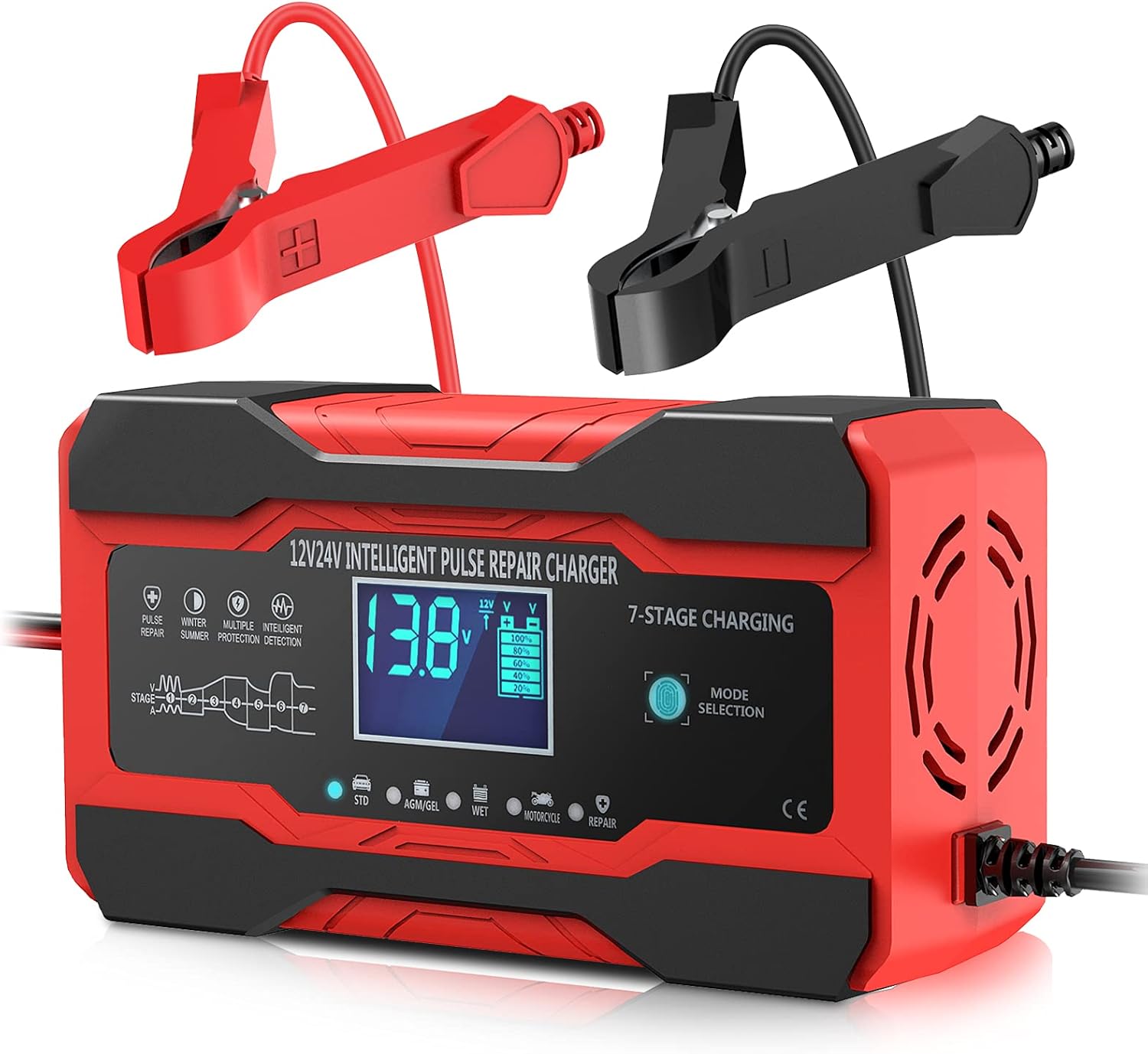
| Output current | 12V 10A / 24V 5A(Max) |
|---|---|
| Input voltage | AC 110-220V (50-60Hz) |
| Supported battery types | 12V/24V lead-acid, AGM, GEL, SLA, Flooded |
| Features | Repair/desulfator mode, temperature compensation, LCD display |
This YONHAN 10‑amp smart charger is a compact all‑in‑one solution for charging and maintaining F-150 batteries. It supports 12V (and 24V) lead‑acid chemistries including AGM, GEL, SLA and flooded batteries, and offers a backlit LCD that displays voltage, current, state of charge and temperature while the charger runs. Typical use for an F-150 is overnight or garage topping and periodic restorative charging after long storage; the unit also includes a repair/desulfator mode to help revive sulfated batteries that are weak but not physically damaged. Temperature compensation and a thermal sensor adjust charging in cold or hot conditions to reduce overcharge risk. Safety protections such as reverse polarity, overcharge and short‑circuit protection make it straightforward to use. Limitations are that it cannot charge lithium vehicle batteries and will not revive batteries that are completely dead or internally damaged, and its cable and clamp construction is modest compared with heavy‑duty shop chargers. For owners who want a portable, feature‑rich charger to keep an F-150 battery healthy, it is a practical choice; those needing a rugged, high‑power commercial charger should look elsewhere.
Best for: Convenience‑driven buyers who value a portable, plug‑and‑go charger to keep an F-150 battery topped up during winter storage or between drives and who prefer simple, automated operation over workshop gear.
Less Ideal for: Drivers who need a high‑duty commercial charger for frequent deep discharges or who use lithium battery systems should choose a more powerful or lithium‑capable unit instead.
- 10A charge current suitable for routine charging and overnight top‑ups on a Ford F-150 battery
- Repair/desulfation mode can restore weak, sulfated batteries without replacing them
- Backlit LCD and thermal sensor provide visible status and temperature‑compensated charging
- Built‑in safety protections including reverse polarity, overcharge and short‑circuit prevention
- Not compatible with lithium vehicle batteries so not suitable if your F-150 has a lithium auxiliary battery
- Cables and clamps are lightweight compared with heavy shop units and may be less durable with frequent outdoor use
Verdict: A portable, feature‑packed 10A charger that’s ideal for convenience‑minded Ford F-150 owners who need reliable topping and battery restoration without workshop equipment.
NOCO GENIUS1 1A 6V/12V Smart Battery Charger and Maintainer

| Voltage | 6V/12V |
|---|---|
| Compatible Battery Types | Lead-acid (AGM, gel, flooded, deep-cycle) and LiFePO4 |
| Minimum Detectable Voltage | Charges from as low as 1 volt |
| Charge Current | 1 Amp |
| Included Accessories | Battery clamps and integrated eyelet terminals |
The NOCO GENIUS1 is a small, user-friendly smart charger designed to charge, maintain, and revive 6V and 12V lead-acid and LiFePO4 batteries. For Ford F-150 owners it functions as a slow 1 amp maintainer for the truck battery when the vehicle sits for long periods and can recover deeply discharged batteries using Force Mode and pulse desulfation. The unit automatically adjusts charge based on an integrated thermal sensor, so it reduces risk of overcharging in hot conditions and undercharging in cold ones. Its built-in monitoring lets you leave the charger connected safely for long-term storage without constant supervision. Practical benefits include a compact wall-plug design, included battery clamps and eyelet terminals for permanent connections, and the ability to charge batteries down to very low voltages. Important limitations are the low 1 amp charge rate, which means large F-150 starter batteries will take many hours or days to reach full charge, and limited fast-charge capability if you need a quick top-up before driving. The single-button interface is simple but can take a moment to learn for advanced modes.
Best for: A risk-averse mainstream buyer who prioritizes safe, reliable battery maintenance and wants a compact, set-and-forget charger to prevent battery failure during long storage periods.
Less Ideal for: Drivers who need a fast top-up or frequent rapid charging for heavy-duty or repeatedly discharged F-150 batteries should consider higher-amp chargers instead.
- Supports both 6V and 12V lead-acid and LiFePO4 battery chemistries for broad compatibility
- Integrated thermal sensor adjusts charging to ambient temperature to protect the battery
- Precision pulse charging and desulfation to help restore and extend battery life
- Safe for indefinite connection so it can be used for long-term maintenance
- Includes clamps and eyelet terminals for temporary or semi-permanent installation
- 1 amp maximum output is very slow for large truck starter batteries and deep discharges
- Single-button UI can be confusing when accessing advanced modes without the manual
Verdict: A reliable, compact maintainer with battery-repair features that is ideal for safe long-term care of an F-150 battery but too slow when you need fast charging.
Choosing the Right Ford F-150 Battery Charger: Key Factors to Consider
Charge Current and Recovery Speed
The charger s output current determines how quickly a depleted Ford F-150 battery can be restored. Higher amperage chargers reduce recovery time, which is useful after long sits or heavy accessory use, but very high current may generate more heat and require proper monitoring.
Think about how often you need a fast turnaround versus slow, gentle charging. If you frequently drain the battery or need quick recovery before driving, prioritize higher charge amperage. For routine top-ups and maintenance, lower current is often safer and gentler on battery life.
Maintenance and Float Modes
Maintenance or float modes automatically hold a battery at a safe charge level once full, preventing overcharge during extended storage. This is important for trucks that sit for weeks or months, because constant trickle charging without proper control can reduce battery lifespan.
Look for chargers that switch to a true float or maintenance profile after bulk charging. That way you get quick recovery when needed and safe, unattended long-term maintenance without risking sulfation or overcharging.
Compatibility With Truck Battery Chemistries
Truck batteries can use different lead-acid chemistries such as flooded, AGM, and gel. Chargers that detect or allow selection of the correct chemistry ensure the charging algorithm matches the battery s requirements and helps avoid damage.
Confirm the charger supports the common 12-volt lead-acid types used in large pickups. Chargers with automatic detection simplify setup, while manual selection offers more control if you know the battery type.
Safety Features
Safety features protect both you and the vehicle during charging. Reverse-polarity protection, spark suppression, over-temperature shutdown, and short-circuit protection reduce the risk of accidents when connecting or charging a truck battery.
Temperature compensation is especially useful in hot or cold climates because batteries accept charge differently with temperature changes. Prioritizing models with comprehensive safety protections makes unattended charging and maintenance far less risky.
Portability and Connection Type
How and where you plan to use the charger matters for size and connection options. A compact, lightweight charger is easier to store and move around the garage, while a heavier, high-capacity unit may sit on a shelf but deliver faster charging.
Consider connection styles such as clamps versus ring terminals if you prefer semi-permanent installation. Cord length, plug type, and whether the unit can run from a portable power source are additional practical points that affect everyday usability.
User Interface and Automation
A clear display and simple controls reduce the chance of user error when charging a truck battery. Smart chargers that offer automatic charge sequencing and fault detection remove the need to micromanage the process.
Look for indicators that show charge stage and battery condition, and for chargers that resume maintenance mode automatically after charging. Ease of use matters when you need reliable charging in stressful situations, such as prepping for a trip or dealing with an unexpected dead battery.
Common Charging Scenarios for Your Ford F-150
Understanding the most likely charging situations for a Ford F-150 helps you pick the right charger capacity and features. Daily drivers that sit overnight and rarely deplete the battery need different equipment than trucks used seasonally, for towing, or for work shifts where heavy accessory loads are common.
Short-term on-the-road recoveries, dead-start situations, and topping up after extended idling are the scenarios you will encounter most. A compact car battery charger is convenient for occasional top-ups and emergency boosts, while a higher-output unit is better for fast recovery after a deep discharge.
If your F-150 is used for towing, hauling, or has aftermarket electronics that draw power when parked, expect deeper and more frequent discharge cycles. For that use case, prioritize chargers with higher amp charging and recovery modes so you can restore full cranking power without long downtime.
- Everyday top-ups and short replenishing: low- to mid-amp chargers.
- Deep discharge recovery after a dead start: high-amp chargers or engine-start assist features.
- Fleet, work, or high-accessory use: chargers with diagnostic and higher recovery current capabilities.
Assessing Battery Health and when to Charge
Before connecting any charger, check the battery condition to make sure charging is appropriate. Look for corrosion, loose connections, physical damage, or significant loss of electrolyte on serviceable batteries. A visual and voltage check avoids wasting time on a battery that needs replacement.
Modern smart battery charger models provide built-in diagnostics that can read battery voltage, estimate state of charge, and detect problems such as sulfation. Using a diagnostic-capable charger lets you choose whether to attempt a recovery charge or plan for battery replacement based on measurable feedback.
If your F-150 shows slow cranking, dashboard warning lights, or inconsistent accessory power, test the battery under load or with a diagnostic charger before relying on repeated charges. Repeatedly charging a failing battery is a temporary fix and can leave you stranded.
- Do a visual inspection before charging.
- Use diagnostic readings to decide between charging and replacement.
- Avoid repeated charging of a battery that fails under load.
Proper Hookup, Charging Modes, and Safety Steps
Safe hookup prevents sparks and protects vehicle electronics. Park on level ground, turn off the engine, remove metal jewelry, and ensure the charger is powered off before connecting. Connect the positive lead to the battery positive terminal first, then connect the negative lead to a chassis ground point away from the battery to reduce spark risk.
An automatic battery charger simplifies charging for most owners by selecting appropriate charge profiles and terminating the cycle when complete. Choose a unit with clear indicator lights or a simple display so you can verify mode and charging progress without guessing.
Always follow manufacturer-recommended charge rates for the battery type fitted to your F-150. Overly aggressive charging can damage battery plates and shorten service life. If your truck has sensitive electronics or aftermarket modules, consult the vehicle manual about any manufacturer-specific charging cautions.
- Connect positive first, negative to chassis ground second.
- Keep charger off until connections are made.
- Use charger indicators to confirm charging mode and completion.
Storage, Seasonal Care, and Maintaining Charge
If you store your Ford F-150 for long periods or only drive it occasionally, use a battery maintainer to keep the battery at an optimal state of charge. Maintainers provide low, sustained current that prevents discharge without overcharging, preserving battery capacity over months of inactivity.
Float charger functionality is useful for owners who want hands-off upkeep. A proper float charger monitors battery voltage and supplies current only when voltage falls below the set threshold. This prevents the battery from cycling unnecessarily while ensuring it is ready when you return.
For winter storage, keep the battery warm and maintain its charge level. Cold temperatures reduce cranking power, and a maintained battery improves start reliability during freezing conditions.
- Use a maintainer for long storage to prevent permanent discharge.
- Float mode provides automatic top-up without risk of overcharge.
- Store the vehicle in a temperature-controlled area when possible.
Onboard Powering Options, Accessories, and Slow-charge Methods
Some F-150 owners prefer to keep a trickle charger or small maintenance unit in the truck for overnight or campsite use. These low current devices are good for maintaining charge on batteries with light accessory use when shore power is available.
When using onboard power outlets or running accessories while the engine is off, monitor battery voltage carefully. Even a slow draw can deplete a battery over days. If you routinely use winches, lights, or refrigerators, consider a higher-capacity charger or an auxiliary battery solution to protect your primary cranking battery.
Cables, clamps, and installation hardware matter. Thicker gauge leads reduce voltage drop during charging and recovery, and quality clamps ensure a reliable connection. Keep terminals clean and use dielectric grease to slow corrosion on connections exposed to the elements.
- Keep a slow trickle charger handy for low-draw maintenance tasks.
- Upgrade cable gauge for fast recovery or frequent charging.
- Protect exposed terminals to reduce corrosion and ensure good contact.
How We Chose the Best Ford F-150 Battery Charger
We focused on chargers suited specifically to the needs of Ford F-150 batteries and modern truck use. Key evaluation criteria included: charge current and recovery speed to assess how quickly a depleted battery can be restored; maintenance and storage modes to prevent overcharging when the truck sits unused; compatibility with common 12-volt lead-acid chemistries used in trucks; safety features such as reverse-polarity protection, spark-proof connections, and temperature compensation; and ease of use including connection type, display clarity, and automatic operation.We excluded units designed only for small passenger-car batteries, non-12-volt systems, and chargers lacking basic safety protections. We also filtered out chargers that require complex programming for routine charging. The resulting list prioritizes practical performance, maintenance capability, and safety for truck owners who need dependable charging and long-term battery care.
Our full evaluation process is outlined in our review methodology.
FAQ
Can I use a car battery charger on a Ford F-150?
Often you can use a car battery charger on a Ford F-150 if it supports 12-volt lead-acid batteries and provides adequate current. Trucks typically have larger batteries, so choose a charger with suitable amperage and safety features. Avoid chargers that are designed only for small passenger-car batteries or lower amperage applications.
What is the difference between a trickle charger and a smart battery charger?
A trickle charger supplies a small, fixed current continuously, which can keep a battery topped up but risks overcharging if not monitored. A smart battery charger uses sensors and microprocessors to adjust charging stages and switch to maintenance or float mode automatically. Smart chargers are generally better for long-term care and preventing damage from overcharge.
How long should I leave a battery maintainer connected?
Battery maintainers are designed for extended connection and can often be left connected for weeks or months as they keep the battery at a safe float level. Still, choose a unit with proper float-mode regulation and safety protections, and check the battery and charger periodically to confirm normal operation.
Is it safe to use an automatic battery charger overnight?
Usually it is safe to use an automatic battery charger overnight if the charger has reliable automatic cutoffs, float-mode maintenance, and safety protections. Automatic chargers monitor the charge state and reduce current or switch to maintenance when appropriate, which reduces the need for constant supervision.
Will temperature affect charging my truck battery?
Yes, temperature affects charging efficiency and battery acceptance. Cold temperatures slow chemical reactions and can require different charging profiles, while hot conditions increase the risk of overcharging and heat buildup. Chargers with temperature compensation adjust the charge algorithm to match ambient conditions for safer and more effective charging.
Do I need professional help to install a charger in the truck?
Not always. Many chargers are plug-and-play with clamp or ring terminal options that an owner can install safely by following the manual. However, if you plan a permanent installation or are unsure about wiring or compatibility, consult a qualified technician to avoid electrical or warranty issues.
Final Verdict
Choosing the right Ford F-150 battery charger means balancing recovery speed, long-term maintenance features, and safety. Prioritize chargers that offer adequate charge current for quick recoveries but also include automatic float or maintenance modes to protect battery health during storage.Also weigh compatibility with your truck s battery chemistry, built-in safety protections, and ease of use. Focusing on those tradeoffs will help you pick a charger that fits your driving patterns and keeps your F-150 reliable year-round.
Explore More:
- Check out all Ford F-150 parts & accessories
- Browse all Tools
