

Note: This article contains affiliate links. If you click on these links and make a purchase, I may earn a small commission at no extra cost to you. This helps support my research and content. Read my full affiliate disclosure here.
If you drive a Subaru Impreza, the exhaust manifold plays a key role in engine performance, emissions, and thermal management. Choosing the right manifold matters because poor fit, inadequate heat resistance, or a leaking flange can lead to drivability issues and costly follow-up work. This guide covers seven shortlisted exhaust manifolds selected for their suitability to the Impreza, focusing on fitment, material, and heat-handling characteristics.Below you will find clear criteria and guidance to help you decide which option suits your needs, plus practical considerations for installation and longevity.
Looking for other parts? See all Subaru Impreza parts & accessories.
Top Picks at a Glance
| Best Overall The best all-around choice for most situations | BDFHYK Catalytic Converter Exhaust Manifold for Subaru 2.0L/2.5L H4 (Direct Fit) |  |
| Best Quality Built to a higher standard if you want something more solid | MagnaFlow OEM-Grade Direct-Fit Catalytic Converter 52587 |  |
| Best Value The sweet spot between price and what you get | AutoShack Front Exhaust Manifold Catalytic Converter Assembly for 2.5L Subaru (Direct Fit) |  |
| Best Budget The cheapest option that still gets the job done reliably | FUTAIHE Exhaust Manifold Catalytic Converter for Subaru 2.5L (Direct Fit) |  |
| Best Seller A high-volume bestseller chosen again and again | A-Premium Front Catalytic Converter Kit — Direct-Fit for Subaru 2.0L/2.5L |  |
1. BDFHYK Catalytic Converter Exhaust Manifold for Subaru 2.0L/2.5L H4 (Direct Fit)

| Brand | BDFHYK |
|---|---|
| Model | 16689 |
| Manufacturer Part Number | BD-05-EXS22-00055SR-000-W |
| Engine compatibility | 2.0L/2.5L H4 |
| Emissions compliance | Federal EPA (restricted in some states) |
This one-piece catalytic converter exhaust manifold is a direct-fit replacement for Subaru Impreza and related models with 2.0L and 2.5L H4 engines and is designed to clear low-efficiency catalyst faults such as P0420 and P0430. It installs in place of the factory manifold and includes gaskets, studs, washers, and nuts to help achieve a leak-free connection. The core is loaded with platinum, rhodium, and palladium and the shell uses 409 stainless steel with Q235 flanges for corrosion resistance and structural strength. In practical use it addresses exhaust-related check-engine lights, can restore fuel economy and throttle response lost to a clogged converter, and is intended to meet federal EPA emissions requirements outside restricted states. Expect straightforward bolt-on installation for a shop or experienced DIYer, but note the unit does not ship with factory heat shields and some buyers paint or otherwise protect the exterior against road salt in harsh climates. Fitment claims reference multiple OEM numbers for seamless replacement but state restrictions apply for California, Colorado, and New York.
Best for: Balanced owners seeking a direct, emissions-focused replacement that restores drivability and clears catalyst-related check-engine lights while keeping installation practical for a shop or capable DIYer.
Less Ideal for: Buyers in states with stricter emissions laws or those who need an exact factory-spec exhaust shield setup without additional modification should consider OEM or state-compliant alternatives.
- Direct factory-fit design for Subaru 2.0L and 2.5L H4 applications to simplify installation
- Inner ceramic core coated with platinum, rhodium, and palladium to restore catalytic efficiency
- Supplied hardware and multi-layer gaskets for a tight, leak-resistant flange seal
- Constructed with 409 stainless steel body and reinforced Q235 flanges for durability
- Does not include factory heat shields which may require transfer from the old unit or aftermarket protection
- Not legal for sale or use in certain states which limits where it can be installed
Verdict: A direct-fit catalytic converter manifold that targets P0420/P0430 faults to restore emissions performance and drivability on Subaru Impreza 2.0L/2.5L H4 models.
2. MagnaFlow OEM-Grade Direct-Fit Catalytic Converter 52587

| Body Material | Stainless Steel |
|---|---|
| Inlet/Outlet Attachment | Bolt-On |
| Main Piping Diameter | 2.25" |
| Oxygen Sensor Location | Midbed & Post Converter |
| Type | Direct-Fit Federal/EPA Compliant |
This MagnaFlow OEM-grade direct-fit catalytic converter is designed to replace the factory manifold unit on compatible Subaru Impreza-family applications and keep the check engine light off by meeting Federal EPA OBDII monitoring requirements. It bolts in with included gaskets and hardware and uses mandrel-bent tubing and a spun-body stainless steel design aimed at corrosion resistance and consistent fit. The converter locates oxygen sensors mid- and post-converter and ships as a direct-fit manifold-style unit so installers can avoid cutting or welding for most replacements. Practical benefits include factory-quality fit intent from 3D-scanned tooling, reduced leak risk from a laser fusion weld, and packaged hardware to replace corroded factory pieces. Important limitations are the legal sales restrictions for some states and reported omissions like a heat shield on some units, so buyers in restricted states must choose a compliant alternative and installers should verify sensor wiring and heat protection during installation.
Best for: Performance-oriented owners seeking a high-quality, factory-replacement manifold catalytic converter that preserves emissions compliance while maintaining exhaust flow and drivability.
Less Ideal for: Drivers in states with restrictive emissions laws or those who need a converter explicitly certified for California or Colorado should look for state-compliant alternatives.
- Direct-fit manifold design with included gaskets and hardware for bolt-on installation
- Stainless steel spun-body construction and mandrel-bent tubing for corrosion resistance and flow
- Engineered to satisfy Federal EPA OBDII monitoring to help keep the check engine light off
- Manufactured using 3D scanning and precision tooling to replicate factory fit and reduce leaks
- Not legal for sale or use in certain states, limiting where it can be installed
- Some users report missing heat shielding which may require additional parts or modification
Verdict: A factory-focused, stainless-steel direct-fit catalytic converter built to restore emissions compliance and maintain exhaust flow for performance-minded Subaru owners.
3. AutoShack Front Exhaust Manifold Catalytic Converter Assembly for 2.5L Subaru (Direct Fit)

| Fitment | 2006-2010 Forester, 2006-2011 Impreza, 2006-2012 Outback/Legacy, 2006 Saab 9-2X 2.5L AWD |
|---|---|
| Exterior | Stainless Steel and Ceramic |
| Manufacturer Part Number | EMCC00004 |
| OEM Part Numbers | 16564, 4442, 674-864 |
This AutoShack unit combines the exhaust manifold and front catalytic converter into a single direct-fit replacement for 2.5L Subaru engines. It is intended to replace the factory front pipe and converter so you can bolt it to the existing exhaust system and restore emissions control and engine codes. The assembly is stainless steel with a ceramic substrate catalytic core and ships with the usual mounting provisions for a straightforward installation when done by a shop. Practical benefits include restoring proper emissions function, clearing P0420-type codes when paired with fresh O2 sensors, and avoiding the higher cost of an OEM manifold-plus-cat. Limitations are notable: it is not CARB compliant so it cannot be used in California, Colorado, New York, or Maine, some buyers reported fitment tweaks and tight clearances during install, and there are mixed long-term reliability reports so expect to follow the seller warranty terms and consider replacing O2 sensors during service.
Best for: Practical optimizers seeking the most cost-effective way to restore emissions function and clear engine codes on a 2.5L Subaru while accepting aftermarket compromises.
Less Ideal for: Buyers who need California-compliant parts, who prioritize long factory-life components, or who prefer strictly OEM replacements should look elsewhere.
- Direct-fit design replaces front manifold and catalytic converter in one assembly
- Stainless steel exterior for corrosion resistance compared with cheaper metals
- Includes ceramic substrate catalytic core to meet federal emissions standards in 46 states
- Saves cost versus buying separate OEM manifold and converter components
- Not legal for use in CARB states (California, Colorado, New York, Maine)
- Some buyers report tight fitment that may require minor modification or a two-person install
- Mixed reports on long-term durability with limited warranty coverage
Verdict: A budget-friendly, direct-fit manifold-plus-catalytic-converter that restores emissions function for 2.5L Subaru models without the OEM price.
4. FUTAIHE Exhaust Manifold Catalytic Converter for Subaru 2.5L (Direct Fit)
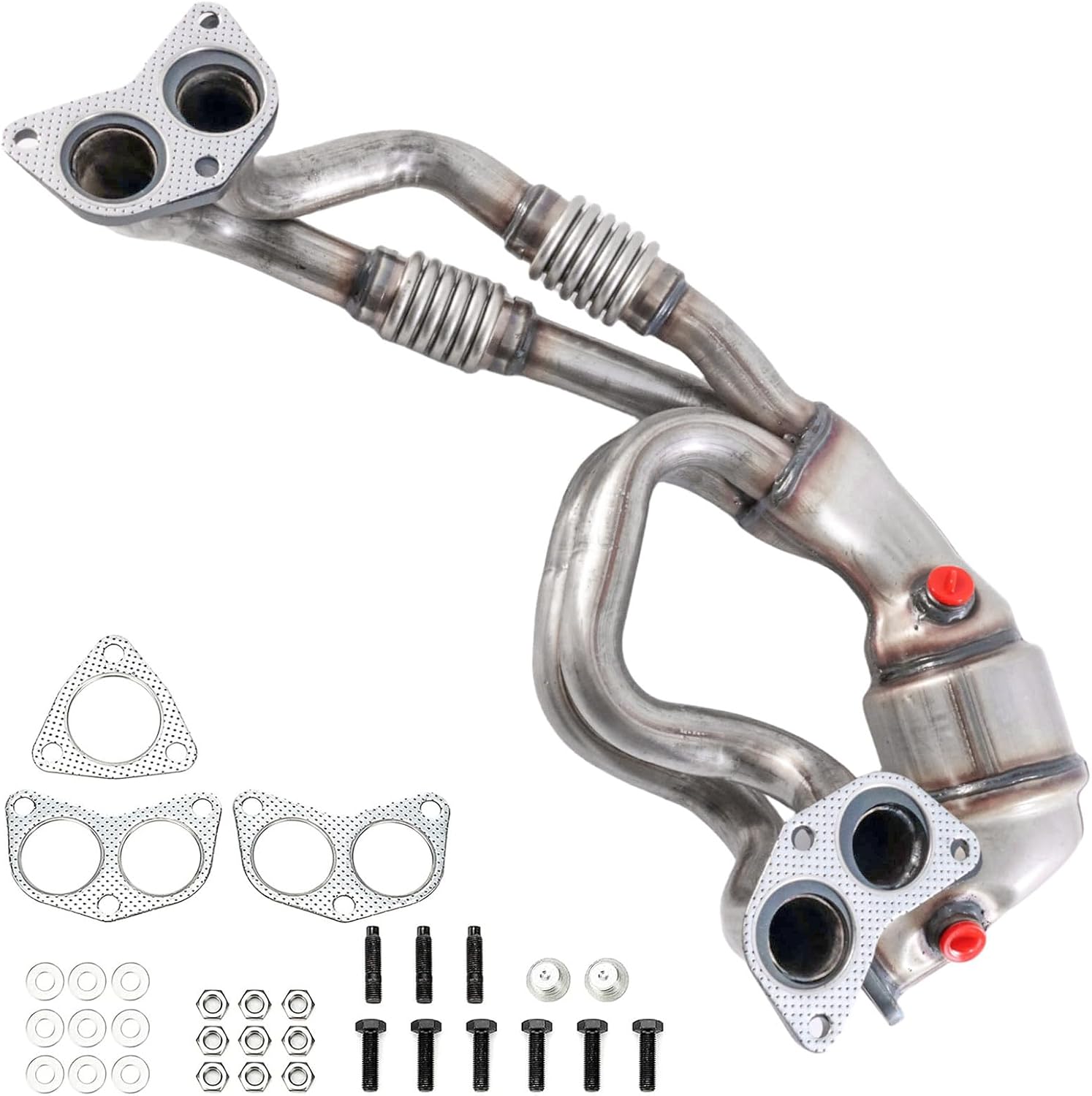
| Compatibility | Selected 2006–2012 Subaru 2.5L models (Forester, Impreza, Legacy, Outback, Saab 9-2X) |
|---|---|
| Tube material | Stainless Steel |
| Substrate material | Ceramic |
| Inlet/Outlet | Single 3-bolt welded flange |
This FUTAIHE exhaust manifold replaces the front catalytic converter and bolts directly to the factory flange for 2.5L Subaru models listed in the compatibility notes. It is built from stainless steel with a ceramic substrate and comes with the inlet and outlet 3-bolt welded flanges and included hardware for a straightforward swap without cutting or welding. For budget repairs it restores catalytic function and can clear P0420-style catalyst codes when the converter itself is the cause. The direct-fit design and included gaskets/hardware simplify installation for a DIYer or independent shop. Important limitations are regulatory and quality-related: the part is EPA compliant but not CARB compliant so it cannot be used in some states, and user reports show variable build finish and occasional internal features that may affect downstream oxygen sensor readings on later engines. Expect a cost-effective replacement that works for many low-mileage to mid-life engines but verify fit and emissions rules before purchase.
Best for: Budget-conscious Subaru owners wanting a low-cost, bolt-on front catalytic converter replacement to repair emissions-related check-engine codes and avoid expensive dealer-level parts.
Less Ideal for: Buyers in CARB-restricted states or owners seeking a factory-quality OEM replacement with guaranteed emissions certification should look at certified alternatives.
- Direct-fit design with 3-bolt flanges for bolt-on installation without cutting or welding
- Stainless steel construction and ceramic substrate aimed at restoring catalytic function
- Includes gaskets and hardware to simplify a DIY or independent shop installation
- Not CARB compliant so cannot be used where California-style emissions rules apply
- Build finish and internal baffling quality vary between units according to user reports
Verdict: A low-cost, direct-fit catalytic manifold that makes an effective budget repair for compatible Subaru 2.5L engines.
5. A-Premium Front Catalytic Converter Kit — Direct-Fit for Subaru 2.0L/2.5L

| Location | Front |
|---|---|
| E.P.A. Compliant | Yes |
| Vehicle's Emissions Specifications | Federal Emissions |
| Body Material | Stainless Steel |
| Gasket & Bolts Included | Yes |
This front catalytic converter kit replaces the factory unit and is intended as a direct-fit exhaust manifold/catalytic converter assembly for specified Subaru H4 2.0L and 2.5L models. It is typically used to clear P0420 check-engine codes and restore emissions functionality after a failed converter. Notable features include stainless steel construction, welded 9-bolt inlet and 3-bolt outlet flanges, and included gaskets and bolts to simplify installation. The EPA-compliant core and welded flanges make it straightforward for a professional or competent DIY installer to swap units without major exhaust modifications, and several owners report successful fits and resolved emissions trouble lights. Limitations to consider are state-level restrictions since it cannot be sold for use in California, Colorado, New York, or Maine, and some buyers reported fitment quirks such as heat shield bolt alignment or occasional internal debris in defective units. A one-year unlimited-mileage guarantee is offered by the brand, which helps offset concerns about longevity for conservative buyers.
Best for: Risk-averse mainstream buyers who prioritize restoring factory emissions performance and a straightforward, mostly bolt-on replacement for their Subaru Impreza or similar Subaru H4 models.
Less Ideal for: Do not choose this if you live in California, Colorado, New York, or Maine or if you require a state-approved converter for those markets; also avoid if you need a custom or performance-oriented exhaust solution.
- Direct-fit design for specified Subaru 2.0L and 2.5L H4 models reduces installation time
- Stainless steel body resists corrosion compared with cheaper materials
- Includes gaskets and mounting bolts so you have the necessary hardware at install
- EPA-compliant for federal-emissions states and intended to clear emissions fault codes
- Not legal for sale or use in California, Colorado, New York, and Maine due to emissions rules
- Some units reported minor fitment issues with heat shields or center brackets requiring adjustment
Verdict: A direct-fit stainless steel catalytic converter kit that restores factory emissions function for specified Subaru 2.0L and 2.5L H4 models.
Looking for the perfect fit?
Select your Subaru Impreza configuration to see the most relevant Exhaust Manifolds recommendations
Choosing the Right Subaru Impreza Exhaust Manifold: Key Factors to Consider
Fitment and Bolt Pattern
Accurate fitment is the first thing to check because bolt pattern and flange geometry determine whether the manifold mounts cleanly to the Impreza head. A manifold that does not align precisely can stress bolts and gaskets, leading to leaks and premature failure.
Make sure the design matches factory mounting locations and accounts for nearby components such as heat shields, sensors, and turbo plumbing when applicable. Ease of access to bolts during installation also matters; some manifolds route piping or flanges in ways that complicate removal and reinstallation.
Material and Thermal Resistance
Materials such as cast iron, stainless steel, and certain high-grade alloys behave differently under heat cycling. Cast iron offers good thermal mass and durability but can be heavier and prone to cracking if stressed. Stainless steel can resist corrosion and often handles thermal expansion better, but wall thickness and construction quality are important.
Consider how the material manages heat to prevent warping or cracking over time. Manifolds that dissipate heat more evenly can protect gaskets and nearby components, reducing the likelihood of heat-related failures.
Sealing Design and Gasket Interface
The flange surface quality and the gasket interface are central to preventing exhaust leaks. Flat, machined flanges with consistent thickness allow gaskets to seal reliably; warped or rough flanges make it difficult to achieve a durable seal. The choice of gasket type and the availability of proper replacement gaskets also affect long-term leak resistance.
Pay attention to whether the manifold design includes raised flanges, integrated sealing surfaces, or provisions for high-temperature gaskets. These features reduce the chance of exhaust gases escaping at the head-to-manifold junction.
Susceptibility to Cracking and Warping
Repeated heat cycles cause expansion and contraction that can eventually lead to cracks or warped flanges. Design features such as reinforcement ribs, thicker walls at stress points, and choice of alloy influence how well a manifold withstands these cycles.
Consider the typical driving conditions the vehicle will face, such as extended highway runs or stop-and-go city traffic, which can affect thermal stress. Manufacturers who account for thermal fatigue in the design will usually produce manifolds that last longer under real use.
Installation Complexity
Installation difficulty affects both time and the risk of errors. Some manifolds are direct bolt-on replacements with access to all fasteners, while others require partial removal of adjacent components or specialized tools. Tight clearances around the Impreza engine bay can make some installations challenging.
Think about whether you will install it yourself or use a technician. Simpler bolt-on designs reduce labor time and the chance of improper torqueing, which in turn lowers the risk of leaks and fastener failures.
Compatibility with Emissions and Sensors
Modern engines rely on sensors and emissions equipment that must be accommodated by the manifold design. Provision for oxygen sensor bungs, EGR passages, or catalytic converter attachment points is necessary for a compliant installation.
Confirm that the manifold supports the required sensor locations and emissions interfaces for the Subaru Impreza. Missing or misplaced sensor ports can lead to check-engine lights, drivability problems, or the need for additional adapters.
How We Chose the Best Subaru Impreza Exhaust Manifold
We evaluated candidates based on factors that affect real-world use on the Subaru Impreza. Key criteria included fitment accuracy to factory mounting points, thermal performance and resistance to warping or cracking, material and construction quality, and flange and gasket sealing features. We also considered the manifolds ease of installation in a typical Impreza engine bay and whether design choices would interfere with nearby components such as heat shields, turbocharger plumbing, or sensors. Durability under repeated heat cycles and resistance to corrosion were used to assess long-term value. Finally, we reviewed documented reports of common failure modes to favor designs that reduce leak risk.We excluded items that require major vehicle modification or extensive custom fabrication, and we did not consider options that lack clear fitment information for the Subaru Impreza. The result is a focused list of manifolds that meet practical fit, durability, and installation expectations for this vehicle.
Our full evaluation process is outlined in our review methodology.
FAQ
What are common exhaust manifold symptoms on a Subaru Impreza?
Common symptoms often include a ticking or tapping noise during cold starts that may become louder under load, reduced engine responsiveness, and a noticeable exhaust odor in the engine bay. You may also see soot or discoloration around the flange area, which can indicate a leak.
How can I diagnose an exhaust manifold leak?
Diagnosis usually starts with a visual inspection for cracks, soot, or loose bolts. A smoke test or listening for changes in sound while a helper revs the engine can help pinpoint leaks. Be cautious working around a hot engine; many owners wait until the engine is cool to inspect and tighten fasteners if needed.
When should I replace the exhaust manifold gasket?
Replace the gasket if you detect persistent exhaust noise at the flange, visible soot, or if the gasket is damaged during removal. Gaskets often fail before the manifold itself, and replacing the gasket when reassembling is good practice to ensure a reliable seal.
Can a cracked exhaust manifold be repaired or does it need replacement?
Small cracks in some materials can sometimes be welded, but repairability depends on the material, crack location, and extent of heat damage. Welding can be a temporary fix; many owners opt for full replacement to restore long-term reliability and avoid repeat failures.
Will swapping an exhaust manifold affect engine performance?
Swapping to a properly fitted manifold can restore lost performance caused by leaks or restrictive flow. However, changes in manifold design can alter exhaust flow characteristics and should be chosen with attention to engine tuning and sensor placement to avoid unintended effects.
How much does installation typically impact the overall cost?
Installation complexity influences labor time; a direct bolt-on manifold with good access usually takes less time than one requiring removal of adjacent components. Expect variation depending on the shop and vehicle condition, and factor in potential additional work like replacing gaskets or bolting hardware.
Conclusion
Focus on fitment, material quality, and sealing features when choosing an exhaust manifold for a Subaru Impreza. Prioritize designs that match factory mounting points, provide durable flange surfaces, and resist thermal fatigue to reduce the chance of leaks and repeat repairs.Balance installation complexity against long-term reliability. If you need easier installation, favor direct-fit options with clear sensor provisions; if longevity under heavy use is the priority, emphasize material and construction that manage heat and stress well.
Explore More:
- Check out all Subaru Impreza parts & accessories
- Explore Exhaust Manifolds Maintenance & Repair Guides
- Explore Exhaust & Emissions
- Browse all Auto Parts
