

Note: This article contains affiliate links. If you click on these links and make a purchase, I may earn a small commission at no extra cost to you. This helps support my research and content. Read my full affiliate disclosure here.
If you drive a Ford F-150 regularly, worn upper control arms can make the truck feel vague, pull to one side, or produce clunks over bumps. Replacing the upper control arm is a common repair that directly affects steering precision, tire wear, and suspension geometry. This guide covers the top shortlisted upper control arms selected for fitment with Ford F-150s, explaining why each option made the list and which driving outcomes they prioritize.Below you will find concise evaluations plus a clear explanation of the evaluation criteria used. Use the quick factors and deeper sections to match the right arm to how you use your truck.
Looking for other parts? See all Ford F-150 parts & accessories.
Top Picks at a Glance
| Best Overall The best all-around choice for most situations | dynofit Upper Control Arms for 2004–2020 Ford F-150 (2–4" Lift) |  |
| Best Quality Built to a higher standard if you want something more solid | KSP Performance Aluminum Front Upper Control Arm for 2004–2020 F-150 (2–4" Lift) |  |
| Best Value The sweet spot between price and what you get | Detroit Axle Front Upper Control Arms with Ball Joints, Pair |  |
| Best Budget The cheapest option that still gets the job done reliably | MOOG RK80306 Front Left Upper Control Arm with Ball Joint |  |
| Highest Rated A top-rated pick with lots of positive feedback | SKUCH 2–4" Front Upper Control Arms for 2004–2020 Ford F-150 (2 pcs) |  |
| Most Popular A crowd favorite that many people choose with confidence | Detroit Axle Front Upper Control Arms with Ball Joints, Pair |  |
| Best Seller A high-volume bestseller chosen again and again | KSP Performance Tubular Upper Control Arms for Ford F-150 (2–4" Lift) |  |
dynofit Upper Control Arms for 2004–2020 Ford F-150 (2–4" Lift)

| Fitment | 2004-2020 Ford F-150 (except Raptor) |
|---|---|
| Lift compatibility | 2-4" leveling/lift kits |
| Material | Alloy steel tubing |
| Bushings | Polyurethane, replaceable |
| Included components | 2-piece front upper control arms |
These dynofit upper control arms replace the factory front upper arms on 2004–2020 Ford F-150s that run a 2–4" leveling or lift kit. Built from welded carbon steel plate with 1.25" DOM tubing and polyurethane bushings, they are meant to restore proper ball-joint geometry after a lift, reduce tire rubbing, and give more steering stability and articulation off road. Notable features include replaceable, heat-treated ball joints with a zinc-nickel coating and grooved, serviceable PU bushings that are more temperature resistant than rubber and can be greased. Installation is straightforward for a competent DIYer with basic tools, though alignment after installation is required. Practical benefits are improved steering feel, reduced tire wear from corrected angles, and the ability to refresh only worn joints or bushings later. Limitations to consider are potential rubbing with conservative stock wheels or large tires unless you use wheel spacers or different wheels, and mixed long-term feedback on bushing and ball-joint longevity among users.
Best for: Buyers who want a durable, serviceable upgrade to restore proper suspension geometry on a lifted F-150 and who value improved steering control and the ability to replace wear items rather than full arms.
Less Ideal for: Not a great choice for owners keeping entirely stock ride height or those unwilling to change wheel backspacing if clearance issues appear; city drivers who never lift their truck should consider standard replacement arms.
- Vehicle-specific design for 2004–2020 F-150s lifted 2–4 inches corrects ball-joint geometry
- Replaceable heat-treated ball joints with corrosion-resistant coating extend service life
- Replaceable polyurethane bushings improve durability, reduce noise, and allow greasing
- Tubular carbon steel construction with reinforced welds offers strong, durable build
- Designed to avoid spring-to-arm rubbing once vehicle weight is on suspension
- May require wheel spacers or aftermarket wheels to prevent tire rubbing on some stock wheel/tire setups
- Some users report premature wear or noise from bushings or ball joints in heavier use cases
Verdict: If you run a 2–4" lift on a 2004–2020 F-150 and want a strong, serviceable arm that corrects ball-joint angle and tightens steering, these dynofit uppers are a practical upgrade.
KSP Performance Aluminum Front Upper Control Arm for 2004–2020 F-150 (2–4" Lift)

| Fit Type | Vehicle Specific Fit |
|---|---|
| Auto Part Position | Front Upper |
| Material | Aluminum |
| Model | 2-4" |
These KSP aluminum upper control arms are built for lifted F-150s and aim to correct ball joint angle and restore proper suspension kinematics after a 2 to 4 inch lift. They are forged from T6 aluminum with CNC machining and magnetic particle inspection, which reduces weight versus steel and eliminates welding weak points. Greaseable polyurethane bushings and serviceable metal-to-metal ball joints with zinc-nickel coated pins extend service life and let you flush contaminants and re-lubricate joints. In practice the arms tighten steering feel, maintain on-road comfort, and provide extra articulation for trail use, but wheel offset can cause inner-rim rubbing so many installers add at least 1.5 inch spacers or low-offset wheels. Installation is straightforward for a shop or experienced DIYer and the arms include protective dust caps and grease zerks. A few users reported inconsistent brake-line mounting orientation between batches and isolated bushing noise on early installs, so verify fitment and inspect mounting holes before torqueing hardware.
Best for: Buyers upgrading a lifted F-150 who prioritize improved suspension geometry, tighter steering response, and serviceable components for performance street and light off-road use.
Less Ideal for: Drivers who want a plug-and-play stock replacement for an unlifted truck or those unwilling to check wheel clearance and brake-line mount orientation before installation.
- Forged T6 aluminum one-piece design is lighter than steel and resists rust
- Greaseable polyurethane bushings and grease zerks allow regular maintenance
- Serviceable metal-to-metal ball joints with zinc-nickel coating for longer life
- Designed to correct ball joint angle for 2–4" lifted F-150s, improving handling and articulation
- May require wheel spacers or different wheel offset to prevent inner-rim rubbing
- Some customers reported mismatched brake-line mount locations between production batches
Verdict: Choose these arms if you need a lighter, serviceable upper control arm that restores correct geometry and tighter handling on a 2–4 inch lifted F-150.
Detroit Axle Front Upper Control Arms with Ball Joints, Pair

| Fit Type | Vehicle Specific Fit |
|---|---|
| Auto Part Position | Front Upper |
| Manufacturer | Detroit Axle |
| Manufacturer Part Number | K80306_K80308 |
These Detroit Axle front upper control arms are a direct-style replacement meant to restore steering and front-end stability on compatible Ford F-150, Expedition and Lincoln Navigator models. The kit ships as two upper control arms with ball joints already pressed in, which speeds installation and reduces the need for specialized presses. In use they tighten up sloppy steering and eliminate clunks from worn upper joints, returning predictable handling and allowing a shop or competent DIYer to complete a front-end refresh with basic tools and a torque wrench. Construction appears solid and finish protects against corrosion, and Detroit Axle reports testing to fatigue standards and offers a long warranty. A few customers noted occasional installation stubbornness when seating a joint and rare packaging damage to a ball joint, so inspect components before installation. These are replacement parts, not adjustable performance arms, so they work best when you want a factory-style fit and value rather than aftermarket alignment or performance tuning features.
Best for: Buyers who want a practical, factory-style replacement to restore handling and eliminate front-end noise without paying OEM prices and who plan a straightforward repair or shop install.
Less Ideal for: Drivers seeking adjustable or performance-oriented control arms for alignment tuning or off-road suspension modification should look at aftermarket performance options instead.
- Comes as a pair with ball joints preinstalled for faster installation
- Vehicle-specific fit that aligns with factory mounting points
- Sturdy construction and protective finish to resist corrosion
- Restores front-end tightness and reduces steering clunk and play
- Not adjustable, so no caster or camber tuning capability
- Occasional reports of a damaged or difficult-to-seat ball joint on arrival
Verdict: A cost-effective, factory-style pair of front upper control arms with preinstalled ball joints that reliably restores steering feel on compatible Ford and Lincoln trucks.
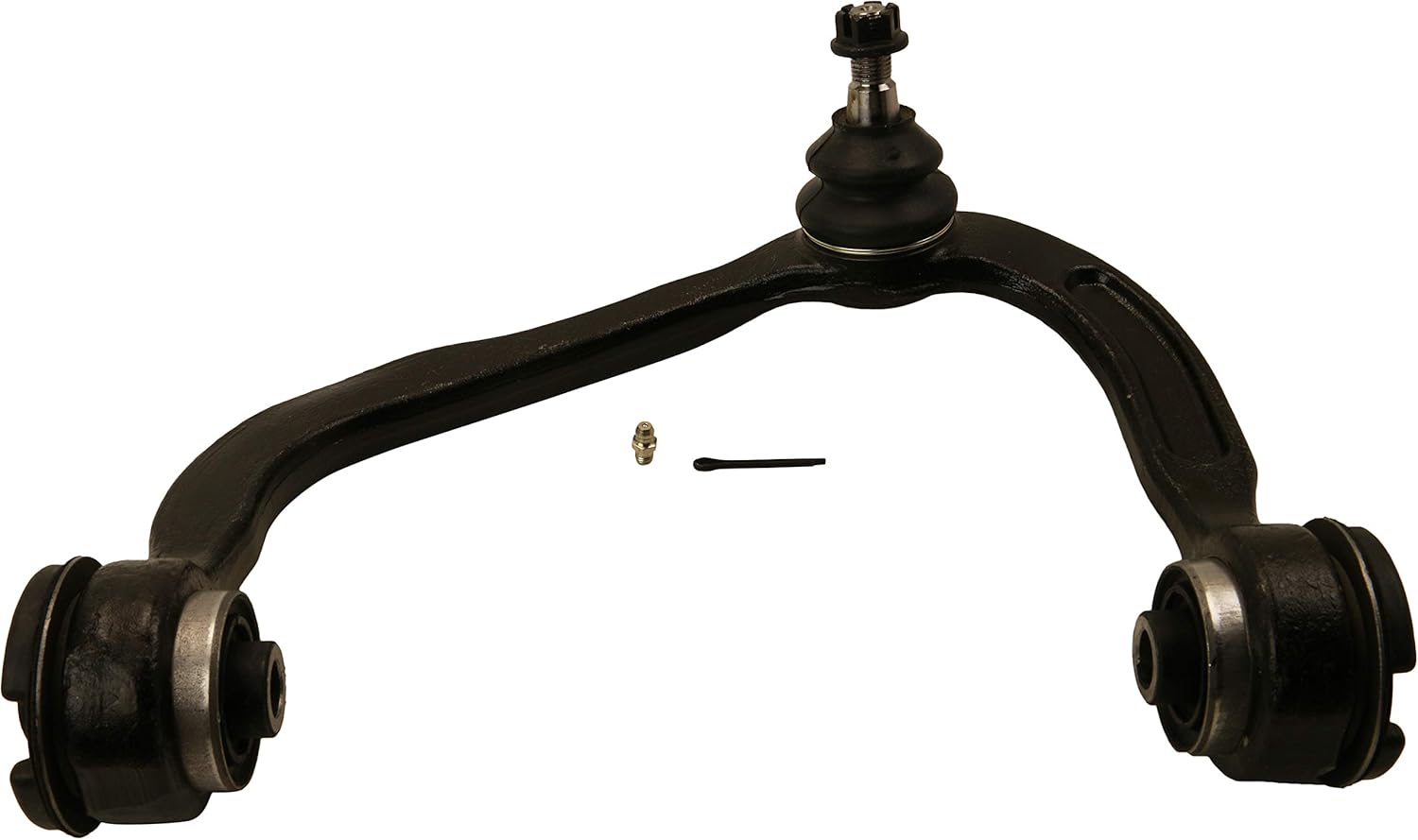
MOOG RK80306 Front Left Upper Control Arm with Ball Joint
| Fit Type | Vehicle Specific Fit |
|---|---|
| Auto Part Position | Front Left Upper |
| Material | Carbon Fiber,Fiber-reinforced,Steel |
| Manufacturer | MOOG Chassis Products |
| Exterior | OE-style |
The MOOG RK80306 replaces the front left upper control arm and includes a preinstalled ball joint and necessary hardware for a straightforward swap on compatible Ford trucks. It is engineered with heat-treated components, corrosion-resistant coatings, and a carbon fiber-reinforced bearing to reduce socket friction and extend service life. Typical use is a one-for-one replacement when bushings or the ball joint wear, restoring steering feel and correcting pull or uneven tire wear. The sealed ball joint and option for grease fittings on some production runs cut maintenance and help longevity. Installation-ready fitment and laser-etched identification simplify identification at the shop or garage. Limitations are that fitment is vehicle specific so buyers must confirm year and trim before ordering, and a professional alignment is recommended after replacement to ensure correct handling. While robust, long-term life still depends on driving conditions and maintenance habits.
Best for: Buyers seeking a cost-conscious, durable factory-style replacement that restores steering precision and reduces the need for immediate follow-up repairs after installation.
Less Ideal for: Drivers looking for heavy-duty aftermarket upgrades for lifted or heavily loaded trucks should consider performance or reinforced arms designed for modified suspensions.
- Direct-fit, installation-ready assembly with preinstalled ball joint and included hardware
- Heat-treated construction for enhanced structural strength under repeated loads
- Corrosion-resistant coatings on studs and e-coated cast components for longer service life
- Carbon fiber-reinforced bearing reduces socket friction compared to non-reinforced bearings
- Vehicle-specific fit requires confirming year, engine, and trim to avoid ordering the wrong side or fitment
Verdict: A budget-friendly, factory-quality replacement that restores front suspension function with minimal fuss and ready-to-install hardware.
SKUCH 2–4" Front Upper Control Arms for 2004–2020 Ford F-150 (2 pcs)

| Fit Type | Vehicle Specific Fit |
|---|---|
| Auto Part Position | Front |
| Material Type | Alloy Steel |
| Unit Count | 2.0 Count |
These front upper control arms replace the factory arms on lifted Ford F-150s to restore proper suspension geometry after a 2–4 inch lift. Constructed from high-strength alloy steel with a tubular design and powdercoat finish, they come as a two-piece set with integrated ball joints and polyurethane bushings. In practice they are installed in place of the factory arms to regain caster and camber adjustment range, reduce premature tire wear, and improve steering stability on lifted trucks. The polyurethane bushings provide firmer control and longer service life than rubber, which helps maintain alignment under load and reduces bushing collapse over time. Buyers should note the listing warns about wheel offset clearance and that some wheel setups may require a minimum 1.5 inch spacer to avoid rubbing. These are vehicle-specific replacement arms, so proper alignment after installation is still required and ball joint replacement parts are not listed with the kit. For reliability-focused builds they offer a durable, factory-style upgrade that keeps lifted F-150 front suspension angles under control.
Best for: A buyer focused on dependable suspension performance after lifting an F-150 who prioritizes restoring correct steering geometry and long-term durability.
Less Ideal for: Drivers who plan no lift or who run extreme lifts outside the 2–4 inch range should consider standard replacement arms or parts designed for their specific setup.
- Vehicle-specific fit for 2004–2020 Ford F-150s designed for 2–4 inch lifts
- Tubular high-strength alloy steel construction for improved durability
- Polyurethane bushings for longer life and firmer, more consistent steering response
- Includes ball joint assemblies so the arms arrive ready to install as a complete upper arm replacement
- May require wheel spacers or zero-offset wheels to prevent tire-to-arm rubbing on some factory wheel offsets
Verdict: If you need a reliable, factory-style upper arm that corrects geometry on a 2–4 inch lifted 2004–2020 F-150, this set delivers durable construction and firmer, longer-lasting bushings.
Detroit Axle Front Upper Control Arms with Ball Joints, Pair

| Fit Type | Vehicle Specific Fit |
|---|---|
| Auto Part Position | Front Upper |
| Material Type | Alloy Steel |
| Unit Count | 2.0 Count |
These Detroit Axle front upper control arms replace the factory front upper links on 2WD Ford F-150s, Expeditions and a few related models. Each arm comes with a preinstalled ball joint so installation is straightforward for a typical front-end repair or refresh; the kit is sold as a pair covering both sides. Built from alloy steel with a corrosion-resistant coating and reinforced structure, the arms are intended to handle repeated impact loads and restore steering geometry and ride stability after worn originals are removed. Buyers will appreciate the ready-to-bolt-in design and that the parts are vehicle-specific for a more predictable fit. Important limitations are that this kit is for 2WD models only and does not include some fasteners in all orders, so you may need to reuse bolts or source new hardware during installation. Also the ball joints are sealed which reduces maintenance options compared with serviceable joints.
Best for: Buyers who prioritize reliable, bolt‑in replacements that restore front-end geometry and want parts with broad positive user feedback and predictable fitment.
Less Ideal for: Those who need parts for 4WD vehicles or who prefer serviceable greasable ball joints for long-term maintenance should look elsewhere.
- Direct-fit, vehicle-specific design simplifies installation and alignment.
- Preinstalled ball joints save installation time and ensure correct assembly.
- Alloy steel construction with anti-rust coating improves durability and corrosion resistance.
- Reinforced structure aimed at withstanding repeated impact loads for longer component life.
- Fitment limited to 2WD models only, not compatible with 4WD applications.
- Sealed ball joints are not serviceable for greasing or rebuilds.
Verdict: A durable, ready-to-install pair of front upper control arms that restore steering stability on 2WD Ford F-150 and Expedition models with the convenience of preinstalled ball joints.
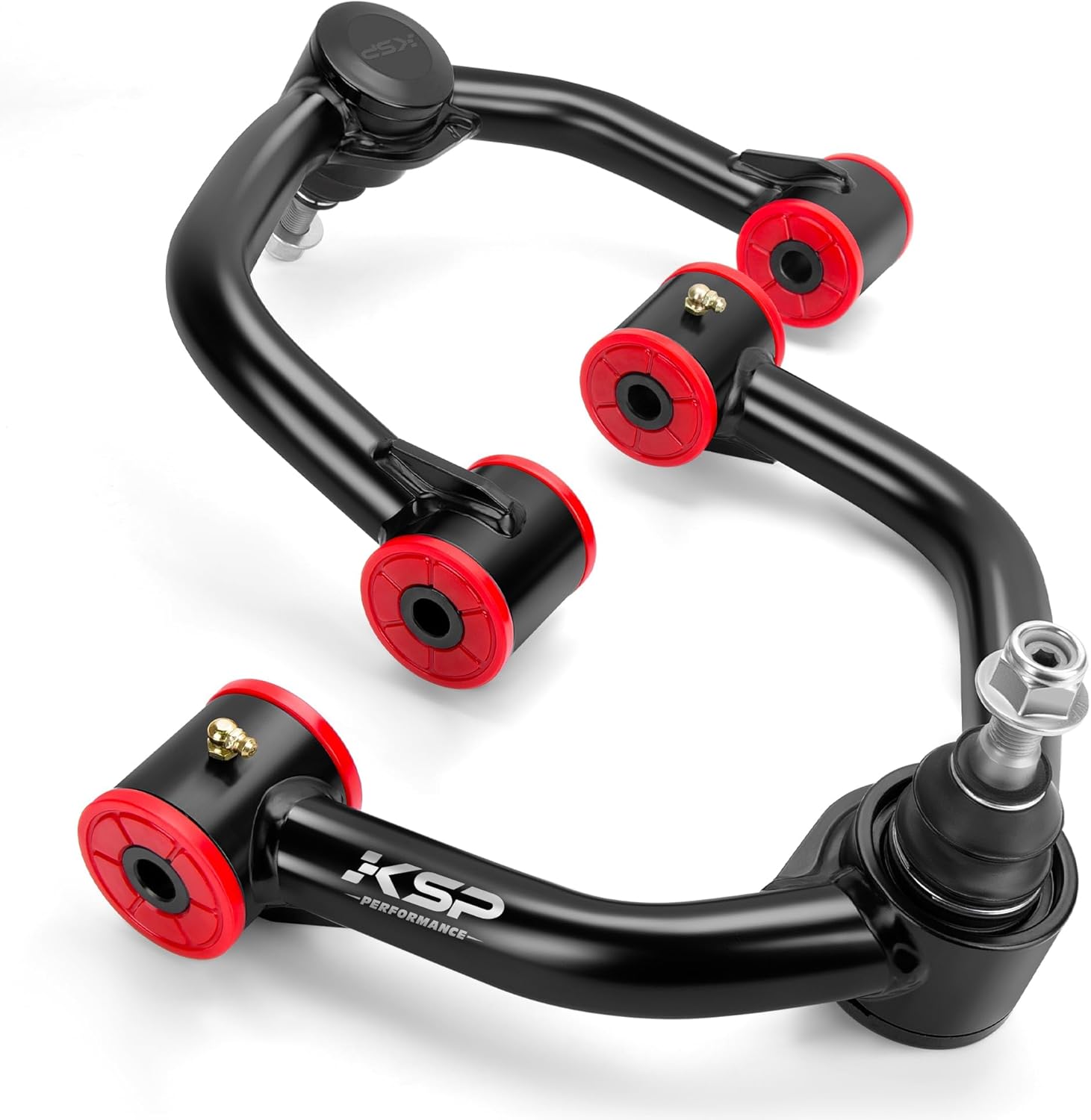
KSP Performance Tubular Upper Control Arms for Ford F-150 (2–4" Lift)
| Fitment | 2004-2020 F150 |
|---|---|
| Lift correction | 2 to 4 inches |
| Material | Alloy Steel |
| Position | Upper |
These KSP tubular upper control arms replace the factory front upper arms on 2004–2020 F-150 trucks and are built to correct caster and control-arm geometry after a 2 to 4 inch lift. They mount like stock arms but use larger tubular construction, MIG welds, greasable polyurethane bushings and serviceable ball joints with grease fittings and dust caps. In practice they reduce coil bucket contact that can occur with stock arms and improve steering feel and suspension travel when paired with matching lower arms and a professional alignment. Buyers should expect straightforward bolt-on installation for a mechanically skilled DIYer or a shop, plus the need to realign afterward. Limitations include possible clearance issues with conservative wheel offsets—wheel spacers or different wheels may be necessary—and some grease fittings can be hard to orient for easy access. KSP backs the parts with a 30-day refund and 12-month ball joint replacement policy, making these a practical, budget-friendly upgrade for lifted F-150s focused on reliability rather than premium finish details.
Best for: Buyers who want a dependable, factory-style suspension correction for a lifted F-150 and prioritize strength and serviceability over cosmetic refinement; suitable for owners who will get a professional alignment after installation.
Less Ideal for: Drivers who need a cosmetically finished showpiece or worry-free, zero-clearance fitment without modifying wheels or using spacers should consider other options.
- Vehicle-specific fit for 2004–2020 F-150s restores suspension geometry after a 2–4 inch lift
- Tubular alloy-steel construction with MIG welding for increased strength over stock arms
- Serviceable ball joints and greasable polyurethane bushings for field maintenance and longer life
- Dust caps and replaceable components help resist dirt and extend service intervals
- May rub on the coil bucket or require wheel spacers with conservative wheel offsets
- Grease fittings can be awkward to orient, making regular greasing less convenient
Verdict: A strong, serviceable tubular upgrade that restores proper suspension geometry for 2–4 inch lifted Ford F-150s while keeping maintenance and repairs simple.
Choosing the Right Ford F-150 Upper Control Arm: Key Factors to Consider
Fitment and Compatibility
Accurate fitment directly affects steering geometry and alignment. An upper control arm designed for the Ford F-150 will match the factory mounting points and ball joint orientation, minimizing the need for additional modifications. Mismatched fitment can cause alignment issues or force you to change other suspension components.
When planning a control arm replacement, confirm the arm corresponds to your F-150 year and factory suspension configuration. Some aftermarket arms are vehicle-specific while others cover multiple production years; the key is ensuring bolt pattern, bushing diameter, and ball joint taper are correct. Proper fitment reduces installation time and lowers the risk of premature wear on related parts.
Bushing Type and Durability
Bushings determine how vibration and load transfer through the control arm to the chassis. Rubber bushings provide a quieter ride and absorb vibration well but can degrade faster in high-mileage or harsh environments. Polyurethane bushings last longer and offer firmer control of suspension geometry, but they can transmit more noise and vibration into the cab.
Evaluate the expected driving conditions when choosing bushing material. If you tow frequently or drive on rough roads, prioritize durable bushing compounds that resist deformation. Also consider whether bushings are serviceable or pressed-in; serviceable designs reduce replacement complexity and cost over the vehicle life.
Ball Joint Construction
The ball joint is the pivot point between the control arm and steering knuckle. Its quality dictates steering responsiveness and longevity. Sealed, greaseable, and replaceable ball joint designs each have tradeoffs. Sealed joints are maintenance-free but may wear out sooner; greaseable joints can be serviced periodically to extend life.
For trucks that see heavy use, choose an upper control arm with a robust ball joint and corrosion-resistant sealing. Check for standard taper sizes and compatibility with factory knuckles to avoid fitment problems. A failing ball joint often presents as looseness in steering or uneven tire wear, so prioritize long-life constructions if you plan to keep the truck for many miles.
Alignment and Adjustment Capability
Some upper control arms offer camber or caster adjustment features. These are useful after suspension modifications or when correcting alignment following worn components. Adjustable arms let you fine-tune alignment to reduce tire wear and improve steering returnability. Non-adjustable arms rely on factory tolerances and will require alignment at installation to ensure proper tracking.
If you install an arm that changes ride height or replaces a heavily worn part, expect alignment service. Owners who regularly tow or carry variable loads may benefit from adjustable options that let them tweak geometry to match load conditions and maintain even tire contact patches.
Corrosion Resistance and Finish
Control arms are exposed to road salt, mud, and water, so material choice and protective finish affect lifespan. Powder coating, electroplating, and proper seam sealing help prevent rust that can compromise structural integrity and make future removal difficult. Mild steel arms without sufficient protection will show rust at welds and mounting points first.
Consider the climate you drive in when weighing finish options. If you live in an area with heavy winter road treatment, prioritize arms with proven corrosion protection and replaceable components so individual parts can be changed without removing a seized assembly.
Ease of Installation and Serviceability
Installation complexity influences labor time and overall cost for a control arm replacement. Arms that reuse factory hardware and match OE mounting geometry are generally easier to install. Designs with replaceable bushings and ball joints let you service components separately, which can save money over the long run.
If you plan to DIY, look for arms that include clear mounting points and grease fittings where applicable. Also check whether the arm allows alignment-friendly features or requires special tools. A straightforward installation reduces the chance of torque or fitment errors that can lead to alignment issues later.
Signs Your Ford F-150 Needs a New Upper Control Arm
Several practical symptoms point to failing upper control arms on a Ford F-150. Listen for clunking or knocking noises when you go over bumps or during sharp turns, which often indicates worn bushings or a loose ball joint. You may also notice uneven tire wear or a gradual pull to one side while driving at highway speeds.
Steering may feel less precise, with increased play at the steering wheel, and alignment may drift after changing road conditions. Visual inspection can reveal cracked or deteriorated bushings, leaking seals around ball joints, or excessive rust where the arm mounts to the frame. Addressing these signs early prevents secondary wear on tires and steering components.
- Clunking over bumps or during turns
- Uneven or accelerated tire wear
- Pulling to one side at highway speed
- Visible bushing cracking or ball joint play
DIY Replacement Tips for F-150 Owners
If you have moderate mechanical skills and the right tools, replacing an upper control arm on an F-150 is feasible. Key preparations include verifying correct replacement arm fitment to your truck's year and configuration, gathering necessary tools such as a torque wrench and ball joint press or separator, and planning for a post-installation alignment.
Work on a level surface with the vehicle securely supported on jack stands. Loosen wheel lug nuts before raising the truck, and always follow factory torque specifications during reassembly. If the replacement arm has grease fittings, apply proper grease after installation and recheck torque after a short break-in drive.
- Confirm part fitment to vehicle year and suspension setup
- Use a ball joint press or suitable separator to avoid damage
- Torque fasteners to factory specifications and recheck after test drive
- Schedule an alignment after installation
How Replacement Affects Alignment and Tire Wear
Replacing an upper control arm resets the relationship between the wheel and chassis, so alignment specifications may shift. Even when a replacement is an exact fit, aged components or different bushing compliance can change camber or caster slightly. That is why a professional alignment is recommended after installation to restore factory geometry and prevent premature tire wear.
Monitoring tire tread after replacement helps verify alignment quality. If uneven wear continues, inspect tie rods, lower control arms, and wheel bearings, since multiple worn components can combine to produce alignment issues.
- Alignment can change even with exact-fit arms
- Always perform an alignment after replacement
- Check other suspension parts if uneven wear persists
When to Choose Adjustable Upper Control Arms
Adjustable arms are beneficial if you have altered ride height, upgraded springs, or carry heavy loads regularly. They let you correct camber and caster beyond factory fixed settings, which can restore steering stability and tire contact patch under different load conditions. For owners who frequently modify suspension or tow, adjustability provides the flexibility to dial in handling.
Keep in mind that adjustable designs add complexity and sometimes require periodic readjustment. If your F-150 remains at stock ride height and you replace worn components with OE-spec parts, a non-adjustable correct-fit arm is often sufficient.
- Helpful for modified ride height or heavy towing
- Provides fine control over camber and caster
- May require periodic readjustment
Maintaining New Upper Control Arms to Maximize Life
Regular inspection and basic maintenance extend the service life of replacement arms. Check bushings and ball joints during routine oil changes or tire rotations for signs of wear, cracking, or grease leakage. If the arm has a grease fitting, apply grease at recommended intervals to protect the ball joint and bushing interfaces.
Protecting the underbody with appropriate coatings and avoiding prolonged exposure to corrosive environments helps prevent metal fatigue and rust at mounting points. Address any alignment problems early to avoid accelerated bushing and tire wear.
- Inspect bushings and ball joints during routine service
- Regrease serviceable joints per manufacturer intervals
- Protect underbody from corrosive exposure
Still looking for the perfect fit?
Select your Ford F-150 configuration to see the most relevant Control Arms recommendations
How We Chose the Best Ford F-150 Upper Control Arm
We focused on criteria that matter specifically to Ford F-150 owners replacing upper control arms. Fitment accuracy was a primary filter; we prioritized options designed to match factory mounting points and steering geometry for the F-150. Durability considerations included bushing material and ball joint quality since those parts determine wear life and handling consistency under load. Corrosion resistance and finish matter in climates where road salt or moisture accelerate rust. Serviceability and replacement ease were evaluated because some arms use pressed-in bushings or sealed ball joints while others allow separate component replacement. Ride and handling impact was judged by design features that control alignment retention under load, such as reinforced mounts and adjustable camber/caster where applicable.We excluded arms intended for other Ford models or universal-fit components that require extensive modification. We also excluded options with unclear fitment data or poor feedback on longevity. The final set balances correct fit, durable materials, and practical installation characteristics that most F-150 owners encounter during a control arm replacement.
Our full evaluation process is outlined in our review methodology.
FAQ
How long does an upper control arm typically last on a Ford F-150?
Lifespan varies widely depending on driving conditions and maintenance. Under normal use, an upper control arm can last many tens of thousands of miles, but heavy-duty use, rough roads, or exposure to corrosive conditions can shorten its life. Regular inspections help catch wear before failure.
What are the common symptoms of a failing upper control arm?
Common signs include clunking noises over bumps, uneven tire wear, steering pull, and increased play in the steering wheel. Visual signs like cracked bushings or ball joint looseness also indicate replacement is needed.
Can I replace the upper control arm myself on an F-150?
Many mechanically inclined owners can perform the swap with proper tools and a safe workspace. Key steps include securing the vehicle on jack stands, using the correct ball joint separation tools, and following torque specs. Plan for a professional alignment afterward.
Will replacing the upper control arm fix alignment problems?
Replacing a worn arm can correct geometry deviations caused by worn components, but you should expect to have a full alignment performed after replacement. If alignment issues persist, other suspension parts may also be worn and need inspection.
Are adjustable upper control arms necessary for towing or hauling?
Adjustable arms can be useful when towing or hauling frequently because they allow compensating changes to camber and caster under load. However, they are not strictly necessary for occasional towing; many owners use OE-spec replacements and then align for their typical load conditions.
What maintenance keeps new control arms performing well?
Regular inspections for bushing cracking, ball joint play, and corrosion keep issues from progressing. Grease any serviceable joints according to intervals and address any alignment drift promptly to prevent uneven tire wear.
Final Verdict
When replacing an upper control arm on a Ford F-150, prioritize correct fitment, durable bushings, and a robust ball joint that matches your driving needs. Decide between quieter rubber bushings and longer-lasting polyurethane based on ride comfort versus durability tradeoffs. If you tow, haul, or run modified suspension, consider adjustable arms to retain control over camber and caster.Whichever option you choose, plan for a post-installation alignment and inspect related suspension components. Focusing on fitment, durability, and serviceability will help you restore steering precision and extend the life of the truck's suspension.
Explore More:
- Check out all Ford F-150 parts & accessories
- Explore Control Arms Maintenance & Repair Guides
- Explore Suspension & Steering
- Browse all Auto Parts
