

Note: This article contains affiliate links. If you click on these links and make a purchase, I may earn a small commission at no extra cost to you. This helps support my research and content. Read my full affiliate disclosure here.
If you want to protect the transmission in your Ford F-150, choosing the right transmission cooler line matters. A quality cooler line helps maintain safe fluid temperatures, prevents leaks that can lead to slipping or overheating, and supports towing or heavy-use driving without premature wear.This guide looks at six top transmission cooler lines shortlisted for the F-150, focusing on fitment, leak resistance, longevity, and installation ease. Read on to understand the practical differences between hard lines and hose options, common failure symptoms to watch for, and which features matter most for your truck and driving habits.
Looking for other parts? See all Ford F-150 parts & accessories.
Top Picks at a Glance
| Best Overall The best all-around choice for most situations | Ford Transmission Cooler Line Assembly for 2015–2019 F-150 (6R80, Heavy Duty Towing) |  |
| Best Value The sweet spot between price and what you get | A-Premium Transmission Oil Cooler Outlet Hose Assembly |  |
| Best Budget The cheapest option that still gets the job done reliably | A-Premium Transmission Oil Cooler Line Hose Assembly |  |
| Highest Rated A top-rated pick with lots of positive feedback | A-Premium Transmission Oil Cooler Line Assembly for Ford F-150 (2015–2020) |  |
| Most Popular A crowd favorite that many people choose with confidence | Dorman Automatic Transmission Oil Cooler Hose Assembly |  |
| Best Seller A high-volume bestseller chosen again and again | 6AN 70" Stainless Steel Braided Transmission Cooler Line Kit (70") |  |
Ford Transmission Cooler Line Assembly for 2015–2019 F-150 (6R80, Heavy Duty Towing)

| Fitment | 2015-2019 Ford F-150 w/ 6R80 6-speed and heavy duty towing package |
|---|---|
| Material Type | Metal |
| Item Length | 36 Inches |
| Manufacturer | Ford |
| Manufacturer Warranty Description | 2 Year Warranty |
This is a factory-quality transmission cooler line assembly intended as a direct replacement for 2015–2019 Ford F-150 models equipped with the 6R80 6-speed transmission and the heavy duty towing package. As a genuine Ford part it matches factory fit and materials, which simplifies installation for anyone swapping a leaking or damaged line. Typical use is restoring proper transmission cooling capacity and sealing an existing leak; the metal construction and dealer-sourced fitment mean it should route and connect exactly like the original. No installation instructions are included, so expect to rely on service manuals or shop experience for proper removal and reinstallation. The part comes with a standard two year warranty, providing some assurance against early defects. If you need an exact factory replacement to maintain factory performance and appearance this part delivers, but independent installers should plan for basic shop time and the possible need for line flaring tools or replacement clamps during installation.
Best for: Buyers who want a like‑for‑like, factory-quality replacement to restore transmission cooling on a 2015–2019 F-150 with the 6R80 and towing package and who prioritize correct fit and long-term reliability.
Less Ideal for: Drivers who need a universal, multi-vehicle solution or a budget aftermarket option are better served by aftermarket lines or universal kits that offer broader compatibility or lower cost.
- Factory genuine Ford part for direct fit on specified F-150 6R80 towing configurations
- Metal construction consistent with original routing and durability
- Sold as a complete line assembly to replace a leaking or damaged cooler line
- Includes a two year manufacturer warranty for part protection
- No installation instructions included, so professional installation or service manual reference is recommended
- Compatibility limited to F-150s with the 6R80 transmission and heavy duty towing package
Verdict: Choose this genuine Ford cooler line when you need a factory-fit replacement to reliably restore transmission cooling on a 2015–2019 F-150 with the 6R80 towing configuration.
A-Premium Transmission Oil Cooler Outlet Hose Assembly
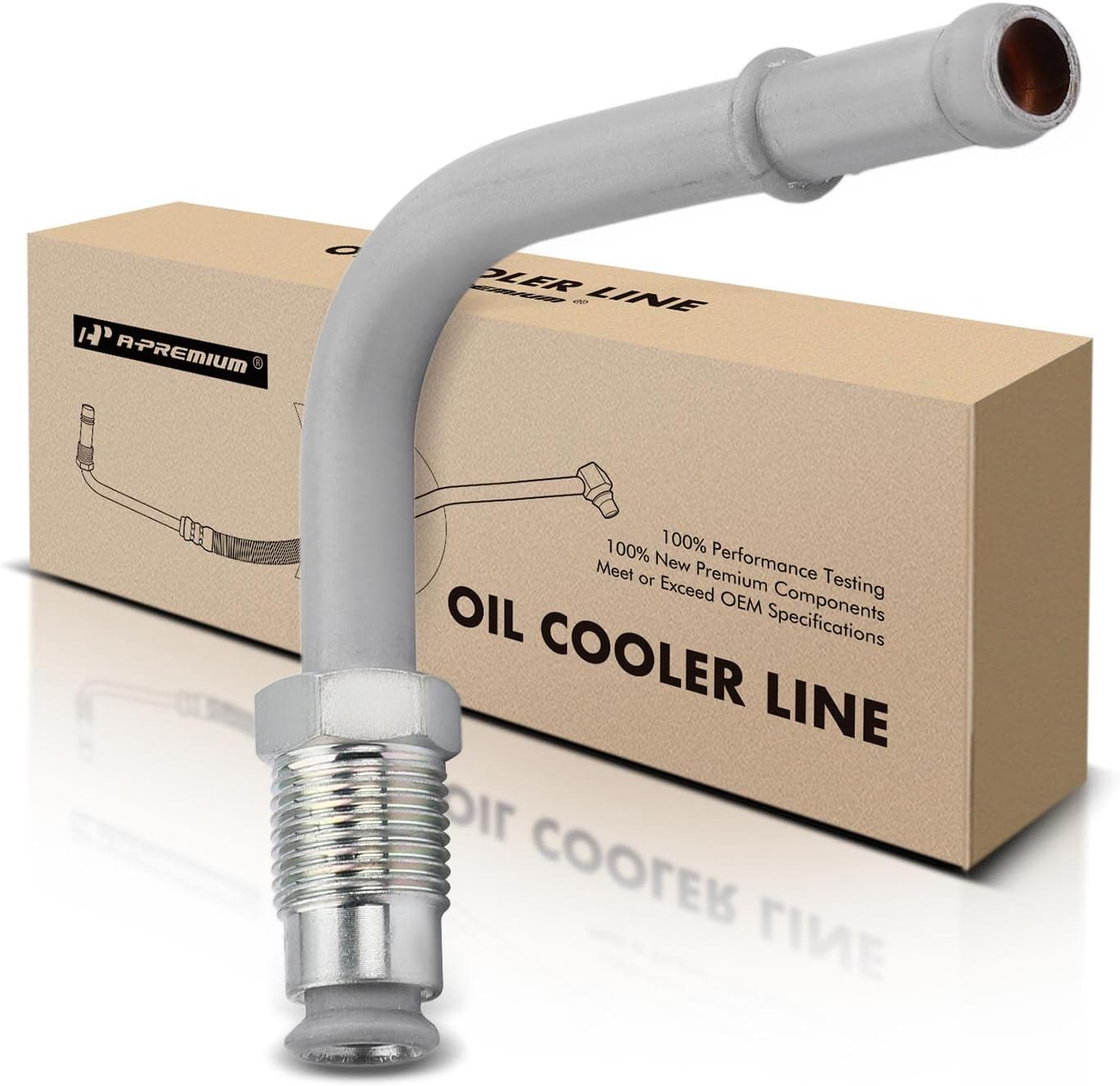
| Manufacturer | PremiumpartsWhosale |
|---|---|
| Brand | A-Premium |
| Manufacturer Part Number | APOCL084 |
| OEM Part Number | 624-224, 624224, 5801190, F7TZ7F112DC |
| Fitment Type | Direct Replacement |
This A-Premium outlet hose assembly replaces the lower line that routes transmission fluid from the auxiliary cooler back to the transmission on compatible Ford trucks and SUVs. It is a metal, direct-replacement part provided with factory reference numbers for vehicles that use either the 4R100 or E4OD transmission and an auxiliary oil cooler. Typical use is as a like-for-like repair when the original cooler line corrodes, cracks, or the fitting fails. The metal construction and OEM reference numbers make it straightforward to match and swap during a routine transmission cooler line replacement. Because it is a single outlet-to-transmission piece, installation requires checking fitment carefully against your vehicle and the auxiliary cooler configuration; it is not a full hose kit and does not include rubber lines or extra fittings. For budget repairs this part gives a solid match to factory routing, but buyers should verify the exact reference numbers and transmission type before ordering to avoid returns or fit issues.
Best for: Buyers who want a practical, budget-friendly direct replacement to restore a leaking or damaged transmission cooler outlet on supported Ford trucks and SUVs and who prioritize a correct fit to factory reference numbers.
Less Ideal for: If you need a complete hose kit, radiator-to-cooler lines, or are unsure about your transmission or auxiliary cooler configuration, this single outlet assembly is not the best choice.
- Direct replacement designed to match factory reference numbers for easy identification
- Metal construction for durability compared with brittle corroded fittings
- Fits models with 4R100 and E4OD transmissions where an auxiliary cooler is installed
- Compact single-piece outlet-to-transmission design simplifies replacement of a failed lower cooler line
- Only the outlet (lower) hose assembly is included so additional hoses or fittings may be needed for a complete repair
Verdict: A simple, metal direct-replacement outlet hose assembly that restores a failed lower transmission cooler line on compatible Ford trucks and SUVs.
A-Premium Transmission Oil Cooler Line Hose Assembly

| Compatible vehicles | Ford F-150 2005-2006; Lincoln Mark LT 2006 |
|---|---|
| Transmission type | Automatic |
| Location | Auxiliary cooler inlet, driver side |
| Material | Rubber |
| Reference numbers | 624-577, 624577, 5801453, 5L3Z7C410AB |
This A-Premium transmission oil cooler line is a direct replacement hose intended for the auxiliary cooler inlet on select 2005–2006 Ford F-150 and 2006 Lincoln Mark LT automatic-transmission vehicles. It is a short rubber hose assembled to match factory connections and reference numbers, so it is typically used to repair a leaking or damaged cooler inlet line without replacing the whole cooler. The hose is marketed as meeting or exceeding factory specifications and comes from a brand that offers a one-year unlimited-mileage guarantee. Practical benefits include simple, bolt-on replacement for the driver-side auxiliary inlet, lightweight construction that resists corrosion, and compatibility with specified OEM reference numbers for easier parts matching. Limitations to expect are that the part is a small rubber section only, so it will not address damage elsewhere in the cooling circuit and a few buyers report fitment differences where bends or mating tolerances matter. Verify the exact fitment before installation and be prepared to reuse existing clips or seals if they are not included.
Best for: Buyers looking for a low-cost, direct replacement hose to stop leaks at the auxiliary transmission cooler inlet and get a serviceable repair without replacing major components.
Less Ideal for: Do not choose this if you need a full cooler assembly, replacement lines with custom bends, or a heavy-duty aftermarket upgrade for high-performance towing or modified vehicles.
- Direct replacement for the auxiliary cooler inlet on listed Ford and Lincoln models
- Meets or exceeds stated factory specifications for basic reliability
- Rubber construction resists corrosion and is suitable for transmission fluid service
- Includes OEM reference numbers to simplify parts matching and verification
- Short section of hose only so it will not fix damaged fittings, bends, or adjacent lines
Verdict: A budget-friendly, factory-style replacement hose to stop leaks at the auxiliary transmission cooler inlet on the specified 2005–2006 F-150 and 2006 Mark LT.
A-Premium Transmission Oil Cooler Line Assembly for Ford F-150 (2015–2020)

| Compatible vehicles | Ford F-150 2015-2020 (specified V6/transmission configs) |
|---|---|
| Reference numbers | FL3Z-7B028-L, FL3Z7B028L |
| Manufacturer | PremiumpartsWhosale |
| Brand | A-Premium |
This A-Premium transmission oil cooler line assembly replaces the factory cooler hose on select Ford F-150 V6 models and routes transmission fluid through the oil cooler to help lower operating temperature. It is intended as a direct-fit replacement for the referenced part numbers and is typically installed where a worn or leaking cooler line is causing fluid loss or higher transmission temps. The hose notes corrosion-resistant construction and precision ends to help ensure a leak-free seal and long service life. For everyday towing-light driving the line should restore proper cooling and prevent overheating that accelerates transmission wear. Installation requires basic mechanical access to the cooler lines and may be straightforward for a DIYer or quick for a professional. The product carries a one-year unlimited-mileage guarantee, but buyers should confirm exact fitment against the vehicle compatibility information before ordering since fitment is limited to specific years, engines, and transmission configurations.
Best for: Buyers who prioritize a dependable, factory-style transmission cooling repair for a Ford F-150 and want a ready-made replacement to restore proper oil temperature and prevent further transmission stress.
Less Ideal for: Drivers seeking a universal or multi-vehicle solution or those who need heavy-duty upgraded lines for frequent heavy towing should consider purpose-built upgrade options instead.
- Designed to match factory routing for direct replacement on specified F-150 V6 models
- Corrosion-resistant construction aimed at reducing leaks and extending service life
- Precision-engineered fittings for a secure, leak-free seal with transmission connections
- One-year unlimited-mileage guarantee for added ownership confidence
- Fitment is limited to specific model years, engines, and transmission types so it is not universal
Verdict: A factory-style, corrosion-resistant replacement cooler line for specified Ford F-150 V6 models that restores transmission cooling and reliability.
Dorman Automatic Transmission Oil Cooler Hose Assembly

| Material Type | Metal, Rubber |
|---|---|
| Maximum Pressure | 100 Pound per Square Inch |
| Included Components | 4 Transmission Lines, 6 Threaded End Connectors, 4 O-rings, 3 brackets |
| Item Type Name | Automatic Transmission Oil Cooler Hose Assembly |
This Dorman transmission oil cooler hose assembly is a kit intended to replace leaking or damaged cooler lines on specified Ford and Lincoln trucks. It includes multiple transmission lines, threaded end connectors, O-rings, and brackets so you can swap out corroded metal or cracked rubber hoses and restore proper transmission cooling. In practice the kit reproduces factory routing and is useful when corrosion or collision damage causes fluid leaks that reduce cooling efficiency. Installers report the lines fit 2006–2008 F‑150 and several F‑250/Lobo/Mark LT years but you should verify trim fitment before buying. The kit does not include every auxiliary hose on some vehicles, and a few users had to source the radiator-to-cooler short line or new quick-connect fittings separately. Quality varies in user reports so expect to check flare and connector fitment during assembly and have a cooler disconnect tool handy. For routine replacement this kit offers a largely complete set of parts and durable construction, but plan for occasional extra fittings or small adjustments during installation.
Best for: Buyers who prioritize restoring proper transmission cooling on older Ford trucks and value a mostly complete parts kit supported by community feedback and installer experience.
Less Ideal for: If you want a guaranteed drop-in with every auxiliary hose and fittings included or prefer dealer-sourced parts with uniform fitment, consider other sources instead.
- Direct replacement design intended to match original fit and routing
- Includes multiple lines and hardware: threaded end connectors, O-rings, and brackets
- Durable metal and rubber construction for corrosion resistance
- Rated for up to 100 PSI to handle transmission system pressure
- Does not include the radiator-to-cooler auxiliary hose on some vehicle configurations
- Some users reported connector flare or quick‑connect fitment issues requiring replacement fittings or minor modifications
Verdict: A practical, largely complete replacement kit for restoring transmission cooling on specified Ford trucks when you are willing to verify fit and source any missing short lines or fittings.
6AN 70" Stainless Steel Braided Transmission Cooler Line Kit (70")

| Material | Stainless Steel/PTFE |
|---|---|
| Size | 70inch |
| Nominal Wall Thickness | 0.0375 inches |
| Outside Diameter | 0.38 Inches |
| Part Number | H-OFK19-70-SS |
This kit supplies two 70" stainless steel braided PTFE transmission lines plus a set of 6AN fittings and 90-degree adapters to route and connect a secondary transmission cooler. Intended for retrofits and repairs, the lines replace factory soft or corroded hoses and let you add or relocate a cooler to reduce operating temperature during towing or heavy load duty. The stainless braid and PTFE core give good abrasion and corrosion resistance while swivel fittings simplify alignment during installation. Buyers should plan to match fittings on their specific Ford F-150 transmission and cooler: the universal 6AN plumbing may require extra adapters or thread-matching for Ford factory ports, and a few customers report occasional quality control issues like wrong length or blemished parts. Installation is straightforward for someone with basic tools, but expect to buy a couple of adapter fittings for Ford-specific quick disconnects on some model years. For a risk-averse owner prioritize careful measurement of factory ports and inspect parts on arrival before installing fluid.
Best for: Ford F-150 owners who want a durable aftermarket solution to add or replace transmission cooler lines for towing or heavy-load use and who prefer a long braided hose they can adapt to their vehicle.
Less Ideal for: Buyers looking for a vehicle-specific, plug-and-play Ford kit with factory-matching fittings and guaranteed fitment should consider purpose-made Ford cooler line assemblies instead.
- Stainless steel braid with PTFE core for corrosion resistance and flexibility
- Includes 90-degree 6AN fittings to ease routing and connection
- 70" length suits longer runs and routing in full-size trucks
- Swivel fittings help align connections and reduce stress at joints
- Uses universal 6AN fittings so additional Ford-specific adapters may be required
- Some buyers reported inconsistent quality control and incorrect lengths on arrival
Verdict: Choose this braided 6AN 70" kit if you need a long, corrosion-resistant transmission cooler line that you can adapt and route for towing or heavy-duty cooling on a Ford F-150.
Choosing the Right Ford F-150 Transmission Cooler Line: Key Factors to Consider
Fitment and Connection Type
Accurate fitment to the Ford F-150 chassis and factory connection points is critical because misaligned lines can rub against frame rails, suspension components, or routing clips and cause premature wear. Confirming the correct connection type avoids adapter splices that increase leak points and simplifies installation.
Hard lines use solid metal bends that match factory routing and often attach to clips or brackets. Hose-style lines rely on correct fittings and secure clamps or crimped ends. For F-150s used for towing, a precise match reduces movement under load and limits stress at connection points. Always verify routing and mounting compatibility for your model year and configuration before installation.
Material and Construction Quality
Materials determine how well a transmission cooler line resists heat, road debris, and corrosion. Steel hard lines offer rigid routing and strong resistance to abrasion from stones and road grit, but they need corrosion-resistant coatings or stainless steel to avoid rust in salty climates. Rubber or synthetic hoses must use high-temperature, oil-resistant compounds to prevent swelling or softening from hot transmission fluid.
Construction details like double-braided reinforcement, crimped fittings, and welded joints improve durability. Look for hoses that specify temperature and pressure ratings and hard lines with protective plating. Higher construction quality reduces the chance of pinhole leaks and burst failures during heavy-duty use.
Leak Resistance and Fitting Security
A tiny leak in the transmission cooling line can lead to fluid loss and overheating, which quickly escalates into transmission damage. Prioritize lines designed to minimize leak paths: integrated fittings, flared or O-ring seals that match factory specifications, and properly crimped hose ends.
Pay attention to how fittings attach to both the cooler and the transmission. Bolt-on flanges and factory-style quick-connects that mate cleanly to the vehicle reduce the need for adapters and extra sealants. For hose-to-hardline transitions, ensure clamps or crimp sleeves are specified and rated for transmission fluid service.
Thermal Performance and Pressure Rating
Transmission fluid cycles through varying temperatures, and cooler lines must withstand repeated thermal stress without degradation. Hose compounds should list maximum operating temperature and burst pressure. Hard lines need to maintain structural integrity under expansion and contraction.
Higher pressure ratings help when using larger auxiliary coolers or towing heavy loads that raise fluid flow and system pressure. If you frequently tow or drive in hot climates, choose lines rated for higher temperatures and pressures to avoid premature failure.
Installation Complexity and Required Tools
Some cooler lines are direct-fit replacements that slide into factory clips and use the original fittings, making them suitable for DIY installation with common hand tools. Others may require flaring, bending, or special fittings and clamps, which increases installation time and the need for specialized tools.
Consider whether you have access to a lift or jack stands, proper line wrenches, and possibly a flaring tool if the kit requires custom fitting. Kits that include brackets and replacement clips simplify the job and reduce the chance of improper routing that causes rubbing or stress.
Corrosion and Abrasion Protection
Road salt, moisture, and debris can corrode metal lines and abrade hoses over time. Protective coatings, plating, and external sleeves extend service life, especially for F-150s driven in winter conditions or off-road. Stainless steel hard lines resist rust, while zinc-plated steel offers a cost-effective alternative with reasonable protection.
For hose assemblies, consider abrasion sleeves or braided outer layers that shield the hose from contact with frame edges and stones. Proper routing that keeps lines away from heat sources and moving suspension parts also reduces wear and the need for premature replacement.
Hard Lines Versus Hose Assemblies
Hard lines and hose assemblies each have tradeoffs for the Ford F-150. Hard lines hold their shape and follow factory routing precisely, which minimizes movement and contact with chassis parts. That rigidity reduces the chance of abrasion from vibration but makes them less forgiving if the route requires slight adjustments.
Hose assemblies are more flexible and can absorb vibration, which reduces stress at attachment points. Modern hoses designed for transmission fluid use often include braided reinforcement and high-temperature compounds that perform well under load. Choose hard lines when you want rigid, factory-style routing; choose hoses for routes that need flexibility or where chassis clearance is tight.
- Hard lines: stable routing, lower abrasion risk, require precise fit
- Hoses: flexible, absorb vibration, need rated fittings and clamps
Common Symptoms of a Failing Cooler Line
Recognizing symptoms early helps avoid major transmission damage. Typical indicators include low transmission fluid level without visible external leaks in obvious places, a burning smell from the engine bay, or visible fluid underneath the truck after parking. Performance signs include slipping gears, delayed shifts, or higher-than-normal transmission temperatures on monitoring equipment.
Inspect the underside of the F-150 for wet spots around fittings and along the line path. Check for crusty residue or dark stains which indicate slow seepage. If you see damaged insulation, kinks, or crushed sections on hard lines, those areas are high risk for developing leaks and should be addressed promptly.
- Watch for fluid stains under the vehicle and around fittings
- Monitor for shift issues or transmission overheating
- Inspect for abrasion marks, kinks, or corroded sections
Routing and Mounting Best Practices
Correct routing and secure mounting reduce movement that leads to chafing and fatigue. Follow factory clip locations and avoid crossing hot exhaust components or steering linkages. Maintain gentle bends rather than sharp kinks to preserve flow and reduce stress points.
Use new mounting clips or brackets if the originals are corroded or missing. Where lines pass close to potential abrasion sources, add protective sleeving or rubber-lined clamps. When replacing a section, mock up the routing before final tightening to confirm clearance under full suspension travel.
- Keep lines away from exhaust and moving suspension parts
- Replace worn clips and add protective sleeves where needed
- Ensure smooth bends and verify clearance with wheels turned
Tools and Supplies You'll Need
A successful installation requires a few specific tools. Line wrenches sized to the factory fittings reduce rounding of nut faces. A torque wrench ensures fittings are secured to specification without overtightening. If the kit includes hard-line sections that require bending or flaring, a tubing bender and flaring tool may be necessary.
Have replacement O-rings, thread sealant specified for transmission fluid, and new mounting clips on hand. If you plan a DIY job under the truck, use quality jack stands or a lift and gloves to protect hands from hot components. A drain pan and suitable absorbent pads help contain spilled fluid during disconnection.
- Line wrenches, torque wrench, tubing bender and flaring tool as needed
- Replacement O-rings, approved sealant, new mounting clips
- Drain pan, jack stands or lift, and protective gloves
When to Replace Only a Section Versus the Whole Line
Deciding between replacing a damaged section or the entire cooler line depends on age, corrosion level, and accessibility. If the failure is a single localized leak in an otherwise clean and well-supported line, a section replacement or a repair sleeve may suffice. However, if there is widespread corrosion, multiple bends showing stress, or mismatched fittings from previous repairs, a full-line replacement is the safer long-term choice.
Consider the labor involved in accessing different routing segments. Replacing the whole line can be more cost-effective over time when it eliminates recurring leaks and ensures consistent material quality and pressure ratings across the entire run.
- Single localized damage: section repair may be adequate
- Widespread corrosion or prior patchwork: prefer full replacement
- Weigh labor access versus long-term reliability
Compatibility With Auxiliary Coolers and Upgrades
If you plan to add an auxiliary transmission cooler, ensure the cooler line you choose can handle the increased flow and pressure. Lines with higher pressure ratings and fittings that match the auxiliary cooler inlet make integration straightforward. When retrofitting, use fittings designed for transmission fluid service and avoid improvised adapters that introduce leak points.
Routing changes required for an auxiliary cooler may favor flexible hose assemblies to simplify connections. Confirm that any added cooler does not create sharp bends or excessive hose length that could reduce flow or trap air in the system.
- Choose lines with pressure ratings suitable for auxiliary coolers
- Match fittings to the cooler inlet to avoid extra adapters
- Plan routing to keep bends smooth and avoid air traps
How We Chose the Best Ford F-150 Transmission Cooler Line
We evaluated candidate transmission cooler lines using criteria that matter for Ford F-150 owners who drive with towing loads, frequent hauling, or high-mileage use. Key evaluation points included fitment accuracy to factory connection points and vehicle subframes, because proper fit reduces chafing and stress that cause leaks. Durability under heat and vibration was assessed by checking construction materials and reinforcement methods, since thermal cycling and road vibration are primary failure drivers.Leak resistance was a major filter. We prioritized lines with robust fittings, crimped or welded joints, and proven hose compounds where applicable. Ease of installation was also considered, including whether lines use factory-style fittings, require special tools, or come with clear hardware and instructions. Corrosion resistance and protective coatings were reviewed for hard lines, and abrasion resistance and high-temperature ratings were checked for hoses.We excluded options that lack clear vehicle-specific fitment for the Ford F-150 or that rely on ambiguous universal fittings. Products that require extensive modifications to the truck or that omit essential mounting hardware were not considered. The final shortlist balances reliable fit, longevity, and straightforward installation for typical F-150 ownership scenarios.
Our full evaluation process is outlined in our review methodology.
FAQ
How long do Ford F-150 transmission cooler lines typically last?
Lifespan varies with material and conditions. Properly installed hard lines with corrosion protection often last many years, while hoses in high-heat or salty environments may need replacement sooner. Regular inspections can catch wear before failure.
Can I repair a small leak in a cooler line or should I replace it?
Small, localized leaks can sometimes be repaired with a sleeve or by replacing a short section, especially if the surrounding line is in good condition. If there is corrosion, multiple stress points, or uncertain fittings, full replacement is usually the safer choice.
Are hose assemblies safe for heavy towing use on the F-150?
High-quality hose assemblies with appropriate temperature and pressure ratings can perform well under towing loads. Ensure the hose has braided reinforcement and factory-style fittings, and verify the pressure rating matches your towing demands.
What are the signs a cooler line fitting is starting to fail?
Look for wetness or residue around the fitting, small drip marks after parking, or a slow loss of transmission fluid level. You may also notice higher transmission temperatures or intermittent shift issues if fluid loss becomes significant.
Do I need to flush the transmission when replacing cooler lines?
A partial fluid change or flush is often recommended after a cooler line replacement to remove any contaminants introduced during the repair. However, full service needs depend on the vehicle's maintenance history and the amount of fluid lost during the job.
Will aftermarket fittings cause problems with the F-150's factory connections?
Aftermarket fittings can work if they are specifically made to match the factory connection type. Avoid generic adapters that require mismatched threads or improvised seals, as these increase leak risk and complicate future maintenance.
Final Verdict
For Ford F-150 owners, prioritizing correct fitment, durable construction, and secure fittings will minimize the risk of transmission fluid leaks and overheating. Choose hard lines when you need rigid, factory-style routing and excellent abrasion resistance; choose quality hose assemblies when flexibility and easier integration with auxiliary components are required.Balance your decision against installation complexity and the vehicle's operating environment. Replace heavily corroded or repeatedly repaired runs rather than patching them, and favor components with clear pressure and temperature ratings. With those priorities in mind, you can select a cooler line that offers reliable service and protects the transmission under real-world F-150 use.
Explore More:
- Check out all Ford F-150 parts & accessories
- Explore Transmission Cooler Lines Maintenance & Repair Guides
- Explore Transmission & Drivetrain
- Browse all Auto Parts
