

Note: This article contains affiliate links. If you click on these links and make a purchase, I may earn a small commission at no extra cost to you. This helps support my research and content. Read my full affiliate disclosure here.
If you drive a 2001-2005 Honda Civic, worn shock absorbers will directly affect ride comfort, braking stability, and cornering. Choosing the right replacement matters because the Civic's suspension geometry and typical mileage patterns mean shocks play a big role in vehicle control and tire wear.This guide highlights six top shock absorber options shortlisted for the 2001-2005 Civic (ES, EM, and EP era), explaining how each candidate addresses damping, durability, and fitment. We evaluate candidates by ride quality, longevity, and installation friendliness to help you pick the right shock absorber for everyday driving or a firmer feel. Read on for the selection criteria and practical advice before you start a shock absorber replacement project.
Looking for other parts? See all Honda Civic parts & accessories.
Top Picks at a Glance
| Best Overall The best all-around choice for most situations | Detroit Axle 4‑PC Complete Front and Rear Strut Assemblies for 2001–2005 Honda Civic / 2001–2003 Acura EL |  |
| Best Quality Built to a higher standard if you want something more solid | Vextone 4‑Piece Front and Rear Shock Absorber Strut Assembly Set |  |
| Best Value The sweet spot between price and what you get | MOSTPLUS Front Complete Strut Assembly Pair for 2001–2005 Honda Civic |  |
| Best Budget The cheapest option that still gets the job done reliably | TRIL GEAR Rear Complete Strut Assemblies with Coil Spring for Honda Civic 2001–2005 (Set of 2) |  |
| Highest Rated A top-rated pick with lots of positive feedback | Detroit Axle 8pc Suspension Kit for 2001–2005 Honda Civic (Complete Struts & Sway Bar Links) |  |
| Most Popular A crowd favorite that many people choose with confidence | Detroit Axle Rear Strut and Coil Spring Kit with Sway Bar End Links |  |
1. Detroit Axle 4‑PC Complete Front and Rear Strut Assemblies for 2001–2005 Honda Civic / 2001–2003 Acura EL

| Fitment | 2001-2002 Civic coupe/sedan (no Si); 2003-2005 Civic hybrid only; 2001-2003 Acura EL |
|---|---|
| Set Includes | 4 complete strut and coil spring assemblies |
| Material Type | Steel |
| Auto Part Position | Front, Rear |
This Detroit Axle kit supplies four fully assembled strut and coil spring units that install without a spring compressor, which makes it convenient for DIYers and shops replacing all four corners at once. The assemblies include mounts and springs sized for the listed Civic and EL fitments and use electrostatic coating to resist corrosion. In use the package restores ride height and reduces body shake, producing a noticeably smoother, more controlled ride on older Civics according to user reports. Installation is straightforward since the struts arrive complete, though some purchasers noted small fit differences such as non-welded nuts or altered spring rates on non-matching applications, so check fitment carefully. This is a vehicle-specific aftermarket replacement aimed at restoring factory-style ride and handling at a lower cost than dealer units, but buyers should plan on a wheel alignment after install and verify part numbers for hybrid, coupe, sedan, and non‑Si model variations to avoid mismatched spring rates.
Best for: Buyers who want a cost-effective, factory-style replacement that restores ride quality and handling on older 2001–2005 Civic or 2001–2003 EL models and prefer fully assembled units to simplify installation.
Less Ideal for: People seeking performance-tuned or custom-rate springs, or those who need parts for models outside the listed Civic/EL fitment should consider other options.
- Comes fully assembled with springs and mounts so no spring compressor or special tools are needed.
- Vehicle-specific fitment for 2001–2005 Honda Civic and 2001–2003 Acura EL simplifies matching parts.
- Electrophoretic coating improves corrosion resistance for longer life in salted or humid climates.
- Restores ride height and handling, reducing body roll and noticeable shaking on worn vehicles.
- Some reports of incorrect spring rates or lifted ride height on incompatible applications, so exact fit verification is important.
- Minor fitment differences reported such as missing welded nut requiring an additional control-arm nut.
Verdict: A practical all‑in‑one replacement kit that restores factory-style ride and handling for 2001–2005 Honda Civic and 2001–2003 Acura EL owners who want an easy DIY or shop installation.
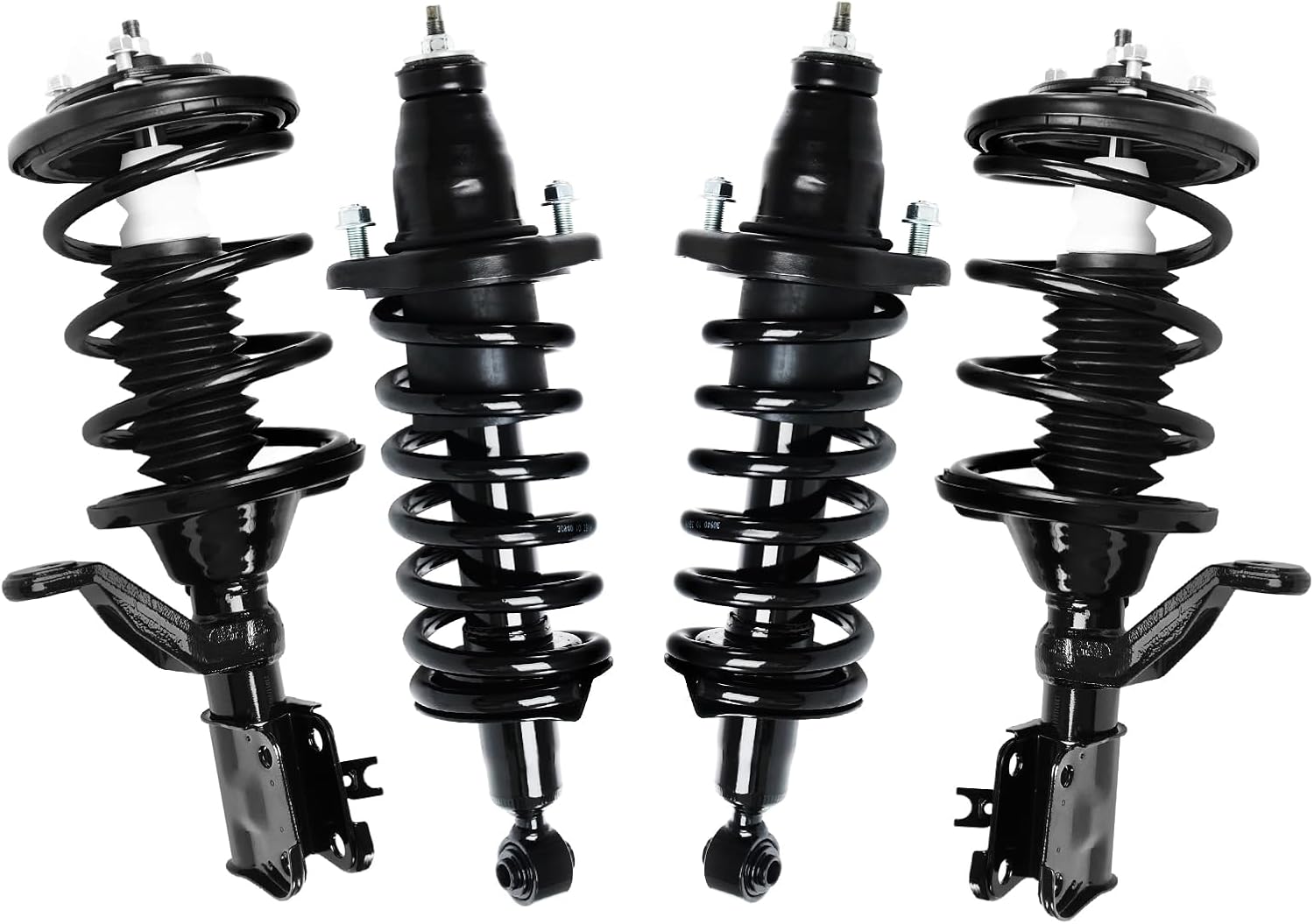
2. Vextone 4‑Piece Front and Rear Shock Absorber Strut Assembly Set
| Set Name | 4-Piece Shock Absorber Set |
|---|---|
| Compatible vehicles | 2001-2002 Civic 1.7L; 2003-2005 Civic 1.3L Hybrid |
| Included Components | Coil Spring |
| Material Type | Steel |
| Manufacturer Warranty Description | 1 Year Manufacturer |
This Vextone 4-piece kit supplies two front complete shocks and two rear complete struts as a direct replacement for worn Civic units. It is sold as a vehicle-specific fit for 2001–2002 Civic 1.7L and 2003–2005 Civic 1.3L Hybrid and arrives with coil springs and installation instructions to simplify a DIY swap. Made from steel with welded tubing construction, the assemblies are meant to restore ride control and straight-line stability; buyers report improved comfort and reduced body roll after installation. Because these are full assemblies, you avoid press work and strut disassembly, which speeds up install and lowers shop time. Limitations: the product is a replacement-style part focused on restoring factory handling rather than increasing performance tuning or track capability, and there is a one-year manufacturer warranty. If you need stiffer valving, adjustable damping, or performance-oriented spring rates, a dedicated performance kit would be a better choice.
Best for: Buyers who want a straightforward, vehicle-matched replacement to restore ride quality and handling on 2001–2005 Civic models without extra fabrication or press work, and who prioritize ease of installation and a factory-like ride.
Less Ideal for: Drivers seeking track-capable or sport-tuned suspension with adjustable damping or firmer spring rates should consider performance-oriented struts and shock kits instead.
- Vehicle-specific complete assemblies include front shocks and rear struts for an out-of-the-box swap
- Includes coil springs and installation instructions to simplify DIY replacement
- Steel construction with welded tubing aimed at structural durability
- Restores ride comfort and traveling stability compared with worn units
- Designed as a factory-style replacement so it does not offer adjustable damping or sport-tuned valving
Verdict: A practical direct-fit four-piece strut and shock assembly kit that restores factory ride and handling on 2001–2005 Honda Civic models with minimal installation work.
3. MOSTPLUS Front Complete Strut Assembly Pair for 2001–2005 Honda Civic

| Auto Part Position | Front |
|---|---|
| Style | 2001-2002 Civic 1.7L / 2003-2005 Civic 1.3L |
| Vehicle Service Type | Compatible for 2001-2005 Honda Civic and 2001-2003 Acura EL |
| Material | Steel and other materials |
| OEM Part Number | 171433, 171434 |
These MOSTPLUS front complete strut assemblies replace the entire front strut unit including spring and mounts for compatible 2001–2005 Honda Civic models. They are supplied as vehicle-specific assemblies to simplify installation and avoid the need to transfer old springs or mounts. In real-world use the parts aim to restore ride control and reduce bouncing compared with worn originals; several owners report straightforward bolt-on fit and improved smoothness. The assemblies are steel construction and include replacement mounts and springs which helps speed up a DIY swap or a quick shop install. Expect a factory-replacement ride rather than upgraded performance; the parts are focused on restoring original handling and comfort, not increasing cornering or load capacity. Some listings note random top cap color and a few users reported fitment issues on certain vehicles, so double-check vehicle fit before you install. If you want a complete front strut swap to bring an aging Civic back to factory-like ride and alignment geometry, these make a practical, cost-conscious option.
Best for: Buyers who want a practical, no-fuss replacement to restore ride control and alignment on an older Civic and prefer a ready-to-install assembly that minimizes shop labor or complex disassembly.
Less Ideal for: Drivers seeking performance upgrades, firmer sport handling, or specialized suspension tuning should consider performance-oriented struts instead.
- Complete assemblies include strut, coil spring, mounts and hardware for a one-piece replacement
- Vehicle-specific fit for 2001–2005 Civic models simplifies installation
- Steel construction aims to restore factory ride and steering geometry
- Multiple customers report easy bolt-on installation and improved ride smoothness
- Designed as a factory-style replacement so it does not improve performance handling
- Some buyers reported occasional fitment defects on certain vehicles
Verdict: If you need a straightforward, ready-to-install front strut replacement to return a 2001–2005 Civic to factory-like ride and handling, these complete assemblies are a practical choice.
4. TRIL GEAR Rear Complete Strut Assemblies with Coil Spring for Honda Civic 2001–2005 (Set of 2)

| Auto Part Position | Rear |
|---|---|
| Compatible with Vehicle Type | Replacement for 2001-2005 Civic 1.3L 1.7L |
| Automotive Fit Type | Vehicle Specific Fit |
| Material Type | Iron |
These TRIL GEAR rear strut assemblies are a budget-minded replacement for the rear suspension on 2001–2005 Honda Civics. They arrive as complete units with coil springs and mounting hardware preassembled so installation is straightforward and can usually be done without disassembling the original strut. The iron construction and claimed anti-corrosion finish aim to withstand road vibration and seasonal exposure. In use the assemblies restore rear damping and ride stability after worn original units, reducing bounce and helping tires stay planted over bumps. Because they are vehicle-specific fit parts, they simplify matching and fitment for the Civic 1.7L lineup. Expect basic but functional performance rather than high-end handling refinement; these are intended as economical factory-style replacements rather than performance upgrades. Buyers should confirm fitment for their exact Civic trim before ordering and be prepared for standard wear characteristics of value-priced suspension parts.
Best for: Buyers looking for an affordable, ready-to-install rear strut replacement to restore ride comfort and stability on a 2001–2005 Civic without upgrading to performance suspension.
Less Ideal for: Drivers seeking performance-tuned suspension or significantly firmer damping for track use should choose a dedicated performance strut instead.
- Comes as complete rear strut assemblies with coil springs for quick, straightforward installation
- Vehicle-specific fit for 2001–2005 Honda Civic 1.3L and 1.7L models simplifies matching
- Iron construction and anti-corrosion finish improve durability for everyday driving
- Packaged as a set of two so both rear sides can be replaced at once
- Designed as an economical, factory-style replacement so it will not provide enhanced performance handling
Verdict: A cost-effective, ready-to-install rear strut set that restores factory-style ride comfort and stability for 2001–2005 Honda Civics.
5. Detroit Axle 8pc Suspension Kit for 2001–2005 Honda Civic (Complete Struts & Sway Bar Links)

| Set Name | Suspension Kit |
|---|---|
| Automotive Fit Type | Vehicle Specific Fit |
| Auto Part Position | Rear |
| Material Type | Metal |
This Detroit Axle suspension kit supplies four complete strut assemblies and four sway bar end links designed as a vehicle-specific fit for 2001–2005 Honda Civic models. Each strut comes preassembled so they install like a factory replacement without pressing springs or special tools, which speeds up a full suspension refresh. The kit is aimed at restoring ride control and steering stability after worn shocks or sagging springs; you should notice reduced body roll and firmer rebound compared with aged components. Parts are metal finished in black and are built to pass impact, wear, and fatigue testing for durability. Practical limitations: this is an aftermarket replacement rather than a performance upgrade, so expect factory-style damping rather than sporty tuning, and installers should confirm exact part interchange numbers before purchase. The kit includes vehicle-specific interchange references to match the Civic platform, making it a practical one-stop option when multiple rear and front suspension pieces need replacement at once.
Best for: Buyers who prioritize restoring reliable factory-style ride and steering control on a 2001–2005 Honda Civic and want a single kit to replace all worn struts and sway bar links at once.
Less Ideal for: Drivers seeking sport-tuned suspension, adjustable damping, or track-capable components should look at performance-oriented options instead.
- Complete kit includes four ready-to-install strut assemblies and four sway bar end links for a full front and rear refresh
- Vehicle-specific fit and listed interchange numbers simplify matching to 2001–2005 Honda Civic models
- Preassembled struts eliminate spring compression and reduce installation time and shop labor
- Designed and tested for impact, wear, and fatigue to improve durability over worn original parts
- Designed for factory-style ride characteristics and not tuned for high-performance handling
Verdict: A practical, vehicle-specific complete strut and sway bar link kit that restores reliable factory-style ride and steering control for 2001–2005 Honda Civic models.
6. Detroit Axle Rear Strut and Coil Spring Kit with Sway Bar End Links

| Fits Models | 2001–2005 Honda Civic, 2001–2003 Acura EL |
|---|---|
| Kit Contents | 2 struts with springs and mounts plus 2 sway bar end links |
| Product Type | Complete assembled strut shock assemblies |
This Detroit Axle rear strut kit delivers a full, ready-to-install replacement for worn rear suspension on 2001–2005 Honda Civic and related vehicles. Each strut arrives preassembled with spring and mount so installation is straightforward for a competent DIYer or a shop, and the included sway bar end links let you replace multiple wear items at once. The assemblies are intended as factory-quality aftermarket replacements and should restore ride control and reduce bounce compared with aging, leaking shocks. Because the kit is vehicle-specific and comes complete, you avoid sourcing separate springs or mounts and save installation time. Expect the typical feel of a factory-style strut rather than a tuned performance setup, so drivers seeking firmer handling or lowered ride height will need a different product. Also, as with most aftermarket assemblies, exact ride tuning can vary slightly from factory originals, so allow an alignment afterward for best results.
Best for: Buyers who want a complete, vehicle-specific rear suspension replacement that minimizes parts-hunting and simplifies installation while prioritizing reliable, factory-style ride restoration.
Less Ideal for: Drivers chasing performance upgrades, lowered stance, or custom suspension tuning should choose specialty performance components instead.
- Comes fully assembled with spring and mount for faster, simpler installation
- Includes sway bar end links so related wear parts are replaced at once
- Marketed as factory-quality aftermarket replacement aimed at restoring original ride control
- Designed for a stock-equivalent ride rather than sport-tuned handling
Verdict: Choose this kit if you want a complete, ready-to-install rear suspension replacement that restores factory-style ride and replaces multiple worn components in one purchase.
Choosing the Right 2001-2005 Honda Civic Shock Absorber: Key Factors to Consider
Damping Characteristics
Damping controls how quickly the Civic's body motion settles after a bump. Shocks with heavier damping reduce body roll and pitch but can make the ride feel firm; lighter damping improves comfort but may allow more oscillation and longer stopping distances. For a 2001-2005 Civic, pick damping that matches your driving style: highway commuters typically benefit from smoother, comfort-oriented valving, while drivers who prioritize sharper turn-in may prefer firmer damping.
Damping also affects tire contact with the road. Consistent valving helps maintain traction under braking and during lane changes. When assessing candidates, consider both low-speed and high-speed damping behavior because Civic suspension needs to handle small road texture as well as larger impacts without bottoming out.
Fitment and Mount Compatibility
Correct fitment for the 2001-2005 Civic is critical. Mounting points, piston rod diameter, and stroke length must match factory geometry to avoid altered ride height or compromised wheel alignment. Using shocks that require different top mounts or adapters can lead to premature wear of ball joints and bushings and may change steering feel.
Also check whether top mounts, bushings, or bump stops are included or recommended for replacement. On the Civic, worn mounts often accompany worn shocks, so a complete fitment plan reduces rework. Verify front and rear shock specifications separately since front shock absorbers commonly share strut assemblies while rear units differ in stroke and mounting.
Durability and Corrosion Resistance
The 2001-2005 Civic often sees varied climates and road conditions, so corrosion resistance extends service life. Look for protective coatings, robust seals, and hardened piston rods to resist pitting and leakage. Durable construction reduces the chance of early oil loss or seal failure, which causes degraded damping performance and shock absorber noise.
Consider the local environment: if you drive in winter salt or coastal areas, prioritize rust-resistant finishes and replaceable components. Durability also includes internal valving that resists fading; shocks that maintain consistent performance after repeated impacts are better suited to long-term ownership.
Ride Height and Spring Compatibility
Maintaining factory ride height is important for the Civic's suspension geometry and anti-squat/anti-dive behavior. Some shocks are designed only for stock springs, while other kits are intended for lowered setups and use different valving or shorter strokes. If you plan to keep original springs, choose shocks specified for standard ride height to avoid binding or overtravel.
If you run aftermarket springs, confirm the shock's travel and valving are compatible. Mismatched shock and spring pairings can lead to poor rebound control, bottoming out, or premature spring wear. Proper pairing preserves handling balance and avoids unexpected car handling problems.
Installation Complexity
Some shock absorber replacements are straightforward, while others require additional parts or suspension disassembly. Front strut replacements may need spring compressors, bearing plates, or alignment afterward. Rear shock replacement can be simpler but may still require lifting the suspension to remove tension on mounting bolts.
Assess whether you will replace mounting hardware, rubber isolators, or bump stops at the same time. Choosing shocks that reuse factory mounts or come with clear fitment instructions reduces installation time and unexpected labor. Consider whether you have access to alignment services after installation, as many replacements will shift toe or camber slightly.
Noise, Ride Smoothness, and NVH
Shock absorber noise and vibration affect perceived quality. Squeaks, knocking, or excessive rebound noise often indicate worn seals, loose mounts, or internal damage. For the Civic, NVH is especially noticeable at highway speeds and over expansion joints. Select shocks with consistent damping to minimize mid-frequency disturbances and sharp impacts.
Check for features that reduce noise transmission such as high-quality bushings and sealed mounts. Reduced NVH improves driver comfort and helps you detect other suspension problems earlier since excessive noise can mask new issues.
How to Recognize Worn Shocks on a 2001-2005 Civic
Worn shocks produce characteristic symptoms that are often the earliest indicators of suspension need. Common signs include increased nose dive under braking, longer settling after hitting a bump, and a loose feeling during cornering. These symptoms can appear gradually, so note changes in ride behavior after long trips or seasonal maintenance.
Visual checks are useful: look for oil seepage on the shock body, rust around seals, or compressed bump stops. Perform simple push tests at each corner to observe rebound timing; an excessively bouncy response usually means reduced damping. Also listen for shock absorber noise such as clunks or hisses that may indicate internal wear or mounting issues.
- Observe nose dive and body roll during braking and turns
- Check for oil or grease on the shock body and mounts
- Perform a bounce test: the car should settle after one or two bounces
- Listen for clunks, rattle, or hissing noises over bumps
Front Vs Rear Shock Considerations
Front shock absorbers on the Civic are often part of a strut assembly that interacts directly with steering and alignment geometry. Front units require careful attention to top mounts and bearing condition because steering feel and return-to-center behavior depend on proper assembly. When replacing front shocks, consider replacing the top mounts if they show play or noise.
Rear shock replacement involves different mounting hardware and stroke length. Rear shocks affect ride balance and how the car reacts to load changes. If you carry frequent cargo or passengers, prioritize rear damping that resists bottoming and helps maintain consistent ride height. Replace rear units in pairs to keep symmetrical handling.
- Replace front shocks along with worn top mounts or bearings
- Rear shocks should be matched left and right for consistent balance
- Consider load conditions when selecting rear damping rates
Signs of Shock-Related Handling Problems
Car handling problems like wandering, poor lane-keeping, or uneven tire wear often trace back to failing shock absorbers. If the Civic feels reactive to small steering inputs or exhibits patchy traction under braking, inspect the shocks for consistent damping and the tires for cupping or scalloped wear. Handling symptoms can be subtle, so document before-and-after behavior when replacing shocks.
Also be mindful of changes after a previous suspension repair. Even correctly installed shocks can lead to handling differences if mounts, bushings, or alignment were not addressed. A professional alignment after replacement ensures toe and camber are within specification and helps the new shocks perform as intended.
- Wandering or instability during lane changes
- Uneven or scalloped tire wear
- Excessive body roll or delayed steering response
- Need for repeated steering corrections on straight roads
Preparing for Shock Absorber Replacement
Before starting a shock absorber replacement on a 2001-2005 Civic, gather the correct tools including a jack, stands, basic hand tools, and spring compressors for front strut work. Inspect replacement recommendations for required torque values and any special tools. Replace mounting hardware and rubber isolators if they show wear to prevent post-install noise.
Plan for a wheel alignment after installation. Even with careful work, suspension geometry can shift slightly when shocks are swapped. If you intend to perform the job yourself, set aside adequate time and follow safety practices. For rear shock replacement, support the axle or trailing arm to remove tension on bolts safely.
- Have spring compressors ready for front strut disassembly
- Replace top mounts and bump stops as needed
- Torque all fasteners to factory specs and recheck after test drive
- Schedule a wheel alignment after replacement
Maintenance Tips to Extend Shock Life
Regular inspections can extend shock service life. Clean debris and inspect for corrosion during oil changes or tire rotations. Address leaking seals early to prevent further internal damage. Replacing worn rubber components such as bushings and bump stops reduces stress on the shock body and seals.
Avoid repeated hard impacts by moderating speed over potholes and rough roads when possible. If you frequently carry heavy loads or tow, inspect rear shocks more often because repeated compression cycles accelerate wear. Proper tire inflation and rotating tires at recommended intervals also reduces uneven loading that stresses shocks.
- Clean and inspect shocks during routine maintenance
- Replace worn mounts, bushings, and bump stops promptly
- Rotate tires and maintain correct inflation
- Reduce repeated harsh impacts over rough roads
When to Replace Both Front and Rear Units
Replacing shocks in pairs maintains predictable balance and handling. If one front shock is worn, the opposite side likely has similar mileage and wear patterns. Installing a new shock opposite an old one can create uneven damping and unexpected handling traits. For the Civic, owners typically replace both front shocks together and both rear shocks together.
If one side shows external damage or severe leakage while the other appears marginal, err on the side of paired replacement. This approach preserves symmetric ride height and response, helping to avoid car handling problems that can arise from mismatched damping characteristics.
- Replace shocks in axle-matched pairs to keep balance
- Consider full-axle replacement when signs appear on one side
- Paired replacement reduces risk of uneven tire wear
Still looking for the perfect fit?
Select your Honda Civic configuration to see the most relevant Shock Absorbers recommendations
How We Chose the Best 2001-2005 Honda Civic Shock Absorber
We focused on criteria that matter specifically to 2001-2005 Honda Civic owners. Durability under common mileage and pothole exposure was prioritized because many Civics accumulate high miles in mixed road conditions. Damping performance and ride tuning were evaluated to ensure candidates balance comfort and control for the Civic's front-wheel-drive layout. Fitment accuracy and correct mounting geometry for the ES, EM, and EP era body were essential filters to avoid alignment or handling tradeoffs. Corrosion resistance and seal quality were considered to extend service life in wet or salted environments. Ease of installation and availability of replacement mounts or bump stops were included because many owners perform suspension work themselves.We excluded options that require significant vehicle modifications, nonstandard spring rates, or any that change ride height beyond factory tolerances. Products that lacked clear fitment for the 2001-2005 Civic or that had inconsistent durability reports were not shortlisted. The final list balances real-world longevity, consistent damping behavior, and straightforward installability for owners replacing worn shocks.
Our full evaluation process is outlined in our review methodology.
FAQ
How do I know if my 2001-2005 Civic needs shock absorber replacement?
Look for increased bouncing after bumps, noticeable nose dive under braking, uneven tire wear, and visible oil on the shock body. A simple push test at each corner helps: if the car continues to oscillate after two bounces, the shocks likely need replacement.
Can I replace just the front shock absorbers and leave the rear ones?
You can replace front shocks independently, but replacing matched pairs is recommended for consistent handling. If the rear shocks are near the end of their life, replacing both axles' shocks together helps maintain balanced ride and predictable control.
Will replacing shocks fix steering pull or alignment issues?
Replacing worn shocks can improve steering stability and reduce wandering, but it will not correct alignment faults. If steering pull persists after new shocks, have the wheel alignment checked since toe or camber issues require alignment adjustments.
How long does a shock absorber replacement take on this Civic?
A competent DIYer with the right tools can replace one axle's shocks in a couple of hours. Front strut jobs take longer due to spring compressors and bearing checks. Allow extra time for safety, torqueing fasteners, and a test drive to confirm proper operation.
Are replacement mounts or bump stops usually needed when changing shocks?
Often yes. Mounts, bushings, and bump stops can wear alongside the shocks. Replacing those components during the job prevents new shocks from transmitting noise or experiencing premature wear due to degraded rubber parts.
What should I expect in terms of noise after installing new shocks?
New shocks should reduce clunks and hissing. Some initial settling noises can occur if mounts are reused. If persistent knocking or squeaking appears, recheck top mounts, bushings, and torque values since loose hardware commonly causes noise.
Final Verdict
Prioritize correct fitment, appropriate damping, and matching front and rear units when selecting shock absorbers for a 2001-2005 Honda Civic. Durability features such as corrosion protection and reliable seals matter for long-term performance, while correct pairing with springs preserves handling balance. Consider installation complexity and plan for a wheel alignment to ensure new shocks deliver the intended improvements.Choose shocks that align with your driving priorities: comfort-oriented valving for daily commuting or firmer damping for more responsive handling. Replacing worn shocks in matched pairs and addressing related mounting components gives the most predictable and lasting results.
Explore More:
- Check out all Honda Civic parts & accessories
- Explore Shock Absorbers Maintenance & Repair Guides
- Explore Suspension & Steering
- Browse all Auto Parts
