

Note: This article contains affiliate links. If you click on these links and make a purchase, I may earn a small commission at no extra cost to you. This helps support my research and content. Read my full affiliate disclosure here.
If you drive a Ford F-250, choosing the right rear brake pads matters for towing safety, everyday braking feel, and long-term reliability. Rear brake pads on a heavy truck handle different loads and heat cycles than passenger cars, so picking pads that match your driving and towing needs helps preserve rotors and maintain consistent stopping performance.This guide shortlists the seven top rear brake pads for the Ford F-250, each selected for specific strengths like low dust, long life, or strong fade resistance. We explain the evaluation criteria used and what to expect in terms of noise, durability, and fitment so you can make a confident choice for your truck. Read on for the key considerations before the product list.
Looking for other parts? See all Ford F-250 parts & accessories.
Top Picks at a Glance
| Best Overall The best all-around choice for most situations | Bosch QuietCast Premium Ceramic Rear Disc Brake Pad Set (BC1691) |  |
| Best Quality Built to a higher standard if you want something more solid | PowerStop Z36 Truck & Tow Rear Carbon-Fiber Ceramic Brake Pads with Hardware |  |
| Best Value The sweet spot between price and what you get | Rockplanet Rear Semi‑Metal Brake Pads for Ford F‑250/F‑350/F‑450 (Rear, D1691) |  |
| Best Budget The cheapest option that still gets the job done reliably | Auto Shack Rear Ceramic Brake Pads for Ford F-250 Super Duty (1999–2004) |  |
| Highest Rated A top-rated pick with lots of positive feedback | Detroit Axle Rear Ceramic Brake Pads (P-1067) for 2005–2012 Ford F-250/F-350 Super Duty (DRW rear wheels) |  |
| Most Popular A crowd favorite that many people choose with confidence | ECCPP Rear Disc Brake Pad Set for Ford F-250/F-350/F-450 Super Duty (Rear) |  |
| Best Seller A high-volume bestseller chosen again and again | BOSCH Severe Duty Semi‑Metallic Rear Brake Pad Set (BSD1691) |  |
1. Bosch QuietCast Premium Ceramic Rear Disc Brake Pad Set (BC1691)

| Material Type | Ceramic |
|---|---|
| Auto Part Position | Rear |
| Model Number | BC1691 |
| Included Components | Brake Pads |
The Bosch QuietCast BC1691 rear brake pad set is a factory-style ceramic replacement designed for quiet, consistent stopping on select Ford F-250 and other Super Duty rear applications. These pads use Bosch's pre-attached multilayer rubber-core shim to reduce noise and vibration, and a proprietary ceramic friction formula that aims for strong stopping power with less rotor wear and low dust. Powder-coated backing plates and OE-style slots and chamfers help resist corrosion and promote proper bedding and pad-to-rotor contact. The set ships with the hardware kit and lubricant where required, which simplifies installation and helps sliding components operate smoothly. Practical benefits for everyday driving include noticeably quieter stops, cleaner wheels from reduced dust, and durable pads that handle regular hauling and towing duty. Limitations are that fitment is vehicle specific so confirmation for trim and year is required, and ceramic pads can feel a touch firmer than some semi-metallic options under repeated heavy-duty braking.
Best for: Buyers seeking a balanced, quiet, low-dust rear pad for everyday driving and moderate towing on Ford Super Duty trucks who prioritize durability and near-factory performance.
Less Ideal for: Drivers who regularly perform severe-duty towing, heavy commercial work, or frequent high-temperature braking should consider heavy-duty or severe-duty friction options instead.
- Pre-attached multilayer rubber-core shim for reduced noise and vibration
- Ceramic friction material formulated for strong stopping and low dust
- Powder-coated backing plate resists corrosion for longer service life
- Includes hardware kit and lubricant where required for easier installation
- Vehicle-specific fit requires verifying trim and year before purchase
- Ceramic material can feel firmer than semi-metallic pads under heavy repeated braking
Verdict: A balanced, factory-style ceramic rear pad that delivers quiet stops, low dust, and durable performance for everyday Ford F-250 Super Duty use.
2. PowerStop Z36 Truck & Tow Rear Carbon-Fiber Ceramic Brake Pads with Hardware

| Auto Part Position | Rear |
|---|---|
| Automotive Fit Type | Vehicle Specific Fit |
| Material Type | Carbon-Fiber Ceramic, Metal, Stainless Steel |
| Manufacturer Warranty Description | 12 Month / 12,000 Mile Limited Warranty |
These PowerStop Z36 Truck & Tow rear brake pads are a direct-fit upgrade for Ford F-250/F-350/F-450 Super Duty trucks that need stronger, more fade-resistant braking when towing or hauling. The carbon-fiber ceramic compound raises coefficient of friction versus factory pads, so drivers notice crisper initial bite and shorter stopping distances under load. Chamfered and slotted faces, stainless-steel shims, and a powder-coated backing plate help control noise, vibration, and corrosion while producing low dust that keeps wheels cleaner. The kit includes stainless-steel installation hardware so swapping pads is straightforward for a competent DIYer. Expect more consistent performance on long downhill runs and when using larger tires or lifted suspensions. These are focused on heavy-duty use rather than track competition, so they prioritize thermal stability and quiet operation over ultra-aggressive racing compounds.
Best for: Drivers who prioritize stronger, more consistent rear braking for towing, hauling, or hilly driving and want a ready-to-install upgrade that reduces dust and noise.
Less Ideal for: Enthusiasts seeking maximum track-spec friction or race pads should choose a competition compound instead.
- Carbon-fiber ceramic compound increases stopping power and resists brake fade under heavy load
- Includes stainless-steel shims and premium hardware for quieter operation and easier installation
- Low-dust formulation helps keep wheels cleaner after use
- Designed as a direct-fit vehicle-specific upgrade for straightforward replacement
- Formulated for towing and heavy-duty street use rather than track-focused maximum friction performance
Verdict: Choose these Z36 rear pads to get a bolt-on, low-dust upgrade that delivers stronger, fade-resistant braking for towing and heavy-duty Super Duty use.
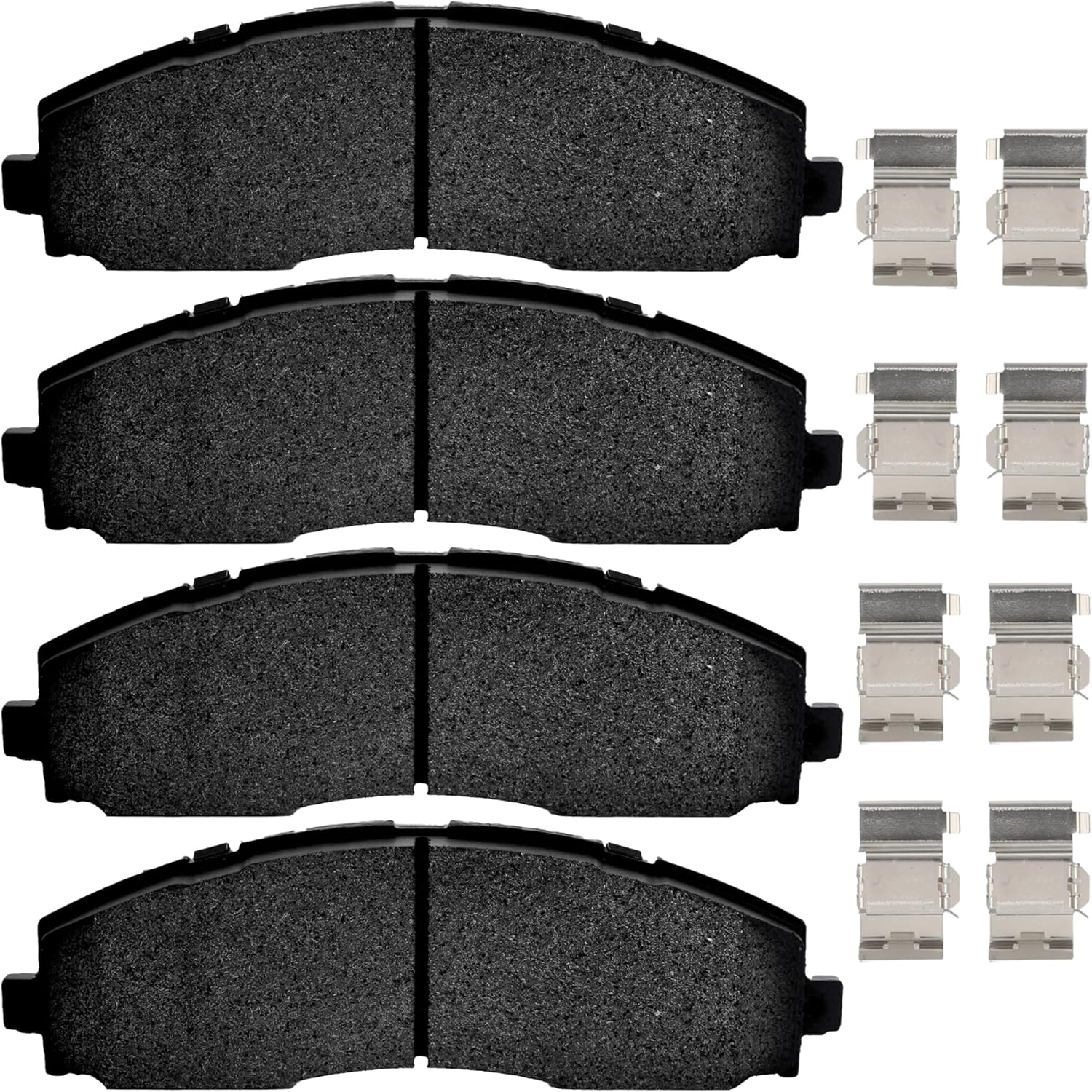
3. Rockplanet Rear Semi‑Metal Brake Pads for Ford F‑250/F‑350/F‑450 (Rear, D1691)
| Auto Part Position | Rear |
|---|---|
| Model Number | D1691 |
| Manufacturer Part Number | RBPD012 |
| Material Type | Semi-metal |
| Manufacturer Warranty Description | 2 years |
These Rockplanet rear brake pads are a vehicle-specific replacement for Ford F-250, F-350, and F-450 Super Duty trucks and are built from semi-metallic material intended for durable everyday and towing use. They install as rear pads and include a slotted face to help heat evenly, improve ventilation, and aid debris and water drainage during hard braking. The listing highlights low dust and a washer-style cushion to reduce vibration and noise, so drivers should notice quieter stops and cleaner wheels compared with some budget organic pads. Because they are aftermarket parts, fitment checks are recommended before purchase and you may need standard bedding-in after installation. The pads aim for longer life and stable performance under load, but semi-metallic material can be slightly noisier and harder on rotors than ceramic options for drivers prioritizing ultimate smoothness. For a practical owner who needs a durable rear pad that handles heavy-duty use, these are a solid, no-frills replacement option.
Best for: Practical owners who need a durable, vehicle-matched rear pad for heavy-duty driving, towing, or frequent hauling and value reliable stopping and lower dust over premium silent operation.
Less Ideal for: Drivers seeking the quietest possible brake feel or the gentlest rotor wear should consider ceramic-brand options instead.
- Vehicle-specific fit for late-model Ford Super Duty rear brakes
- Semi-metallic compound for durability and consistent friction under load
- Slotted pad face to aid heat dissipation and improve wet/debris performance
- Washer cushion included to help reduce vibration and braking noise
- Semi-metallic material can be more abrasive to rotors than ceramic alternatives
Verdict: A durable, vehicle-specific semi-metal rear pad set that gives Ford Super Duty owners reliable stopping power and lower dust for heavy-duty use.
4. Auto Shack Rear Ceramic Brake Pads for Ford F-250 Super Duty (1999–2004)

| Compatible models | Ford F-250 Super Duty 1999-2004 |
|---|---|
| Position | Rear |
| Material Type | Ceramic |
| Included Components | Ceramic Brake Pad Set |
These Auto Shack rear ceramic pads are a direct-fit replacement for 1999–2004 Ford F-250 Super Duty rear brakes and are intended as a budget-friendly option for routine service. They install like a factory-style pad and are typically used during rear brake maintenance or rotor resurfacing jobs. The ceramic compound is formulated for quieter stops and reduced brake dust, which keeps wheels cleaner between washes and reduces nuisance noise on daily driving. Seller notes highlight fitment verification before purchase and the set does not include clips. Practical benefits include consistent friction for everyday towing and hauling scenarios common to F-250 ownership and a design focused on longer rotor life. Limitations to consider are the basic 6-month part warranty and absence of extra hardware, so plan to reuse or replace backing clips if needed; performance-oriented drivers seeking heavier-duty or high-temperature stopping power should look at performance-focused alternatives.
Best for: Buyers looking for an affordable, straightforward rear pad replacement for routine service on a Ford F-250 who prioritize quiet, low-dust operation and rotor longevity.
Less Ideal for: Drivers who frequently perform heavy towing, hard‑use braking, or who want upgraded high-temperature stopping power should consider performance brake compounds instead.
- Direct-fit, vehicle-specific replacement for Ford F-250 Super Duty 1999–2004 rear brakes
- Ceramic formulation delivers quieter operation and low brake dust
- Designed to reduce rotor wear for longer rotor life compared with some semi-metallic compounds
- Does not include mounting clips or extra hardware with the pad set
Verdict: A cost-conscious, quiet, low-dust ceramic rear pad set that restores everyday braking performance for 1999–2004 Ford F-250 Super Duty trucks.
5. Detroit Axle Rear Ceramic Brake Pads (P-1067) for 2005–2012 Ford F-250/F-350 Super Duty (DRW rear wheels)

| Fitment | 2005–2012 Ford F-250/F-350 Super Duty (DRW rear wheels only) |
|---|---|
| Material Type | Ceramic |
| Position | Rear |
| Number of Items | 2 |
These Detroit Axle rear ceramic pads are a direct replacement kit intended for 2005–2012 Ford F-250 and F-350 Super Duty trucks with dual rear wheels. The pads use a ceramic friction formula with chamfers and multi-layer backing to reduce vibration, lower noise, and limit brake dust, making them a good fit for everyday hauling and towing where quiet, consistent braking matters. High-temperature resistance and a stable friction coefficient are highlighted to help prevent fade under heavier loads. Because they are vehicle-specific fitment, installation is straightforward for someone replacing rear pads and includes the two rear pads needed per axle. The main limitations are that this particular SKU is for dual rear wheel configurations only and does not include rotors or extra hardware beyond the pads, so buyers replacing rotors or upgrading braking performance will need additional parts. For drivers prioritizing reliability and a low-noise, low-dust ceramic option, these pads offer a practical factory-style replacement.
Best for: Buyers who want a reliable, quiet factory-style replacement for the rear brakes on dual-rear-wheel Super Duty trucks and who prioritize consistent, low-dust braking for towing and daily use.
Less Ideal for: If you need a full brake service including rotors, upgraded stopping power for heavy-duty commercial use, or pads for single rear wheel models, choose a different kit or include additional parts.
- Ceramic formulation reduces dust and is gentler on rotors compared with metallic pads.
- Chamfered, multi-layer design lowers vibration and driving noise.
- High-temperature resistance helps maintain braking performance under load.
- Vehicle-specific fit simplifies installation for compatible Super Duty DRW trucks.
- Fitment is limited to dual rear wheel (DRW) configurations, not single rear wheel trucks.
- Kit includes only the rear pads and does not include rotors or extensive hardware.
Verdict: A dependable, low-noise ceramic rear pad option tailored for Ford Super Duty dual-rear-wheel trucks that prioritizes quiet, consistent braking.
6. ECCPP Rear Disc Brake Pad Set for Ford F-250/F-350/F-450 Super Duty (Rear)

| Auto Part Position | Rear |
|---|---|
| Material | Metallic |
| Friction Coefficient | FE(0.35~0.45/0.25~0.35) |
| Tolerant Temperature | 600℃ |
| Thickness of Friction Material | 11.8 mm |
These ECCPP rear brake pads are a direct-fit replacement for Ford F-250, F-350 and F-450 Super Duty trucks in the listed years and are built as metallic pads intended for heavier-duty use. They install in the rear brake calipers and include chamfers and vibration-dampening shims to reduce squeal after proper bedding. The pads are described with a high temperature tolerance and an 11.8 mm friction thickness that supports towing and heavier loads better than typical street-only pads. Typical use is highway and worktruck driving where stronger initial bite and heat resistance matter; they will create more brake dust and sound different from ceramic pads but offer improved durability under load. Installation follows normal pad replacement and benefits from the recommended bedding procedure to establish even pad transfer to the rotors. Limitations are that metallic pads are dustier and can be harsher on rotors than ceramic options, and correct fitment should be verified against your vehicle trim and original parts before purchase.
Best for: Buyers who want a robust, work-ready rear pad for Super Duty trucks and prioritize durability and heat resistance over low dust and ultra-quiet operation.
Less Ideal for: Drivers seeking the quietest, lowest-dust option for daily city commuting or those planning to preserve rotors at all costs should consider ceramic alternatives.
- Direct-fit replacement designed for 2013–2021 Ford Super Duty rear brakes
- Vibration-dampening shims and chamfers to reduce squeal after proper bedding
- Higher temperature tolerance and thicker friction material for heavier loads and towing durability
- Metallic formulation produces more brake dust and is generally harsher on rotors compared with ceramic pads
Verdict: Choose these ECCPP rear pads if you need durable, heat-resistant stopping power for Ford Super Duty trucks used for towing or heavy duty work.
7. BOSCH Severe Duty Semi‑Metallic Rear Brake Pad Set (BSD1691)

| Auto Part Position | Rear |
|---|---|
| Material Type | Semi-Metallic |
| Number of Items | 1 |
| Specification Met | OEM |
These Bosch Severe Duty rear brake pads are designed for heavy use on trucks that see frequent stop-and-go driving or carry heavier payloads. The semi‑metallic friction compound, combined with multilayer shims, slots, and chamfers where required, gives consistent stopping power and helps control noise and vibration. Bosch supplies pads for one axle along with synthetic lubricant and any applicable hardware, and the pads are engineered and tested in North America. In practice this set is a straightforward, direct-fit replacement that installs like a factory-quality part and holds up better than standard commuter pads when under load. The semi‑metallic material can produce slightly more dust than ceramic alternatives and may be a bit firmer at very low temperatures, but it delivers reliable braking under sustained use. This is a practical choice if you want a durable, vehicle-matched rear pad that prioritizes consistent performance and longevity for heavier-duty driving.
Best for: Buyers who prioritize reliable, factory-quality braking under heavy or frequent-load conditions and want a direct-fit rear pad that minimizes installation hassle.
Less Ideal for: Drivers who want the lowest dust and the quietest, softest pedal feel for light daily commuting should consider ceramic-focused options instead.
- Designed for severe-duty use so it resists fade under repeated heavy braking
- Vehicle-specific fit with OE-style shims, slots, and chamfers for straightforward installation
- Semi-metallic compound offers strong, predictable stopping power under load
- Includes pads for one axle plus synthetic lube and applicable hardware for a complete rear-axle replacement
- Semi-metallic material can produce more brake dust and feel firmer than ceramic pads in cold conditions
Verdict: Choose these Bosch Severe Duty rear pads when you want a direct-fit, durable replacement that maintains strong, consistent braking for heavier-duty Ford F-250 use.
Choosing the Right Ford F-250 Rear Brake Pads: Key Factors to Consider
Stopping Power Under Load
Stopping performance matters more for the Ford F-250 than for lighter vehicles because you may routinely tow, haul, or carry heavy payloads. Effective rear brake pads should offer consistent bite across a range of temperatures and loads so braking distances remain predictable when the truck is loaded.
Look for pad materials and formulations that list friction coefficients or describe performance under heavy duty conditions. While rear pads alone do not determine total stopping distance, their contribution to balanced braking and vehicle stability is critical, especially during trailer braking or emergency stops.
Heat Tolerance and Fade Resistance
Repeated heavy braking generates significant heat, and pads that lose friction when hot will lengthen stopping distances. Fade resistance describes a pad's ability to sustain braking force during repeated stops or downhill descents.
Consider pads designed with higher temperature capacities and compounds intended for heavy-duty use. Adequate heat tolerance reduces the risk of glazing and premature hardening, which ties into how often to replace brake pads and overall maintenance intervals.
Durability and Wear Patterns
Durability influences ownership costs and maintenance frequency. For the F-250, pads that wear slowly under load save time and prevent frequent brake service. Equally important is how the pad wears relative to the rotor. Even wear extends rotor life and avoids uneven rotor surfaces that cause vibration.
Inspect manufacturer guidance on expected pad life under typical towing or fleet duty cycles, and match pad compound choice to your driving patterns to balance longevity with braking performance.
Noise, Vibration, and Harshness (NVH)
Brake pad noise grinding and vibration are common complaints on heavy trucks if pads or hardware are not matched to the brake system. Some compounds are prone to squeal, while others incorporate shims and chamfers to reduce noise.
Choose pads that explicitly address NVH through design features or materials. Proper installation, including clean contact surfaces and recommended hardware, also plays a key role in minimizing noise and ensuring a comfortable ride.
Material Type and Dust
Pad material, whether organic, semi-metallic, or ceramic-like formulations, affects dust generation, corrosiveness to rims, and braking characteristics. Lower-dust pads keep wheels cleaner, which matters on show trucks or daily drivers, while semi-metallic compounds may offer stronger initial bite at the cost of more dust.
Weigh the tradeoffs between low-dust, quiet operation and the raw stopping power you need for towing. For many F-250 owners, a balanced compound that offers acceptable dust, strong performance, and reasonable longevity is ideal.
Fitment Accuracy and Pad Thickness
Correct fitment and proper pad thickness relative to the Ford F-250 rear caliper are essential to avoid installation issues and ensure proper clearance. Pads that deviate from specified thickness can cause early wear sensors to trigger or lead to inadequate pad life.
Confirm pad dimensions and any included hardware or instructions. A good fitment guide reduces installation time and the risk of returning parts. Also consider how the pad thickness spec affects bedding-in procedures and initial braking feel after installation.
Understanding Rear Brake Responsibilities on a Heavy-Duty Truck
Rear brake pads on the Ford F-250 do more than provide stopping force. They help balance braking distribution, support brake proportioning under load, and assist with stability when towing. Because of higher Gross Vehicle Weight Ratings and frequent towing, rear components encounter different stress patterns than those on lighter vehicles.
Recognizing this role helps when choosing pads. For example, a pad tuned for stable, predictable engagement can reduce nose-dive and help the anti-lock braking system operate smoothly under high-load conditions.
- Rear pads contribute to overall brake balance and vehicle stability.
- They must handle different heat cycles during towing and heavy hauling.
- Proper rear pad selection reduces rotor wear and helps ABS modulation.
Material Options and What They Mean for F-250 Owners
Material choice affects bite, noise, dust, and longevity. Ceramic-like compounds are often quieter and produce less dust, while semi-metallic compounds may deliver stronger initial bite and better heat tolerance. For an F-250, the decision should align with your typical use—daily driving, frequent towing, or mixed-duty work.
If you tow heavy loads regularly, prioritize compounds listed for higher-temperature stability. If you use the truck mainly for commuting and occasional light hauling, low-dust, low-noise options may be preferable.
- Ceramic-style: lower dust, quieter operation, smoother initial feel.
- Semi-metallic-style: higher heat tolerance, stronger bite under load.
- Hybrid formulations attempt to balance these traits for mixed use.
Installation and Bedding-In for Reliable Performance
Proper installation affects pad life and performance. Replace or clean hardware, apply recommended lubricants to contact points, and confirm caliper operation and rotor condition before installing new pads. Misalignment or sticking calipers can cause uneven wear and noise.
Bedding-in, or breaking in new rear pads, helps transfer an even layer of friction material to the rotor surface. Follow manufacturer-recommended procedures for initial stops and cool-down periods to achieve consistent braking feel and reduce the chance of glazing.
- Inspect rotors for grooves or warping and resurface or replace if necessary.
- Use proper shims and hardware to minimize vibration and noise.
- Perform a staged bedding-in routine with gradual stops and cool-downs.
Signs You Need Rear Brake Pad Service
Knowing brake pad wear symptoms lets you address issues before safety or rotor damage occurs. Common signs include a grinding sound, a change in pedal feel or travel, a pulsation through the pedal, or visible thinness of pad material behind the wheel. On heavier trucks, these symptoms can escalate faster under load.
Regular inspections are important. Check pad thickness during routine maintenance and look for uneven wear patterns that could indicate caliper problems, improper installation, or rotor issues.
- Grinding noises often indicate metal-on-metal contact and the need for immediate service.
- Vibration or pulsation can point to rotor warping or uneven pad deposits.
- Visual checks of pad thickness are the simplest way to track wear.
Matching Rear Pads to Driving Style and Towing Needs
Different owners have different priorities. If you frequently tow trailers, prioritize pads with higher fade resistance and stronger mid-range friction. If you mostly commute, prioritize low noise and low dust. For mixed-use, look for compromise compounds that maintain stability under occasional heavy braking while remaining comfortable in daily driving.
Consider also whether you need pads that work well with trailer brake controllers and the vehicle's ABS tuning. A properly matched pad will provide predictable modulation without abrupt grab that can unsettle a loaded trailer.
- Towing: heat-resistant compounds and steady friction at high temperatures.
- Commuting: quiet, low-dust pads for cleaner wheels and comfortable stops.
- Mixed use: balanced compounds that cover both duty cycles adequately.
Rotor Condition and Its Impact on Pad Performance
New pads perform best against rotors that are flat and within thickness specifications. Deep grooves, excessive runout, or uneven thickness can cause noise, vibration, and shortened pad life. When replacing pads, inspect rotor thickness and surface finish to determine whether machining or replacement is needed.
Matching pad material to rotor type also matters. Some compounds work better with certain rotor finishes; for heavy towing, a smooth, properly bedded rotor surface helps maintain consistent braking and reduces glazing risk.
- Measure rotor thickness and compare to the Ford F-250 service limits.
- Address excessive runout to prevent pulsation and uneven wear.
- Surface condition influences bedding-in and long-term pad behavior.
Still looking for the perfect fit?
Select your Ford F-250 configuration to see the most relevant Brake Pads recommendations
How We Chose the Best Ford F-250 Rear Brake Pads
We evaluated rear brake pads for the Ford F-250 using a focused set of criteria aimed at the demands of a heavy-duty pickup. Primary evaluation factors included stopping performance under load, which assesses friction compound effectiveness when towing and hauling; heat tolerance and fade resistance, which identify pads that maintain braking force during repeated or heavy stops; and longevity and pad material wear pattern, which influence how often you will need brake pads replacement and rotor resurfacing.Additional criteria covered noise and vibration control to reduce brake pad noise grinding and ensure a quiet daily drive; dust generation and rotor compatibility to limit cleanup and protect wheel finishes; and fitment accuracy to minimize installation issues and ensure correct pad thickness relative to the brake pad thickness spec. We also considered aftermarket brake pads' reputation for consistent manufacturing quality and verified that friction formulations suit truck duty cycles.Exclusions: We excluded pads intended solely for racing or specialty competition use, options lacking clear material or performance specs, and any products without documented fitment for the Ford F-250 rear brakes. Our process prioritized reproducible performance characteristics and real-world suitability for towing and heavy-duty use.
Our full evaluation process is outlined in our review methodology.
FAQ
How often should I inspect rear brake pads on my Ford F-250?
Inspect rear pads every 6,000 to 12,000 miles or during scheduled maintenance, and more frequently if you tow often. Heavy towing accelerates wear and can reveal issues like uneven wear or glazing earlier than normal driving.
Can I use low-dust ceramic-style pads if I tow regularly?
You can, but check the pad's stated heat tolerance. Low-dust options are quieter and cleaner, but some formulations sacrifice high-temperature stability. For consistent towing, choose a compound rated for heavier duty cycles.
What does a grinding noise from the rear brakes usually mean?
Grinding typically indicates the friction material is worn down to the backing plate or that debris is trapped between the pad and rotor. Address grinding promptly to avoid rotor damage and potential safety issues.
Is it okay to replace only the rear brake pads and not the front?
Replacing only the rear pads is acceptable when the fronts are still within service limits. However, consider overall balance and inspect all components for wear so braking performance remains predictable, especially when towing.
How can I tell if uneven pad wear is a caliper issue?
Uneven wear across the pad face, rapid wear on one pad compared with its pair, or visible scoring may indicate a sticking caliper or guide hardware issue. Verify caliper slide pins, piston movement, and hardware condition during service.
Does pad thickness spec matter for bedding-in new rear pads?
Yes. Proper pad thickness affects heat capacity and bedding-in behavior. Follow the bedding procedure recommended for the pad thickness to ensure an even transfer layer and consistent initial braking feel.
Final Verdict
Choosing rear brake pads for a Ford F-250 is about matching pad characteristics to how you use the truck. Prioritize stopping power and heat tolerance if you tow frequently, or choose lower-dust, quieter compounds if day-to-day comfort and clean wheels are more important. Always verify fitment and inspect rotor condition during installation to avoid premature wear.Balance the tradeoffs between noise, dust, longevity, and high-temperature performance. With the right priorities set for your driving and towing habits, you can select rear brake pads that deliver predictable, durable braking for your F-250.
Explore More:
- Check out all Ford F-250 parts & accessories
- Explore Brake Pads Maintenance & Repair Guides
- Explore Brake System
- Browse all Auto Parts
