

Note: This article contains affiliate links. If you click on these links and make a purchase, I may earn a small commission at no extra cost to you. This helps support my research and content. Read my full affiliate disclosure here.
A mirror dash cam can transform how you monitor the road and record incidents in your Ford Ranger. These integrated rearview mirror units replace or attach over the factory mirror to give you a front-facing recorder plus a rear view feed, often with a built-in display and parking surveillance features. Choosing the right mirror dash cam matters because it affects daytime and nighttime visibility, installation simplicity, and how useful recorded footage will be if you need it.This guide covers the top shortlisted mirror dash cams for the Ford Ranger and explains the practical tradeoffs we considered, like video quality, mounting and wiring complexity, and parking mode capabilities. Read on to see which features matter most for everyday use and for protecting your truck on and off the road.
Looking for other parts? See all Ford Ranger parts & accessories.
Top Picks at a Glance
| Best Overall Mirror Dash Cam The best all-around mirror dash cam for most drivers | pelsee S12 12" Mirror Dash Cam — True 4K Front + 2.5K Rear with GPS and Wi‑Fi 6 |  |
| Best Budget Mirror Dash Cam A low-cost mirror dash cam that covers the basics well | Jansite 10" Mirror Dash Cam with Dual 1080P Front and Rear Cameras | 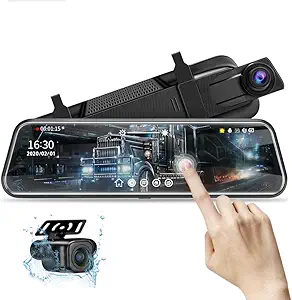 |
| Best Premium Mirror Dash Cam A higher-end mirror dash cam with top-tier features and build | Roadwitness SQ13 PRO 12" Mirror Dash Cam with Dual Sony STARVIS 2 4K Sensors |  |
| Best Dual-Lens Mirror Dash Cam Front-and-rear or interior dual-camera setup for complete coverage | WOLFBOX G840S 12" 4K Mirror Dash Cam with Dual Front/Rear Cameras and GPS |  |
| Best Compact Mirror Dash Cam A slim, low-profile mirror dash cam that minimizes obstruction | AUKEPO 4.3" Full HD 1080P Dual Dash Cam Rearview Mirror Camera |  |
1. pelsee S12 12" Mirror Dash Cam — True 4K Front + 2.5K Rear with GPS and Wi‑Fi 6
Best Overall Mirror Dash Cam

| Video Capture Resolution | Front 3840×2160P, Rear 2560×1440P |
|---|---|
| Screen Size | 12 Inches |
| Field Of View | 160 Degrees |
| Included Memory Card Size | 64 GB |
| Connectivity Technology | Wi‑Fi (Wi‑Fi 6) |
The pelsee S12 replaces your factory mirror with a 12-inch IPS display that records the road in true 4K up front and 2.5K at the rear while providing a continuous live rearview feed. It mounts over the stock mirror and is controlled via touch or the smartphone app, where Wi‑Fi 6 lets you download clips quickly and view GPS-tagged routes. Notable features include starlit color night vision with an f/1.5 aperture for improved low-light detail, a 19.6 ft rear camera cable with IP67 protection for the rear unit, and a 64 GB card included for out-of-the-box use. In practice the S12 is aimed at drivers who want clear incident footage and an integrated rearview camera without running separate monitors. Limitations to consider are the mirror-style form factor, which can be bulky compared with compact cameras, and the need for a hardwire kit if you want true 24/7 parking surveillance. Installation on a mid-size truck like the Ford Ranger is typically DIY-friendly but may require additional cable routing for extended-cab or crew-cab layouts.
Best for: Ford Ranger drivers who want a dependable, all‑around mirror dash cam that prioritizes high-resolution incident capture and simple smartphone access for reviewing footage.
Less Ideal for: Drivers who prefer a minimalist, compact dash cam or who need continuous 24/7 parking surveillance without installing a hardwire kit should consider other formats or accessories.
- Native 4K front and 2.5K rear recording for sharp, evidence-grade footage
- Wi‑Fi 6 support for faster downloads and app control with GPS tagging
- Starlit color night vision and f/1.5 aperture boost low-light clarity
- Includes 64 GB card and a 19.6 ft IP67-rated rear camera cable for out-of-the-box setup
- Mirror-unit size can obstruct sightlines or require adjustment compared with a standard mirror
Verdict: The best all-around mirror dash cam balances video quality, reliable recording features, usability, and build quality to suit most drivers and DIY mechanics who want dependable incident capture.
2. Jansite 10" Mirror Dash Cam with Dual 1080P Front and Rear Cameras
Best Budget Mirror Dash Cam

| Screen Size | 10 Inches |
|---|---|
| Video Capture Resolution | 1080p |
| Real Angle of View | 170 Degrees |
| Field Of View | 140 Degrees |
| Memory Support | SD up to 128GB |
This Jansite 10-inch mirror dash cam replaces the factory mirror with a streaming-media display that records both front and rear in 1080p. It mounts over your existing mirror with elastic straps and runs from the vehicle power outlet while the small internal battery only preserves settings. The touchscreen interface makes switching between front and rear views and adjusting exposure or viewing angle easy on the move. The included IP68 rear camera and a 6 m cable help install the back camera on larger crew cabs like a Ranger, and the system offers loop recording, a G-sensor to lock collision footage, and parking monitoring when paired with a hardwire kit. Night-vision improvements and adjustable parking guide lines make reversing safer in low light. Expect basic but reliable video quality rather than high-resolution detail, no cloud or app support, and the device depends on the supplied Type-C power cord for correct operation. Installation is DIY-friendly but may require time to route the long rear cable neatly on a Ranger cab.
Best for: Budget-minded Ranger owners who want dependable front-and-rear recording, simple touchscreen controls, and a straightforward parking camera solution without paying for high-end resolution or cloud features.
Less Ideal for: Drivers who need app connectivity, wireless file transfer, or 4K/2.5K image resolution should look at higher-end mirror dash cams with advanced connectivity and greater image detail.
- Dual 1080p streaming front and IP68 waterproof rear camera for simultaneous coverage
- Large 10-inch IPS touchscreen with touch controls for quick adjustments
- 6 m rear camera cable included to reach larger trucks and trailers
- G-sensor and loop recording protect and preserve incident footage
- Parking assist lines and improved low-light processing for safer reversing
- No mobile app or Wi-Fi for wireless file transfer or remote viewing
- Built-in battery only stores settings and will not power recording without car power
- Screen reflectivity optimized against glare means the display is not a usable mirror when off
Verdict: The best budget mirror dash cam gives reliable front-and-rear recording and essential features at a low price for buyers prioritizing cost over advanced options.
3. Roadwitness SQ13 PRO 12" Mirror Dash Cam with Dual Sony STARVIS 2 4K Sensors
Best Premium Mirror Dash Cam

| Video Capture Resolution | 4K |
|---|---|
| Screen Size | 12 Inches |
| Field Of View | 170 Degrees |
| Connectivity Technology | App, USB-C, Wifi, touch |
| Built-In Media | 64GB memory card included |
The Roadwitness SQ13 PRO is a premium mirror-style dash cam built around dual Sony STARVIS 2 IMX678 sensors that record true 4K front and rear footage to capture fine details day or night. It mounts over your factory mirror and provides a 12" anti-glare touchscreen for live view, playback, and menu control while also offering app and USB-C connectivity for offloading clips. Key features include a 170 degree ultra-wide field of view, HDR/WDR night handling, built-in GPS for speed and route logging, 5G WiFi for quick transfers, AI blind spot detection and ADAS voice alerts, plus a 24-hour parking monitor when hardwired. In use it is practical for capturing high-resolution evidence, improving situational awareness with audible alerts, and replacing a mirror with an integrated display. Trade-offs are the larger mirror footprint that changes cabin sightlines and the need to hardwire for full parking monitoring; installation on a pickup like a Ford Ranger may require careful routing of the rear camera cable and secure mounting to avoid vibration affecting image stability.
Best for: Buyers seeking a long-term, high-performance mirror dash cam for a Ford Ranger who prioritize top-tier video quality and advanced driver-assist features and are comfortable with a more involved installation.
Less Ideal for: Drivers who want a minimalist or factory-identical mirror replacement or those unwilling to hardwire or manage a larger mirror display should consider simpler dash cams instead.
- True 4K front and rear recording with Sony STARVIS 2 sensors for superior low-light detail
- Large 12" anti-glare touchscreen for easy live view and local control
- ADAS and AI blind spot detection provide audible and visual driving alerts
- Built-in GPS and 5G WiFi simplify logging and file transfer
- Includes 64GB card and comes ready for 24-hour parking monitoring when hardwired
- Larger mirror unit can alter forward sightlines and may require trimming or repositioning
- Full 24-hour parking features require a hardwire kit and professional-style wire routing
Verdict: The best premium mirror dash cam offers superior video resolution, advanced driver-assist and parking features, and a robust build for buyers willing to pay more for long-term performance.
4. WOLFBOX G840S 12" 4K Mirror Dash Cam with Dual Front/Rear Cameras and GPS
Best Dual-Lens Mirror Dash Cam

| Video Capture Resolution | 2160p |
|---|---|
| Mounting Type | Rearview Mirror Mount |
| Field Of View | 170 Degrees |
| Included Memory Card Size | 32 GB |
| Frame Rate | 30 FPS |
The WOLFBOX G840S is a dual-lens mirror dash cam that replaces your factory mirror with a 12" touch display while recording the road ahead in 4K and the rear in 1080p. It mounts over the existing mirror and runs with a front-facing 170° lens and a rear 140° lens to capture wide-angle views; split-screen mode shows both feeds on the large IPS panel. The unit includes an external GPS antenna for speed and route logging and supports 5.8GHz Wi‑Fi for live viewing and quick file transfer to the WOLFBOX mobile app. Built-in features such as WDR/HDR, a Sony-class sensor, night vision, loop recording, G-sensor impact detection, and a 24-hour parking monitor (requires hardwiring) make it practical for daily driving and incident documentation. Trade-offs to expect are the sizable mirror footprint that changes cabin sightlines and reliance on accessory hardwiring for continuous parking surveillance. Installation may take longer than a simple stick-on camera because of the rear camera cabling and optional hardwire kit.
Best for: Drivers who want continuous, simultaneous front and rear recording and prioritized incident documentation with on-screen GPS and phone access for playback and sharing.
Less Ideal for: Buyers seeking a minimal or discreet install or those who do not want a large replacement mirror that alters interior sightlines should consider smaller dash or modular cameras instead.
- True 4K front recording for detailed evidence capture.
- Large 12" touchscreen mirror reduces blind spots and supports split-screen viewing.
- External GPS and 5.8GHz Wi‑Fi enable route/speed logging and convenient phone access to footage.
- Night vision plus WDR/HDR and Sony-class sensor improve low-light image quality.
- Supports 24-hour parking monitoring and loop recording for continuous coverage when hardwired.
- Parking monitor requires an optional hardwire kit to run when the vehicle is off.
Verdict: The best dual-lens mirror dash cam provides simultaneous front and rear (or cabin) recording for comprehensive incident documentation and improved situational awareness while driving.
5. AUKEPO 4.3" Full HD 1080P Dual Dash Cam Rearview Mirror Camera
Best Compact Mirror Dash Cam

| Display | 4.3" TFT |
|---|---|
| Front resolution | Full HD 1080P |
| Rear camera cable length | 23FT |
| Special features | G-Sensor, Loop Recording, Night Vision |
This AUKEPO mirror dash cam fits behind your factory mirror to provide simultaneous front and rear recording on a 4.3-inch display. The front camera records in Full HD 1080p while the wired waterproof rear camera gives a wide rearward view and improved night performance. It uses loop recording so continuous capture is possible with a micro‑SD card, and the built-in G-sensor locks footage automatically when it detects an impact or movement in parking mode. Installation involves mounting the mirror unit over the stock mirror and routing the included 23 ft rear cable to the back of a Ranger; once set up the unit offers instant playback and basic parking monitoring. Limitations are the small 4.3-inch screen which reduces on-screen detail compared with larger mirror displays and the user interface is basic, so adjusting advanced settings can be slower than on higher-end models. For everyday recording and a low-profile install on a Ford Ranger, this model covers the essentials without drawing attention.
Best for: Ford Ranger owners wanting a discreet, low-profile mirror dash cam that records both front and rear for daily driving and parking monitoring.
Less Ideal for: Drivers who need a large in-mirror touchscreen, advanced driver assistance features, or higher-resolution multi-channel recording should consider more premium alternatives.
- Dual-channel recording shows front and rear views simultaneously for fuller incident coverage
- 1080P front camera provides clear daytime footage for driver and insurance needs
- Waterproof rear camera and 23 ft cable allow tidy routing to the truck bed or tailgate area
- Built-in G-sensor automatically locks files on impact and supports parking motion-triggered recording
- Loop recording enables continuous use without manual file management
- Compact 4.3-inch display offers limited on-screen detail and smaller playback controls
- Basic user interface and controls can be slower to navigate compared with premium units
Verdict: The best compact mirror dash cam fits discreetly behind your mirror, reducing visual obstruction while still providing reliable recording and essential features for everyday use.
Choosing the Right Ford Ranger Mirror Dash Cam: Key Factors to Consider
Video Quality and Low-Light Performance
High-resolution front and rear recording matters because clearer footage increases the chance of capturing usable license plates, road signs, and incident details. For the Ford Ranger you will often face mixed lighting conditions—bright highways, shaded neighborhoods, and dim parking lots—so a sensor with good dynamic range and effective noise reduction helps preserve detail across varied scenes.
Nighttime and sunrise/sunset performance is particularly important for highway driving and overnight parking. Look for units with strong aperture and sensor specs for the front camera and at least adequate low-light sensitivity for the rear camera. Image stabilization or electronic stabilization can reduce motion blur over rough roads, making footage more reliable for incident review.
Rear Camera Capability and Field of View
A mirror dash cam should provide a useful rearward view that goes beyond a narrow backup feed. For the Ranger, consider rear camera mounting locations and the field of view needed to capture trailers, loads in the bed, and approaching traffic from behind. A wider-angle rear lens gives better coverage but can distort distances; a balance between angle and detail is ideal.
Also consider whether the rear camera is weatherproof and rated for exterior mounting if you plan to position it outside the cab or near the tailgate. Cable length and connector routing are practical concerns; ensure the rear camera can be routed without interfering with the tailgate or cargo. Some systems offer mirror-style backup modes that prioritize a distortion-corrected, practical reverse image over raw wide-angle recording.
Mounting, Fitment, and Installation Complexity
Mirror dash cams come as clip-on units or full replacements, and the best choice depends on your Ranger's interior and your tolerance for installation work. Clip-on units are easier to install and can be swapped between vehicles, while replacement mirrors give a cleaner look but may require removing trim and refastening the mirror bracket.
Powering the unit affects complexity. Hardwiring to an accessory or fused circuit enables parking mode and continuous monitoring but requires routing a power cable to the fuse box. Simpler 12V plug-and-play options minimize effort but may not support advanced parking features. Consider wire routing for the rear camera as well; longer cables can be tucked along factory headliner and trim but may require panel removal for a truly clean install.
Parking Mode and Power Management
Parking mode is a key reason Ford Ranger owners choose mirror dash cams. It allows the camera to record impacts or motion while the vehicle is parked. Effective parking mode needs reliable low-current standby, a trigger mechanism for events, and ideally battery protection to avoid draining the truck battery.
Look for units with built-in voltage cutoff or smart parking modes that enter low-power states and only record when motion or shock is detected. Some devices use capacitors instead of batteries to improve long-term durability in hot engine bays. If you plan to park overnight or for extended periods, consider professional hardwiring kits or dedicated power modules that isolate the dash cam from the main battery when voltage falls below a safe threshold.
Display, Usability, and App Integration
A clear mirror display helps you confirm framing and review footage without removing SD cards. For the Ranger, daytime display brightness and anti-glare behavior are important because the cab can be exposed to direct sunlight. Touchscreen interfaces simplify menu navigation, but tactile buttons can be easier to operate while wearing gloves or in cold weather.
Smartphone connectivity and app features offer easy access to GPS-stamped clips and quick downloads. Wi-Fi or Bluetooth integration is useful for transferring clips without pulling the SD card. Evaluate whether the app provides straightforward playback, export options, and firmware updates, since an unintuitive app can negate the benefits of high-quality hardware.
Durability and Weather Resistance
Mirror dash cams and their rear cameras are exposed to temperature swings, sunlight, and potential moisture. For a Ford Ranger that sees outdoor use and variable climates, durability matters for long-term reliability. Choose units built with heat-tolerant components and rated for the temperature extremes common in your area.
Check the IP rating or stated weather resistance for the rear camera if it will be mounted externally. Corrosion-resistant connectors and secure mounting hardware will reduce the chance of failure in wet or salty conditions. Warranty and support availability are also part of long-term durability considerations.
How Mirror Dash Cams Improve Visibility While Driving
Mirror dash cams provide a live rear-facing feed on the mirror surface or an integrated display, which can reduce blind spots compared with a standard reflective mirror. For the Ford Ranger, the higher seating position and potential cargo in the bed can obstruct sight lines; a mirror dash cam with a wide rear view helps you monitor traffic and trailer approaches more effectively.
Using the mirror display while reversing or merging can reveal objects otherwise hidden by headrests or cargo. Some systems let you switch between full-screen forward view and rear view, making it easier to prioritize situational awareness in congested or low-visibility conditions.
- Real-time rear feed reduces reliance on shoulder checks when reversing a loaded bed
- Split-screen and picture-in-picture modes let you keep an eye on both front and rear
- High-brightness displays counteract daytime glare common in truck cabins
Routing the Rear Camera: Practical Tips for the Ranger
Planning the cable path before installation saves time and prevents snags. For most mirror dash cams the rear camera cable runs along the headliner, down the door jamb, and either through the tailgate area or inside the cab depending on mounting location. Take care to avoid pinch points that could cut wires when the tailgate opens and closes.
If you mount the rear camera externally near the tailgate, position it so it is protected from direct spray and not blocked by common cargo loads. Internal mounting behind the rear window reduces exposure but may slightly degrade low-light performance and field of view.
- Use trim tools to tuck cables under the headliner for a factory look
- Secure excess cable with zip ties and avoid tight bends near connector ends
- Test camera angle before finalizing mounts to ensure trailer tongues or bed rails do not obstruct the view
Parking Mode Strategies for Frequent Overnight Parking
If you frequently park overnight or in public locations, a dash cam with intelligent parking mode can provide peace of mind. Choose systems that minimize battery draw while remaining sensitive to motion and impact events. Hardwiring to a fused accessory circuit with a voltage cutoff is a common approach for dependable long-term parking surveillance.
Consider using a separate power management module if you cannot tolerate even a small risk of battery drain. These modules allow longer parking surveillance by isolating the dash cam when vehicle battery voltage drops below a preset threshold. Also think about where the Ranger is parked; in high-temperature environments the camera electronics can be stressed, so parking mode usage patterns may need to be adjusted.
- Enable motion detection and impact-triggered recording to preserve storage
- Use timed parking mode or smart voltage cutoff to protect the truck battery
- Periodically check SD card health if the camera records frequently while parked
Display Options: Brightness, Anti-Glare, and Size
Mirror displays range from subtle overlays to full-width screens. For daytime driving in a Ford Ranger, pick a display with sufficient brightness and anti-glare coating so images remain visible in bright sunlight. Larger displays make playback easier in-cab, but they can also obscure a portion of the reflective mirror when turned off.
Some owners prefer a dimmable display or an option to show minimal HUD-style information while driving. Evaluate whether the unit allows quick toggling between modes and whether controls are reachable without distracting from driving.
- Dimmable screens reduce night glare while preserving functionality
- Full-screen mode helps review incidents without removing the SD card
- Physical controls may be preferable for gloved operation
Storage, File Management, and SD Card Choices
Continuous dual-channel recording can fill storage quickly. For the Ford Ranger, choose an SD card class and capacity recommended by the manufacturer to avoid recording interruptions. Higher endurance cards designed for constant overwrite are a better long-term choice than generic consumer cards.
Look for loop recording and event-lock features that protect important clips from being overwritten. Regularly back up critical footage to avoid accidental loss, and format the card in the camera periodically to maintain reliable performance.
- Select high-endurance microSD cards from reputable manufacturers
- Enable event-lock on impact detection to preserve evidence
- Schedule periodic downloads or backups of important files
How We Chose the Best Ford Ranger Mirror Dash Cam
We focused on features and performance that matter specifically for Ford Ranger owners who want a mirror-style dash cam solution. Evaluation centered on five core dimensions: video quality, rear camera capability, installation and fitment, reliability and power management, and user interface. Video quality covered resolution, dynamic range, and low-light performance for both front and rear lenses. Rear camera capability looked at sensor quality, field of view, and whether the unit provides a true backup-style image or only a narrow rear feed. Installation and fitment emphasized how the unit mounts to or replaces the factory mirror, cable routing through the cabin and tailgate, and whether hardwiring or accessory power options were available.Reliability and power management assessed parking mode behavior, battery or capacitor design, and how the system handles long idle periods without draining the vehicle battery. User interface and connectivity examined display clarity, touch or button controls, GPS logging, and smartphone app access. We excluded devices that require invasive modifications to the windshield or permanently alter the cabin trim. We also excluded single-lens units that do not provide both forward and rear coverage, since dual-view capability is central to the mirror dash cam category.
Our full evaluation process is outlined in our review methodology.
FAQ
Will a mirror dash cam fit my Ford Ranger without professional help?
Often yes. Many mirror dash cams attach over the existing mirror with clips and can be installed with basic tools. If you choose a full replacement mirror or want hardwiring for parking mode, professional installation is recommended to ensure secure fitment and clean cable routing.
Can the rear camera be mounted outside the cab on the Ranger?
Yes, some rear cameras are designed for external mounting and offer weather resistance. External mounting provides a clearer, less-obstructed rear view but requires careful sealing and secure routing of the cable near the tailgate or bed area.
How do parking mode and battery drain interact on the Ranger?
Parking mode uses low-current standby until motion or impact is detected, but extended use can draw the battery down. Hardwiring with a voltage cutoff or using a dedicated power management kit reduces the risk of draining the vehicle battery during extended parking periods.
Does the mirror display affect rearview mirror functionality while driving?
Most systems let you toggle the display or dim it so the mirror still functions normally. Some full-screen units will cover part of the reflective surface when active, so choose a configuration and brightness level that preserves daytime visibility.
What SD card capacity is best for continuous dual-channel recording?
That depends on resolution and bitrate, but higher-capacity, high-endurance cards are recommended. For dual 1080p recording, consider 128GB or larger endurance-rated cards to reduce the need for frequent file management.
Will a mirror dash cam record while towing a trailer?
Yes, a dual-lens mirror dash cam records forward and rear views regardless of towing, but you should check rear camera angle and mounting to ensure the trailer does not block the field of view. Adjust angles and test recordings with the trailer connected before relying on the system.
Final Verdict
Prioritize the features that match how you use your Ford Ranger. If you need reliable evidence capture, favor units with strong video quality, low-light performance, and secure event-locking. If daily convenience and a clean install matter more, look for models that clip on cleanly or replace the mirror with minimal cabin modification.Balance parking mode needs against installation complexity and battery protection options. By focusing on video clarity, dependable rear coverage, and appropriate power management, you can choose a mirror dash cam that enhances visibility and gives you confidence on the road and while parked.
Explore More:
- Check out all Ford Ranger parts & accessories
- Explore Electronics
- Browse all Accessories
