

Note: This article contains affiliate links. If you click on these links and make a purchase, I may earn a small commission at no extra cost to you. This helps support my research and content. Read my full affiliate disclosure here.
If your 2012-2015 Honda Civic is showing rough idle, poor fuel economy, or hesitation under load, upgrading or replacing the fuel injectors can restore smooth performance. The 2012-2015 Civic (FB and FG) uses specific injector flow rates and electrical connectors, so selecting injectors that match those specifications matters for drivability and engine management.This guide covers our shortlisted top options for these model years. We focused on fitment, spray pattern consistency, and flow tolerances so you can pick injectors that support reliable starts, steady idling, and predictable throttle response. Read on for the evaluation criteria and practical guidance before the product list.
Looking for other parts? See all Honda Civic parts & accessories.
Top Picks at a Glance
| Best Overall The best all-around choice for most situations | YZHIDIANF Premium Fuel Injectors 16450R40Y01 (4-Pack) |  |
| Best Quality Built to a higher standard if you want something more solid | Honda Fuel Injector Assembly 16450-R40-Y01 |  |
| Best Value The sweet spot between price and what you get | EMTMOUN Set of 4 Fuel Injectors FJ1046 for 2.4L L4 (fits select Honda/Acura) |  |
| Best Budget The cheapest option that still gets the job done reliably | SCITOO 4-Piece Fuel Injector Kit for 2012–2015 Honda Civic and 2016 HR-V |  |
| Highest Rated A top-rated pick with lots of positive feedback | ENA Set of 4 Fuel Injectors Compatible with 2.4L Honda/Acura L4 Engines |  |
| Most Popular A crowd favorite that many people choose with confidence | A-Premium Fuel Injectors Set of 4 for 2.4L Honda/Acura L4 Engines |  |
| Best Seller A high-volume bestseller chosen again and again | TRQ Fuel Injector Set, 4-Pack, Direct-Fit Replacement |  |
1. YZHIDIANF Premium Fuel Injectors 16450R40Y01 (4-Pack)

| Brand | YZHIDIANF |
|---|---|
| Model | Premium Fuel Injectors 16450R40Y01 |
| Manufacturer Part Number | 1WHFUSD0807B00 |
| Fitment reference | Replaces 16450R40Y01 / FJ1046 / MP-56160 |
These YZHIDIANF injectors are an aftermarket direct-fit replacement sold as a four-pack for vehicles using part number 16450R40Y01. They are preassembled with upper and lower O-rings and intended to drop into the fuel rail and intake without modification after cleaning the injector bores. In use they aim to restore balanced fuel delivery, smoother idle, and improved combustion compared with worn injectors, which can reduce misfires and help fuel economy. The listing emphasizes factory-spec fitment, multiple quality checks during production, and basic guidance on cleaning ports before installation. Practical benefits include straightforward swap-in installation for compatible Hondas and Acuras and a full set of injectors to maintain even performance across all cylinders. Limitations to be aware of are that this is an aftermarket unit rather than a factory part, so long-term durability can vary, and some vehicles may need O-ring adjustment using rings from the original injectors for a perfect seal. Professional installation or careful cleaning of injector holes is recommended to avoid leaks or fit issues.
Best for: Buyers seeking a balanced, practical replacement that restores smooth idle and fuel delivery for a 2012–2015 Honda Civic 2.4L, prioritizing straightforward fit and consistent performance across cylinders.
Less Ideal for: Drivers looking for an OEM-branded injector or those who want a performance-upgrade injector with higher flow rates and tuning-focused features should consider other options.
- Sold as a matched four-pack to ensure even cylinder fueling
- Preinstalled upper and lower O-rings for faster installation
- Manufactured to match the referenced part number for direct-fit compatibility
- Manufacturer performs multiple quality control checks during production
- Aftermarket part so long-term durability may differ from factory parts
- May require reusing original O-rings or minor adjustments for an exact seal on some engines
Verdict: A practical four-pack direct-fit replacement that restores balanced fuel delivery and smooth idle for 2012–2015 Civic 2.4L owners seeking reliable, easy-to-install injectors.
2. Honda Fuel Injector Assembly 16450-R40-Y01

| Valve Type | electromechanical |
|---|---|
| Number of Ports | 1 |
| Inlet Connection Type | O-ring face seal |
| Outlet Connection Type | NPT |
This genuine Honda fuel injector is a direct-replacement electromechanical injector intended to restore factory fuel delivery on compatible Honda engines. It installs like a factory part and connects via an O-ring face seal inlet and NPT outlet for a secure fit. In use it delivers the expected OEM spray pattern and metering, which helps maintain smooth idle, consistent throttle response, and efficient fuel economy compared with worn or aftermarket units. The metal construction and single-port design match original equipment specifications, reducing the guesswork on fitment and durability. Practical benefits include straightforward swap-in installation and predictable calibration so you do not need additional tuning when replacing a failing injector. Limitations are that this is a single injector sold individually and it does not include electrical harnesses, seals beyond the inlet type, or installation hardware, so replacing multiple units or doing a full service may require ordering extras.
Best for: Buyers seeking a factory-quality replacement to restore original fuel delivery and throttle response on a Honda engine, prioritizing reliability and plug-and-play fitment over aftermarket performance tuning.
Less Ideal for: Drivers who want upgraded high-flow injectors for forced-induction builds or those needing multi-injector kits for engine upgrades should look at performance-specific options instead.
- Factory-brand electromechanical design for consistent fuel metering
- O-ring face seal inlet and NPT outlet for secure connections
- Metal construction matching original component durability
- Single-port configuration that mirrors factory spray pattern
- Sold as a single injector so full-rail replacement requires multiple purchases
Verdict: Choose this genuine Honda injector when you want a factory-spec replacement that restores stock fuel delivery and drivability without added tuning.
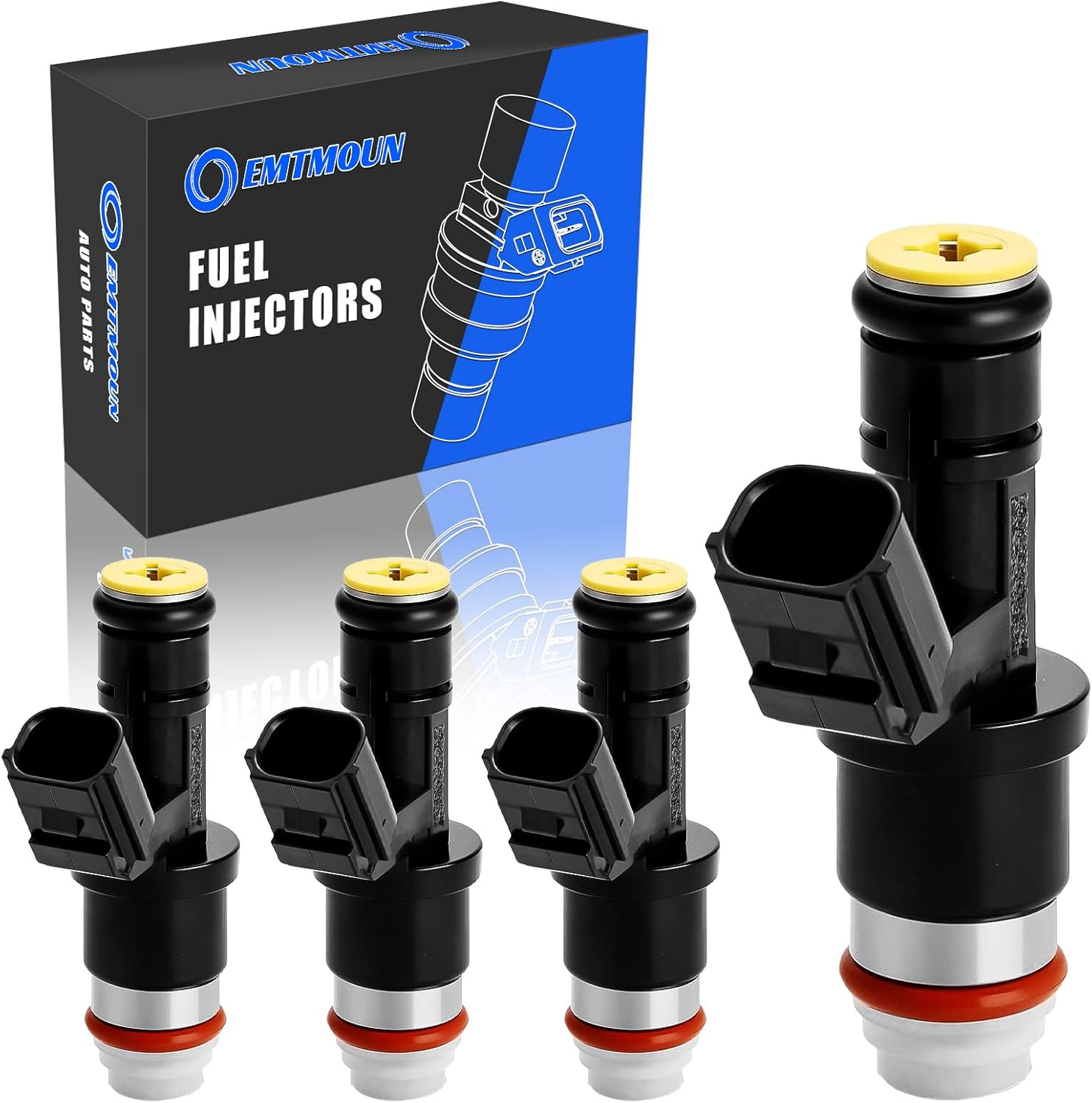
3. EMTMOUN Set of 4 Fuel Injectors FJ1046 for 2.4L L4 (fits select Honda/Acura)
| Compatible engine | 2.4L L4 |
|---|---|
| Replaces OEM numbers | FJ1046, 16450-R40-Y01, 800-2082N, MP56160 |
| Tested for | Flow, leak, electrical response |
These EMTMOUN fuel injectors are sold as a set of four replacement units intended for vehicles with the 2.4L L4 engine family. They install in place of the listed OEM numbers and are flow tested and leak tested before shipment. In real-world use they aim to restore smooth idle, reduce hesitation, and recover lost power or misfire symptoms caused by clogged or worn injectors. The design emphasizes consistent spray pattern and stable fuel flow so throttle response and combustion efficiency are improved when the rest of the fuel system is healthy. Installation is typical for direct-replacement injectors and can be done by a competent DIYer with basic tools or a technician. Limitations to expect are variability in long-term durability compared with higher-end branded replacements and the need to confirm exact fitment for your Civic year, engine code, and connector type before ordering. Some users reported mixed results on fuel economy and a few early failures, so keep an eye on post-install diagnostics and fuel trims after fitting.
Best for: Buyers who want a cost-effective, do-it-yourself replacement to recover lost performance or clear injector-related drivability issues on a 2.4L Civic while prioritizing immediate function over premium longevity.
Less Ideal for: Those who need guaranteed long-term durability or who prefer dealer-level, brand-name injectors with extended proven track records should consider higher-end alternatives or professional sourcing.
- Direct-replacement design matched to common OEM part numbers for straightforward fitment
- Each injector undergoes flow, leak, and electrical response testing before shipping
- Stable spray pattern and consistent fuel flow aimed at restoring smooth idle and throttle response
- Some reviewers reported early failures or inconsistent long-term reliability
- A few users noticed increased fuel consumption after installation
Verdict: A practical, budget-friendly direct-replacement injector set for restoring drivability on 2.4L Civics when you want reliable fitment and immediate performance improvement.
4. SCITOO 4-Piece Fuel Injector Kit for 2012–2015 Honda Civic and 2016 HR-V

| Fitment | 2012–2015 Honda Civic, 2016 Honda HR-V |
|---|---|
| Quantity | 4 pieces |
| Injector Design | Metal composite plastic with multi-hole nozzle |
| Inlet Connection Type | Push-In |
| Outlet Connection Type | O-ring face seal |
These SCITOO injectors are a budget-friendly replacement kit intended to restore fuel delivery on compatible 2012–2015 Honda Civic 1.8L engines and certain 2016 HR-V applications. The set includes four injectors with O-rings and two electrical terminals each, and the listing says each unit is bench-tested before shipping. The injector body uses a metal composite design and a multi-hole nozzle to improve atomization, which can help throttle response and emissions compared with a worn injector. Installation is straightforward for anyone comfortable with basic fuel-rail work since they are made to drop into the factory rail and manifold without modifications. Practical downsides to note are mixed user reports about sealing on some vehicles and occasional returns when fit or performance did not match the original parts. For a cost-sensitive buyer these provide a reasonable balance of price and claimed durability, but if you need guaranteed factory-equivalent longevity or dealer support you may prefer a factory-quality replacement.
Best for: Buyers looking to replace worn or clogged injectors on a tight budget who prioritize a complete plug-and-play kit that restores drivability without dealer pricing.
Less Ideal for: Drivers seeking a factory-backed or dealer-sourced injector with full manufacturer warranty and guaranteed long-term OEM service life should consider factory-quality replacements instead.
- Sold as a complete four-piece kit with O-rings and terminals included
- Bench-tested units and multi-hole nozzle design for improved fuel atomization
- Designed to fit factory fuel rail for straightforward, no-mod installation
- Some buyers reported sealing issues or leaks on certain vehicles
Verdict: A budget-oriented four-injector kit that restores fuel delivery with plug-in fitment and improved spray pattern, making it a practical cost-saving repair for compatible Civics.
5. ENA Set of 4 Fuel Injectors Compatible with 2.4L Honda/Acura L4 Engines

| Fuel Injector Type | MFI Injector |
|---|---|
| Connector Type | Blade |
| O-Rings | Preinstalled |
| Material Type | Metal and composite plastic |
| Set Size | Set of 4 |
These ENA fuel injectors are sold as a set of four and intended to replace the factory injectors on 2.4L L4 Honda and Acura engines from the specified model years. They are electronic MFI-style injectors with blade terminals, preinstalled O-rings, and a metal/composite construction that aims to balance flow across cylinders and restore proper fuel delivery. Installation is meant to be straightforward because they are listed as direct-fit replacements, so a technician can swap them into the intake rail without custom adapters. In practice the advantages are improved spray matching and potentially smoother idle and throttle response when original injectors are worn. Limitations to consider are mixed user reports on fitment and tip quality, so careful inspection at install is advisable and some vehicles may need calibration or diagnostics after replacement. The product comes with a one year limited warranty and is best used when replacing all injectors together to maintain consistent performance across the engine.
Best for: A buyer who prioritizes restoring reliable fuel delivery on a 2.4L L4 Honda or Acura and prefers a direct-fit replacement they can install quickly or have installed by a mechanic.
Less Ideal for: Drivers looking for performance upgrades or higher-end refinements should consider upgraded or OEM-matched injectors rather than this standard replacement set.
- Direct-fit design for listed 2.4L Honda and Acura L4 engines simplifies installation
- Flow-matched 12-hole spray design promotes even fuel distribution between cylinders
- Preinstalled O-rings and standard blade terminals reduce parts prep during replacement
- Some buyers reported quality issues with spray tip and O-rings and required further inspection or replacement parts
Verdict: Choose these ENA injectors when you need a straightforward direct-fit replacement to restore consistent fuel delivery on a 2.4L Honda/Acura L4 engine.
6. A-Premium Fuel Injectors Set of 4 for 2.4L Honda/Acura L4 Engines

| Vehicle fitment | Acura ILX/TSX; Honda Accord/Civic/CR-V 2.4L L4 (listed years) |
|---|---|
| Inlet/Outlet | Top Feed |
| Connector Type | Blade |
| Thread Size | M8 or M10 |
| Static flow | 143.5 ml/30s |
These injectors are a direct-replacement style set intended for 2.4L Honda and Acura four-cylinder engines and are sold as a pack of four. They use top-feed inlet and outlet connections with blade electrical terminals and are specified to match OEM flow characteristics for gasoline engines. In practice they are used when replacing worn or leaking injectors to restore smooth idling, steady fuel delivery and normal drivability. Notable features include metal construction, M8/M10 thread compatibility and an advertised static and dynamic flow rate that aims to replicate factory fueling. Buyers report generally straightforward installation on compatible Civics and Accords, though some users experienced issues such as fitment mismatches, poor O-ring quality or intermittent drivability and check-engine lights on a minority of units. That means proper part-number verification and inspection of seals at install time are important. The product comes with a one-year limited coverage for the cost of the item only, and because mixed user feedback suggests variable quality control this is best used by DIYers comfortable diagnosing fitment or by shops that can bench-test injectors before final installation.
Best for: Buyers who want a budget-friendly, OEM-spec replacement for a 2.4L Honda/Acura four-cylinder and who will verify part number and inspect or swap seals at install time.
Less Ideal for: Drivers who want a guaranteed plug-and-play replacement without any bench testing or part-number confirmation should consider higher-tier branded injectors or dealer units.
- Designed to match OEM flow characteristics for 2.4L L4 gasoline engines
- Top-feed, blade-terminal design fits common Honda/Acura fuel rails
- Metal construction and standard M8/M10 threads support secure installation
- Sold as a set of four so all cylinders can be serviced at once
- Some customers report fitment issues that trigger engine codes if the wrong emission variant or part number is used
- O-ring quality appears inconsistent and may require replacement during installation
- Mixed quality-control reports mean a small risk of early failure or drivability problems
Verdict: A cost-conscious replacement set for 2.4L Honda/Acura engines that can restore factory-style fueling if you confirm exact part numbers and check seals before installation.
7. TRQ Fuel Injector Set, 4-Pack, Direct-Fit Replacement

| Brand Name | TRQ |
|---|---|
| Number of Pieces | 4 |
| Inlet Connection Type | Threaded |
| Material Type | Metal |
| Manufacturer Warranty Description | 2 years |
This TRQ fuel injector set supplies four direct-fit replacement injectors intended for 2.4L Honda and Acura engines. Installation is typical for injector swaps: remove the rail, replace the injectors, and reconnect fuel and electrical lines; TRQ provides step-by-step video resources to help DIYers. The injectors are metal-bodied with threaded inlet connections and a machined finish, which suggests a solid factory-replacement construction and straightforward fit when the vehicle compatibility is correct. Buyers report improved throttle response and resolved misfires after replacement, so the part performs its core function in many cases. Common issues in reviews include missing O-rings or seals in some shipments and occasional failures that required warranty or return handling, so confirm included hardware before installation and keep diagnostic tools handy. Because these are direct replacements, expect OEM-like operation but plan for careful installation and verification of sealing to avoid leaks or engine damage.
Best for: Buyers who prioritize a factory-style, direct-replacement injector for a 2.4L Honda engine and prefer parts with DIY installation support and clear fitment guidance.
Less Ideal for: People looking for performance or upgraded injectors beyond stock flow and spray pattern should consider tuned or high-flow aftermarket options instead.
- Direct-fit 4-piece kit matched to 2.4L Honda/Acura engine fitments
- Metal construction and machined finish for a factory-replacement feel
- Includes installation video resources to guide DIY replacement
- Addresses misfires and can restore throttle response when original injectors fail
- Some orders arrive without O-rings or seals which must be purchased separately
- A minority of users report premature failures requiring warranty support
Verdict: Choose this TRQ four-pack when you want a direct-fit, factory-style replacement for 2.4L Honda/Acura injectors with installation guidance for DIY repair.
Choosing the Right 2012-2015 Honda Civic Fuel Injector: Key Factors to Consider
Flow Rate and Calibration Tolerance
Flow rate is the primary technical specification for fuel injectors. For the 2012-2015 Civic, matching the factory flow rate keeps air/fuel ratios predictable across operating conditions and prevents lean or rich running that can trigger check engine lights. Small variations between injectors in a bank can lead to uneven cylinder fueling, rough idle, and uneven power delivery.
Calibration tolerance describes how much actual flow can deviate from the published rate. Lower tolerance numbers mean injectors are more uniform and easier to balance during installation. When selecting injectors, look for clearly stated flow numbers and tolerances so you can confirm they fall within acceptable limits for the FB and FG engine calibration.
Electrical Resistance and Connector Compatibility
Injector electrical resistance affects how the engine control unit drives the injectors and how quickly they respond. The 2012-2015 Civic uses specific coil resistances; mismatched resistance can alter injector opening characteristics and affect pulse width calculations.
Connector compatibility is equally important. The injector plug shape, terminal spacing, and sealing features must mate with the stock wiring harness. Choosing injectors designed to fit the FB and FG connector avoids splicing, adapter use, or loose connections that can cause intermittent misfires.
Nozzle Type and Spray Pattern
Nozzle design determines atomization and fuel distribution in the combustion chamber. Proper atomization promotes more complete combustion, smoother idle, and consistent throttle response. For the Civic's intake geometry, a spray pattern that disperses fuel evenly into the intake port and valve area reduces carbon buildup and cold-start issues.
Consider whether the injector uses a single or multiple-hole nozzle and whether the spray angle suits port layout. Manufacturers sometimes quote spray angles and spray types; these details help assess suitability for the FB and FG intake design.
Materials, Seals, and Ethanol Compatibility
Fuel formulation can include ethanol blends that are harsher on injector components. O-rings, internal seals, and pintle materials need to resist swell, corrosion, and degradation over time. Selecting injectors with materials rated for ethanol helps prevent leaks and maintaining consistent spray characteristics.
Durable finishes on the injector body and anti-corrosion treatments extend service life, especially if the vehicle sees seasonal storage or variable fuel quality. Pay attention to stated material specifications and sealing designs when choosing replacements.
Serviceability and Cleanability
Injectors may become clogged or lose efficiency over time. Choose injectors that are accessible for professional ultrasonic cleaning or compatible with common in-vehicle cleaning methods. Serviceability affects long-term ownership costs and whether routine maintenance can restore performance without full replacement.
Some injectors are rated to withstand multiple cleaning cycles; others are less tolerant. Consider how easy it will be to remove and reinstall injectors on the FB and FG engine and whether replacement o-rings and seals are readily available.
Flow Matching and Bank Consistency
Even when each injector meets the correct nominal flow, variability between units can create cylinder-to-cylinder imbalance. Flow matching is the process of measuring each injector and pairing or matching units to minimize differences.
For best results on the Civic, consider whether the option you choose is sold as a matched set or whether the vendor provides flow variance data. Minimizing bank inconsistency improves idle smoothness and allows the ECU to make compensation more effectively.
Signs You Need Fuel Injector Service on a 2012-2015 Civic
Faulty or clogged injectors often show up as rough idle, hesitation during acceleration, or inconsistent cold starts. You may also notice higher fuel consumption or a sudden drop in mpg if one or more injectors are underperforming.
Other symptoms include an illuminated check engine light with misfire or fuel trim codes, uneven exhaust smell, or intermittent stalling. Recognizing these signs early helps you decide whether cleaning, testing, or replacement is the appropriate next step.
- Rough or fluctuating idle
- Hesitation or stumble on acceleration
- Poor cold-start behavior
- Check engine light with misfire or fuel trim codes
How to Test Injectors on the FB and FG 2012-2015 Engines
Basic on-vehicle testing starts with checking injector resistance with a multimeter and comparing readings across the bank. Consistent resistance values suggest similar coil health, while outliers can flag a failing unit.
For deeper diagnosis, flow bench testing or professional ultrasonic cleaning and reflow testing reveal actual volumetric performance and spray quality. Fuel pressure and fuel rail condition should be confirmed as well because injector testing without proper rail pressure can give misleading results.
- Measure electrical resistance across each injector
- Verify fuel rail pressure before flow testing
- Use professional flow testing for precise diagnosis
When to Clean Vs When to Replace
Cleaning can restore injectors that are partially clogged or contaminated with varnish and deposits. Ultrasonic cleaning combined with flow testing often returns acceptable performance for injectors with minor deposits, and it is a practical first step when symptom history and test results indicate only reduced flow.
Replace injectors when flow testing shows significant deviation that cleaning cannot correct, when there is internal mechanical damage, or when electrical resistance and response timing are outside acceptable ranges. Also consider replacement if sealing surfaces or connectors are degraded and not serviceable.
- Clean if reduced flow but structure and resistance are within spec
- Replace if flow deviation persists after cleaning or if seals/connectors are damaged
Installation Tips for 2012-2015 Civic Injectors
Before installation, depressurize the fuel system and relieve fuel rail pressure following safe procedures. Replace injector O-rings and apply a light lubricant to prevent pinching and ensure a fuel-tight seal when seating injectors into the rail and intake manifold.
Torque retainers and reassembly steps should match factory service recommendations. After installation, perform a pressure check and a road test to confirm no leaks and that fueling behavior has normalized. Clear any stored fault codes and let the engine relearn trim values through normal operation.
- Always replace O-rings and seals during install
- Verify fuel pressure and check for leaks after assembly
- Clear codes and allow ECU to relearn fuel trims
Considerations for Performance Injector Upgrades
If you are considering injectors as part of a performance upgrade, ensure the chosen flow rate matches other engine upgrades and tuning. Upgraded injectors change fueling dynamics and usually require recalibration of the ECU to maintain safe air/fuel ratios.
On the FB and FG engines, modest flow increases can support bolt-on modifications, but significant increases will need supporting fuel system and mapping changes. Keep in mind that larger injectors can reduce atomization quality at low pulse widths unless they are designed for multi-point port applications.
- Match flow rate increases to other engine modifications
- Plan for ECU tuning when increasing injector capacity
- Check low-end atomization characteristics for street drivability
Routine Maintenance to Prolong Injector Life
Use quality fuel and consider periodic fuel system cleaning to reduce deposit buildup. Short trips and prolonged idling can accelerate varnish formation, so occasional longer drives at higher engine loads help burn off deposits.
Inspect seals and electrical connectors during routine service intervals and replace aged O-rings proactively. Keeping the fuel filter in good condition also protects injectors from particulate contamination.
- Use recommended fuel grades and change filters regularly
- Inspect injector seals and harness connectors during service
- Consider periodic professional cleaning if symptoms recur
Still looking for the perfect fit?
Select your Honda Civic configuration to see the most relevant Fuel Injectors recommendations
How We Chose the Best 2012-2015 Honda Civic Fuel Injector
We evaluated candidates based on concrete, vehicle-specific performance and compatibility checks relevant to 2012-2015 Honda Civic owners. Key criteria included correct flow rate and calibration tolerance so engine fueling remains within factory parameters; electrical connector and pintle geometry compatibility to ensure direct plug-and-play replacement for the FB and FG injector harness; nozzle spray pattern and atomization quality because poor atomization can cause rough idle and higher emissions; material durability and corrosion resistance to withstand ethanol blends and long-term use; and consistent manufacturing tolerances to minimize variation between injectors in a bank.We also checked documented returnability and warranty provisions as a proxy for quality control and excluded units lacking clear flow specifications or without matching electrical and mechanical fitment notes for the 2012-2015 Civic. Products that required manifold or harness modification were filtered out unless explicitly described as designed for the FB and FG chassis. We prioritized options that support routine maintenance tasks like cleaning and testing and that cite measurable flow or resistance specs rather than vague performance claims.
Our full evaluation process is outlined in our review methodology.
FAQ
How do I know if an injector leak is the cause of my Civic's problem?
Visible fuel smell, pooling around the injector base, or fuel-soaked intake components often indicate a leak. You can also check for sudden drops in fuel pressure or wetness at the injector O-ring area after a short run. If in doubt, have a technician perform a pressure and leak-down test.
Can I swap injectors one at a time or should I replace the full set?
Swapping a single injector can work in a pinch, but mismatched flow and age between new and old units can create imbalance. For consistent fueling and easier calibration, replacing the full bank or at least matching flows across cylinders is recommended.
Will cleaning injectors fix rough idle and hesitation?
Cleaning often resolves issues caused by deposits and reduced flow, especially if symptoms are mild. However, if an injector has internal mechanical damage or electrical faults, cleaning will not fix those problems and replacement may be necessary.
Do upgraded injectors require ECU tuning on the 2012-2015 Civic?
Usually upgrades that significantly change flow rates will require ECU recalibration to maintain safe air/fuel ratios. Small, conservative increases might work with stock calibration, but any performance-focused change should be evaluated alongside tuning plans.
How often should injectors be tested or serviced?
There is no fixed interval, but testing every 60,000 to 100,000 miles or when symptoms appear is a common approach. Vehicles that use lower-quality fuel or see many short trips may need more frequent attention.
What tests are most reliable for diagnosing a bad injector?
A combination of electrical resistance checks, fuel pressure verification, and flow bench testing gives the most reliable diagnosis. Ultrasonic cleaning followed by repeat flow testing can also indicate whether deposits were the cause or if replacement is required.
Final Verdict
Choose injectors that match the 2012-2015 Civic's flow and electrical specifications to preserve drivability and avoid fueling discrepancies. Prioritize units with clear flow data, compatible connectors, and durable materials that resist ethanol and deposits. If you are unsure whether cleaning will suffice, start with testing and cleaning; replace injectors when tests show persistent flow or electrical faults.Balancing bank consistency with proper installation and ECU calibration will yield the most consistent results. Focus on correct fitment and measurable specs rather than vague performance claims to ensure dependable operation on the FB and FG 2012-2015 Civic.
Explore More:
- Check out all Honda Civic parts & accessories
- Explore Fuel Injectors Maintenance & Repair Guides
- Explore Fuel System
- Browse all Auto Parts
