

Note: This article contains affiliate links. If you click on these links and make a purchase, I may earn a small commission at no extra cost to you. This helps support my research and content. Read my full affiliate disclosure here.
If your Ford Ranger 4WD is showing vibration, clunking, or driveline shudder, the driveshaft is often the source. Choosing the right driveshaft matters because it directly affects how power is transferred to the rear axle, how the truck feels on the road, and how long related components last. A correctly matched driveshaft reduces noise, minimizes vibration, and prevents premature wear on universal joints and bearings.This guide covers the six best Ford Ranger 4WD driveshaft options we shortlisted for fitment, durability, and vibration control. We evaluate each option for fit accuracy, balance quality, and joint durability so you can pick the best replacement or upgrade for your use. Read on to compare the features and tradeoffs and prepare for installation or service planning.
Looking for other parts? See all Ford Ranger parts & accessories.
Top Picks at a Glance
| Best Overall The best all-around choice for most situations | A-Premium Front Complete Drive Shaft Assembly for Ford Ranger and Compatible 4WD Trucks |  |
| Best Quality Built to a higher standard if you want something more solid | SCITOO Rear Drive Shaft Assembly for Ford Ranger (4WD) |  |
| Best Value The sweet spot between price and what you get | SYKRSS 936-813 Front Drive Shaft Assembly (Front) |  |
| Best Budget The cheapest option that still gets the job done reliably | Saitourne Front Driveshaft Prop Shaft Assembly (Front) CF1-12T-0012 |  |
| Highest Rated A top-rated pick with lots of positive feedback | Rough Country Front CV Drive Shaft for 1998–2011 Ranger 4WD (fits 5" lift) 5089.1 |  |
| Most Popular A crowd favorite that many people choose with confidence | BDFHYK Front Drive Shaft Assembly (fits select Ranger, Explorer, Mountaineer, B3000) |  |
1. A-Premium Front Complete Drive Shaft Assembly for Ford Ranger and Compatible 4WD Trucks

| Position | Front |
|---|---|
| Shaft Material | Steel |
| Extended Shaft Length | 31.26 inch |
| Compressed Shaft Length | 29.37 inch |
| Vehicle Fitment Notes | Certain Ford Explorer, Ranger, Explorer Sport Trac, Mazda B3000/B4000, Mercury Mountaineer 4WD models |
This A-Premium front complete drive shaft replaces the factory front prop shaft on compatible 4WD Ford Ranger and related trucks. It arrives as a ready-to-install assembly intended to restore smooth power transfer from the transfer case to the front differential. Built from steel with painted exterior protection and corrosion-resistant components, the shaft is described as offering vibration damping and enhanced driving stability for everyday and light-duty off-road use. The assembly includes matched splines and U-joint connections sized for the listed vehicles so installation is typically straightforward for a mechanic familiar with front driveline work. Limitations to note are typical of aftermarket shafts: exact fit depends on verifying the reference numbers and vehicle configuration, and it may not match heavy-duty or heavily modified drivetrains. For balanced buyers seeking a durable, no-frills replacement that prioritizes drivability and reduced vibration, this unit is a practical choice.
Best for: Buyers who want a practical, factory-style front driveshaft replacement that restores smooth power delivery and reduces driveline vibration on stock 4WD trucks.
Less Ideal for: Not a good choice for motorsport use or heavily modified vehicles that need uprated or custom-length shafts.
- Complete assembled unit reduces installation time compared with piecemeal parts
- Steel construction and painted finish for durability and corrosion resistance
- Engineered spline and U-joint connections for a direct-fit replacement on listed 4WD models
- Designed with vibration damping to improve ride smoothness
- Fits front position so it restores proper driveline geometry without driveshaft modification
- Fit requires confirming listed reference numbers and exact vehicle configuration before ordering
- Not intended for heavy-duty upgraded or highly modified drivetrains
Verdict: A practical, ready-to-install front driveshaft that restores smooth, low-vibration driveline operation on compatible 4WD Rangers and similar trucks.
2. SCITOO Rear Drive Shaft Assembly for Ford Ranger (4WD)

| Position | Rear |
|---|---|
| Material | Steel |
| Wheel Drive | 4WD |
| Transmission Type | Auto |
| OEM Part Number | 976-207, 1L5Z4602HC, 6L5Z4602A, 6L5Z4602D |
This SCITOO rear driveshaft is a direct-fit replacement engineered for 4WD Ford Ranger extended-cab trucks with the listed wheelbase and bed lengths. Built from steel with a precision-made shaft, it replaces the factory rear propeller shaft and is intended to reduce vibration and restore smooth driveline performance after a worn or damaged unit. Installation is straightforward because the assembly is supplied as a complete prop shaft, which saves time versus rebuilding U-joints or assembling components. Notable features include a 62.375 inch length matched to specific Ranger configurations and compatibility with 2.3L, 3.0L, and 4.0L engines where stated. Practical benefits are improved driveline stability and a quick return to roadworthy operation without custom work. Limitations are strict fitment requirements: it only fits 4WD extended-cab Rangers with the exact bed and wheelbase notes, so buyers must verify those details before ordering. The part’s heavy steel construction favors durability over lightweight performance upgrades.
Best for: Rangers with the specified 4WD extended-cab configurations whose priority is restoring or maintaining solid driveline performance with a durable, ready-to-install replacement.
Less Ideal for: Buyers seeking a lightweight or performance-optimized driveshaft for racing or weight reduction, or owners of standard-cab or rear-wheel-drive Rangers not covered by the fitment notes.
- Direct-fit assembly replaces the entire rear prop shaft for faster installation
- Steel construction offers strong, durable driveline support
- Designed to reduce vibration and restore smooth driveline operation
- Matches multiple factory OEM part numbers for straightforward compatibility checks
- Fitment is limited to specific 4WD extended-cab Ranger bed lengths and wheelbases
Verdict: Choose this steel direct-fit rear driveshaft to get a durable, ready-to-install replacement that restores smooth driveline performance for the specified 4WD extended-cab Ford Rangers.
3. SYKRSS 936-813 Front Drive Shaft Assembly (Front)

| Material | High-Strength Alloy Steel |
|---|---|
| Position | Front Side |
| Shaft Length (In) | 29.88 |
| Wall Thickness (In) | 0.083 |
This SYKRSS front drive shaft assembly is a direct replacement designed for front-drive 4WD applications on older Ford Ranger and Explorer models and a few compatible Mazda and Mercury trucks. It arrives as a complete shaft engineered from high-strength alloy steel with precision-forged joints and dynamic balancing to minimize vibration and deliver smooth torque transfer. Installation is typical for a front shaft swap and should be straightforward for a mechanically inclined DIYer or a shop; the unit replaces specific OEM part numbers so confirm fitment before ordering. In use it restores drivetrain smoothness and reduces the shudder and play that worn shafts cause, and the painted exterior helps resist corrosion. Limitations include the need to verify exact year/engine fit and that this is a like-for-like replacement rather than an upgraded heavy-duty performance shaft, so it may not be the best choice for high-power builds or severe offroad abuse.
Best for: Buyers who want a practical, like-for-like replacement that restores factory drivability on an older 4WD Ranger or similar vehicle and value straightforward fitment and reduced vibration.
Less Ideal for: Drivers building high-horsepower or heavy-duty offroad rigs who need a reinforced or upgraded driveshaft tailored for extreme loads.
- Complete front drive shaft assembly ready to install eliminates need to source separate U-joints or components
- High-strength alloy steel construction and forged joints designed for reliable torque transfer
- Dynamically balanced to reduce vibration and improve driving smoothness
- Painted exterior for basic corrosion resistance
- Direct replacement for listed OEM part numbers to simplify fitment when matched correctly
- Not marketed as a heavy-duty or performance-upgraded shaft for high-power or extreme offroad use
Verdict: A cost-effective, factory-style front driveshaft replacement that restores smooth, vibration-free driveline operation for older Ford Ranger 4WDs when matched to the correct year and engine.
4. Saitourne Front Driveshaft Prop Shaft Assembly (Front) CF1-12T-0012

| Position | Front |
|---|---|
| Manufacturer | Saitourne |
| Item model number | CF1-12T-0012 |
| OEM Part Number | 936-813, F77Z4A376BA, XL2Z4A376AA |
This Saitourne front driveshaft is a fully assembled, direct-replacement prop shaft intended to restore smooth driveline operation on older 4.0L 4WD Ford platforms. It arrives balanced and straightened, with lubricated slip yoke and a corrosion-resistant painted coating meant to extend service life. Typical use is a like-for-like swap when the factory driveshaft shows vibration, clunking, or noise; installation is straightforward for a shop with routine drivetrain experience. The unit lists multiple OE reference numbers for fit verification and is built from high-strength steel to handle normal street and light-duty use. Practical benefits include reduced vibration after replacement, improved ride comfort, and a ready-to-install assembly that saves time compared with rebuilding a worn shaft. Limitations are that it targets specific model years and engine configurations only and may not match heavy off-road or high-power modified vehicles that demand upgraded components.
Best for: Buyers needing an affordable, ready-to-install replacement driveshaft to stop vibration and restore smooth operation on older 4.0L 4WD Ford vehicles who prioritize cost-effective, factory-style repairs.
Less Ideal for: Drivers building high-power, heavily modified, or extreme off-road Rangers should look for performance or heavy-duty aftermarket shafts with reinforced components.
- Direct-replacement assembly built to OEM reference numbers for easier fitment
- Dynamically balanced and straightened to reduce driveline vibration
- Slip yoke pre-lubricated to limit initial wear and simplify installation
- Painted, corrosion-resistant coating for longer service life
- Designed for factory-spec duty and not intended for high-horsepower or heavy off-road use
Verdict: A budget-friendly, factory-spec front driveshaft replacement that restores smooth driveline performance on compatible 4.0L 4WD Ford Rangers and related models.
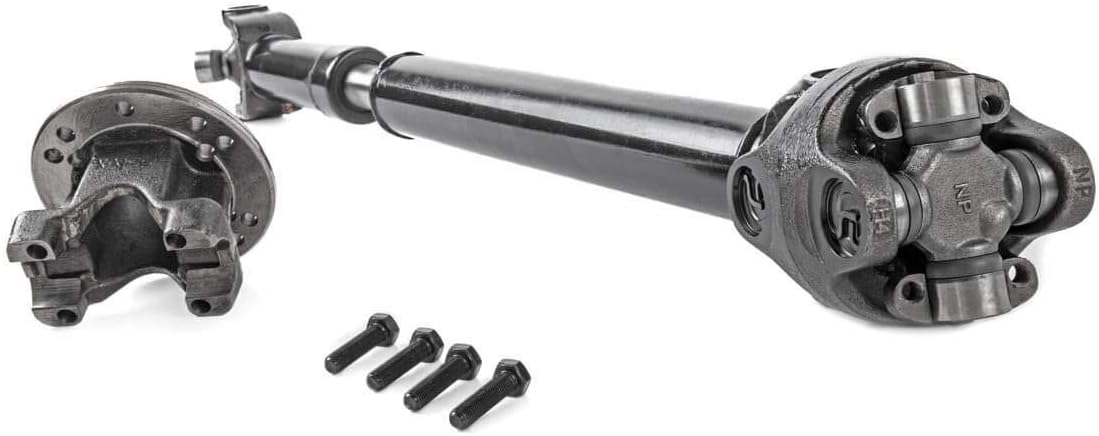
5. Rough Country Front CV Drive Shaft for 1998–2011 Ranger 4WD (fits 5" lift) 5089.1
| Fits | 1998–2011 Ford Ranger 4WD |
|---|---|
| Lift compatibility | Designed for 5" suspension lift |
| Position | Front, Lower |
| Construction | No drilling required |
This Rough Country front CV driveshaft is a direct replacement designed specifically for 1998–2011 Ford Ranger 4WD trucks that run a 5 inch lift. It lengthens the front driveline to restore proper geometry after lifting, which reduces vibration and stress on other drivetrain components. The shaft is described as roughly twice as strong as the factory unit and uses upgraded CV joints for improved durability under lifted conditions. Installation is straightforward for a competent mechanic and does not require drilling. In real-world use this part is targeted at owners who want a more robust, lift-specific driveshaft to avoid premature wear or failure from the extra angles created by a taller suspension. Important limitations are fitment strictness and the need for professional installation and periodic torque and driveline inspections to maintain safety and alignment. Buyers should also confirm it is the 5" lift version because it is made to work only with that lift height.
Best for: Owners who prioritize long-term driveline reliability after lifting a Ranger and want a purpose-made replacement to eliminate vibration and premature wear.
Less Ideal for: Drivers keeping their truck at stock ride height or those who plan frequent, varying lift heights should look for a different or adjustable solution.
- Built to fit Ranger 4WD with a 5" lift to restore correct driveline geometry
- Shaft strength advertised as twice that of the factory driveshaft
- Includes upgraded CV joints for improved durability on lifted trucks
- No drilling required for installation
- Only compatible with the 5" lift configuration and specific model years
- Requires professional installation and regular post-install inspections
Verdict: If you lifted a 1998–2011 Ranger 4WD by 5 inches and want a stronger, lift-specific front driveshaft to eliminate vibration and extend drivetrain life, this is a practical, purpose-built upgrade.
6. BDFHYK Front Drive Shaft Assembly (fits select Ranger, Explorer, Mountaineer, B3000)

| Shaft Position | Front |
|---|---|
| Material | Steel |
| Shaft Length | 29.88 Inch |
| Shaft Diameter | 1.77 Inch |
| Replaces Part | 65-9293, 65-9451, 936-813, F77A4376BB, XL2Z4A376AA |
This BDFHYK front drive shaft is a direct-replacement style assembly designed to restore front driveline function on compatible 4WD Rangers, Explorers, Mountaineers, and Mazda B3000s. It is made from forged steel with high-strength alloy joints and is dynamically balanced at the factory to reduce vibration. Installation replaces the front shaft and universal joints to return smooth torque transfer under everyday driving and light off-road use. The listing identifies specific compatible years and engine sizes, and the shaft is sold as a complete assembly that matches common replacement part numbers so you can swap it in without sourcing separate components. Buyers should verify exact year and model fitment before purchase because several similar shaft lengths and diameters exist for nearby model years. This unit prioritizes a factory-replacement fit and improved vibration control over performance upgrades, so it is best for repairing worn or failed front driveline components rather than boosting driveline strength for heavy-duty towing or race use.
Best for: A buyer who wants a dependable, factory-style replacement to restore smooth driveline operation on a 4WD Ranger, Explorer, Mountaineer, or B3000 and values verified fitment and reduced vibration.
Less Ideal for: Not the best choice for someone seeking a heavy-duty or performance uprated shaft for frequent towing, severe off-road use, or racing applications.
- Complete front drive shaft assembly including joints for straightforward replacement.
- Forged steel construction with high-strength alloy joints for reliable torque transfer.
- Dynamically balanced at the factory to minimize vibration and improve ride comfort.
- Direct-replacement design that matches common replacement part numbers for easier fitment verification.
- Fitment varies by year and engine and requires careful verification to avoid mismatch.
Verdict: Choose this BDFHYK front drive shaft when you need a factory-style, balanced replacement to restore smooth front driveline operation on the specified 4WD Ranger and related models.
Choosing the Right Ford Ranger 4WD Driveshaft: Key Factors to Consider
Fitment and Length Accuracy
Correct length and flange pattern are critical for a Ford Ranger 4WD driveshaft because even small deviations change driveline angles and U-joint operating ranges. A driveshaft that is too long or too short can bottom out or pull the transmission and axle into incorrect positions, causing premature wear and potential safety issues.
When evaluating fitment, confirm center-to-center length, spline count, and yoke or flange style. Also consider whether the vehicle has nonstandard lift height or aftermarket axles; those modifications often require a custom or adjustable driveshaft. Proper fitment reduces installation time and eliminates the need for shims, spacers, or secondary modifications.
Balance and Vibration Control
Dynamic balance is one of the most important contributors to vibration-free operation. Driveshafts that are dynamically balanced reduce harmonic vibrations that can transmit into the cab, cause noise, and stress U-joints and carrier bearings.
Look for driveshafts that specify dynamic balancing tolerances or are balanced to industry standards. Even a small imbalance in a rotating assembly at driveline speeds can create noticeable vibration, so balance verification is essential, especially for vehicles driven frequently on highways or carrying variable loads.
U-Joint Quality and Compatibility
Universal joints are wear items and the typical failure point on a driveshaft. High-quality U-joints with proper bearing caps and grease fittings deliver longer service life and simpler maintenance. Compatibility with factory yokes and proper cross dimension prevents fit issues.
Consider whether the driveshaft uses serviceable U-joints or sealed assemblies, and whether replacement parts are readily available. For vehicles exposed to water, mud, or heavy use, choose joints with corrosion-resistant finishes and positive grease paths to reduce the risk of premature failure.
Material, Construction, and Corrosion Protection
The driveshaft tube material and weld quality determine strength and long-term durability. Proper tube wall thickness, correct tube diameter relative to torque loads, and full-penetration welds reduce the chance of cracking or structural failure under load.
Because a Ranger 4WD often sees wet or off-road conditions, driveshafts with corrosion-resistant coatings or treated surfaces last longer. Consider driveshafts with sealed seams, zinc or powder coatings, and robust flange finishing to prevent rust-related degradation that can lead to misalignment or noise.
Serviceability and Parts Availability
Ease of future service affects ownership cost and downtime. Driveshafts that use common U-joint sizes and standard carrier bearings make repairs and part sourcing easier at independent shops. Also, driveshafts designed for field-serviceable U-joints allow routine greasing and bearing replacement without full assembly swaps.
Confirm that replacement U-joints, carrier bearings, and mounting hardware are documented and obtainable. Driveshafts that require proprietary or hard-to-source parts increase long-term maintenance complexity and may raise repair turnaround time.
Intended Use and Load Capacity
Consider how you use the Ranger 4WD when choosing a driveshaft. Daily commuting and light hauling place different demands on the driveline than frequent towing, heavy payloads, or off-road use. Driveshafts must handle peak torque events and occasional shock loads without deforming or transferring harmful forces into the driveline.
Select a driveshaft whose construction and material grade match expected loads. If you tow regularly or run larger tires and gearing, prioritize sturdier construction and higher-rated components to maintain reliability under heavier duty cycles.
Signs Your Driveshaft Needs Replacement
Recognizing driveshaft symptoms early helps prevent further damage to U-joints, differential seals, and transmission mounts. Common clues include rhythmic vibration that changes with vehicle speed, a clunk when shifting from drive to reverse, or a noticeable wobble under acceleration. These are often the first indicators that balance or joint failure is starting.
Another sign is visible wear at the universal joint caps or excessive play when the driveshaft is moved by hand. Unusual noises like metallic clicking or low-frequency rumble during takeoff also point to driveline issues. Addressing these symptoms quickly reduces the chance of damage to adjacent components and can simplify the repair to a driveshaft service rather than more extensive drivetrain work.
- Speed-dependent vibration increasing at highway speeds
- Clunking during acceleration or when shifting
- Visible play or worn U-joint caps
- Grease leakage or rust at yokes and flanges
Installation and Alignment Considerations
Proper installation ensures the driveshaft operates within acceptable U-joint operating angles and maintains correct pinion angle. During installation, torque specifications for flange bolts and fasteners must be followed. If the vehicle has a suspension lift or aftermarket components, measure driveline angles and consider adjustable-length or slip-type shafts where appropriate.
If a carrier bearing is present, check its condition and alignment during replacement. Misaligned bearings or worn mounting brackets can reintroduce vibration even with a new driveshaft. After installation, test for vibration across the full speed range and recheck fastener torque after a short break-in period.
- Verify center-to-center length before final installation
- Check and correct pinion and driveline angles
- Torque flange bolts to factory specification
- Re-inspect and retorque after initial break-in
When to Choose a Direct-Fit Vs Adjustable Driveshaft
A direct-fit driveshaft that matches factory dimensions is usually the quickest and most reliable repair for a stock Ford Ranger 4WD. It minimizes installation complexity and preserves the original driveline geometry. Direct-fit units are ideal when the vehicle retains factory suspension height and axle location.
Adjustable or slip-yoke designs are better when the truck has aftermarket lifts, altered ride height, or different axle spacing. They allow length tuning to accommodate modifications but require careful setup and dynamic balancing. Choose an adjustable design only when necessary, and ensure it is properly locked or welded according to manufacturer guidance to prevent movement during operation.
- Direct-fit: best for stock vehicles and quickest install
- Adjustable: useful for modified suspension or custom setups
- Ensure adjustable shafts are secured against unintended slip
Routine Maintenance Tips to Extend Driveshaft Life
Regular inspection and maintenance help prolong driveshaft and U-joint life. Greaseable joints should be lubricated at recommended intervals, especially after exposure to water, mud, or off-road conditions. Periodic visual checks of yokes, flanges, and seals will catch early corrosion or wear.
Keep mounting hardware tight and inspect carrier bearings for play. If you hear new vibration or noise, address it promptly rather than waiting for failure. Early intervention often allows replacing a U-joint or rebalancing instead of swapping the entire driveshaft.
- Grease serviceable U-joints as per maintenance schedule
- Inspect yokes and flanges for rust or abrasion
- Monitor carrier bearings and replace when play is detected
- Rebalance after major repairs or if vibration appears
Understanding Rear Driveshaft Vs Front Driveshaft Roles
On a Ford Ranger 4WD, the rear driveshaft transmits power from the transfer case or transmission output to the rear differential. Its job is primarily torque delivery to the rear axle and it sees the torque and speed characteristics determined by gearing and load. The front driveshaft, if present, serves the front differential and may experience different operating angles and load cycles.
When servicing a rear driveshaft, consider how changes to rear-end gearing, larger tires, or towing loads affect torque demands. Matching the driveshaft's material and joint ratings to the rear axle's duty cycle helps avoid failures that can be exacerbated by increased torque from modifications or heavy towing.
- Rear driveshaft handles main torque delivery to the rear axle
- Front driveshaft operates under different angles and cycles
- Changes to gearing or tire size increase torque demands on rear shaft
Still looking for the perfect fit?
Select your Ford Ranger configuration to see the most relevant Driveshafts recommendations
How We Chose the Best Ford Ranger 4WD Driveshaft
We focused on criteria that matter most to Ford Ranger 4WD owners replacing or upgrading a driveshaft. First, fitment accuracy was a primary filter. Driveshafts that match factory flange patterns, center-to-center length, and splines reduce installation time and ensure proper driveline geometry. Second, balance and dynamic balancing were weighted heavily because poor balance increases vibration, accelerates u-joint wear, and can create noise at highway speeds. Third, U-joint and yoke quality were evaluated; durable bearing caps, correctly sized cross bearings, and corrosion-resistant finishes extend service life. Fourth, material and construction were considered, favoring properly welded tubes, correct wall thickness, and corrosion protection for a vehicle that may see wet or off-road conditions. Fifth, serviceability and availability of replacement parts like U-joints and carrier bearings influenced selection for long-term ownership.We excluded driveshafts without verifiable fitment specs or those lacking balance documentation. We also excluded incomplete kits that required unspecified modifications. Our process prioritized measurable fit and durability attributes rather than marketing claims. The resulting shortlist reflects driveshafts that meet practical installation needs, reduce vibration risk, and offer clear serviceability for Ford Ranger 4WD owners.
Our full evaluation process is outlined in our review methodology.
FAQ
What are common driveshaft symptoms I should watch for on a Ranger 4WD?
Common symptoms include speed-dependent vibration, clunking when shifting or accelerating, visible play in U-joints, and unusual noises during takeoff. These often indicate worn joints, imbalance, or misalignment.
Can I replace just the U-joint instead of the whole driveshaft?
Often you can replace worn U-joints if the tube and yokes are in good condition. However, if the driveshaft is bent, badly corroded, or out of balance, replacing the entire assembly is a safer long-term solution.
How important is balancing when installing a new driveshaft?
Balancing is very important. Even small imbalances create vibration at higher speeds and accelerate wear on U-joints and bearings. Choose a driveshaft that is dynamically balanced or have it balanced after installation.
Will a lift or larger tires affect driveshaft fitment?
Yes. Suspension lifts and larger tires can change driveline angles and required length. In those cases, an adjustable or custom-length driveshaft may be needed to maintain proper operating angles and avoid joint binding.
What maintenance helps prolong driveshaft life?
Regular greasing of serviceable U-joints, inspecting yokes and flanges for corrosion, checking carrier bearings for play, and addressing new vibrations promptly will extend service life and prevent cascading drivetrain damage.
How do I know if vibration comes from the driveshaft or another part?
Drive at varying speeds and note when the vibration changes. Driveshaft vibration often correlates with vehicle speed and appears at specific RPM ranges. Inspect U-joints and runout, and check for play in mounts; if symptoms persist after inspection, a shop can perform dynamic balancing to confirm the source.
Final Verdict
When replacing or upgrading a driveshaft on a Ford Ranger 4WD, prioritize correct fitment, dynamic balance, and durable U-joint construction. These factors most directly affect vibration, noise, and long-term reliability for highway driving and towing.Weigh your intended use against construction and serviceability: a direct-fit unit is typically best for stock trucks, while adjustable or heavier-duty shafts make sense for lifted or towing-focused Rangers. Focus on preventing imbalance and selecting components that are easy to service to keep your driveline dependable.
Explore More:
- Check out all Ford Ranger parts & accessories
- Explore Driveshafts Maintenance & Repair Guides
- Explore Transmission & Drivetrain
- Browse all Auto Parts
