

Note: This article contains affiliate links. If you click on these links and make a purchase, I may earn a small commission at no extra cost to you. This helps support my research and content. Read my full affiliate disclosure here.
If your 2002-2006 Honda CR-V is showing wandering steering, uneven tire wear, or a clunk over bumps, replacing worn control arms can make a dramatic difference in handling and safety. The right control arm restores proper suspension geometry, reduces vibration, and improves tire life while keeping the vehicle stable during cornering and braking. This guide covers seven carefully shortlisted control arms that suit the CR-Vs built in those years and explains the factors that matter when choosing a replacement.Below you will find evaluation details and practical guidance on fitment, bushings, ball joints, and installation considerations to help you pick the right part for your driving needs and maintenance goals.
Looking for other parts? See all Honda CR-V parts & accessories.
Top Picks at a Glance


1. Detroit Axle Front Lower Control Arms and Ball Joints Kit for 2002–2006 Honda CR-V

| Fitment | 2002-2006 Honda CR-V |
|---|---|
| Kit contents | 2 lower control arms, 2 lower ball joints |
| Position | Front |
| Manufacturer | Detroit Axle |
This Detroit Axle kit supplies both front lower control arms plus two lower ball joints as a direct-fit replacement for 2002–2006 Honda CR-Vs. The control arms are made from a premium alloy and the listing emphasizes enhanced structural strength and corrosion resistance, which should help the parts hold up to regular driving and light off-road or rough-road impacts. Installation is intended to be straightforward since the parts are designed as direct replacements, so a competent DIYer or a mechanic can swap the arms and ball joints without major modification. In real use the reinforced construction should restore correct suspension geometry, reduce play in the front end, and improve steering feel compared with worn components. Limitations include that this is a basic replacement kit rather than a performance upgrade, so drivers seeking stiffer handling or adjustable geometry will need aftermarket performance arms. Also the ball joints are press-in style as supplied and may require common shop tools or a press for removal and installation.
Best for: Drivers who want a cost-effective, factory-style restoration of front suspension on a 2002–2006 Honda CR-V and prefer parts that simplify a straight swap by a mechanic or competent DIYer.
Less Ideal for: Enthusiasts seeking performance-tuned suspension, adjustable geometry, or ride-height changes should look at dedicated aftermarket control arms instead.
- Includes both left and right lower control arms plus two lower ball joints for a complete front-end replacement
- Premium alloy construction with rust resistance for longer service life
- Designed as direct-fit replacements to simplify installation and maintain correct suspension geometry
- Manufacturer claims factory-quality fit, form, and function and notes testing for durability
- Not a performance or adjustable arm so it will not change ride height or handling characteristics beyond restoring factory behavior
Verdict: A practical, factory-style replacement kit that restores front suspension function on 2002–2006 Honda CR-Vs with durable alloy control arms and included ball joints.
2. Metrix Premium Chassis Parts Front Right Lower Control Arm (RK640399)

| Fit Type | Vehicle Specific Fit |
|---|---|
| Auto Part Position | Front Right Lower |
| Auto Part Orientation | Passengers Side |
| Material Type | Carbon Steel |
This Metrix front right lower control arm replaces the factory part on 2002–2006 Honda CR-V models and is built from carbon steel with a pre-greased ball joint and bushing for easier installation and initial movement. It is designed to restore steering geometry, reduce play in the front suspension, and improve handling responsiveness compared with a worn arm. Typical use is a direct replacement during a suspension repair or when addressing symptoms such as clunking over bumps, uneven tire wear, or loose steering. Notable features include vehicle-specific fitment claims, a greasable design for maintenance, and manufacturing to industry quality standards. Practical benefits are straightforward fitment, reduced drivetrain vibration, and a longer service life thanks to corrosion-resistant coatings and pre-lubrication. Limitations to consider are that this is a single-side steel arm rather than an aluminum lightweight option, which means a small weight penalty and no inherent weight-saving benefit for performance builds, and wheel alignment is still required after installation.
Best for: A buyer who wants a direct, durable replacement to restore steering precision and handling on a 2002–2006 Honda CR-V and prioritizes reliability and service life over lightweight upgrades.
Less Ideal for: Drivers seeking a weight-saving or track-focused upgrade should look for aluminum performance control arms or aftermarket options tuned for reduced unsprung mass and adjustable geometry.
- Vehicle-specific fit for 2002–2006 Honda CR-V for straightforward replacement.
- Pre-greased ball joint and bushing for easier initial installation and reduced break-in noise.
- Manufactured to recognized quality standards and corrosion-resistant coating for longer service life.
- Greasable design allows periodic maintenance to extend component life.
- Made from carbon steel rather than a lightweight alloy, so it does not reduce unsprung weight for performance tuning.
Verdict: A durable, vehicle-specific replacement that restores factory steering feel and handling on 2002–2006 Honda CR-Vs while offering easy installation and maintenance.
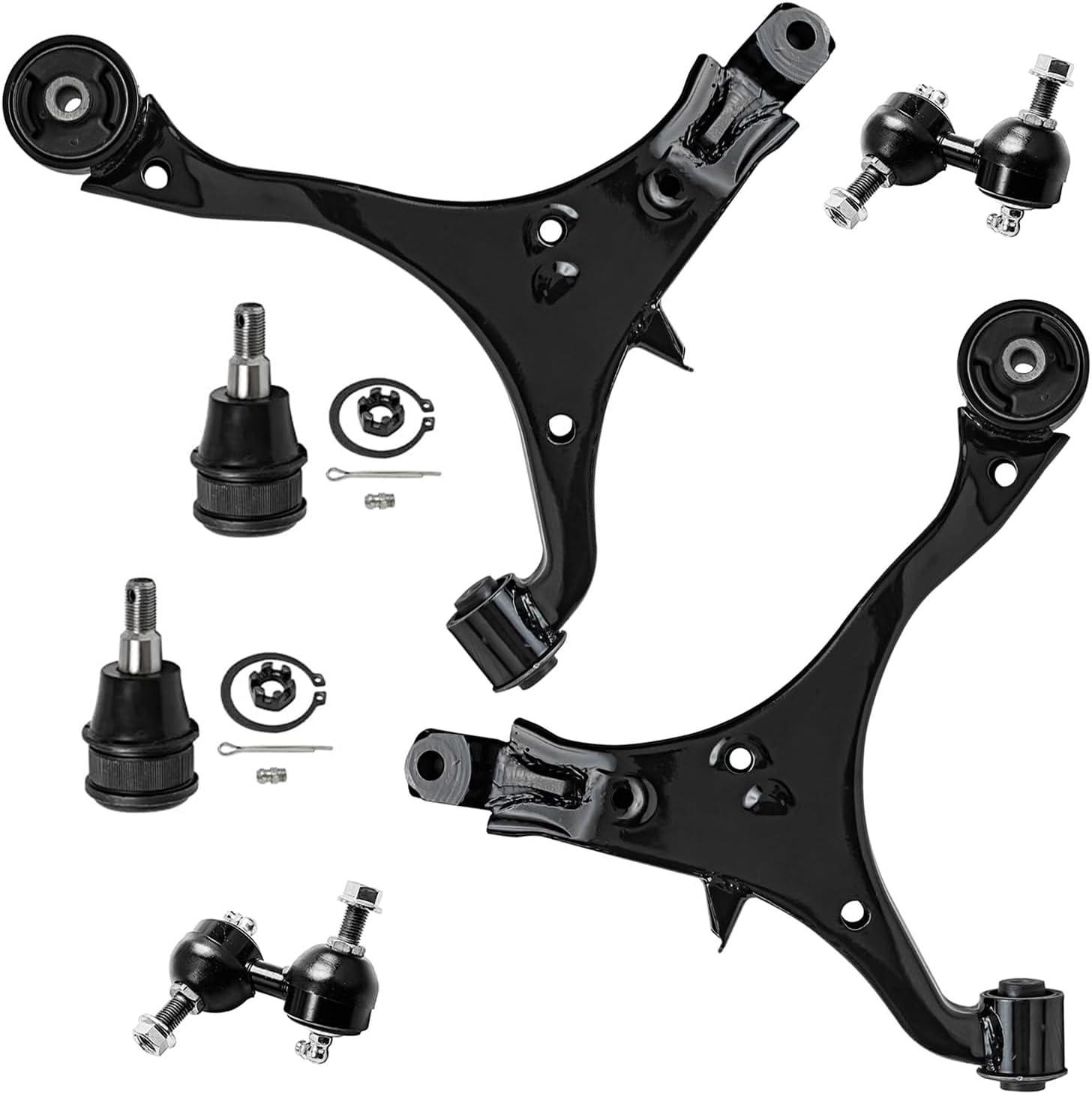
3. Detroit Axle Front Lower Control Arm Suspension Kit for 2002–2006 Honda CR-V
| Fit Type | Vehicle Specific Fit |
|---|---|
| Auto Part Position | Front |
| Material Type | Alloy Steel, Aluminum, Stainless Steel |
| Kit Includes | 2 Lower Control Arms, 2 Lower Ball Joints, 2 Sway Bar Links |
This Detroit Axle six-piece front end kit supplies both front lower control arms, two lower ball joints, and a pair of sway bar end links as a complete replacement for 2002–2006 Honda CR-V models. Designed as direct-fit, vehicle-specific parts, the components install where the originals mount so most DIY mechanics can swap them without modification. The control arms are made from alloy steel and aluminum with stainless-steel hardware for corrosion resistance and claimed high rigidity to resist repeated impacts. Including ball joints and sway bar links means you refresh multiple wear items at once, restoring steering feel and reducing front-end play. The practical benefit is fewer returns visits because the kit addresses the common failure points together. Expect factory-quality fit and a focus on value rather than premium performance tuning; heavier-duty off-road use or performance alignment tweaks may require aftermarket performance parts. Installation still requires basic suspension tools and alignment after fitting, so plan for wheel alignment afterwards.
Best for: A buyer who wants a practical, one-stop repair to restore front suspension function and steering feel on a 2002–2006 CR-V without upgrading to performance parts, and who prefers parts that bolt in for straightforward installation.
Less Ideal for: Drivers looking to upgrade handling for track use or heavy off-road duty should choose performance-oriented or heavy-duty suspension components instead.
- Complete kit includes both lower control arms plus ball joints and sway bar links to replace multiple wear items at once
- Vehicle-specific direct-fit design simplifies installation and reduces the need for modification
- Materials listed (alloy steel, aluminum, stainless steel) improve corrosion resistance and structural strength
- Not aimed at performance or heavy-duty off-road upgrades; built for factory-style replacement and value
Verdict: Buy this kit if you want a practical, direct-fit replacement that refreshes the main front suspension wear items on a 2002–2006 Honda CR-V in one go.
4. maXpeedingrods Front Lower Control Arm Kit with Ball Joints for Honda CR-V 2002–2006 (2WD)

| Fit Type | Vehicle Specific Fit |
|---|---|
| Auto Part Position | Front Left Lower, Front Right Lower |
| Automotive Fit Type | Vehicle Specific Fit |
| Unit Count | 4.0 Count |
This maXpeedingrods kit includes both front lower control arms plus two lower ball joints so you get all the core components needed to refresh the front suspension on a 2002–2006 CR-V 2WD. The arms are stamped from high-strength steel and arrive with rubber bushings installed, which helps reduce road noise and vibration compared with worn factory parts. Fitment is intended to be vehicle specific and most installers report a direct replacement with factory mounting points, though some users noted slight alignment and bushing press issues that required careful fitting. Ball joints come preinstalled which speeds up installation, but a few installers prefer to swap in heavier aftermarket ball joints for extra durability. Expect standard suspension tools, pressing or hammering on stubborn bolts, and a wheel alignment after installation. For non-aggressive daily drivers this kit restores steering precision and quiets clunks, but long-term corrosion protection and batch-to-batch quality control can vary compared with higher-end replacements.
Best for: Buyers who need an affordable, complete front suspension refresh for a 2002–2006 CR-V and prioritize restoring everyday ride comfort and steering tightness without paying OEM prices.
Less Ideal for: Drivers who frequently tow, drive aggressively, or require the highest long-term durability should consider heavier-duty branded replacements or professional-grade components instead.
- Complete kit includes both front lower control arms and two lower ball joints for a one-stop repair
- Constructed from high-strength steel with pre-installed rubber bushings to reduce vibration and noise
- Designed as a direct replacement that aligns with factory mounting points for straightforward installation
- Preinstalled ball joints save assembly time during installation
- Quality control can vary between batches leading to unevenly pressed bushings on some units
- Ball joints and finish may not match the long-term durability or corrosion resistance of premium or factory-quality parts
Verdict: A budget-friendly, all-in-one front lower control arm kit that restores steering feel and quiets a worn front end on 2002–2006 CR-V 2WDs.
5. TRQ Front Lower Control Arm and Ball Joint Set, 4-Piece for 2002–2006 Honda CR-V

| Fit Type | Vehicle Specific Fit |
|---|---|
| Auto Part Position | Front Lower |
| Included Components | 2 Front Lower Ball Joints, 2 Front Lower Control Arms |
| Manufacturer Part Number | PSA62527 |
This TRQ kit bundles two front lower control arms with two front lower ball joints to provide a ready-to-install replacement for worn suspension components on 2002–2006 Honda CR-Vs. The parts are supplied pre-assembled to match factory fit and make a direct swap during a typical front suspension repair, which reduces install time for DIYers and independent shops. Notable features include vehicle-specific fitment, OEM-equivalent reference numbers for easy cross-checking, and TRQ support materials such as installation videos. In practice the set restores steering response and front-end stability after wear-related looseness or noise, and the included ball joints simplify replacement compared with buying components separately. Limitations to consider are that the kit covers only the front lower position and does not include other suspension parts you might replace at the same time, and long-term durability depends on driving conditions and maintenance. For reliability-focused buyers this kit delivers a straightforward, factory-style replacement that gets the front suspension back to proper geometry without modification.
Best for: Buyers prioritizing a dependable, factory-style replacement who want a ready-to-install front lower control arm solution to restore steering feel and eliminate play without custom work.
Less Ideal for: Customers planning a full suspension overhaul who need upper arms, sway components, or aftermarket performance upgrades should consider a more comprehensive or purpose-built kit.
- Vehicle-specific design for direct-fit replacement on 2002–2006 Honda CR-V front lower position
- Includes both control arms and ball joints so the assembly is ready to install
- Pre-assembled components reduce installation time and the need for modifications
- Manufacturer provides DIY videos and compatibility references to guide installation
- Covers only the front lower control arms and ball joints, not other suspension components
Verdict: A complete, vehicle-specific front lower control arm and ball joint kit that restores factory steering feel on 2002–2006 Honda CR-Vs with minimal fuss.
6. Detroit Axle Front End 10‑Piece Suspension Kit for 2002–2006 Honda CR‑V

| Fit Type | Vehicle Specific Fit |
|---|---|
| Auto Part Position | Front |
| Auto Part Orientation | Passengers Side |
| Material Type | Alloy Steel |
This Detroit Axle 10‑piece front end kit is a comprehensive replacement for the front suspension on 2002–2006 Honda CR‑V models and is designed for do‑it‑yourself or shop installs. The kit includes two lower control arms, front ball joints, inner and outer tie rod ends, and sway bar end links so you can renew most front-end wear items at once. Parts are stamped alloy steel with corrosion-resistant coating and are described as direct-fit to the vehicle, which simplifies installation and reduces the need for modifications. In practical use the kit restores steering stability and reduces play from worn components, making the ride feel firmer and quieter. Customer feedback generally praises fit and value, though a handful of users reported fitment or interference issues with shock mounts on non-CR‑V applications. Expect routine installation tasks like pressing or bolting ball joints and aligning tie rods; shops can do the full job quickly but DIYers should allow extra time for separating old fasteners. This kit is a budget-friendly way to overhaul the front suspension, but verify fit for your exact configuration before installation and plan a wheel alignment after replacement.
Best for: Buyers who want a full, vehicle‑matched front suspension refresh for a 2002–2006 Honda CR‑V and prioritize getting all common wear parts at once with straightforward installation.
Less Ideal for: Drivers who only need a single replacement part or who expect precision OEM tolerances for high‑performance or heavily modified suspensions should consider individual factory‑quality parts instead.
- Complete kit replaces most front wear items so you can do a single coordinated repair
- Vehicle-specific fitment for 2002–2006 Honda CR‑V reduces need for modifications
- Alloy steel construction with corrosion-resistant finish for durability
- Includes both inner and outer tie rod ends and sway bar links for improved steering feel
- Some isolated reports of control arm shock‑mount clearance or dimensional issues on certain vehicles
Verdict: A cost‑effective, vehicle‑specific front suspension kit that swaps most worn front‑end parts on 2002–2006 Honda CR‑V models in one job, restoring steering stability and reducing play.
7. Aeagle Front Lower Control Arm and Ball Joint Suspension Kit for Honda CR-V 2002–2006 (6-piece)

| Fit Type | Vehicle Specific Fit |
|---|---|
| Auto Part Position | Front Lower |
| Material | Alloy Steel, Aluminum |
| Unit Count | 6.0 Count |
| Exterior | Electrophoretic Coating |
This Aeagle suspension kit supplies both front lower control arms, two lower ball joints and left/right sway bar end links so you can replace the major wear items on a 2002–2006 CR-V in one purchase. The parts are made from alloy steel and aluminum with an electrophoretic coating to resist corrosion, and the kit is presented as vehicle-specific fitment to simplify installation. In practice this type of kit is used when inner or outer joints are worn, steering feels loose, or there is uneven tire wear; swapping the full lower arm assembly is faster than rebuilding individual components. Customers report generally solid fit and improved ride smoothness after installation, though several reviews mention ball joint stud length and grease fitting placement that can interfere with snap rings or CV shafts on some vehicles. The kit includes commonly replaced items so a home mechanic or installer can complete the front-lower refresh without sourcing separate parts, but expect to check ball joint fit and possibly modify grease fittings during assembly on a minority of CR-Vs.
Best for: A buyer who wants a single, vehicle-specific kit to refresh front lower suspension components on a 2002–2006 CR-V and prefers a straightforward replacement rather than sourcing individual parts.
Less Ideal for: Drivers who need factory-exact ball joint geometry or who are unwilling to perform minor fitting tweaks during installation should consider higher-end or OEM replacement parts.
- Complete 6-piece kit covers both front lower control arms, ball joints and sway bar end links for one-stop replacement
- Vehicle-specific fitment simplifies part selection for 2002–2006 Honda CR-Vs
- Corrosion-resistant electrophoretic coating extends service life compared with uncoated parts
- Made from alloy steel and aluminum for strength while keeping assemblies manageable to handle
- Some ball joint studs reported too short for snap ring installation on certain 2006 CR-Vs
- Grease fitting on the ball joints can interfere with CV shafts requiring removal or replacement of the fitting
- Sway bar links may arrive without grease nipples despite depiction in some images
Verdict: If you want a convenient, vehicle-specific kit to replace worn front lower control arms and associated parts on a 2002–2006 CR-V, this Aeagle 6-piece set gives a practical, corrosion-resistant solution.
Choosing the Right 2002-2006 Honda CR-V Control Arm: Key Factors to Consider
Fitment and Mounting Geometry
Correct fitment is the single most important factor for a 2002-2006 Honda CR-V control arm because deviations change suspension geometry and wheel alignment. A replacement must match factory mounting hole placements, bushing bore sizes, and ball joint locations so the vehicle tracks and steers as intended. Even small differences in arm length or pivot location can cause toe or camber shifts that lead to premature tire wear or unstable handling.
When evaluating parts, look for clear documentation of vehicle-year fit and factory-equivalent mounting hardware. Parts designed specifically for the 2002-2006 CR-V range reduce the need for additional shims or aftermarket alignment corrections. Proper fit also simplifies installation and minimizes labor time, because technicians can reuse original fasteners and follow factory torque specs without modification.
Bushing Type and Durability
Bushing design directly affects ride quality and steering feedback. Rubber bushings provide better NVH isolation and a compliant ride but may degrade faster, especially if the vehicle sees salt, heat, or rough roads. High-density rubber compounds with internal reinforcements resist tearing and offer longer life than economy-grade rubbers.
Polyurethane bushings increase steering precision and durability but transfer more vibration to the cabin and can accelerate wear on adjacent components if not matched to the vehicle's use. For the CR-V, consider the typical driving conditions: daily commuting favors resilient rubber-style bushings, while frequent towing, off-pavement driving, or performance-focused setups may justify stiffer alternatives. Inspect the bushing sealing and bonding method because poorly bonded bushings can separate from the control arm housing under load.
Ball Joint Quality and Serviceability
Many 2002-2006 CR-V control arms use integrated ball joints that take steering and suspension loads. A robust ball joint with adequate articulation and a durable bearing surface prevents looseness and maintains predictable steering feel. Look for ball joints with replaceable seals, grease fittings, or serviceable designs if you plan to extend service life with periodic greasing.
Inferior ball joints develop play, causing clunks, steering wander, or uneven tire wear. For a vehicle owner, choosing a control arm with a sealed ball joint that has a track record of lasting mileage reduces maintenance frequency. If the option exists, prioritize designs with metal dust boots and corrosion-resistant finishes to prevent water intrusion and premature failure.
Material and Corrosion Protection
Control arms face constant exposure to road grime, moisture, and salt. Construction material and surface treatment determine how long a control arm stays serviceable without rust compromising structural integrity. Forged or cast arms typically have better strength-to-weight ratios than thin stamped units, and thick, uniform wall sections resist bending and cracking under load.
Corrosion protection such as e-coating, powder coating, or zinc plating extends life in wet climates. Pay attention to welded seam quality and whether fastener threads or pressed joints receive protective finishes. For owners in areas with heavy road salt, prioritize parts with documented corrosion resistance to avoid premature replacement.
Alignment Impact and Adjustability
A replacement control arm should preserve the CR-V's factory alignment geometry or provide controlled adjustability where appropriate. Nonadjustable arms that do not precisely match OEM dimensions can push alignment outside acceptable ranges, requiring extra steering corrections. Some aftermarket arms include eccentric bushings or adjustable ball joints to correct camber or caster during installation, which can be useful when correcting wear-induced drift.
However, adjustable components require careful setup. Incorrect adjustments can worsen tire wear or handling. If you plan to perform alignment at home, choose arms with user-friendly adjustment features and clear instructions. For most owners, OEM-equivalent geometry that allows standard alignment procedures at a shop is the safest path.
Installation Complexity and Hardware
Installation requirements affect both labor and the likelihood of proper reassembly. Control arms that reuse factory fasteners and bushings simplify installation and lower the chance of torque or clearance errors. Some replacement arms come with new mounting bolts, nuts, and preinstalled bushings or ball joints, which reduces steps but may require pressing in parts if not fully assembled.
Consider whether the arm requires special tools such as a ball joint press, torque-angle tools, or alignment shims. If you plan a DIY installation, choose options that minimize the need for specialized equipment or that include clear instructions. Also check whether the part needs a full alignment immediately after installation; most control arm replacements will require an alignment to ensure safe handling and even tire wear.
Common Symptoms That Point To A Faulty Control Arm
Recognizing symptoms early helps prevent further suspension damage on a 2002-2006 Honda CR-V. Typical signs include a loose or wandering steering feel, a distinct clunk when driving over bumps, and uneven or accelerated tire wear on the front wheels. You may also notice vibration through the steering wheel at certain speeds or a pulling sensation to one side during braking.
Some symptoms overlap with other suspension or steering issues, so use a combination of visual inspection and road testing. Check for torn bushings, excessive play at the ball joint, or visible bending of the arm. When in doubt, have a technician lift the vehicle and check suspension articulation to isolate the control arm as the source.
- Steering wander or looseness
- Clunking noise over bumps
- Uneven front tire wear
- Steering wheel vibration at speed
- Pulling to one side under braking
Replacing Bushings Versus Full Arm Replacement
Deciding whether to replace just the bushings or the entire control arm depends on the arm's construction and condition. For arms with serviceable pressed-in bushings that are otherwise straight and rust-free, bushing replacement can restore isolation and alignment at a lower cost. However, pressing new bushings requires a shop press or a qualified technician to avoid damaging the arm.
If the arm shows corrosion, bent geometry, or an integral ball joint with play, full arm replacement is usually the more reliable choice. A complete assembly removes uncertainty about hidden damage and ensures correct factory geometry without the added labor of bushing presses.
- Replace bushings when arm is straight and corrosion-free
- Replace whole arm if ball joint has play or arm is bent
- Press tools are typically needed to swap bushings properly
What To Expect During Alignment After Replacement
After replacing control arms on a 2002-2006 CR-V, an alignment is normally required to return toe and camber to factory specifications. Expect the alignment technician to check and adjust toe first, then confirm camber and caster if adjustments are available. If the replacement arm matches OEM geometry, the alignment should be straightforward and within the vehicle's allowable adjustment ranges.
If adjustable arms are used, the technician will set camber or caster to compensate for worn suspension components or slight differences in part geometry. Communicate whether you want factory settings for comfort and tire life or slightly more aggressive alignment for handling to ensure the technician sets the right targets.
- Alignment typically required after control arm replacement
- Technician will adjust toe first, then camber/caster as needed
- Adjustable arms allow corrective alignment adjustments
Tools And Prep For A DIY Control Arm Job
If you plan to replace a control arm yourself on a 2002-2006 CR-V, prepare the right tools and a safe workspace. Essentials include a quality floor jack and jack stands, torque wrench, socket set, breaker bar, and possibly a ball joint press if the ball joint is not preinstalled. Penetrating lubricant and anti-seize help with removing old fasteners that may be corroded.
Follow the factory torque specifications during reassembly and always torque suspension fasteners with the vehicle on the ground when required by factory procedures. After installation, verify that fasteners are properly torqued and schedule a wheel alignment before driving at highway speeds.
- Floor jack and jack stands
- Torque wrench and breaker bar
- Ball joint press may be required
- Penetrating oil and anti-seize recommended
- Wheel alignment after installation is necessary
Corrosion Prevention And Long-Term Maintenance
To extend the life of replacement control arms on a CR-V, address corrosion proactively. After installation, inspect welded seams and fastener areas for exposed metal and treat with rust-inhibiting coatings if necessary. Regular underbody washes in winter and periodic inspections for bushing cracking or ball joint boot tears will catch issues before they lead to failure.
If you drive on salted roads, consider applying a protective spray to fasteners and exposed metal annually. Also monitor wheel alignment and tire wear; unusual patterns often reveal suspension issues early, allowing intervention before more expensive damage occurs.
- Treat exposed metal with rust inhibitor
- Wash undercarriage after winter driving
- Inspect bushings and ball joint boots regularly
- Monitor tire wear patterns for early warning signs
Still looking for the perfect fit?
Select your Honda CR-V configuration to see the most relevant Control Arms recommendations
How We Chose the Best 2002-2006 Honda CR-V Control Arm
We focused on fitment and durability specific to 2002-2006 Honda CR-V models, prioritizing parts and assemblies that match factory mounting points and suspension geometry. Evaluation criteria included material and construction quality, bushing type and longevity, ball joint strength and serviceability, and adherence to factory dimensions to preserve alignment. We also considered corrosion protection for long-term service life in varied climates, and compatibility with common OEM suspension settings to avoid unexpected handling changes.Our selection process emphasized objective technical fit: measured tolerances, bushing durometer and design, ball joint articulation range, and manufacturer documentation for part fitment. We excluded any components that required major suspension modification, nonstandard fabrication, or that lacked explicit fitment data for the 2002-2006 CR-V range. Finally, we filtered out options with poor build-quality indicators such as thin stamped metal without adequate reinforcement or missing corrosion coatings.
Our full evaluation process is outlined in our review methodology.
FAQ
How do I tell if a control arm is bad on my 2002-2006 CR-V?
Common indicators include clunking noises over bumps, loose or wandering steering, vibration through the steering wheel, and uneven front tire wear. A lift inspection that finds torn bushings, excessive ball joint play, or bending confirms the control arm as the likely culprit.
Can I replace just the control arm bushings instead of the whole arm?
Sometimes you can if the arm is straight, not corroded, and the ball joint is serviceable. Bushing replacement requires a press and technical skill; if the arm has rust or other damage, replacing the entire arm is usually more reliable.
Will replacing control arms fix alignment issues on the CR-V?
Replacing worn or bent control arms often corrects alignment drift, but an alignment procedure is usually required afterward. If the replacement part does not match OEM geometry, additional adjustment or an alignment with adjustable components may be necessary.
Are ball joints on CR-V control arms serviceable or sealed?
It depends on the design of the replacement part. Some control arms use sealed, nonserviceable ball joints while others offer grease fittings or replaceable joints. Serviceable joints allow periodic greasing and can extend life, but sealed joints are common and reduce maintenance steps.
How hard is control arm installation for a DIYer?
A moderately experienced DIYer can replace a control arm with basic automotive tools and a safe lifting setup. Expect potential need for a ball joint press, penetrating lubricant for rusty bolts, and a mandatory wheel alignment after installation.
What maintenance helps prevent premature control arm failure?
Regular inspection of bushings and ball joint boots, prompt replacement of torn boots, annual undercarriage cleaning in corrosive climates, and addressing alignment issues early all help lengthen control arm life.
Final Verdict
Prioritize correct fitment, robust bushings, and durable ball joints when choosing control arms for a 2002-2006 Honda CR-V. Decide between bushing replacement and full-arm swap based on the arm's condition, corrosion, and whether the ball joint is serviceable. Remember that alignment after installation is essential to restore handling and tire life.Focus on parts that match factory geometry and offer proven corrosion protection to balance longevity with ride comfort. With the right choice and proper installation, you will regain stable steering and predictable suspension performance.
Explore More:
- Check out all Honda CR-V parts & accessories
- Explore Control Arms Maintenance & Repair Guides
- Explore Suspension & Steering
- Browse all Auto Parts
