

Note: This article contains affiliate links. If you click on these links and make a purchase, I may earn a small commission at no extra cost to you. This helps support my research and content. Read my full affiliate disclosure here.
If you drive a 2017-2022 Ford F-350, a failing catalytic converter can degrade fuel economy, trigger the check engine light, and cause emissions failures during inspections. Choosing the right catalytic converter matters because fitment, substrate type, and emission efficiency determine drivability and legal compliance for your truck.This guide shortlists five top options that suit the F-350's factory exhaust layout and common powertrain setups. We evaluated each choice for fitment accuracy, emission control effectiveness, durability, and installation practicality. Read on for the factors we used, practical installation notes, and common symptoms to watch for before you replace the part.
Top Picks at a Glance
| Best Quality Built to a higher standard if you want something more solid | Walker Ultra Direct-Fit Catalytic Converter 73004 |  |
| Best Budget The cheapest option that still gets the job done reliably | ACZCR Left and Right Catalytic Converter Pair for Ford F-250/F-350 Super Duty 6.2L (2011–2022) |  |
| Highest Rated A top-rated pick with lots of positive feedback | PHILTOP Catalytic Converter for 2011-2022 F-250/F-350 Super Duty 6.2L, Direct-Fit Stainless Steel |  |
| Most Popular A crowd favorite that many people choose with confidence | PHILTOP Catalytic Converter for 2011-2022 F-250/F-350 6.2L (Front) |  |
| Best Seller A high-volume bestseller chosen again and again | PHILTOP Catalytic Converter Kit for 2011–2022 Ford F-250/F-350 6.2L (EPA Compliant) | |
1. Walker Ultra Direct-Fit Catalytic Converter 73004

| Fits | 2011-2017 Ford F-250 and F-350 Super Duty |
|---|---|
| OBDII | 1996 and newer vehicles |
| Manufacturer | Walker Exhaust |
| Item model number | 73004 |
This Walker Ultra direct-fit catalytic converter is a bolt-on replacement designed to match the factory fitment and emissions performance for compatible Ford Super Duty trucks. It installs using OE-style hangers, flanges, brackets and heat shields so no welding or fabrication is required for a straightforward swap. Walker specifies an industry-grade washcoat and precious metal loading intended to deliver the required reduction in tailpipe emissions for EPA-compliant OBDII vehicles. The unit also features thicker flanges and aluminized heat shields where originally equipped to resist heat and provide durability under truck duty cycles. For a performance-minded owner focused on restoring factory emissions function and maintaining exhaust flow, this converter gives a direct replacement that preserves routing and mounting. Buyers should note this is designed as an emissions-compliant replacement rather than a performance-enhancing high-flow aftermarket race unit, so expect factory-like backpressure and emissions behavior rather than increased horsepower.
Best for: Owners who want a reliable, emissions-compliant replacement that restores factory routing and function without fabrication and who prioritize proper emissions control over adding power.
Less Ideal for: Drivers seeking a high-flow performance converter to increase horsepower or reduce backpressure should consider aftermarket performance-specific units instead.
- Direct-fit design with OE-style hangers and flanges for simple bolt-on installation
- EPA-compliant design for OBDII vehicles to meet emissions requirements
- High-technology washcoat and calibrated precious metal load aimed at restoring required emissions control
- Thicker flanges and aluminized heat shields improve durability under truck operating conditions
- Not engineered as a high-flow performance converter so horsepower gains should not be expected
- Compatibility must be confirmed for exact engine and trim before purchase
Verdict: Choose this Walker Ultra if you need a direct-fit, EPA-compliant replacement that restores factory emissions performance and fitment on the specified Ford Super Duty trucks.
2. ACZCR Left and Right Catalytic Converter Pair for Ford F-250/F-350 Super Duty 6.2L (2011–2022)

| Fitment | Ford F-250/F-350 Super Duty 6.2L 2011-2022 |
|---|---|
| Material | 409L stainless steel housing |
| Substrate | 400-cell honeycomb ceramic, platinum/rhodium/palladium coated |
| Installation | Direct-fit bolt-on, hardware included |
| EPA compliant | Yes (restricted in some states) |
This ACZCR catalytic converter set replaces the left and right factory units on 6.2L Super Duty trucks and is built as a direct-fit bolt-on assembly to avoid cutting or welding during standard installation. The housings use 409L stainless steel with robotic welds and an OEM-grade 400-cell ceramic honeycomb substrate coated with platinum, rhodium, and palladium to meet EPA-compliant emission targets in allowed states. It ships with the necessary clamps, seals, bolts, and coil springs and offers precision-matched flanges to simplify alignment and reduce installation time for a DIYer or a shop. Practical benefits include solid corrosion resistance from stainless steel, factory-style fitment that preserves exhaust geometry, and an included hardware kit so additional parts are usually unnecessary. Limitations include state-specific sale restrictions for some jurisdictions and the need to confirm year and sensor bung counts before ordering because fitment varies by year and exhaust configuration.
Best for: Buyers looking for a budget-conscious, factory-replacement catalytic converter pair for Super Duty trucks who prioritize straightforward installation and parts that match factory exhaust geometry.
Less Ideal for: Drivers in states with strict emissions restrictions or anyone who needs a high-flow performance converter for modified or tuned engines.
- Direct-fit bolt-on design with included hardware reduces installation time and avoids cutting or welding
- 409L stainless steel housing and robotic welding for improved corrosion and heat resistance
- OEM-grade 400-cell ceramic substrate with precious-metal coating for effective emissions purification
- Complete kit includes clamps, seals, bolts, and coil spring so additional parts are rarely needed
- Restricted for sale or installation in certain states under local emissions laws
Verdict: If you need an affordable, factory-style replacement catalytic converter pair for 6.2L Super Duty trucks that installs without cutting or welding, this ACZCR unit is a practical, budget-focused choice.
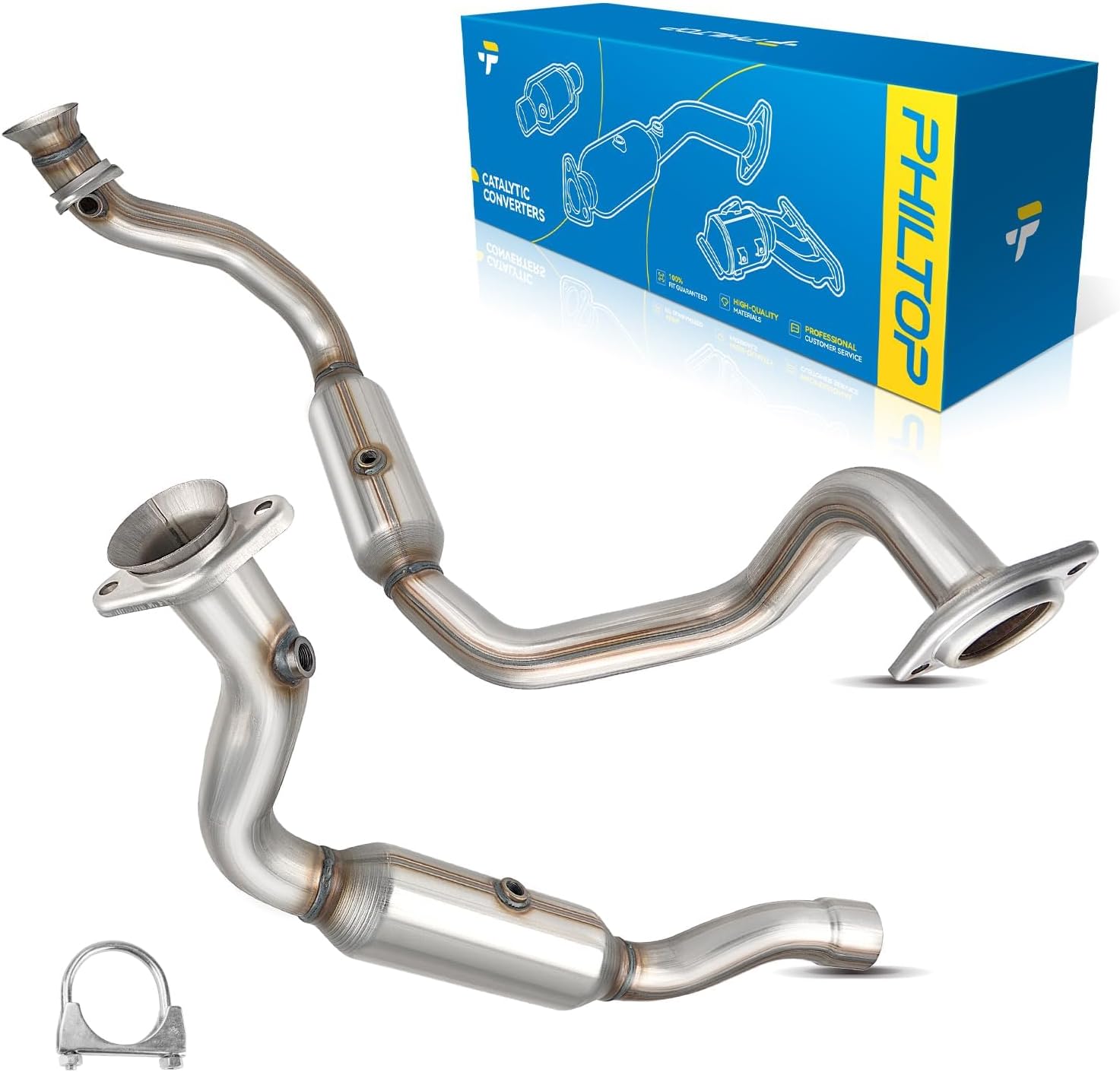
3. PHILTOP Catalytic Converter for 2011-2022 F-250/F-350 Super Duty 6.2L, Direct-Fit Stainless Steel
| Compatible engines | 6.2L |
|---|---|
| Model fit | F-250 / F-350 Super Duty 2011-2022 |
| Position | Front Left, Front Right |
| Manufacturer part number | 6906EXP3193US |
| OEM part numbers | 52297, 645158, 19457, 73004, 50370, 30603 |
This PHILTOP catalytic converter is a direct-fit replacement for 6.2L Super Duty trucks and is intended to restore emission control and exhaust flow without modifications. It uses a stainless steel outer shell and a high-flow honeycomb substrate to reduce backpressure while maintaining catalytic efficiency, and it includes OE-style gaskets and mounting hardware for bolt-on installation. Typical installation takes a few hours and matches factory mounting points, so it is suitable for a professional shop or a competent DIYer with basic exhaust tools. The stainless shell and welded connections are built for durability in the underbody environment, and the unit is EPA-compliant for most states. Limitations to consider are legal restrictions for use in states that require California-standard parts and that fitment must be confirmed to your exact model/side since the listing covers front left and right positions. The product is practical for restoring emissions performance and reducing rattling or damaged-converter noise, but buyers in regulated states will need a CARB-compliant alternative.
Best for: Buyers who prioritize a reliable, factory-style replacement to restore emissions function and exhaust behavior on older Super Duty trucks and want a durable, bolt-on unit they can install or have installed without modifications.
Less Ideal for: Owners in states that require California emissions certification or anyone who needs a CARB-compliant converter should look for a certified alternative.
- Direct-fit design with OE-style gaskets and hardware for bolt-on installation
- High-flow ceramic substrate reduces backpressure while maintaining catalytic conversion
- Stainless steel outer shell and welded connections for improved durability
- EPA-compliant for federal emissions applications (not CARB)
- Not legal for use in states that require California emissions parts
- Fitment must be verified for side and exact model to avoid mismatches
Verdict: A durable, direct-fit stainless steel converter that reliably restores emissions control and exhaust flow on 6.2L Super Duty trucks when federal EPA compliance is acceptable.
4. PHILTOP Catalytic Converter for 2011-2022 F-250/F-350 6.2L (Front)

| Compatible engines/years | 2011–2022 F-250/F-350 6.2L |
|---|---|
| Position | Front Left, Front Right |
| Material | Stainless steel |
| EPA compliance | Federal emissions compliant (not for CA/NY/CO/ME) |
The PHILTOP catalytic converter is a direct-fit replacement for the front positions on 2011–2022 F-250 and F-350 6.2L trucks. It uses a stainless steel body and a high-flow ceramic honeycomb substrate with precious metal loading to lower emissions while reducing backpressure compared with a clogged unit. Typical installation uses the factory mounting points and included OE-style gaskets and hardware, so most owners can expect a 3–4 hour install without cutting or welding. In practice this model should quiet rattling from a failing converter, help the engine run more smoothly, and maintain power delivery thanks to the high-flow internal design. It is EPA-compliant for federal emissions but explicitly not for states with stricter rules such as California, New York, Colorado, and Maine. Buyers should note that fitment is limited to the specified 6.2L Super Duty application and that states with local emissions rules will require a different certified unit.
Best for: Buyers who want a factory-style replacement that restores emissions function and reduces exhaust noise while keeping installation simple and predictable; good for owners who value verified fitment and peer feedback when choosing parts.
Less Ideal for: Drivers who need a California Air Resources Board certified converter or who require a multi-vehicle universal solution should look for a different, state-compliant option.
- Direct-fit design with OE-style gaskets and hardware for straightforward installation
- Stainless steel construction and welded seams resist corrosion and heat for longer service life
- High-flow honeycomb substrate reduces backpressure and can restore power and throttle response
- EPA-compliant for federal emissions standards (not for states with stricter rules)
- Includes front left and right position compatibility for the specified 6.2L Super Duty trucks
- Not CARB-compliant and therefore illegal for use in certain states with stricter emissions rules
Verdict: If you want a straightforward, factory-style replacement that restores emissions performance and reduces exhaust noise on 2011–2022 F-350 6.2L trucks, this PHILTOP unit is a practical, installer-friendly choice.
5. PHILTOP Catalytic Converter Kit for 2011–2022 Ford F-250/F-350 6.2L (EPA Compliant)
| Compatible engines | 6.2L V8 Super Duty (front left/right) |
|---|---|
| Certifications | EPA compliant |
| Included items | OE-style gaskets and hardware |
| Manufacturer part number | 8605EXP3195US |
This PHILTOP catalytic converter kit replaces the front left or right converter on compatible 6.2L Super Duty trucks and is intended as a direct factory-style replacement. It uses a stainless steel/aluminized housing with a double-layer high-temperature ceramic substrate and a high-flow design that lowers backpressure compared with a clogged or damaged unit. The kit ships with gaskets and hardware sized to the factory mounting points so most installations take about 3 to 4 hours without modification. Practical benefits include reduced exhaust noise from a failing converter, restored emissions function where allowed, and potential slight gains in throttle response and efficiency thanks to the high-flow substrate. Important limitations: this unit is EPA compliant but not legal for sale or installation in California and certain other states that require CARB-certified parts, and compatibility is limited to the specified Ford 6.2L fitment so confirm your VIN fitment before buying.
Best for: Buyers who prioritize a straightforward, factory-style replacement to restore emissions and drivability on compatible 6.2L Super Duty trucks and who want an off-the-shelf unit that installs with minimal modification.
Less Ideal for: Drivers in states requiring CARB-certified catalytic converters or anyone looking for a universal performance-oriented aftermarket converter for multiple vehicle applications.
- Direct-fit design with included gaskets and hardware for bolt-on installation
- Stainless steel/aluminized construction resists rust and should last longer than plain steel
- High-flow double-layer ceramic substrate reduces backpressure and can improve engine breathing
- EPA-compliant for federal emissions regions where allowed
- Not CARB certified and therefore not legal for sale or installation in California and some other states
Verdict: Choose this PHILTOP kit if you need a direct-fit, EPA-compliant replacement to restore emissions function and drivability on a 6.2L Super Duty with minimal fuss.
Choosing the Right 2017-2022 Ford F-350 Catalytic Converter: Key Factors to Consider
Fitment and Compatibility
Proper fitment is essential because the F-350 uses specific flange patterns, pipe diameters, and oxygen sensor placements that vary across engine and axle configurations. A converter that matches the vehicle's factory attachment points reduces installation time and avoids exhaust leaks caused by misaligned flanges or incorrect pipe sizes.
Compatibility also determines whether the converter preserves the factory O2 sensor locations and heater circuits. Maintaining sensor placement prevents check engine light triggers that stem from incorrect air-fuel feedback. For many owners, a direct-fit unit that bolts to existing flanges is preferable to a universal part that requires cutting, welding, or adapter piping.
Emission Performance and Substrate Type
The core function of a catalytic converter is to reduce hydrocarbons, carbon monoxide, and nitrogen oxides. Substrate material and cell density influence conversion efficiency and backpressure. High-quality substrates and appropriate washcoat formulations provide better conversion rates and longer life under heavy-duty cycles common to the F-350.
Selecting a converter rated for the emissions standard applicable to your truck helps ensure it performs well during inspections. Consider units that specify oxidation and reduction performance metrics or that match OEM design targets to maintain proper emission control.
Durability and Construction
Durability matters because F-350s often operate in harsh conditions, from highway hauling to off-road work. Look for converters built with corrosion-resistant shells, reinforced welds, and robust internal mounts that withstand vibration and heat cycling.
A sturdier housing and quality internal supports reduce the chance of substrate breakage, which causes rattles and rapid failure. Heat shielding and proper thermal management also prolong life by reducing thermal stress during repeated hot-cold cycles typical of heavy towing or short-trip duty cycles.
Impact on Engine Performance
Catalytic converters affect exhaust backpressure and therefore can influence engine breathing and fuel mapping. Choosing a converter designed for the F-350's engine characteristics helps avoid excessive backpressure that could reduce power or fuel economy.
Manufacturers that tune cell density and flow paths to balance conversion efficiency with minimal restriction offer the best compromise. If you operate under heavy loads or tow frequently, prioritize units engineered to maintain exhaust flow under sustained high-heat conditions.
Installation and Serviceability
Ease of installation is important for reducing labor time and the chance of installation errors. Direct-fit converters that include required gaskets, bolts, and hardware simplify replacement and lower overall service cost. Also consider whether the design allows access to oxygen sensors and whether the converter can be serviced or replaced without removing large sections of the exhaust.
Serviceability also includes the availability of replacement components and whether the part requires specialty tools. For fleet vehicles or owners who perform their own maintenance, a straightforward bolt-on replacement is usually preferable to one requiring welding or fabrication.
Legal Compliance and Warranty
Because catalytic converters are emissions-control devices, ensure the unit aligns with local emissions requirements for the 2017-2022 F-350. Some converters are designed to meet specific regulatory standards and may include certifications or documentation to support compliance.
Warranty coverage and the manufacturer's stated lifespan provide additional assurance. A clear warranty that covers substrate failure, corrosion, and mounting defects helps protect your investment and signals confidence in the product's longevity.
Common Catalytic Converter Symptoms to Watch For
Recognizing failure signs early can prevent further damage to the exhaust and engine systems. Typical symptoms include persistent check engine light illumination, reduced fuel economy, and abnormal exhaust odor. These signs often precede more severe issues like substrate breakage or clogged flow passages.
Other indicators include rattling noises from under the truck that appear when the engine is cold or during acceleration, rough idling, and hesitation under load. If you experience multiple symptoms simultaneously, it is prudent to inspect the converter and related components such as oxygen sensors and exhaust gaskets.
- Persistent or intermittent check engine light with P0420-style codes
- Decline in fuel economy or power under load
- Rattling sounds from the converter area indicating broken substrate
- Strong sulfur or rotten-egg smell from exhaust
- Failed emissions test or visible black smoke from the tailpipe
Preparing for a Catalytic Converter Replacement
Before purchasing a replacement, verify the F-350's engine and exhaust configuration to confirm the correct flange pattern and sensor locations. Gather required tools and replacement gaskets, and consider penetrating lubricant for aged bolts and studs. If the converter is near the muffler or manifold, note the routing to avoid damaging heat shields or wiring during removal.
Plan for safe vehicle support using jack stands or a lift. Disconnect the battery before working on exhaust components that interface with oxygen sensors. If you are not comfortable with cutting and welding, select a direct-fit unit to minimize the need for fabrication.
- Confirm engine type and exhaust pipe diameter
- Have replacement gaskets and O2 sensor hardware ready
- Use penetrating oil on rusted fasteners before removal
- Support the vehicle securely and disconnect the battery
Maintaining Your F-350's Exhaust After Replacement
Regular visual inspections help extend the life of a new converter. Check for corrosion, dents, and loose mounts, and ensure heat shields remain in place. Avoid prolonged idling and address misfires or oil consumption quickly, because unburned fuel and oil contaminate the catalyst and shorten its lifespan.
Keep up with engine tune-up intervals and promptly replace failing oxygen sensors, which help preserve optimal combustion and reduce stress on the catalyst. For trucks used in heavy-duty service, periodic underbody cleaning to remove road salts and debris will reduce corrosion risk.
- Inspect mounts and heat shields periodically
- Address engine misfires and oil burning promptly
- Replace oxygen sensors per maintenance intervals
- Clean underbody to reduce corrosion risk
How Emissions Testing Affects Converter Choice
Emissions testing requirements influence which converters are appropriate. For vehicles that must pass state inspections, choose a converter that restores quantifiable reduction of regulated pollutants and retains the factory sensor layout. Some replacement units are built to meet or approximate OEM emissions performance, which can ease test outcomes.
If you plan on registering the F-350 in an area with strict emissions checks, prioritize documented performance and units intended for compliance rather than universal or modified designs. Proper installation and attention to upstream engine health are equally important for passing emissions checks.
- Select converters with documented emissions performance when inspections are required
- Preserve factory O2 sensor locations to maintain monitoring accuracy
- Ensure installation does not introduce exhaust leaks that affect test results
When to Consult a Professional
If you encounter complex exhaust routing, seized flange bolts, or are unsure about oxygen sensor wiring, consult a qualified technician. Professionals can verify fitment, perform proper sealing with high-temperature gaskets, and test post-installation OBD-II readiness and emissions parameters.
Also seek professional help if engine misfires or fuel system issues are present, because these conditions can rapidly damage a new catalyst and lead to repeated failures. A mechanic can diagnose upstream issues first to protect the new converter.
- Complex exhaust modifications or seized hardware
- Persistent OBD-II codes after replacement
- Repeated catalyst contamination due to engine issues
Still looking for the perfect fit?
Select your Ford F-350 configuration to see the most relevant Catalytic Converters recommendations
How We Chose the Best 2017-2022 Ford F-350 Catalytic Converter
We focused on attributes that matter specifically for the 2017-2022 Ford F-350 and the way owners use these trucks. Key evaluation criteria included fitment accuracy to factory exhaust flanges and tubing diameters, emissions reduction efficiency as verified by catalyst substrate type and washcoat technology, and durability against heat cycling and road debris common to heavy-duty use. We also weighed backpressure characteristics to avoid negatively impacting engine performance, and construction quality such as robust welded flanges and corrosion-resistant materials.Other practical filters included ease of installation for common service scenarios on this chassis, availability of replacement gaskets and hardware, and whether the unit preserves O2 sensor locations and OEM mounting points. We excluded units that required extensive exhaust modification, generic universal converters that need custom cutting or welding, and designs incompatible with typical F-350 powertrains during these model years. The final list balances compliance-oriented performance with serviceability and long-term durability.
Our full evaluation process is outlined in our review methodology.
FAQ
How long does a catalytic converter usually last on a Ford F-350?
Lifespan varies based on driving conditions and engine health. Many converters last several years under normal use, but exposure to road salt, engine misfires, or oil contamination can shorten their life significantly.
Will a check engine light always mean the catalytic converter is bad?
Not always. The check engine light can indicate upstream issues such as oxygen sensor failure or engine misfires. However, persistent codes related to catalyst efficiency often point to the converter and merit inspection.
Can I install a catalytic converter myself on a 2017-2022 F-350?
You can if you have the right tools and experience with exhaust work. Direct-fit units simplify installation, but seized bolts, sensor wiring, or complex exhaust geometry may require professional help.
Do I need to replace oxygen sensors when replacing the converter?
Not always, but it is wise to inspect sensor condition. Faulty sensors can affect engine control and catalyst performance, so replacing worn sensors during converter service can prevent future issues.
How does a clogged catalytic converter affect towing performance?
A clogged converter increases backpressure, which can reduce power and throttle response under load. Towing heavy loads with a restricted converter can also cause overheating and accelerated damage.
Are there fitment differences between engine options for the F-350?
Yes. Pipe diameters, flange types, and sensor locations can vary by engine and exhaust configuration. Verify the exact engine and exhaust layout before selecting a replacement to ensure proper fitment.
Final Verdict
When replacing a catalytic converter on a 2017-2022 Ford F-350, prioritize correct fitment, emission performance, and robust construction. Balancing conversion efficiency with low restriction helps maintain drivability, especially when towing or carrying heavy loads.Consider installation practicality and long-term durability as part of your decision. Address any engine or sensor issues before fitting a new converter to protect the unit and maximize its lifespan. With those tradeoffs in mind, choose a direct-fit, compliance-focused converter that aligns with your truck's engine and service needs for the most reliable outcome.
