

Note: This article contains affiliate links. If you click on these links and make a purchase, I may earn a small commission at no extra cost to you. This helps support my research and content. Read my full affiliate disclosure here.
If you own a 1999-2007 Ford F-350, the catalytic converter plays a central role in controlling exhaust emissions and keeping the engine management system stable. A failing converter can trigger the check engine light, reduce fuel economy, and lead to failed emissions testing. This guide narrows the field to the top catalytic converters suited to the F-350's exhaust routing and duty cycle.We evaluated converters that address fitment, longevity, and emissions performance so you can choose a replacement that matches your truck's use. Below are the shortlisted options and the criteria we used to assess them, followed by practical guidance on installation considerations and maintenance.
Top Picks at a Glance


1. PHILTOP Catalytic Converter Direct-Fit for Ford F-250/F-350 Super Duty (2005–2007), Left

| Vehicle fitment | Ford F-250/F-350/F-450/F-550 Super Duty 2005-2007 |
|---|---|
| Position | Left |
| EPA status | EPA compliant |
| Included hardware | OE-style gaskets and mounting hardware |
| Construction | Stainless steel, welded connections |
This PHILTOP catalytic converter is a direct-fit replacement for left-side exhaust on 2005–2007 Ford Super Duty trucks with 5.4L and 6.8L engines. It installs using the supplied gaskets and hardware and is intended to match factory mounting points so most installations take a few hours without modification. Inside is a high-flow ceramic honeycomb substrate aimed at reducing backpressure compared with a clogged or damaged unit, which can help restore throttle response and may slightly improve fuel efficiency. The welded stainless steel construction is built to resist high temperatures and corrosion common in heavy-duty use. The converter is EPA-compliant for federal emissions applications, so it is suitable for states that accept federal aftermarket parts. It will not meet states that require CARB-compliant parts. Expect a straightforward replacement that addresses rattling or failed catalytic function, but keep in mind legal restrictions for certain states and that professional installation is advisable if you lack exhaust experience.
Best for: Buyers who want a reliable, factory-style replacement to restore emissions performance and exhaust behavior on mid-2000s Ford Super Duty trucks without custom fabrication.
Less Ideal for: Do not choose this if you need a California-compliant converter or are looking for a universal or performance-tuned aftermarket unit for modified engines.
- Direct-fit design with included OE-style gaskets and hardware for bolt-in installation
- High-flow ceramic substrate intended to reduce backpressure and improve exhaust flow
- Stainless steel construction and welded joints built for high-temperature durability
- EPA-compliant for federal emissions applications
- Not CARB-compliant and therefore not legal for use in some states with stricter aftermarket rules
Verdict: A durable, bolt-in replacement that restores emissions function and exhaust flow on 2005–2007 Ford Super Duty trucks without needing modifications.
2. MagnaFlow OEM Grade Series Catalytic Converter 49911

| Model | OEM Grade Series 49911 |
|---|---|
| Position | Front |
| Manufacturer | MagnaFlow Exhaust Products |
| Material | 16 gauge 409 stainless steel |
This MagnaFlow OEM Grade Series catalytic converter is a direct-fit replacement designed to restore factory exhaust flow and emissions compliance on 2005–2007 Ford F-250 and F-350 Super Duty trucks. It uses 3D-scanned tooling and mandrel-bent tubing to replicate factory geometry, which helps maintain engine breathing and peak fuel economy while avoiding restrictions that can hurt performance. The unit arrives with gaskets and hardware to reduce the risk of exhaust leaks and to simplify installation compared with reusing corroded factory parts. Constructed from high-strength 16-gauge 409 stainless steel and painted exterior finishes, it prioritizes corrosion resistance for long service life on heavy-duty trucks. It is built to meet Federal/EPA emissions requirements for OBDII-registered vehicles but is not legal for sale in certain states where additional rules apply. Compared with high-flow competition pieces tuned specifically for maximum horsepower, this part focuses on matching factory flow and durability rather than pursuing extreme performance gains.
Best for: Purchasers who want a durable, factory-like replacement that preserves factory exhaust flow and emissions compliance while minimizing installation hassles.
Less Ideal for: Drivers seeking a high-flow, performance-tuned converter for maximum power gains or those who require state-specific certified converters.
- Direct-fit design based on 3D scans for reliable factory-like fit and alignment
- Mandrel-bent tubing preserves smooth exhaust flow and supports fuel economy
- Includes gaskets and hardware to reduce leak risk and ease installation
- 16-gauge 409 stainless steel construction for improved corrosion resistance and durability
- Meets Federal/EPA emissions requirements for compliant operation on qualifying vehicles
- Not legal for sale or use in certain states with stricter emissions rules
Verdict: Choose this MagnaFlow direct-fit converter when you want a durable, factory-quality replacement that maintains stock flow and emissions compliance for 2005–2007 Super Duty trucks.
3. PHILTOP Stainless Steel Direct-Fit Catalytic Converter for 1999–2007 F-250/F-350/Excursion (Replace 78300)
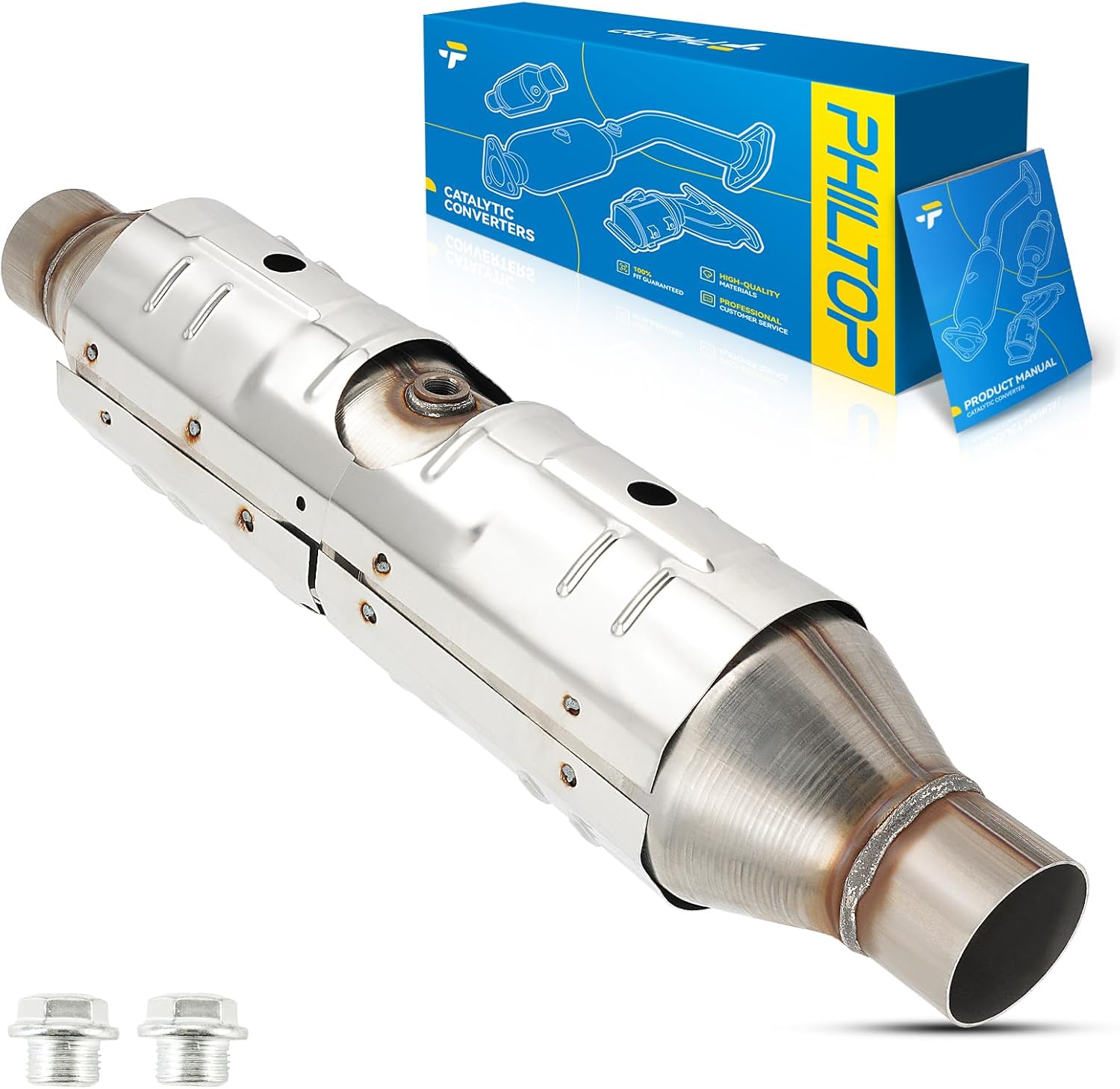
| Position | Front |
|---|---|
| Manufacturer | PHILTOP |
| OEM Part Number | 78300, 200007, 606307 |
| EPA Compliance | Federal emissions (not CARB) |
This PHILTOP catalytic converter is a bolt-on, flange-to-flange replacement built for front-position installs on 1999–2007 Ford Super Duty and compatible Econoline vehicles. It uses a high-flow ceramic substrate intended to lower backpressure and improve catalytic conversion efficiency, which can restore performance and help with fuel economy if the original unit was clogged. The converter ships with OE-style gaskets and hardware so most installations can be completed in a few hours without modification. Its stainless steel outer shell and welded connections aim to resist heat and corrosion for longer service life. It is EPA-compliant for federal emissions but not legal in states that require California standards, so it is not suitable where CARB certification is required. Buyers should also be prepared to verify fitment against the listed reference number and vehicle specifics before ordering to ensure a correct match.
Best for: A practical buyer who needs a reliable, ready-to-install replacement that restores emissions function and drivability on the specified 1999–2007 Ford Super Duty family without paying for dealer installation.
Less Ideal for: Drivers in states that require California emissions certification or anyone needing a universal/modified-fit performance converter for custom exhaust systems.
- Direct-fit flange-to-flange design with included gaskets and hardware for straightforward installation
- High-flow ceramic substrate reduces backpressure and can improve engine breathing and catalytic efficiency
- Stainless steel shell and welded connections designed for durability under heat and road conditions
- Not CARB-compliant and therefore illegal for use in states that require California emissions standards
Verdict: Choose this durable, bolt-on stainless steel replacement if you want a straightforward EPA-compliant front converter to restore performance and emissions on the 1999–2007 Ford Super Duty lineup.
4. ZonCar Front Catalytic Converter for 2000–2007 Ford F-250/F-350 Super Duty

| Brand | ZonCar |
|---|---|
| Position | Front |
| Model fit | F-250 Super Duty 2000-2007 |
| Manufacturer Part Number | 3076EXP641EUS |
This ZonCar front catalytic converter is a direct-fit replacement aimed at restoring emissions control and maintaining engine flow on 2000–2007 Ford Super Duty trucks. It uses a honeycomb ceramic substrate pre-coated with precious metal catalysts and a stainless-steel shell for heat and corrosion resistance. In practice it installs in the front position to bring a failed or clogged converter back to spec and help the vehicle pass emissions checks while avoiding the power loss that comes with severely restricted units. Notable features are the high-load catalyst coating and machined exterior that should resist rust and high exhaust temperatures. Expect a functional, no-frills replacement that focuses on emissions efficiency and durability rather than performance gains. Limitations include the typical variability of aftermarket fit and finish compared with factory parts and no included hardware or detailed installation guidance beyond standard replacement procedures.
Best for: Buyers looking for an affordable, functional replacement to fix emissions-related issues and get a 2000–2007 Super Duty truck back to driving condition without upgrading other exhaust components.
Less Ideal for: Owners seeking a performance-oriented or custom exhaust upgrade or those who need guaranteed factory-identical finish and fit should consider higher-end or OEM options.
- Designed for direct front-position replacement on 2000–2007 Super Duty trucks
- Stainless-steel shell improves resistance to heat and corrosion
- Honeycomb ceramic substrate with catalyst coating for effective emissions conversion
- High-flow design aims to retain engine output while restoring emissions control
- Aftermarket fit and finish may vary compared with factory parts
Verdict: A practical, budget-focused front catalytic converter that restores emissions control on 2000–2007 Ford Super Duty trucks without adding complexity.
5. A-Premium Catalytic Converter with Gasket Kit for Ford F-250/F-350/Excursion 2000–2005 (EPA Compliant)

| Vehicle Fitment | Ford Excursion and F-250/F-350 2000–2005, 5.4L/6.8L |
|---|---|
| EPA Compliance | Yes (federal emissions) |
| Body Material | Stainless Steel |
| Inlet Type | 3 Bolt Welded |
| Outlet Diameter | 3" OD |
This A-Premium catalytic converter is a direct-fit replacement intended for 2000–2005 Ford F-250, F-350, and Excursion trucks with 5.4L or 6.8L engines. It installs where the factory converter mounts, includes gaskets and mounting hardware, and uses stainless steel construction for corrosion resistance. The unit is EPA compliant for federal emissions and has a welded 3-bolt inlet with a 3-inch OD outlet to match standard exhaust piping, which simplifies swap-in replacement and reduces fabrication work. Practical benefits include factory-style fitment that cuts shop time and the included hardware so you are less likely to need extra parts. Limitations are that it is restricted from sale or installation in some states with stricter regulations and it is specified only for the listed model years and engine sizes, so fit must be confirmed before purchase. A one-year unlimited-mileage guarantee is offered by the manufacturer for added peace of mind.
Best for: Buyers who prioritize a dependable, factory-style replacement that installs with minimal modification and keeps a well-maintained older Ford running to emissions standards.
Less Ideal for: Drivers in states with strict aftermarket converter restrictions or anyone with a nonlisted engine or model year should look for a converter specifically certified for their location or vehicle.
- Direct-fit design for 2000–2005 F-250/F-350/Excursion minimizes modifications and installation time
- Stainless steel body improves corrosion resistance over time
- Includes gaskets and mounting hardware so fewer additional parts are needed
- EPA-compliant for federal emissions, matching regulatory requirements for many regions
- Not legal for sale or installation in certain states with stricter aftermarket converter rules
Verdict: Choose this direct-fit stainless steel converter when you want a factory-style, low-hassle replacement that restores emissions compliance for the specified 2000–2005 Ford F-250/F-350/Excursion engines.
6. PHILTOP Direct-Fit Catalytic Converter for 1999–2007 F-250/F-350/Excursion (Replace# 78300)
| Compatible vehicles | 1999–2007 F250/F350/Excursion and select Econoline models (see fitment) |
|---|---|
| OEM part number | 78300, 200007, 606307 |
| Position | Front |
| Construction | Stainless steel shell |
This PHILTOP catalytic converter is a bolt-on, flange-to-flange replacement built to match factory mounting points for 1999–2007 F-250/F-350/Excursion and related Econoline models. It uses a high-flow ceramic substrate to reduce backpressure and improve catalytic efficiency, and the stainless steel shell with welded connections aims to resist heat and corrosion for long service life. The unit ships with OE-style gaskets and hardware so installation can usually be completed in a few hours without modification. It is sold as EPA-compliant for federal emissions states but is not legal in California, New York, Colorado, or Maine for vehicles that must meet those states' stricter standards. For buyers who value a factory-style replacement with higher flow characteristics, this converter balances durability and ease of fitment; buyers should confirm vehicle fit with the listing's compatibility tool before ordering and be aware of regional emissions restrictions.
Best for: Buyers who prioritize a proven, bolt-on replacement that fits original mounting points and want reassurance from other shoppers that the part installs cleanly and performs like a factory-style converter.
Less Ideal for: People who need a catalytic converter certified for California or other state-specific emissions programs or buyers seeking a custom high-performance racing setup.
- Direct-fit flange-to-flange design matches factory mounting points for simpler installation.
- High-flow ceramic substrate reduces backpressure and can improve engine breathing compared with a damaged converter.
- Stainless steel outer shell with welded connections enhances durability under high heat.
- Includes OE-style gaskets and hardware so no additional parts are typically required for installation.
- Not compliant with California, New York, Colorado, or Maine emissions requirements so cannot be used where those standards apply.
Verdict: A straightforward, factory-style direct-fit replacement that offers higher flow and simple bolt-on installation for 1999–2007 Ford Super Duty trucks when federal EPA compliance is acceptable.
7. PHILTOP Catalytic Converter Kit for Ford F-250/F-350 Super Duty and E-Series (front)
| Position | Front |
|---|---|
| Material | 409L stainless steel |
| Application | 1999–2007 F-250/F-350 Super Duty and listed E-Series models |
| OEM part numbers | 78300, 200007, 606307 |
| EPA status | EPA-compliant (not for CA/CO/ME/NY) |
This PHILTOP catalytic converter is a direct replacement intended to restore emissions control and reduce exhaust noise and rattling from a damaged converter. It is made from 409L stainless steel with a high-flow ceramic honeycomb substrate to lower backpressure while maintaining catalytic efficiency. The kit includes OE-style gaskets and hardware so installers can bolt it in with no modification; the brand says a typical install takes about 3 to 4 hours. The converter is EPA approved for federal emissions but is not legal for sale or installation in California, Colorado, Maine, or New York. Practical benefits are straightforward: factory-compatible mounting, corrosion-resistant construction, and a high-flow internal design that can help engine breathing and idle smoothness. Limitations include regional emissions restrictions and the need to verify exact vehicle fit with the confirmed-fit tool before buying. Expect professional installation if you are not comfortable working under the vehicle.
Best for: Buyers who want a reliable, factory-style replacement to restore emissions performance and quiet operation with straightforward bolt-on installation and minimal fuss.
Less Ideal for: Do not choose this if you need a converter certified for California or other state-specific emissions programs or if you prefer a universal or performance aftermarket unit.
- Direct-fit design with OE-style gaskets and hardware for straightforward installation
- Constructed from 409L stainless steel for corrosion resistance and long service life
- High-flow ceramic honeycomb substrate to reduce backpressure and help engine breathing
- EPA-compliant for federal emissions standards, restoring legal emissions control where allowed
- Not legal for sale or installation in California, Colorado, Maine, or New York
Verdict: A factory-style, EPA-compliant direct-fit replacement that restores emissions control and exhaust quieting for 1999–2007 Ford Super Duty trucks where federal certification is accepted.
Choosing the Right 1999-2007 Ford F-350 Catalytic Converter: Key Factors to Consider
Fitment and Exhaust Routing
Correct fitment is the first priority because the 1999-2007 Ford F-350 has specific exhaust pipe diameters, hanger locations, and oxygen sensor ports. A converter that matches flange types and sensor bung positions reduces installation time and the need for cutting or welding.
Mismatched fitment can lead to leaks, improper sensor readings, and accelerated wear on adjacent exhaust components. When a converter requires pipe modification, plan for welding and alignment to maintain proper hanger support and avoid undue strain on the exhaust system.
Catalyst Substrate and Emissions Performance
The substrate type and washcoat loading determine how effectively the converter reduces hydrocarbons, carbon monoxide, and nitrogen oxides. Higher cell density and quality washcoat chemistry improve conversion efficiency, especially during engine warm-up when emissions are highest.
For heavy-duty use or frequent towing, choose converters with substrates designed to handle higher exhaust temperatures and increased contaminant loads. Better substrates help the vehicle pass emissions tests and reduce the likelihood of repeat failures from clogging or catalyst degradation.
Durability and Heat Resistance
Durable construction is essential for a truck that sees high loads, long hauls, or off-highway use. Look for robust steel shells, quality internal supports, and thermal resilience in the catalyst materials to resist cracking or collapse under thermal cycling.
Rust resistance and corrosion protection matter in regions with road salt or heavy moisture. A converter that resists external corrosion and maintains internal integrity will last longer and reduce labor costs from repeated replacements.
Oxygen Sensor Provision and Compatibility
The F-350's engine management depends on upstream and downstream oxygen sensors for closed-loop control. A replacement converter must provide sensor bungs in the correct locations or allow transfer of the original sensors without affecting wiring length or sensor performance.
Incorrect sensor placement can trigger diagnostic trouble codes or interfere with fuel trim. Confirm the converter supports your engine's sensor layout to avoid additional electrical or harness work.
Installation Complexity and Hardware
Some converters are direct-fit with all necessary gaskets and flange hardware, while others require cutting, welding, or new mounting parts. Installation complexity affects labor time and cost, plus the likelihood of exhaust leaks after service.
Choosing a unit that includes replacement gaskets and matches existing flange types reduces installation pitfalls. If welding is needed, ensure proper alignment and sealing practices are followed to maintain exhaust backpressure and sensor readings.
Maintenance Considerations and Longevity
Think ahead about common failure modes such as substrate clogging, impact damage, or contamination from oil/antifreeze burning. Regular inspections for rattling, rust, and sensor codes help catch problems early and extend the component's life.
Selecting a converter with accessible service points and documented lifespan expectations helps you plan maintenance intervals. Consider how heavy-duty usage patterns affect longevity and whether replacement is likely sooner under frequent towing or idling conditions.
Common Symptoms of Catalytic Converter Problems
Recognizing failure signs early prevents secondary engine problems. Common symptoms on the 1999-2007 Ford F-350 include a persistent check engine light related to emissions codes, reduced acceleration, or unusual exhaust odor. Rattling noises under the vehicle can indicate a disintegrating substrate.
Other practical indicators are a noticeable drop in fuel economy and difficulty passing emissions testing. If you experience abrupt loss of power under load, the converter may be partially clogged and restricting exhaust flow, which is especially evident when towing.
- Check engine light codes related to oxygen sensors or catalyst efficiency
- Reduced throttle response and acceleration, particularly under load
- Rattling noises from beneath the vehicle at idle or on acceleration
- Stronger exhaust odor or visible smoke indicating contamination
Fitment Tips for 1999-2007 F-350 Exhausts
Before ordering a replacement, confirm the converter's inlet and outlet diameters and flange type match your F-350's factory exhaust. If your truck has been modified or raised, verify hanger positions and pipe routing to avoid interference with the body or suspension components.
If the replacement requires welding, plan for proper support and hangers to prevent sagging. Retain or reuse oxygen sensors and associated wiring where possible to preserve sensor calibration and reduce installation complexity.
- Measure pipe diameters and flange bolt patterns before purchase
- Check sensor bung locations versus your current converter
- Inspect hangers and heat shields for compatibility
Installation and Replacement Considerations
Replacing a catalytic converter can be straightforward if the unit is a direct fit. For converters that require welding or cutting, ensure the exhaust system is cold and supported. Use proper safety equipment and follow torque specs for flange connections to avoid leaks.
After installation, clear any stored diagnostic codes and perform a test drive under varied loads to confirm there are no leaks and sensors are reading properly. Reinspect flanges and hangers after initial heat cycles to ensure seals remain tight.
- Ensure anti-seize on sensor threads and correct torque on bolts
- Clear engine codes and monitor fuel trims after installation
- Recheck for leaks after a few heat cycles
Emissions Testing and Legal Considerations
If your region requires emissions testing, select a converter designed to meet applicable emissions requirements for the 1999-2007 F-350. Using a converter without proper catalyst substrate or missing sensor provisions can result in failed inspections or persistent diagnostic trouble codes.
Maintain documentation of the part specifications and installation in case inspectors request proof of compliance. In some jurisdictions, certain aftermarket converters are restricted, so verify local regulations before purchasing and installing a replacement.
- Confirm catalytic efficiency specifications align with local testing requirements
- Keep installation and parts documentation available
- Verify legality of aftermarket parts in your jurisdiction
Preventive Care to Extend Converter Life
Preventive maintenance reduces the risk of early converter failure. Regularly address engine issues that cause oil or coolant contamination of the exhaust, such as valve cover leaks or head gasket problems. Fixing misfires and fueling issues promptly prevents unburned fuel from overheating or poisoning the catalyst.
Routine inspections for exhaust leaks, damaged heat shields, and secure hangers also protect the converter from mechanical damage. For trucks used in heavy towing, inspect the exhaust system more frequently due to increased thermal and mechanical stress.
- Repair engine oil or coolant leaks promptly
- Address misfires and ignition issues right away
- Inspect exhaust hangers and heat shields regularly, especially after heavy use
Still looking for the perfect fit?
Select your Ford F-350 configuration to see the most relevant Catalytic Converters recommendations
How We Chose the Best 1999-2007 Ford F-350 Catalytic Converter
We focused on criteria that matter for the 1999-2007 Ford F-350 and the common service needs for these trucks. Primary evaluation factors included fitment accuracy to the F-350's exhaust geometry, catalyst substrate type and washcoat quality for emissions control, and the converter's durability under heavy-duty or towing loads. We also examined material and construction quality for resistance to rust and exhaust heat, and inlet/outlet flange compatibility to minimize welding or modification.Additional selection filters included compliance with emissions standards where applicable, the availability of replacement gaskets and mounting hardware, and whether the unit supports the truck's oxygen sensor positions. We excluded universal or generic designs that require extensive modification to fit the F-350, and any converters lacking clear specification data on substrate composition or sensor provision. Our approach prioritized real-world reliability, ease of installation, and emissions effectiveness.
Our full evaluation process is outlined in our review methodology.
FAQ
How do I know if the catalytic converter is causing the check engine light?
A check engine light tied to catalyst efficiency or oxygen sensor codes often points to converter issues. Diagnosis usually involves reading trouble codes and monitoring upstream and downstream oxygen sensor voltages to see if the converter is achieving expected conversion levels.
Can a clogged catalytic converter reduce towing performance?
Yes. A partially clogged converter restricts exhaust flow, which reduces available power and throttle response when towing. If you notice power loss under load, inspect the exhaust for backpressure issues and have the converter checked.
Is a direct-fit converter always the best choice for the F-350?
Direct-fit units typically simplify installation and reduce the need for modifications, making them preferable for most owners. However, quality and catalyst construction are equally important, so weigh both fitment and substrate specifications.
Will repairing engine misfires help prevent catalytic converter failure?
Yes. Ongoing misfires can allow raw fuel into the exhaust stream, which can overheat or contaminate the catalyst and shorten its life. Address ignition and fueling problems promptly to protect the converter.
Can I reuse the original oxygen sensors when replacing the converter?
Often you can reuse the sensors if they are in good condition and the new converter provides compatible bungs. Inspect the sensors for wear and ensure wiring lengths and connectors match to avoid adding diagnostic issues.
How often should the exhaust and converter be inspected on a working F-350?
For typical use, inspect the exhaust and converter at routine service intervals or whenever diagnostics suggest an emissions problem. For heavy-duty use or frequent towing, increase inspection frequency to catch heat- or load-related damage early.
Final Verdict
When replacing a catalytic converter on a 1999-2007 Ford F-350, prioritize correct fitment, solid catalyst construction, and proper provision for oxygen sensors. These elements determine installation ease, emissions performance, and long-term durability. Balance your need for a unit that stands up to heavy-duty use against installation complexity.Ultimately, choose a converter that matches the truck's exhaust geometry and intended duty cycle. Focus on substrate quality, corrosion resistance, and correct sensor placement to restore emissions control and keep the F-350 running reliably under load.
