

Note: This article contains affiliate links. If you click on these links and make a purchase, I may earn a small commission at no extra cost to you. This helps support my research and content. Read my full affiliate disclosure here.
Replacing the battery in a Toyota Camry LE is one of the most practical maintenance tasks you can do to avoid unexpected no-starts and electrical gremlins. The right car battery affects cold-weather starting, accessory runtime when the engine is off, and how often you need to replace it. This guide covers seven carefully shortlisted options suited to the Camry LE specification and daily driving demands.We evaluated candidates across key metrics like cold-cranking power, reserve capacity, compatibility with the Camry LE battery tray and terminal layout, and real-world reliability indicators. Read on for a concise breakdown of what matters and how to choose the right battery for your Camry LE, followed by focused FAQs and a final verdict to help you decide confidently.
Looking for other parts? See all Toyota Camry parts & accessories.
Top Picks at a Glance
| Best Overall The best all-around choice for most situations | UPLUS AGM Group 140R Start-Stop Car Battery, 12V 50Ah |  |
| Best Quality Built to a higher standard if you want something more solid | OPTIMA YELLOWTOP D35 High Performance Dual Purpose AGM Battery |  |
| Best Value The sweet spot between price and what you get | Goodyear Platinum 47-H5-AGM 12V 60Ah Rechargeable AGM Car Battery |  |
| Best Budget The cheapest option that still gets the job done reliably | Mighty Max Battery MM-G35 Group 35 12V 55Ah AGM Automotive Battery |  |
| Highest Rated A top-rated pick with lots of positive feedback | OPTIMA RedTop 35 High Performance Sealed AGM Starting Battery |  |
| Most Popular A crowd favorite that many people choose with confidence | Mighty Max Battery MM-G35 12V 55Ah AGM Car Battery | |
| Best Seller A high-volume bestseller chosen again and again | ACDelco Gold 48AGM Group 48 AGM Automotive Battery |  |
UPLUS AGM Group 140R Start-Stop Car Battery, 12V 50Ah

| Voltage | 12 Volts |
|---|---|
| Capacity (20HR) | 50 Ah |
| Cold Cranking Amps | 570 CCA |
| Battery Technology | AGM |
| Reserve Capacity | 80 min |
This UPLUS Group 140R AGM battery is a maintenance-free start-stop replacement designed to deliver steady starting power and better deep-cycle performance than a conventional flooded battery. Intended for vehicles that accept a Group 140R/H4/LN1 unit, it pairs 570 CCA with AGM construction to provide reliable cold starts and improved resistance to vibration and leakage. The battery’s design emphasizes extra cycling life and reserve capacity, which helps when a car sits unused for days or when electronics draw current during short trips. Installation is straightforward where the Group 140R form factor and SAE terminals match the vehicle’s tray and cable orientation. Important limitations are its specific group size and terminal layout, so fitment must be confirmed for a Toyota Camry LE before purchase, and its 50 Ah capacity is targeted at moderate accessory loads rather than heavy aftermarket electrical systems. The included three-year after-sales support is useful if any early issues appear.
Best for: Buyers who want a balanced, reliable factory-style replacement that improves start reliability and battery longevity without upgrading to a high-capacity or performance unit.
Less Ideal for: Drivers planning heavy electrical upgrades, high-draw audio systems, or those who need a different group size or terminal layout should choose a different battery.
- AGM construction improves vibration resistance and prevents acid leakage compared with flooded batteries
- Designed for start-stop use with higher cycle life for frequent short trips or vehicles that sit unused
- 570 CCA provides reliable cold-start performance in most climates
- Compact Group 140R form factor fits vehicles specified for H4/LN1 batteries and uses SAE terminals
- Only fits vehicles that accept Group 140R/H4/LN1 batteries with the same terminal layout, so not universally compatible
Verdict: A practical AGM Group 140R replacement that balances dependable starting power and improved cycle life for drivers seeking a reliable factory-style battery swap.
OPTIMA YELLOWTOP D35 High Performance Dual Purpose AGM Battery

| Voltage | 12 Volts |
|---|---|
| Cold Cranking Amps | 620 CCA |
| Battery Type | Lead Acid AGM |
| Terminal | SAE Terminal |
| Automotive Fit Type | Vehicle Specific Fit |
The OPTIMA YELLOWTOP D35 is a sealed AGM battery designed to combine high cranking amps with deep-cycle capability for vehicles that run extra electronics or sit for long periods. It uses SpiralCell construction to resist vibration and charge faster than conventional flooded batteries, and its sealed, maintenance-free design lets it be mounted in more orientations without leaking. Typical uses include cars with high-demand audio, vehicles with winches or inverters, and daily drivers that need reliable cold starts after long idle periods. The battery offers a 620 CCA rating and a long reserve capacity, which helps cold-weather starting and running accessories with the engine off. Trade-offs are cost and weight compared with standard replacement batteries and the need to use a charger with an AGM or deep-cycle setting for best life. Warranty coverage is limited compared with some competitors, so keep purchase documentation if you need service.
Best for: Drivers who prioritize dependable starting and the ability to run high-draw accessories or aftermarket audio without frequent battery replacement.
Less Ideal for: Buyers seeking the lowest-cost or lightest replacement battery for basic commuting without high electrical loads should consider simpler flooded options.
- Dual-purpose AGM design combines strong starting power with deep-cycle ability for accessory loads
- SpiralCell construction offers enhanced vibration resistance and longer life versus standard flooded batteries
- Sealed, maintenance-free design allows flexible mounting and reduces leakage risk
- High cold cranking amps and substantial reserve capacity aid reliable cold-weather starts and accessory use
- Higher upfront cost and greater weight compared with conventional replacement batteries
- Requires an AGM-aware charger for optimal charging and long service life
Verdict: Choose the OPTIMA YELLOWTOP D35 if you need stout starting power plus reliable deep-cycle performance for a Camry with heavy electrical accessories.
Goodyear Platinum 47-H5-AGM 12V 60Ah Rechargeable AGM Car Battery
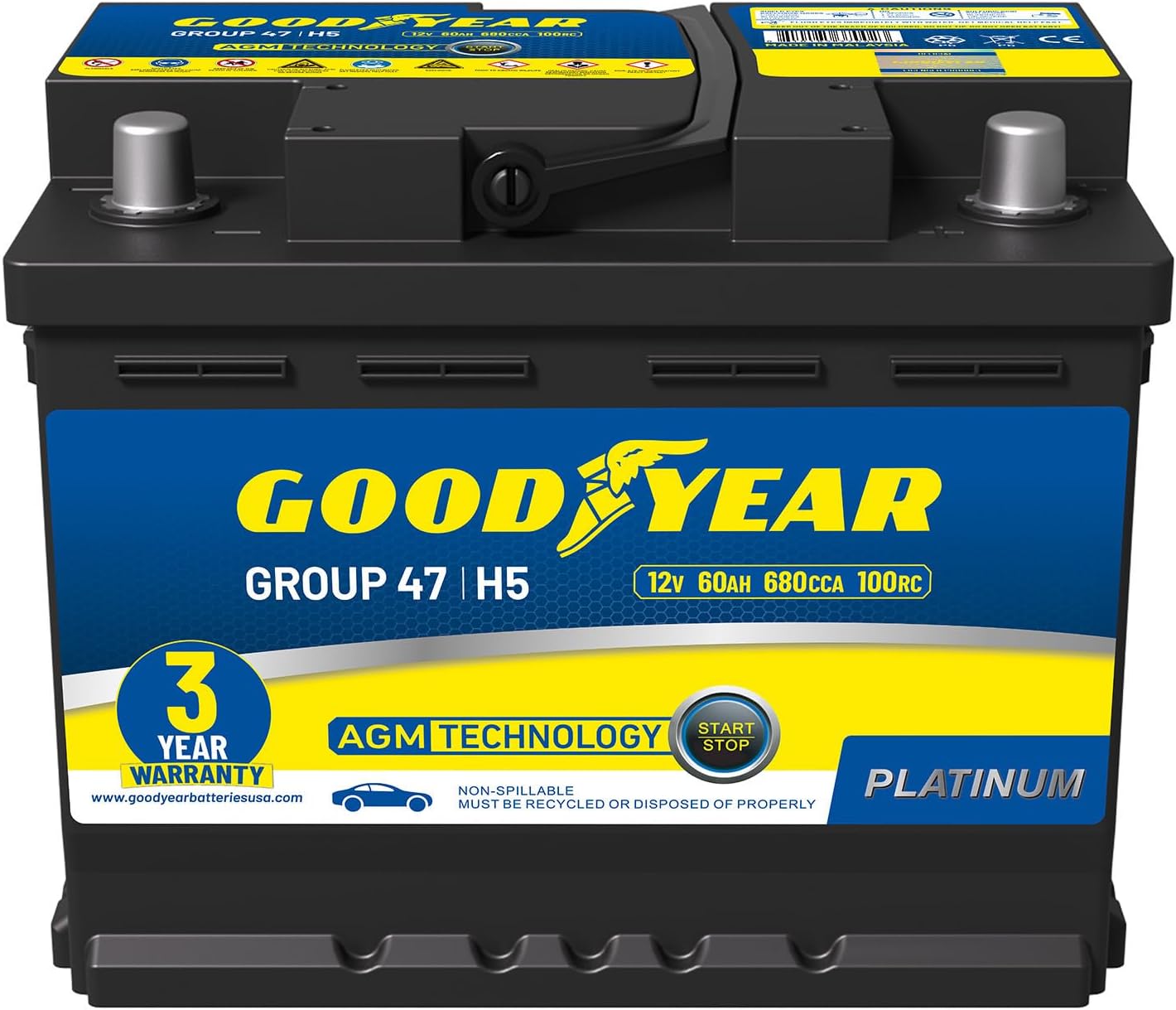
| Voltage | 12 Volts |
|---|---|
| Battery Capacity | 60 Amp Hours |
| Terminal | Pole Terminal |
| Compatible with Vehicle Type | Passenger Car |
| Automotive Fit Type | Universal Fit |
The Goodyear Platinum 47-H5-AGM is a sealed AGM replacement battery designed to deliver reliable starts and steady electrical performance in everyday passenger car use. It supplies 680 cold cranking amps and a 100-minute reserve capacity, which helps with consistent starting and keeps accessories powered during short alternator interruptions. The sealed Absorbed Glass Mat design means no topping up, minimal leakage risk, and better vibration resistance compared with conventional flooded batteries. Installation is straightforward in Camry applications that accept this group size, and the battery can be mounted in multiple positions except upside down for flexible fitment in tighter battery trays. The practical benefits are strong starting in cold weather, maintenance-free operation, and longer cycle life than a conventional battery. Limits to consider are that it is a lead-acid AGM rather than a lithium option, so it is heavier and not the lowest-weight choice, and some users report compatibility issues with terminal types or vendor support—verify terminal orientation and physical fit for your Camry before buying.
Best for: Buyers who want a dependable, low-maintenance replacement that prioritizes reliable starting and longer cycle life over the lightest possible weight.
Less Ideal for: Drivers looking for the lightest or highest energy-density option or those needing specialized terminal configurations without adapters should consider other battery types or verify fitment first.
- AGM sealed design prevents spills and reduces maintenance needs.
- 680 CCA and 100 RC deliver reliable cold starts and reserve power for accessories.
- Vibration-resistant construction suited to everyday driving and rough roads.
- Can be mounted in multiple positions for flexible installation in compact battery compartments.
- Terminal style may not match every vehicle harness without an adapter.
- Being an AGM lead-acid battery it is heavier than lithium alternatives.
Verdict: Choose this Goodyear Platinum AGM when you want a maintenance-free battery that delivers reliable cold starts and consistent electrical performance for daily Camry driving.
Mighty Max Battery MM-G35 Group 35 12V 55Ah AGM Automotive Battery

| Voltage | 12 Volts |
|---|---|
| Battery Capacity | 55 Amp Hours |
| Battery Type | Lead Acid |
| Compatible with Vehicle Type | Passenger Car |
The Mighty Max MM-G35 is a sealed AGM Group 35 replacement battery intended for everyday passenger car use such as the Toyota Camry LE. It supplies 650 CCA for reliable cold starts and a 100-minute reserve capacity so accessories keep running during brief alternator interruptions. The AGM design is spill-proof and supports multiple mounting positions, which simplifies installation and reduces maintenance compared with flooded lead acid cells. Rugged construction and vibration resistance help it tolerate typical road conditions, and the included mounting screws make swapping the battery straightforward. Limitations include its lead acid chemistry rather than newer lithium options and a listed manufacturer warranty that varies in product copy, so buyers seeking the longest lifespan or lightest weight may prefer other chemistries. For budget-focused shoppers needing a direct Group 35 replacement with solid starting power and low upkeep, this battery is a practical choice.
Best for: Drivers looking for an affordable, low-maintenance Group 35 replacement that reliably starts daily-driven Camry LE vehicles and keeps accessories powered during short electrical interruptions.
Less Ideal for: Owners who prioritize the lightest possible battery, maximum cycle life, or the latest lithium technology should consider higher-end alternatives.
- 650 cold cranking amps delivers reliable starting power in most weather conditions
- AGM sealed design is spill-proof and maintenance-free compared with flooded batteries
- 100-minute reserve capacity supports accessory loads during brief alternator outages
- Multiple mounting positions increase fitment flexibility for Group 35 applications
- Lead acid AGM is heavier and offers lower cycle life than lithium alternatives
Verdict: A budget-friendly, maintenance-free Group 35 AGM battery that delivers dependable starting power for daily-driven Toyota Camry LE cars.
OPTIMA RedTop 35 High Performance Sealed AGM Starting Battery

| Voltage | 12-Volt |
|---|---|
| Cold Cranking Amps | 720 CCA |
| Capacity (C20) | 44 AH |
| Reserve Capacity | 90 minutes |
| Terminal | SAE Terminal |
The OPTIMA RedTop 35 is a sealed AGM starting battery built for reliable, high-current starts in demanding conditions. It uses SpiralCell construction to deliver strong cold cranking amps and faster recharge compared with conventional flat-plate batteries, and its sealed, non-spillable design lets you mount it in multiple orientations. Typical use is as a direct-replacement starting battery for vehicles like the Toyota Camry LE where dependable starting and resistance to vibration matter more than deep-cycle capacity. Notable features include 720 CCA, a 90-minute reserve capacity, SAE post terminals, and heavy-duty plastic casing for durability. In practice that means quicker, more confident starts in cold or hot weather and less worry about vibration-related damage on rough roads. Limitations are higher weight and cost compared with standard flooded batteries and the product is optimized for starting rather than heavy accessory loads or frequent deep discharging. Expect to pair it with a proper charging system and avoid prolonged deep discharge to get its best lifespan.
Best for: Buyers who prioritize a worry-free, long-lasting starting battery and want dependable cold-start performance and vibration resistance for everyday driving.
Less Ideal for: Drivers who need a battery for frequent deep-discharge cycles, heavy aftermarket electronics, or off-grid camping should consider a deep-cycle or dual-purpose battery instead.
- Sealed AGM construction allows safe mounting in multiple positions and is non-spillable.
- High cold cranking amps for consistent starting performance in cold weather.
- SpiralCell design and higher reserve capacity for faster recharging and longer service life than standard flooded batteries.
- Focused on starting power rather than deep-cycle performance for accessories or prolonged off-grid use.
Verdict: Choose the OPTIMA RedTop 35 if your priority is reliable, high-current starting and long-term vibration-resistant performance.
Mighty Max Battery MM-G35 12V 55Ah AGM Car Battery
| Voltage | 12V |
|---|---|
| Capacity | 55 Amp Hours |
| Cold Cranking Amps | 650 CCA |
| Reserve Capacity | 100 minutes |
| Battery Type | Lead Acid AGM |
The Mighty Max MM-G35 is a sealed AGM replacement battery sized to Group 35 applications and built for reliable starting and moderate accessory loads. It supplies 650 CCA for strong cold starts, a 55 Ah capacity for run-time between charging, and a 100-minute reserve capacity to handle short accessory use or unexpected drain. The AGM construction is maintenance-free and spill-proof, which makes installation cleaner and allows mounting in multiple orientations except upside down. The battery is designed to resist vibration and temperature extremes and ships ready to install with mounting screws included. Practical limitations are that fitment must match your Camry's Group 35 tray and terminal orientation, and some buyers report inconsistent longevity and warranty handling, so keep records and test the unit if any issues appear. For a Camry LE this battery is a budget-friendly AGM option that balances starting power and convenience, but plan to verify fit and register the product to preserve warranty coverage.
Best for: Buyers who prioritize peer-reviewed reliability and want a maintenance-free AGM replacement that delivers dependable starting and simple installation for everyday driving.
Less Ideal for: Drivers who need extended deep-cycle performance for heavy aftermarket electronics or who prefer dealer-backed warranty service and hassle-free local replacements.
- AGM sealed design provides spill-proof, maintenance-free operation
- 650 CCA delivers reliable cold starts in most climates
- 100-minute reserve capacity supports short accessory use without immediate recharge
- Included mounting screws and ready-to-install charge out of the box
- Some customers report early failures and difficult warranty claim processes
Verdict: A cost-conscious AGM Group 35 replacement that gives strong starting power and maintenance-free operation for standard Camry LE use.
ACDelco Gold 48AGM Group 48 AGM Automotive Battery

| Number Of Cells | 6 |
|---|---|
| Resistance | 0.02 Ohms |
| Amperage | 70 Amps |
| Item model number | 48AGM |
The ACDelco Gold 48AGM is an absorbent glass mat battery intended as a direct replacement for vehicles that require a Group 48/H6 battery. It provides strong starting power and improved resistance to vibration and leakage compared with conventional flooded batteries, making it suitable for daily driving and cars with heavier accessory loads. Typical use is as the vehicle’s primary 12V battery in applications where reliability matters, including stop/start or hybrid-adjacent electrical systems. Notable features include AGM construction for spill-proof, maintenance-free operation and a manufacturer-backed 36 month free replacement period. In practical terms this means fewer worries about terminal corrosion and better charge retention over time, which is useful for drivers who want predictable starts after short trips or in cold weather. Trade-offs are that AGM batteries cost more than standard flooded units and are larger and heavier, so confirm fitment and mounting in the Camry LE’s battery tray and hold-down before purchasing.
Best for: Buyers who prioritize dependable, low-maintenance starting and want a durable factory-quality replacement that reduces the risk of unexpected battery failure.
Less Ideal for: Shoppers who want the lowest upfront cost or who need the absolute lightest battery option should consider conventional flooded batteries instead.
- AGM design is spill-proof and maintenance-free which reduces upkeep
- Higher cold-cranking and reserve performance than typical flooded batteries for reliable starts
- Good vibration resistance and longer expected life in demanding use
- Backed by a 36 month free replacement period from the manufacturer
- Higher purchase cost and greater weight compared with conventional flooded batteries
Verdict: Choose this ACDelco Gold AGM when you want a durable, maintenance-free Group 48 battery that delivers reliable starts and longer service life.
Choosing the Right Toyota Camry LE Car Battery: Key Factors to Consider
Cold-Cranking Amps (CCA)
Cold-cranking amps measure how much current a battery can deliver at low temperatures and directly affects whether your Camry LE will start reliably in cold weather. Higher CCA ratings provide a larger safety margin on chilly mornings or after prolonged idling. For Camry LE owners who live in regions with winter temperatures, choosing a battery with sufficient CCA reduces the risk of slow cranking or multiple start attempts.
Keep in mind that CCA is only one piece of the puzzle. The charging system condition, starter health, and engine temperature also influence starting performance. Still, when choosing between acceptable fits, prioritize a higher CCA within the recommended group size to improve cold-start resilience without compromising fitment or safety.
Reserve Capacity and Accessory Load
Reserve capacity defines how long a battery can supply power if the charging system fails, measured in minutes until a specified voltage drop. For Camry LE owners who use accessories with the engine off, like music systems or interior lights during short stops, a higher reserve capacity provides a longer buffer before the battery becomes depleted. It also helps during repeated start attempts and when the alternator output is temporarily reduced.
Reserve capacity matters for road trips and situations where the vehicle may sit in traffic with accessories running. Choose a battery with reserve capacity that balances physical size constraints with the extra runtime you expect to need. A larger reserve capacity often correlates with longer service life under deep discharge events.
Fitment: Group Size, Terminal Location, and Tray Compatibility
Physical fit matters as much as electrical specs. The Camry LE requires batteries that match its battery tray footprint and terminal orientation to avoid cable strain and ensure the hold-down clamps fit properly. Incorrect group size or reversed terminals can result in installation difficulties or unsafe cable routing.
Before finalizing a purchase, confirm the battery group size recommended for the Camry LE model year and check that the positive and negative terminal positions align with the vehicle cables. Also consider the battery height if your vehicle has a cover or clamp with limited clearance. Proper fitment prevents vibration-related wear and keeps electrical connections secure.
Battery Chemistry and Lifespan
Battery chemistry—flooded lead-acid, AGM, or enhanced flooded types—affects performance, maintenance needs, and expected service life. AGM batteries typically offer better vibration resistance and lower internal resistance for higher cold-cranking performance, while conventional flooded batteries are often more affordable but may require more frequent replacement under heavy use.
For the Camry LE, pick a chemistry that fits your driving pattern. If you frequently run accessories while stopped or do many short trips that prevent full charging, AGM can tolerate partial-state-of-charge conditions better. If the vehicle spends long periods parked or you prioritize lower upfront cost, a conventional battery with solid CCA and reserve capacity may be acceptable. Expect lifespan to vary based on climate, driving habits, and charging system health.
Warranty, Support, and Expected Service Life
Warranty length and terms provide insight into expected reliability and manufacturer confidence. A longer free-replacement period can reduce ownership cost if the battery fails early. However, warranty conditions often require proof of proper installation and may exclude issues caused by charging system faults or abusive use.
Consider the practical service life you can expect in your climate and driving conditions when weighing warranty value. A battery with strong early replacement coverage and reasonable prorated terms offers better peace of mind, but always ensure your vehicle charging system is in good condition to avoid premature failures that warranties may not cover.
Maintenance Needs and Installation Considerations
Some batteries require periodic topping up or special handling, while maintenance-free and sealed designs reduce routine care. For most Camry LE owners, a maintenance-free battery simplifies ownership and lowers the chance of corrosion-related starting issues. However, sealed designs may still require correct charging profiles from the alternator.
Installation ease matters too. Look for batteries with clearly labeled terminals, comfortable handling features, and compatibility with standard hold-downs. Proper installation includes secure mounting, clean terminal connections, and correct torque on cable clamps to avoid voltage drop and premature failure. If you plan to install the battery yourself, factor in safe lifting and disposal practices.
Choosing the Right Battery Group Size for Camry LE
Selecting the correct group size ensures the battery sits securely in the Camry LE tray and that the terminal positions match the vehicle cables. Group size affects not just fit but also capacity and available CCA range. Verify the recommended group size for your Camry LE model year before comparing electrical specs.
If a battery is slightly larger in capacity but shares the same footprint and terminal layout, it can be a good upgrade. Avoid units that alter terminal positions or require adapters, as improvised cable routing can lead to abrasion or electrical faults.
- Confirm tray dimensions and terminal orientation before purchase
- Prefer direct-fit group sizes to avoid adapters
- Check battery height clearance if the car has a cover or clamp
When to Replace the Battery in a Camry LE
Typical automotive batteries last anywhere from three to six years, but climate, driving style, and charging system health can shorten that window. Signs that replacement is due include slow cranking, dim headlights at idle, dashboard battery warnings, or a battery age over three years in hot climates.
If you experience recurring low-voltage events or the vehicle struggles to start after short trips, investigate the battery and the charging system promptly. Early replacement prevents being stranded and protects sensitive electronics from erratic voltage.
- Slow engine crank or multiple start attempts
- Dim lights when idling
- Dashboard battery or charging warnings
- Battery older than three years in warm climates
Maintaining Battery Health in a Camry LE
Routine checks help extend battery life. Inspect terminals for corrosion and clean connections with a brush and appropriate cleaner. Ensure the hold-down clamp is secure to minimize vibration, and check that cables are in good condition without cracks or heavy corrosion.
Minimize short trips that keep the battery partially charged and consider occasional longer drives to allow the alternator to fully recharge the battery. For vehicles with infrequent use, using a maintenance charger or performing periodic charge cycles can prevent deep discharge and sulfation.
- Inspect and clean terminals periodically
- Secure the battery to reduce vibration
- Avoid frequent short trips without full recharge
- Use a maintenance charger for long-term storage
Testing and Diagnosing Battery Issues
A proper battery test evaluates voltage, CCA capability, and internal resistance. Basic voltage checks can indicate charge level, but a load test or conductance test gives a clearer picture of starting capability. If you suspect a weak battery, perform a test before replacing it to rule out alternator or starter issues.
Record the battery age and test results; repeated marginal tests suggest declining capacity. If the battery passes testing but problems persist, inspect charging system output and engine grounds for proper operation.
- Start with a voltage check at rest and after cranking
- Use a load or conductance tester for definitive evaluation
- Check alternator output and engine grounds if battery tests pass
Installation Tips for a Safe Swap
When installing a replacement battery in the Camry LE, follow safe procedures: disconnect the negative terminal first, then the positive, and reverse the order when installing. Tighten terminals to the recommended torque to prevent voltage drop and avoid sparks by keeping tools clear of both terminals simultaneously.
Dispose of the old battery properly through local recycling channels. After installation, start the vehicle and check system voltage to confirm the alternator is charging normally. If the vehicle has electronic memory items, be aware that some settings may reset and might require reprogramming or idle time to reinitialize.
- Disconnect negative terminal first and reconnect it last
- Tighten cable clamps to proper torque
- Confirm alternator charging after installation
- Recycle the old battery through proper channels
Still looking for the perfect fit?
Select your Toyota Camry configuration to see the most relevant Car Batteries recommendations
How We Chose the Best Toyota Camry LE Car Battery
We prioritized criteria that matter specifically for Toyota Camry LE owners and excluded products that do not fit the Camry LE battery tray, terminal orientation, or recommended group sizes. Primary evaluation factors included cold-cranking amps (CCA) to ensure dependable cold-weather starts and reserve capacity (minutes) for accessory use and starting reliability under load. We also assessed battery chemistry and construction for typical lifespan expectations and maintenance needs, and looked for compatibility with the Camry LE's charging system and alternator output to avoid over- or under-charging.Additional selection filters covered physical fitment: group size and terminal type, secure hold-down compatibility, and vibration resistance suited to everyday sedan use. We considered warranty length and claims as an indicator of manufacturer confidence but did not let warranty alone determine inclusion. Batteries lacking clear spec documentation, nonstandard terminal layouts for the Camry LE, or with poor reliability histories were excluded. The result is a list of seven well-documented, fitment-appropriate batteries chosen for real-world reliability and owner-focused performance.
Our full evaluation process is outlined in our review methodology.
FAQ
How often should I replace the battery in my Toyota Camry LE?
Battery lifespan varies, but many owners see replacement needs between three and six years depending on climate and driving habits. If you notice slow cranking, dim lights at idle, or the vehicle struggles after short trips, have the battery tested and consider replacement if it is older than three years in hot climates.
What group size battery does a Toyota Camry LE need?
The Camry LE requires a specific battery group size to ensure proper fitment and terminal orientation. Check the owner's manual or under-hood labeling for the recommended group size and confirm the terminal layout before purchasing a replacement.
Can I install a new battery myself in the Camry LE?
Yes, many owners can perform a battery swap with basic tools by disconnecting the negative terminal first, then the positive, removing the hold-down, and reversing the steps on install. Follow safety precautions, tighten terminals correctly, and confirm the alternator is charging afterward. If unsure, seek professional help.
How do I test whether the battery or alternator is the problem?
Start with a voltage check at rest; a fully charged battery reads about 12.6 volts. With the engine running, system voltage should be around 13.5 to 14.8 volts if the alternator is charging. Use a load or conductance test on the battery for a definitive assessment. If the battery tests healthy but voltage is low while running, investigate the alternator.
Is AGM technology worth it for a Toyota Camry LE?
AGM offers better vibration resistance and generally stronger cold-crank performance, which can benefit owners who run accessories or make many short trips. Whether it is worth the extra cost depends on your driving pattern and climate. For routine commuting in mild climates, a high-quality conventional battery may be sufficient.
What should I do if my Camry LE battery terminals are corroded?
Clean corrosion with a terminal brush and a suitable cleaner or a baking soda solution, then rinse and dry thoroughly. After cleaning, apply a thin coat of dielectric grease or approved protector to help prevent recurrence. Ensure cable clamps are tight and inspect cables for damage that may require replacement.
Final Verdict
Focus on fitment, cold-cranking power, and reserve capacity when choosing a replacement battery for your Toyota Camry LE. Prioritize a battery that matches the recommended group size and terminal layout, offers sufficient CCA for your climate, and provides enough reserve capacity for your accessory use. Balance chemistry and warranty considerations against your driving habits and local conditions.Ultimately, select a battery that delivers reliable starts and fits securely in the Camry LE tray. Attend to proper installation and regular maintenance checks to maximize service life and avoid unexpected starting issues.
Explore More:
- Check out all Toyota Camry parts & accessories
- Explore Car Batteries Maintenance & Repair Guides
- Explore Electrical System
- Browse all Auto Parts
