

Note: This article contains affiliate links. If you click on these links and make a purchase, I may earn a small commission at no extra cost to you. This helps support my research and content. Read my full affiliate disclosure here.
If your 2015-2019 Subaru Outback is showing vibration, noise, or fading brakes, choosing the right brake rotors can make a tangible difference in braking performance and safety. The correct rotors restore consistent pedal feel, reduce vibration and noise, and help the calipers work effectively across a range of driving conditions you are likely to encounter with this vehicle.This guide shortlists the top rotors that meet common Outback fitment needs and driving styles. We evaluated each option for fitment accuracy, heat management, and longevity so you can pick a solution that suits daily commuting, towing, or light outdoor duty. Read on to see the evaluated criteria and what to consider before you replace the rotors on your Outback.
Looking for other parts? See all Subaru Outback parts & accessories.
Top Picks at a Glance
| Best Overall The best all-around choice for most situations | Max Advanced Brakes StyleMAX Front & Rear Brake Kit for Subaru Outback (2015–2019) |  |
| Best Quality Built to a higher standard if you want something more solid | PowerStop Z26 Street Warrior Brake Pad and Drilled/Slotted Rotor Kit (Front & Rear) |  |
| Best Value The sweet spot between price and what you get | Detroit Axle Rear Brake Kit with 11.81" Rotors and Ceramic Pads for Subaru |  |
| Best Budget The cheapest option that still gets the job done reliably | Metrix Premium Chassis Parts 300 mm Coated High-Carbon Rear Brake Rotor for Subaru Legacy/Outback/WRX |  |
| Highest Rated A top-rated pick with lots of positive feedback | Detroit Axle Front Brake Kit with 12.43" Rotors and Ceramic Pads | |
| Most Popular A crowd favorite that many people choose with confidence | Max Advanced Brakes Front Brake Kit with Carbon Ceramic Pads |  |
1. Max Advanced Brakes StyleMAX Front & Rear Brake Kit for Subaru Outback (2015–2019)

| Compatible vehicle years | 2015-2019 Subaru Outback |
|---|---|
| Includes | Front and rear rotors, brake pads, hardware |
| Pad type | Carbon-ceramic |
| Rotor style | Cross-drilled |
This Max Advanced Brakes StyleMAX kit supplies everything needed to replace both front and rear braking surfaces on a 2015–2019 Subaru Outback. It includes cross-drilled rotors and low-dust carbon-ceramic pads plus installation hardware for a direct bolt-on swap. The drilled rotors help dissipate heat during repeated stops, which can reduce fade on long descents, while the carbon-ceramic pads are formulated to cut pad dust and suppress low-speed squeal for cleaner wheels and quieter operation. The kit is tuned for everyday balanced performance—improved pedal feel and stable response for city and highway driving rather than track use. Because it is a vehicle-specific fit, installation is straightforward for a competent home mechanic or shop and avoids modification. Limitations: drilled rotors can be slightly noisier under some conditions and are not a high-friction racing compound, so drivers seeking maximum track endurance should choose a performance-specific setup instead.
Best for: Someone who wants a balanced, easy-to-install brake upgrade that improves everyday pedal feel, reduces dust, and controls heat for daily driving on a 2015–2019 Subaru Outback.
Less Ideal for: Drivers focused on aggressive track use or maximum racing endurance should pick a dedicated performance rotor and pad package instead.
- Complete kit includes front and rear rotors, pads, and installation hardware for a single purchase.
- Cross-drilled rotors improve heat dissipation to reduce brake fade during repeated stops.
- Carbon-infused ceramic pads produce significantly less brake dust and reduce low-speed noise.
- Vehicle-specific fitment for direct bolt-on installation without modifications.
- Drilled rotors may generate more noise or vibration than plain rotors in some driving conditions.
Verdict: For 2015–2019 Subaru Outback owners wanting a clean, quieter, and heat-resistant daily-drive brake replacement in one complete kit, this StyleMAX set is a practical choice.
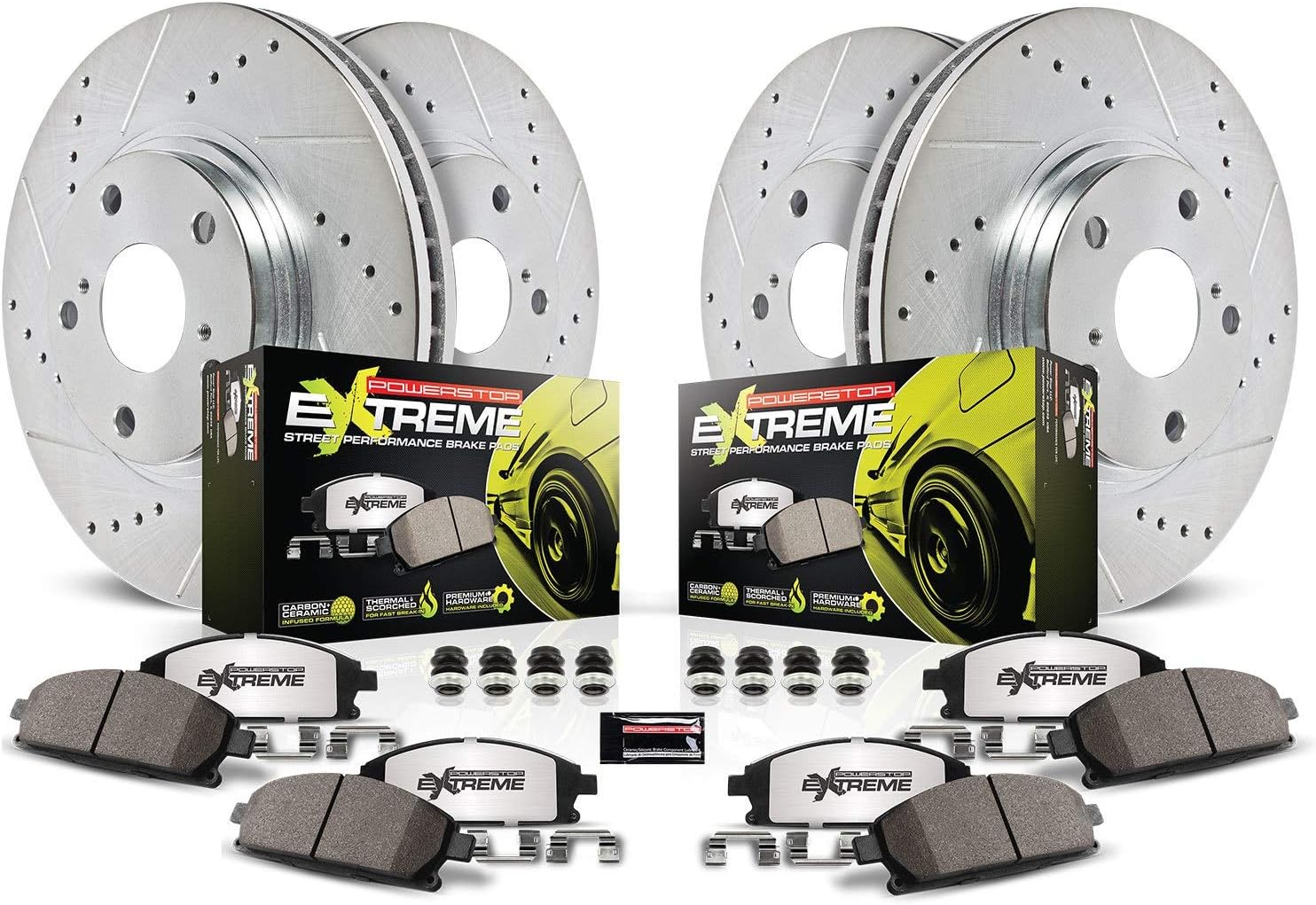
2. PowerStop Z26 Street Warrior Brake Pad and Drilled/Slotted Rotor Kit (Front & Rear)
| Included components | Front and rear Z26 pads, drilled & slotted rotors, installation hardware |
|---|---|
| Fit type | Vehicle Specific Fit |
| Warranty | 36 Month / 36,000 Mile Limited Warranty |
| Orientation | Dual |
This PowerStop Z26 kit bundles carbon-fiber ceramic Z26 pads with drilled and slotted rotors and all necessary hardware for a bolt-on front and rear replacement on compatible Subaru models. The Z26 pads are formulated for high-stress street use, offering stronger initial bite and resistance to fade at elevated temperatures compared with typical factory pads, while producing less wheel dust than many semi-metallic options. The rotors are precision cast to factory tolerances, drilled and slotted to help dissipate heat and clear gas and debris during spirited driving, and plated to resist surface corrosion. Installation is straightforward since the kit is vehicle-specific and includes stainless hardware and shims. Buyers should note this is tuned for aggressive street performance rather than track-only endurance braking, so extreme repeated track use may still require a dedicated track rotor and pad setup. For Outback drivers wanting a noticeable step up in stopping power and cleaner wheels without major modification, this kit is a practical upgrade.
Best for: Drivers who want a clear step up in street braking performance and thermal stability for spirited driving and larger-wheel builds while keeping installation simple.
Less Ideal for: Someone focused solely on dedicated track days or endurance racing should consider motorsport-specific pads and rotors engineered for continuous extreme heat cycles.
- Carbon-fiber reinforced ceramic pads deliver stronger bite and high-temperature fade resistance
- Drilled and slotted rotors improve cooling and help remove gases and debris during aggressive stops
- Plated rotors resist rust and corrosion for better longevity behind wheels
- Includes stainless hardware and shims for a straightforward bolt-on installation
- Low-dust pad formula helps keep wheels cleaner than many performance semi-metallic pads
- Designed for aggressive street use but not optimized for extreme repeated track sessions
Verdict: A practical bolt-on upgrade that gives 2015–2019 Outback drivers stronger, fade-resistant street braking with cleaner wheels and corrosion-resistant rotors.
3. Detroit Axle Rear Brake Kit with 11.81" Rotors and Ceramic Pads for Subaru

| Rotor diameter | 11.81 inches |
|---|---|
| Includes | 2 rear rotors, 2 rear ceramic pads, hardware |
| Compatible models (listed) | Subaru Outback 2015-2025, Legacy 2015-2025, WRX 2016-2024, Forester 2025 |
This Detroit Axle rear brake kit replaces the rear rotors and pads with a matched set intended for 11.81 inch rotor Subaru rear brakes. It includes two disc rotors, two ceramic brake pads and the necessary hardware, so installation replaces the complete rear friction assembly in one job. The rotors and pads are produced to meet or exceed factory fit and performance and the ceramic pads offer quieter operation and reduced dust compared with semi-metallic compounds. Buyers will appreciate the kit approach for a tidy DIY job or a single-visit shop replacement, and Detroit Axle backs the parts with impact, wear and fatigue testing plus a long warranty. Limitations are that this listing covers the specific 11.81 inch rear rotor application and fitment must match the vehicle and equipment (for example certain WRX trims noted in the listing); the kit does not include front brakes or other suspension components, so plan accordingly if you need a full-vehicle service.
Best for: Buyers who want a practical, cost-effective replacement that refreshes the rear braking system in a single purchase and prefer lower-noise ceramic pads for everyday driving.
Less Ideal for: Drivers needing a complete front and rear brake overhaul, performance-oriented track use, or vehicles that do not match the specified rotor size or listed Subaru fitments.
- Complete rear kit bundles rotors, ceramic pads, and installation hardware for a one-step replacement
- Ceramic pads tend to run quieter and produce less wheel dust than semi-metallic pads
- Rotors and pads manufactured to meet or exceed factory fit and performance expectations
- Includes hardware and is sized specifically for the listed Subaru rear rotor application
- Only covers rear brakes with 11.81 inch rotors so it is not a full front-and-rear solution
Verdict: A practical, all-in-one rear brake replacement kit that refreshes factory braking with quieter ceramic pads and properly sized rotors for the specified Subaru rear application.
4. Metrix Premium Chassis Parts 300 mm Coated High-Carbon Rear Brake Rotor for Subaru Legacy/Outback/WRX

| Compatible vehicles | 2015-2023 Subaru Legacy, 2015-2023 Subaru Outback, 2016-2021 Subaru WRX |
|---|---|
| Material Type | Cast Iron |
| Certification | ECE R 90 |
| Included components | Comes with housing |
This Metrix rear brake rotor is a direct-style replacement engineered for 2015–2023 Subaru Legacy and Outback models and 2016–2021 WRX; it uses high-carbon cast iron with a corrosion-resistant coating and factory mill balancing. In everyday use it serves as a straightforward replacement rotor: install after cleaning the hub and it delivers consistent pad contact and steady stopping power without the vibration that warped or imbalanced rotors produce. The vented design (vane/pillar vents) helps shed heat under repeated braking, which reduces fade during highway or towing-style loads, and the precision machining promotes uniform thickness for predictable pedal feel. Because it is built to meet industry certifications, it is intended to match factory performance while lasting longer than low-grade blanks. Limitations are typical of solid replacement rotors: it is a plain coated rotor, not slotted or cross-drilled for aggressive track use, and buyers replacing rotors should follow standard practice of installing in pairs and checking hub surfaces for corrosion before fitting.
Best for: Budget-minded owners looking for a reliable, direct-fit replacement rotor that restores factory stopping performance without paying for premium performance features.
Less Ideal for: Drivers who plan regular track days or demand maximum pad bite and cooling should choose a dedicated performance rotor with slots or drilled features instead.
- High-carbon cast iron construction for improved heat resistance and durability
- Factory mill-balanced to reduce vibration and ensure smooth stops
- Coated surface offers corrosion protection for longer service life
- Vented vane/pillar design improves heat dissipation under repeated braking
- Precision machining provides consistent rotor thickness for reliable pad contact
- Not performance-oriented: no slots or cross-drilling for aggressive track braking
Verdict: A cost-conscious, factory-quality high-carbon coated rotor that restores smooth, dependable rear braking for 2015–2019 Subaru Outback drivers without unnecessary performance extras.
5. Detroit Axle Front Brake Kit with 12.43" Rotors and Ceramic Pads
| Manufacturer | Detroit Axle |
|---|---|
| Brand | Detroit Axle |
| Manufacturer Part Number | 4PR471590 |
| Date First Available | May 16, 2025 |
This Detroit Axle front brake kit bundles two 12.43 inch front rotors with ceramic brake pads and installation hardware to replace worn front braking components on compatible Subaru models. It is intended as a direct replacement package used during routine brake service to restore stopping power and reduce vibration. The rotors are described as undergoing impact, wear, and fatigue testing, and the ceramic pads offer quieter braking and lower dust compared with semi-metallic pads. Including the hardware simplifies installation and gives a more complete refresh than buying rotors or pads separately. The kit targets durability and everyday drivability rather than performance braking for track use, so expect solid daily braking, reduced noise, and cleaner wheels at normal driving speeds. Buyers should confirm the 12.43 inch rotor fitment for their specific vehicle because the kit is limited to models with that rotor diameter.
Best for: Buyers who prioritize a dependable, factory-style replacement to restore everyday braking performance and reduce noise and dust during routine maintenance.
Less Ideal for: Drivers who need high-performance or track-oriented braking upgrades or those who want a one-size-fits-all solution across multiple rotor sizes.
- Complete kit includes rotors, ceramic pads, and mounting hardware for a single front-axle service
- Ceramic pads produce less brake dust and typically run quieter than semi-metallic options
- Rotors reportedly undergo impact, wear, and fatigue testing for improved durability
- Designed as a direct replacement for vehicles with 12.43 inch front rotors, simplifying selection
- Kit is limited to vehicles with 12.43 inch front rotors so it will not fit other rotor sizes
Verdict: Choose this kit when you want a ready-to-install front brake replacement that restores reliable, low-dust braking on Subaru models with 12.43 inch front rotors.
6. Max Advanced Brakes Front Brake Kit with Carbon Ceramic Pads

| Included Components | Brake Rotors, Brake Pads, Hardware |
|---|---|
| Automotive Fit Type | Vehicle Specific Fit |
| Orientation | Front |
| OEM Equivalent Part Number | 1078 31414 980377 |
This Max Advanced Brakes front kit is a complete, vehicle-specific replacement designed for everyday driving on compatible Subaru models. It supplies two machined cast iron rotors plus four carbon-infused ceramic pads and the necessary hardware for a direct bolt-on installation. The precision-machined rotors aim to promote smooth pad bedding and steady pedal feel, while the low-dust ceramic pads cut visible residue and reduce low-speed noise. The set is marketed as an integrated system so pad and rotor pairing should give consistent stopping and predictable pedal response for commuting, school runs, and highway driving. Buyers looking for longevity will appreciate the factory-style rotor construction and the included hardware that simplifies replacement. Limitations to note are that this is tuned for daily driving rather than performance braking and the warranty periods differ between combined kits and individual components, so warranty coverage is shorter for single parts.
Best for: Buyers who prioritize proven compatibility and reliable everyday stopping on their Subaru and who value products with strong customer feedback and tested manufacturing standards.
Less Ideal for: Drivers seeking high-performance or track-oriented braking upgrades should choose performance rotors and pads engineered for higher heat and repeated heavy use.
- Complete front kit with rotors, pads, and installation hardware for a direct bolt-on replacement
- Precision-machined cast iron rotors for smooth pad bedding and stable pedal feel
- Carbon-infused ceramic pads that produce significantly less brake dust and reduce low-speed noise
- Engineered as a matched system to promote consistent stopping performance
- Designed for everyday driving rather than aggressive or track use
- Warranty length varies by component and combined kits have longer coverage than individual parts
Verdict: A ready-to-install front brake kit that delivers dependable, low-dust everyday braking with matched rotors and carbon ceramic pads for compatible Subaru models.
Choosing the Right 2015-2019 Subaru Outback Brake Rotors: Key Factors to Consider
Fitment and Hub Compatibility
Correct fitment is the most basic requirement when replacing rotors on a 2015-2019 Subaru Outback. Rotors must match the vehicle's bolt pattern, center bore diameter, and overall diameter to seat properly and avoid hub-centric runout. Even small mismatches can cause vibration, accelerated pad wear, or premature bearing stress.
Pay attention to whether the rotor is meant for models with parking brake assemblies integrated into the rotor or those that use separate parking brake components. Some rotors are designed specifically for vehicles with a particular handbrake mechanism; installing the wrong type can create clearance issues.
Rotor Thickness and Service Limits
Rotor thickness determines how much material you have before the part reaches the minimum service limit. A thicker rotor can absorb and dissipate more heat, which helps prevent brake fade during repeated stops or when towing. Always check the new rotor's thickness and compare it to the Outback's factory specifications and the minimum allowable thickness printed on the rotor.
Also consider how easy it is to measure and verify thickness during installation and future inspections. Rotors with a clearly marked minimum thickness make maintenance simpler and reduce the risk of running a rotor below safe limits.
Heat Management and Venting
How a rotor manages heat directly affects stopping performance and durability. Vented rotors with directional vanes help move air through the disc to cool the braking surface more quickly. For the Outback, which is often used for longer highway drives, towing light loads, or mountain routes, proper venting reduces the chance of thermal cracking and warping.
Surface treatments and slotting patterns also change how heat is shed from the pad interface. Consider rotors engineered to balance heat rejection with consistent contact area to maintain predictable pedal feel.
Corrosion Resistance and Surface Finish
Subaru Outback owners frequently encounter wet, salty, or muddy conditions. Rotors with protective coatings, zinc plating, or other surface treatments resist rust on non-friction surfaces and reduce the risk of squeal and uneven wear. Corrosion on the hat or hub area can cause mounting irregularities and vibration.
A tied-in finish also helps maintain appearance and reduces the chance that rust will transfer to other brake components. While friction surfaces must remain bare metal, quality finishing on the rotor hat and edges contributes to longer service life.
Noise and Vibration Control
Excessive noise or juddering during braking often comes from rotor imbalance, poor machining, or incorrect fit. Rotors that are accurately balanced and properly machined reduce the likelihood of steering wheel vibration or pulsing in the brake pedal on the Outback.
Look for features such as precise machining tolerances, tapered face designs, and chamfered edges that help bedding-in and minimize initial noise. These design choices influence perceived quality and driver confidence more than raw spec sheets alone.
Intended Use and Surface Pattern
The driving conditions you expect with your Outback should inform whether you choose a plain, slotted, or drilled rotor. Plain rotors provide the most contact area and tend to last longest in everyday driving. Slotted rotors help remove gas and debris from the pad surface and can aid initial bite in wet conditions.
Drilled rotors evacuate water and help cooling but can be more prone to cracking under heavy thermal cycling. Consider the balance between improved wet-weather response and long-term durability for your typical driving scenarios.
OEM Specification Vs. Upgraded Rotors
Sticking with a rotor that meets OEM specifications ensures predictable fit and braking behavior. OEM-style rotors match factory dimensions, thickness, and surface finish, which can be ideal if you want a straightforward replacement that preserves original brake feel.
Upgraded rotors offer improvements in heat management, corrosion resistance, or noise control. For the Outback, an upgraded rotor might include enhanced venting or a protective coating. Consider upgrades if you tow occasionally, drive in hilly terrain, or need better fade resistance.
- OEM spec: consistent pedal feel and guaranteed fit
- Upgraded: better cooling, coatings, or surface treatments
- Choose upgrades when expecting heavier thermal loads
When to Resurface Rotors Vs Replace Them
Resurfacing can be a cost-effective option if the rotor has minor scoring or unevenness and sufficient thickness remains above the minimum service limit. Properly resurfaced rotors restore a flat contact surface and can reduce vibration if the damage is shallow.
Replacement is the safer choice when thickness is near or below the minimum limit, when there is heat cracking, or when the rotor has deep grooves. For the 2015-2019 Outback, confirm thickness with the vehicle specification and avoid resurfacing multiple times as this reduces rotor life and heat capacity.
- Resurface for light scoring and adequate thickness
- Replace for heat cracks, deep grooves, or low thickness
- Repeated resurfacing lowers thermal mass and service life
Brake Pad Pairing and Bedding-In
Rotor performance is closely tied to the pads you use. Different pad compounds transfer varying levels of material to the rotor surface during bedding-in, which changes initial bite and long-term rotor wear. Match pad type to the rotor surface and the Outback's expected driving condition for best results.
Follow a controlled bedding-in process after installing new rotors and pads to create a consistent transfer layer. Proper bedding reduces noise and helps the braking system stabilize faster, particularly in mixed driving conditions common to Outback ownership.
- Match pad compound to rotor design for consistent bedding
- Perform staged bedding-in to prevent glazing and noise
- Inspect for uneven transfer after initial miles
Maintenance Tips to Prolong Rotor Life
Regular inspection helps you catch wear or damage early. Check rotor thickness, surface condition, and runout during routine maintenance intervals and whenever you notice vibration or noise. Keep the hat area clean to ensure proper seating on the hub.
Corrosion can be mitigated by cleaning contact surfaces and using anti-seize on mounting interfaces where appropriate. Replacing hardware like lug bolts or hub-centric rings that are damaged or corroded improves mounting accuracy and reduces vibration risk.
- Measure thickness periodically and compare to service limits
- Keep mounting surfaces clean to prevent runout
- Replace damaged hardware to ensure concentric mounting
Installation Considerations for the Outback
Torque sequencing and proper lug nut torque are important to avoid warping new rotors. Tighten wheel fasteners to the Subaru-specified torque in the correct sequence and re-torque after a short break-in distance. Confirm that the parking brake components engage correctly after rotor replacement.
If the vehicle has any hub corrosion, clean the hub face before mounting the rotor to ensure the rotor sits flush. Check rotor runout with a dial indicator after installation to verify there is no excessive wobble that would cause pedal pulsation.
- Follow manufacturer torque specs and sequence
- Clean hub surface before mounting new rotors
- Check runout after installation to prevent pulsation
Still looking for the perfect fit?
Select your Subaru Outback configuration to see the most relevant Brake Rotors recommendations
How We Chose the Best 2015-2019 Subaru Outback Brake Rotors
We focused on criteria that matter for 2015-2019 Subaru Outback owners and practical on-vehicle performance. Primary evaluation factors included fitment and hub compatibility, ensuring each rotor matched the Outback's bolt pattern, center bore, and thickness range. We assessed thermal performance and resistance to warping by looking at rotor construction, venting or vanes, and surface treatment options used to control heat under repeated stops.Corrosion resistance and finishing were evaluated because many Outback owners drive in wet or salted conditions; a protective coating extends service life and keeps noise down. We also considered rotor thickness range and minimum service limit tolerances to ensure replacements restored safe braking and allowed for future machining where appropriate. Noise and vibration control features such as chamfers, balanced machining, and surface finish were part of the filter set.Excluded items: we did not include rotors that required hub modifications, rotors incompatible with the Outback's parking brake or hub design, or those intended solely for track use with extreme, non-road service profiles. We prioritized rotors that provide reliable, repeatable stopping for street use while maintaining proper fit and longevity.
Our full evaluation process is outlined in our review methodology.
FAQ
How do I know when my Outback's rotors need replacement?
Common signs include persistent vibration or pulsation in the steering wheel or brake pedal, visible scoring or grooves, and thickness near the minimum service limit. Also watch for a drop in braking performance or unusual noises that persist after bedding-in.
Can I resurface the rotors on my 2015-2019 Outback instead of replacing them?
You can resurface rotors if they have shallow scoring and sufficient thickness above the minimum limit. Replacement is recommended if there are heat cracks, deep grooves, or if resurfacing would reduce thickness below safe levels.
Are slotted or drilled rotors better for my Outback?
Slotted rotors help sweep debris and gases off the pad surface and are often a good compromise for wet-weather performance and durability. Drilled rotors can aid water evacuation but may be more prone to cracking under heavy thermal loads, so consider how you drive before choosing.
How should I measure rotor thickness properly?
Use a micrometer at multiple points around the braking surface to get an accurate reading, and compare measurements to the vehicle's minimum thickness specification. Measure after cleaning the friction surface and avoid areas with heavy scoring for consistent readings.
Will a coated rotor reduce corrosion on my Outback?
Coated rotors typically resist rust on non-friction surfaces such as the hat and edges, which helps maintain mounting accuracy and appearance. The friction surface remains bare, but a coating can slow corrosion in areas that would otherwise affect fitment or cause noise.
What causes rotor warping and how can I prevent it?
Warping often results from excessive heat cycles followed by uneven cooling or improper installation torque. Prevent it by ensuring proper torque sequencing, avoiding aggressive repeated heavy braking when the system is cold, and choosing rotors with adequate venting and thermal capacity for your driving.
Final Verdict
Prioritize correct fitment, rotor thickness, and heat management when replacing rotors on a 2015-2019 Subaru Outback. Those three factors most directly influence pedal feel, longevity, and resistance to vibration. Balance corrosion protection and surface pattern choices with your usual driving conditions to get the best long-term performance.Choose a rotor that meets the Outback's hub and parking brake requirements, has adequate thickness margin, and provides the cooling characteristics you need. That approach will deliver dependable stopping, minimize noise and warping risks, and help you drive with confidence.
Explore More:
- Check out all Subaru Outback parts & accessories
- Explore Brake Rotors Maintenance & Repair Guides
- Explore Brake System
- Browse all Auto Parts
