

Note: This article contains affiliate links. If you click on these links and make a purchase, I may earn a small commission at no extra cost to you. This helps support my research and content. Read my full affiliate disclosure here.
If you own a 1997-2003 Ford F-150, choosing the right brake pads makes a big difference in daily drivability and towing confidence. Worn or inappropriate pads can increase stopping distance, produce excessive noise, and accelerate rotor wear. This guide focuses on the most suitable brake pads for the 1997-2003 F-150 and explains why certain friction materials and designs matter for this generation.We shortlisted seven top options that fit the 1997-2003 F-150 and evaluated them for stopping performance, noise control, durability, and rotor friendliness. Below you will find a practical overview to help you pick pads that match your driving style and load needs, followed by detailed buying guidance.
Looking for other parts? See all Ford F-150 parts & accessories.
Top Picks at a Glance
| Best Overall The best all-around choice for most situations | Bendix Fleet Metlok MKD679FM Semi‑Metallic Rear Brake Pad |  |
| Best Quality Built to a higher standard if you want something more solid | PowerStop Z17 Front Ceramic Brake Pads with Hardware |  |
| Best Value The sweet spot between price and what you get | Wagner QS ZD679 Front Ceramic Disc Brake Pad Set |  |
| Best Budget The cheapest option that still gets the job done reliably | Auto Shack Front Ceramic Brake Pad Set (Front) for Ford F-150 1997–2004 |  |
| Highest Rated A top-rated pick with lots of positive feedback | Bendix Priority1 CFC679 Ceramic Front Brake Pads (front) |  |
| Most Popular A crowd favorite that many people choose with confidence | Detroit Axle Front Brake Kit with Drilled & Slotted Rotors and Ceramic Pads for 1997-2003 Ford F-150 (4WD, 5-Lug) |  |
| Best Seller A high-volume bestseller chosen again and again | Detroit Axle 4WD Front Brake Kit (12.13" Rotor) for 1997–2003 Ford F-150 |  |
Bendix Fleet Metlok MKD679FM Semi‑Metallic Rear Brake Pad

| Auto Part Position | Rear |
|---|---|
| Material Type | Copper |
| Included Components | (1) Bendix Feet Metlok Brake Pad Set with Installation Hardware |
| Automotive Fit Type | Vehicle Specific Fit |
These Bendix Fleet Metlok MKD679FM rear brake pads are a semi‑metallic, vehicle‑specific replacement intended for Ford F‑150 and related trucks from the late 1990s and early 2000s. They are supplied as a single pad set with installation hardware and are built for tougher duty, offering improved thermal stability and strong stopping power under repeated or heavy braking. In day‑to‑day use they behave like a heavy‑duty factory replacement: solid pedal feel, quick bedding, and reliable performance during commuting, towing, or fleet use. Notable features include factory‑grade machining for consistent pad‑to‑rotor contact and copper‑type material aimed at durability. Practical benefits are longer service life and consistent braking in demanding conditions, plus included hardware simplifies installation. Downsides are the semi‑metallic composition which can produce more brake dust than low‑dust ceramic pads and a firmer initial bite that some drivers find less refined for light city driving. Overall these are a practical choice when you want robust, long‑lasting replacement pads for older F‑150s without changing rotors or brake hardware.
Best for: Buyers who want a durable, fleet‑grade replacement that prioritizes consistent stopping and long service life for older Ford trucks used for towing, hauling, or regular highway duty.
Less Ideal for: Drivers who prioritize the lowest possible dust, the quietest ride, or the softest initial pedal feel should consider a ceramic or street‑comfort pad instead.
- Designed to vehicle specific fit for Ford F‑150 and related models for straightforward installation
- Semi‑metallic construction offers strong stopping power and high thermal stability under heavy use
- Includes installation hardware so you get a complete pad set ready to fit
- Manufactured to factory machining specs to improve pad‑to‑rotor contact and pedal response
- Semi‑metallic formula tends to create more brake dust than ceramic alternatives
- Firm initial bite may feel less refined for drivers who prioritize ultra‑smooth, quiet urban braking
Verdict: Choose these Bendix Fleet Metlok pads if you need durable, fleet‑grade rear replacement pads that deliver strong, consistent braking and long life for 1997–2003 Ford F‑150s.
PowerStop Z17 Front Ceramic Brake Pads with Hardware

| Auto Part Position | Front |
|---|---|
| Material Type | Ceramic |
| Included Components | Brake Pads |
| Manufacturer | Power Stop |
The PowerStop Z17 front ceramic pads are built as an OE-plus replacement for daily-driven 1997–2003 Ford F-150 variants, offering a straightforward bolt-on swap for the front brakes. These pads use a thermal-scorched ceramic formula with chamfered and slotted faces plus dual-layer rubberized shims to speed break-in and suppress noise. Stainless-steel installation hardware is included so you can complete the job without sourcing extra parts. In real-world use they deliver consistent, confidence-inspiring stopping for commuting and light towing while producing noticeably less brake dust than semi-metallic alternatives, which keeps wheels cleaner. Expect quiet operation under normal driving; heavy repeated stops or aggressive performance driving will highlight ceramic limits compared with performance compounds. A few users noted occasional fitment quirks on specific vehicles, so double-check fitment before installation. Overall this set is a practical, low-maintenance upgrade for F-150 owners who prioritize calm, clean daily-driving braking rather than track-level bite.
Best for: F-150 drivers who want a quiet, low-dust, factory-quality front pad that improves daily commuting and light towing braking without extra installation parts.
Less Ideal for: Drivers who regularly demand aggressive, high-temperature braking for track use or heavy towing should choose a performance-oriented pad compound instead.
- Ceramic formula reduces brake dust for cleaner wheels
- Chamfered and slotted surfaces with thermal scorched face for faster break-in and quieter stops
- Includes stainless-steel installation hardware for a true bolt-on replacement
- Dual-layer rubberized shims help minimize brake noise
- Ceramic compound offers less high-temperature fade resistance than performance or track-oriented pads
Verdict: Choose these Z17 ceramic front pads if you want a quiet, low-dust, factory-quality replacement for a 1997–2003 F-150 that includes hardware for an easy install.
Wagner QS ZD679 Front Ceramic Disc Brake Pad Set

| Auto Part Position | Front |
|---|---|
| Compatible with Vehicle Type | Pickup Truck |
| Material Type | Ceramic |
| Automotive Fit Type | Vehicle Specific Fit |
The Wagner QS ZD679 front brake pads are a vehicle-specific ceramic replacement designed for street use on 1997–2003 Ford F-150 models. They use an application-specific ceramic friction material and chamfered edges to minimize noise and vibration while providing consistent, balanced stopping power during everyday driving. The pads are integrally molded for uniform contact and include stainless-steel hardware and an OE-style lubricant in most kits, which makes installation straightforward and helps reduce rattle and uneven wear. Ceramic composition keeps rotor dust and noise down compared with many semi-metallic pads, and the manufacturer recommends a simple burnish routine to seat the pads for best results. Limitations are typical of ceramic street pads: they prioritize quiet, consistent braking over high-temperature track performance, so they are not intended for heavy towing or sustained high-load braking where more aggressive compounds perform better.
Best for: Buyers who want a quiet, low-dust, factory-style replacement that restores everyday braking feel and reduces brake-related noise without overinvesting in performance compounds.
Less Ideal for: Drivers who regularly tow heavy loads, carry heavy payloads, or routinely subject brakes to high-temperature repeated stops should choose a more aggressive brake compound.
- Ceramic friction material reduces noise and brake dust compared with metallic pads
- Chamfered edges and application-specific design minimize vibration and chatter
- Integrally molded construction promotes even contact and consistent wear
- Includes stainless-steel hardware and OE-style lubricant in most kits for easier installation
- Designed for street use and not optimized for heavy towing or track conditions
Verdict: A quiet, low-dust ceramic front pad that restores factory-like braking for 1997–2003 Ford F-150 daily driving needs.
Auto Shack Front Ceramic Brake Pad Set (Front) for Ford F-150 1997–2004

| Auto Part Position | Front |
|---|---|
| Compatible with Vehicle Type | Truck |
| Manufacturer | Auto Shack |
| Material Type | Ceramic |
| Unit Count | 4.0 Count |
These Auto Shack ceramic front pads are a straightforward vehicle-specific replacement for 1997–2004 Ford F-150 models and similar Ford/Lincoln applications. They install like a factory-style pad and are intended for everyday street and light-duty truck use. The ceramic material aims to deliver quiet stops with reduced brake dust, which keeps wheels cleaner and reduces cleanup time. The listing notes pads are designed to extend rotor life and offer consistent friction so pedal feel is predictable during normal driving. Installation is typical for a front pad change and the set ships with four pads included. Important limitations are that these are not performance or heavy-haul pads, so drivers who tow frequently or do aggressive driving may see faster wear or less fade resistance than specialty compounds. Also clips are not included so you may need to reuse factory hardware or buy hardware separately. Fitment verification before purchase is advised to ensure the set matches your specific model and drivetrain configuration.
Best for: Drivers looking for an affordable, factory-style replacement that restores everyday stopping performance and keeps wheel cleanup to a minimum.
Less Ideal for: Drivers who frequently tow heavy loads, haul payloads, or require track-capable braking should choose performance or heavy-duty brake compounds instead.
- Vehicle-specific fitment for 1997–2004 Ford F-150 applications simplifies installation
- Ceramic compound produces low dust and quieter braking compared with many semi-metallic pads
- Designed to be gentle on rotors to help extend rotor life
- Includes a full front set of four brake pads so you get the complete kit for one axle
- Does not include brake hardware clips which may be needed for a fresh installation
- Not engineered for heavy towing, track use, or aggressive braking where high-temperature fade resistance is required
Verdict: A budget-friendly ceramic front pad set that restores quiet, low-dust stopping for late 1990s to early 2000s F-150s without premium performance features.
Bendix Priority1 CFC679 Ceramic Front Brake Pads (front)

| Auto Part Position | Front |
|---|---|
| Material Type | Ceramic |
| Automotive Fit Type | Vehicle Specific Fit |
| Included Components | Brake pad set with installation hardware |
| Specification Met | OEM |
These Bendix Priority1 CFC679 ceramic front brake pads are a direct-fit replacement engineered to meet factory specifications for fit, form, and function on compatible Ford trucks. They install like a factory-quality part and include installation hardware and grease, which makes a backyard brake job straightforward. The ceramic friction material is formulated to reduce dust and noise while maintaining reliable stopping power under everyday and heavier loads. Built-in shims, slots, and chamfers help prevent vibration and squeal, and reviewers report consistent, quiet operation after proper bedding and rotor prep. Because they are tuned for steady performance rather than aggressive track stops, initial bite is smooth and progressive, and braking remains predictable when towing or hauling. Limitations: they are not a high-performance or competition pad, so drivers seeking extreme bite or track endurance should look elsewhere, and some users noted minor differences in hardware design compared with original parts that may affect long-term corrosion resistance in harsh climates.
Best for: Buyers who prioritize reliable, low-noise daily braking and want a direct-fit, factory-quality replacement for their 1997–2003 Ford F-150 without upgrading to performance pads.
Less Ideal for: Drivers who frequently race, tow at grossly heavy weights, or need maximum track-oriented stopping power should choose a specialized high-performance compound instead.
- Designed to factory-spec fit for straightforward installation
- Ceramic blend reduces wheel dust and keeps braking quiet
- Includes installation hardware and grease for a complete swap
- Shims, slots, and chamfers help minimize vibration and squeal
- Engineered for consistent performance under everyday towing and hauling
- Not intended for high-performance or track use where extreme bite and fade resistance are required
Verdict: A dependable, quiet ceramic front pad that restores factory-style braking and reduces dust for 1997–2003 Ford F-150 owners who value reliability.
Detroit Axle Front Brake Kit with Drilled & Slotted Rotors and Ceramic Pads for 1997-2003 Ford F-150 (4WD, 5-Lug)
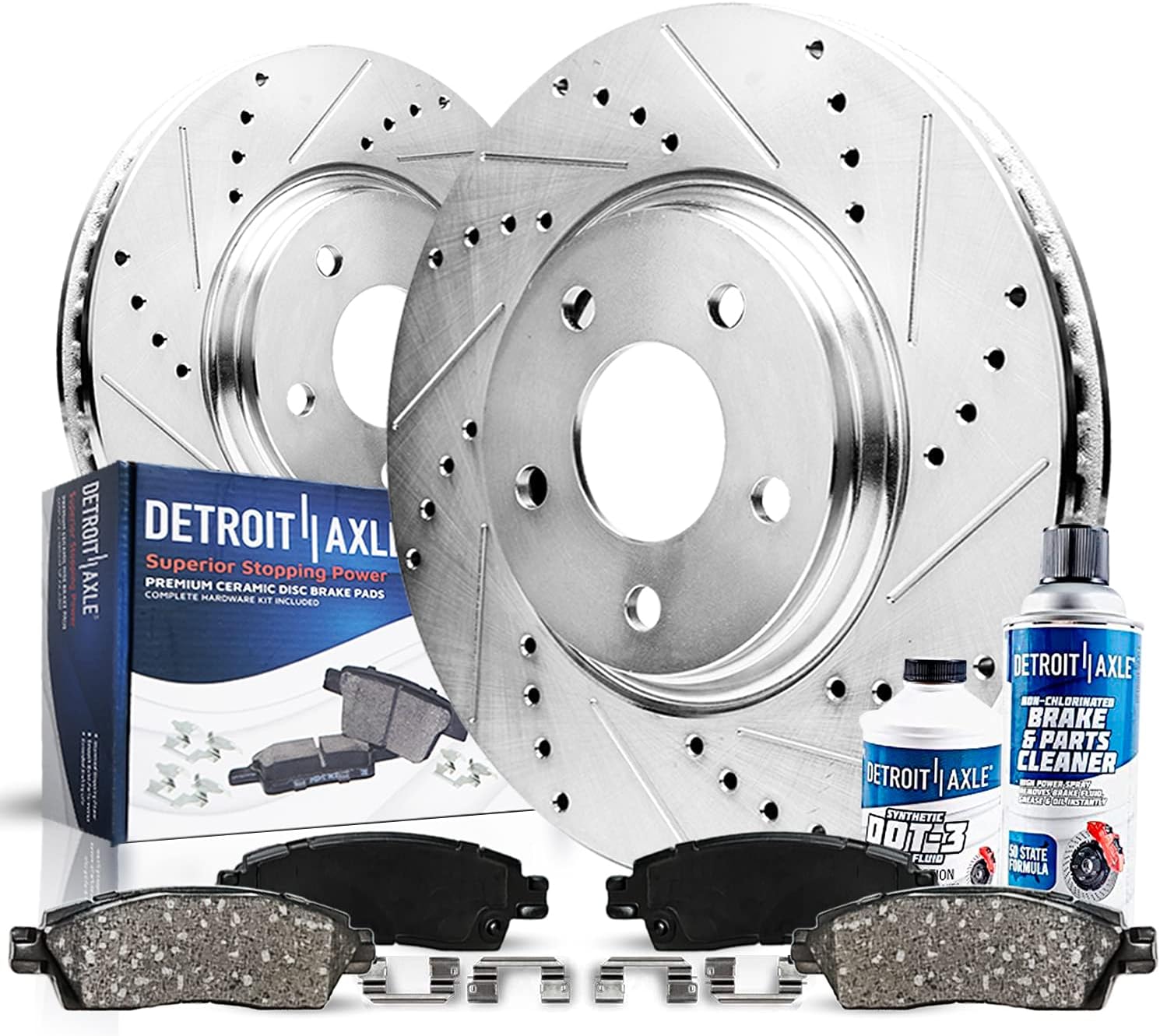
| Fitment | 1997-2003 Ford F-150 (4WD, 5-Lug) |
|---|---|
| Rotor size | 12.13 inch (308 mm) |
| Rotor type | Drilled & slotted |
| Pad material | Ceramic |
| Orientation | Front |
This Detroit Axle kit supplies everything needed to replace the front brakes on 4WD, 5-lug 1997–2003 Ford F-150s that use 12.13 inch rotors. The package includes two drilled and slotted rotors, a pair of ceramic pads with hardware, a brake cleaner spray and a small bottle of brake fluid. Drilled and slotted rotors help shed heat and moisture faster than plain rotors, which is useful if you tow or do repeated stops, while ceramic pads aim for quieter, low-dust operation compared with semi-metallic pads. Fitment is machined for a direct swap and many buyers report straightforward installation and good stopping feel right away. Expect a short bedding-in period where new pads can be a bit noisy before they settle. The small bottle of DOT3 fluid may not match every vehicle requirement so confirm fluid type before use. This kit is a convenient option when you want a matched rotor-and-pad replacement that includes common accessories rather than buying parts separately.
Best for: Buyers who value a one-box replacement that matches rotors and pads and prefer a tried aftermarket brand with many positive reviews and real-user fitment feedback.
Less Ideal for: Drivers seeking track-focused brake upgrades or those who require a specific brake fluid type should look for purpose-built performance kits or separately sourced fluid to match factory specifications.
- Complete kit includes rotors, ceramic pads, hardware, brake cleaner and brake fluid for a single front-axle service
- Drilled and slotted rotors improve cooling and debris removal during repeated heavy braking
- Ceramic pads produce lower dust and a quieter stop compared with many metallic pads
- Machined locating holes and zinc plating improve fit and corrosion resistance for cleaner wheels
- Included brake fluid is DOT3 which may not be appropriate for vehicles requiring DOT4
- Drilled and slotted rotors can be louder and require a bedding-in period before noise subsides
Verdict: A convenient, well-reviewed matched rotor-and-pad kit for 4WD 5-lug 1997–2003 F-150s that balances cooling and low-dust braking for everyday and towing use.
Detroit Axle 4WD Front Brake Kit (12.13" Rotor) for 1997–2003 Ford F-150

| Fitment | 1997–2003 Ford F-150 (4WD; 5 lug) with 12.13" front rotor |
|---|---|
| Kit contents | 2 front rotors and 2 front ceramic brake pads |
| Rotor type | Vented, zinc plated |
| Pad material | Ceramic |
| Orientation | Front |
This Detroit Axle front brake kit supplies two 12.13" vented rotors and a pair of ceramic front brake pads designed for 4WD, 5‑lug 1997–2003 Ford F-150 models. It is intended as a straight replacement: the rotors are machined with locating holes for direct fitment and zinc plating to resist surface corrosion, while the ceramic pads aim to deliver quieter, smoother stops and longer pad life versus typical metallic options. Installation is the normal brake‑service process and most buyers can install with basic tools, though compressing the caliper pistons may require a common piston tool. The kit is marketed as tested for impact, wear, and fatigue and many users report good fit and predictable stopping power. Be aware these are midrange aftermarket parts: you may see surface rust on cast areas over time and some shipments have arrived damaged in isolated cases, so inspect components before installation. For a risk‑averse buyer this kit offers OEM‑style fit and quiet ceramic braking at a value price, but it is not a high‑performance upgrade for heavy towing or track use.
Best for: Buyers who prioritize reliable, factory‑style replacements and quiet everyday braking for a 1997–2003 F-150 and prefer a value kit that covers the full front axle job.
Less Ideal for: Drivers who regularly tow heavy loads, do frequent heavy braking, or want high‑performance brake compounds should consider performance‑oriented rotors and pads instead.
- Complete front kit includes both rotors and ceramic pads for a full front brake refresh
- Vented rotors with machined locating holes for direct, factory‑style fitment
- Zinc plating on rotors helps reduce visible corrosion on exposed surfaces
- Ceramic pads are quieter and tend to produce less dust than metallic pads
- Components undergo impact, wear, and fatigue testing according to the listing
- Not intended for high‑performance or heavy towing applications where upgraded rotors/pads are required
- Some customers reported shipping damage or rust on arrival in isolated cases
Verdict: A complete, factory‑style front brake kit that gives quiet, dependable ceramic braking and direct fitment for 4WD 1997–2003 F-150s at an attractive value.
Choosing the Right 1997-2003 Ford F-150 Brake Pads: Key Factors to Consider
Friction Material and Rotor Compatibility
The pad friction compound determines stopping feel, heat tolerance, and rotor friendliness. Ceramic-style compounds tend to offer quieter operation and lower dust output, which can preserve wheel appearance on the 1997-2003 F-150, while semi-metallic compounds can provide stronger bite under heavy loads but may accelerate rotor wear. Consider how often you tow or haul and choose a compound that balances stopping power with rotor preservation.
For the F-150 from 1997 to 2003, original caliper and rotor metallurgy influences how aggressive a compound you can use without introducing rotor glazing or scoring. If you plan frequent heavy braking, favor formulas rated for higher operating temperatures and fade resistance. If quiet daily driving is the priority, prioritize softer, noise-resistant compounds.
Noise, Vibration and Harshness Control
Brake noise and vibration are common on older trucks and can come from pad compound, backing plate fitment, or worn hardware. Look for pads engineered with chamfers, shims, and damping layers to reduce squeal on the 1997-2003 F-150. Proper pad backing plate fit and hardware compatibility help prevent movement that causes vibration and uneven wear.
Addressing NVH proactively reduces the likelihood of false negatives where a pad is otherwise effective but considered poor due to noise. If your F-150 already has warped rotors or loose caliper hardware, replacing pads alone may not eliminate noise, so factor in the condition of the braking system when choosing pads.
Heat Tolerance and Fade Resistance
Heat management becomes important when carrying heavy loads or during repeated braking on long descents. Pads with higher heat thresholds maintain friction longer and resist fade, which preserves stopping distance and driver confidence for the 1997-2003 F-150. Fade-resistant compounds often include higher metallic content or specialized binders that sustain performance at elevated temperatures.
Evaluate whether your typical use involves towing, heavy payloads, or frequent highway braking. For moderate use, standard compounds are adequate. For towing or spirited driving, choose pads specified for higher thermal capacity to avoid progressive loss of braking efficiency.
Longevity and Wear Characteristics
Pad life affects maintenance intervals and total ownership cost. Different compounds and pad thicknesses influence how quickly the friction material will wear. On the 1997-2003 F-150, driving conditions such as city stop-and-go versus highway miles will change wear rates substantially. Pads that last longer may be harder on rotors, so balance pad life with rotor friendliness when deciding.
Inspecting remaining pad thickness regularly helps you plan replacements before metal-to-metal contact. Consider pads with predictable wear patterns and clear thickness specs to maintain safe stopping distances without unexpected repairs.
Fitment Accuracy and Hardware Compatibility
Correct fit prevents uneven wear, noise, and caliper issues. The 1997-2003 Ford F-150 has specific pad shapes and retaining hardware; choose pads that match factory dimensions and include or clearly list compatible hardware. Using pads that require different hardware or adaptors can lead to improper seating and premature wear.
If aftermarket rotors or calipers are installed, verify the pad geometry matches those components. Ease of installation and whether the pads work with factory anti-rattle clips, shims, and caliper pistons should be confirmed before purchase.
Front Versus Rear Application and Balance
Front and rear pads serve different roles in braking balance. The front pads typically do most of the work on an F-150 and therefore often require a compound focused on maximum stopping power and heat resistance. Rear pads contribute to stability and parking brake function and can use a milder compound to reduce noise and wear.
When replacing pads, assess both axles. Replacing only the front or only the rear can change braking feel and balance, especially on older trucks. Match pad characteristics so overall pedal feel remains predictable and safe under the loads your 1997-2003 F-150 regularly experiences.
How to Tell If Your F-150 Needs New Pads
Several symptoms indicate pad wear on the 1997-2003 Ford F-150. Common signs include a persistent squeal at low speeds, reduced braking responsiveness, or a pulsation in the brake pedal that may signal uneven wear or rotor issues. Visual inspection through the wheel can reveal remaining pad thickness; most pads should be replaced before the friction layer is less than 3 millimeters.
Other indicators include increased stopping distance under normal conditions and a grinding noise, which often means pads are worn to the backing plate and require immediate attention. Regular checks help you catch progressive wear before it damages rotors or compromises safety.
- Squeal or chatter at low speeds
- Spongy or low brake pedal feel
- Grinding noise indicating metal contact
- Visible pad thickness below 3 mm
Front Versus Rear Pad Roles on the 1997-2003 F-150
The front brakes handle a greater share of braking force and heat on the F-150, so front pads are typically specified with higher friction and heat tolerance. Rear pads support balance and vehicle stability and often see less aggressive wear. When selecting pads, treat front and rear as separate decisions to ensure correct braking balance.
If you frequently tow or haul, consider heavier-duty front compounds to cope with higher thermal loads while keeping rear pads optimized for stability and parking brake performance.
- Front pads: primary stopping power and heat management
- Rear pads: stability, lower heat load, parking brake function
Installation Tips and Hardware Checks
Proper installation reduces noise and extends pad life. Inspect caliper slides, anti-rattle clips, and pad shims during replacement. Clean mating surfaces and apply the recommended high-temperature lubricant to slide points and backing plate contact areas. Replace any corroded hardware to ensure smooth operation on the 1997-2003 F-150.
Torque caliper guide bolts to factory specifications and check piston retraction before seating the new pads. After installation, perform a few low-speed stops to bed the pads and confirm there is no unusual noise or pull.
- Clean and lubricate slide pins and contact points
- Replace worn anti-rattle clips and hardware
- Torque fasteners to factory specs
- Bed new pads with progressive stops
When to Consider Rotor Resurfacing or Replacement
New pads on warped or deeply scored rotors can still cause vibration and rapid wear. Inspect rotors for runout and surface condition when changing pads on your 1997-2003 F-150. Minor scoring and thickness variation can often be addressed by resurfacing if the rotor remains within the manufacturer thickness spec, but deep grooves or significant runout require replacement.
Measure rotor thickness and compare it to the Ford specification for your model year. If resurfacing brings the rotor below minimum thickness, replace it to maintain safe braking and prevent accelerated pad wear.
- Check rotors for runout and scoring
- Resurface only if thickness stays above spec
- Replace rotors with deep grooves or excessive runout
Matching Pad Choice to Driving Use
Match pad material and expected life to how you use the truck. For primarily city and light highway driving, a quiet, long-wearing compound is often the best fit. For towing, frequent heavy loads, or occasional spirited driving, choose pads rated for higher heat and fade resistance. This targeted approach helps maintain braking performance without unnecessary tradeoffs.
Consider also typical mileage intervals. If you cover many highway miles, you may prioritize longevity and consistent low dust output. If you perform frequent low-speed stops, focus on initial bite and NVH control.
- City driving: prioritize quiet operation and low dust
- Towing/heavy loads: prioritize heat tolerance and fade resistance
- Highway mileage: prioritize longevity and predictable wear
Maintaining Brake Performance Over Time
Regular inspection and timely replacement preserve braking performance on the 1997-2003 F-150. Check pad thickness, rotor condition, and hardware at oil changes or every 12,000 miles. Replace pads in axle pairs to maintain balanced braking, and address any unusual sounds or pedal changes promptly to prevent cascading damage.
Documenting replacement intervals and observing how different pad compounds perform in your usage pattern helps you choose better next-time options and avoid premature failure.
- Inspect at least every 12,000 miles or during service intervals
- Replace pads in axle pairs
- Address noises or pedal changes immediately
Still looking for the perfect fit?
Select your Ford F-150 configuration to see the most relevant Brake Pads recommendations
How We Chose the Best 1997-2003 Ford F-150 Brake Pads
We selected pads using criteria that matter specifically to 1997-2003 Ford F-150 owners and the typical driving loads for this truck. Key evaluation points included stopping performance under light and heavy loads, friction material composition and how it affects rotor wear, and measured or reported pad longevity under mixed driving conditions. Noise and vibration control were prioritized because brake squeal and chatter are common complaints on older F-150s. Fitment accuracy and the availability of correct front and rear pad shapes for the 1997-2003 model years were required for inclusion.We also considered heat tolerance and fade resistance since some owners tow or haul and need consistent braking under elevated temperatures. Ease of installation and whether pads work with common factory caliper hardware on the 1997-2003 F-150 were evaluated. We excluded pads without verifiable fitment for the 1997-2003 F-150 or those with widespread reports of abnormal rotor scoring. The resulting list favors balanced performance, proven durability, and effective noise mitigation for this generation of F-150.
Our full evaluation process is outlined in our review methodology.
FAQ
How often should I replace brake pads on a 1997-2003 F-150?
Replacement intervals vary with driving style and load. Many owners find pads last between 30,000 and 60,000 miles under mixed driving. Check pad thickness regularly and replace before the friction layer is under roughly 3 millimeters to avoid rotor damage.
Can I replace only the front pads on my F-150?
You can replace only the front pads, but it may alter braking feel and balance. It is generally recommended to replace pads in axle pairs to keep pedal response and stopping behavior consistent.
What causes a grinding noise after installing new pads?
Grinding often means the old pads wore to the backing plate and damaged the rotor, or debris is trapped between pad and rotor. Verify rotor condition and verify that the new pads are correctly fitted with proper hardware and shims. Address any rotor damage before continuing use.
Are ceramic compounds a good choice for the 1997-2003 F-150?
Ceramic-style compounds can be a good fit for owners prioritizing quiet operation and low dust. They may not tolerate heavy, repeated high-heat use as well as some semi-metallic options, so evaluate your towing and hauling habits before choosing a ceramic-based pad.
How do I check pad thickness without removing the wheel?
You can visually inspect pad thickness through the wheel spokes in many cases. Use a flashlight to view the friction material above the caliper. If visibility is poor or the pad appears thin, remove the wheel for an accurate measurement.
Will new pads fix a pulsating brake pedal?
A pulsating pedal is often caused by rotor runout or uneven thickness rather than pad wear. While new pads may temporarily hide the symptom, correcting rotor runout by machining or replacement is typically required to fully resolve pedal pulsation.
Final Verdict
Choosing the right brake pads for a 1997-2003 Ford F-150 means balancing stopping performance, noise control, and durability against the way you use the truck. Prioritize front pads with appropriate heat tolerance if you tow or haul frequently, and favor quieter, rotor-friendly compounds for daily driving. Ensure correct fitment and fresh hardware to avoid NVH and premature wear.Focus on consistent pad thickness checks and replace pads in matched pairs. Use the evaluation factors above to weigh tradeoffs and select pads that deliver safe, predictable braking for your F-150.
Explore More:
- Check out all Ford F-150 parts & accessories
- Explore Brake Pads Maintenance & Repair Guides
- Explore Brake System
- Browse all Auto Parts
