

Note: This article contains affiliate links. If you click on these links and make a purchase, I may earn a small commission at no extra cost to you. This helps support my research and content. Read my full affiliate disclosure here.
If you own a 2011-2019 Ford Explorer, the right brake pad and rotor kit affects safety, pedal feel, and long-term maintenance. Brake components wear with use and age, and swapping pads and rotors together restores consistent braking performance and reduces the chance of uneven wear.This guide shortlists seven top kits that match the Explorer's front and rear fitment profiles and common service specifications. We evaluated stopping power, rotor thickness and runout tolerance, pad material, and ease of installation so you can pick a kit that fits your driving style and maintenance goals. Read on for what mattered in our selection and practical advice for installation and upkeep.
Looking for other parts? See all Ford Explorer parts & accessories.
Top Picks at a Glance
| Best Overall The best all-around choice for most situations | Detroit Axle Brake Kit with Ceramic Pads and Front/Rear Rotors |  |
| Best Quality Built to a higher standard if you want something more solid | PowerStop K6375 Z23 Carbon-Fiber Ceramic Brake Pad and Drilled/Slotted Rotor Kit (Front & Rear) |  |
| Best Value The sweet spot between price and what you get | Auto Shack Front & Rear Drilled/Slotted Brake Rotors with Ceramic Pads (Black) |  |
| Best Budget The cheapest option that still gets the job done reliably | KAX Rear Brake Rotors and Pads Kit, 12.99-inch |  |
| Highest Rated A top-rated pick with lots of positive feedback | Detroit Axle Front and Rear Brake Kit with Ceramic Pads for Ford Explorer/Taurus/Flex/Lincoln MKS |  |
| Most Popular A crowd favorite that many people choose with confidence | Detroit Axle Front and Rear Drilled & Slotted Brake Kit with Ceramic Pads |  |
| Best Seller A high-volume bestseller chosen again and again | Detroit Axle Front Brake Kit — Drilled & Slotted Rotors with Ceramic Pads (13.86" Front) |  |
1. Detroit Axle Brake Kit with Ceramic Pads and Front/Rear Rotors

| Front Rotor Size | 12.80 inch (325mm) |
|---|---|
| Rear Rotor Size | 12.99 inch (330mm) |
| Pad Type | Ceramic |
| Fit Type | Vehicle Specific Fit |
This Detroit Axle brake kit supplies both front and rear replacement rotors plus ceramic pads and a small service kit so you can refresh the entire stopping system in one job. The kit contains two front and two rear rotors sized to the listed vehicles along with front and rear ceramic pads, mounting hardware, a 10 oz brake cleaner, and a 12 oz bottle of brake fluid, which makes it convenient for a backyard DIY or a single-visit shop job. Ceramic pads typically run quieter and produce less dust than semi-metallic alternatives, and the matched rotor set helps restore even braking feel and pedal response. Because the kit is a vehicle-specific fit, it removes much of the guesswork for fitment on the covered model years. The main limits are that the rotors are solid rather than vented or slotted for performance cooling, so drivers who tow frequently or push the vehicle hard may see faster fade or wear compared with performance rotors. Installation requires basic brake tools and some mechanical familiarity when replacing all four corners at once.
Best for: Buyers looking for a balanced, all-in-one brake refresh that combines quieter ceramic pads with matched rotors for routine street driving and straightforward DIY or shop installation.
Less Ideal for: Drivers who regularly tow heavy loads, frequently tow, or drive aggressively and need high-performance or enhanced cooling rotors should consider performance-oriented rotors and pads instead.
- Complete kit includes front and rear rotors, front and rear ceramic pads, hardware, brake cleaner, and brake fluid
- Vehicle-specific fit reduces fitment guesswork for the covered Ford models
- Ceramic pads offer quieter operation and lower dust than many semi-metallic pads
- Matched rotor set restores consistent pedal feel across front and rear
- Rotors are solid rather than slotted or drilled, so they offer less heat dissipation under heavy use
Verdict: A convenient, vehicle-specific package that refreshes all four brakes with quieter ceramic pads and matched rotors for reliable everyday stopping.
2. PowerStop K6375 Z23 Carbon-Fiber Ceramic Brake Pad and Drilled/Slotted Rotor Kit (Front & Rear)

| Position | Front, Rear |
|---|---|
| Automotive Fit Type | Vehicle Specific Fit |
| Exterior | Zinc Plated |
| Model | Power Stop K6375 |
This PowerStop K6375 kit replaces front and rear pads and rotors with Z23 carbon-fiber ceramic pads and drilled-and-slotted rotors designed as a bolt-on upgrade for compatible Ford models. It is intended for everyday drivers who also want stronger, quieter braking and better heat control under demanding use. The Z23 pad compound is low-dust and engineered to stay quiet while delivering more stopping power than many factory replacements. The rotors are precision drilled and slotted to help dissipate heat and wipe away gas and debris, and a zinc plating helps resist rust for longer life in wet climates. Included stainless steel hardware and rubberized shims make installation straightforward without modifications. Expect improved pedal feel and reduced brake fade during repeated hard stops, but know this is a performance-minded street kit rather than a track-only solution and may not match aggressive race pads for ultimate bite or track durability.
Best for: Drivers who want a noticeable upgrade over factory brakes for spirited street driving and repeat-demand situations without sacrificing daily comfort or creating excess dust.
Less Ideal for: Drivers seeking race-spec pads or those who need a track-focused braking system designed for very high temperatures and rapid pad wear.
- Z23 carbon-fiber ceramic pads offer stronger stopping power with low dust and quiet operation
- Drilled and slotted rotors improve cooling and reduce fade during repeated heavy braking
- Zinc plating on rotors provides enhanced corrosion resistance for longer service life
- Includes stainless steel hardware and shims for a direct bolt-on installation
- Designed for performance street use but not optimized for extreme track or racing conditions
Verdict: A bolt-on brake kit that gives Explorer drivers stronger, quieter, low-dust braking with improved cooling and rust protection for spirited street use.
3. Auto Shack Front & Rear Drilled/Slotted Brake Rotors with Ceramic Pads (Black)

| Included components | Ceramic brake pad set and 4 coated drilled & slotted rotors |
|---|---|
| Fit type | Vehicle Specific Fit |
| Front rotor construction | Vented |
| Rear rotor construction | Solid |
| OEM equivalent part numbers | 680281, 680688, EHT1376H |
This Auto Shack kit supplies front and rear rotors plus two sets of ceramic pads intended as a direct vehicle-specific replacement for compatible Ford and Lincoln models. The rotors are e-coated and drilled and slotted to help with heat dissipation, debris shedding, and corrosion resistance, while the ceramic pads are aimed at quieter operation and lower dust than semi-metallic options. The bundle includes vented front rotors and solid rear rotors sized to match the listed applications, so installation restores full braking hardware on both axles in one job. Expect consistent, predictable stopping for daily driving and light towing, and the black coating helps the rotors resist surface rust between drives. This is a practical, cost-conscious kit best for owners who want a full фронт-and-rear replacement without upgrading to performance-only components. Note that fitment must be verified carefully against your vehicle configuration and some drivers seeking aggressive track performance or heavy-duty duty towing may prefer heavier-duty or performance-specific rotors and pads.
Best for: Buyers who prioritize a practical, all-in-one brake refresh for daily-driven Explorers and similar vehicles and want quieter, lower-dust ceramic pads with corrosion-resistant rotors.
Less Ideal for: Drivers who regularly race, track, or tow heavy loads frequently and need high-performance or heavy-duty brake components should consider specialty performance or heavy-duty kits instead.
- Complete front and rear kit replaces rotors and pads in one purchase
- E-coated, drilled and slotted rotors improve heat dissipation and resist surface rust
- Ceramic pads designed for quieter braking and reduced wheel dust
- Vehicle-specific fit minimizes fitment changes when matched correctly
- Not targeted at high-performance track use or severe-duty towing scenarios
Verdict: A convenient, vehicle-matched front-and-rear kit that delivers quieter ceramic pads and corrosion-resistant drilled and slotted rotors for reliable everyday braking.
4. KAX Rear Brake Rotors and Pads Kit, 12.99-inch

| Rotor diameter | 12.99 inch (330 mm) |
|---|---|
| Material | G3000 cast iron |
| Coating | Galvanized anti-corrosion |
| Fitment | Vehicle specific fit (rear brakes) |
This KAX rear brake kit supplies a full rotor-and-pad replacement for late-model Ford Explorers and related Ford/Lincoln vehicles. The kit pairs 12.99-inch G3000 cast-iron rotors with galvanized anti-corrosion coating and a choice of ceramic, semi-metallic, or organic pads designed for low dust and quiet operation. In practice the rotors are built to withstand high temperatures and the coating helps resist rust in wet climates, while the pads aim to balance stopping power with reduced noise for comfortable daily driving. Installation is the same as a factory-style replacement and the vehicle-specific fit reduces fitment guesswork. Limitations to keep in mind are that these are solid rotors rather than drilled or slotted performance designs, and buyers seeking track use or extreme fade resistance may prefer upgraded performance rotors and pads. For routine street and light towing use this kit is a cost-focused way to restore braking performance on the specified Explorer-era platforms.
Best for: Buyers looking for an affordable, factory-style rear brake replacement for 2011–2019 Ford Explorer and similar Ford/Lincoln vehicles who prioritize reliable daily braking and low-noise operation.
Less Ideal for: Drivers who regularly do high-speed track sessions, heavy performance towing, or want aggressive rotor designs should pick a dedicated performance rotor and pad set instead.
- Complete rotor and pad set matched for rear application to simplify replacement
- Cast-iron rotors rated for high-temperature use with galvanized anti-corrosion coating
- Choices of ceramic, semi-metallic, or organic pads to balance dust, noise, and bite
- Vehicle-specific fitment for Ford Explorer and compatible Ford/Lincoln models reduces compatibility issues
- Rotors are solid with no drilled or slotted pattern, so they lack enhanced cooling or aggressive bite for high-performance driving
Verdict: A budget-friendly, vehicle-specific rear rotor and pad kit that restores quiet, dependable stopping for 2011–2019 Ford Explorer and related Ford/Lincoln models.
5. Detroit Axle Front and Rear Brake Kit with Ceramic Pads for Ford Explorer/Taurus/Flex/Lincoln MKS

| Front rotor type | Vented 325mm |
|---|---|
| Rear rotor type | Solid 330mm |
| Pad material | Ceramic |
| Fitment | Vehicle Specific Fit |
This Detroit Axle brake kit supplies a full front-and-rear replacement for compatible Ford Explorer, Taurus, Flex and Lincoln MKS models, bundling vented 325mm front rotors, solid 330mm rear rotors and matching ceramic pads with hardware. It is intended for a direct, vehicle-specific swap so installation should be straightforward for a shop or a competent DIYer. The rotors are zinc plated to resist corrosion and the vented front discs aid quicker heat dissipation under repeated stops, while ceramic pads aim to reduce dust and audible noise compared with some semi-metallic pads. Because the kit is sold as a complete matched set, buyers get consistent bedding behavior and braking feel across axles. Limitations to note are that fitment is specific to the listed rotor sizes and vehicle configurations, so verifying rotor diameter and brake type before purchase is essential, and ceramic pads typically provide slightly less bite than high-performance metallic pads in extreme driving or towing situations.
Best for: Buyers who prioritize dependable, factory-style replacements and consistent braking performance across both axles for daily driven Explorers and similar models will appreciate this matched kit.
Less Ideal for: Drivers seeking maximum track or heavy-towing stopping power or those who need an upgraded high-friction pad compound should consider performance-oriented brake components instead.
- Complete matched kit includes front and rear rotors plus ceramic pads and installation hardware
- Vented front rotors improve cooling during repeated braking
- Zinc plating helps resist rust and reduces visible wheel dust
- Vehicle-specific fit intended for direct replacement without modifications
- Fitment depends on exact rotor size and brake configuration so it is not universal
Verdict: A full matched front-and-rear replacement kit that delivers corrosion resistance and predictable, low-dust ceramic braking for reliability-minded drivers of the specified Ford and Lincoln models.
6. Detroit Axle Front and Rear Drilled & Slotted Brake Kit with Ceramic Pads

| Compatible with Vehicle Type | Car, Truck, Van, SUV |
|---|---|
| Automotive Fit Type | Vehicle Specific Fit |
| Orientation | Dual |
| Manufacturer Warranty Description | 10 Year |
| Model Year | 2026 |
This Detroit Axle kit supplies matched drilled and slotted rotors for front and rear plus ceramic brake pads and basic consumables to replace a complete braking setup on Explorers and similar Ford vehicles that use 12.80" front and 12.99" rear rotors. Installation mirrors a standard rotor-and-pad swap and is suitable for professional shops or competent DIYers because the parts come vehicle-specific and are designed to match factory fitment. The drilled and slotted rotor pattern helps dissipate heat and shed debris under repeated hard stops while ceramic pads aim to reduce dust and noise compared with semi-metallic compounds. The kit is manufactured in ISO-certified facilities and carries a 10-year warranty, which provides additional confidence for buyers who prefer documented durability and support. Expect a firmer initial bite and possible quicker bed-in than factory pads; heavy towing or extreme performance use may still favor heavier-duty rotors or performance-oriented pad compounds not included here.
Best for: Buyers who want a complete, vehicle-specific brake refresh that balances quieter street-friendly braking with improved heat control and prefer products with strong manufacturer support and documented testing.
Less Ideal for: Drivers who need race-spec braking, frequent high-load towing, or who prefer track-oriented pad compounds should consider performance or heavy-duty brake options instead.
- Complete matched kit includes front and rear drilled and slotted rotors plus ceramic pads for a single coordinated replacement.
- Vehicle-specific fit reduces the need for additional modifications or machining.
- Drilled and slotted rotors improve heat dissipation and help maintain braking performance under repeated stops.
- Ceramic pads produce less dust and tend to be quieter than many semi-metallic pads.
- Manufactured in ISO-certified facilities and backed by a 10-year warranty for long-term assurance.
- Ceramic pads and drilled rotors prioritize everyday street performance and may not suit aggressive track or heavy towing demands.
Verdict: A complete, vehicle-specific rotor-and-pad kit that gives Explorer owners a quieter ceramic upgrade with drilled and slotted rotors and strong manufacturer backing.
7. Detroit Axle Front Brake Kit — Drilled & Slotted Rotors with Ceramic Pads (13.86" Front)
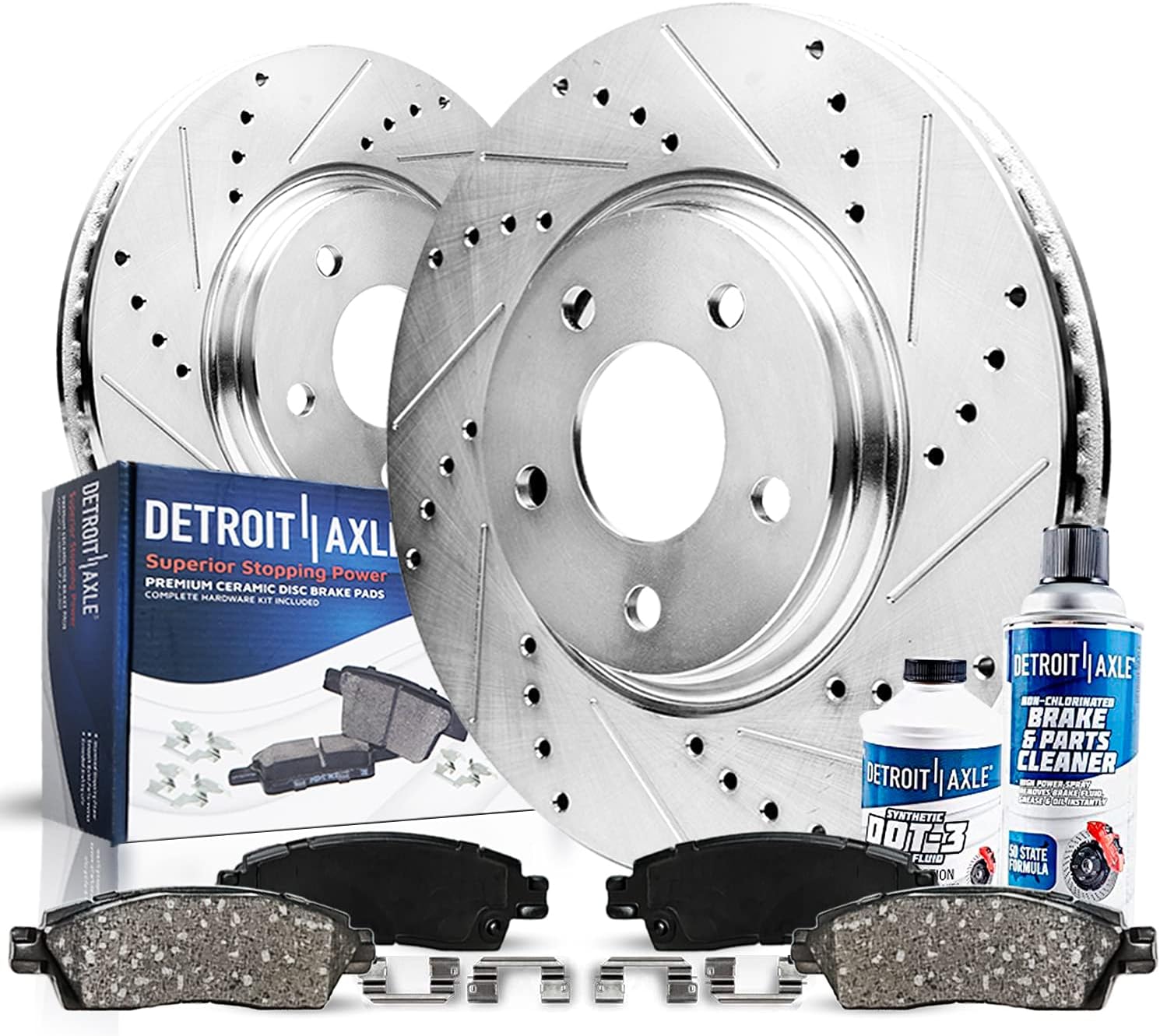
| Front rotor diameter | 13.86" (352 mm) |
|---|---|
| Pad type | Ceramic |
| Rotor style | Drilled and slotted |
| Manufacturer | Detroit Axle |
This Detroit Axle front brake kit supplies two drilled and slotted 13.86-inch rotors, a pair of ceramic front brake pads, and cleaning fluid to replace the factory front braking components on compatible 2013–2019 Ford Explorer models and closely related vehicles. The drilled and slotted rotor surfaces help dissipate heat and shed debris during spirited driving or repeated stops, while the ceramic pads are formulated for quieter operation and reduced dust compared with some semi-metallic compounds. The kit is packaged as a direct replacement and is intended for mechanics or experienced DIYers who want a full front brake refresh in one purchase. Notable benefits are the included rotor finish that resists corrosion and the complete pad-plus-rotor pairing that avoids cross-compatibility guesswork. Buyers should expect an installation similar to other front brake replacements and consider professional installation if they are not comfortable with brake work. This kit targets reliable, factory-style braking with a modest performance edge from the rotors rather than a race-oriented upgrade.
Best for: Buyers who want a dependable, factory-style front brake replacement for a 2013–2019 Ford Explorer and prefer lower noise and dust with a rotor that helps manage heat.
Less Ideal for: Drivers seeking high-temperature track performance or heavy towing/hard-service duty should choose purpose-built performance or heavy-duty brake components instead.
- Includes both front rotors and ceramic pads for a matched replacement
- Drilled and slotted rotors improve heat dissipation and water clearing
- Ceramic pads are quieter and produce less brake dust than many semi-metallic pads
- Ships with brake cleaner and fluid to simplify installation prep
- Designed as a direct replacement not a heavy-duty or track-focused performance upgrade
Verdict: A straightforward matched rotor-and-ceramic-pad kit that restores reliable, quieter front braking on 2013–2019 Ford Explorer models with a slight performance-oriented rotor upgrade.
Choosing the Right 2011-2019 Ford Explorer Brake Pad & Rotor Kit: Key Factors to Consider
Correct Fitment and Year Coverage
Exact fitment is the most important factor when replacing pads and rotors on a 2011-2019 Ford Explorer. Even small differences in rotor diameter, thickness, hat height, or bolt pattern can prevent proper installation or lead to premature wear. Confirm whether a kit lists explicit coverage for the Explorer years in question and whether it specifies front or rear application. For owners of Explorers with optional configurations, verify any notes about parking brake type or sensor wiring so you do not end up with mismatched components.
Kits that document rotor measurements and pad backing plate shape reduce the chance of returns and extra shop time. Proper fitment also ensures OEM-caliber clearance around calipers and suspension components, preserving wheel alignment and preventing rubbing during operation.
Pad Material and Performance Characteristics
Pad composition determines initial bite, fade resistance under heat, and dust generation. Ceramic-based formulations are known for quieter operation and lower dust, while metallic or semi-metallic compounds offer stronger initial friction and better heat tolerance for heavier loads or towing. For a 2011-2019 Explorer, select a material that matches your typical driving: daily commuting favors quieter ceramic-style compounds, while frequent highway driving, towing, or spirited use benefits from higher friction metallic blends.
Consider pad bedding behavior and how the material pairs with rotor surface finish. A mismatch can increase noise or shorten rotor life. Also check whether the pad compound is rated for the temperature ranges you expect to encounter.
Rotor Construction and Thermal Management
Rotors differ by material quality, venting style, and surface design. Vented rotors evacuate heat more effectively than solid units and are common on front applications for Explorers. Slotted or cross-drilled surfaces can help gas and debris escape, improving bite during repeated stops, but may affect rotor longevity under heavy loads. Thicker rotors maintain thermal mass better and resist warping, while rotor metallurgy and coating influence corrosion resistance.
Look at rotor runout and thickness specifications to understand how long a rotor will remain serviceable before it reaches minimum thickness. Proper thermal management helps avoid brake fade during towing or mountainous driving and extends pad life by keeping operating temperatures in an optimal range.
Brake Noise, Vibration, and Harshness Control
NVH matters because noise or vibration after replacement is a common complaint. Factors that reduce brake squeal include quality shims, chamfered pads, and adhesive backing to isolate vibration. Rotor finish and balance also influence whether owners hear squeal or pulse through the pedal. For Explorers, pay attention to kits that highlight anti-noise measures, especially if you drive in stop-and-go conditions that can amplify any NVH issues.
Also consider how pad bedding is handled. Proper bedding procedures and using pads compatible with the rotor surface will minimize glazing and squeal. If noise sensitivity is high, prioritize kits that emphasize low-dust ceramic materials and include hardware to damp vibration.
Included Hardware and Ease of Installation
A complete kit that includes new hardware, caliper guide pins, anti-rattle clips, and sensors streamlines a front brake kit replacement or a rear brake rotor and pads service. Missing hardware can add cost and labor time during installation. Kits that include clear instructions or online fitment notes reduce the chance of mistakes, especially for DIY owners working in their driveway.
Consider whether the kit requires machining or whether rotors are ready-to-install. Some rotors need resurfacing to meet runout specs, while others arrive pre-finished and balanced. For owners without access to a lathe or a machine shop, a ready-to-install rotor shortens downtime.
Longevity and Maintenance Considerations
Longer-lasting pads and rotors lower lifetime service costs but may trade off initial bite or comfort. Look at expected pad wear rates, rotor minimum thickness, and whether rotors can be resurfaced economically. For those planning multiple service cycles, rotors with thicker hats and quality metallurgy are more likely to remain serviceable after one or two resurfacings.
Also account for regional factors such as road salt and humidity that accelerate corrosion. Coated rotors and corrosion-resistant hardware extend service intervals for Explorers driven in harsher climates, reducing the frequency of component replacement and preserving caliper operation over time.
Front Vs Rear Kits: What Differences Matter
Front and rear brake kits are designed around different loads and cooling requirements. Front rotors on the Explorer handle the bulk of braking energy and commonly use vented or larger-diameter rotors. Rear kits may be smaller, sometimes accommodate integrated parking brake mechanisms, and do not always require the same thermal capacity as the front.
When buying a front brake kit replacement, confirm venting style, hat dimensions, and pad backing plate shape. For rear brake rotor and pads sets, check whether the kit supports the Explorer's parking brake setup and whether the rotor includes the correct drum or e-brake mounting features.
- Front kits usually prioritize thermal capacity and fade resistance.
- Rear kits may include parking brake hardware or different pad profiles.
- Mixing front and rear components not designed for the Explorer can cause uneven wear and pedal feel changes.
Ceramic Vs Metallic Pads for Explorer Use
Choosing between ceramic and metallic pad compounds depends on driving style. Ceramic-style pads typically produce less dust and run quieter, which suits everyday commuting and lighter city driving. Metallic or semi-metallic pads provide stronger initial stopping power and better heat tolerance for highway towing or heavier loads.
Think about tradeoffs: ceramics offer comfort and cleaner wheels but may have slightly reduced initial bite under extreme conditions. Metallic pads often generate more dust and can be louder, but they maintain friction under higher temperatures and extended braking events.
- Ceramic: quieter, low dust, comfortable pedal feel.
- Metallic: higher friction, better heat resilience, more dust.
When to Resurface Rotors Versus Replace Them
Deciding whether to resurface or replace rotors depends on remaining thickness, surface condition, and runout. If a rotor can be machined without dropping below the manufacturer's minimum thickness and the runout is within tolerance, resurfacing can restore a smooth braking surface. However, repeated resurfacing reduces rotor mass and may shorten service life for future cycles.
For 2011-2019 Explorer owners, consider replacement when rotors show deep grooves, visible cracking, or when the hat thickness is near the minimum. New rotors eliminate uncertainty about hidden internal flaws and often arrive balanced and pre-finished, reducing the need for additional machining.
- Resurface when thickness and runout are within safe limits.
- Replace if there are deep grooves, cracks, or insufficient residual thickness.
- New rotors reduce the chance of future warping and often include protective coatings.
Fitment Tips and Preparing for Installation
Before starting a front or rear pad and rotor swap, gather the correct tools, a torque wrench, and any caliper-specific tools. Verify you have the correct replacement kit for the Explorer's model years and note whether the kit supplies guide pins, clips, and new hardware. Inspect caliper pistons and seals during disassembly; any sticking or leakage is a sign to address caliper service or replacement.
Measure existing rotor thickness and runout, and compare to the kit specifications. Clean mating surfaces, apply lubricants where recommended on sliding surfaces, and torque fasteners to factory values. If you are not comfortable with brake work, professional installation reduces the risk of safety-critical errors.
- Always check kit fitment notes for front or rear specific parts.
- Replace or service caliper hardware if guide pins are corroded.
- Use a torque wrench and follow manufacturer torque specs for wheel and caliper bolts.
Addressing Brake Noise After Replacement
Brake noise after installing new pads and rotors often comes from improper bedding, missing anti-squeal shims, or uneven rotor surfaces. Ensure pads are properly bedded to the rotor with controlled stops to transfer a thin, even layer of pad material. Check that shims and anti-rattle clips are installed correctly and that pads are not over-torqued or binding in the caliper.
If squeal persists, inspect rotor surfaces for glazing or contamination and recheck caliper alignment. In some cases, upgrading to pads with better NVH characteristics or adding a thin shim layer can significantly reduce high-frequency squeal without compromising braking performance.
- Perform a bedding procedure with gradual stops to mate pads and rotors.
- Ensure shims and clips are installed; replace any corroded hardware.
- Clean rotors before installation to remove shipping oil or contaminants.
High-Performance Options for Occasional Towing or Aggressive Driving
If you tow occasionally or drive more aggressively, consider higher-performance kits with enhanced thermal capacity and more aggressive friction compounds. These kits typically use thicker or vented rotors and semi-metallic pads formulated to resist fade during repeated heavy stops. They may be louder or produce more dust, but they provide more consistent pedal feel under stress.
Balance the need for performance with everyday comfort. For mixed use on an Explorer, a mid-grade performance kit often provides a good compromise: improved stopping and fade resistance while maintaining acceptable NVH for daily driving.
- Choose vented rotors and higher-friction pads for improved fade resistance.
- Expect more dust and possible increase in noise with aggressive compounds.
- Verify that performance rotors meet the Explorer's thickness and runout specifications.
Still looking for the perfect fit?
Select your Ford Explorer configuration to see the most relevant Brake Pad & Rotor Kits recommendations
How We Chose the Best 2011-2019 Ford Explorer Brake Pad & Rotor Kit
We focused on criteria that matter specifically for 2011-2019 Ford Explorer owners and for full pad-and-rotor replacement. Fitment accuracy was primary: we checked kit coverage for the Explorer model years, rotor diameter and thickness specifications, mounting hat and bolt pattern compatibility, and front versus rear application where applicable. Braking performance was assessed by looking at pad material type, friction ratings, and rotor construction to estimate stopping power, fade resistance, and longevity. Durability factors included rotor metallurgy and slot or vane design, pad backing plate quality, and corrosion protection for the climates many Explorers see. NVH was considered by evaluating pad shims, chamfers, and rotor surface finish to reduce brake noise after replacement. Serviceability and installation were judged by whether kits included hardware, sensors, and clear fitment notes to support straightforward front brake kit replacement or rear brake rotor and pads swaps.We excluded partial components that do not replace both pads and rotors together and any items without confirmed fitment notes for the 2011-2019 Explorer. Kits that required major machining or custom adapters were not considered. Our shortlist emphasizes options that offer the best balance of correct fitment, braking performance, and long-term value for Explorer owners.
Our full evaluation process is outlined in our review methodology.
FAQ
How often should I replace both pads and rotors on a 2011-2019 Ford Explorer?
Replacement intervals depend on driving style and conditions. Many owners replace pads every 30,000 to 60,000 miles and rotors every 60,000 to 100,000 miles, but heavy towing or aggressive driving shortens these intervals. Inspect thickness and runout regularly to decide when both components should be changed together.
Can I just replace pads and keep my existing rotors on the Explorer?
You can replace pads alone if rotors are within thickness and runout limits and have no deep scoring or cracks. However, pairing new pads with worn rotors may cause noise, uneven wear, or reduced performance. Replacing pads and rotors together is often recommended for consistent results.
What should I do if my Explorer has brake pulsation after a rotor and pad replacement?
Pulsation often indicates excessive rotor runout or uneven mounting surface. Recheck rotor thickness and runout, ensure mating surfaces are clean, and verify wheel torque is correct. If the rotor itself is warped beyond tolerances, replacement is usually the remedy.
Are there special fitment considerations for rear brake rotor and pads on the Explorer?
Yes. Rear kits may need to accommodate the parking brake mechanism and could include different pad shapes. Confirm the kit specifies rear fitment for the Explorer years and whether parking brake hardware or sensor provisions are included to avoid compatibility issues.
Will switching to ceramic pads reduce brake dust on my Explorer's wheels?
Ceramic pads generally produce less visible brake dust compared with metallic compounds. While they reduce dust and are often quieter, they may offer slightly different initial bite characteristics, so choose based on your priorities for cleanliness versus aggressive stopping performance.
Do I need to resurface rotors when installing a new pad-and-rotor kit?
New kits typically include ready-to-install rotors that do not require resurfacing. If you are retaining existing rotors, check for glazing, grooves, and thickness; resurface only if the rotor can be machined within safe limits.
Final Verdict
When replacing brake pads and rotors on a 2011-2019 Ford Explorer, prioritize correct fitment and the pad material that matches your driving habits. Front components need greater thermal capacity, while rear kits must accommodate the parking brake setup. Balance stopping performance, NVH, and longevity to choose a kit that meets your daily driving and any occasional towing needs.Focus on kits that provide documented fitment, include necessary hardware, and specify rotor thickness and runout. That approach helps you avoid installation problems and achieve predictable braking behavior for years to come.
Explore More:
- Check out all Ford Explorer parts & accessories
- Explore Brake Pad & Rotor Kits Maintenance & Repair Guides
- Explore Brake System
- Browse all Auto Parts
