

Note: This article contains affiliate links. If you click on these links and make a purchase, I may earn a small commission at no extra cost to you. This helps support my research and content. Read my full affiliate disclosure here.
If you own a 1998-2011 Ford Ranger, choosing the right brake fluid can make a noticeable difference in pedal feel, braking consistency, and long-term component life. Brake fluid performance affects how the system responds under load and how well it resists moisture and corrosion over time. In this guide we shortlisted six top brake fluids suited to the Ranger's hydraulic system, focusing on properties that matter most for everyday driving and towing.Below you will find concise evaluations of each option, plus practical buying factors and maintenance guidance so you can pick a fluid that matches your driving style and service routine.
Looking for other parts? See all Ford Ranger parts & accessories.
Top Picks at a Glance
| Best Overall Brake Fluid A balanced, reliable formula with strong boiling point and corrosion resistance | Valvoline DOT 3 & 4 Synthetic Brake Fluid, 32 oz |  |
| Best Budget Brake Fluid An affordable DOT‑rated fluid that covers routine brake maintenance needs | Mag 1 DOT4 Brake Fluid, 12 Ounce Bottle |  |
| Best DOT 3 Brake Fluid A DOT‑3 formulation ideal for older systems and standard boiling requirements | Valvoline DOT 3 Synthetic Brake Fluid, 32 oz |  |
| Best DOT 4 Brake Fluid A higher‑boiling DOT‑4 formula suited for ABS and modern braking components | Prestone AS800Y DOT 4 Synthetic Brake Fluid, 12 oz. |  |
| Best DOT 5.1 / High‑Temp Brake Fluid A full‑synthetic, very high‑boiling formula built to resist fade under extreme heat | Liqui Moly DOT 5.1 Brake Fluid, 250 ml |  |
| Best Quart / Bulk Brake Fluid A larger‑volume bottle or quart can for multiple flushes and long‑term maintenance | Johnsen's 5034 Premium Synthetic DOT-4 Brake Fluid, 1 Gallon |  |
1. Valvoline DOT 3 & 4 Synthetic Brake Fluid, 32 oz
Best Overall Brake Fluid

| Unit Count | 32.0 Fluid Ounces |
|---|---|
| Liquid Volume | 0.92 Liters |
| Specific Uses For Product | Vehicle Brake Systems |
| Item Form | Liquid |
This Valvoline synthetic brake fluid is a versatile DOT 3/4 formulation designed to mix with conventional fluids and protect hydraulic brake systems. It is typically used when topping off or flushing brake systems on passenger trucks and light vehicles and works with ABS, disc, and drum brakes. The low-moisture formula improves vapor lock resistance and helps maintain higher wet and dry boiling points for more consistent stopping performance under load. Because it is compatible with both DOT 3 and DOT 4 specifications, it simplifies maintenance for DIY mechanics who want one fluid that fits multiple vehicles or model years. Practical benefits include easier cross-compatibility, corrosion protection for internal components, and reduced risk of brake fade during heavy or repeated braking. Limitations are that it is not a dedicated high-performance DOT 5.1 product and will not match the higher boiling point of some premium DOT 4 or DOT 5.1 fluids, so drivers who push braking systems hard or require extreme heat resistance may prefer a different specification.
Best for: DIY mechanics and owners of late 1990s to early 2010s light trucks who want a single, compatible brake fluid that balances boiling resistance and corrosion protection for routine maintenance.
Less Ideal for: Drivers who need the highest possible boiling point for track use or heavy towing should choose a dedicated high-performance DOT 4 or DOT 5.1 fluid instead.
- DOT 3/4 compatibility lets you use the same fluid across multiple brake system specs
- Low-moisture formula designed to resist vapor lock and maintain boiling point
- Formulated for corrosion protection to help preserve brake system components
- Ready-to-use 32 oz bottle suited for a full flush or multiple top-offs
- Not a DOT 5.1-grade fluid so it offers lower maximum boiling performance than some high-end options
Verdict: The top all-purpose brake fluid pick balances high wet/dry boiling points, corrosion protection, and compatibility so DIY mechanics get dependable stopping power without fuss.
2. Mag 1 DOT4 Brake Fluid, 12 Ounce Bottle
Best Budget Brake Fluid

| Viscosity | High viscosity suitable for high-temperature conditions |
|---|---|
| Upper Temperature Rating | 311 Degrees Fahrenheit |
| Liquid Volume | 12 Fluid Ounces |
| Container Type | Bottle |
Mag 1 DOT4 is a straightforward DOT‑rated brake fluid intended for regular brake maintenance such as flushes and topping off the reservoir. Packaged in a 12 ounce bottle, the formula emphasizes high viscosity and high‑temperature resistance with a minimum wet boiling point of 311°F, which helps maintain braking performance under heavier use and higher temperatures. It is compatible where DOT 4 or DOT 3 fluids are acceptable and is described as moisture resistant and lubricious to protect seals and moving parts in disc and drum systems. The small bottle size makes it convenient for occasional top‑offs or as a carry‑along service bottle, but it is not sized for multiple full system flushes on larger vehicles. The product is a basic, budget‑oriented option: it meets required safety standards and SAE J1703 but does not offer advanced performance additives or extended service claims found in premium formulations. For routine maintenance on older Ford Rangers this provides safe, adequate performance at a low cost, while heavier duty or performance braking needs may warrant a higher‑spec fluid.
Best for: Buyers who want an affordable, compliant brake fluid for routine flushes and occasional topping off on older trucks and daily drivers prioritizing basic, safe performance.
Less Ideal for: Drivers who plan aggressive driving, heavy towing, track use, or who need extended service intervals should choose a higher‑spec or performance brake fluid instead.
- Meets DOT4 rating for safe use in systems specifying DOT3 or DOT4
- High wet boiling point (311°F) helps resist vapor lock under higher temperatures
- Small 12 ounce bottle is convenient for topping off and occasional maintenance
- Formulation notes moisture resistance and lubricity to protect seals and components
- 12 ounce size limits usefulness for multiple full system flushes on larger vehicles
- No premium additive package or extended service claims compared with high-end fluids
Verdict: Choose this low-cost DOT‑rated fluid for routine flushes and topping off when you want safe, basic performance without paying for premium specs.
3. Valvoline DOT 3 Synthetic Brake Fluid, 32 oz
Best DOT 3 Brake Fluid

| Material | Synthetic |
|---|---|
| Liquid Volume | 32 Fluid Ounces |
| Viscosity | 10w |
| SAE J300 Viscosity Grade | 10W |
Valvoline DOT 3 is a synthetic brake fluid aimed at drivers who need a reliable DOT 3 formulation for older hydraulic systems. It is used like any standard brake fluid: fill the master cylinder reservoir during service or top off during a bleed, and it is compatible with ABS, disc, and drum brakes. The formula emphasizes a premium high boiling point to reduce risk of vapor lock and brake fade in demanding driving, and the synthetic base helps resist moisture absorption and corrosion to protect system components over time. It meets SAE and federal specifications relevant to DOT 3 and is presented in a 32 ounce bottle suitable for a full system refill on many compact trucks. Limitations are that it is still a DOT 3 fluid, so it has lower wet and dry boiling points than DOT 4/5.1 alternatives and should not be mixed with silicone-based fluids, nor used where a higher DOT rating is required by the vehicle maker.
Best for: Drivers maintaining older hydraulic brake systems that specify DOT 3 and who prioritize a higher boiling point and corrosion resistance in a factory‑replacement fluid.
Less Ideal for: Drivers who need higher temperature performance or who are specifying DOT 4 or DOT 5.1 for upgraded or heavy‑duty braking applications.
- Full synthetic formulation improves resistance to moisture absorption compared with conventional DOT 3 fluids
- Premium high dry boiling point helps reduce vapor lock and brake fade under heat
- Compatible with ABS, disc, and drum brake systems and meets relevant SAE/federal specs
- 32 oz bottle size is convenient for a complete system refill on small trucks and cars
- Lower boiling point ceiling than DOT 4/5.1 fluids so less margin for extreme-performance use
Verdict: This slot is for DOT‑3 fluids offering appropriate boiling points and compatibility for older-style hydraulic brake systems where DOT‑3 is specified.
4. Prestone AS800Y DOT 4 Synthetic Brake Fluid, 12 oz.
Best DOT 4 Brake Fluid

| Unit Count | 12.0 Fluid Ounces |
|---|---|
| Brand Name | Prestone |
| Part Number | AS800Y |
| Item Form | Liquid |
This Prestone DOT 4 synthetic brake fluid is designed to deliver a higher dry boiling point and extended service life for vehicles that require DOT 4. It is typically used when flushing or topping up brake systems, including ABS, disc, and drum brakes, and it is compatible with other DOT 4 fluids. Notable features include a formula claimed to resist vaporization and reduce water-related performance decline, corrosion inhibitors for metal components, and a 12 oz. bottle size convenient for single repairs or top-offs. In practice the product suits routine maintenance and brake fluid replacement intervals, helping reduce brake fade under high-temperature conditions and protecting internal parts from rust. Limitations are its single small bottle size for full system overhauls on larger vehicles and the reminder that you must use the DOT grade specified by your vehicle manufacturer to maintain correct boiling characteristics and replacement intervals.
Best for: Drivers who need a DOT 4 fluid with a higher boiling point and corrosion protection for ABS-equipped vehicles and routine brake maintenance.
Less Ideal for: People who plan to do multiple full brake system flushes at once or need larger bulk quantities should consider purchasing larger containers.
- Higher dry boiling point than DOT minimums to help resist brake fade
- Formulated to prevent corrosion of metal components in the braking system
- Compatible with all DOT 4 systems including ABS, disc, and drum brakes
- Extended life formulation marketed for up to 50,000 mile service intervals
- 12 oz bottle may be small for a full system flush on many vehicles
Verdict: Pick a DOT‑4 fluid when you need the higher boiling point and ABS compatibility required by many modern braking systems.
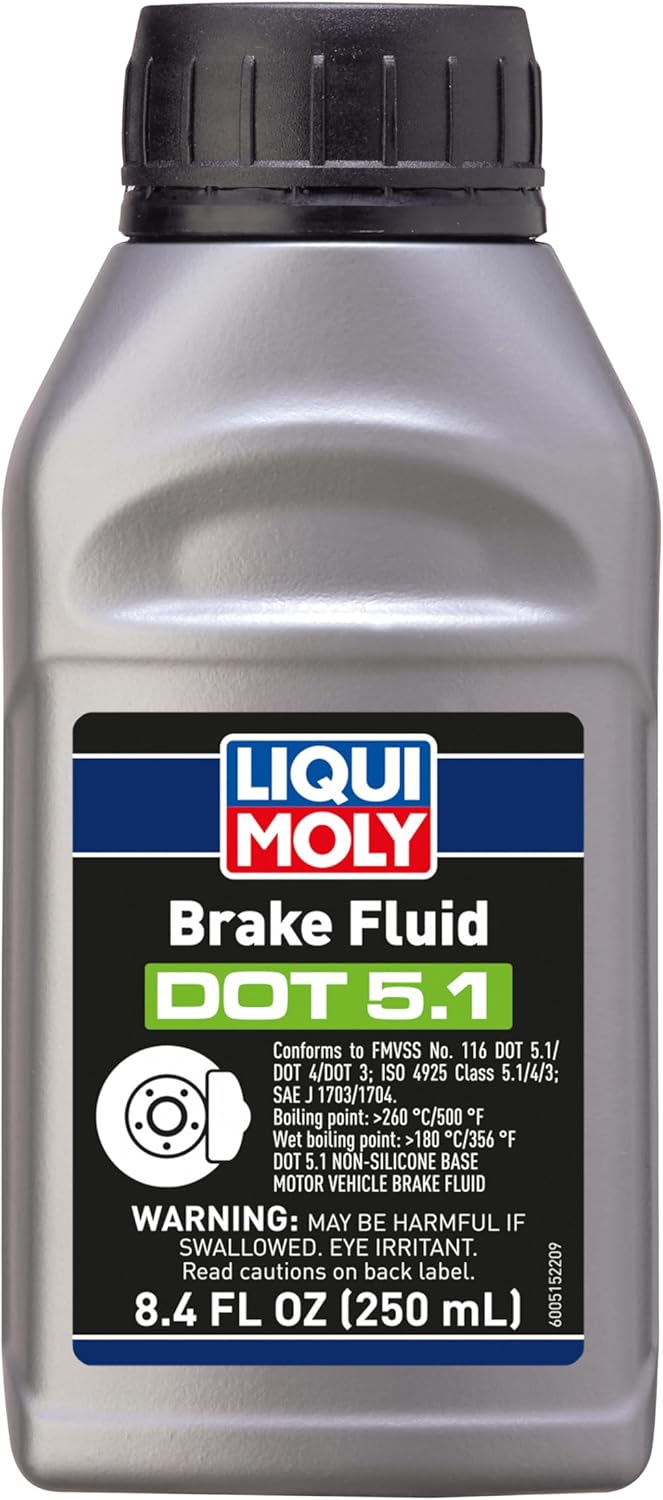
5. Liqui Moly DOT 5.1 Brake Fluid, 250 ml
Best DOT 5.1 / High‑Temp Brake Fluid
| Liquid Volume | 250 Milliliters |
|---|---|
| Recommended Uses For Product | Automotive |
| Specific Uses For Product | High‑performance and extreme temperature braking systems |
| Item Form | Liquid |
Liqui Moly DOT 5.1 is a full‑synthetic brake fluid formulated for high‑temperature braking demands. It mixes with other high‑quality synthetic fluids and delivers higher wet and dry boiling points than DOT 3 and DOT 4, which helps resist vapor lock and reduce fade during heavy or repeated braking. The formula includes corrosion and oxidation inhibitors and scavengers to limit steam formation as moisture builds in the system, and its lubricating properties help protect moving components in the hydraulic circuit. In practice this is used as a system top‑up or bleed fluid when you need a higher boiling point for towing, mountain driving, or spirited use. The 250 ml bottle suits small jobs and bleeding a single caliper but may require multiple bottles for full fluid changes on most trucks. Handle with care and protective equipment because the material can irritate eyes and has reproductive hazard warnings on the label.
Best for: Drivers looking to upgrade braking performance for towing, steep terrain, or spirited driving who prioritize maximum boiling resistance and system protection.
Less Ideal for: Those who need bulk quantities for routine full brake fluid changes on larger vehicles should consider larger container sizes instead.
- Full‑synthetic DOT 5.1 formulation with higher wet and dry boiling points than DOT 3/4
- Compatible and miscible with other high‑quality synthetic brake fluids
- Contains corrosion and oxidation inhibitors to protect hydraulic components
- Includes scavengers to reduce steam formation as moisture increases
- 250 ml bottle is small for a full system flush on most pickup trucks
Verdict: This category highlights full‑synthetic DOT‑5.1/high‑temp fluids for drivers who want maximum boiling resistance and reduced brake fade under demanding conditions.
6. Johnsen's 5034 Premium Synthetic DOT-4 Brake Fluid, 1 Gallon
Best Quart / Bulk Brake Fluid

| Liquid Volume | 128 Fluid Ounces |
|---|---|
| Viscosity | Stable viscosity over wide temperature range |
| Upper Temperature Rating | 446 Degrees Fahrenheit |
| Recommended Uses | Brake oil |
Johnsen's 5034 is a premium synthetic DOT 4 brake fluid supplied in a full gallon bottle for fleet work or frequent bleeding. It is formulated to resist vapor lock and reduce moisture absorption while meeting DOT 4 and DOT 3 requirements, so it can be used where DOT 4 spec is required and mixed safely with DOT 3 if needed. In practice the large bottle makes repeated servicing and bleeding simpler and reduces trips to the store for technicians or home mechanics working on multiple vehicles. The fluid lists a high upper temperature rating and stable viscosity over a wide range, which helps maintain pedal feel under heat and during heavy use. As a bulk product it requires careful storage and handling to avoid moisture pickup after opening, and it is not suitable where a silicone DOT 5 fluid is explicitly required. For routine service on late 1990s to early 2010s light trucks this gallonsize DOT 4 gives good convenience and factoryreplacement performance.
Best for: Home mechanics, shops, and fleet owners who perform frequent brake bleeding or service multiple vehicles and want a single gallonsize fluid to simplify refills and reduce cost per service.
Less Ideal for: Drivers who only need a single small topup or who must use silicone DOT 5 fluid should choose a smaller container or the appropriate fluid type instead.
- One gallon volume is costeffective for repeated bleeding and servicing multiple vehicles
- Meets DOT 4 specifications and is compatible with DOT 3 fluids
- Formulated to resist vapor lock and reduce moisture absorption for more stable performance
- Stable viscosity and high temperature rating help preserve pedal feel under heat
- Gallon packaging requires careful resealing and storage to prevent moisture contamination
- Not suitable for systems that require nonhygroscopic silicone DOT 5 fluid
Verdict: This pick is for quart‑size or bulk bottles that save money and simplify repeated bleeding jobs or servicing multiple vehicles.
Choosing the Right 1998-2011 Ford Ranger Brake Fluid: Key Factors to Consider
Boiling Point (Dry and Wet)
Boiling point determines how well brake fluid resists vapor formation under heat. A higher dry boiling point reduces the chance of vapor lock during repeated heavy stops or when towing, which preserves pedal firmness and stopping power.
Wet boiling point reflects the fluid performance after it has absorbed moisture, which is inevitable in a sealed but hygroscopic hydraulic system. For the Ranger, selecting a fluid with a strong wet boiling point extends safe service intervals and improves safety under real-world, moisture-affected conditions. Consider both ratings rather than just the dry number when evaluating candidate fluids.
DOT Specification and Compatibility
DOT classification (for example DOT 3 or DOT 4) describes chemical and performance characteristics that affect compatibility with existing seals, rubber components, and system tolerances. Using a fluid that matches or exceeds the Ranger's recommended DOT spec helps avoid seal swelling or shrinkage and ensures predictable hydraulic behavior.
If you plan to switch fluid types (for instance from DOT 3 to DOT 4), confirm compatibility with the vehicle service manual and be prepared to perform a full flush to remove legacy fluid. Choosing the proper DOT rating reduces the risk of damage and maintains warranty or service expectations where applicable.
Hygroscopic Behavior and Moisture Management
Most conventional and synthetic brake fluids absorb moisture over time. The rate at which they do so affects how quickly boiling points decline and how fast internal corrosion can begin. For an older Ranger, slower moisture uptake translates into more predictable braking performance between service intervals.
Consider fluids with proven corrosion inhibitors and lower hygroscopic rates to extend safe service life. Regular maintenance still matters, but selecting a fluid with better moisture resistance reduces the frequency of mandatory flushes and lowers the chance of moisture-induced component failure.
Corrosion Inhibition and Seal Compatibility
Brake fluids must protect metal components and be chemically compatible with rubber seals and hoses. Effective corrosion inhibitors slow rust in calipers, lines, master cylinders, and ABS components, which is especially important for Rangers exposed to road salt or humid climates.
Seal compatibility avoids premature leaks and maintains pedal feel. When evaluating fluids, check manufacturer specifications for compatibility with common elastomers and look for explicit corrosion protection claims backed by standards or laboratory data.
Service Interval and Maintenance Practicality
Some brake fluids provide longer safe service intervals due to higher wet boiling points or slower moisture absorption. Choosing a fluid that aligns with your maintenance habits can reduce the number of required flushes and simplify long-term ownership.
Also consider how easy the fluid is to bleed or flush from the system and whether it requires special equipment or procedures. For do-it-yourself servicing, a fluid that cleans system components well and is straightforward to handle will make routine maintenance less time-consuming.
Performance Needs and Intended Use
Your driving style and how you use the Ranger should influence fluid selection. Occasional city driving has different demands than frequent towing, off-road use, or highway hauling. Higher-performance or higher DOT-rated fluids provide increased thermal tolerance for heavy-duty use.
Balance the marginal gains in boiling point against cost and maintenance commitments. For trucks that do periodic towing or load carrying, prioritize thermal stability and wet boiling point to maintain consistent pedal feel under stress.
DOT 3 Versus DOT 4: Which Fits the Ranger Best
DOT ratings reflect standardized performance thresholds and chemical formulations. DOT 3 fluids are commonly recommended for many light-duty applications and offer adequate boiling points for everyday driving. DOT 4 fluids usually provide higher boiling points and better thermal performance, making them attractive for heavier or more demanding use.
For the 1998-2011 Ford Ranger, consider DOT 4 if you frequently tow or push the brakes hard, as the higher dry and often higher wet boiling points give an added margin against vapor lock. If the truck is used mainly for routine commuting with no heavy braking demands, a quality DOT 3 that meets the vehicle's specification may be sufficient.
- DOT 3: generally lower boiling points, adequate for light use
- DOT 4: higher boiling points, better for towing or spirited driving
- If switching specs, perform a complete system flush to avoid mixing incompatible fluids
Signs Your Brake Fluid Needs Service
Watch for changes in pedal feel such as sponginess, increased travel, or decreased responsiveness. These symptoms can indicate moisture contamination, air in the lines, or deteriorated fluid. Squealing or unusual braking noise is less likely from fluid alone, but fluid-related performance loss should always be ruled out.
Visual checks include inspecting the fluid reservoir for darkened fluid or debris. Dark, cloudy, or rusty-looking fluid often signals contamination and an overdue flush. Regularly scheduled fluid checks and periodic replacement help maintain braking reliability and avoid costly component wear.
- Spongy or soft brake pedal
- Increased stopping distance during repeated braking
- Dark or contaminated reservoir fluid
How Driving Conditions Affect Fluid Choice
Driving environments such as frequent mountain descents, towing, or stop-and-go urban traffic raise thermal loads on the braking system. These conditions accelerate fluid heating and can reveal limitations in boiling point or moisture management. For Rangers used in these situations, prioritize fluids with higher wet and dry boiling points.
Conversely, mild driving without heavy loads favors fluids that balance corrosion protection and maintenance intervals. Match the fluid's capabilities to the Ranger's typical workload to avoid overpaying for attributes you will never need or under-specifying for heavy-duty demands.
- Towing and hill descents increase thermal stress
- Cold and humid climates accelerate moisture absorption
- Urban driving often cycles brakes frequently, increasing heat generation
Bleeding and Flushing Best Practices
A complete flush is recommended whenever changing DOT class or when fluid is badly contaminated. Proper bleeding removes trapped air and ensures consistent pedal feel. For the Ranger, follow the service manual sequence and use appropriate tools such as a pressure bleeder or one-way bleeder to simplify the process.
Collect old fluid safely and top up the reservoir as needed during bleeding to prevent intake of air. After bleeding, test pedal firmness at low speed before normal operation. Document the service date and mileage to track future maintenance intervals.
- Perform a full flush when changing DOT types
- Use the correct bleeding sequence specified for the vehicle
- Test pedal feel carefully after service
Material Compatibility and Aging Components
Older Rangers may have rubber hoses, seals, and caliper components that have aged. Choose a fluid with proven compatibility to reduce the risk of accelerated seal degradation. Verify that the fluid's chemistry is suitable for legacy elastomers and does not introduce swelling or shrinking beyond normal tolerances.
If components show signs of wear or leakage, address hardware issues before or during fluid service. Replacing degraded hoses and seals while performing a fluid change improves long-term reliability and prevents repeating the service soon after.
- Inspect for cracked or bulging hoses before fluid service
- Replace worn seals to prevent leaks after a flush
- Use compatible fluids to limit unintended chemical reactions with old components
When High-Performance Fluids Make Sense
High-performance or synthetic brake fluids can offer higher boiling points and superior moisture resistance. These benefits help trucks that see occasional high-heat situations such as heavy towing, long descents, or frequent hard braking. They can also extend safe service intervals when used correctly.
However, for everyday city driving without heavy loads, the extra performance may provide limited real-world advantage. Evaluate whether the added thermal margin justifies the maintenance change and whether your system requires any additional precautions when using a specialty fluid.
- Benefits: higher boil points, better moisture resistance
- Consider for towing, repeated heavy braking, or track use
- Assess whether system flushing and compatibility checks are required
Still looking for the perfect fit?
Select your Ford Ranger configuration to see the most relevant Brake Fluids recommendations
How We Chose the Best 1998-2011 Ford Ranger Brake Fluid
We evaluated candidate fluids using criteria that directly affect how a brake system performs and endures in a 1998-2011 Ford Ranger. Key evaluation points included boiling point under dry and wet conditions, since higher boiling points reduce the risk of vapor lock during heavy use or towing. We also prioritized moisture resistance and hygroscopic behavior, because fluids that absorb less water maintain performance longer and slow internal corrosion.Compatibility with the Ranger's hydraulic system and commonly recommended specifications was another filter; we focused on fluids that meet or exceed DOT classifications appropriate for this vehicle. Corrosion inhibition and material compatibility were assessed to limit seal, hose, and master cylinder degradation. Finally, we considered long-term maintenance intervals and whether the fluid type simplifies service tasks like bleeding and flushing.We excluded any fluids that lack clear specification data, that are labeled only for specialty race use without standard DOT ratings, or that require system changes to use. The final six picks represent reliable, specification-backed choices that suit typical Ranger use cases from daily driving to light towing.
Our full evaluation process is outlined in our review methodology.
FAQ
How often should I change brake fluid in a 1998-2011 Ford Ranger?
Frequency depends on driving conditions, but a common recommendation is every two years or according to the manufacturer schedule. If you tow frequently or notice pedal changes, consider more frequent intervals.
Can I mix DOT 3 and DOT 4 fluids in my Ranger?
Technically DOT 3 and DOT 4 are compatible chemically and will mix, but mixing lowers the overall boiling point to that of the weaker component. For best results, perform a full flush when changing between DOT types.
Will a higher-rated brake fluid improve stopping distance?
A higher-rated fluid mainly improves thermal tolerance and pedal consistency under heavy use. It does not directly shorten stopping distances in normal conditions, but it helps maintain braking performance during repeated hard stops.
Are synthetic brake fluids better for older Rangers?
Synthetic fluids can offer higher boiling points and slower moisture uptake, which benefits older systems under heavy thermal stress. Make sure the fluid is compatible with existing seals and perform a full flush if switching types.
How can I test if my brake fluid is contaminated?
Visual inspection of reservoir fluid for darkening and laboratory or test-strip checks for moisture content are practical methods. If you detect significant moisture or discoloration, schedule a flush and component inspection.
Does heavy towing require a different brake fluid for the Ranger?
Heavy towing increases thermal load, so choosing a fluid with higher dry and wet boiling points is advisable. Prioritize fluids with demonstrated thermal stability and low hygroscopic rates for towing applications.
Final Verdict
Prioritize fluids with the right balance of boiling point, moisture management, and compatibility for your 1998-2011 Ford Ranger. Match the DOT specification to your typical use, and favor higher wet boiling points if you tow or frequently subject the brakes to high heat. Maintain a regular flush schedule and inspect aging components so the chosen fluid can perform reliably.Ultimately, pick a fluid that aligns with your driving demands and commit to the maintenance practices that protect braking performance and hydraulic components over time.
Explore More:
- Check out all Ford Ranger parts & accessories
- Explore Fluids & Chemicals
- Browse all Accessories
