

Note: This article contains affiliate links. If you click on these links and make a purchase, I may earn a small commission at no extra cost to you. This helps support my research and content. Read my full affiliate disclosure here.
If you drive a 1997–2003 Ford F-150 you know worn ball joints show up as loose steering, uneven tire wear, or a vague front end. Selecting the correct ball joints for that model year range is important because fitment, load rating, and dust-seal quality directly affect handling and suspension life.This guide covers six carefully shortlisted ball joint options that fit the 1997–2003 F-150. We evaluate each on fitment accuracy, durability, and installation considerations so you can pick the part that best matches how you use the truck, whether daily driving, towing, or light-duty hauling. Read on to see what matters when replacing these suspension pivots and what to expect during installation.
Looking for other parts? See all Ford F-150 parts & accessories.
Top Picks at a Glance
| Best Overall The best all-around choice for most situations | Detroit Axle 10‑Piece Front Suspension Kit (4WD) for Ford F‑150/F‑250/Expedition/Navigator |  |
| Best Quality Built to a higher standard if you want something more solid | MOOG K8695T Front Lower Suspension Ball Joint (greasable) |  |
| Best Value The sweet spot between price and what you get | Detroit Axle 4‑Piece Front Ball Joint Kit for Ford F-150/F-250/Expedition/Navigator (1997–2003) |  |
| Best Budget The cheapest option that still gets the job done reliably | PM Auto Front Lower Suspension Ball Joint (Front Lower) |  |
| Highest Rated A top-rated pick with lots of positive feedback | Metrix Premium Chassis Parts 2‑Piece Front Lower Ball Joint Kit (K8695T) |  |
| Most Popular A crowd favorite that many people choose with confidence | Detroit Axle Front Lower Ball Joints (pair) for Ford F-150 |  |
Detroit Axle 10‑Piece Front Suspension Kit (4WD) for Ford F‑150/F‑250/Expedition/Navigator

| Fit Type | Vehicle Specific Fit |
|---|---|
| Auto Part Position | Front |
| Material | Alloy Steel |
| Included Components | 2 Upper Control Arms w/ Ball Joints; 2 Lower Ball Joints; 2 Sway Bar End Links; 4 Tie Rod Ends |
This Detroit Axle 10-piece front suspension kit supplies the main front-end wear items you need to rebuild steering and control on compatible 4WD Ford trucks and SUVs. The kit includes two upper control arms with ball joints, two lower ball joints, two sway bar end links and four tie rod ends so you can replace worn pivot points and steering links in one job. Components arrive prepackaged and several reviews report plug-and-play fitment and pre-greased joints that speed installation. The alloy steel parts feel sturdy and the kit is aimed at restoring steering precision and reducing play compared with aged factory components. Expect to need an alignment after installation and allow time for a proper press or shop install for the pressed-in ball joints. Some buyers have reported occasional issues with grease fittings, packaging mismatches, and surface corrosion over long term use, so consider addressing grease fittings during install and inspect parts before assembly. For a balanced rebuild that targets handling and steering feel without buying individual parts, this kit covers the essential front-end components efficiently.
Best for: Buyers who want a single, vehicle-specific kit to replace worn front control and steering components and restore steering feel without sourcing parts separately.
Less Ideal for: Do not choose this kit if you need corrosion-resistant or heavy-duty aftermarket parts for offroad or salt‑exposed use, or if you prefer to replace only one or two individual components at a time.
- Complete set covers upper control arms with ball joints, lower ball joints, sway bar end links and tie rod ends for a full front-end refresh
- Vehicle-specific fitment for the listed 4WD Ford models reduces guesswork during installation
- Pre-greased joints and organized packaging speed up assembly and reduce prep time
- Alloy steel construction provides stronger-feeling components compared with generic economy parts
- Some users reported grease fittings that did not accept grease and occasional wrong or damaged rubber boots in the package
- Reports of surface rust developing on certain parts over time suggest limited corrosion protection in some environments
Verdict: If you want an economical, all-in-one front-end refresh for the specified 4WD Ford models, this kit delivers the essential control arms and steering links to restore steering precision.
MOOG K8695T Front Lower Suspension Ball Joint (greasable)

| Position | Front |
|---|---|
| Manufacturer | MOOG Chassis Products |
| Item model number | K8695T |
| OEM Part Number | F57Z3050BB |
The MOOG K8695T is a direct-fit front lower ball joint intended to restore steering feel and suspension tightness on compatible Ford F-150 and similar vehicles. It uses a metal-to-metal gusher bearing and a Belleville preload washer that keep the bearing snug and let grease flow through for reduced friction and longer service life. The joint is greasable and arrives with a robust pre-installed boot to keep contamination out, which makes periodic lubrication straightforward and helps extend service intervals. Installation is designed to match factory tolerances for an easy press-in fit and correct alignment; a ball-joint press and basic hand tools are normally required. Practical benefits include stronger heat-processed studs for fatigue resistance and a replaceable grease fitting that lets you maintain the joint yourself. Limitations: this is a vehicle-specific factory replacement part, so you must confirm fit for your year and trim, and press-in installation can be time consuming if you lack the right tools or experience.
Best for: Buyers who want a durable, serviceable replacement that tightens steering and can be maintained with regular greasing to maximize lifespan.
Less Ideal for: Drivers who prefer sealed-for-life, maintenance-free replacements or who are unwilling to rent or buy a ball-joint press should consider other options.
- Direct-fit design for Ford front lower application ensures correct alignment and easier installation.
- Greasable socket and pre-installed boot allow routine lubrication to flush debris and extend life.
- Heat-processed ball stud and metal-to-metal bearing improve strength and resistance to premature wear.
- Belleville preload washer maintains bearing tightness as internal components wear.
- Requires a ball-joint press and moderate mechanical skill to install properly.
- Fitment is specific to certain model years and trims so compatibility must be verified before purchase.
Verdict: A serviceable, heavy-duty direct-fit lower ball joint for 1997–2003 Ford F-150 owners who prioritize durability and the ability to maintain the part with grease.
Detroit Axle 4‑Piece Front Ball Joint Kit for Ford F-150/F-250/Expedition/Navigator (1997–2003)

| Manufacturer | Detroit Axle |
|---|---|
| Kit contents | 2 upper and 2 lower front ball joints |
| Fitment years | 1997-2003 (selected models) |
| Manufacturer Part Number | 4S2500160 |
This Detroit Axle kit supplies two upper and two lower front ball joints intended as direct-fit replacements for 1997–2003 Ford F-150, select F-250, Expedition and Lincoln Navigator applications where the control arm is compatible. The kit is typically used when worn ball joints cause looseness, vibration, uneven tire wear, or steering wander; installers will press the joints into the control arms and torque to spec, then perform an alignment. Notable features include premium alloy construction and a high-strength design aimed at resisting wear and corrosion, plus factory-style fit for straightforward installation on compatible control arms. Practical benefits are restored steering feel, reduced play at the front end, and the convenience of replacing all four joints at once. Limitations are that it will not fit certain OE control arms as noted in the fitment details and some users report minimal pre-applied grease, so you may want to add lubricant at installation; proper pressing tools and a post-install alignment are required.
Best for: Buyers who want a practical, value-oriented repair that restores front-end stability on eligible 1997–2003 Ford trucks and SUVs and prefer replacing all four joints at once to avoid repeated labor.
Less Ideal for: People whose vehicles use the excluded OE control arm designs or those seeking a premium, grease-packed factory-lubricated assembly straight out of the box.
- Includes both upper and lower front ball joints so all front joints can be replaced together
- Premium alloy construction and reinforced structure aimed at improved durability and corrosion resistance
- Designed as direct-fit replacements for listed 1997–2003 Ford fitments to simplify installation
- Multiple positive user reports of correct fit and improved ride quality after installation
- Explicitly will not fit some OE control arms, limiting compatibility in certain configurations
- Some units arrive with little pre-applied grease, requiring additional lubrication during installation
Verdict: A cost-effective four-piece front ball joint kit that restores steering stability on compatible 1997–2003 Ford trucks and SUVs while keeping installation straightforward for mechanically capable buyers.
PM Auto Front Lower Suspension Ball Joint (Front Lower)

| Fit Type | Vehicle Specific Fit |
|---|---|
| Material Type | Cast Iron, Rubber |
| Included Components | Ball Joint |
| Unit Count | 1.0 Count |
This PM Auto front lower ball joint is a direct-fit replacement designed for 1997–2003 Ford F-150 trucks and installs in the lower control arm to restore suspension pivot and steering stability. It comes with a powdered-metal gusher bearing that helps grease reach bearing surfaces and a pre-installed integral dust boot to keep contaminants out. Material choices of cast iron and rubber aim to offer a durable, budget-minded option for drivers replacing a worn joint. Typical use is as a single-side or paired replacement during front suspension service; it includes the ball joint itself and uses the factory-style castle nut and cotter pin retention method. Expect straightforward fitment when the vehicle, VIN notes, and position match the listing, and the part is appropriate for routine driving and light-duty use. Limitations are that it is a basic replacement part intended for road use rather than heavy off-road or towing abuse and it does not include extra hardware beyond the joint itself.
Best for: A buyer replacing a worn front lower ball joint on a 1997–2003 F-150 who prioritizes an affordable, direct-fit replacement that restores steering and suspension function without premium features.
Less Ideal for: Not the best choice for drivers who regularly carry heavy loads, tow frequently, or use the truck for aggressive off-road driving where heavy-duty or upgraded suspension components are required.
- Vehicle-specific fit for 1997–2003 Ford F-150 for easier installation
- Powdered-metal gusher bearing allows grease to penetrate bearing surfaces for improved lubrication
- Pre-installed integral dust boot helps keep out dirt and extend service life
- Uses familiar castle nut and cotter pin retention for secure, factory-style fixing
- Single-unit listing with no additional hardware may require reuse or replacement of mounting fasteners
Verdict: A straightforward, budget-friendly direct replacement to restore front lower suspension function on 1997–2003 Ford F-150s.
Metrix Premium Chassis Parts 2‑Piece Front Lower Ball Joint Kit (K8695T)
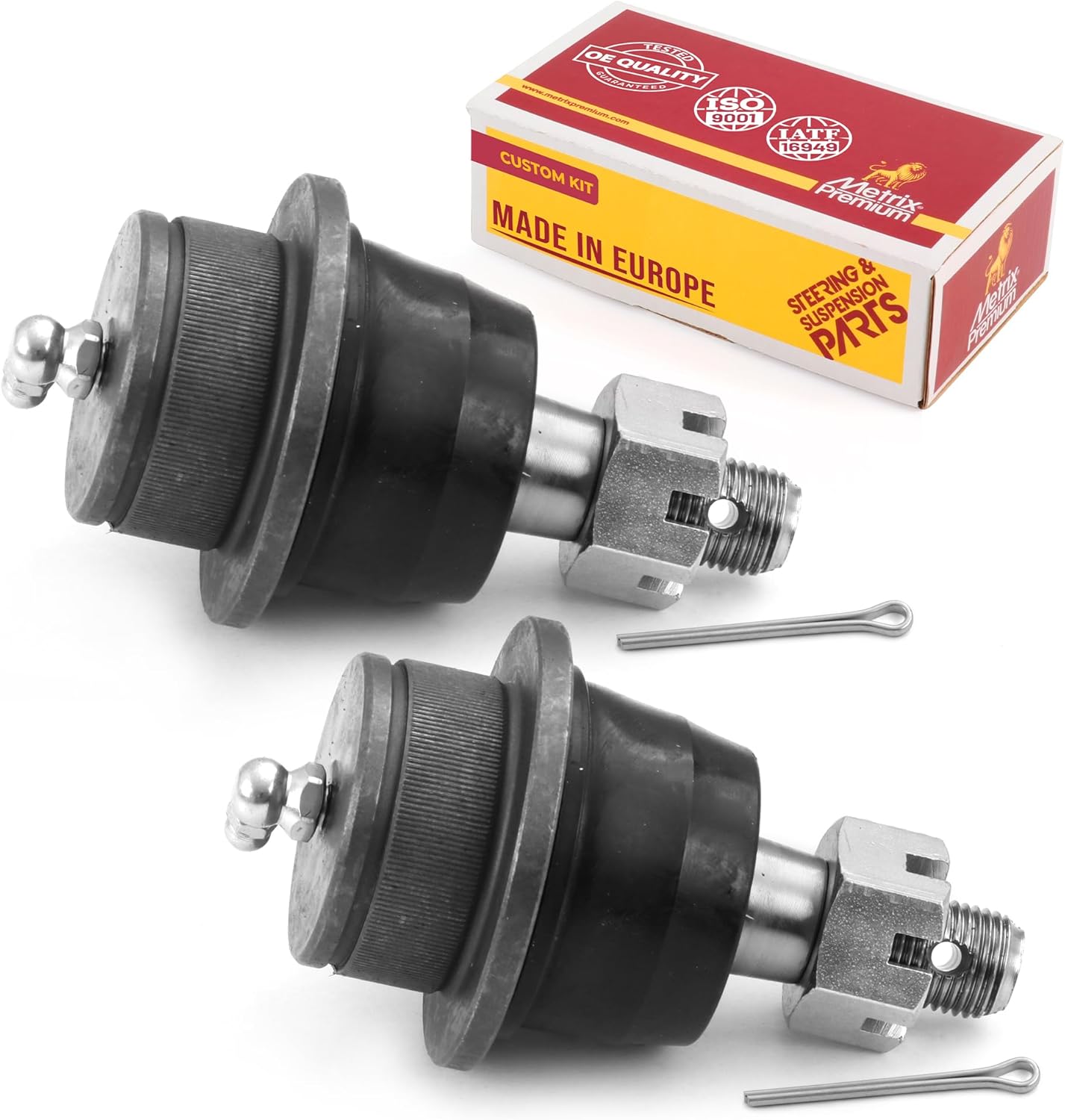
| Position | Front Lower |
|---|---|
| Material | Steel |
| Grease Fitting | Included |
| Manufacturer Part Number | 99545MT |
| OEM Part Number | 46D2281A, 536-554, F5TZ3078A, K8695T, MK8695T |
This Metrix two-piece front lower ball joint kit replaces worn front-lower joints and restores steering precision and suspension control on the specified Ford applications. Each steel joint includes a grease fitting and cotter pin so you can service the joint without removing it, which helps extend service life. Metrix highlights heat-treated components, machined exterior, and corrosion-resistant coating intended to withstand road salt and high temperatures. Installation follows standard ball-joint press procedures and is suitable for DIYers with a press or a professional shop; after installation you should check wheel alignment. The parts carry manufacturer certifications and a limited warranty, and customer feedback indicates consistent fit and solid build quality. Limitations are that this is a direct replacement part only for the listed model years and positions and it requires correct installation and alignment to deliver the expected longevity.
Best for: Buyers who prioritize a reliable, serviceable factory-quality replacement for worn front lower ball joints on late 1990s and early 2000s Ford trucks and SUVs and value parts that can be greased for extended life.
Less Ideal for: People seeking an upgraded performance joint for heavy off-road abuse or a lifetime maintenance-free unit should consider purpose-built aftermarket options instead.
- Greasable design with included grease fitting for periodic maintenance and longer service life
- Steel construction with heat-treated stud for durability under load and temperature
- Machined exterior and precision fit intended to match factory replacement geometry
- Includes cotter pin and necessary hardware for secure installation
- Requires a press and alignment after fitting so professional installation may be needed
Verdict: A reliable, greasable factory-quality front lower ball joint kit built for longevity on compatible Ford F-150 and related models.
Detroit Axle Front Lower Ball Joints (pair) for Ford F-150

| Fitment | 1997-2003 Ford F-150 |
|---|---|
| Kit contents | 2x front lower ball joints |
| Manufacturer | Detroit Axle |
| Manufacturer Part Number | K8695 x2 |
These Detroit Axle lower ball joints are a direct-fit replacement intended for front suspension on 1997-2003 Ford F-150 trucks. The kit includes two lower ball joints and the hardware needed for installation, so you can swap them during a routine suspension repair or while replacing control arms. Constructed from premium alloy with a reinforced structure, they are made to resist rust and repeated impact loads. In practice they offer straightforward installation and solid steering feel for common driving conditions, and many users report quiet operation and good initial fit. Expect budget-oriented longevity though; some technicians note limited grease volume and occasional fit variance that may require attention during press-in installation. For a buyer balancing cost and proven results, these deliver factory-quality fit and immediate drivability, but if your priority is maximum service life under heavy off-road use or repeated high-load cycles, higher-end OE replacement parts may last longer.
Best for: Buyers who want an affordable, ready-to-install front lower ball joint set that restores steering feel and fits like a factory replacement for their 1997-2003 F-150.
Less Ideal for: Drivers who expect long-term heavy off-road durability or want factory-spec longevity without any possibility of re-greasing should consider premium or OEM alternatives.
- Direct-fit design made for 1997-2003 Ford F-150 for straightforward installation
- Includes both ball joints and necessary hardware for a complete front lower replacement
- Premium alloy construction and reinforced structure resist rust and impact
- Many user reports of good initial fit, quiet operation, and improved steering feel
- Some units have small amount of factory grease and lack a service fitting for re-greasing
- A few reviews report occasional fitment variance requiring extra effort or minor modification
Verdict: A practical, cost-conscious direct-fit replacement that gets a 1997-2003 F-150 back to solid steering and quiet operation with minimal fuss.
Choosing the Right 1997-2003 Ford F-150 Ball Joint: Key Factors to Consider
Correct Fitment and Taper Dimensions
Fitment is the first priority because the ball joint must seat correctly in the steering knuckle and control arm. Incorrect taper angle or stud diameter can cause premature wear, steering play, or unsafe installation.
Verify vehicle-year-specific part numbers and physical dimensions. For the 1997–2003 F-150, ensure the tapered stud and housing diameter match the knuckle bore and that the overall height restores the factory suspension geometry. Proper fit preserves alignment settings and prevents accelerated tire wear.
Load Rating and Bearing Design
A ball joint must handle the static and dynamic loads the F-150 sees during cornering, braking, and when carrying cargo. Load rating and bearing type affect steering feel and longevity under the truck's typical weight.
Look for parts with bearing designs that resist deformation under load and specify maximum load or torque limits where available. Heavier-duty constructions or improved internal bearing materials reduce play over time, which is especially important if you tow or frequently haul heavy loads.
Seal Quality and Lubrication System
Road grit, water, and salt are primary causes of ball joint failure. The quality of the dust boot and the presence of a grease fitting strongly influence service life.
A robust one-piece boot with good material and a secure clamp reduces contamination ingress. Serviceable joints with grease fittings allow periodic lubrication, extending life. For sealed-for-life joints, prioritize better boot materials and factory-applied grease with proven resistance to breakdown.
Construction Materials and Corrosion Protection
Materials and plating affect both longevity and reliability. Forged housings and heat-treated studs resist fatigue better than lower-grade cast parts. Corrosion protection like zinc plating or powder coating prevents rust that can seize the stud in the knuckle.
Consider the local climate and exposure to road salt when choosing finishes. Robust materials reduce the chance of unexpected failure and simplify future removal if replacement becomes necessary.
Serviceability and Installation Requirements
Some ball joints are pressed in and require a ball joint press tool and possibly control arm removal. Others are bolt-in or screw-in designs that simplify replacement.
Understand whether the repair for your F-150 will need a press, what hardware is reused, and whether alignment will be required afterward. Choosing a part that matches your available tools and mechanical skill can save time and reduce the risk of installation error.
Warranty and Expected Lifespan
Warranty terms and stated lifespan help set expectations for maintenance intervals and replacement cycles. Longer warranties often indicate higher confidence from the manufacturer in the component's durability.
Check what the warranty covers and whether routine service, such as greasing, is required to maintain it. Warranty length alone should not be the deciding factor, but it is useful when balanced with material quality and real-world durability reports.
Identifying Ball Joint Symptoms on Your F-150
Worn ball joints on a 1997–2003 F-150 usually present as steering looseness, clunking noises over bumps, uneven tire wear, or vibration at certain speeds. Symptoms help you prioritize which joint is failing and whether the issue is urgent.
- Loose or wandering steering feel during cornering
- Clunking or knocking from the front suspension when hitting bumps
- Inner or outer edge tire wear indicating misalignment from joint play
- Vibration in the steering wheel that can be linked to front suspension play
Front Lower Vs Upper Ball Joints: Roles and Differences
On the F-150, lower ball joints carry more of the vehicle weight and are typically subject to higher loads, while upper ball joints are more involved with steering articulation. Understanding the distinct roles helps you decide whether to replace both at once or focus on the worn component.
- Lower ball joints often show more wear due to load and road impact
- Upper ball joints affect steering precision and may fail differently
- Replacing both sides at once preserves balanced steering feel and even tire wear
When To Replace: Inspection and Safety Thresholds
Routine inspections should include checking boot condition, play at the joint, and any visible corrosion or grease leakage. Minor play can progress rapidly, so measure or feel for perceptible movement with the wheel off the ground.If you detect significant vertical or lateral movement, a tear in the boot, or metal-on-metal noise, plan for replacement soon. Safety-first: a ball joint that allows the wheel to move independently can compromise vehicle control.
- Check boots for cracks or splits
- Jack the truck and test for free play by moving the wheel top-to-bottom and side-to-side
- Listen for clunks when steering while someone else moves the wheel
Tools and Prep for a Smooth Replacement
Basic jobs may require a ball joint press tool, pry bars, torque wrench, and sometimes a pickle fork for separating the joint. Some installations are simpler if the control arm can be removed; other times the joint can be pressed out with the knuckle in place.Prepping the work area with the right tools and new hardware where needed reduces install time. Have alignment resources available after replacement because even direct-fit parts can shift toe or camber slightly.
- Ball joint press tool or appropriate hydraulic press
- Proper jack stands and wheel chocks
- Replacement cotter pins and axle nuts if applicable
- Torque wrench for correct fastener tightening
Maintenance Tips to Extend Service Life
If your chosen ball joint has a grease fitting, schedule greasing with quality chassis grease after the first few hundred miles post-install and then at service intervals. For sealed units, keep an eye on boot integrity and address any tears immediately to avoid contamination.Avoid high-pressure washers directly on the joint boots and inspect after winter months where salt can accelerate corrosion. Regular inspections of suspension components help catch early wear before it affects alignment or handling.
- Grease service schedules for serviceable joints
- Avoid high-pressure spray directly at boots
- Inspect boots seasonally for cracks or splits
Still looking for the perfect fit?
Select your Ford F-150 configuration to see the most relevant Ball Joints recommendations
How We Chose the Best 1997-2003 Ford F-150 Ball Joint
We focused on parts that match the specific suspension geometry and load requirements of the 1997–2003 Ford F-150. Selection criteria prioritized correct OEM-equivalent fitment, durable sealing against road contaminants, and materials engineered to handle typical pickup loads.Concrete evaluation points included bearing type and load rating to ensure steering responsiveness under load; dust boot and grease fitting design for long-term resistance to contamination; stud and taper dimensions for straightforward steering knuckle fitment; and overall construction quality, such as forged versus cast housings and plated finishes for corrosion resistance.We also weighed installation factors like whether the joint is serviceable, compatibility with factory hardware, and whether specialized tools like a ball joint press tool are typically required. Durability data and user-reported longevity under varied use cases helped prioritize options.Excluded items were universal or multi-fit joints without explicit 1997–2003 F-150 fitment information and parts intended only for heavy-duty or engineered suspension lifts that alter factory geometry. The resulting list emphasizes correct fit, reliable sealing, and long-term serviceability for the specified F-150 years.
Our full evaluation process is outlined in our review methodology.
FAQ
How do I tell if the lower ball joint on my 1999 F-150 is bad?
Common signs include clunking over bumps, uneven tire wear on the inner edge, and noticeable play when you lift the vehicle and try to move the wheel vertically. A torn boot or visible grease leakage also indicates the joint is compromised.
Can I replace a ball joint on the 2001 F-150 without special tools?
Some replacements can be done with basic hand tools if the joint is a bolt-in design, but many press-fit joints require a ball joint press tool or hydraulic press for safe removal and installation. Avoid hammer-only methods that can damage the knuckle.
Should I replace both ball joints at the same time?
It often makes sense to replace both joints on the same axle to maintain balanced steering feel and even tire wear, especially if one has failed due to age. If the opposite side shows minimal wear and matching service history, you can weigh cost and remaining life.
Will replacing ball joints affect my wheel alignment?
Yes. Even direct-fit replacements can alter toe or camber slightly, so an alignment check after replacing front ball joints is recommended. Proper alignment preserves tire life and steering stability.
Are ball joint press tools necessary for the 1997–2003 F-150?
They are commonly required for press-fit lower or upper joints. A proper press tool prevents damage to the knuckle and control arm and makes the job safer and faster compared with improvised removal methods.
How long should new ball joints last on this F-150?
Lifespan depends on use, environment, and maintenance. Serviceable joints with regular greasing can last significantly longer than sealed units in harsh conditions. Expect several years of service under normal driving, but inspect periodically for boot damage and play.
Final Verdict
Prioritize correct fitment, robust sealing, and a construction that matches how you use your 1997–2003 F-150. Lower ball joints typically bear higher loads and deserve particular attention for towing or heavy-duty use, while upper joints influence steering precision.Balance the desire for ease of installation against long-term serviceability. If you tow or drive in corrosive conditions, choose joints with better corrosion protection and serviceable grease fittings where possible. After replacement, verify alignment and inspect boots regularly to maximize lifespan and maintain safe steering control.
Explore More:
- Check out all Ford F-150 parts & accessories
- Explore Ball Joints Maintenance & Repair Guides
- Explore Suspension & Steering
- Browse all Auto Parts
