

Note: This article contains affiliate links. If you click on these links and make a purchase, I may earn a small commission at no extra cost to you. This helps support my research and content. Read my full affiliate disclosure here.
A clean, correctly fitted air filter matters for day-to-day driving and long-term engine health in the Hyundai Santa Cruz. Replacing the air filter restores proper airflow, reduces engine wear from dirt and debris, and helps maintain consistent fuel economy and throttle response. This guide covers the top shortlisted air filters suited to the Santa Cruz and explains the tradeoffs between filtration efficiency, airflow, and fitment.Below you will find the top picks chosen for reliability and compatibility, followed by practical buying guidance and maintenance tips to help you pick the best option for your driving needs.
Looking for other parts? See all Hyundai Santa Cruz parts & accessories.
Top Picks at a Glance
| Best Overall The best all-around choice for most situations | StaunchAuto Engine and Cabin Air Filter Combo (2-Pack) for Hyundai Tucson, Santa Cruz, Santa Fe, Sorento, Sonata, K5 |  |
| Best Quality Built to a higher standard if you want something more solid | K&N High-Flow Lifetime Engine Air Filter 33-5108 |  |
| Best Value The sweet spot between price and what you get | Forccord Cabin and Engine Air Filter Kit (Vehicle Specific Fit) |  |
| Best Budget The cheapest option that still gets the job done reliably | Carory AF816 Engine Air Filter (Vehicle-Specific Fit) |  |
| Highest Rated A top-rated pick with lots of positive feedback | Carory CF820 Cabin Air Filter with Activated Carbon |  |
| Most Popular A crowd favorite that many people choose with confidence | RVgolf Engine and Cabin Air Filter Set for Hyundai Santa Cruz and Select Hyundai/Kia 2.5L Gas Models |  |
| Best Seller A high-volume bestseller chosen again and again | Capume Engine Air Filter JM1000 (28113-L1000) — Fits Hyundai/Kia 2021–2025 |  |
1. StaunchAuto Engine and Cabin Air Filter Combo (2-Pack) for Hyundai Tucson, Santa Cruz, Santa Fe, Sorento, Sonata, K5

| Applicable Models | Select 2020–2026 Hyundai and 2021–2026 Kia gas models (not hybrid) |
|---|---|
| Included Components | Engine air filter and cabin air filter |
| Cabin Filter Type | Activated carbon, double-layer |
| Engine Filter Construction | Multi-layer filter paper with ABS frame |
| Recommended Replacement | Every 6 months or 12,000 miles |
This StaunchAuto kit pairs a replacement engine air filter with a cabin filter treated with coconut-shell activated carbon to address both engine protection and interior air quality. The engine filter uses multi-layer filter paper and a rigid ABS frame intended to trap dust and debris while maintaining low airflow resistance, which helps preserve engine performance and minimizes HVAC noise. The cabin filter uses a double-layer design and activated carbon to reduce odors and capture fine particles for healthier in-cabin air. Installation is typical for factory-style replacements and should be straightforward for DIYers following the vehicle service manual. The filters are positioned as a cost-effective maintenance item with a suggested change interval around every six months or 12,000 miles. Limitations: this kit is vehicle-specific so confirm fitment to your exact model and engine, and it is not listed for hybrid variants; also the listing does not include long-term durability testing beyond manufacturer claims.
Best for: Drivers who want a balanced, practical maintenance upgrade that improves engine protection and cabin air quality with an easy DIY replacement for supported Hyundai and Kia gas models.
Less Ideal for: Owners seeking filters explicitly tested to OEM or aftermarket performance certifications or those driving hybrid variants should look for alternative, certified options.
- Includes both engine and cabin filters for a complete air maintenance service
- Cabin filter uses activated carbon to reduce odors and adsorb harmful gases
- Engine filter has a reinforced ABS frame for reported longer lifespan and consistent fit
- Designed for low airflow resistance to help maintain HVAC performance and reduce noise
- Fitment excludes hybrid models and must be verified against your vehicle's part numbers
- Manufacturer claims on lifespan and filtration efficiency are not independently validated in the listing
Verdict: A convenient two-filter kit that balances engine protection and improved cabin air quality for supported Hyundai and Kia gas models, making it a good choice for routine maintenance-minded drivers.
2. K&N High-Flow Lifetime Engine Air Filter 33-5108

| Model Number | 33-5108 |
|---|---|
| OEM Equivalent Part Number | Hyundai 28113L1000, Kia 28113L1000 |
| Manufacturer | K&N Engineering, Inc. |
| Manufacturer Warranty Description | 1,000,000 Miles/10 Year |
The K&N High-Flow Lifetime Engine Air Filter is a reusable replacement designed to boost airflow and help extract small horsepower and throttle response gains compared with standard paper filters. It drops into the factory air box and is pre-oiled so installation takes only minutes. The filter uses multilayer cotton gauze media that K&N says improves airflow up to 50% while still trapping contaminants; in practice this means sharper acceleration at part-throttle and a slightly freer-revving engine for daily driving and light towing. Its washable construction eliminates routine replacements and can be cleaned every 75,000 miles under normal highway use, which reduces waste and long-term filter cost. Important limitations are that peak gains depend on the engine and intake setup, and pre-oiling requires correct handling during cleaning to avoid performance or sensor issues. This is best treated as a bolt-in performance upgrade for drivers who want modest real-world improvements without modifying the intake system.
Best for: Drivers who prioritize small, reliable performance and throttle response improvements without extensive intake modification and who prefer a reusable, low-maintenance upgrade.
Less Ideal for: Users seeking large horsepower increases or who plan major forced-induction or intake modifications should consider performance intakes or tuning-oriented filters instead.
- Washable, reusable design cuts ongoing filter replacement waste and cost
- Multilayer cotton gauze media engineered to increase airflow and support modest horsepower gains
- Pre-oiled and shaped for direct drop-in installation into the factory air box
- Backed by a long limited warranty for extended use
- Actual power gains vary with engine and intake configuration and may be modest on stock setups
- Requires proper cleaning and re-oiling to avoid filter or sensor issues
Verdict: A practical, washable high-flow replacement that gives Santa Cruz drivers modest real-world airflow and throttle-response improvements with minimal fuss.
3. Forccord Cabin and Engine Air Filter Kit (Vehicle Specific Fit)

| Included Components | HEPA Cabin Air Filter and Engine Air Filter |
|---|---|
| Unit Count | 2.0 Count |
| OEM Equivalent Part Number | 28113L1000 |
| Manufacturer Part Number | FOR00146 |
| Manufacturer Warranty Description | 1 Year |
This Forccord kit includes a HEPA-grade cabin filter and a compatible engine air filter sold as a vehicle-specific replacement for recent Hyundai and Kia gasoline models. The cabin filter focuses on finer particulate capture and the listing claims up to 30% longer life than standard cabin filters, while the engine filter is rated for about 20,000 miles between changes, which reduces how often you need to open the airbox. Installation is straightforward and uses the factory filter locations; the seller provides an instructional video to help with panel and clip removal. In practical use you should see cleaner cabin air and fewer engine intake contaminants compared with worn stock filters, plus lower replacement frequency. Limitations to note are the compatibility scope and the manufacturer's life claims, which depend on driving conditions; this kit is explicitly not for hybrid variants. If you prioritize longer service intervals and simple DIY replacement for a Santa Cruz or other listed model, this kit delivers solid value.
Best for: Drivers who want a straightforward, longer-life replacement filter pair for routine maintenance and prefer a kit that fits listed Hyundai and Kia gasoline models without extra parts shopping.
Less Ideal for: People seeking filters for hybrid powertrains or those who need proven independent lab certifications for specialized allergy or industrial environments.
- Includes both cabin HEPA filter and engine air filter for matched maintenance
- Manufacturer states longer service life for engine filter (up to 20,000 miles)
- HEPA cabin media designed to capture fine particulates and reduce in-cabin dust
- Vehicle-specific fit reduces fitment guesswork for supported models
- Not compatible with hybrid models
- Longevity and filtration claims depend on driving conditions and are manufacturer-stated
Verdict: A convenient matched cabin and engine filter kit that extends service intervals and simplifies routine maintenance for supported gasoline Hyundai and Kia models.
4. Carory AF816 Engine Air Filter (Vehicle-Specific Fit)

| Brand Name | Carory |
|---|---|
| Model Number | AF816 |
| Product Grade | Replacement Part |
| Fit Type | Vehicle Specific Fit |
The Carory AF816 is a direct-replacement engine air filter intended for non-hybrid Hyundai and Kia vehicles within the listed model years. It fits vehicle-specific airboxes and is used the same way OEM filters are: remove the old filter, install this unit, and reinstall the cover. Key features include a pleated media design and stated compatibility with factory part numbers like 28113-L1000 and 28113N9000, which helps ensure proper fit and sealing. In practice the filter maintains steady airflow to support combustion efficiency and can help preserve engine performance between service intervals. The product is straightforward to install for DIYers and comes in a single-count unit. Limitations are that it is not compatible with hybrid variants and compatibility must be checked against the exact model and engine; the listing also does not include detailed material or filtration efficiency data beyond being a replacement-grade part.
Best for: Buyers looking for an affordable, ready-to-install replacement air filter that matches factory part numbers and keeps routine maintenance simple for non-hybrid Santa Cruz vehicles.
Less Ideal for: Drivers seeking high-performance or specialty filtration upgrades or owners of hybrid models should look for alternative filters designed for those needs.
- Vehicle-specific fit for listed Hyundai and Kia models for straightforward installation
- Matches common factory part numbers for easier verification of fit
- Pleated media construction supports steady airflow and engine combustion efficiency
- Single-count packaging is simple for one-time replacement during routine maintenance
- Not compatible with hybrid powertrains so it cannot be used on hybrid variants
- Manufacturer does not publish detailed filtration efficiency or media composition specifications
Verdict: A budget-friendly, vehicle-specific replacement that restores proper airflow and fits factory part numbers for non-hybrid Santa Cruz models.
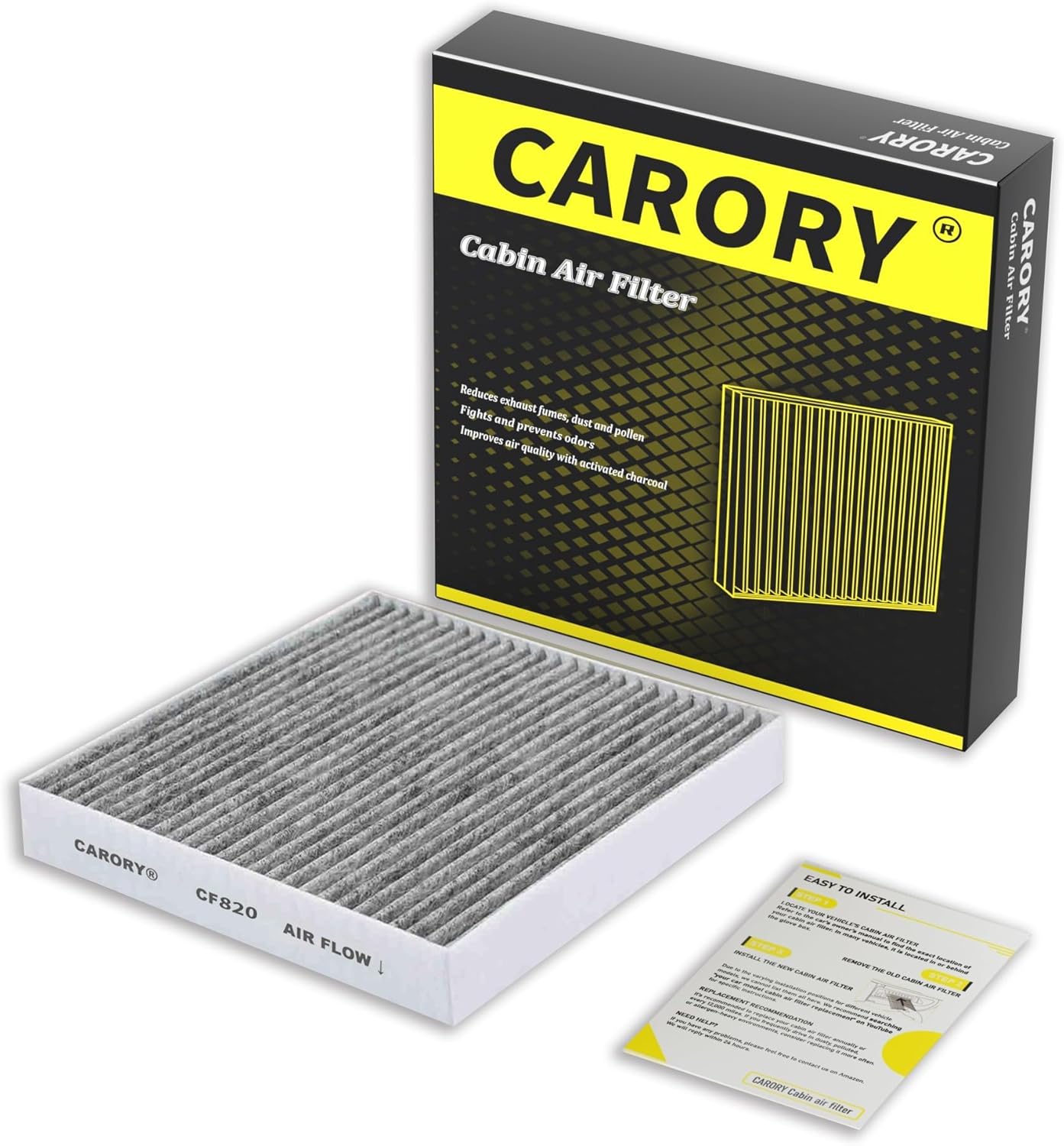
5. Carory CF820 Cabin Air Filter with Activated Carbon
| Material Type | Multi-layer |
|---|---|
| Air Filter Construction | Pleated |
| Unit Count | 1 Count |
| Product Grade | new |
The Carory CF820 is a replacement cabin air filter that installs in the passenger compartment to trap dust, pollen and micro-particles while using an activated carbon layer to help reduce odors. It is a pleated, multi-layer design intended for routine maintenance—swap it during scheduled service intervals to restore airflow and cabin air quality. Notable features include the activated carbon media for odor control and a pleated construction to increase filtration surface area, which together balance particle capture and airflow. Practical benefits are straightforward: cleaner cabin air, fewer allergens, and reduced stale smells without modifying HVAC performance. Limitations are typical for disposable cabin filters—performance declines with heavy contamination so periodic replacement is required, and it does not provide medical-grade filtration for viruses or ultrafine particles. Fitment must match the vehicle reference numbers listed, so confirm compatibility before purchasing.
Best for: Buyers who prioritize dependable, maintenance-focused replacements to keep cabin air fresh and the HVAC system working as intended in their Santa Cruz.
Less Ideal for: Not suited for users needing hospital-grade or HEPA-level filtration or those seeking reusable or washable filter solutions.
- Activated carbon layer helps reduce common cabin odors
- Pleated multi-layer construction increases filtration surface area for better particle capture
- Designed to match factory replacement reference numbers for straightforward fitment
- Filter media will clog over time and requires regular replacement to maintain airflow and effectiveness
Verdict: Choose this filter if you want a factory-style, activated-carbon cabin replacement that reliably restores cabin air quality and controls odors.
6. RVgolf Engine and Cabin Air Filter Set for Hyundai Santa Cruz and Select Hyundai/Kia 2.5L Gas Models

| Included Components | 1 engine air filter, 1 cabin air filter |
|---|---|
| Fit Type | Vehicle Specific Fit |
| Product Grade | Replacement Part |
| OEM Equivalent Part Number | RV00148 |
This RVgolf kit includes one engine air filter and one cabin air filter engineered for 2.5L gasoline Santa Cruz and several related Hyundai and Kia models. The engine filter uses a high-fiber, high-precision media intended to trap the majority of airborne contaminants before they reach the intake, while the multi-layer cabin filter captures dust, pollen, and some gaseous pollutants to improve in-cabin air quality. The design emphasizes low airflow resistance, which should help maintain intake efficiency and keep cabin blower noise down. Installation is straightforward for a DIY owner and the listing references common replacement part numbers to help confirm fit. Recommended service interval is about every 12 months or 12,000 miles. Limitations are that compatibility is explicitly for non-hybrid 2.5L gasoline variants and the listing does not provide detailed filtration ratings or materials beyond general claims, so buyers seeking lab-certified filtration performance may want a filter with published MERV or particle-efficiency data.
Best for: Buyers who prioritize reliable, vehicle-specific replacements and want a straightforward DIY swap to maintain engine breathing and cabin air quality on a Santa Cruz equipped with the 2.5L gasoline engine.
Less Ideal for: Users seeking certified laboratory filtration performance data or owners of hybrid variants or other engine types should consider alternative filters with verified ratings or explicit hybrid fitment.
- Includes both engine and cabin filters for a coordinated replacement
- High-fiber and multi-layer media claim to capture most particles and allergens
- Low-resistance design aimed at preserving intake efficiency and reducing blower noise
- Fits specific non-hybrid 2.5L Santa Cruz and matching Hyundai/Kia gasoline models for direct replacement
- No published filtration rating (MERV or percentage by particle size) to verify claims
Verdict: If you drive a non-hybrid Santa Cruz with the 2.5L gasoline engine and want an easy, matched replacement for both engine and cabin filters, this kit offers a convenient, vehicle-specific option.
7. Capume Engine Air Filter JM1000 (28113-L1000) — Fits Hyundai/Kia 2021–2025

| Item Type | Engine Air Filter |
|---|---|
| Manufacturer | Capume Direct |
| OEM Equivalent Part Number | 28113-L1000, 28113N9000, 33-5108, PA99540 |
| Product Grade | Performance Part |
| Fit Type | Vehicle Specific Fit |
This Capume JM1000 engine air filter is a direct replacement designed for specific Hyundai and Kia vehicles including the Santa Cruz 2022–2025. It installs like a factory-style filter and is intended for routine engine intake protection, trapping dust and debris before air reaches the engine. The listing notes compatibility with several OEM part numbers so it can be used where those numbers apply, and Capume recommends replacing the filter about every 12,000 miles to maintain performance. As a performance-grade, vehicle-specific fit it offers a tighter fit than generic universal filters and uses standard pleated media to balance airflow and filtration. Expect straightforward, no-modification installation and typical longevity for a replacement intake filter. Limitations are that fit and compatibility depend on matching the exact year and model and that the product carries a short 90-day manufacturer warranty, so long-term durability beyond typical service intervals depends on replacement frequency and driving conditions.
Best for: Careful owners who prioritize a correct, factory-style replacement for routine maintenance on a Santa Cruz and want a straightforward, vehicle-specific filter that restores proper intake protection.
Less Ideal for: Buyers seeking long-term warranties or reusable/upgradeable high-performance filters should consider other options.
- Vehicle-specific fit for Hyundai and Kia models including Santa Cruz 2022–2025
- Compatible with multiple OEM part numbers for easy cross-referencing
- Performance-grade filter media designed to balance airflow and particle capture
- Simple drop-in replacement that requires no modification to install
- Manufacturer warranty period is only 90 days
Verdict: If you want a ready-fit replacement for a Santa Cruz that matches common OEM part numbers and installs like the factory filter, the Capume JM1000 is a practical, low-risk choice.
Choosing the Right Hyundai Santa Cruz Air Filter: Key Factors to Consider
Filtration Efficiency
Filtration efficiency determines how well the air filter removes particulates before they reach the engine. Higher efficiency media capture finer dust and soot, reducing abrasive wear on cylinder walls, valves, and sensors.
While top-tier filtration reduces engine contamination, it can also increase airflow resistance. For the Santa Cruz, choose a filter whose efficiency rating balances protection with acceptable pressure drop so you do not sacrifice throttle response or fuel economy.
Airflow and Pressure Drop
Airflow capacity affects engine breathing under load and during acceleration. Look for filters tested for low pressure drop at realistic flow rates rather than headline airflow numbers that may not reflect on-vehicle performance.
A moderate pressure drop preserves power and fuel efficiency. If you frequently tow, haul cargo, or drive aggressively, prioritize media and design that maintain flow at higher engine demands while still offering particle capture.
Fitment and Seal Integrity
Proper fitment ensures the filter seals to the airbox and prevents unfiltered air from entering the intake tract. Even a high-efficiency filter is ineffective if it does not seat correctly or compresses incorrectly in the housing.
Confirm the filter matches the Santa Cruz airbox shape and dimensions. Consider the quality of the gasket material and whether the filter maintains shape under installation pressure and heat cycles to avoid bypass issues.
Media Type and Durability
Filter media varies from paper to cotton or synthetic blends. Paper media are common and provide good filtration for many drivers; oiled cotton and synthetic media can offer higher flow or longer service life but may require different maintenance.
Assess the media's resistance to humidity and contaminants common in your area. Durable media that resists sagging and breakdown will maintain performance between service intervals and reduce the risk of media fragments entering the intake.
Service Interval and Maintenance
Consider how often the filter needs replacement or cleaning. Disposable filters simplify maintenance but require periodic replacement, while reusable filters lower waste but need correct cleaning and re-oiling procedures.
Think about your driving conditions. Dusty or off-road use shortens service intervals, so choose a filter with a realistic maintenance cycle you can follow to keep the Santa Cruz running clean.
Compatibility With Vehicle Systems
Some filters alter intake temperatures or airflow characteristics that can affect sensor readings or engine management behavior. Ensure the chosen filter preserves the intake geometry and does not interfere with MAF sensors or ducting.
Match the filter to the Santa Cruz model year and any applicable engine variants so that seals align and electrical or vacuum fittings are unaffected. Proper compatibility minimizes drivability issues and maintains factory system behavior.
Engine Air Filter Replacement: When to Do It
Regular inspection is the best way to know when the Santa Cruz needs a new engine air filter. Check the filter every 12 months or at routine oil-change intervals, and sooner if you drive on dusty roads or in heavy construction zones. A visibly dark, clogged, or damaged element indicates replacement is needed.
Road conditions matter. Frequent short trips in urban environments clog filters more slowly than heavy dust exposure or extensive idling in congested areas. Use visual inspection and simple airflow checks to set an appropriate replacement cadence.
- Inspect at least once a year or every 12,000 miles, whichever comes first under normal driving.
- Check sooner if you regularly drive on dirt roads or in dusty climates.
- Replace immediately if the media is torn, warped, or contaminated with oil or debris.
OEM Vs Aftermarket Air Filter: Pros and Cons
Original equipment filters are designed to the factory fit and performance targets and typically offer predictable fitment and seal quality. Aftermarket options can match or exceed filtration or airflow characteristics but vary widely in materials and construction quality.
When selecting an aftermarket filter for the Santa Cruz, verify the exact fit, gasket design, and media specifications. Aftermarket filters that document filtration efficiency and pressure-drop testing provide more reliable guidance than generic listings.
- OEM: predictable fit, consistent quality, straightforward replacements.
- Aftermarket: potential performance or service-life benefits, requires careful spec verification.
Cabin Vs Engine Air Filter: Understand the Difference
The engine air filter cleans intake air for combustion, while the cabin filter protects passengers from dust and pollen. Both should be maintained but serve distinct functions. Replacing the engine air filter does not affect cabin air quality and vice versa.
If you notice reduced HVAC performance or bad odors inside the cabin, check the cabin filter separately. For engine performance issues like reduced power or poor fuel economy, focus on the engine air filter and intake components.
- Engine air filter protects the engine; cabin filter protects occupants.
- Service intervals and contamination sources differ between the two filters.
Air Filter Size Guide and Fitment Tips
Air filters come in specific dimensions that must match the Santa Cruz airbox. Measure the existing filter or consult the vehicle documentation to confirm length, width, and thickness before purchasing. Slight dimensional differences can lead to poor sealing or stress on the airbox.
When installing, check the filter seat and surrounding ductwork for debris. Clean the airbox and mating surfaces to ensure the new filter seals properly and does not trap grit against the gasket.
- Confirm filter dimensions against the factory element.
- Inspect and clean the airbox before installation.
- Ensure gaskets compress evenly and that the filter lies flat in the housing.
Best Air Filter for Fuel Economy: What to Expect
A filter that preserves optimal airflow without letting excessive particulates through helps maintain factory fuel economy. Filters with very high restriction can lower efficiency, while very porous media that allow contaminants through may degrade engine performance over time and indirectly affect economy.
Prioritize a balanced filter that documents both low pressure drop and adequate filtration. For most Santa Cruz owners, that balance will sustain expected fuel consumption without increasing maintenance burden.
- Look for pressure-drop or airflow data at realistic engine flow rates.
- Avoid filters that prioritize airflow at the expense of filtration efficiency.
How We Chose the Best Hyundai Santa Cruz Air Filter
Our shortlist focused on criteria that directly affect performance and longevity on the Hyundai Santa Cruz. We prioritized filtration efficiency and particle capture because fine dust and road debris are primary causes of accelerated engine wear. Airflow performance was evaluated to balance power delivery and fuel economy; overly restrictive filters can hurt drivability while too-permissive media can let harmful particles through. Fitment and seal integrity were critical filters to ensure a correct fit in the factory airbox and to avoid unfiltered bypass. Media durability and moisture resistance were considered since the Santa Cruz can be exposed to varied climates and road conditions. Finally, ease of installation and maintenance mattered for owners who service the vehicle themselves.Excluded items included any filters that did not meet basic fitment specifications for the Santa Cruz or that used unproven filtration materials. We did not include cabin air filters or any items outside the engine intake role. The resulting picks reflect products that align with those evaluation dimensions rather than marketing claims.
Our full evaluation process is outlined in our review methodology.
FAQ
How often should I change the engine air filter on my Hyundai Santa Cruz?
It usually depends on driving conditions. Under normal city and highway use, inspect annually or around 12,000 miles. If you drive in dusty or off-road conditions, check and replace the filter more frequently.
Can I clean and reuse a reusable air filter in the Santa Cruz?
Reusable filters can be cleaned and reinstalled if the manufacturer specifies a safe cleaning method. Make sure to follow correct procedures so you do not damage the media or leave residue that could affect filtration performance.
Will a higher-flow air filter improve my Santa Cruz fuel economy?
A better-flowing filter that maintains proper filtration can help preserve fuel economy, but gains are typically modest. Significant improvements are unlikely unless the current filter is heavily clogged or damaged.
Does changing the engine air filter affect emissions or the check engine light?
Replacing a clogged or damaged air filter can improve sensor readings and combustion quality. However, a filter change alone usually will not trigger or clear a check engine light unless the engine has run in poor conditions that affected sensors.
Should I replace the air filter myself or have a shop do it?
Many owners can replace the Santa Cruz air filter with basic tools and a clean workspace. If you are unsure about fitment or detect damaged ducting or sensors, a shop can ensure correct installation and inspect related components.
How do I know if the filter is fitting and sealing correctly after installation?
Visually confirm the filter sits flat in the housing and that the gasket compresses evenly around the perimeter. Start the engine and look for abnormal intake noises or air leaks; secure fitment should eliminate noticeable hissing or gaps.
Final Verdict
Prioritize a filter that balances reliable particle capture with low airflow restriction for the Hyundai Santa Cruz. Fitment and seal quality are as important as media performance because even the best media cannot protect the engine if air bypasses the element. Choose a filter with documented airflow and filtration characteristics, match the correct size, and set a realistic maintenance interval based on your driving conditions.By focusing on these tradeoffs you will preserve engine life and maintain expected fuel economy. Select the option that aligns with how you drive the Santa Cruz and commit to regular inspections to keep the intake system performing as intended.
Explore More:
- Check out all Hyundai Santa Cruz parts & accessories
- Explore Air Filters Maintenance & Repair Guides
- Explore Engine
- Browse all Auto Parts
