

Note: This article contains affiliate links. If you click on these links and make a purchase, I may earn a small commission at no extra cost to you. This helps support my research and content. Read my full affiliate disclosure here.
If you own a 2004–2008 Ford F-150, picking the right air filter matters for engine responsiveness, longevity, and fuel economy. The correct filter keeps dirt and debris out of the intake while allowing adequate airflow for reliable performance under towing, hauling, and daily driving. This guide focuses on the specific fitment and needs of the 2004–2008 F-150, covering the filters that suit that generation and typical use cases. We shortlisted six top options that meet common owner priorities and evaluated them by filtration efficiency, airflow impact, and durability.Read on to understand the tradeoffs between cleaner filtration and unrestricted airflow, plus practical maintenance guidance to keep your F-150 running well.
Looking for other parts? See all Ford F-150 parts & accessories.
Top Picks at a Glance
| Best Overall The best all-around choice for most situations | Motorcraft FA1754 Engine Air Filter |  |
| Best Quality Built to a higher standard if you want something more solid | K&N High-Flow Lifetime Engine Air Filter (33-2287) |  |
| Best Value The sweet spot between price and what you get | A-Premium Engine Air Filter (fits Ford 5.4L V8, 2004–2008) |  |
| Best Budget The cheapest option that still gets the job done reliably | ECOGARD XA5528 Premium Engine Air Filter |  |
| Highest Rated A top-rated pick with lots of positive feedback | K&N Advantage Plus Engine Air Filter — 18,000 Mile Life (KNA-2385) |  |
| Best Seller A high-volume bestseller chosen again and again | EPAuto GP039 Engine Air Filter (replacement for Ford Triton engines) |  |
Motorcraft FA1754 Engine Air Filter

| Brand | Motorcraft |
|---|---|
| Model Number | FA1754 |
| Item Type | Engine Air Filter |
| Fit Type | Vehicle Specific Fit |
| Unit Count | 1.0 Count |
The Motorcraft FA1754 is a vehicle-specific engine air filter built to screen dust, sand, and other abrasives from intake air before they reach the engine. It installs the same way as a factory replacement and is used during routine air filter service intervals to maintain engine performance and fuel economy. Notable features include a large media area for increased dirt-holding capacity, well-bonded end plates to keep pleats consistent, and a perforated center tube to prevent collapse under pressure. The filter is made to resist oil and moisture damage and is intended as a direct fit for the listed Ford fitments. The practical benefits are simple: predictable fit, reliable filtration, and low maintenance compared with some high-flow aftermarket options that require oiling or frequent cleaning. Limitations are straightforward for a factory-style paper filter — it does not provide the increased airflow or reusable lifespan of premium performance or reusable filters, so drivers wanting maximum flow or long-term reusability should consider other designs.
Best for: Buyers who want a reliable, no-frills replacement that mirrors factory performance and keeps routine maintenance simple and predictable.
Less Ideal for: Drivers seeking increased intake airflow, reusable filters, or performance gains should look at dedicated high-flow or washable filter options instead.
- Factory-quality fit and construction for direct replacement in compatible Ford vehicles
- Large filter media area for better dirt capacity and filtration efficiency
- Durable components including perforated center tube and bonded end plates to resist collapse and maintain pleat spacing
- Not a reusable or high-flow performance filter, so less airflow improvement compared with oiled or cotton performance filters
Verdict: Choose the Motorcraft FA1754 when you want a dependable factory-style replacement that restores stock filtration and fitment for your F-150.
K&N High-Flow Lifetime Engine Air Filter (33-2287)

| Brand Name | K&N |
|---|---|
| Model Number | 33-2287 |
| Fit Type | Vehicle Specific Fit |
| Product Grade | Replacement Part |
This K&N High-Flow air filter replaces the factory panel filter with a multilayer cotton gauze element that is washable and intended to last the life of the vehicle. It installs in the stock airbox and is aimed at drivers who want a simple performance upgrade without other intake changes. The filter is built with premium materials and a tacking agent on the cotton layers to trap contaminants while allowing increased airflow; K&N claims up to a 50% airflow improvement and reduced restriction that can translate to crisper throttle response and modest fuel-economy gains on highway driving. Maintenance is infrequent — cleaning is typically recommended every 75,000 miles under normal highway use — and the washable design reduces recurring filter purchases. Limitations: measurable gains depend on the rest of the engine and intake setup and dirtier or dusty environments will require more frequent service; this is a vehicle-specific replacement and must match fitment for proper sealing in the airbox.
Best for: Buyers who want a low-effort performance bump and long-term, cost-saving filtration for their 2004–2008 F-150 without modifying the factory intake system.
Less Ideal for: Drivers who frequently operate in extremely dusty or off-road conditions and prefer disposable filters or who want major horsepower gains that require additional intake or tuning upgrades.
- Washable, reusable construction reduces recurring filter purchases
- Designed to increase airflow for improved throttle response and potential fuel economy gains
- Engineered to fit the factory airbox for simple, tool-minimal installation
- Premium multilayer cotton gauze media for effective contaminant capture while maintaining flow
- Performance improvements vary with vehicle setup and are not guaranteed for every driving condition
Verdict: Choose this K&N filter if you want a durable, washable factory-fit replacement that can improve airflow and deliver modest real-world performance and fuel-economy benefits for a 2004–2008 F-150.
A-Premium Engine Air Filter (fits Ford 5.4L V8, 2004–2008)

| Fitment | Ford F-150 2004-2008, F-250/350 2005-2007, Expedition 2005-2006, Lincoln Navigator/Mark LT 2005-2008 |
|---|---|
| Engine | V8 5.4L |
| Washable | No |
| Reusable | No |
| Package Quantity | 1 |
This A-Premium engine air filter is a vehicle-specific replacement for Ford and Lincoln models using the 5.4L V8 from the 2004–2008 era. It installs in the front intake box and uses fine filtration media to trap dirt and particulates without overly restricting airflow, which helps maintain engine efficiency and throttle response between service intervals. Typical use is straightforward: remove the old element, seat the new filter in the housing, and reseal — most buyers report an easy fit and quick install. The filter is disposable rather than washable or reusable, so it is intended for scheduled replacement roughly every 12 months or 12,000 miles depending on driving conditions. Practical benefits include good fitment to the listed models and filtration performance comparable to common aftermarket replacements. Important limitations are its single-use design and lack of any performance upgrade over factory-spec filters; drivers seeking reusable or high-flow performance elements should look elsewhere.
Best for: Buyers who want a straightforward, factory-style replacement for mid-2000s Ford 5.4L V8 trucks and SUVs and prioritize correct fit and dependable filtration over specialty performance upgrades.
Less Ideal for: Do not choose this if you want a washable reusable element or a high-flow performance filter tuned for increased horsepower or modified intakes.
- Vehicle-specific fit for Ford and Lincoln 5.4L V8 models in the listed years for reliable installation
- Fine filtration media that captures dust and debris while maintaining airflow
- Easy, tool-light installation reported by users
- Fits common OEM reference numbers so it matches factory replacement requirements
- Not reusable or washable, requires regular replacement
Verdict: A practical, factory-style disposable replacement that delivers correct fit and reliable filtration for 2004–2008 Ford 5.4L V8 vehicles.
ECOGARD XA5528 Premium Engine Air Filter

| Brand Name | ECOGARD |
|---|---|
| Model Number | XA5528 |
| OEM Equivalent Part Number | 4L3Z-9601BA |
| Fit Type | Vehicle Specific Fit |
The ECOGARD XA5528 is a direct-fit replacement engine air filter for 5.4L Ford and Lincoln applications from the mid-2000s. It installs like a factory-style filter and is intended for routine maintenance to restore clean intake airflow, which helps with throttle response and reduces engine wear from dust and debris. ECOGARD positions this as a premium replacement with vehicle-specific fit, and customers report straightforward installation and consistent fitment. The filter replaces several common OEM and aftermarket part numbers, so it is easy to match when servicing those trucks. As a budget-focused option it delivers the expected benefits of a fresh paper air filter without performance modifications; it is not a reusable or high-flow performance element, so drivers seeking measurable horsepower gains or lifetime washable filters should look elsewhere. Expect standard replacement intervals and simple swap-out installation with basic hand tools if needed.
Best for: Buyers who want a low-cost, factory-style replacement that reliably restores intake airflow and protects the engine on mid-2000s 5.4L Ford and Lincoln trucks without extra features.
Less Ideal for: Drivers looking for a washable or high-flow performance filter or those wanting to extract measurable power gains should consider performance aftermarket options instead.
- Vehicle-specific fit for Ford F-150 and related 5.4L models ensures proper installation
- Restores clean airflow to help maintain acceleration and reduce engine wear
- Replaces common OEM and aftermarket part numbers for easy cross-referencing
- Compact, lightweight design makes it easy to handle and swap during routine maintenance
- Paper disposable design is not reusable or washable, so it requires periodic replacement
Verdict: A cost-conscious, factory-fit replacement that reliably restores clean intake airflow and protects 5.4L Ford and Lincoln engines.
K&N Advantage Plus Engine Air Filter — 18,000 Mile Life (KNA-2385)

| Manufacturer | K&N Engineering, Inc. |
|---|---|
| Model | K&N Advantage Plus Air Filter 18K Miles |
| Item model number | KNA-2385 |
| Replace interval | 18,000 miles under normal highway driving |
| Filter efficiency | Up to 99% engine protection |
The K&N Advantage Plus air filter is a reusable replacement designed to fit factory air boxes for compatible Ford trucks. It uses a premium synthetic or cellulose blend media that K&N rates for up to 18,000 miles between changes, extending service intervals compared with standard 12,000-mile disposable filters. Installation is straightforward — the filter drops into the factory housing and secures like the original — and the durable construction holds up to repeated use until replacement is due. The higher-efficiency media is intended to provide strong engine protection while allowing good airflow, which appeals to owners who want to preserve engine life without modifying the intake. Limitations to expect are that this is a vehicle-specific fit and must be matched to the correct part number, and longevity claims depend on driving conditions so more frequent changes may be sensible in dusty or off-road use. The filter carries a one-year limited warranty and is positioned as a higher-quality factory-replacement option for drivers focused on reliability and longer maintenance intervals.
Best for: Buyers who prioritize dependable engine protection and longer maintenance intervals over lowest upfront cost, and who prefer a direct-fit, factory-style replacement for routine driving.
Less Ideal for: Drivers who frequently operate in heavy dust, off-road conditions, or who want the absolute lowest initial purchase cost should consider alternatives or more frequent replacement schedules.
- Long 18,000-mile service interval reduces frequency of changes under normal driving
- Premium synthetic or cellulose blend media for high filtration efficiency
- Direct-fit design installs in the vehicle factory air box without modifications
- Durable construction suitable for repeated use until the recommended replacement interval
- Service life varies with driving conditions so may require earlier replacement in dusty environments
Verdict: Choose this K&N filter if you want a durable, factory-fit replacement that extends service intervals and prioritizes consistent engine protection.
EPAuto GP039 Engine Air Filter (replacement for Ford Triton engines)
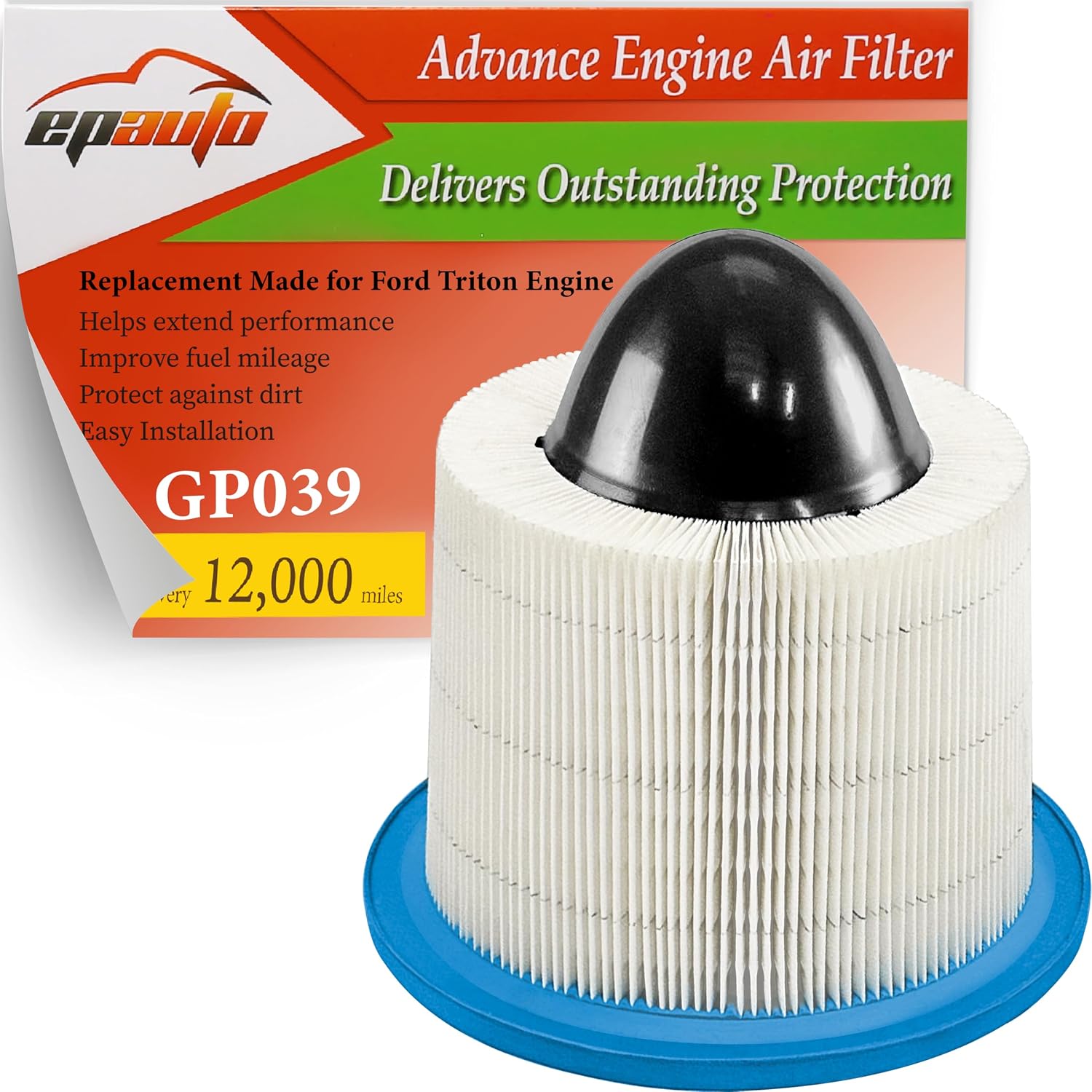
| Brand Name | EPAuto |
|---|---|
| Model Number | FP-082-1 |
| Manufacturer Part Number | GP039 |
| OEM Equivalent Part Number | F50Y-9601-A, F50Z-9601-BA, F5OX-9601-AB, F6ZZ-9601-A, F6ZZ-9601-AA, YC3Z-9601-AA |
The EPAuto GP039 is a direct replacement engine air filter made to fit vehicles with the Triton engine family, including many Ford F-series trucks from the 1990s into the 2000s. It installs like a factory filter in the airbox and is intended for routine maintenance to trap dust and debris before air reaches the engine. The listing cites compatibility with F-150 4.6L and 5.4L Triton engines that cover model years relevant to the 2004 to 2008 F-150 range, so it is suitable for owners doing scheduled filter changes. Buyers will appreciate straightforward fitment, OEM-equivalent part numbers, and the paper media that provides standard filtration to help protect intake components and maintain fuel economy between changes. This filter is a simple, no-frills replacement rather than a high-performance or reusable element, so expect typical service intervals and disposal after use. For someone who wants an affordable, correctly sized replacement that matches factory fit, this is a practical option; those seeking long-life or high-flow performance aftermarket filters should look elsewhere.
Best for: Buyers who prioritize correct fit and reliable, factory-style filtration for scheduled maintenance on Triton-engine F-150s and want a straightforward replacement that matches factory sizing and part references.
Less Ideal for: Drivers looking for washable, high-flow, or performance-oriented air filters should consider performance brands or reusable elements instead of this standard replacement.
- Vehicle-specific fit for Triton engines simplifies installation
- Lists OEM-equivalent part numbers for easier cross-referencing
- Standard paper filtration helps protect the engine from dust and debris
- Widely compatible with 2004–2008 F-150 Triton engine variants based on fitment listing
- Not a reusable or high-flow performance filter; intended for standard maintenance only
Verdict: A dependable, vehicle-specific factory-style replacement filter for Triton-engine F-150s that makes scheduled maintenance quick and worry-free.
Choosing the Right 2004-2008 Ford F-150 Air Filter: Key Factors to Consider
Filtration Efficiency
Filtration efficiency determines how well the air filter captures dust, pollen, and abrasive particles before they reach the intake. Higher-efficiency media reduces contaminant ingestion, which lowers wear on the throttle body, mass airflow sensor, and cylinder surfaces. For the 2004–2008 F-150, particles carried in road dust or construction environments can accelerate engine wear if poorly filtered.
That said, ultra-high-efficiency media can increase airflow restriction if poorly designed. Balance is required: choose a filter whose efficiency rating is documented and that provides sufficient protection without overly choking the engine. Consider environments you typically drive in; dusty or sandy conditions make filtration efficiency a higher priority.
Airflow and Engine Response
Airflow affects throttle response, low-end torque, and engine load tolerance. Filters with low resistance help maintain factory power characteristics and minimize backpressure on the intake tract. For owners who tow or haul with the 2004–2008 F-150, preserving airflow under load is especially important for heat management and consistent performance.
When assessing airflow, look for designs that offer a large media surface area and well-sealed frames to avoid bypass. If you frequently operate at high RPM or tow heavy loads, prioritize filters that demonstrate good flow rates while still offering acceptable filtration.
Fitment and Seal Integrity
A correct fit is fundamental. An air filter that does not match the 2004–2008 F-150 housing or that allows air to bypass the media undermines both protection and performance. Proper sealing prevents unfiltered air from entering the intake and ensures the filter works as rated.
Check that the filter's outer dimensions, gasket shape, and thickness align with the vehicle's airbox. A secure, uniform seal around the perimeter prevents gaps caused by vibration or improper seating during routine maintenance. Fitment also impacts installation ease and the likelihood of repeated correct placement during service.
Material Durability and Construction
Durable construction helps the filter maintain shape and media integrity over time. Frames that warp or media that delaminates can cause leakage or collapse, especially during heat cycles and exposure to moisture. For the 2004–2008 F-150, which sees a range of climates and driving conditions, robust materials lengthen replacement intervals and reduce service problems.
Look for rigid frames, bonded seals, and media that resist tearing or sagging. If a reusable filter is considered, evaluate how well it tolerates cleaning procedures and whether repeated service affects its fit and filtration performance.
Maintenance and Service Life
Maintenance frequency affects total cost of ownership and convenience. Disposable filters are simple to replace at scheduled intervals, while reusable filters require periodic cleaning and re-oiling where applicable. For an owner who prefers low upkeep, a long-life disposable filter with clear replacement intervals may be preferable.
Service life also ties to environmental exposure. Vehicles driven in dusty or off-road conditions will require more frequent attention. Choose an option that matches your willingness to perform maintenance and the typical operating environment of the F-150.
Compatibility With Emissions and Engine Sensors
The 2004–2008 F-150 relies on properly metered intake air for emissions control and engine management. Filters that shed fibers or produce excessive oil residue from improper maintenance can contaminate the mass airflow sensor or throttle body, causing hesitation and check engine lights. Additionally, filter designs that alter intake temperature or flow patterns dramatically can affect sensor readings.
Prefer filters with clean construction that do not shed media particles and, if reusable, follow manufacturer cleaning instructions that minimize residue. Ensure the chosen filter maintains consistent airflow characteristics to avoid unintended effects on emission-related systems.
When To Replace Your Engine Air Filter
Replacement intervals depend on driving conditions. For typical highway and city use, inspect the air filter at least every 12,000 to 15,000 miles. If you frequently operate the 2004–2008 F-150 on gravel roads, in dusty construction zones, or in agricultural settings, check the filter more often—every 6,000 to 8,000 miles or during seasonal service intervals.
Visual inspection is a practical indicator: a filter that looks dark, clogged, or crushed should be replaced regardless of mileage. Also pay attention to changes in throttle response, reduced fuel economy, or unusual intake sounds, which can indicate restriction.
- Inspect filter during oil changes or major service intervals
- Replace sooner if driving in dusty or off-road conditions
- Look for visible dirt buildup, damage, or oil saturation
Disposable Vs Reusable Filters: Pros and Cons
Disposable paper or synthetic filters are maintenance-light and simple to swap out. They often provide predictable filtration performance over their service life and avoid the need for cleaning. For many 2004–2008 F-150 owners, disposables are a low-maintenance choice that ensures consistent fit and sealing.
Reusable filters can reduce waste and, when cleaned properly, offer long service life. However, they require correct cleaning and reinstallation techniques; improper re-oiling or incomplete drying can alter airflow characteristics or harm sensors. Consider your comfort with periodic filter servicing before choosing a reusable option.
- Disposable: low maintenance, predictable performance
- Reusable: longer life, requires cleaning and careful reinstallation
- Match choice to how often you perform scheduled maintenance
How Filter Choice Affects Fuel Economy
Airflow restriction increases engine pumping losses and can slightly reduce fuel economy. On the 2004–2008 F-150, changes in filter airflow typically produce modest differences in fuel consumption, but cumulative effects over time can be noticeable. A moderately low-restriction filter that still provides good particle capture often gives the best balance for everyday driving.
If you prioritize maximum fuel economy, focus on filters designed for low pressure drop with documented flow characteristics. Maintain the filter on schedule, because even the best filter will reduce economy when clogged.
- Keep filters clean to preserve factory fuel efficiency
- Low-restriction designs help under towing and high-load conditions
- Balance airflow and filtration for dependable economy gains
Checking Fitment and Measuring Air Filter Size
Confirming correct dimensions matters more than a marketing claim. Measure the existing filter cavity or the old filter before ordering replacements to verify height, length, and width. For the 2004–2008 F-150, gasket profile and sealing surface shape are common fitment checkpoints.
When using an aftermarket filter, compare the gasket contact area and ensure the filter will not compress or flex excessively when installed. Proper fit prevents bypass and ensures the filter performs as intended throughout its service life.
- Measure old filter to confirm dimensions
- Inspect sealing surface for uniform contact
- Avoid filters that require forceful seating or modification
Tips for Installing and Servicing the Air Filter
Always turn off the engine and allow it to cool before accessing the airbox. Remove the airbox cover carefully to avoid stressing clips or screws. When installing a new filter, seat it fully and verify the seal around the perimeter; an incomplete seal invites unfiltered air.
For reusable filters, follow the cleaning and lubrication steps recommended by the filter manufacturer, allow the media to dry completely before reinstalling, and apply oil evenly and sparingly. After installation, check for any unusual intake noises or dashboard warnings and re-inspect after a short test drive.
- Seat the filter fully and check the entire gasket
- Avoid over-oiling reusable filters to prevent sensor contamination
- Re-check the installation after the first short drive
Still looking for the perfect fit?
Select your Ford F-150 configuration to see the most relevant Air Filters recommendations
How We Chose the Best 2004-2008 Ford F-150 Air Filter
We evaluated candidate air filters for the 2004–2008 Ford F-150 using criteria that matter to owners and technicians. Key evaluation points included filtration efficiency, measured by particle-capture capability and media quality; airflow restriction, assessing how the filter affects engine breathing under load; fitment accuracy, ensuring proper sealing and precise dimensions for the 2004–2008 intake housing; and build durability, including frame rigidity and resistance to collapse or deformation in varied temperatures.We also considered maintenance needs, such as serviceability and whether the filter is reusable, and materials compatibility with common cleaning or replacement practices. Real-world suitability for typical F-150 uses like towing, light off-road exposure, and long highway runs was factored into the selection. Exclusions: we did not include filters that lack documented fitment for the 2004–2008 F-150, filters with unclear media specifications, or items that fail basic sealing or dimensional checks. The result is a concise list of six options that passed these practical performance and fitment filters.
Our full evaluation process is outlined in our review methodology.
FAQ
How often should I change the air filter on my 2004–2008 F-150?
It depends on driving conditions. For normal city and highway driving, inspect at 12,000 to 15,000 miles and replace as needed. If you drive in dusty or off-road conditions, check and likely replace every 6,000 to 8,000 miles.
Can I use a reusable air filter in the 2004–2008 F-150?
Yes, you can use a reusable filter if it is sized and shaped to fit the F-150's airbox. Be prepared to clean and re-oil it per the manufacturer's instructions and avoid excessive oil that could foul sensors.
Will a different air filter change my truck's fuel economy?
A filter that reduces airflow can slightly lower fuel economy, while a low-restriction filter may help maintain factory efficiency. The effect is usually modest; maintaining a clean filter is the most reliable way to preserve economy.
How do I know if my air filter is clogged?
A visibly dark, compressed, or damaged filter indicates clogging. You may also notice reduced throttle response, sluggish acceleration, or a change in engine sound. When in doubt, remove and inspect the filter for excessive debris.
Does the cabin air filter affect engine performance?
No. The cabin air filter is separate from the engine intake system and only affects ventilation and HVAC airflow. Make sure not to confuse cabin and engine filters when performing maintenance.
Are OEM and aftermarket filters interchangeable for the 2004–2008 F-150?
They can be, but only if the aftermarket option matches the exact fitment and sealing characteristics required by the F-150. Evaluate media quality and construction rather than assuming interchangeability.
Final Verdict
For the 2004–2008 Ford F-150, prioritize a filter that delivers reliable filtration without excessively restricting airflow. Focus on proper fit, durable construction, and maintenance needs that match how you drive. If you operate in dusty environments, lean toward higher-efficiency media and inspect more frequently; for mostly highway use, a lower-restriction filter with good sealing offers dependable performance.Weigh the tradeoffs between disposable convenience and reusable service requirements, and pick the option that fits your maintenance habits and operating conditions. With the right filter and regular inspections, you will maintain engine health and consistent performance in your F-150.
Explore More:
- Check out all Ford F-150 parts & accessories
- Explore Air Filters Maintenance & Repair Guides
- Explore Engine
- Browse all Auto Parts
