

Note: This article contains affiliate links. If you click on these links and make a purchase, I may earn a small commission at no extra cost to you. This helps support my research and content. Read my full affiliate disclosure here.
If you drive a Ford Ranger, a reliable cooling fan is essential to keep engine temperatures in check during towing, heavy traffic, or hot weather. Choosing the right Ford Ranger cooling fan helps prevent overheating, reduces strain on the cooling system, and can improve cabin comfort under load. This guide presents seven shortlisted options that meet real-world needs for airflow, durability, and ease of installation. Below we explain the evaluation criteria so you can decide which fan best matches your typical driving conditions.
Looking for other parts? See all Ford Ranger parts & accessories.
Top Picks at a Glance
| Best Quality Built to a higher standard if you want something more solid | Ford Genuine Fan Assembly F3TZ-8600-C |  |
| Best Value The sweet spot between price and what you get | A-Team Performance 16-inch Reversible Electric Radiator Fan Kit |  |
| Best Budget The cheapest option that still gets the job done reliably | BLACKHORSE-RACING 12" Slim Electric Radiator Cooling Fan (12V, 80W) |  |
| Highest Rated A top-rated pick with lots of positive feedback | A-Premium Engine Radiator Cooling Fan Blade, 11-Blade Compatible with Ford Ranger 1998-2003 4.0L |  |
| Most popular A crowd favorite that many people choose with confidence | Dorman Engine Cooling Fan Blade 620-155 |  |
| Best Seller A high-volume bestseller chosen again and again | UPGR8 Universal 12V Slim Electric Radiator Fan with Mounting Kit (14") |  |
1. Ford Genuine Fan Assembly F3TZ-8600-C

| Power Connector Type | 3-Pin or 4-Pin |
|---|---|
| Cooling Method | Air |
| Compatible Devices | Radiator, Transmission Coolers |
| Maximum Rotational Speed | 8500 RPM |
This Ford Genuine Fan Assembly is a factory replacement cooling fan meant to restore or maintain the original cooling performance on compatible Ford vehicles. It is a vehicle-specific fan assembly supplied by the manufacturer for direct-fit installation and works with radiator and transmission cooler setups. Notable features include compatibility with 3- or 4-pin power connectors and a high maximum rotational speed up to 8500 RPM, which helps deliver strong airflow for demanding highway and idling conditions. In practice this fan is used to replace a worn or damaged factory fan to regain proper engine and A/C cooling without modification. The primary benefits are factory-quality fit and predictable operation, which reduce fuss during installation and integration with existing wiring and mounting points. Limitations are typical of OEM replacements: fewer aftermarket performance tuning options and no bundled clutch or additional adapters, so buyers seeking increased cooling beyond stock will need a performance-specific assembly or supporting components.
Best for: Performance-oriented buyers who prioritize factory-quality parts that restore reliable cooling and integrate cleanly with the vehicle without modification.
Less Ideal for: Drivers seeking a high-performance aftermarket upgrade or those planning a custom cooling retrofit that requires higher airflow or included mounting hardware.
- Factory-quality construction for direct-fit replacement and reliable fitment
- Supports 3-pin or 4-pin power connectors for compatibility with common wiring setups
- Rated up to 8500 RPM to provide strong airflow for improved cooling under load
- Designed specifically for radiator and transmission cooler applications
- Offers factory-spec performance only and does not increase cooling beyond stock capacity
- Does not include auxiliary hardware like a fan clutch or adapter for nonstandard swaps
Verdict: A factory Ford fan assembly that gives you reliable, direct-fit cooling performance with OEM-quality fit and operation.
2. A-Team Performance 16-inch Reversible Electric Radiator Fan Kit

| Voltage | 12 Volts |
|---|---|
| Power | 120 Watts |
| Connector | 3-Pin |
| Maximum Rotational Speed | 3000 RPM |
| Air Flow Capacity | 3000 Cubic Feet Per Minute |
This A-Team Performance 16-inch fan kit is a budget-friendly, high-flow electric radiator fan intended to replace or supplement a factory cooling fan on vehicles like the Ford Ranger. It mounts to the radiator and can be wired as either a pusher or puller, giving flexibility for different engine bay layouts. The fan advertises a high-flow motor with eight wide curved S-blades, a sealed ball-bearing motor for longer life, and a slim profile that helps fit tight spaces behind the radiator. In practical use it provides noticeably more airflow than typical stock fans and is effective at reducing engine temperatures during idling and towing. The included mounting kit and three-pin connector make installation straightforward for someone comfortable with basic wiring and brackets, though some buyers report the supplied hardware is marginal and may be augmented with zip ties or stronger brackets. Noise is present under load but not excessive for the performance. Expect a cheap, powerful cooling upgrade that may require a small amount of install adaptation for a reliable long-term fit in a Ford Ranger.
Best for: Practical optimizers looking for a cost-effective cooling upgrade for a Ford Ranger who prioritize measurable temperature improvement over factory-original appearance.
Less Ideal for: Buyers seeking a direct factory-quality plug-and-play replacement or silent OEM-level operation should consider purpose-built Ranger-specific fans instead.
- Reversible push/pull design offers flexible mounting options for different Ranger engine bays
- High advertised airflow and powerful motor that improves cooling under idle and load
- Slim 3.26-inch thickness helps fit tight radiator clearances
- Sealed ball bearings and balanced blades for smoother operation and longer motor life
- Some customers find the included mounting hardware weak and prefer aftermarket brackets or zip-tie installs
- Advertised CFM figures have been disputed by users measuring lower airflow
Verdict: A powerful, low-cost 16-inch reversible fan that delivers strong cooling for a Ford Ranger but may require better mounting hardware and realistic expectations on advertised airflow.
3. BLACKHORSE-RACING 12" Slim Electric Radiator Cooling Fan (12V, 80W)

| Voltage | 12 Volts |
|---|---|
| Wattage | 80 watts |
| Air Flow Capacity | 800 Cubic Feet Per Minute |
| Power Connector Type | 3-Pin or 4-Pin |
| Maximum Rotational Speed | 2250 RPM |
This 12-inch BLACKHORSE-RACING slim electric fan is a straightforward, low-cost way to add auxiliary cooling to a Ford Ranger radiator, condenser, oil cooler, or transmission cooler. Its slim 2.36-inch depth helps it fit tight engine bays where a thicker fan would not, and the 10-blade design moves up to 800 CFM while drawing around 7.5 amps, so it runs from a standard 12V vehicle circuit. You can wire it as a pusher or puller by swapping blade orientation and polarity, and it accepts either a 3-pin or 4-pin connector depending on how you want to control it. Practical benefits for Ranger owners include improved idle and low-speed cooling and a compact profile for cramped mounting locations. The fan is a basic universal unit so it does not include a relay or thermostat switch and the supplied mounting ties and hardware are utilitarian rather than heavy-duty, so plan to add a proper relay and stronger fasteners for long-term use. Noise and raw airflow can vary depending on mounting and shroud fitment, so expect real-world results to depend on installation quality.
Best for: Budget-conscious Ford Ranger owners who want an inexpensive auxiliary fan to improve low-speed or idle cooling without major modifications.
Less Ideal for: Drivers seeking a complete plug-and-play cooling upgrade with included relay, thermostat, and heavy-duty mounting hardware should consider more complete kits or vehicle-specific fans.
- Slim 2.36-inch profile fits tight radiator clearances in the Ranger
- High airflow for the size with rated 800 CFM
- Runs from standard 12V systems at modest current draw (~7.5 A)
- Can be configured as pusher or puller by reversing blade/wiring
- Mounting kit and cable ties are basic and may need upgrading for permanent installs
- Does not include relay or thermostat for automatic control
Verdict: A compact, high-CFM 12-inch fan that delivers strong low-speed cooling for Ford Ranger owners on a tight budget.
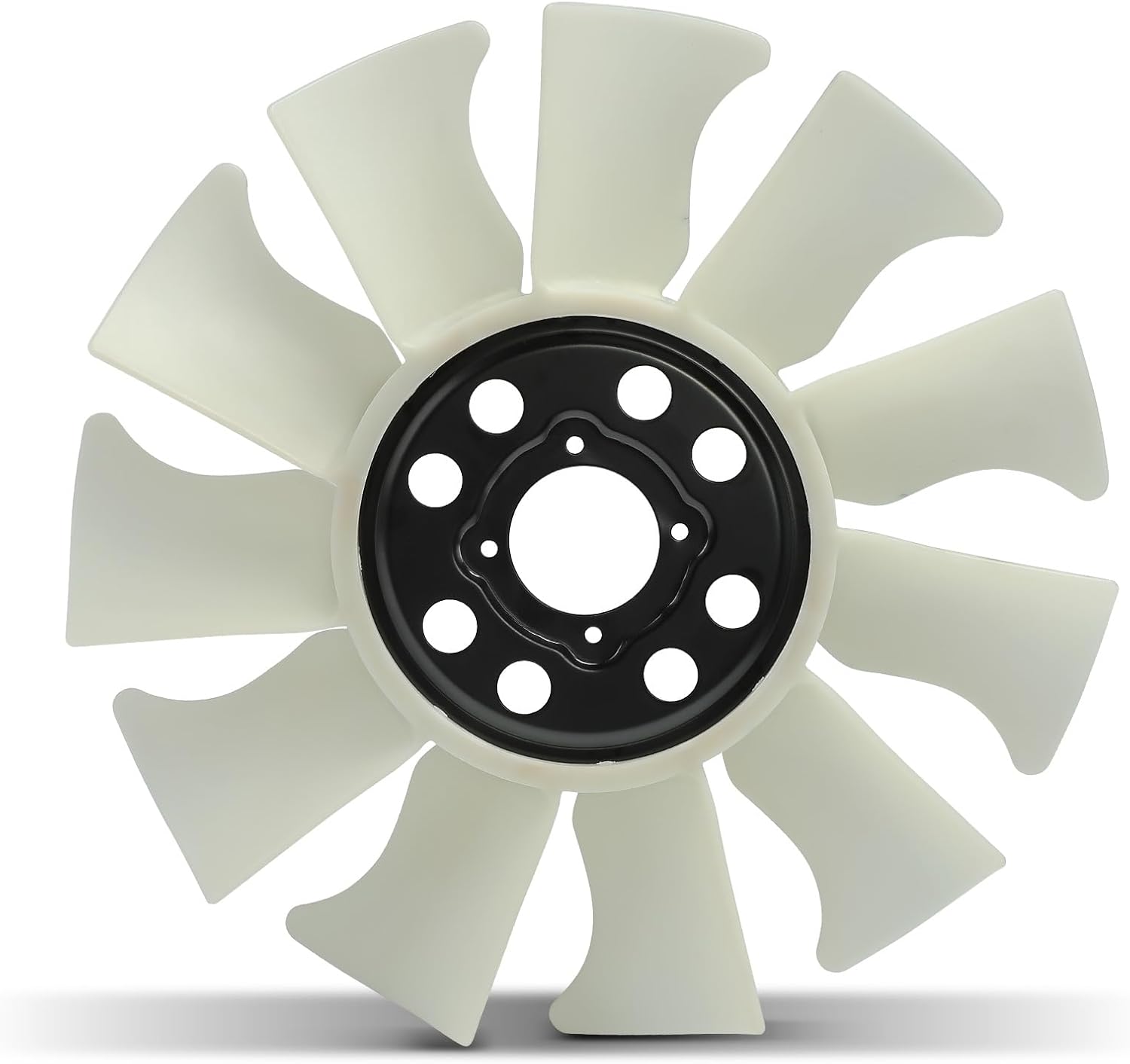
4. A-Premium Engine Radiator Cooling Fan Blade, 11-Blade Compatible with Ford Ranger 1998-2003 4.0L
| Compatible Engines | 4.0L V6 |
|---|---|
| Blades Count | 11 |
| Position | Front Side |
| Material | Plastic |
This A-Premium cooling fan blade replaces the factory fan on Ford 4.0L V6 Rangers and related 1998–2003 models to restore radiator airflow and prevent overheating. Designed with 11 blades and a roughly 18.15-inch diameter, the plastic assembly mounts on the front side of the fan clutch assembly and works as a straightforward mechanical replacement. In daily use it increases airflow through the radiator core to speed heat transfer and lower coolant temperatures, which is especially useful when towing or driving in warm conditions. Customers report reliable fitment and factory-like performance, and the part carries reference OEM numbers for easy matching. The main limitations are that it is a plastic, non-electric blade and requires correct fit to the existing clutch or motor, and buyers should verify exact vehicle cutoffs and cooling system variants before ordering. For a reliability-focused replacement that restores original cooling function without upgrades, this fan is a practical option.
Best for: Reliability-focused owners who want a like-for-like, dependable replacement fan to restore proper cooling on older Ford Ranger 4.0L vehicles without modifying the cooling system.
Less Ideal for: Drivers looking to increase cooling performance beyond factory levels or those who need a complete electric fan or new clutch assembly should consider performance upgrades instead.
- 11-blade design increases airflow through the radiator for improved cooling.
- Made to match factory reference numbers for straightforward fitment on compatible Ford models.
- Durable plastic construction resists corrosion and is lightweight for easier handling.
- Specifically sized to replace the original front-side fan assembly on 4.0L V6 Rangers.
- Plastic blade is a direct replacement only and does not upgrade cooling capacity beyond stock.
- Requires compatibility check with the vehicle's existing fan clutch or motor since it is not a complete clutch assembly.
Verdict: A practical, factory-style 11-blade replacement that restores cooling reliability for Ford Ranger 4.0L owners who need a dependable direct-fit fan.
5. Dorman Engine Cooling Fan Blade 620-155

| Model | Fan Blade |
|---|---|
| Manufacturer Part Number | 620-155 |
| OEM Part Number | YA220; F87Z8600EA |
| Voltage | 12 Volts |
| Wattage | 80 watts |
This Dorman fan blade is a direct replacement designed to match the fit and function of the factory fan on compatible Ford Ranger and related models. It is used to replace a damaged or worn fan blade and re-establish proper airflow through the engine bay, typically paired with the vehicle's existing fan clutch. Notable features include vehicle-specific engineering for a precise fit and quality construction aimed at long service life. In real-world use it reliably lowers operating temperatures when fitted correctly and reviewers report it restores consistent cooling during slow traffic and hot conditions. Installation is straightforward for someone comfortable with basic underhood work, though accessing the fan on some engine bays can still take time. The part is a single-piece fan blade that works with a 12V clutch-driven setup and has been tested for fit and performance. It does not include a fan clutch or hardware, so buyers replacing those components simultaneously will need to source them separately.
Best for: Convenience-driven buyers who want a direct, vehicle-matched replacement that restores cooling reliability with minimal fuss and aftermarket modification.
Less Ideal for: Buyers looking for a complete cooling kit or those who prefer an all-in-one conversion to electric fans should consider other options.
- Vehicle-specific design for a close fit to factory mounting points
- Manufactured for durability to restore long-term cooling performance
- Quality-tested to ensure proper fit and function
- Positive owner reports of improved temperature control in stop-and-go conditions
- Sold as the blade only and does not include the fan clutch or mounting hardware
- May require moderate disassembly to access and install depending on engine layout
Verdict: A straightforward, vehicle-specific replacement fan blade that restores factory-style cooling but ships as the blade only so plan to source the clutch or hardware if needed.
6. UPGR8 Universal 12V Slim Electric Radiator Fan with Mounting Kit (14")

| Voltage | 12 Volts |
|---|---|
| Wattage | 90 watts |
| Power Connector Type | 3-Pin |
| Compatible Devices | Radiator |
This UPGR8 14-inch slim electric radiator fan is a budget-friendly universal replacement intended to improve radiator airflow for vehicles that need an aftermarket push or pull fan. It installs as a standalone fan and includes mounting brackets and zip ties so you can mount it directly to the radiator or adapt it into an existing shroud. The single-speed 12V motor and 3-pin connector deliver about 90 watts of forced-air cooling, and the multi-blade design moves a lot of air for its size, making it useful for helping cooling under load or for fitted condenser support. Practical benefits include a slim profile for tight engine bays, simple wiring to an existing fan controller or switched circuit, and low upfront cost. Important limitations are that it is a universal unit so some trimming or custom mounting is often required, instructions are not included, and continuous heavy-duty duty in high-heat situations may stress the motor compared with heavier commercial fans. Professional installation is recommended if you are not comfortable fabricating mounts or wiring fan controllers.
Best for: Risk-averse mainstream buyers who prioritize reliable, low-cost fixes and want a straightforward airflow upgrade for everyday driving and occasional towing or hot-weather use.
Less Ideal for: Do not choose this if you need a direct-fit OEM replacement with plug-and-play shroud mounting or if you require a heavy-duty continuous-duty fan for sustained high-load operation.
- Slim profile fits tight engine bays and allows push or pull mounting.
- Includes mounting brackets and zip-tie kit for direct radiator attachment or custom shroud installs.
- High blade count and 90W motor provide strong airflow for its size.
- Simple 3-pin electrical connector that works with common fan controllers or switched circuits.
- Universal design requires trimming or custom mounting to fit specific factory shrouds.
- Single-speed motor may not handle continuous high-heat heavy-duty duty as robustly as specialty continuous-duty fans.
Verdict: A low-cost, slim-profile universal electric fan that delivers strong airflow and simple mounting for improving radiator cooling in tight engine bays.
Choosing the Right Ford Ranger Cooling Fan: Key Factors to Consider
Airflow and CFM Performance
Airflow capacity, usually rated in cubic feet per minute, directly affects how quickly heat is moved away from the radiator and engine. Higher CFM can improve temperature control during high-load situations like towing or climbing hills, but airflow alone does not guarantee better results if the fan or shroud does not direct air efficiently.
Consider both peak and sustained airflow figures. Some fans produce strong bursts at higher RPM but drop off under continuous load. Balance peak performance with steady-state airflow so the fan can maintain safe engine temperatures during prolonged use.
Motor Durability and Duty Cycle
The cooling fan motor must tolerate frequent starts and extended runs without overheating or losing torque. Look for motors with thermal protection, sealed bearings, and ratings that indicate continuous or intermittent duty life. Motors designed for heavy-duty duty cycles are preferable for trucks that tow or operate in hot climates.
Durability affects long-term ownership costs and reduces the chance of sudden fan failure that could lead to overheating. Consider the maintenance implications of motor type and the expected service life under your typical driving patterns.
Fitment and Mounting Compatibility
Proper physical fit is critical for effective cooling and safe installation. The fan should align with the factory mounting points and clear surrounding components such as the radiator, intercooler, and intake ducts. A shroud-compatible design helps direct airflow through the radiator core rather than around it.
Verify that bolt patterns, harness connectors, and blade clearance match the Ranger's layout. Poor fitment can lead to rubbing, vibration, or reduced heat transfer, undermining the advantages of a higher-performing fan.
Electrical Load and Connector Type
Cooling fans draw significant electrical current, so the motor's amperage requirements and the vehicle's electrical system capacity must match. Check whether the fan uses the stock connector or requires an adapter, and whether additional relays or fuses are needed to prevent wiring overload.
Proper wiring and protection reduce the risk of blown fuses, damaged harnesses, or intermittent operation. Consider the quality of the supplied wiring and whether the unit includes features like thermal switches or pigtailed harnesses for safer installation.
Noise Levels and Blade Design
Noise is often an overlooked factor that affects driver comfort. Blade shape, pitch, and tip design influence both airflow efficiency and the amount of acoustic disturbance generated during operation. Some designs prioritize quiet, steady flow while others maximize airflow at the expense of higher noise.
If you frequently drive in urban settings or spend long hours behind the wheel, choose a fan whose blade geometry and motor speed offer a good balance between cooling power and acceptable noise. Also consider blade materials, as they affect vibration characteristics and long-term stability.
Shroud Integration and Radiator Contact
A well-designed fan shroud concentrates airflow through the radiator core so the fan does useful work rather than moving air around the sides. Shroud fitment also helps maintain consistent blade-to-radiator distance, which is important for maximizing heat transfer efficiency.
Inspect shroud compatibility with the Ranger's radiator and any front-end accessories. A secure, closely fitting shroud reduces recirculation of hot air and improves overall cooling system performance.
How We Chose the Best Ford Ranger Cooling Fan
We focused on components designed specifically to manage engine temperature and ensure compatibility with the Ford Ranger platform. Primary evaluation criteria included measured airflow or CFM performance, motor durability and duty cycle, electrical draw and thermal protection, physical fitment and mounting alignment, and ease of installation including connector accessibility. We also weighed noise levels under load and shroud design, since those influence both cooling effectiveness and driver comfort.Items were excluded if they lacked clear fitment data for the Ford Ranger, did not provide motor protection features, or offered insufficient installation guidance. We prioritized parts that balance sustained cooling performance with long-term reliability and straightforward replacement procedures.
Our full evaluation process is outlined in our review methodology.
FAQ
How can I tell if my Ford Ranger cooling fan is failing?
Common signs include the fan not running when the engine reaches normal operating temperature, the engine running hotter than usual in traffic, or unusual noises from the fan area. Electrical issues like blown fuses or visible wiring damage can also indicate a problem. Diagnostic checks include monitoring coolant temperature, listening for fan operation when the engine is hot, and testing the fan motor directly with power applied.
Is it necessary to replace the fan shroud when installing a new cooling fan?
Not always. If the existing shroud is intact, mounts securely, and fits the replacement fan correctly, it can usually be reused. However, a damaged or warped shroud reduces airflow efficiency and can cause rubbing or vibration. Replace the shroud if it compromises fitment or if the new fan's blade clearance is different from the original.
Can I install an electric cooling fan myself on a Ford Ranger?
Many owners can complete an installation with basic mechanical and electrical skills, provided they follow wiring best practices. You should be comfortable disconnecting the battery, mounting hardware, and making secure electrical connections with proper fuses and relays. If you are unsure about wiring or thermal switch setup, seek professional help to avoid electrical faults or cooling failures.
What causes a cooling fan motor to stop running intermittently?
Intermittent operation can result from loose or corroded electrical connections, failing relays, a weak thermal switch, or a motor nearing the end of its service life. Overheating due to high current draw or degraded bearings can also cause sporadic function. A systematic inspection of the electrical circuit and motor will usually reveal the source of intermittent behavior.
Will a higher-flow fan always lower my engine temperature?
A higher-flow fan often helps, but its effectiveness depends on overall fitment and shroud design. If the fan does not direct air through the radiator core or if blade clearance is poor, increased airflow may be wasted. Also consider the electrical system's ability to sustain the fan under load; inadequate power can limit real-world gains.
Conclusion
Choosing the right Ford Ranger cooling fan comes down to balancing airflow needs, motor durability, and correct fitment. Prioritize a fan that matches the Ranger's mounting layout, has a motor rated for the expected duty cycle, and integrates with the radiator shroud to direct air efficiently.Pay attention to electrical compatibility and noise characteristics based on how you use the truck. Focusing on these factors will help you maintain reliable engine temperatures and reduce the likelihood of cooling-related breakdowns.
Explore More:
- Check out all Ford Ranger parts & accessories
- Explore Cooling Fans Maintenance & Repair Guides
- Explore Cooling System
- Browse all Auto Parts
