

Note: This article contains affiliate links. If you click on these links and make a purchase, I may earn a small commission at no extra cost to you. This helps support my research and content. Read my full affiliate disclosure here.
Picking the right coolant for a 2014-2018 Subaru Forester matters for corrosion control, thermostat performance, and long-term engine health. The Forester's cooling system has specific material and formulation sensitivities, so using a coolant that matches the vehicle's chemistry and recommended protection timeline will reduce corrosion, prevent overheating, and limit scale buildup.This guide shortlists six top coolants that meet the Forester's needs and explains the criteria we used to evaluate them. You will find practical guidance on compatibility, service intervals, and maintenance steps to help you choose the best option for daily driving, towing, or harsher climates. Next up are the top picks and what makes each formulation useful for this vehicle.
Looking for other parts? See all Subaru Forester parts & accessories.
Top Picks at a Glance
| Best Overall Coolant The best all-around coolant balancing protection, longevity, and compatibility | Subaru Super Coolant Blue Prediluted 50/50, 1 Gallon |  |
| Best Budget Coolant A low-cost coolant that provides basic engine protection and value | Prestone MAX Asian Green 50/50 Antifreeze Coolant |  |
| Best Premium Coolant A higher-end formula with superior additives and extended protection | Zerex Asian Vehicle Blue Prediluted 50/50 Antifreeze/Coolant 1 Gal |  |
| Best Long-Life Coolant Formulated for extended change intervals and durable inhibitor packages | PEAK OET Extended Life Green Concentrate Antifreeze/Coolant, 1 Gal |  |
| Best Pre-Mixed Coolant Ready-to-use coolant that needs no dilution for quick top-ups | PEAK OET Extended Life Blue 50/50 Prediluted Antifreeze/Coolant, 1 Gal |  |
| Best Concentrated Coolant Undiluted concentrate for custom mixing and bulk refills | PEAK OET Extended Life Blue Concentrate Antifreeze/Coolant (1 Gal) |  |
1. Subaru Super Coolant Blue Prediluted 50/50, 1 Gallon
Best Overall Coolant

| Model | SOA868V9270 |
|---|---|
| Formulation | Prediluted 50/50 |
| Volume | 1 Gallon |
| Cold protection | To -62°F |
This Subaru Super Coolant comes premixed 50/50 for direct use during routine coolant service, removing the need to measure concentrate or worry about water quality. It is formulated with organic corrosion inhibitors to protect aluminum and other cooling-system components and claims cold-weather protection to around -62°F, making it suitable for winter driving in cold climates. Because it is a genuine Subaru product, compatibility and corrosion protection are tuned for 2009-and-newer Subaru cooling systems, so installation is straightforward for scheduled maintenance or top-offs. Practical benefits include factory-spec chemistry, a bittering agent to discourage ingestion, and a full gallon container that covers a radiator flush and refill for most applications. Limitations are that it is vehicle-specific by design and sold prediluted, so users who prefer concentrate for custom mixing or non-Subaru vehicles should look elsewhere; also a single gallon may not be enough for multiple full-system changes on larger jobs.
Best for: Buyers who want a factory-matched, ready-to-use coolant for routine maintenance on compatible Subaru models and prioritize correct chemistry and ease of use.
Less Ideal for: People who need a concentrate to adjust mixture for extreme climates or who are servicing non-Subaru vehicles that require a different coolant formulation.
- Premixed 50/50 ready to pour with no mixing required
- Formulated with organic corrosion inhibitors tuned for Subaru cooling systems
- Provides extended cold-weather protection to about -62°F
- Factory-branded fluid ensures chemistry matched to Subaru components
- Prediluted formulation prevents concentrating for custom freeze/boil targets
Verdict: The best all-around coolant that balances corrosion protection, freeze/boil performance, and compatibility for most routine maintenance needs.
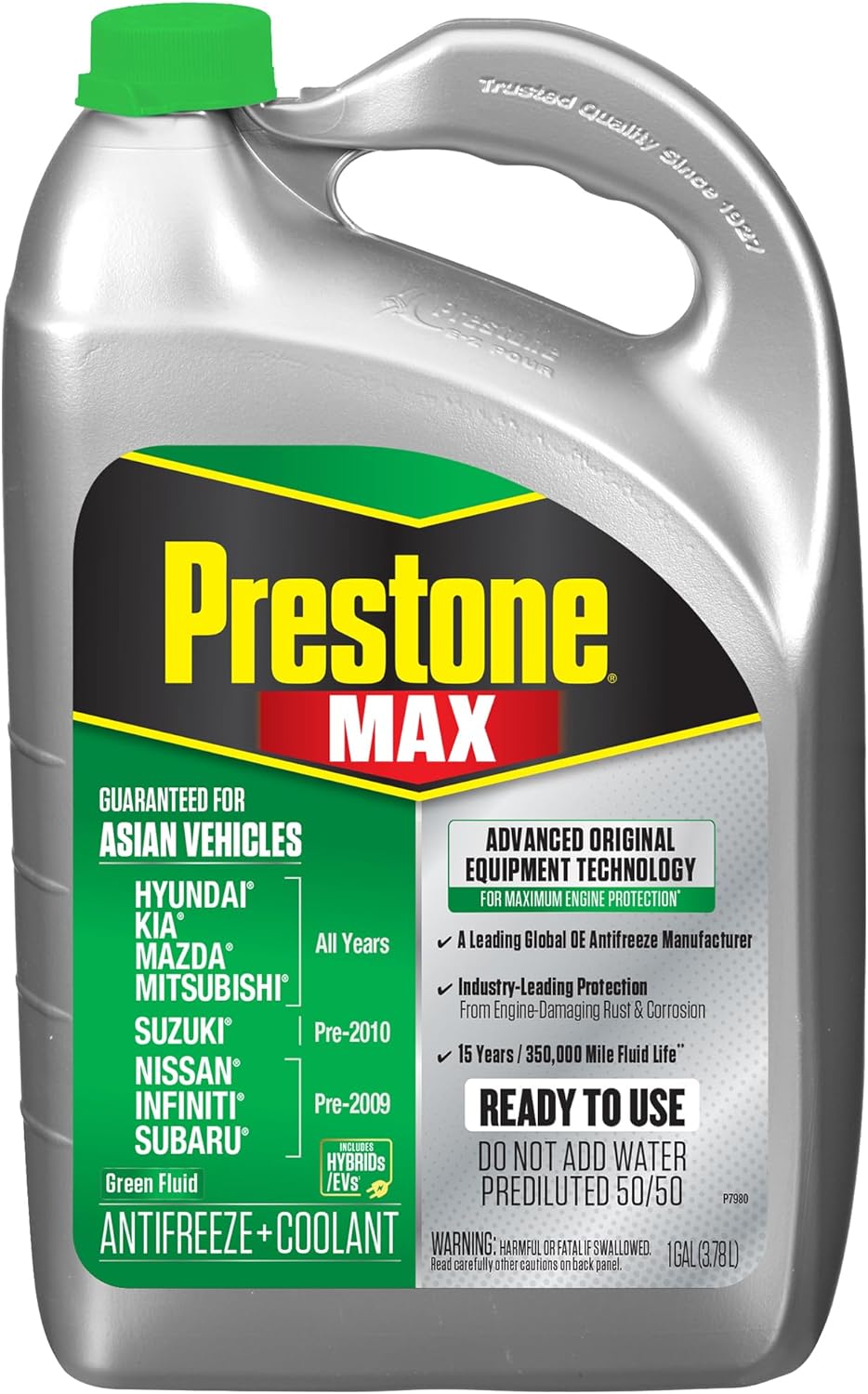
2. Prestone MAX Asian Green 50/50 Antifreeze Coolant
Best Budget Coolant
| Brand | Prestone |
|---|---|
| Model | AF6610/F |
| Item Weight | 9.17 pounds |
This Prestone MAX Asian Green 50/50 antifreeze arrives pre-mixed and ready to pour, so it simplifies routine coolant service on compatible vehicles. It uses a formula intended for Asian-style cooling systems and includes corrosion inhibitors and Prestone CorGuard technology to help protect metal and aluminum components from rust and scale. The product is marketed for wide temperature protection, which helps guard against freezing in winter and overheating in summer during normal driving. Because it is supplied in a 50/50 mix, there is no need for dilution and less chance of mixing errors during top-offs or flushes. The main limitation is that it is a vehicle-specific Asian formula, so confirm compatibility with the Subaru Forester cooling system before use; it is not a universal coolant for every vehicle. For routine maintenance on a 2014-2018 Subaru Forester that accepts Asian-formula 50/50 coolant, this provides a practical, low-cost option that keeps service simple.
Best for: Buyers seeking the lowest-cost, ready-to-use coolant that still offers corrosion and temperature protection for routine service on compatible vehicles.
Less Ideal for: Drivers who prefer a universal or long-life OEM-specified coolant, or those unsure of their Forester's required coolant spec without checking the owner's manual or dealer.
- Pre-mixed 50/50 formula removes need for dilution and reduces installation errors
- Formulated for Asian-style cooling systems with corrosion inhibitors for metal and aluminum protection
- Includes Prestone CorGuard technology aimed at extending cooling system life
- Provides wide temperature protection for freeze and boil resistance during regular driving
- Designed as an Asian-specific formula so compatibility must be confirmed before use
- Contains bitterant additive which some users may find unnecessary
Verdict: The best low-cost coolant for buyers who prioritize affordability while still getting acceptable corrosion and freeze protection for regular service intervals.
3. Zerex Asian Vehicle Blue Prediluted 50/50 Antifreeze/Coolant 1 Gal
Best Premium Coolant

| Formulation | Prediluted 50/50 |
|---|---|
| Chemistry | HOAT with phosphate additive |
| Silicate/Borate | Silicate-free, borate-free |
| Volume | 1 gallon |
| Contains bitterant | Denatonium benzoate (30–50 ppm) |
Zerex Asian Vehicle Blue is a ready-to-use 50/50 antifreeze/coolant designed around Hybrid Organic Acid Technology with a phosphate additive and no silicates or borates. It is intended for vehicles that require a blue, silicate-free formula and is typically used for topping off the radiator or doing a full system flush and refill. The HOAT chemistry and phosphate package target corrosion and scale control across aluminum and mixed-metal cooling systems, helping radiators, water pumps, and hoses stay cleaner over long service intervals. Because it is prediluted, it removes the guesswork of mixing and is convenient for DIY maintenance. The formula excludes nitrites, amines, and 2-EHA, which reduces certain deposit risks but also means it is a specialty fluid matched to specific manufacturer specs rather than a universal coolant. Buyers should confirm their 2014–2018 Subaru Forester requires a blue, silicate-free HOAT formula before using this product to ensure compatibility with the vehicle coolant specification.
Best for: Buyers who prioritize long-term corrosion protection and prefer a premixed, factory-style coolant matched to Asian vehicle specifications for straightforward maintenance on their Forester.
Less Ideal for: Owners who need a universal green or OAT formula, want concentrate to customize dilution, or who cannot confirm their vehicle calls for a blue, silicate-free coolant.
- Prediluted 50/50 mix for immediate use and correct concentration
- HOAT chemistry with phosphate additive targets corrosion and scale in mixed-metal systems
- Silicate- and borate-free formula matches many Asian manufacturers' blue coolant specs
- Made by a recognized brand with OEM-approved positioning and extensive vehicle coverage
- Formulated for vehicles specifying a blue HOAT coolant so it is not a universal replacement for all makes/models
Verdict: The best premium coolant for users willing to pay more for advanced anti-corrosion chemistry, longer service life, and higher thermal stability.
4. PEAK OET Extended Life Green Concentrate Antifreeze/Coolant, 1 Gal
Best Long-Life Coolant

| Manufacturer | PEAK |
|---|---|
| Concentration | Concentrate |
| Formulation | Phosphate-enhanced Organic Acid Technology (POAT) |
| Capacity | 1 Gallon |
This concentrated PEAK OET Extended Life green coolant is a phosphate-enhanced organic acid technology formula designed to deliver long service life and stable inhibitor performance when used in compatible Asian vehicles. It is intended for use as part of a complete flush and fill and can be diluted to a 50/50 mix for typical installations. The formulation focuses on rust and corrosion prevention across cooling system components, and the brand guarantees protection up to 400,000 miles or 15 years when installed correctly. For a 2014-2018 Subaru Forester, using a coolant with long-term inhibitor stability reduces how often you need to flush the cooling system and helps maintain consistent protection in mixed-metal systems. Limitations are that this is a green POAT concentrate intended for vehicles specifying that chemistry; it requires correct dilution and a proper flush to achieve the stated long-life benefits and is not a drop-in if your Forester calls for a different coolant chemistry.
Best for: Forester owners who prioritize long service intervals and want a coolant with stable inhibitors to minimize how often the cooling system needs draining and refilling.
Less Ideal for: Owners whose 2014–2018 Forester requires a different coolant chemistry or who prefer pre-mixed, ready-to-use antifreeze without any dilution steps.
- Extended-life formula with claimed protection up to 400,000 miles or 15 years when used as part of a complete flush and fill
- Concentrated product lets you mix to the correct 50/50 ratio for the vehicle and climate
- Formulated to prevent rust and corrosion across cooling system components
- Designed for Asian vehicles and compatible with phosphate-enhanced organic acid technology applications
- Requires correct dilution and a full system flush to deliver the guaranteed long-life performance
Verdict: The best long-life coolant for owners who want extended service intervals and stable inhibitor performance to minimize flush frequency.
5. PEAK OET Extended Life Blue 50/50 Prediluted Antifreeze/Coolant, 1 Gal
Best Pre-Mixed Coolant

| Formulation | 50/50 prediluted |
|---|---|
| Volume | 1 gallon |
| Vehicle fit | Recommended for Asian vehicles |
| Technology | Phosphate-enhanced Organic Acid Technology (POAT) |
This is a ready-to-use, 50/50 prediluted extended-life coolant formulated for Asian vehicles and designed to protect cooling system components from rust and corrosion. It is used for topping off or performing a full flush and fill without the need to measure or mix concentrate, which makes service faster and less error prone. The formulation is phosphate-enhanced POAT in blue color and the manufacturer guarantees protection for up to 150,000 miles or five years when installed as part of a complete flush and fill. Practical benefits include easy pourability from a 1-gallon container, compatibility with other extended-life coolants, and a bittering agent to discourage accidental ingestion. Limitations include the color and chemistry being intended for Asian vehicle specifications, so it is important to confirm compatibility with your vehicle; also prediluted fluid increases shipping volume compared with concentrate and offers less flexibility if you need a custom concentration for extreme climates.
Best for: Buyers who want the convenience of a premixed coolant that provides correct freeze and boil protection without mixing and prefer a long-life formula for routine top-offs or a full flush and fill.
Less Ideal for: Anyone who needs a coolant formulated to a different chemistry or color standard than phosphate-enhanced POAT, or who prefers concentrate to adjust dilution for extreme climates or to save storage space.
- Ready-to-use 50/50 mix eliminates measuring and reduces installation errors
- Extended-life formulation rated up to 150,000 miles or 5 years when used with a complete flush and fill
- Formulated to prevent rust and corrosion across cooling system components
- Designed for Asian vehicles that specify a blue phosphate-enhanced POAT coolant
- Contains a bittering agent to deter accidental ingestion
- Chemistry and color target Asian vehicle specifications and may not suit vehicles requiring different formulations
Verdict: The best pre-mixed coolant for buyers who prefer convenience and correctly balanced freeze/boil protection without measuring or mixing concentrate.
6. PEAK OET Extended Life Blue Concentrate Antifreeze/Coolant (1 Gal)
Best Concentrated Coolant

| Volume | 1 gallon |
|---|---|
| Chemistry | Phosphate-enhanced Organic Acid Technology (POAT) |
| Concentration | Concentrate (mix before use) |
| Vehicle focus | Formulated for Asian vehicles |
This one-gallon concentrate is designed for mixing to the desired 50/50 or other ratios so you can set the freeze and boil points you need and stock a serviceable volume for multiple coolant jobs. It uses a phosphate-enhanced organic acid technology (POAT) chemistry intended for Asian makes and includes corrosion inhibitors to protect radiators, water pumps, and heater cores during long service intervals. The concentrate format makes it straightforward to flush and refill a Forester cooling system and tailor concentration for climate or performance needs. PEAK also states a guaranteed service life of up to 150,000 miles or five years when installed after a full flush. Limitations: this formula is targeted at vehicles specifying a blue POAT-style coolant, so it is important to confirm Subaru 2014–2018 Forester coolant requirements before use and to thoroughly flush incompatible fluids first to avoid chemical mixing issues.
Best for: Buyers who plan to mix coolant to specific concentrations, perform multiple coolant services, or keep a single bulk container for scheduled maintenance on a 2014–2018 Subaru Forester.
Less Ideal for: If you prefer premixed ready-to-use coolant, single one-off top-offs, or are uncertain about your Forester's factory coolant spec, choose a vehicle-specific premixed option instead.
- Concentrated gallon size lets you mix to exact freeze/boil points and service multiple vehicles
- Formulated for Asian vehicles with POAT chemistry to control corrosion over long intervals
- Guaranteed protection up to 150,000 miles or 5 years when used after a complete flush
- Bittering agent added to discourage accidental ingestion
- Intended for vehicles that require blue POAT-type coolant so it may not be compatible with all Subaru systems without a full flush
Verdict: The best concentrated coolant for users who want to mix to a specific freeze/boil point, save on bulk purchases, or stock larger volumes for multiple services.
Choosing the Right 2014-2018 Subaru Forester Coolant: Key Factors to Consider
Coolant Chemistry and Inhibitor Type
Coolant chemistry determines how the fluid protects aluminum heads, radiators, and heater cores. Organic acid technology and hybrid organic acid formulations provide different corrosion protection profiles and depletion rates. For the Forester, which has aluminum and mixed-metal components, choosing a coolant with a compatible inhibitor package helps prevent pitting and electrochemical corrosion.
Some long-life coolants use organic inhibitors that last longer between service intervals but require that the system be properly flushed before switching. Using an incompatible inhibitor type can reduce protection and accelerate component wear, so confirm the chemistry aligns with Subaru guidance or that a full flush and replacement schedule is followed.
OEM Compatibility and Service Recommendations
OEM compatibility is about matching the coolant's stated approvals and recommended service interval to Subaru's specifications. A product labeled as suitable for use with Subaru or meeting equivalent OEM specs reduces uncertainty about material interactions and recommended drain intervals.
Service recommendations also inform whether you can top up with the same fluid after a partial loss or if a full system refill and flush are required. For owners who prefer to stay within manufacturer-style maintenance windows, choosing a coolant with clear OEM-aligned guidance simplifies long-term service planning.
Protection Duration and Maintenance Interval
Different formulations advertise varying protection spans, ranging from conventional 2-year fluids to long-life 5-year or longer options. Longer protection intervals can reduce service frequency but rely on an uncontaminated cooling system and correct initial fill procedures.
Consider the vehicle's mileage and service history; an older system that has mixed coolant types or contains sediment may not benefit from extended-interval claims without a proper flush. Match the coolant's expected life to your maintenance habits and the Forester's documented service requirements.
Freeze and Boil Point Performance
A coolant's freeze and boil protection depends on its antifreeze concentration and the presence of additives that stabilize boiling temperatures. For Forester owners in cold climates, maintaining the correct concentration prevents freezing and protects metal components from cracking. In hotter environments or during heavy load use, higher boiling points help reduce vapor lock risk and maintain consistent thermostat operation.
Always follow specified mixing ratios and use distilled water when diluting to avoid mineral deposits that lower freeze/boil effectiveness and shorten inhibitor life.
Compatibility With Coolant Flush Procedures
How a coolant behaves during a flush matters when replacing or changing formulations. Some long-life coolants require a thorough flush and neutralizer to remove old inhibitor residues before switching chemistry. Incomplete flushing can lead to chemical interactions that reduce corrosion protection or cause cloudiness and deposits.
If you plan to do a coolant flush yourself, pick a product with clear instructions for system preparation. For shop services, confirming the recommended flush steps and whether additional additives are needed prevents mistakes during installation.
Materials Protection and Scale Control
Beyond corrosion inhibitors, some coolants include dispersants that keep scale and deposits from forming on radiator fins and heater cores. Scale reduces heat transfer efficiency and can raise operating temperatures, impacting thermostat and fan control behavior.
Inspect the cooling system condition before choosing a coolant: heavy deposits or rust may require mechanical cleaning or a chemical flush to restore proper heat transfer. A coolant with good scale control will help maintain radiator efficiency over the long term.
When to Perform a Coolant Flush on a Forester
Signs you need a coolant flush include discolored or cloudy fluid, overheating events, visible rust or sediment in the reservoir, and a history of unknown coolant types. For the 2014-2018 Forester, following the service schedule is a baseline, but driving conditions such as frequent towing, mountainous routes, or stop-and-go city traffic can justify earlier service.
A flush should also precede switching coolant chemistries. If the system has accumulated deposits or old inhibitors, a full drain, radiator cleaning, and refill with fresh coolant is the safest route to ensure the new formulation performs as intended.
- Check reservoir color and clarity every oil change interval
- Flush earlier if you see rust flakes or sediment
- Always perform a full system refill when changing inhibitor types
Mixing Ratios and How to Top Up Correctly
Maintaining the correct antifreeze-to-water ratio is essential for freeze and boil protection and for proper inhibitor concentration. Most long-life formulations recommend a 50/50 mix with distilled water, which offers a balanced freeze and boil point for temperate climates. Adjust concentration based on local winter severity, but do not exceed recommended limits without consulting vehicle guidance.
When topping up, add the same chemistry as currently in the system whenever possible. If the existing coolant type is unknown, plan for a full flush and refill to avoid compatibility problems.
- Use distilled water to prevent mineral deposits
- Aim for 50/50 mix unless extreme climate requires adjustment
- Top up only with matching chemistry or flush before switching
Signs of Coolant-Related Problems to Watch For
Watch for coolant leaks from hoses, water pump seals, or the radiator. Persistent low coolant level can indicate a leak or internal consumption. Overheating under load or during idling, unexplained white smoke from the exhaust, or persistent coolant odors can signal head gasket issues or coolant circulation problems.
Also monitor heater performance. A failure to provide cabin heat or erratic temperature swings often points to air pockets in the cooling system or thermostat problems rather than coolant chemistry, but poor coolant condition can exacerbate these symptoms.
- Persistent low reservoir level without visible leaks
- Overheating during heavy loads or hill climbs
- Coolant discoloration, sediment, or oil contamination
Preparing the Cooling System Before Installation
Before introducing a new coolant, drain the existing fluid completely and inspect the system for contamination. If you find heavy rust or sediment, use a chemical flush or have the radiator professionally cleaned. Replace worn hoses, clamps, and the thermostat if they show signs of age, since new coolant performs best in a healthy system.
Bleed trapped air after refill following Subaru-recommended bleed steps to prevent hot spots and ensure heater core circulation. Proper bleeding reduces the risk of thermostat cycling and abnormal temperature readings.
- Replace brittle hoses and worn clamps during service
- Consider thermostat replacement if the vehicle has high hours
- Bleed the system to remove air after refill
Environmental Considerations and Disposal
Used coolant contains additives and antifreeze compounds that are hazardous to people, pets, and the environment. Collect used fluid in a sealed container and take it to an approved recycling or disposal facility. Avoid pouring coolant down drains or onto the ground.
When selecting a coolant, consider formulations that maintain protective properties longer, which reduces the frequency of disposal events. However, always balance long-life claims with the condition of your existing system before extending intervals.
- Store used coolant safely before disposal
- Recycle at approved collection sites
- Longer-life coolants reduce disposal frequency but require proper system condition
Still looking for the perfect fit?
Select your Subaru Forester configuration to see the most relevant Coolants recommendations
How We Chose the Best 2014-2018 Subaru Forester Coolant
We focused on factors that matter specifically for the 2014-2018 Subaru Forester cooling system and selected products that meet those technical needs. Our evaluation prioritized coolant chemistry compatibility with Subaru engine alloys and heater cores, recommended protection intervals in real-world conditions, and performance across expected temperature ranges. We also weighed corrosion inhibitor technology, whether the formulation is silicate-free or contains controlled silicates, and vendor data on extended life or long-life coolant claims.Practical service factors such as compatibility with existing OEM coolant, clarity on mixing ratios, and whether a product supports standard coolant flush procedures were included. We excluded formulations lacking clear compatibility documentation for Subaru engines or those that recommend universal mixing without specifying corrosion inhibitor types. Each shortlisted coolant was judged on measurable attributes: material compatibility, corrosion protection duration, thermal stability, ease of use during a coolant flush, and manufacturer guidance for service intervals. This approach ensures the list favors chemistry and maintenance behavior that reduce long-term repair risk for Forester owners.
Our full evaluation process is outlined in our review methodology.
FAQ
Can I top off my Forester with any engine coolant?
Topping off with an unknown coolant type is not recommended. Mixing incompatible inhibitor chemistries can reduce corrosion protection. If the existing coolant chemistry is unknown, plan a complete flush and refill with a compatible formulation.
How often should I change coolant in a 2014-2018 Forester?
It depends on the coolant type and service history. Conventional formulations may need earlier service, while long-life coolants advertise longer intervals. Base your schedule on the product's recommended protection duration and the actual condition of the cooling system.
Will switching to a long-life coolant void any warranty?
Using a coolant that meets OEM compatibility guidance should not void manufacturer coverage. However, follow Subaru service recommendations and keep records of maintenance. Avoid mixing chemistries without a proper flush to maintain warranty-relevant care.
Is a coolant flush necessary if my Forester is not overheating?
Not always. If the coolant is clean, the reservoir level is stable, and there are no signs of contamination, you can follow the recommended service interval. But visible discoloration, sediment, or unknown fluid chemistry justifies a flush even without overheating.
Can I use premixed coolant or concentrate for the Forester?
Both are acceptable as long as you achieve the correct antifreeze-to-water ratio. Premixed options simplify installation and avoid dilution errors, while concentrates require mixing with distilled water to the specified ratio.
What should I do if coolant looks oily or has a milky appearance?
Oily or milky coolant often indicates oil contamination such as a head gasket leak or other internal issue. Stop driving if severe and have the system inspected. Do not simply replace the coolant without diagnosing and repairing the source of contamination.
Final Verdict
Prioritize coolant chemistry compatibility, protection duration, and proper installation when selecting coolant for a 2014-2018 Subaru Forester. Confirm the inhibitor type aligns with Subaru guidance or perform a full flush before switching formulations, and maintain correct mix ratios and bleeding to preserve cooling performance.Focus on long-term corrosion protection and system cleanliness rather than marketing claims. By matching chemistry to the vehicle and following recommended service steps, you can choose confidently and reduce the risk of cooling-system failures.
Explore More:
- Check out all Subaru Forester parts & accessories
- Explore Fluids & Chemicals
- Browse all Accessories
