

Note: This article contains affiliate links. If you click on these links and make a purchase, I may earn a small commission at no extra cost to you. This helps support my research and content. Read my full affiliate disclosure here.
If you own a 1998-2002 Subaru Forester, the right coolant keeps the engine running at safe temperatures and prevents premature wear to the cooling system. Older Subaru boxer engines and their aluminum components are sensitive to corrosion and require a coolant formulation that protects seals, hoses, and the radiator over extended service intervals.This guide covers the top coolant options we shortlisted for the 1998-2002 Forester and explains how we evaluated them for corrosion inhibitors, freeze protection, compatibility with Subaru materials, and expected service life. Read on for the key differences and what to prioritize for reliable year-round performance.
Looking for other parts? See all Subaru Forester parts & accessories.
Top Picks at a Glance
| Best Overall Coolant The best all-around coolant balancing protection, longevity, and compatibility | Zerex Asian Vehicle Blue Prediluted 50/50 Antifreeze/Coolant 1 Gal |  |
| Best Budget Coolant A low-cost coolant that covers basic protection and maintenance needs | Prestone MAX Asian Green 50/50 Antifreeze Coolant |  |
| Best Premium Coolant Higher-end formulation with extra additives and longer service intervals | PEAK OET Extended Life Green Concentrate Antifreeze/Coolant (1 Gal) |  |
| Best Concentrate Coolant Undiluted concentrate intended to be mixed to specific ratios before use | PEAK OET Extended Life Blue Concentrate Antifreeze/Coolant (1 gal) |  |
| Best Pre-Mixed Coolant Ready-to-use formula that needs no measuring or mixing before filling | Zerex Original Green 50/50 Prediluted Antifreeze/Coolant 1 gal |  |
1. Zerex Asian Vehicle Blue Prediluted 50/50 Antifreeze/Coolant 1 Gal
Best Overall Coolant

| Formulation | HOAT (Hybrid Organic Acid Technology) |
|---|---|
| Mix | Prediluted 50/50 ready-to-use |
| Free of | Silicates and borates |
| Container | 1 gallon |
Zerex Asian Vehicle Blue is a ready-to-use 50/50 antifreeze/coolant formulated with Hybrid Organic Acid Technology and a phosphate additive to protect cooling system metals and resist corrosion, scale, and deposits. For routine DIY maintenance on a 1998–2002 Subaru Forester this product lets you top off or perform a full system flush without mixing, and its silicate- and borate-free formula is designed to match Asian manufacturers that call for a blue HOAT coolant. In practice that means good protection against freezing and boiling, and reduced risk of buildup that can impair radiators, water pumps, and hoses. The pre-mixed gallon size is convenient for a single refill or partial change. One limitation is that it is formulated specifically to meet Asian blue-coolant specifications, so you must confirm the Forester’s factory coolant requirement before switching; also long-term service intervals depend on following Subaru maintenance guidance rather than assuming indefinite life from any single fluid.
Best for: DIYers doing routine cooling system maintenance on a 1998–2002 Subaru Forester who want a ready-to-use, factory-style blue coolant that prioritizes corrosion protection and easy installation.
Less Ideal for: Owners who need a coolant specified by a different color or chemistry for modified engines or nonstandard cooling systems should choose a product matched to those specific requirements.
- Ready-to-use 50/50 premix requires no on-site dilution or measuring
- HOAT formula with phosphate additive protects aluminum and other cooling-system metals from corrosion
- Silicate- and borate-free chemistry reduces risk of scale and deposits from long-term use
- Pre-measured 1 gallon size is convenient for topping off or a partial system flush
- Formulated to Asian blue-coolant specs so compatibility must be verified against Subaru factory requirements before use
Verdict: The best all-around coolant that balances corrosion protection, freeze/boil performance, and broad compatibility for most routine DIY maintenance.
2. Prestone MAX Asian Green 50/50 Antifreeze Coolant
Best Budget Coolant
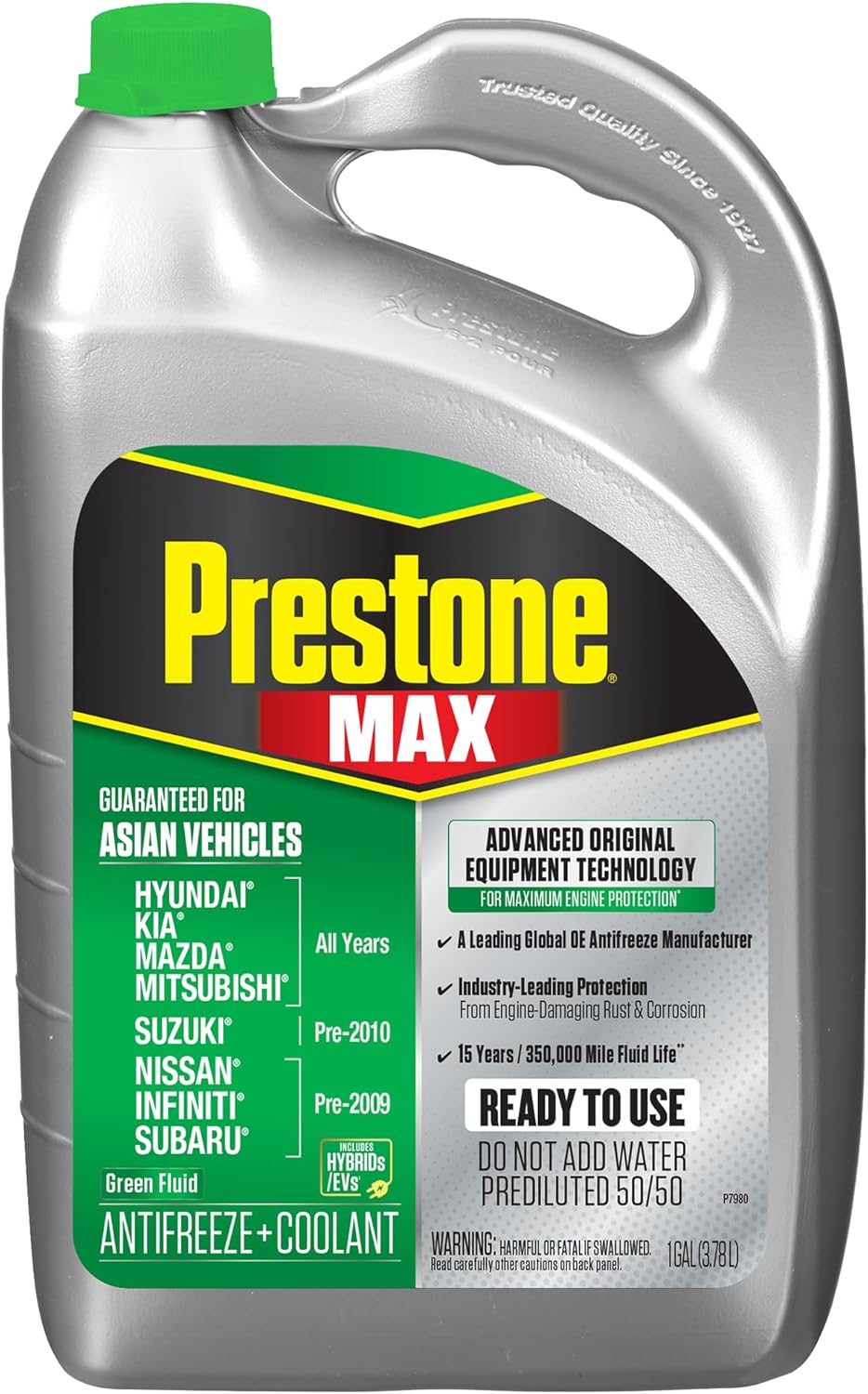
| Brand | Prestone |
|---|---|
| Model | AF6610/F |
| Item Weight | 9.17 pounds |
This Prestone MAX Asian Green 50/50 coolant is a ready-mixed antifreeze formulated for Asian vehicles and intended to provide basic freeze, boil, and corrosion protection without extra performance additives. It ships pre-diluted so you can pour it straight into the cooling system to replace drained fluid or top off after a service. Notable features include Prestone CorGuard corrosion inhibitors and a bitterant to discourage accidental ingestion. In practical use it delivers reliable temperature control for daily driving and seasonal extremes, and the 50/50 mix saves the step of blending concentrate with water. The product focuses on core protection rather than extended-life chemistry, so you should expect conventional service intervals rather than the longer drain intervals offered by specialty extended-life coolants. For a budget-minded replacement that matches Asian cooling system requirements, this provides straightforward, factory-replacement compatible protection with minimal fuss.
Best for: Budget-focused owners working on a 1998–2002 Subaru Forester who want a simple, OEM-style coolant replacement that provides reliable freeze, boil, and corrosion protection without extra additives.
Less Ideal for: Owners seeking long-life or specialty formulations that extend change intervals or provide additional additives should consider extended-life or performance coolants instead.
- Ready-to-use 50/50 mix requires no dilution before filling
- Formulated for Asian vehicles to match common coolant specifications
- Includes corrosion inhibitors to protect metal components
- Provides broad temperature protection for cold winters and hot summers
- Conventional formula without extended-life additives for very long drain intervals
Verdict: The best low-cost coolant for shoppers who need adequate freeze/boil protection and corrosion control on a tight budget without extra additives.
3. PEAK OET Extended Life Green Concentrate Antifreeze/Coolant (1 Gal)
Best Premium Coolant

| Brand | PEAK |
|---|---|
| Formula type | Concentrate |
| Target vehicles | Asian vehicles (POAT green) |
| Volume | 1 gallon |
The PEAK OET Extended Life Green Concentrate is a phosphate-enhanced organic acid technology coolant designed for Asian vehicle cooling systems. As a concentrate it is meant to be mixed to the correct 50/50 ratio for topping off, flushing, or a full fill. Its formulation emphasizes corrosion and rust protection for metal and aluminum components and is guaranteed for extended service life when used as part of a complete flush and fill. That makes it useful for owners who want a durable, long-lasting inhibitor package rather than a basic, short-life coolant. Practical benefits include broad protection across engine cooling components and suitability where a green POAT formula is specified. Limitations to note are that it is a concentrate requiring proper dilution and that it is colored and phosphate-enhanced, so it should only be used where the vehicle manufacturer permits phosphate-containing coolants; do not mix with incompatible coolant chemistries.
Best for: Owners who prioritize long-term cooling system protection and are willing to follow proper flush and dilution procedures for a high-performance coolant.
Less Ideal for: If you prefer a ready-to-use 50/50 premix or your vehicle requires a phosphate-free coolant chemistry, choose a different product.
- Long-life corrosion inhibitors formulated for extended service intervals
- Concentrated formula allows precise 50/50 mix for flushes, fills, or top-offs
- Specifically formulated for Asian vehicles that require a green POAT chemistry
- Backed by a long service-life guarantee when used with a complete flush and fill
- Contains phosphates so incompatible with vehicles that specify phosphate-free formulas
Verdict: The best premium coolant for users willing to pay more for superior corrosion inhibitors, extended service life, and enhanced thermal stability.
4. PEAK OET Extended Life Blue Concentrate Antifreeze/Coolant (1 gal)
Best Concentrate Coolant

| Formulation | Concentrate |
|---|---|
| Volume | 1 gallon |
| Technology | Phosphate-enhanced OAT (POAT) |
| Intended vehicles | Asian vehicles (lists Acura, Honda, Infiniti, Mitsubishi, Nissan, Subaru, Suzuki) |
This one-gallon PEAK OET blue concentrate is a phosphate-enhanced organic acid technology coolant formulated for Asian cars, and it is supplied as a concentrate so you control the final mix. For a 1998–2002 Subaru Forester the concentrate lets a DIYer set a precise freeze and boil protection level by mixing with distilled water to the vehicle maker’s recommendation or a colder-climate ratio. The formula claims extended-life corrosion protection suitable for aluminum and other cooling system components and is intended for flush-and-fill service. Because it is a concentrate it has longer on-shelf storage life and is convenient for topping off after a cooling-system service. Limitations: you must dilute accurately to avoid incorrect coolant strength, and this formula is the blue POAT type specified for some Asian applications rather than Subaru-specific premixed formulations, so confirm compatibility with your Forester before use.
Best for: DIY owners who perform their own cooling-system flushes and want full control over dilution to tune freeze and boil protection and extend shelf life of their coolant supply.
Less Ideal for: Drivers who prefer ready-to-use premixed coolant or who are uncomfortable measuring and mixing fluids should choose a prediluted product or have a shop handle the service.
- Concentrated gallon size lets you tailor freeze and boil protection by choosing dilution ratio.
- Extended-life POAT formula designed to resist rust and corrosion in mixed cooling systems.
- One-gallon container is convenient for full system flush-and-fill or multiple top-offs.
- Compatible with common Asian vehicle coolant chemistries where blue POAT is specified.
- Requires careful dilution with distilled water to achieve correct protection levels and avoid warranty issues.
- Not a vehicle-specific premixed coolant so buyers must verify suitability for their Forester.
Verdict: The best concentrate coolant for DIYers who want control over dilution ratio, longer on-shelf life, and the ability to tailor freeze/boil protection.
5. Zerex Original Green 50/50 Prediluted Antifreeze/Coolant 1 gal
Best Pre-Mixed Coolant

| Formulation | 50/50 prediluted |
|---|---|
| Additive technology | IAT (low silicate) |
| Volume | 1 gal |
Zerex Original Green 50/50 prediluted antifreeze comes ready to pour so you do not need to mix concentrate with water. It uses an IAT low-silicate formula designed to protect metal cooling system components from corrosion, scale and rust while providing freeze and boil protection appropriate for a 50/50 solution. Typical use is topping off or refilling the cooling system after a flush; the prediluted gallon is convenient for DIYers who want to avoid measuring or dilution mistakes. Notable features include a low-silicate chemistry compatible with many older passenger cars and light trucks that call for inorganic additive technology and the inclusion of corrosion inhibitors to help protect radiators, water pumps and aluminum parts. Practical benefits are simple, mess-free application and immediate correct coolant concentration. The product is not a long-life organic acid formula, so it follows conventional IAT maintenance intervals and may require more frequent coolant changes compared with extended-life coolants.
Best for: Buyers who prioritize convenience and want a no-mix, ready-to-pour coolant for routine topping off or refills on older vehicles where a low-silicate IAT formula is specified.
Less Ideal for: Drivers looking for extended-life or long-interval coolants should consider OAT or hybrid formulas designed for longer maintenance intervals instead.
- Prediluted 50/50 ready-to-pour formula eliminates mixing and dilution errors
- Low-silicate IAT chemistry formulated to limit corrosion and deposits in older cooling systems
- Includes corrosion inhibitors to help protect radiators, water pumps and aluminum components
- Suitable for topping off or full system fills after a flush without additional additives
- Not an extended-life organic acid coolant so it requires conventional service intervals
Verdict: The best pre-mixed coolant for convenience-minded buyers who prefer a no-mix, ready-to-pour solution that eliminates dilution errors.
Choosing the Right 1998-2002 Subaru Forester Coolant: Key Factors to Consider
Coolant Chemistry and Inhibitor Type
Different coolants use distinct inhibitor chemistries such as inorganic additive technology, organic acid technology, or hybrid blends. For the 1998-2002 Forester, chemistry affects how well the coolant prevents corrosion in aluminum heads, block, and the radiator.
Inorganic inhibitor systems typically provide strong initial protection but need more frequent replacement. Organic acid formulas often offer longer service intervals but require careful compatibility checks. Hybrid or extended-life blends aim to balance immediate corrosion protection with longer intervals. Choosing the right chemistry helps avoid accelerated corrosion, pitting, or deposits that can reduce heat transfer and lead to overheating.
Concentration and Freeze/Boil Protection
Correct coolant concentration with distilled water is crucial for freeze and boilover protection. For this Forester, the right ethylene glycol concentration prevents freezing in cold climates and raises boiling point under pressure to reduce vapor lock.
Owners should follow the vehicle manual for target freeze points and use a refractometer or test strips when topping up. Too weak a mixture exposes the engine to freeze damage and cavitation; too strong a mixture can reduce heat transfer efficiency and increase fluid viscosity, stressing the water pump.
Compatibility With Subaru Materials
The 1998-2002 Subaru Forester uses aluminum components and specific elastomers in hoses and seals. Some coolant formulations can cause swelling, hardening, or degradation of seals if the inhibitors are incompatible.
Always check that the coolant formulation is marked as safe for aluminum engines and compatible with mixed-metal systems. Using an incompatible formula can lead to leaks, seal failures, and premature part replacement, which are costly and avoidable with the right selection.
Longevity and Maintenance Interval
Service life varies by chemistry: some coolants are labeled for short service intervals and others for long-life or lifetime use. For an older Forester, longer intervals can reduce maintenance frequency but only when the coolant chemistry remains effective and the system is clean.
Consider your driving patterns and climate when choosing longevity. If the vehicle has an unknown maintenance history or visible rust and deposits, a more frequent change interval combined with a proper flush may be safer. Conversely, a well-maintained system can benefit from extended-life coolants to minimize routine servicing.
Corrosion and Cavitation Protection
Subaru boxer engines can be vulnerable to localized corrosion and cavitation damage around cylinder walls and water jackets. Coolants with proven corrosion inhibitor packages help inhibit electrochemical reactions that cause pitting.
Look for products with documented corrosion test results or OEM compatibility claims. Good inhibitor performance reduces the risk of leaks, maintains heat-transfer efficiency, and helps prolong the life of the radiator, water pump, and heater core.
Ease of Use and Mixing Requirements
Some coolants are sold pre-mixed while others require dilution with distilled water. For owners doing their own maintenance on a 1998-2002 Forester, pre-mixed options reduce the chance of incorrect concentrations.
Also consider whether a product requires an initial conditioner or additive, or if it is fully formulated as a direct fill. Simpler products lower the risk of user error during topping off and are typically better for DIY maintenance on older vehicles.
Why Subaru Engines Need Specific Coolant Attention
Subaru s horizontally opposed engines use aluminum heads and unique cooling passages that benefit from inhibitor packages designed to protect mixed metals. Over time, inadequate coolant chemistry can lead to pitting, electrochemical corrosion, and buildup that reduces flow and heat transfer. Maintaining the right coolant type and concentration helps preserve head gasket sealing surfaces and reduces the risk of overheating during sustained highway driving.
- Aluminum components are more sensitive to corrosion than cast iron.
- Gasket surfaces and cylinder bores can be affected by coolant chemistry over years of use.
- Consistent coolant maintenance supports heater core and radiator longevity.
When To Flush and Replace Coolant In A 1998-2002 Forester
Older Foresters often benefit from a flush when maintenance history is uncertain or when coolant shows discoloration, debris, or a rusty appearance. A proper flush removes deposits that reduce heat transfer and allows fresh inhibitor chemistry to protect the system.If a long-life coolant is installed, initial flush intervals may still be shorter if the system was previously filled with a different chemistry. Follow visible signs and periodic testing with a refractometer along with time-based intervals rather than relying solely on mileage.
- Perform a visual check for discoloration or particulate matter.
- Test freeze/boil protection and inhibitor levels before long trips.
- Consider a flush if switching inhibitor types or if contamination is present.
How Coolant Affects Heater Performance and Cabin Comfort
Coolant that loses inhibitor strength or becomes contaminated can reduce heat transfer through the heater core, resulting in reduced cabin heat and longer warm-up times. For drivers in cold climates, consistent heat delivery is also a safety and comfort consideration.Maintaining the recommended coolant concentration and keeping the system free of sludge ensures steady circulation through the heater core and more reliable defrosting performance.
- Clogged heater cores mean reduced cabin warmth and possible vent smells.
- Maintaining concentration preserves heat transfer efficiency.
- Regular checks before winter prevent comfort and safety issues.
Signs of Coolant-Related Problems To Watch For
Look for white or brownish residue, persistent low coolant level without visible leaks, overheating during idle or slow-speed driving, or visible rust around the radiator and overflow tank. These symptoms often indicate compromised inhibitor performance or internal corrosion.Early detection allows you to address coolant chemistry issues before they lead to water pump failure, head gasket problems, or radiator leaks. If you encounter persistent symptoms after a flush and refill, further mechanical inspection is advisable.
- Discolored coolant or sludge in the reservoir.
- Frequent need to top off coolant without external leaks.
- Overheating under load or during idling.
Preparing The System Before Adding New Coolant
Before installing a new coolant, drain the old fluid and inspect the reservoir, hoses, and radiator for visible corrosion or debris. If contamination is present, perform a thorough flush using manufacturer-recommended procedures or a safe flushing agent designed for aluminum systems.Replace worn hoses, clamps, or the thermostat if they show signs of age. Bleed trapped air from the system according to Subaru service guidance to prevent hot spots and ensure consistent circulation after refilling.
- Inspect and replace brittle hoses or failing clamps.
- Flush until drained fluid runs clear when contamination is present.
- Bleed air pockets to avoid overheating and cavitation.
Still looking for the perfect fit?
Select your Subaru Forester configuration to see the most relevant Coolants recommendations
How We Chose the Best 1998-2002 Subaru Forester Coolant
We selected candidates based on attributes that matter specifically to the 1998-2002 Subaru Forester cooling system. Our evaluation used a combination of manufacturer chemistry specifications, corrosion-inhibition claims, user maintenance reports, and formulation compatibility with aluminum engines and mixed-metal systems. Key evaluation criteria included inhibitor type and longevity, freeze and boilover protection at recommended concentrations, compatibility with Subaru elastomers and seals, and reported effects on radiator and heater core longevity.We excluded products that explicitly list incompatibility with Subaru vehicles, lack published corrosion test results, or are marketed solely for racing use where replacement intervals are impractical for everyday ownership. We also deprioritized coolants that require complex additive topping procedures or those that mandate full system replacement without clear service guidance. The final shortlist emphasizes long-life formulations, straightforward mixing or pre-mixed convenience, and chemistry known to be safe for aluminum boxer engines.
Our full evaluation process is outlined in our review methodology.
FAQ
Can I use a universal coolant in my 1998-2002 Forester?
It depends on the chemistry. Some universal formulations are compatible with aluminum engines and mixed-metal systems, while others are not. Check the product specifications for aluminum compatibility and recommended mixing instructions before using.
How often should I flush the cooling system on a Forester from 1998-2002?
Flush intervals depend on the coolant chemistry and the vehicle s maintenance history. If the system has unknown history or shows contamination, flush and replace sooner. For long-life formulations in a clean system, intervals can be extended but periodic testing is still advised.
Is ethylene glycol required for my Subaru Forester?
Most factory-recommended coolant formulations for this era rely on ethylene glycol as the base for freeze and boil protection. Propylene glycol variants exist but may have different inhibitor packages, so ensure compatibility with Subaru materials before switching.
Will switching coolant chemistry harm my engine?
Switching between incompatible inhibitor chemistries without a complete flush can reduce corrosion protection and cause deposits. If you change chemistry types, perform a thorough flush to remove the old coolant and follow the new product s instructions to avoid adverse reactions.
What symptoms indicate the water pump or thermostat is failing rather than just coolant issues?
If you see coolant that is clean but experience persistent overheating, inconsistent temperature gauge readings, or coolant leaks near the pump, those point to mechanical issues. Coolant problems more often present as discoloration, sludge, or steady loss of fluid.
Final Verdict
For a 1998-2002 Subaru Forester, prioritize coolant formulations that offer proven corrosion protection for aluminum components, correct freeze and boil protection for your climate, and a clear maintenance interval you can follow. Balance the desire for longer service intervals with the vehicle s current condition; a cleaner, well-maintained system can safely use extended-life products, while older or contaminated systems benefit from more frequent changes and a thorough flush.Ultimately, choose a coolant that is explicitly compatible with aluminum engines and mixed-metal systems, maintain proper concentration, and monitor the system regularly. That approach will help minimize the risk of overheating and extend the life of your Forester s cooling components.
Explore More:
- Check out all Subaru Forester parts & accessories
- Explore Fluids & Chemicals
- Browse all Accessories
