

Note: This article contains affiliate links. If you click on these links and make a purchase, I may earn a small commission at no extra cost to you. This helps support my research and content. Read my full affiliate disclosure here.
If your 2012-2015 Honda Civic feels loose in the front end or you notice uneven tire wear, worn ball joints are a common cause. For Civic owners of the FB and FG chassis years, selecting the right ball joint matters for steering feel, suspension geometry, and long-term safety. This guide covers the top shortlisted options for these model years and explains the practical tradeoffs between OEM-style fitment, heavy-duty longevity, and ease of installation.Below you will find the best ball joints chosen for the 2012-2015 Civic, plus what to consider before you replace a joint and what tools or preparations typically matter for a smooth install.
Looking for other parts? See all Honda Civic parts & accessories.
Top Picks at a Glance
| Best Overall The best all-around choice for most situations | MOOG K500234 Front Lower Suspension Ball Joint |  |
| Best Quality Built to a higher standard if you want something more solid | TRQ Front Lower Driver and Passenger Side Ball Joint Set (2-piece) |  |
| Best Value The sweet spot between price and what you get | BOXI Front Lower Ball Joint Kit (2 pcs) — Fit for Acura ILX 2013–2015 / Honda Civic 2012–2015 |  |
| Best Budget The cheapest option that still gets the job done reliably | TRQ Front Lower Ball Joint (PSA63985) — Direct-fit replacement |  |
| Highest Rated A top-rated pick with lots of positive feedback | Metrix Premium Chassis Parts Front Lower Ball Joint Kit (2 pc) |  |
| Most Popular A crowd favorite that many people choose with confidence | Detroit Axle Front Lower Ball Joints (2 pack) for 2012–2015 Honda Civic / 2013–2015 Acura ILX |  |
| Best Seller A high-volume bestseller chosen again and again | Detroit Axle Front Outer Tie Rods and Lower Ball Joints Kit — 4‑Piece for 2012–2015 Honda Civic / 2013–2015 Acura ILX |  |
1. MOOG K500234 Front Lower Suspension Ball Joint

| Model | K500234 |
|---|---|
| Position | Center (front lower) |
| Brand | MOOG |
The MOOG K500234 is a front lower suspension ball joint engineered to replace a worn factory unit and restore controlled pivoting between suspension components. It is typically used when steering feels loose, there is uneven tire wear, or during a suspension refresh; installation is intended for the vehicle-specific front lower location. MOOG emphasizes durable construction and machined exterior finish, which translates to reliable everyday driving performance and longer service life compared with generic replacements. The design supports alignment stability and predictable steering response, so drivers should notice firmer steering and reduced play after fitting. Installation requires basic suspension tools and alignment verification afterward. This is a single replacement part sold individually and does not include related fasteners or a press tool, so professional installation or a well-equipped DIYer is recommended. For a balanced buyer seeking a dependable, factory-quality replacement that focuses on restoring original handling, the K500234 is a practical choice.
Best for: Buyers who want a reliable, factory-quality replacement to restore original steering feel and handling on specified Civic and ILX model years without exotic performance upgrades.
Less Ideal for: Drivers seeking an upgraded performance or heavy-duty suspension component for racing or off-road use should consider performance-oriented alternatives.
- Vehicle-specific fitment for 2012–2015 Honda Civic and 2013–2015 Acura ILX
- Machined exterior and durable construction aimed at longer service life
- Designed to restore steering stability and reduce suspension play
- Backed by a reputable chassis parts brand with engineering focus
- Sold as a single unit and may require separate hardware or a press for installation
Verdict: Choose the MOOG K500234 when you want a dependable, vehicle-specific front lower ball joint that restores factory steering stability for 2012–2015 Civics and 2013–2015 ILX models.
2. TRQ Front Lower Driver and Passenger Side Ball Joint Set (2-piece)

| Fitment | 2012-2015 Honda Civic; 2013-2015 Acura ILX |
|---|---|
| Quantity | 2 Piece |
| Exterior | Machined |
| Model | TRQ PSA66834 |
The TRQ two-piece front lower ball joint set replaces both driver and passenger lower joints with pre-assembled, machined units intended for direct-fit installation. It is used to restore steering precision and suspension geometry on affected 2012–2015 Honda Civics and 2013–2015 Acura ILX models, and includes step-by-step installation videos to guide DIYers. Notable features are the machined exterior finish and factory-style fitment that eliminate modification during swap-in, plus TRQ reference numbers matching common OEM part numbers for easier verification. In practice these joints tighten up play in worn suspension, improve steering response, and reduce clunking or uneven tire wear when both sides are replaced. Limitations to consider are that this is a direct replacement lower ball joint set only, so it does not address other worn front-end components and professional press or removal tools may still be needed for installation on some cars. Overall the kit is a practical, hands-on solution for performance-minded owners wanting to restore crisp steering feel without custom parts.
Best for: A performance-focused DIY owner who wants to restore steering response and reduce play by replacing both front lower ball joints with a direct-fit, factory-quality replacement.
Less Ideal for: Buyers looking for an upgraded performance or heavy-duty aftermarket ball joint beyond factory-spec or those who need a full front suspension overhaul including control arms and tie rods.
- Direct-fit pre-assembled units for front lower driver and passenger positions
- Machined exterior finish for consistent seating and smooth operation
- Includes video resources to assist DIY installation and reduce guesswork
- Matches common reference/OEM part numbers for easier compatibility checks
- Only replaces lower ball joints so worn control arms, tie rods, or bushings still need separate attention
Verdict: Choose this TRQ front lower ball joint kit when you want a direct-fit, pre-assembled replacement to quickly restore steering precision on 2012–2015 Civics and 2013–2015 ILX models.
3. BOXI Front Lower Ball Joint Kit (2 pcs) — Fit for Acura ILX 2013–2015 / Honda Civic 2012–2015

| Fitment | Acura ILX 2013-2015; Honda Civic 2012-2015 (specified trims) |
|---|---|
| Position | Front lower, left and right |
| OEM part number | K500234 |
| Package contents | 2x front lower ball joints |
These BOXI front lower ball joints are sold as a two-piece kit intended to replace the front lower ball joints on Acura ILX 2013–2015 and Honda Civic 2012–2015 (specified trims). They install in the front lower control arm to restore steering precision and reduce play that causes clunks or uneven tire wear. The listing states the parts are direct-fit replacements with premium alloy construction, enhanced structural strength, and corrosion resistance for longer service life. In practice this means the kit should install without modification on compatible cars and hold up under normal street driving. The parts come with OEM cross-reference K500234 so they match the factory location and mounting. Limitations are typical of aftermarket suspension parts: long-term durability depends on installation torque, driving conditions, and regular inspection, and you may prefer a dealership or well-reviewed brand for high-mileage or heavy-duty use. Overall the kit is a practical option for owners wanting a straightforward replacement to restore proper front-end feel and alignment without upgrading other suspension components.
Best for: Buyers who want a no-frills, factory-style replacement to restore steering feel and stop lower-joint noise on the listed Civic and ILX years, prioritizing straightforward fit and value.
Less Ideal for: Drivers seeking performance upgrades, heavy-duty off-road use, or those who need a parts supplier with extended warranty and long-term proven track record should consider higher-end or dealer-sourced options.
- Direct-fit replacement specified for Acura ILX 2013–2015 and Honda Civic 2012–2015 so no modifications are needed for compatible cars
- Sold as a pair covering driver and passenger lower front positions for one-time service
- Uses premium alloy and reinforced structure aimed at corrosion resistance and longer service life
- Supplies OEM cross-reference (K500234) to help confirm correct fitment
- Long-term durability depends on driving conditions and installation quality rather than a manufacturer-backed longevity guarantee
Verdict: A practical, direct-fit two-piece front lower ball joint kit that gets compatible 2012–2015 Civics and 2013–2015 ILX back to factory steering feel with minimal fuss.
4. TRQ Front Lower Ball Joint (PSA63985) — Direct-fit replacement

| Manufacturer | TRQ |
|---|---|
| Model | TRQ PSA63985 Ball Joint |
| Mounting Type | Bolt-In |
| Greaseable | No |
| Position | Front Left Lower, Front Right Lower |
The TRQ front lower ball joint is a pre-assembled, direct-replacement suspension part intended to restore steering control and suspension geometry on compatible 2012–2015 Honda Civic and 2013–2015 Acura ILX lower control arms. It installs as a bolt-in unit and includes a dust boot so you can swap it in without modifying the knuckle. TRQ promotes easy DIY installation with videos and a fitment chart, though several owners note the joint is not greaseable and some found little or no pre-applied grease in the socket, so adding lubricant before installation is a common step. In practice this part brings back a firmer steering feel and removes play when the original joint is worn, and its machined exterior and factory-style mounting make it suitable for routine street use. Be aware that press-fit removal of the old joint can be difficult on some cars and may require a press or shop service. Quality reports are mixed, so this is best for drivers prioritizing an affordable direct-fit replacement and willing to inspect and prep the joint before installation.
Best for: Buyers looking to make an affordable, factory-style repair to a 2012–2015 Civic (or 2013–2015 ILX) who prefer a ready-to-install part and are comfortable inspecting or adding lubricant before fitting.
Less Ideal for: Drivers who want a permanently serviceable, greaseable joint or who prioritize the highest-end longevity for heavy-duty or performance use should consider premium alternatives.
- Direct-fit, pre-assembled design for straightforward replacement
- Includes dust boot and machined exterior for a factory-style fit
- Extensive DIY installation videos and compatibility information available
- Non-greaseable design and reports of little or no factory-applied grease in some units
- Some users report variable long-term durability compared with higher-end brands
Verdict: A cost-conscious, direct-fit lower ball joint that restores steering control on 2012–2015 Civics when inspected and prepped before installation.
5. Metrix Premium Chassis Parts Front Lower Ball Joint Kit (2 pc)

| Position | Front Lower |
|---|---|
| Material | Steel |
| Quantity | 2 pc |
| Compatible engines | L4 1.5L / L4 1.8L |
This Metrix two-piece front lower ball joint kit replaces the factory lower ball joints and restores steering control and suspension articulation. It is intended as a direct-replacement part for the listed Civic and ILX models and includes two ball joints plus cotter pins for straightforward installation. The joints are steel with a greasable design so you can refresh lubrication during routine service, which helps extend service life. Metrix advertises factory-quality fit and IATF 16949 and ISO 9001 certification, and customers report consistent fit and easy installation when paired with a post-replacement wheel alignment. Practical benefits are improved steering stability, fewer noises over bumps, and the ability to service the joint with grease instead of replacing it early. Limitations are that installation requires press tools or a shop if you lack mechanical equipment, and you must follow alignment procedures after replacement; this kit does not include control arms or related suspension parts, so plan for any additional components if they are worn.
Best for: Buyers who prioritize long-term reliability and a factory-like replacement for their Civic or ILX will appreciate the serviceable greasable design and certified manufacturing behind these joints.
Less Ideal for: If you want a full front suspension refresh or prefer one-time sealed-for-life joints that never need greasing, this basic ball-joint-only kit is not the best single-purchase solution.
- Direct-fit replacement for specified 2012–2015 Honda Civic and 2013–2015 Acura ILX applications
- Greasable design allows periodic lubrication to extend service life
- Steel construction with cotter-pin hardware for secure, serviceable installation
- Manufacturer certifications (IATF 16949 and ISO 9001) that indicate controlled manufacturing processes
- Requires press tools or professional installation for fitment and removal
- Kit includes only the ball joints and cotter pins so additional worn suspension parts may need separate purchase
Verdict: A serviceable, factory-style front lower ball joint kit that prioritizes reliable fitment and long-term durability for the 2012–2015 Honda Civic and 2013–2015 Acura ILX.
6. Detroit Axle Front Lower Ball Joints (2 pack) for 2012–2015 Honda Civic / 2013–2015 Acura ILX

| Fitment | 2012-2015 Honda Civic; 2013-2015 Acura ILX |
|---|---|
| Kit contents | 2x Front Lower Ball Joints (driver and passenger) |
| Position | Front Lower |
| Manufacturer | Detroit Axle |
These Detroit Axle front lower ball joints are a two-piece replacement kit intended to restore steering feel and front suspension stability on compatible 2012–2015 Honda Civic and 2013–2015 Acura ILX models. The parts are designed as direct-fit replacements so installation follows the original mounting points and hardware, which makes them suitable for a DIY install or a routine shop job. Material and structural descriptions claim premium alloy construction and enhanced strength to resist wear and corrosion, and multiple user reports cite good initial fit and quiet operation after installation. Some technicians have noted limited grease in the sealed units and at least one professional reported dimensional tolerances that required extra attention during pressing, so check fit carefully during installation and consider adding grease if needed. For buyers focused on value, these offer a factory-style replacement at a lower price than dealer parts, but those seeking longest-term durability may prefer higher-end OE-brand options.
Best for: Buyers who want an affordable, ready-to-install replacement that restores steering stability and reduces front-end noise while relying on real-user feedback to confirm fit before installation.
Less Ideal for: Drivers who prioritize maximum longevity under heavy use or who prefer factory-dealer parts and guaranteed OEM tolerances should consider higher-end replacements.
- Direct-fit kit matched to the listed Civic and ILX model years for straightforward installation.
- Constructed from alloy with claimed rust resistance and reinforced structure for impact and wear resistance.
- Includes both passenger and driver side lower ball joints and needed hardware for a complete front replacement.
- Widely reviewed by users with many reports of good initial fit and restored steering feel.
- Some units arrive with minimal factory grease and lack a grease service port, requiring manual lubrication.
- A few professional installers reported fitment tolerance variation that needed extra work to press or secure the joint.
Verdict: A budget-friendly, direct-fit pair of front lower ball joints that restore steering feel and are backed by extensive user reviews for fit and function.
7. Detroit Axle Front Outer Tie Rods and Lower Ball Joints Kit — 4‑Piece for 2012–2015 Honda Civic / 2013–2015 Acura ILX
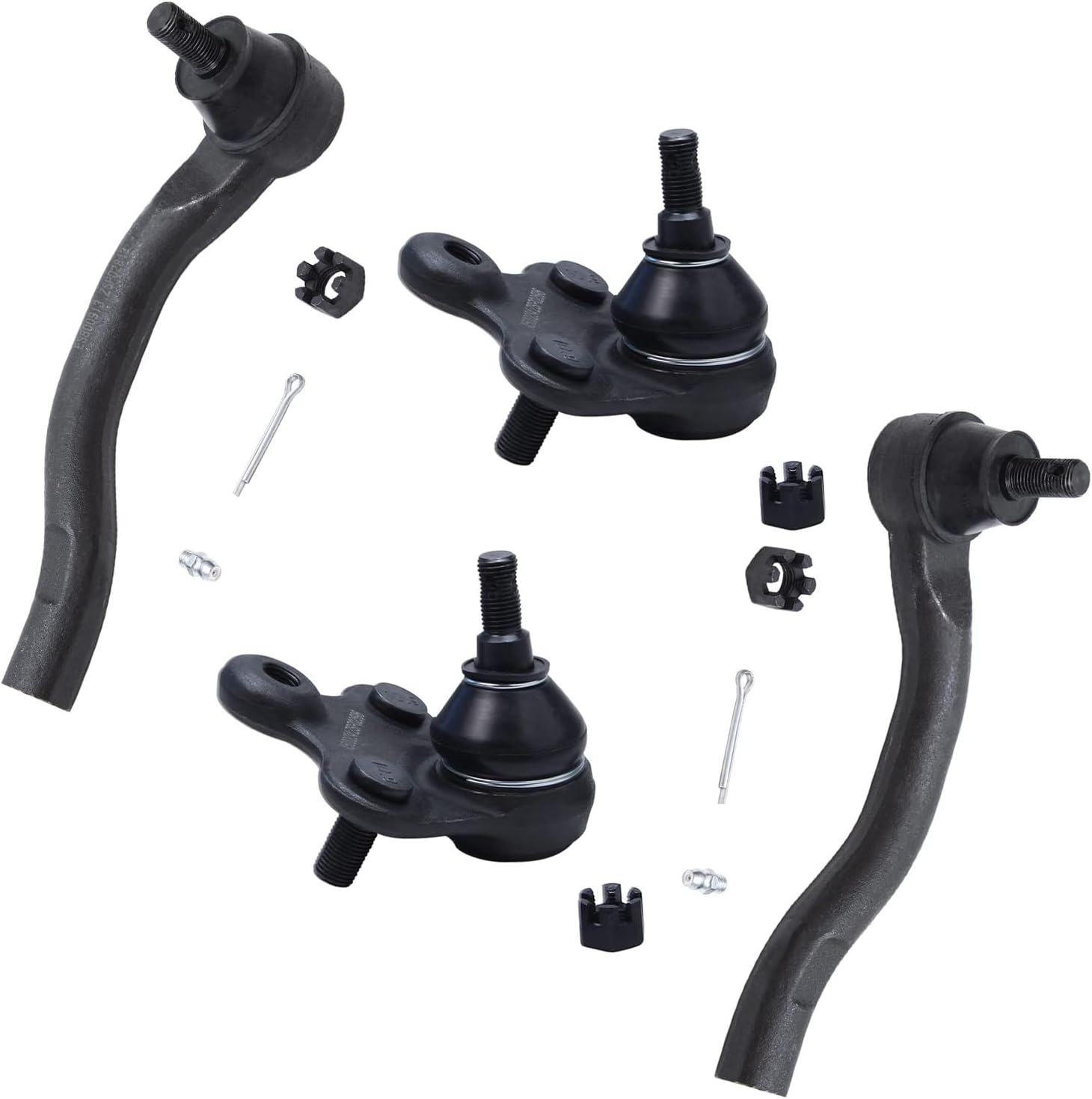
| Fitment | 2012–2015 Honda Civic; 2013–2015 Acura ILX |
|---|---|
| Kit contents | 2 front outer tie rods, 2 front lower ball joints |
| Manufacturer | Detroit Axle |
| Manufacturer Part Number | 4S2501051 |
| Date First Available | July 16, 2020 |
This Detroit Axle 4-piece kit replaces the front outer tie rods and lower ball joints on 2012–2015 Honda Civics and 2013–2015 Acura ILX models. It is intended as a direct replacement for worn steering and suspension joints and is typically used during front-end repairs to restore steering response and reduce play. The parts are designed to meet common aftermarket fitment standards and Detroit Axle states the components undergo impact, wear, and fatigue testing. In practice the kit simplifies a basic suspension refresh by supplying both tie rod ends and ball joints together so alignment and steering feel can be corrected in one job. The package includes factory-style hardware and the company backs the line with a long warranty, which gives conservative buyers extra reassurance. Expect typical aftermarket finish and fit that may require minor adjustment at installation and professional alignment afterward; this is a repair-focused kit rather than an upgrade for performance handling.
Best for: Buyers who prioritize a straightforward, factory-style front suspension replacement and want the reassurance of tested components and a long warranty for their 2012–2015 Civic or 2013–2015 ILX.
Less Ideal for: Shoppers seeking performance-oriented steering or heavy-duty upgraded suspension components should look at specialty parts designed for improved handling or load capacity.
- Complete 4-piece kit replaces both front outer tie rods and lower ball joints for a coordinated repair
- Designed for direct fitment to specified Civic and ILX model years to simplify installation
- Components undergo impact, wear, and fatigue testing per the brand description
- Packaged hardware and matched parts reduce time on the repair and make alignment easier
- Backed by a long manufacturer warranty for added buyer reassurance
- Aftermarket fit and finish can be slightly different from factory parts and may need minor adjustment during installation
- Not intended as a performance upgrade; aimed at restoring factory-level steering and suspension behavior
Verdict: A convenient, warranty-backed four-piece front suspension kit that restores steering feel and reduces play for 2012–2015 Civics and 2013–2015 ILX models.
Choosing the Right 2012-2015 Honda Civic Ball Joint: Key Factors to Consider
Fitment and Chassis Code Compatibility
Correct fitment to the 2012-2015 Civic FB and FG front suspension is the first priority. Ball joints vary by taper angle, stud diameter, and mounting method; a mismatch can lead to improper steering response or premature wear. Verify the joint matches the vehicle's front lower or upper control arm attachment points and the OEM-style hardware pattern.
Chassis-code compatibility matters because small dimensional differences between FB and FG subvariants affect press-in depth and boot clearance. Ensuring exact fit reduces the risk of additional repairs during installation and helps maintain factory suspension geometry.
Durability and Boot Design
Durability is driven largely by the quality of the ball stud, housing materials, and the dust boot. Look for joints with robust, multi-lip boots and good sealing to keep grease in and contaminants out. A torn or porous boot is the most common cause of accelerated joint failure.
Corrosion-resistant finishes and hardened studs help the joint resist wear from road salt, water, and grit. For drivers in harsh climates or with higher mileage, prioritize heavier-duty constructions that reduce the likelihood of midlife failure.
Load Capacity and Steering Feel
Ball joints carry steering and suspension loads, so their internal clearances and bearing surfaces influence steering feel and alignment stability. A ball joint with excessive internal play can produce sloppy steering and contribute to wheel vibration or uneven tire wear.
Choose a joint whose tolerance and bearing design maintain firm steering feedback without transmitting excessive road harshness. That balance preserves driving comfort while keeping handling predictable under braking and cornering.
Serviceability and Installation Requirements
Some ball joints press into control arms while others are bolt-in replacements or part of a ball joint kit. Consider whether you have access to a ball joint press tool or professional help, and whether the control arm must be removed for a safe installation.
Serviceable designs that allow boot replacement or repacking can extend service life. If you plan to replace joints yourself, prioritize units with clear instructions, included hardware, and compatibility with common garage tools to reduce labor time and the chance of installation errors.
Noise, Vibration, and Ride Comfort
Worn ball joints often create clunks, wind-up in the steering, or subtle wheel vibration. The joint's internal damping and fit influence how much road noise and harshness get transmitted into the cabin.
When selecting a replacement for the Civic, weigh options that reduce wheel vibration and damping-transmitted noise without stiffening the ride excessively. For daily-driven Civics, a balance that favors smooth operation and low NVH is usually preferable to ultra-stiff race-style joints.
Warranty, Availability of Parts, and Long-Term Support
Warranty length and the availability of replacement boots or hardware affect long-term ownership cost. Parts with clear support and readily available replacement components simplify future repairs if a boot fails or a stud shows corrosion.
Also consider whether the supplier documents installation procedures and provides torque specifications. Good after-sales documentation reduces the risk of incorrect installation and supports safer long-term outcomes for your Civic.
Signs Your Civic Needs a Ball Joint Replacement
Common symptoms include clunking noises when going over bumps, looseness in the steering wheel, or uneven tire wear at the front. Wheel vibration at highway speeds can also indicate a failing joint, though it can share causes with tires and alignment issues.
A simple push-test with the vehicle on jack stands or a professional inspection can reveal excessive play in the joint. Early detection prevents secondary wear to control arms and tie rods, which increases repair complexity and labor.
- Clunk or knock from the front suspension when driving over irregular surfaces
- Excessive free play or wandering in steering feel
- Inner or outer edge tire wear not explained by alignment
- Visible grease leakage or a torn dust boot
Upper Vs Front Lower Ball Joint: Which One Is It?
The 2012-2015 Civic uses both upper and front lower ball joints depending on the specific control arm and suspension layout. Upper joints sit higher in the knuckle assembly and often have different load patterns than front lower joints.
Diagnosing which joint is failing requires targeted inspection. Front lower joints typically carry more vertical load and may show symptoms under braking or when the vehicle is loaded, whereas upper joints can manifest as steering instability or clunking when turning.
- Front lower ball joint: often higher load, more likely to affect ride height and tire wear
- Upper ball joint: more directly affects steering precision and can create clunks during steering inputs
Tools and Prep for a DIY Ball Joint Replacement
A successful DIY job requires the right tools and safety practices. For press-fit joints you will usually need a ball joint press tool, appropriate sockets, torque wrench, and possibly a pickle fork to separate the joint from the steering knuckle. A service manual or reliable torque spec reference is important to tighten fasteners to factory values.
Plan to support the vehicle safely on jack stands, remove the wheel and, if necessary, the control arm or steering knuckle to access the joint. Clean mounting surfaces and inspect surrounding components such as bushings and tie rod ends while you have the assembly apart.
- Essential: ball joint press tool, torque wrench, jack stands
- Helpful: penetrating oil, replacement nuts/bolts, replacement boot if reusable
- Tip: document bolt locations and take photos to aid reassembly
Alignment and Post-Installation Checks
After replacing a ball joint on a 2012-2015 Civic, an alignment check is important because small differences in joint seating can shift toe or camber. Even when the new joint matches OEM specifications, final toe adjustments may be required to prevent premature tire wear.
Perform a road test to confirm the steering feel and listen for residual noises. Re-torque suspension fasteners after a short break-in period according to the vehicle's service manual to ensure nothing has loosened during initial driving.
- Get a professional alignment if tow or camber is visibly off after installation
- Re-check torque specs after 100 to 200 miles
- Inspect boots periodically for the first few hundred miles to ensure seals are intact
When to Consider a Ball Joint Kit or Control Arm Replacement
If the control arm is corroded, damaged, or the ball joint is non-serviceable, replacing the entire control arm or using a ball joint kit that includes mounting hardware can save time and ensure long-term reliability. A kit can also simplify installation for DIYers by including pre-pressed joints or matched hardware.
Assess the condition of surrounding suspension parts while replacing the joint. If bushings, sway bar links, or tie rods show wear, addressing them together reduces repeat labor and restores overall suspension performance more effectively than a single-part swap.
- Opt for a kit when the original joint is riveted or difficult to press out
- Replace corroded control arms rather than attempting to press new joints into weakened metal
- Coordinating related repairs saves time and ensures consistent suspension geometry
Still looking for the perfect fit?
Select your Honda Civic configuration to see the most relevant Ball Joints recommendations
How We Chose the Best 2012-2015 Honda Civic Ball Joint
We evaluated candidates for the 2012-2015 Honda Civic on criteria that reflect real-world ownership needs and common failure modes. Primary considerations were fitment accuracy to FB and FG front suspension mounting points and taper specifications, and material durability including grease-sealed boots and corrosion-resistant finishes. We also prioritized load-handling capability and compliance to factory steering geometry to avoid alignment drift after installation. Ease of installation was assessed by whether the joint is serviceable with common tools, compatibility with a ball joint press tool, and whether the part requires control arm replacement or comes as a ball joint kit.Additional filters included warranty terms, availability of replacement boots and hardware, and customer reports about long-term noise and looseness under normal driving. We excluded items that lacked clear fitment documentation for 2012-2015 Civic FB and FG chassis or that required substantial suspension modification to install. The final shortlist balances dependable performance, installation practicality, and build quality for everyday driving as well as occasional spirited use.
Our full evaluation process is outlined in our review methodology.
FAQ
How long do ball joints usually last on a 2012-2015 Civic?
Ball joint lifespan varies with driving conditions and maintenance. Under normal driving they often last many tens of thousands of miles, but exposure to road salt, potholes, or torn boots can shorten life significantly.
Can I replace a worn ball joint myself without a press tool?
It depends on whether the joint is press-fit or bolt-in. Some joints are serviceable with basic tools, but press-fit designs typically require a ball joint press tool for safe removal and installation to avoid damaging the control arm.
What symptoms distinguish a failing ball joint from a bad tie rod end?
Both can cause looseness and noise, but ball joints more commonly produce clunks under vertical load and can cause uneven tire wear. Tie rod issues typically present as play or wander in steering and more consistent noise during steering inputs.
Do I need an alignment after replacing a ball joint on my Civic?
You usually should check alignment after replacing a ball joint because seating differences can change toe and camber. A professional alignment ensures even tire wear and predictable steering.
Are there signs I can inspect visually without a lift?
Yes. With the wheel removed and the car safely supported, inspect the dust boot for tears, look for grease leakage around the joint, and check for rust on the stud. Excessive play often requires lifting the vehicle so you can manipulate the wheel to check movement.
Is it worth replacing just the ball joint if the control arm bushings are worn?
Often it is better to address both at once. Worn bushings change suspension geometry and load paths, which can accelerate wear on a new ball joint. Coordinating repairs reduces the chance of repeat labor.
Final Verdict
When replacing ball joints on a 2012-2015 Honda Civic (FB and FG), prioritize correct fitment and durable boot design to preserve steering precision and prevent repeat work. Decide between a direct press-fit replacement, a bolt-in kit, or full control arm replacement based on the condition of surrounding suspension components and your access to tools.Balance durability against installation complexity and plan an alignment after installation. Focusing on exact fitment, sealing quality, and serviceability will yield the most reliable outcome for everyday driving and help you avoid follow-up repairs.
Explore More:
- Check out all Honda Civic parts & accessories
- Explore Ball Joints Maintenance & Repair Guides
- Explore Suspension & Steering
- Browse all Auto Parts
