

Note: This article contains affiliate links. If you click on these links and make a purchase, I may earn a small commission at no extra cost to you. This helps support my research and content. Read my full affiliate disclosure here.
A turbocharged engine depends on a sealed intake path to build and hold boost properly. Even a small leak can cause weak acceleration, unstable idle, poor throttle response, and tuning headaches that waste time when you are trying to diagnose a drivability problem. That is why a turbo boost leak tester is one of the most useful diagnostic tools a DIY mechanic can keep in the garage.The right tester should fit securely, apply pressure in a controlled way, and make it easy to pinpoint leaks at couplers, clamps, intercooler piping, vacuum lines, and intake connections. In the picks that follow, you will see options designed to help you test with more confidence and less guesswork.
Top Picks at a Glance
| Best Overall Turbo Boost Leak Tester for DIY Mechanics A versatile, reliable tester offering balanced accuracy, durability, and usability | Turbo Boost Leak Tester 4" Billet Aluminum End Cap with Gauge and Adapters |  |
| Best Budget Turbo Boost Leak Tester for DIY Mechanics Affordable, functional tester delivering basic leak detection without extra features | KUNGJUER Charge Air Cooler (CAC) Boost Leak Tester Kit with 3", 3.5", 4" End Caps and 150 PSI Regulator |  |
| Best Premium Turbo Boost Leak Tester High-end tester with precise controls, refined build, and pro features | Duramax 6.6L Turbo Boost Leak Tester with 60 PSI Gauge and 150 PSI Regulator |  |
| Best Compact Turbo Boost Leak Tester Pocketable, lightweight design for easy storage and quick portability | Turbo Boost Leak Testers 2.5" Billet Aluminum Boost Leak Tester End Cap with 30 PSI Gauge |  |
| Best Complete Turbo Boost Leak Tester Kit Comprehensive kit including multiple adapters, hoses, and fittings | Yuesstloo Turbo System Leakage Tester Kit with 16 Stepped Adapters and Pressure Gauge |  |
| Best Heavy-Duty Turbo Boost Leak Tester Industrial-grade construction designed for frequent use and workshop environments | Turbo Boost Leak Testers Charge Air Cooler (CAC) Boost Leak Tester Kit with Regulator Line |  |
| Best High-Precision Turbo Boost Leak Tester Engineered for highly accurate, repeatable pressure readings and diagnostics | Orion Motor Tech Turbo Boost Leak Tester Kit with Stepped Adapters and 0-70 PSI Gauge |  |
Turbo Boost Leak Tester 4" Billet Aluminum End Cap with Gauge and Adapters
Best Overall Turbo Boost Leak Tester for DIY Mechanics

| Material Type | 3 layer Silicone adapter, 6061 Billet Aluminum end cap |
|---|---|
| Thread Style | 1/4"-18 NPT |
| Included Components | boost leak tester |
| Unit Count | 1.0 Count |
This kit is built to find and isolate boost leaks in turbocharged intake systems by sealing a 4 inch inlet and pressurizing the charge piping while the engine is off. It includes a 6061 billet aluminum end cap with anti-slip machining, multilayer silicone adapter pieces to fit stepped pipe diameters, stainless steel T-bolt clamps, and both a tire Schrader valve and 1/4" air fitting so you can connect shop air. A liquid-filled 30 PSI gauge and a regulator/valve in the extension make setting and holding test pressures straightforward for garage use. Practical benefits include a durable machined end cap that resists deformation, easy hookup to common compressors, and multiple adapter sizes that reduce the need for improvisation during testing. Limitations are the 30 PSI gauge rating when some users may want higher test pressure for heavy-duty systems and the kit focuses on 3"–4" pipe sizes so custom or unusual piping may need additional adapters.
Best for: Home mechanics and DIY tuners who need a reliable, easy-to-use kit for diagnosing turbo intake and intercooler leaks in common shop settings and want a durable, value-oriented tool that balances accuracy with straightforward setup and operation.
Less Ideal for: Professional shops or builders who need higher-pressure testing or a wider range of custom pipe diameters for heavy-duty or race applications.
- Machined 6061 billet aluminum end cap provides a secure, deformation-resistant seal.
- Includes multilayer silicone adapters and stepped sizes for 3" to 4" pipe fitment.
- Liquid-filled 30 PSI gauge and in-line regulator let you set and hold test pressure accurately.
- Comes with stainless steel T-bolt clamps and both tire and 1/4" compressor fittings for quick hookup.
- Gauge and kit are optimized for up to 30 PSI which may be low for some high-boost applications.
- Designed around 3"–4" pipe sizes so uncommon diameters require extra adapters.
Verdict: The all-around best turbo boost leak tester for DIY mechanics that balances accuracy, ease of use, durability, and value for common garage diagnostics.
KUNGJUER Charge Air Cooler (CAC) Boost Leak Tester Kit with 3", 3.5", 4" End Caps and 150 PSI Regulator
Best Budget Turbo Boost Leak Tester for DIY Mechanics

| Material Type | Aluminum, Stainless Steel |
|---|---|
| Thread Style | Npt, G1/4 |
| Included Components | Boost Gauges, Billet End Caps, Regulator, Hoses, Fittings |
| Applicable Vehicles | Class 7-8 Trucks, Tractors, Machinery |
This KUNGJUER CAC boost leak tester kit is built to pressurize and isolate charge air cooler hoses so you can find boost leaks quickly on heavy trucks and tractors. It installs between intercooler hoses using the included billet end caps in 3, 3.5, and 4 inch sizes and uses the 5 foot extension hose and integrated ball valve to introduce air while monitoring the system with shockproof gauges. A 150 psi regulator lets you step down source pressure to the safer test range and a pressure relief valve protects components during use. Construction from 6061 aluminum and stainless steel gives it a workshop-tough feel and the kit includes both US and EU fittings for compatibility. For DIY mechanics working on Class 7–8 equipment this puts a complete test setup in one case and simplifies routine diagnosis. The kit is focused on heavy-duty applications so it is bulkier than passenger-car tools and geared for larger hoses rather than small intercooler plumbing, which limits its usefulness for lighter vehicles.
Best for: Practical DIY mechanics and owner-operators who need an affordable, purpose-built boost leak tester to find intercooler and charge-air system leaks on heavy-duty trucks and machinery without paying for pro-level extras.
Less Ideal for: Light-duty owners, weekend car hobbyists, or anyone working primarily on small passenger vehicles should consider a compact tester tailored to smaller intercooler hoses and lower-pressure systems.
- Includes billet end caps in three common heavy-duty sizes (3", 3.5", 4") to fit large intercooler hoses
- 150 psi regulator and pressure relief valve for controlled, safer testing
- Durable 6061 aluminum and stainless steel construction suited to workshop use
- Comes with shockproof gauges, 5 ft extension hose, and both US and EU air fittings for immediate testing
- Designed for Class 7–8 trucks and industrial machinery and is oversized for most passenger cars
- Bulk and component set make it less convenient for technicians who need a lightweight, portable kit
Verdict: A low-cost turbo boost leak tester that gives DIY mechanics reliable leak detection and basic measurement capability without extra features or high price.
Duramax 6.6L Turbo Boost Leak Tester with 60 PSI Gauge and 150 PSI Regulator
Best Premium Turbo Boost Leak Tester

| Compatible Engines | Duramax 6.6L applications listed |
|---|---|
| Max Test Pressure | 60 PSI (gauge) |
| Regulator Pressure Rating | 150 PSI air regulator |
| Material Type | Aluminum, Stainless Steel |
| Thread Style | Sae J514 |
This kit lets a DIY mechanic pressurize the turbocharger charge system to locate leaks across the entire charge path, including hot and cold pipes, intercooler, Y-bridge and clamped connections. It installs at the turbo compressor discharge hose and uses an air compressor to supply pressure while the included 5 ft hose, ball valve, and 150 PSI regulator let you control test pressure without working directly over the engine. Notable hardware includes a machined billet aluminum end cap, a 60 PSI boost gauge with stainless housing, stainless ball shutoff valve, and a heavy-duty T-bolt clamp for secure connections. In practice the tool simplifies diagnosing P0299 codes, loss of boost, poor towing performance, and other symptoms of leaks so you can find and repair the problem faster. The kit is focused on Duramax 6.6L applications and is overbuilt compared with cheap adapters, but it requires an external air source and some familiarity with pressure testing and clamps to use safely. The regulator and quality fittings improve control and durability compared with basic test plugs.
Best for: Experienced DIY mechanics and professional technicians who demand a durable, precision-built boost leak tester for diagnosing and sealing turbocharge systems on Duramax diesel trucks, and who prioritize accurate pressure control and long-term reliability during frequent shop use.
Less Ideal for: Casual owners who rarely work on their truck or shops that need a universal tester for many different engine families should consider other, more general-purpose testers.
- Purpose-built for Duramax 6.6L charge systems so fitment and testing points match factory plumbing
- Solid construction with billet 6061-T6 aluminum end cap and stainless fittings for durability
- Integrated 60 PSI gauge and 150 PSI regulator give accurate, controllable pressure for safe testing
- Includes long hose and ball valve to let you test without leaning over the engine bay
- Requires an air compressor to generate test pressure
- Not a universal plug so limited to specified Duramax applications
Verdict: A higher-end tester with superior build quality, precise pressure control, and advanced features for users who want professional-level diagnostics.
Turbo Boost Leak Testers 2.5" Billet Aluminum Boost Leak Tester End Cap with 30 PSI Gauge
Best Compact Turbo Boost Leak Tester

| Material Type | 6061-T6 Billet Aluminum |
|---|---|
| Gauge Range | 30 PSI |
| Fits Hose ID | 2.5 inch |
| Includes | T-bolt clamp and Schrader valve |
This billet 2.5" end cap is designed to seal into a silicone or rubber intake hose so you can pressurize the charge system and locate boost leaks without running the engine. It includes a shock-proof 30 PSI stainless gauge and a tire Schrader valve so you can hook up shop air and watch how quickly the system holds or bleeds pressure. Typical use is pressurizing the intake after disconnecting intake plumbing to isolate leaks in hoses, intercoolers, or manifolds during tune or maintenance work. The 6061-T6 billet construction and T-bolt clamp make the cap durable and simple to install and remove, and the gauge gives a clear safety reference so you do not over-pressurize the system. Limitations are the 30 PSI gauge range which covers most street and moderate boost levels but is not suited for very high-boost race applications, and the tool requires an air source and basic familiarity with pressurizing engine systems safely. Follow safety guidance closely when using compressed air near engine components.
Best for: DIY mechanics and weekend tuners who need a compact, easy-to-store boost leak tester for quick routine checks and mobile troubleshooting where portability and straightforward setup matter more than workshop-only tooling.
Less Ideal for: High-performance builders who routinely test pressures above 30 PSI or shops that need multi-vehicle adapters and broader gauge ranges should consider more heavy-duty or higher-range testers.
- Durable 6061-T6 billet aluminum construction resists deformation under clamping and repeated use
- Integrated stainless 30 PSI gauge provides a visible, shock-resistant pressure readout for safe testing
- Includes tire Schrader valve and T-bolt clamp for quick hookup to shop air and secure sealing
- Compact 2.5" design fits inside silicone or rubber intake hoses for straightforward leak isolation
- Gauge is limited to 30 PSI so it does not support very high boost testing
- Requires an external air compressor and basic safety precautions when pressurizing the intake system
Verdict: A small, lightweight tester that prioritizes portability and easy storage while still providing dependable leak detection for routine checks.
Yuesstloo Turbo System Leakage Tester Kit with 16 Stepped Adapters and Pressure Gauge
Best Complete Turbo Boost Leak Tester Kit

| Pressure gauge range | 0-6 bar (0-87 psi) |
|---|---|
| Adapter count | 16 stepped adapters |
| Included pieces | 19 count |
| Material type | Metal, Plastic |
This Yuesstloo kit is built to pressure-test turbocharger intake and intercooler plumbing using shop compressed air and the included stepped adapters. You assemble the matching plug for the hose, connect the gauge with its shut-off valve and regulator, pressurize to the desired level and listen or use soapy water and the smoke adaptor to find leaks. Notable features include a 0–6 bar (0–87 psi) gauge with a locking dial and excess pressure release, 16 stepped adapters that cover a wide range of hose diameters, quick-connect fittings for the test line, and a smoke adaptor for visual leak location. In practical use the kit simplifies isolating leaks without removing the turbo or intercooler and the regulator plus shut-off valve helps avoid accidental over-pressurisation. Limitations are that you need a compatible workshop air supply and may have to verify adapter-seat fitment on unfamiliar hose profiles, and the kit does not include a dedicated carrying case or detailed vehicle-specific instructions.
Best for: Home mechanics and DIY turbo owners who want a one-stop kit to pressure-test turbos, intercoolers and cooling pipes without fabricating adapters, preferring a ready set of stepped plugs and a gauge for routine diagnostics and leak isolation.
Less Ideal for: Users without access to a reliable compressed air supply or those who prefer plug-and-play, vehicle-specific diagnostic tools with step-by-step guided procedures.
- Covers a broad range of hose diameters with 16 stepped adapters for versatile turbo and intercooler fitment.
- Integrated pressure gauge with regulator and shut-off valve allows controlled pressurization and readable measurements.
- Includes smoke adaptor and quick-connect fittings to help visually locate and isolate leaks.
- Pressure locking dial and excess pressure release improve safety during testing.
- Requires a shop compressed air source and basic familiarity with pressurised testing.
- Adapter plugs may need trial fitting on nonstandard hoses to get an airtight seal.
Verdict: A tester sold as a comprehensive kit with a wide range of adaptors, hoses, and fittings to cover many turbo and intake configurations out of the box.
Turbo Boost Leak Testers Charge Air Cooler (CAC) Boost Leak Tester Kit with Regulator Line
Best Heavy-Duty Turbo Boost Leak Tester
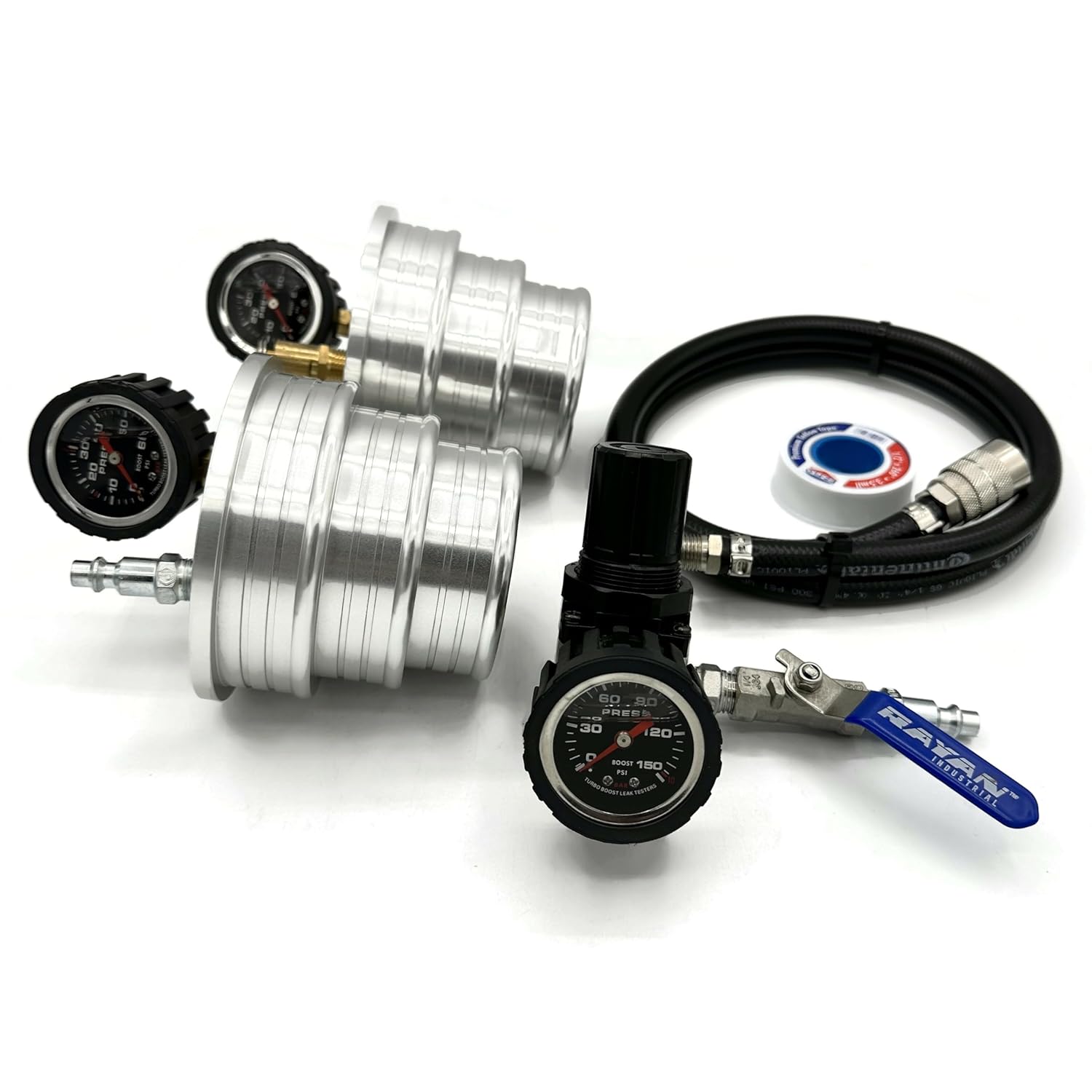
| Material Type | 6061 billet aluminum end caps; reinforced PVC hose; stainless-steel gauge housing |
|---|---|
| Thread Style | 1/4"-18 NPT connections |
| Included Components | End caps, 5 ft extension hose, regulator, gauges, shut-off valve |
| Set Name | CAC w/Regulator Line Kit |
This kit is built to pressurize and isolate a charge air cooler (CAC) so you can find leaks in intercooler hoses and end tanks without removing the core. It uses two CNC-machined 6061 billet aluminum end caps with stepped diameters (4, 3.5 and 3 inches) that seat into flexible intercooler hoses while the included 5 ft extension hose, shut-off valve, pressure gauges and 150 PSI regulator let you control and monitor test pressure up to a safe 60 PSI. In practice it is a shop-friendly tool for diagnosing boost leaks on heavy-duty Class 7 and 8 trucks, cutting diagnostic time and preventing driveability issues or fuel penalties. Notable features are the anti-slip grooves and bead for a positive seal, a built-in pressure relief for safety and stainless-steel gauge housings for durability. The main limitations are its focus on large-diameter heavy-duty applications and the need for an air source and basic fittings knowledge to use the kit correctly.
Best for: Hands-on DIY mechanics and small shop technicians who need a heavy-duty, workshop-grade boost leak tester for frequent use on Class 7–8 trucks and industrial charge air coolers, and who prioritize durable construction, precise pressure control, and serviceable components over lightweight or occasional-use tools.
Less Ideal for: Casual weekend car enthusiasts working on small gasoline engines or those without access to a compressor and basic pressure-testing experience should consider simpler, vehicle-specific testers instead.
- CNC-machined 6061 billet aluminum end caps provide durable, precise sealing surfaces
- Includes 150 PSI regulator, gauges and shut-off valve for controlled, repeatable tests
- Stepped sizes (4", 3.5", 3") cover common HD truck intercooler hose diameters
- Anti-slip grooves and a bead improve grip and reduce blow-off during pressurization
- Stainless-steel gauge housings and reinforced hose improve longevity in shop use
- Designed specifically for large charge air cooler hoses so it is not useful for small aftermarket or passenger car intakes
- Requires an external compressed air source and basic knowledge of pressure testing procedures
Verdict: A rugged, workshop-grade tester built from durable materials and robust components to withstand frequent use and harsher environments.
Orion Motor Tech Turbo Boost Leak Tester Kit with Stepped Adapters and 0-70 PSI Gauge
Best High-Precision Turbo Boost Leak Tester

| Manufacturer | Orion Motor Tech |
|---|---|
| Model | Turbo Test Kit |
| Number of Adapters | 12 |
| Adapter Size Range | 1.2 to 3.5 in. |
| Pressure Gauge Range | 0-70 psi |
This Orion Motor Tech kit is made for DIY mechanics who need to locate boost and intake system leaks without a trip to the shop. It provides stepped adapters that fit a wide range of hose diameters, a 0-70 psi gauge assembly that connects to shop air, blanking adapters for isolating sections, and a smoke adapter for visual leak detection when paired with a smoke source. In practice you attach the best-fit stepped adapter, pressurize the system from an airline, and listen or watch for pressure loss or smoke escape. The nylon and metal parts feel durable and the blow-molded case keeps the pieces organized for garage use. Limitations are the reliance on an external smoke generator if you want visible smoke and the gauge tops out at 70 psi which is more than enough for most boost tests but not suitable for higher-pressure systems. For hands-on troubleshooting this kit speeds up diagnosis and reduces guesswork.
Best for: Hands‑on DIY mechanics and home tuners who need repeatable, accurate pressure and vacuum readings for diagnosing turbo, intake, and charge‑pipe leaks and who value a complete, workshop‑style kit for consistent testing.
Less Ideal for: Professionals needing integrated smoke generation or testers rated for pressures well above typical turbo boost should consider higher-end shop units instead.
- Wide range of stepped adapters covers common hose diameters for turbo and intake systems
- Includes 0-70 psi pressure gauge assembly for direct, shop-air pressurization and leak detection
- Blanking adapters allow isolating sections of the system for targeted testing
- Durable nylon and metal components stored in a blow-molded case for garage organization
- Requires a separate smoke generator to use the smoke adapter for visible leak detection
- Gauge maximum of 70 psi may be insufficient for uncommon high-pressure applications
Verdict: A tester focused on the most accurate pressure and vacuum readings, ideal for DIYers who need exact measurement and repeatable diagnostic results.
How We Chose the Best Turbo Boost Leak Tester
We selected these turbo boost leak tester options based on the needs of DIY mechanics who want repeatable, safe diagnostics at home. The first filter was fit range, since a tester is only useful if it seals properly to common turbo inlet, charge pipe, or intercooler pipe sizes. We also looked closely at pressure control features, including how easily each setup can be connected to regulated shop air and whether it supports gradual pressurization instead of sudden spikes.Gauge readability and pressure accuracy were important because leak testing depends on seeing pressure drop clearly over time. Build quality also mattered, especially cap material, coupler durability, clamp security, and valve hardware that can tolerate repeated use. Ease of setup was another key factor, including how quickly a user can install the tester, adapt it to different pipe diameters, and start checking for leaks without extra fabrication.We excluded options that appeared poorly sealed, lacked dependable hardware, used fragile fittings, or seemed too limited in sizing to be practical for most garage users. For this category, the details that mattered most were sealing consistency, pressure stability, compatibility, and safe, straightforward operation.
Our full evaluation process is outlined in our review methodology.
Why a Boost Leak Test Matters
A boost leak test helps you verify that the pressurized side of the intake system can actually hold air the way it should. When there is a leak anywhere between the turbo and the engine, the system may struggle to build target boost, and symptoms can show up as hesitation, lost power, rich or lean corrections, compressor overspeed, or inconsistent tuning results. A proper test gives you a controlled way to isolate the problem instead of replacing parts blindly.
For DIY troubleshooting, this matters because many common issues can mimic one another. A split coupler, loose clamp, leaking diverter valve connection, cracked vacuum line, or pinhole in intercooler piping can all create similar complaints. Using a dedicated tester lets you confirm whether the issue is truly a leak before chasing sensors, ignition parts, or calibration changes.
- Useful for diagnosing low boost, unstable idle, and poor throttle response
- Helps reveal leaks at couplers, clamps, intercooler end tanks, vacuum ports, and intake seals
- Can save time by narrowing faults before deeper mechanical work
Key Features to Look For in a Turbo Boost Leak Tester
The most important buying factor is fit. You need a tester that matches the diameter and connection style of the pipe or inlet you plan to pressurize. A poor fit creates false results because the tester itself becomes the leak point. Measure your piping carefully before buying, and consider whether you need one fixed size or a kit that covers multiple diameters.
Pressure control is just as important as fit. A good setup should work with regulated air so you can raise pressure slowly and stay within a safe testing range for your engine and plumbing. Clear pressure readings matter too, because watching whether the system holds steady, drops quickly, or bleeds down slowly tells you a lot about the type and severity of the leak.
Durability also deserves attention. Repeated testing puts stress on clamps, fittings, gauges, and couplers. If the hardware deforms easily or the seals do not stay tight, your results become unreliable. DIY users usually benefit most from testers that balance simple setup with enough adaptability to handle future projects.
- Correct diameter and secure sealing surface
- Compatible with regulated compressed air
- Readable gauge or easy pressure monitoring
- Strong clamps and durable coupler materials
- Simple installation and removal
Choosing the Right Size and Connection Style
Before choosing a turbo boost leak tester, decide where you want to pressurize the system. Some DIY mechanics prefer testing from the turbo inlet side, while others pressurize from a charge pipe or intercooler connection. The best location depends on the engine layout and the area you want to inspect. Testing farther upstream may cover more of the system, but it can also require blocking off additional openings such as crankcase ventilation paths or other bypass routes.
Pipe diameter matters because even a small mismatch can prevent an airtight seal. If your setup includes stepped tubing, aftermarket intercooler piping, or custom couplers, check the exact outer or inner diameter at the intended test point instead of relying on a rough estimate. If you work on more than one vehicle, a multi-size kit can be more practical than a single fixed cap.
Connection style also affects convenience. Some testers are better suited to straight pipe ends, while others handle beaded pipes or coupler-mounted setups more securely. Think about how often you will test and whether quick setup or broader compatibility matters more for your garage routine.
- Measure the actual test point, not a nearby pipe section
- Consider whether you need one size or a kit for multiple vehicles
- Choose a connection style that seals well on your specific piping layout
How to Perform a Safe and Accurate Leak Test
Start with the engine off and cool enough to work around comfortably. Install the tester securely, connect regulated air, and begin with low pressure rather than jumping straight to a high number. The goal is controlled diagnosis, not stress testing every hose and fitting in the system. As pressure builds, listen for hissing and inspect common leak points with a spray bottle of soapy water if needed.
Keep in mind that some air loss can occur through engine-related paths depending on where the valves stop and how the system is configured. That is why consistency matters more than chasing a perfect number without context. If pressure falls rapidly, isolate sections of the system step by step until the leak source becomes clear. Slow, methodical testing is usually more revealing than simply adding more air.
For garage users, the safest approach is to stay within a sensible pressure range for the setup and use a regulator you trust. Overpressurizing can unseat couplers, stress old hoses, or create misleading failures that were not part of the original complaint.
- Use regulated air and increase pressure gradually
- Listen for leaks and use soapy water to confirm suspicious areas
- Test methodically instead of relying on maximum pressure
- Recheck clamps and caps if the tester itself may be leaking
Common Leak Points DIY Mechanics Should Check First
Most boost leaks show up in a handful of predictable places. Couplers and clamps are at the top of the list, especially after recent maintenance or modifications. Intercooler piping joints can loosen over time, and rubber or silicone connections may split underneath where damage is hard to see. The throttle body area, vacuum reference lines, bypass or diverter valve connections, and intake manifold fittings are also worth close inspection.
On older setups, heat cycles often harden seals and hoses until they no longer hold pressure reliably. Plastic end tanks, small vacuum nipples, and capped ports can also become trouble spots. If the system seems to leak everywhere, begin with the largest visible connection points and then move toward smaller lines and fittings. A structured approach usually finds the real issue faster than checking random components.
- Charge pipe couplers and clamp joints
- Intercooler end tanks and pipe connections
- Diverter or bypass valve hoses and fittings
- Vacuum lines, capped ports, and manifold connections
- Throttle body and intake sealing points
When a Basic Tester Is Enough and When You Need More Flexibility
A simple turbo boost leak tester can be enough if you work on one vehicle with a known pipe size and a mostly stock intake layout. In that situation, a straightforward cap-style design may do the job well without adding complexity. If your testing needs are occasional and you only want a quick way to verify leaks after repairs, simplicity can be an advantage.
A more adaptable setup makes sense if you maintain multiple turbo vehicles, switch between stock and aftermarket piping, or troubleshoot often. Interchangeable sizes, stronger hardware, and easier pressure monitoring become more valuable when the tool needs to serve different combinations over time. The right choice depends less on having the most features and more on whether the tester matches the variety of jobs you actually do.
- Basic designs suit one vehicle and occasional use
- Multi-size options help if you work on several setups
- Extra flexibility is useful for modified piping and repeat diagnostics
FAQ
What pressure should I use for a boost leak test?
Use a regulated pressure level that makes sense for your setup and start lower than you think you need. The goal is to find leaks safely, not to push the system to its limit. Many DIY mechanics begin with modest pressure and increase gradually only if the system remains stable and the test requires it.
Can I do a boost leak test without removing many parts?
Usually yes, but the exact amount of disassembly depends on where you choose to connect the tester. Some vehicles give easy access to a charge pipe or turbo inlet, while others may require removing an intake tube or loosening a coupler. The easier the access point, the more likely you are to test regularly.
Why does the system lose pressure even when I cannot hear a leak?
A small pressure drop does not always mean the tester failed. Some engine configurations allow air to move past certain paths depending on valve position and system design. If the drop is fast, check the tester seal first, then isolate sections of the intake tract and inspect with soapy water for smaller leaks.
Is a larger kit better than a single-size tester?
It depends on how many vehicles or pipe sizes you need to cover. A single-size tester is often enough for one car with a known setup and can be simpler to use. A larger kit becomes more useful if you maintain several turbo vehicles or frequently change piping components.
Can a boost leak tester help diagnose poor idle and drivability issues?
Yes, especially if those issues are tied to unmetered air or leaks in the pressurized intake path. While not every idle problem comes from a boost leak, this test can quickly rule in or rule out one of the most common causes on turbocharged engines. It is a useful first diagnostic step before moving to more complex troubleshooting.
Do I need a gauge on the tester itself?
An integrated gauge can make testing more convenient because you can monitor pressure at the tool. It is not absolutely required if you already have a reliable way to regulate and read pressure elsewhere in the setup. What matters most is being able to apply pressure gradually and observe whether the system holds it consistently.
Final Verdict
Choosing the right turbo boost leak tester comes down to three basics: accurate fit, safe pressure control, and dependable sealing. If the tester matches your piping and lets you apply air gradually, you will get more useful results and spend less time second-guessing your diagnosis.For most DIY mechanics, the best choice is the one that fits the intended test point securely, reads pressure clearly, and is simple enough to use whenever a turbocharged vehicle starts showing symptoms. Focus on compatibility and repeatable testing first, and you will be able to track down leaks with much more confidence.
