

Note: This article contains affiliate links. If you click on these links and make a purchase, I may earn a small commission at no extra cost to you. This helps support my research and content. Read my full affiliate disclosure here.
A good multimeter is one of the most useful diagnostic tools you can keep in the garage. Whether you are tracking down a parasitic draw, checking battery voltage, testing fuses, or confirming continuity in a wiring repair, the right meter helps you work faster and with more confidence.For DIY mechanics, the challenge is choosing a multimeter that fits automotive tasks without paying for functions you will never use. Accuracy, ease of use, safety, durability, and the right test ranges all matter. The picks that follow are aimed at common garage needs, from basic troubleshooting to more detailed electrical diagnosis.
Top Picks at a Glance
| Best Overall Multimeter for DIY Mechanics Reliable, accurate all-purpose multimeter for common garage electrical tasks | Fluke 117 Electrician's True RMS Digital Multimeter |  |
| Best Budget Multimeter for DIY Mechanics Basic, dependable measurements without frills for budget-conscious DIYers | AstroAI AM33D Digital Multimeter (2000 Counts) |  |
| Best Compact Multimeter Pocket-sized unit offering essential functions for quick, tight-space checks | Fluke 106 Palm-Sized Digital Multimeter, CAT III 600V |  |
| Best True RMS Multimeter Accurate AC readings on complex waveforms for modern electronics troubleshooting | Klein Tools MM420 Auto-Ranging TRMS Digital Multimeter |  |
| Best Automotive-Specific Multimeter Features and ranges optimized for vehicle electrical testing and diagnostics | Fluke 88V Deluxe Automotive Multimeter |  |
| Best Heavy-Duty Multimeter Built to withstand shop conditions with enhanced durability and safety | Fluke 87V Industrial True RMS Multimeter with TL75 Leads and Temperature Probe |  |
| Best Premium Multimeter Professional-grade accuracy and advanced measurement capabilities for demanding users | Fluke 87V MAX True-RMS Digital Multimeter |  |
Fluke 117 Electrician's True RMS Digital Multimeter
Best Overall Multimeter for DIY Mechanics

| Maximum Operating Voltage | 600 Volts |
|---|---|
| Measurement Type | Multimeter |
| Power Source | Battery Powered |
| Upper Temperature Rating | 50 Degrees Celsius |
The Fluke 117 is a compact true-RMS multimeter built for routine electrical troubleshooting and diagnostics. It combines a non-contact voltage detector with AutoVolt automatic AC/DC selection and a low input impedance mode to reduce false readings from ghost voltage, so you can check outlets, switches, and lighting circuits quickly and confidently. The meter measures resistance, continuity, frequency, capacitance and provides Min/Max/Average logging for capturing transients. A bright white backlight and long battery life make it practical for dim basements or intermittent field work. Its commercial-grade design and IEC compliance mean it holds up to regular shop use, but it does not include advanced lab features like high-resolution logging, PC connectivity, or specialized automotive adapters. For DIY mechanics who need a reliable, easy-to-use meter for electrical checks on vehicles and workshop circuits, the Fluke 117 focuses on accuracy and speed rather than lab-level data capture.
Best for: DIY mechanics and home garage enthusiasts who need a reliable, easy-to-use multimeter that delivers accurate true-RMS readings, built-in non-contact voltage detection, and practical safety features for routine automotive and electrical troubleshooting.
Less Ideal for: Users who need extensive data logging, advanced bench diagnostics, or specialized automotive sensors should consider meters with PC interfaces or dedicated automotive functions.
- Integrated non-contact voltage detection speeds up safety checks without probe contact
- AutoVolt automatic AC/DC selection simplifies use across different circuits
- Low input impedance mode prevents false readings from ghost voltage
- True RMS measurements provide accurate readings on non-linear loads
- Bright white backlight and long battery life support work in low-light or intermittent conditions
- No PC connectivity or advanced data logging for long-term analysis
- Lacks some specialized automotive features like dedicated temperature or inrush modules
Verdict: The best all-around multimeter that balances accuracy, safety features, ease of use, and durability for most DIY automotive and garage electrical tasks.
AstroAI AM33D Digital Multimeter (2000 Counts)
Best Budget Multimeter for DIY Mechanics

| Measurement Type | Multimeter |
|---|---|
| Maximum Operating Voltage | 500 Volts |
| Digital Display | 2000 Counts |
| Power | 2 x 1.5 V AAA Batteries |
| Fuse Protection | mA: F250 mA/250 V; 10 A: F10 A/250 V |
The AstroAI AM33D is an entry-level handheld multimeter intended for routine DIY and automotive checks. It measures DC and AC voltage, DC current, resistance, continuity and diode, and displays readings on a backlit 2000-count LCD. Typical use cases are testing household outlets, batteries, fuses and basic automotive circuits where you need quick diagnostics rather than laboratory accuracy. The unit includes dual fuses for overload protection and a silicone protective cover to reduce impact and shock risk. Its manual range selection and simple rotary dial keep the tool straightforward, while data hold and auto-shutoff add convenience for one-person testing. Limitations include a 2000-count display with modest sampling speed and no low-voltage AC capability below 100 mV, so it is not suited for precision electronics or advanced measurements; the manual ranges also mean more fiddling compared with auto-ranging meters. For a budget tool that covers common garage and home tasks, the AM33D provides solid functionality and built-in safety features at a basic performance level.
Best for: Hands-on DIYers and budget-conscious home mechanics who need a reliable basic multimeter for routine car and household electrical checks, like testing battery voltage, continuity, and resistance, without paying for advanced lab features.
Less Ideal for: Electronics hobbyists, professional technicians, or anyone needing high-resolution, auto-ranging, or low-voltage AC measurements should consider a higher-end meter with more accuracy and features.
- Covers common measurements for DIY and automotive checks: AC/DC voltage, DC current, resistance, continuity and diode
- Dual fuse protection and silicone cover reduce risk of damage from overloads and drops
- Backlit 2000-count LCD and data hold make readings easier in dim or awkward spaces
- Includes test leads and battery so it is ready to use out of the box
- Manual range selection and a 2000-count display limit speed and resolution compared with auto-ranging higher-count meters
- Cannot measure AC voltages below 100 mV and has modest sampling speed, so it is not suited for precision electronics
Verdict: The best low-cost multimeter that still provides reliable basic voltage, continuity, and resistance measurements suitable for common car and home electrical troubleshooting.
Fluke 106 Palm-Sized Digital Multimeter, CAT III 600V
Best Compact Multimeter
| Maximum Operating Voltage | 600 Volts |
|---|---|
| Measurement Type | 0.001 A, 0.01 A |
| Power Source | Battery Powered |
| Specification Met | Iec 61326-1: Portable |
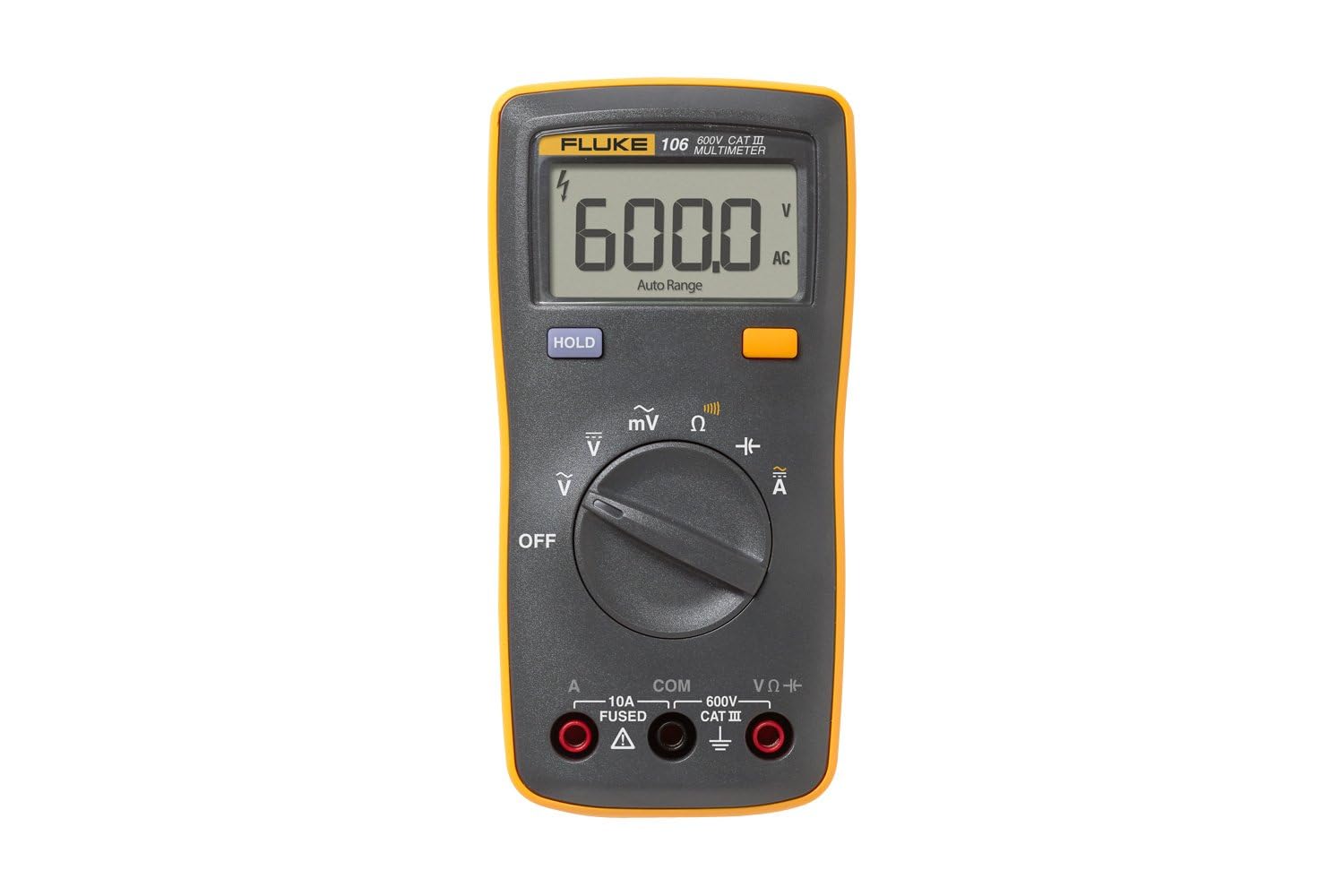
The Fluke 106 is a palm-sized digital multimeter built for quick, on-the-go electrical checks. It measures AC and DC voltage to 600V, AC/DC current to 10A, resistance, continuity, capacitance and frequency, and includes a data-hold function and TL75 test leads for everyday troubleshooting. Its slim, lightweight design and included smart strap make it convenient to carry in a pocket or hang while you work, so it is well suited to fast diagnostics in garages and home workshops. The CAT III 600V rating and Fluke’s reputation for ruggedness mean it is safe for most automotive and small electrical systems. The primary limitations are its compact control layout, which can be less comfortable for extended bench use, and a basic feature set compared with larger true-RMS or advanced diagnostic meters. For routine voltage, continuity and current checks on vehicles, the 106 delivers reliable, easy-to-use performance without extra bulk.
Best for: DIY mechanics who need a pocketable, easy-to-use meter for quick voltage, continuity, and basic current checks in tight engine bays or on-the-go troubleshooting and who prioritize portability and reliable, straightforward readings over advanced lab features.
Less Ideal for: Users who need advanced diagnostic features, extensive lab-style measurements, or frequent long-duration bench use should consider larger, feature-rich meters instead.
- Pocket-friendly slim design that is easy to carry and hang using the smart strap
- Measures AC/DC voltage to 600V and AC/DC current up to 10A for common automotive checks
- CAT III 600V safety rating for reliable protection when working on electrical systems
- Includes TL75 hard-point test leads and data-hold for practical field use
- Compact control layout can be fiddly for extended bench work or detailed measurements
- Not a full-featured advanced meter; lacks some higher-end true-RMS or diagnostic functions
Verdict: A small, pocketable multimeter that prioritizes portability and simple essential functions for quick checks and tight workspace use.
Klein Tools MM420 Auto-Ranging TRMS Digital Multimeter
Best True RMS Multimeter

| Maximum Voltage | 600V AC/DC |
|---|---|
| Maximum Current | 10A AC/DC |
| Resistance Range | 50 MOhms |
| Safety Rating | Cat III 600V |
| Power Source | Battery Powered |
The Klein Tools MM420 is a handheld, auto-ranging TRMS multimeter built for field use and routine diagnostic work. It measures AC/DC voltage to 600V, AC/DC current to 10A, resistance up to 50 MΩ and also provides temperature, capacitance, frequency, duty cycle, diode and continuity tests. Practical features like lead-placement LEDs, a backlit LCD, rear test lead holders, a kickstand and optional magnetic hanger make one-handed and hands-free work easier when you are under a dash or in a tight engine bay. The meter includes test leads, a thermocouple and batteries so it is ready to use out of the box, and it is rated to survive a 2 m drop for on-the-job durability. Limitations to note are the 10A current range which is fine for most automotive checks but not for high-current draws, and its compact size can make the display and buttons slightly cramped for users who prefer larger controls. For DIY mechanics who need reliable, accurate TRMS readings in a durable package, the MM420 covers the essentials without extra complexity.
Best for: DIY mechanics who need reliable, true-RMS AC measurements for troubleshooting modern vehicle electronics and who prioritize accurate readings on non-sinusoidal signals while working on electrical diagnostics and component testing.
Less Ideal for: Professional shops or users who frequently measure very high currents or who prefer larger, feature-dense benchtop meters for advanced bench diagnostics.
- True RMS auto-ranging for accurate readings on non-sinusoidal signals
- Comprehensive functions including voltage, current, resistance, temperature, capacitance and frequency
- Lead-placement LEDs and backlit display improve safety and visibility in tight or low-light spaces
- Rugged design rated to survive a 2 m drop and convenient hands-free mounting options
- 10A current range may be insufficient for measuring higher automotive currents
- Compact form factor yields a smaller display and tighter button layout that some users may find fiddly
Verdict: A multimeter with true RMS capability for accurate AC measurements on non-sinusoidal signals commonly encountered in modern vehicle electronics.
Fluke 88V Deluxe Automotive Multimeter
Best Automotive-Specific Multimeter

| Measurement Type | Multimeter |
|---|---|
| Power Source | Battery Powered |
| Minimum Operating Voltage | 3 Volts |
| Upper Temperature Rating | 1090 Degrees Celsius |
The Fluke 88V is a professional-grade automotive multimeter built to diagnose electrical problems on both conventional and hybrid vehicles. It measures AC/DC voltage, resistance, continuity, frequency, duty cycle and pulse width and includes min/max/average logging and an autohold for capturing transient readings. The large, two-level backlit display and analog bargraph make it easy to follow changing signals while working under the hood. It can measure up to 1000 V and take current readings up to 10 A continuously or 20 A for short bursts, and supports high-capacitance and high-frequency checks important for modern vehicle systems. Safety ratings and a rugged design mean it tolerates workshop conditions and voltage spikes. On the downside it is a professional tool with a higher price and learning curve compared with basic DMMs, and some advanced functions require optional probes or accessories. For hands-on DIY mechanics who want a durable, accurate instrument for complex automotive diagnostics the 88V delivers the capabilities and reliability expected in a shop environment.
Best for: DIY mechanics and home garage technicians who need a rugged, automotive-focused multimeter with vehicle-specific functions like pulse width, duty cycle, and RPM/Hz support for diagnosing both conventional and hybrid cars.
Less Ideal for: Casual users who only need occasional basic voltage or continuity checks and want a lower-cost, simpler meter.
- Automotive-specific functions including pulse width and duty-cycle measurements for fuel injectors and waveform checking
- Min/Max/Avg logging and autohold to capture intermittent or transient faults
- High safety ratings and rugged construction suited to workshop environments
- Large backlit display and analog bargraph for clear, real-time signal monitoring
- Higher cost and steeper learning curve than basic multimeters
- Some optional measurements such as RPM or temperature require add-on probes
Verdict: A multimeter tailored for vehicle diagnostics with auto-ranging, RPM/Hz features, and automotive-friendly test functions designed for car electrical systems.
Fluke 87V Industrial True RMS Multimeter with TL75 Leads and Temperature Probe
Best Heavy-Duty Multimeter

| Measurement Type | Multimeter |
|---|---|
| Maximum Operating Voltage | 1000 Volts |
| Power Source | Alkaline |
| Upper Temperature Rating | 752 Degrees Fahrenheit |
The Fluke 87V is a professional-grade True RMS digital multimeter built to handle demanding troubleshooting on motor drives, power distribution, and vehicular electrical systems. It measures up to 1000 V AC/DC, captures fast transients with peak capture down to 250 microseconds, and uses a low-pass filter to get accurate readings on variable-frequency drives. The large digit display with two-level backlight, analog bar graph, and touch-hold make it practical for one-person diagnostics in dim or noisy garages. Safety-rated inputs, audible input alert, and high-voltage spike protection increase confidence when working around high-energy circuits. Included TL75 test leads, alligator clips, and a temperature probe make it useful out of the box for common auto and shop tasks. The meter is built for durability and ease of service with a fast-access battery door and removable holster that can double as a probe holder. The main compromises are its professional feature set and price, which exceed what casual hobbyists need, and the size and weight that reflect its heavy-duty construction rather than pocket portability.
Best for: Mechanically minded DIYers and small-shop technicians who need a tough, professional-grade multimeter built for frequent use in garage and workshop environments, with a focus on safety, durability, and reliable troubleshooting under demanding conditions.
Less Ideal for: Casual hobbyists who only need occasional basic voltage or continuity checks and prefer a lighter, lower-cost meter.
- True RMS measurements and low-pass filter for accurate readings on VFDs and noisy signals
- Peak capture to record fast transients down to 250 microseconds
- Robust safety ratings and spike protection for working on high-voltage systems
- Large backlit display, analog bar graph, and touch-hold for easier field use
- Includes test leads, alligator clips, holster, and temperature probe for immediate diagnostics
- Higher cost and heavier construction than entry-level meters, making it overkill for casual users
Verdict: A rugged, professionally built multimeter with robust housing, higher safety ratings, and durable probes to withstand frequent garage and shop use.
Fluke 87V MAX True-RMS Digital Multimeter
Best Premium Multimeter

| Measurement Type | Multimeter |
|---|---|
| Power Source | Alkaline |
| Upper Temperature Rating | 55 Degrees Celsius |
| Included Components | Test Leads, Alligator Clips, Temperature Probe, Holster |
The Fluke 87V MAX is a professional-grade True-RMS multimeter built for harsh environments; it is waterproof, dustproof, and drop-tested for dependable field use. Technicians and DIY mechanics will use it for diagnosing automotive electrical systems, checking AC/DC voltages and currents, and measuring temperature with the included probe. Notable features include an IP67 rating, enhanced test leads, high safety ratings for industrial work, and a long battery life that reduces downtime on the job. In practice the meter reads cleanly on noisy circuits and its rugged housing and holster protect it when working around engines or ladders. The included accessories such as alligator clips and a temperature probe make it practical straight out of the box. The main limitations are its professional focus and size, which may feel bulky for casual hobbyists, and the higher-end price compared with basic handheld meters.
Best for: DIY mechanics who demand professional-grade accuracy and durable construction for troubleshooting and repairs, and who prioritize reliable, long-lasting tools that handle harsh jobsite conditions and advanced measurements.
Less Ideal for: Casual users who only need occasional voltage or battery checks and want a compact, low-cost meter for simple tasks.
- IP67 waterproof and dustproof rating for reliable use in wet or dirty work environments
- True-RMS measurement for accurate readings on non-sinusoidal and noisy signals
- High safety ratings (CAT III 1000 V, CAT IV 600 V) suitable for automotive and industrial tasks
- Includes temperature probe, test leads, and alligator clips so it is ready for common diagnostics
- Larger, heavier form factor that can be cumbersome for occasional or pocket carry
- Premium price compared with basic consumer multimeters
Verdict: A higher-end multimeter offering top-tier accuracy, advanced features, broader measurement ranges, and superior build quality for mechanics who want professional-grade performance.
How We Chose the Best Multimeter
We selected these multimeters based on the kinds of electrical checks DIY mechanics actually perform on cars, trucks, motorcycles, and small engines. Our focus was not lab style testing. It was real garage use, where a meter needs to be easy to read, simple to operate, and dependable around vehicle electrical systems.The main criteria included DC voltage accuracy for battery and charging system checks, resistance and continuity performance for wiring diagnosis, current measurement options for draw testing, fuse protection and safety rating, and overall durability for shop use. We also looked closely at backlit displays, probe quality, auto ranging versus manual ranging, and whether the meter offered useful automotive functions such as duty cycle, temperature, or RPM support where relevant.We excluded meters with confusing controls, weak safety protection, poor readability, overly fragile construction, or features that sounded impressive but added little value for typical automotive troubleshooting. The goal was to highlight tools that make common electrical diagnosis more practical and less frustrating for hands on mechanics.
Our full evaluation process is outlined in our review methodology.
What DIY Mechanics Need From a Multimeter
Automotive electrical work places different demands on a meter than household projects. In the garage, you are usually checking 12 volt and sometimes 24 volt systems, tracing wiring faults, testing switches and relays, and verifying whether charging and starting components are operating within a healthy range. That means the most useful multimeter is not always the one with the longest feature list. It is the one that gives stable readings, is easy to use around an engine bay, and has the functions that match the jobs you actually do.
For most DIY mechanics, the essentials include reliable DC voltage testing, resistance measurement, continuity with an audible alert, and enough build quality to survive regular use. If you plan to do deeper diagnostics, current measurement, duty cycle, capacitance, or temperature can also be helpful.
- Stable DC voltage readings for batteries, alternators, and sensors
- Clear continuity testing for wiring, grounds, and fuse checks
- Useful resistance ranges for switches, coils, and circuits
- A readable screen and solid probes for cramped engine bay work
Key Features That Matter Most
Accuracy is important, but usability matters just as much. A meter with a bright display, sensible dial layout, and quick response is often more valuable in the garage than one packed with advanced modes you rarely touch. Auto ranging can make routine testing faster, while manual ranging can be useful if you prefer more control over readings.
Probe quality is another major factor. Stiff, flimsy leads can make testing frustrating, especially when you are trying to hold a connection on a battery terminal or fuse slot with one hand. Good probe tips, flexible leads, and secure input jacks improve both convenience and safety. If you work in dim conditions, a backlight and built in work light can also make a real difference.
- Auto ranging for speed and convenience
- Backlit display for low light testing
- Flexible leads and sharp probe tips
- Fast continuity response
- Protective holster or durable outer shell
Safety Ratings and Fuse Protection Explained
Even if most automotive testing happens at relatively low voltage, safety still matters. A well designed multimeter should have proper internal protection, quality input jacks, and fused current ranges. This becomes especially important when measuring amperage or moving between different test modes, where mistakes can damage the meter or create a hazard.
Look for clear safety labeling and a category rating that reflects competent electrical design. For automotive users, strong fuse protection and overload protection are often more practical concerns than chasing high end specifications meant for industrial work. Just as important, choose a meter with a layout that reduces user error. A confusing meter can be more dangerous than a simpler one with fewer functions.
- Fused current inputs help protect the meter during amp testing
- Overload protection reduces damage from incorrect settings
- Clear jack labeling lowers the chance of setup mistakes
- A rugged case adds protection during normal garage use
Auto Ranging Vs Manual Ranging for Car Work
Auto ranging is usually the easier choice for DIY mechanics. It automatically selects the appropriate range, which speeds up common checks like battery voltage, continuity, and basic resistance testing. If you are newer to electrical diagnosis, it can help reduce setup errors and make the meter more approachable.
Manual ranging still has value. Some users prefer it when they want more control over how a reading settles, especially during sensor checks or when comparing small changes. It can also be useful on simpler meters where the interface is straightforward and predictable. In practice, either type can work well for automotive use if the meter is responsive and easy to read.
- Choose auto ranging for quick everyday checks
- Choose manual ranging if you want direct control over ranges
- Response speed and display clarity matter more than the ranging style alone
Functions Worth Paying For and Ones You Can Skip
Not every extra function is equally useful in a home garage. Features that commonly earn their keep include continuity, min max recording, current measurement, and temperature if you work on cooling systems, HVAC diagnostics, or engine checks. Duty cycle can help with certain sensors and control circuits, while capacitance may be useful for occasional component testing.
On the other hand, some advanced functions look impressive on paper but offer little value for routine mechanical work. If you mostly test batteries, fuses, grounds, and basic wiring, you do not need to pay extra just for a long list of modes. Prioritize core performance, safety, and durability first, then add specialty features only if they match the kind of diagnostics you actually perform.
- Worthwhile for many users: continuity, DC voltage, resistance, amperage
- Useful for some diagnostics: duty cycle, temperature, capacitance
- Often less important: niche functions that do not support common automotive tasks
How to Match a Multimeter to Your Garage Tasks
If your work is mostly basic maintenance, such as checking battery health, blown fuses, trailer wiring, and simple continuity, a straightforward digital multimeter with dependable core functions is often enough. If you regularly troubleshoot charging problems, intermittent drains, or more involved wiring faults, a meter with better leads, stronger protection, and a few added diagnostic modes is usually worth it.
Think about how and where you work. A compact meter is easier to maneuver under a dash, while a larger screen may be better if you often test in poor lighting. If you work on multiple vehicles or older projects with inconsistent wiring, durability and ease of use become even more important than raw feature count.
- Basic garage work favors simplicity and speed
- Frequent diagnostics justify better build quality and added functions
- Choose size and display style based on your workspace
- Buy for your real jobs, not the most impressive specification list
FAQ
What should a multimeter read on a healthy car battery?
With the engine off, a fully charged 12 volt battery typically reads around 12.6 volts. A lower reading can indicate partial discharge or a battery issue. With the engine running, charging system voltage is usually higher, often in the mid 13 to mid 14 volt range depending on the vehicle and conditions.
Do DIY mechanics need an auto ranging multimeter?
Auto ranging is not required, but it is very convenient for most garage users. It speeds up common tests and reduces the chance of choosing the wrong range. If you are experienced and prefer direct control, a manual ranging meter can still work very well.
Can a multimeter test an alternator?
A multimeter can help you evaluate alternator output by checking battery voltage with the engine off and then with the engine running. It can also help identify overcharging or undercharging conditions. For a complete diagnosis, you may still need to inspect wiring, grounds, and battery condition.
Is continuity mode useful for automotive wiring?
Yes, continuity mode is one of the most useful features for wiring repairs and electrical troubleshooting. It lets you quickly confirm whether a wire, fuse, switch, or connection has a complete path. An audible continuity alert is especially helpful when you cannot watch the screen while probing a circuit.
Should I use a multimeter to measure parasitic draw?
Yes, but only if the meter is designed for current measurement and you use the correct input and range. Parasitic draw testing can blow a fuse inside the meter if it is set up incorrectly. It is important to follow a proper testing procedure and allow vehicle modules time to go to sleep before judging the reading.
Are clamp meters better than multimeters for car work?
They serve different purposes. A standard multimeter is usually better for voltage, resistance, continuity, and detailed circuit checks. A clamp meter can be more convenient for measuring current without breaking the circuit, but many DIY mechanics still benefit most from a good multimeter as their primary electrical tool.
Final Verdict
The best multimeter for DIY mechanics is the one that matches your actual diagnostic work without overcomplicating simple jobs. Core functions like accurate DC voltage, reliable continuity, solid probes, and proper protection matter more than an inflated feature list.If you mainly handle battery checks, fuse testing, and basic wiring repairs, keep your focus on clarity and ease of use. If you dig deeper into charging faults, current draw, and sensor diagnosis, look for stronger build quality and a few added test functions. Choose based on how you work in the garage, and you will end up with a tool you can rely on for years.
