

Note: This article contains affiliate links. If you click on these links and make a purchase, I may earn a small commission at no extra cost to you. This helps support my research and content. Read my full affiliate disclosure here.
Towing with a Dodge Dakota demands gear that restores proper balance and predictable handling. A well-chosen weight distribution hitch reduces rear sag, levels the truck and trailer, and helps stabilize steering inputs under load. For Dakota owners who tow heavier loads or long trailers, the right hitch can make the difference between a tense trip and a composed tow.This guide covers seven shortlisted weight distribution hitches that suit Dodge Dakota towing needs. We focus on how each option addresses tongue weight, sway resistance, ease of installation, and day-to-day use so you can pick a system that matches your trailer weight and towing style. Read on for practical setup tips and the decision factors we used to evaluate these hitches.
Looking for other parts? See all Dodge Dakota parts & accessories.
Top Picks at a Glance
| Best Overall Weight Distribution Hitch Top pick that balances capacity, durability, and easy setup | CURT 17063 Round Bar Weight Distribution Hitch with Integrated Sway Control |  |
| Best Budget Weight Distribution Hitch A lower-cost hitch that still meets basic towing needs | Fastway CONNECT Weight Distribution Hitch with 2-5/16" Ball |  |
| Best High-Capacity Weight Distribution Hitch Built for heavier GTW/TW ratings and large trailer loads | Weigh Safe TrueTow Heavyweight Weight Distribution Hitch with Built-In Scale |  |
| Best Integrated-Sway Weight Distribution Hitch Hitch with built-in sway control for simpler, one-piece towing setup | CURT TruTrack 17500 Integrated Sway Weight Distribution Hitch |  |
| Best Trunnion-Style Weight Distribution Hitch Uses trunnion spring bars for stronger leverage and consistent control | CURT 17322 Trunnion Weight Distribution Hitch with Sway Control, 10,000 lb Capacity |  |
| Best Grease‑Free / Tension‑Chain Hitch Low‑maintenance designs that avoid greasing spring bars or use tension chains | Andersen Hitches Weight Distribution Hitch 4" Drop/Rise, 2" Ball (Model 3324) |  |
| Best Adjustable‑Shank / Deep‑Drop Hitch Shanks and drops/rises that fit lifted trucks and varied receiver heights | CURT Deep Drop Trunnion Weight Distribution Hitch (Up to 10,000 lb, 2" Shank) |  |
1. CURT 17063 Round Bar Weight Distribution Hitch with Integrated Sway Control
Best Overall Weight Distribution Hitch

| Towing capacity | 10,000–14,000 lbs. GTW |
|---|---|
| Tongue weight | 1,000–1,400 lbs. TW |
| Shank size | 2-Inch |
| Ball size | 2-5/16-Inch |
| Material | Carbon Steel |
The CURT 17063 is a round bar weight distribution hitch built to handle heavier trailer setups while keeping setup simple for the DIY mechanic. It redistributes tongue weight to level the tow vehicle and trailer and comes with a preinstalled 2-5/16-inch ball and an included sway control unit to reduce trailer yaw. The forged steel spring bars and formed steel head give it the strength to support 10,000 to 14,000 pounds GTW and 1,000 to 1,400 pounds tongue weight, and grease zerk fittings built into the head make routine lubrication straightforward without disassembly. Installation uses chain hookup brackets and a snap-up design for easy adjustment, and the shank fits a 2-inch receiver common on full-size pickups and mid-size trucks such as the Dodge Dakota when properly rated. The powder coat finish helps resist corrosion on road trips, but the unit is heavy and bulky to handle during install and may require a second person to align and torque components safely. Expect a solid, no-nonsense hitch that focuses on durability and practical sway control rather than lightweight convenience.
Best for: A hands-on DIY owner who needs a robust, factory-quality weight distribution solution for towing larger trailers and values straightforward setup and effective sway control.
Less Ideal for: People towing very light trailers who prioritize low weight or those who cannot manage a heavy hitch during installation should consider lighter alternatives or professional installation.
- High towing capacity range up to 14,000 lbs. GTW and 1,000–1,400 lbs. TW for heavier trailers
- Integrated sway control unit included for improved towing stability
- Grease zerk fittings on the head allow easy continuous lubrication
- Forged spring bars and formed steel head provide durable, heavy-duty construction
- Heavy 100 lb assembly can be awkward to handle during installation
Verdict: The all-around best choice for DIY mechanics who want a reliable, well-built weight distribution hitch that pairs strong load ratings with straightforward setup and effective sway control.
2. Fastway CONNECT Weight Distribution Hitch with 2-5/16" Ball
Best Budget Weight Distribution Hitch

| Maximum Towing Capacity | 10000 Pounds |
|---|---|
| Pull Force | 10000 Pounds |
| Automotive Fit Type | Universal Fit |
| Material Type | Alloy Steel |
| Finish Type | Powder Coated |
The Fastway CONNECT is a chain-style weight distribution hitch that helps restore a level tow and improve steering and braking when pulling a trailer behind a Dodge Dakota. It installs to a 2" receiver and includes a 2-5/16" pre-installed ball and a standard shank with a 3" drop and 7" rise for common receiver fits. Setup is straightforward: hardened steel chains attach the round-bar spring arms to the trailer frame and you fine-tune distribution by selecting different chain links. In practice this provides noticeable reduction in rear sag and better front-end control when loaded, which makes towing at a vehicle's conventional capacity safer and more predictable. The powder-coated alloy steel construction should resist corrosion and the universal fit means no frame drilling for most small RV, utility, or cargo trailers. Limitations are its basic chain-and-arm design versus higher-end spring-bar systems with sway control integration and the 1,000 lb tongue weight limit that restricts heavier setups.
Best for: Buyers who want an affordable, functional way to regain level towing and better control for everyday towing with a Dodge Dakota, prioritizing straightforward setup and proven chain-style performance over premium features.
Less Ideal for: Drivers who tow very heavy trailers, need built-in sway control, or want the refined adjustability of premium spring-bar systems should consider higher-end alternatives.
- Restores level tow and reduces rear sag for improved steering and braking
- Includes 2-5/16" pre-installed ball and standard shank for easy mounting to a 2" receiver
- Hardened steel chain links and round bar arms allow quick, tool-free adjustment of weight distribution
- Powder-coated alloy steel construction offers corrosion resistance for towing use
- Chain-style system lacks integrated sway control and higher-end finesse of premium models
- 1,000 lb tongue weight and 10,000 lb trailer capacity limit use to lighter towing setups
Verdict: Choose this economical option if you need a functional weight distribution hitch that restores level towing and control without the higher price of premium systems.
3. Weigh Safe TrueTow Heavyweight Weight Distribution Hitch with Built-In Scale
Best High-Capacity Weight Distribution Hitch
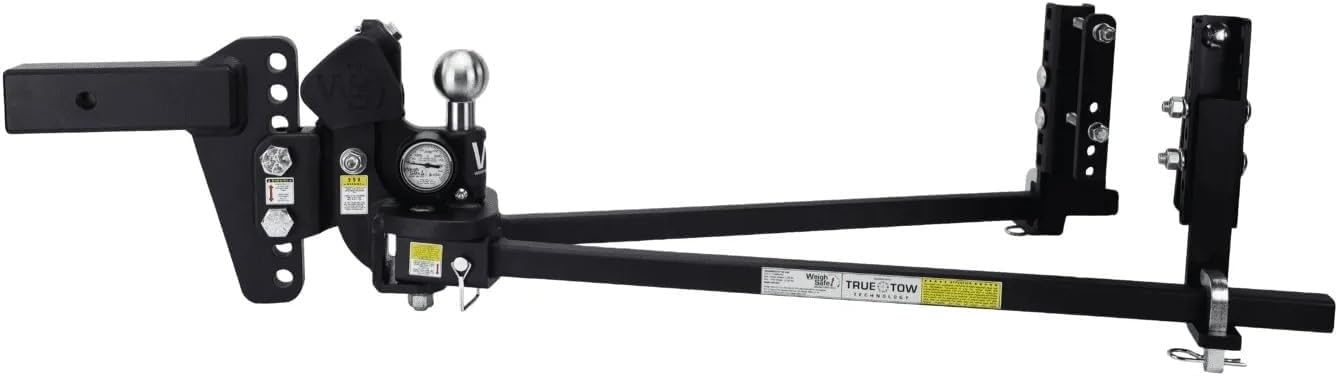
| GTW rating | 22,000 Pounds |
|---|---|
| Compatible vehicle type | RV, Truck |
| Receiver size | 2.5" (listed option) |
| Material | Alloy Steel |
The Weigh Safe TrueTow Heavyweight is a high-capacity weight distribution hitch designed to give DIYers the capacity and control needed for heavier trailers. It installs into a 2.5-inch receiver and features a 6-inch adjustable drop option on this listing, a built-in hydraulic gauge to measure tongue weight and distributed tongue weight, and four-area anti-sway points for stronger sway control. The live adjustment screw in the head lets you fine-tune tension without disassembling the system, and the DTW tool app can help translate the built-in scale readings into proper spring bar settings. Made from alloy steel with a powder coat finish, it is built for regular towing use and corrosion resistance. The hitch's 22,000-pound GTW rating and focus on true weight distribution make it suitable for hauling heavier trailers while restoring front axle load. Trade-offs are its substantial mass and the need for correct setup to realize the benefits, plus limited adjustment ranges tied to the chosen shank and drop size.
Best for: DIY-minded owners of Dodge Dakota trucks who tow heavier trailers and want a high-capacity, adjustable distribution hitch that restores front axle load and improves stability for demanding towing tasks.
Less Ideal for: Drivers who tow light loads infrequently or who prefer the simplest snap-on solutions that require minimal setup should consider lighter or simpler hitch options.
- High 22,000 lb gross trailer weight rating for heavy towing
- Built-in hydraulic scale measures tongue weight and distributed tongue weight for accurate setup
- Four-area anti-sway connections provide stronger sway control than basic systems
- Live adjustment screw allows on-the-fly tension changes without disassembly
- Alloy steel construction with powder coat finish improves durability and corrosion resistance
- Heavy and bulky, adding significant weight to the hitch receiver assembly
- Proper setup requires measuring and adjustment; incorrect setup reduces effectiveness
Verdict: This high-capacity hitch is for DIYers who tow heavier trailers and need extra gross trailer weight and tongue-weight rating for safe, stable hauling.
4. CURT TruTrack 17500 Integrated Sway Weight Distribution Hitch
Best Integrated-Sway Weight Distribution Hitch

| Maximum trailer capacity | Up to 10,000 lbs. |
|---|---|
| Shank size | 2 in |
| Hitch ball size | 2-5/16 in |
| Material | Carbon Steel |
| Finish | Powder Coated |
The CURT TruTrack 17500 is a heavy-duty weight distribution hitch that combines a four-point integrated sway control system with spring-and-cam spring bars to manage up to 10,000 pounds trailer capacity. It is used by mounting the 2-inch shank in the receiver, attaching the 2-5/16-inch hitch ball, fitting the adjustable support brackets to the trailer frame, and tensioning the spring bars to redistribute tongue weight across axles. Notable features include welded head construction with cast pieces, trunnion-style forged steel spring bars, six preset tilt holes with external interlocking nuts for quicker, more precise setup, and hardened components intended to resist wear. In practice the TruTrack reduces trailer yaw while maintaining smooth turning because the integrated sway arms build pressure to stop sway and then relax for maneuvers. The main trade-offs are the added complexity and weight compared with a simple ball mount and the need to match the hitch setup to the Dakota's towing specs and receiver size; installation and adjustment are easier than many competitor models but still require careful tuning for optimal performance on a Dodge Dakota.
Best for: Buyers towing heavier trailers with a Dodge Dakota who want an all-in-one solution that both redistributes tongue weight and actively resists sway, prioritizing ride stability and simpler adjustment over minimal hardware.
Less Ideal for: Drivers who tow very light loads infrequently or who prefer the lightest possible hitch setup should consider simpler ball mounts or lighter distribution systems instead.
- Integrated four-point sway control reduces trailer yaw without a separate sway device
- Trunnion-style forged steel spring bars and hardened components for longer life
- External interlocking nuts and six preset holes make setup and adjustment faster
- Welded head and powder-coated carbon steel construction for durability
- Heavier and more complex than a standard ball mount, requiring more installation effort
Verdict: Pick this integrated-sway model if you want combined weight distribution and effective sway resistance without installing separate add-on sway devices.
5. CURT 17322 Trunnion Weight Distribution Hitch with Sway Control, 10,000 lb Capacity
Best Trunnion-Style Weight Distribution Hitch

| Gross trailer weight | 10,000 Pounds |
|---|---|
| Material | Carbon Steel |
| Shank size | 2-Inch |
| Ball size | 2-5/16-Inch |
The CURT 17322 is a heavy-duty trunnion weight distribution hitch designed to level the tow vehicle and trailer and to improve stability while towing. It uses forged trunnion-style spring bars and a formed head to redistribute tongue weight across axles, which helps keep the nose of the Dodge Dakota from sagging when paired with a properly rated trailer. The kit includes a 2" shank, 2-5/16" ball, hook-up brackets, safety chains, and an integrated sway control unit for additional lateral resistance. Its powder-coated carbon steel construction and forged bars make it durable for frequent towing and the built-in sway attachment tabs simplify installation of the included sway control. Important limitations are that the hitch increases allowable gross trailer weight only if the vehicle and hitch ratings are all observed and that installation and proper setup are required to gain the intended handling benefits. Also verify the Dakota's receiver class and tongue weight capacity before selecting this unit.
Best for: Buyers who tow medium to heavier trailers with a Dodge Dakota and want a durable trunnion-style system that delivers firm, consistent sway control and improved leveling when properly set up.
Less Ideal for: Those who only tow light loads infrequently or who prefer a simpler, no-adjustment hitch should consider lighter weight or friction-style options instead.
- Forged trunnion-style spring bars provide strong, consistent leverage and improved sway resistance
- Includes sway control unit and mounting tabs for added lateral stability
- Durable powder-coated carbon steel construction resists rust and wear
- Comes with hitch ball, hook-up brackets, safety chains, and necessary hardware for a complete assembly
- Requires correct receiver class and careful setup to achieve intended weight distribution and handling benefits
Verdict: Opt for a trunnion-style hitch when you prefer forged trunnion bars that provide extra leverage, durability, and a firmer, more consistent anti-sway response.
6. Andersen Hitches Weight Distribution Hitch 4" Drop/Rise, 2" Ball (Model 3324)
Best Grease‑Free / Tension‑Chain Hitch

| Maximum Towing Capacity | 10000 Pounds |
|---|---|
| Pull Force | 10000 Pounds |
| Compatible with Vehicle Type | Trailer |
| Material Type | Alloy Steel |
| Finish Type | Powder Coated |
The Andersen Hitches 4" drop/rise weight distribution hitch uses a tension-chain and friction-cone design to control sway and reduce bounce while eliminating the need for routine greasing. It fits a 2" ball and a 2" shank configuration and is built for up to 10,000 pounds GTWR, so it handles typical mid-size truck and trailer combinations. The tension chains make attaching and adjusting faster than traditional spring bars, which keeps hookups cleaner and saves time at the campsite or jobsite. Powder-coated alloy steel construction and a factory-style ball housing give it a durable, rust-resistant finish for long-term use. Because it is a universal-fit weight distribution system, installation requires matching the shank drop/rise to your truck and trailer heights and may need additional brackets or adjustments for exact fitment on a Dodge Dakota. It is not a plug-and-play solution for every vehicle, so expect a short setup and alignment process on first install.
Best for: Buyers who prioritize low maintenance and faster, cleaner hookups for regular towing with a Dodge Dakota and want a tension-chain system to cut down on lubrication chores.
Less Ideal for: Drivers who need a vehicle-specific, bolt-on hitch solution with no initial adjustment or those towing unusually heavy or specialized trailers outside the listed capacity.
- Grease-free tension-chain and friction-cone design reduces maintenance and keeps hookups cleaner.
- Rated for up to 10,000 lb GTWR, suitable for many bumper-pull trailers commonly towed by mid-size trucks.
- Tension chains attach and adjust faster than spring bars, speeding hitching and unhitching.
- Powder-coated alloy steel construction resists corrosion for durability.
- Built in the USA with components sized for common 2" ball/shank towing setups.
- Universal-fit design may require additional shank/bracket adjustments to achieve correct geometry on a Dodge Dakota.
Verdict: This low-maintenance category is for buyers who want a grease-free or tension-chain style hitch that reduces routine lubrication and makes hookup faster and cleaner.
7. CURT Deep Drop Trunnion Weight Distribution Hitch (Up to 10,000 lb, 2" Shank)
Best Adjustable‑Shank / Deep‑Drop Hitch

| Pull Force | 10000 Pounds |
|---|---|
| Material Type | Alloy Steel |
| Finish Type | Powder Coated |
| Automotive Fit Type | Universal Fit |
This CURT deep drop trunnion weight distribution hitch is built to level a tow vehicle and trailer by shifting tongue weight across axles, which improves handling and reduces rear sag when towing heavier campers or trailers behind a Dodge Dakota. It uses forged trunnion-style spring bars and a formed head for solid load control, and the 2" x 2" adjustable shank can be flipped to give up to 7" of drop or 10.5" of rise to match lifted or lowered truck heights. The hitch includes hook-up brackets, safety chains, and a pin and clip, and the powder coat finish helps resist corrosion. Practical benefits include finer leveling for safer towing and compatibility with class 3–5 receiver setups commonly found on mid-size trucks. Buyers should note a trailer ball is not included and the hitch must not be used beyond the lowest rated component in the tow system, so correct matching to the Dakota and trailer tongue weight is required.
Best for: Drivers who tow midweight to heavy travel trailers with a Dodge Dakota and need an adjustable deep-drop option to level the rig across different vehicle or trailer heights.
Less Ideal for: People who only tow very light loads infrequently or those who prefer a simple weight distribution solution without adjustable rise/drop settings.
- Adjustable shank flips to provide up to 7" drop or 10.5" rise for matching lifted or lowered truck heights
- Trunnion-style forged steel spring bars and formed head deliver firm weight distribution and improved trailer control
- Rated for up to 10,000 lb gross trailer weight and 1,000 lb tongue weight for heavier trailers
- Durable powder coat finish reduces corrosion and surface damage during regular use
- Does not include a trailer ball, which must be purchased separately
Verdict: Choose an adjustable-shank or deep-drop hitch if you need multiple rise/drop settings to level your tow rig across different vehicle heights or lifted suspensions.
Choosing the Right Dodge Dakota Weight Distribution Hitch: Key Factors to Consider
Tongue Weight Capacity and Range
Matching the hitch's tongue weight capacity to your loaded trailer matters because under-rated systems can overload the Dakota's hitch and rear axle, while over-rated systems may limit proper load transfer. Look for a weight distribution hitch that covers the typical loaded tongue weight of the trailers you tow and offers adjustable range so you can retune the system when trailer loads fluctuate.
Range flexibility also affects how well the hitch levels the truck and trailer. A hitch with stepped or continuous adjustment makes it easier to dial in the correct tension and ride height, reducing rear sag and improving front axle load for safer steering feel. Always verify the hitch's rated tongue weight range against your trailer's expected tongue weight, including cargo and fluids.
Sway Control Effectiveness
Sway control is essential for towing stability, particularly when towing with a shorter wheelbase like the Dakota's. Different systems provide sway resistance through friction brackets, integrated cams, or spring-bar geometry. Effective sway control reduces oscillation from wind, passing vehicles, and imperfect trailer loading.
Consider how the sway-control mechanism interacts with the weight-distributing function. Some hitches combine both features in the same assembly, which simplifies setup. Others allow add-on sway-control attachments. Prefer designs that provide smooth, predictable damping without making the trailer feel overly stiff during small corrections.
Compatibility With Receiver and Trailer Coupler
Ensuring physical fit is a practical first step. The hitch must match the Dakota's receiver class and the trailer coupler height range when the trailer is loaded. Some systems require specific head heights, shank lengths, or drop/rise options to achieve a level tow. If you have a lift or lowered suspension on your Dakota, plan for shank selection and additional drop or rise to maintain proper geometry.
Coupler latch types and ball sizes must also be compatible. While most weight distribution hitches accommodate common ball sizes, verify that the head assembly and spring bar geometry clear your trailer frame and allow full articulation for turning without binding.
Adjustability and Fine-Tuning
A hitch that is easy to adjust makes it simpler to achieve the correct load distribution and sway settings. Look for systems with clear adjustment points for bar tension, head angle, and hitch height. Some designs use threaded turnbuckles or multiple chain/shot-pin positions to change leverage and tension.
Good adjustability shortens setup time when switching between trailers or varying cargo loads. It also allows you to optimize for ride comfort versus maximum sway resistance depending on trip conditions. Consider how easy it is to check and change settings roadside if needed.
Durability and Maintenance
Road salt, dirt, and vibration take a toll on towing hardware. Durable finishes, replaceable wear parts, and robust metallurgy extend service life and reduce ownership cost. Inspect whether key components like spring bars, clips, chains, and cams are serviceable and whether replacement parts are commonly available.
Routine maintenance needs should be low; however, greasing pivot points and checking fasteners regularly is typical. Choosing a design with accessible adjustment points and corrosion-resistant coatings will simplify upkeep for a Dodge Dakota that sees regular towing duty.
Installation Complexity and Tools Required
Installation ease matters because complicated setups can lead to improper adjustment. Some weight distribution hitches bolt on with minimal tools and clear instructions, while others require assistance to achieve initial tension. Consider whether you have access to the necessary tools, a helper, or professional installation.
Also factor in how often you will remove the hitch. If you frequently disconnect the trailer, quick-attach features or easier pin-and-clip systems speed repeated installation. Clear alignment marks and numbered adjustment positions reduce guesswork and help ensure correct setup each time.
Understanding How Weight Distribution Helps a Dodge Dakota
A weight distribution hitch shifts part of the trailer's tongue load forward onto the Dakota's front axle and the trailer axle. This restores steering traction and ground clearance lost to rear sag when towing heavier loads. For a pickup like the Dakota, improved front-end load helps maintain predictable steering response and braking performance.
Beyond leveling, weight distribution changes the truck-trailer pivot characteristics, reducing the tendency to trailer-lift or create excessive downward force on the rear. That makes lane changes and emergency maneuvers more controlled, especially when towing trailers with variable cargo placement.
- Reduces rear sag and restores front wheel contact for better steering
- Improves braking balance by distributing load forward
- Modulates trailer pitch and reduces aft-heavy handling tendencies
Common Sway Causes and How Systems Counter Them
Sway can start from uneven loading, gusty crosswinds, or aerodynamic disturbances. With a Dakota's relatively short wheelbase, these forces can translate into noticeable trailer oscillation unless damped. Weight distribution systems with integrated sway control add resistance to lateral motion and help the trailer track behind the truck.
Friction-style sway control absorbs motion through contact surfaces, while cam or spring-bar designs resist movement through geometry and leverage. Understanding which method suits your towing style helps you choose a system that balances damping with normal articulation.
- Friction control provides steady resistance and can be modular
- Spring-bar geometry offers continuous load transfer with sway resistance
- Choose based on typical driving speeds, wind exposure, and trailer profile
Setup Checklist Before Your First Tow
Before hitching up, confirm the trailer's unloaded and loaded tongue weight. Verify the Dakota's receiver class and the hitch's shank height to ensure a level tow. Inspect the trailer coupler, ball size, and safety chains for compatibility and proper function.
When initial setup is complete, perform a short test drive in a safe area to validate ride height, steering feel, and sway behavior. Recheck fasteners and adjustment points after the first mile or two to ensure nothing settles. Make incremental changes rather than large jumps when adjusting tension or sway settings.
- Measure tongue weight and confirm hitch rating
- Set head height so truck and trailer are level under load
- Test drive and recheck adjustments after initial miles
Installation Tips Specific to Dodge Dakota Owners
Dakota owners should plan for the truck's ground clearance and suspension travel when selecting shank length and drop/rise. If you have an aftermarket lift or lower suspension, adjust shank choice accordingly to maintain correct hitch geometry. Ensure the spring bars clear your trailer frame and do not contact the bumper on full lock.
Use calibrated torque values for hitch hardware and follow the manufacturer's recommended procedures for seating spring bars and engaging sway-control features. If you are unfamiliar with torque specs or tensioning methods, seek assistance to avoid under-tightening or over-tensioning components.
- Account for Dakota ride height and any suspension modifications
- Verify spring-bar clearance and full articulation
- Follow torque specs and recommended tensioning steps
Routine Checks and Seasonal Care
Perform a quick inspection before each trip: check that the spring bars are seated correctly, chains or brackets are secured, and no components show excessive corrosion or wear. Keep pivot points lightly lubricated and replace worn clips or pins promptly.
For winter use, pay attention to salt exposure and clean or apply protective coatings to metal surfaces. Storage between towing seasons should be dry and free from compressive loads that could deform spring components.
- Inspect mounting points and hardware before every tow
- Lubricate pivots and protect exposed metal in corrosive conditions
- Store components in a dry area when not in use
How We Chose the Best Dodge Dakota Weight Distribution Hitch
We prioritized evaluation criteria that matter for Dodge Dakota owners who tow medium to heavy trailers. First, effective tongue-weight redistribution: systems were chosen based on their rated range for spreading tongue load between the truck and trailer without overloading the Dakota's hitch receiver or rear axle. Second, integrated sway-control performance: we selected hitches that offer reliable sway damping either through friction, dual-cam geometry, or spring-bar resistance to reduce side-to-side oscillation in crosswinds and passing vehicles. Third, build quality and durability: materials, corrosion protection, and serviceable components were considered to ensure long-term reliability in road conditions typical for Dakota drivers.We also considered fitment and adjustability, favoring systems that allow fine tuning of tension and ride height to match different trailer setups. Ease of installation and regular maintenance were factored in to reduce on-road headaches. Items excluded from the shortlist were hitches with insufficient tongue-weight ratings for common Dakota towing loads, systems incompatible with standard hitch receivers for this truck, or designs that lack clear adjustment ranges. Overall, our filters emphasize safety, compatibility, and real-world usability for Dodge Dakota towing scenarios.
Our full evaluation process is outlined in our review methodology.
FAQ
How do I know if my Dodge Dakota needs a weight distribution hitch?
If your Dakota shows rear sag when loaded, has reduced steering response, or the trailer feels unstable at highway speeds, a weight distribution hitch can help. Check your trailer's tongue weight: if it approaches or exceeds the recommended percentage of gross trailer weight, distribution is often beneficial.
Will a weight distribution hitch increase my towing capacity?
A weight distribution hitch does not increase your vehicle's published towing capacity. It redistributes load to improve handling and reduce rear-axle overload, but you must still stay within the Dakota's and trailer's rated limits.
Can I install a weight distribution hitch myself on a Dodge Dakota?
Many owners can install these hitches with basic tools and a helper for initial spring-bar seating. However, correct setup requires measuring tongue weight, selecting appropriate shank/drop, and tensioning the bars properly. If you are unsure about torque specs or geometry, professional installation is a safe option.
How often should I check or adjust the hitch settings?
Check hitch hardware and settings before every tow and re-inspect after the first few miles of a new setup. Adjustments may be needed when trailer load, cargo placement, or tongue weight changes significantly.
Will a weight distribution hitch reduce trailer sway completely?
No system can guarantee complete elimination of sway. A properly selected and adjusted weight distribution hitch with effective sway control greatly reduces the frequency and severity of sway events, but safe loading, speed management, and proper tire pressures also play important roles.
Do I need a different ball size or coupler for a weight distribution hitch?
Most weight distribution systems accommodate common ball sizes, but you must match the hitch ball to your trailer coupler size. Verify that the head assembly and ball platform on the hitch accept the correct diameter and are rated for your tongue weight.
Final Verdict
When towing with a Dodge Dakota, prioritize a weight distribution hitch that matches your trailer's tongue weight range and offers dependable sway control. Balance capacity, adjustability, and installation practicality to ensure predictable handling and braking under load. Regular inspections and proper setup are essential to get the most benefit from the system.Focus on the tradeoffs most relevant to your towing use: simpler friction-based control can be easier to use, while integrated spring-bar systems offer continuous distribution and robust damping for heavier loads. Choose a setup that you can adjust confidently and maintain over time to keep Dakota towing safe and stable.
Explore More:
- Check out all Dodge Dakota parts & accessories
- Explore Other Accessories
- Browse all Accessories
