

Note: This article contains affiliate links. If you click on these links and make a purchase, I may earn a small commission at no extra cost to you. This helps support my research and content. Read my full affiliate disclosure here.
If you own a Nissan Frontier with an automatic transmission, the fluid you choose affects shift feel, longevity, and reliability under load. Using the wrong fluid can lead to harsh shifts, increased wear, or overheating, while the right fluid helps maintain consistent hydraulic pressure and friction characteristics that the transmission needs.This guide shortlists the six top transmission fluids suitable for the Nissan Frontier Automatic configuration and explains the evaluation criteria you should use, including friction performance, thermal stability, and compatibility with Nissan specifications. Read on to understand the tradeoffs and how to pick the best option for everyday driving, towing, or higher-mileage service intervals.
Looking for other parts? See all Nissan Frontier parts & accessories.
Top Picks at a Glance
| Best Overall Transmission Fluid The top pick that balances compatibility, protection, and shifting performance | Idemitsu ATF Type S Automatic Transmission Fluid, 5 Quart |  |
| Best Budget Transmission Fluid A low-cost, reliable fluid for routine top-ups and basic maintenance | Valvoline MaxLife Multi-Vehicle Full Synthetic Automatic Transmission Fluid, 1 qt |  |
| Best OEM Nissan Transmission Fluid Factory-formulated Nissan/Infiniti spec fluids for exact OEM compatibility | Nissan Genuine Matic-S Automatic Transmission Fluid, 5-Quart Pack (5 bottles) |  |
| Best Gallon / Bulk ATF 1‑gallon or multi-quart packs for full changes or workshop stock | Valvoline MaxLife Multi-Vehicle Full Synthetic ATF 1 Gallon |  |
| Best Multi‑Vehicle Universal ATF Versatile ATF that meets many OEM specs for broader fitment | Castrol Transmax ATF/CVT Universal Automatic Transmission Fluid, 1 Gallon |  |
| Best Seal‑Conditioning / High‑Mileage ATF Formulated seal conditioners and additives to help stop leaks and refresh seals | Valvoline MaxLife Automatic Transmission Fluid with Stop Leak, 32 oz |  |
1. Idemitsu ATF Type S Automatic Transmission Fluid, 5 Quart
Best Overall Transmission Fluid

| Volume | 5 Quart |
|---|---|
| Manufacturer | Idemitsu |
| Item model number | 30040101-95300C020 |
This Idemitsu ATF Type S is a 5‑quart jug formulated specifically to meet Nissan and Infiniti Matic‑S, Matic‑J, and Matic‑D specs, making it suitable for DIY transmission service on compatible vehicles. In use it aims to provide smooth, anti‑shudder shifting and strong oxidation resistance to help the fluid last longer under heat. The formula also emphasizes deposit control and seal conditioning, which helps keep internal components clean and reduces the chance of leaks from hardened seals. For a home mechanic the 5‑quart size covers most drain-and-fill jobs and the factory‑spec targeting simplifies fitment decisions for Nissan transmissions. The main limitations are that it is tuned for Nissan/Infiniti Matic families, so it is not a universal ATF replacement for vehicles requiring other specifications, and you must confirm your Frontier’s required spec before use. Overall this is a practical, factory‑replacement quality fluid for owners who value compatibility and longevity in routine transmission maintenance.
Best for: Home mechanics and Frontier owners who want a single, factory‑spec transmission fluid for routine DIY drain‑and‑fill jobs and reliable shifting performance.
Less Ideal for: Drivers looking for a universal fluid to cover multiple makes or older transmissions with non‑Matic requirements should consider a different product.
- Meets Matic‑S, Matic‑J, and Matic‑D specifications for Nissan/Infiniti transmissions
- Formulated for strong anti‑shudder performance for smoother gear changes
- Good oxidation resistance to help extend fluid life under heat
- Deposit control and seal conditioning to maintain internal cleanliness and reduce leak risk
- Not a universal ATF and may be incompatible with transmissions requiring different specifications
Verdict: Choose this when you want a single, well-rounded transmission fluid that delivers reliable shifting, strong wear protection, and broad compatibility for DIY service.
2. Valvoline MaxLife Multi-Vehicle Full Synthetic Automatic Transmission Fluid, 1 qt
Best Budget Transmission Fluid

| Liquid Volume | 1 Quarts |
|---|---|
| Material | Synthetic |
| Flash Point | 394 Degrees Fahrenheit |
| Viscosity | 1 |
Valvoline MaxLife Multi-Vehicle ATF is a full synthetic transmission fluid formulated for a wide range of light-duty automatic transmissions, including many Nissan Frontier applications. It is typically used for routine top-offs, drain-and-fill service, or when replacing degraded fluid to restore smoother shifts and reduce wear. Notable features include frictional enhancements for smoother gear engagements, additives to help prevent leaks by conditioning seals, and improved thermal and viscosity stability for longer fluid life compared with conventional ATFs. In practice you can expect steady shift quality across temperature extremes and reduced risk of sludge or deposit-related problems in older or higher-mileage transmissions. The product is not a vehicle-specific factory replacement and may not match every Nissan Frontier factory fluid specification, so check the owner manual for the recommended spec before doing a full service. For budget maintenance it offers strong protection and broad fitment without specialty formulations aimed at racing or heavy-duty towing.
Best for: Buyers seeking an affordable, reliable ATF for routine top-offs or standard maintenance on a Nissan Frontier who prioritize value and dependable protection over vehicle-specific specialty fluids.
Less Ideal for: Owners needing a transmission fluid specified explicitly by Nissan for warranty or severe-duty towing and performance drivers seeking track or heavy-load formulations should consider manufacturer-recommended or specialty fluids instead.
- Full synthetic formula offers better thermal and viscosity stability than conventional ATF
- Seal-conditioning additives help reduce leaks in older transmissions
- Friction modifiers promote smoother gear changes
- Broad multi-vehicle compatibility suitable for many light-duty applications
- Well suited for routine top-offs and budget maintenance
- Not guaranteed to match every manufacturer's specific ATF specification for a precise factory match
Verdict: Pick this if you need an inexpensive, dependable ATF for routine fluid top-offs or budget-minded maintenance without specialty additives.
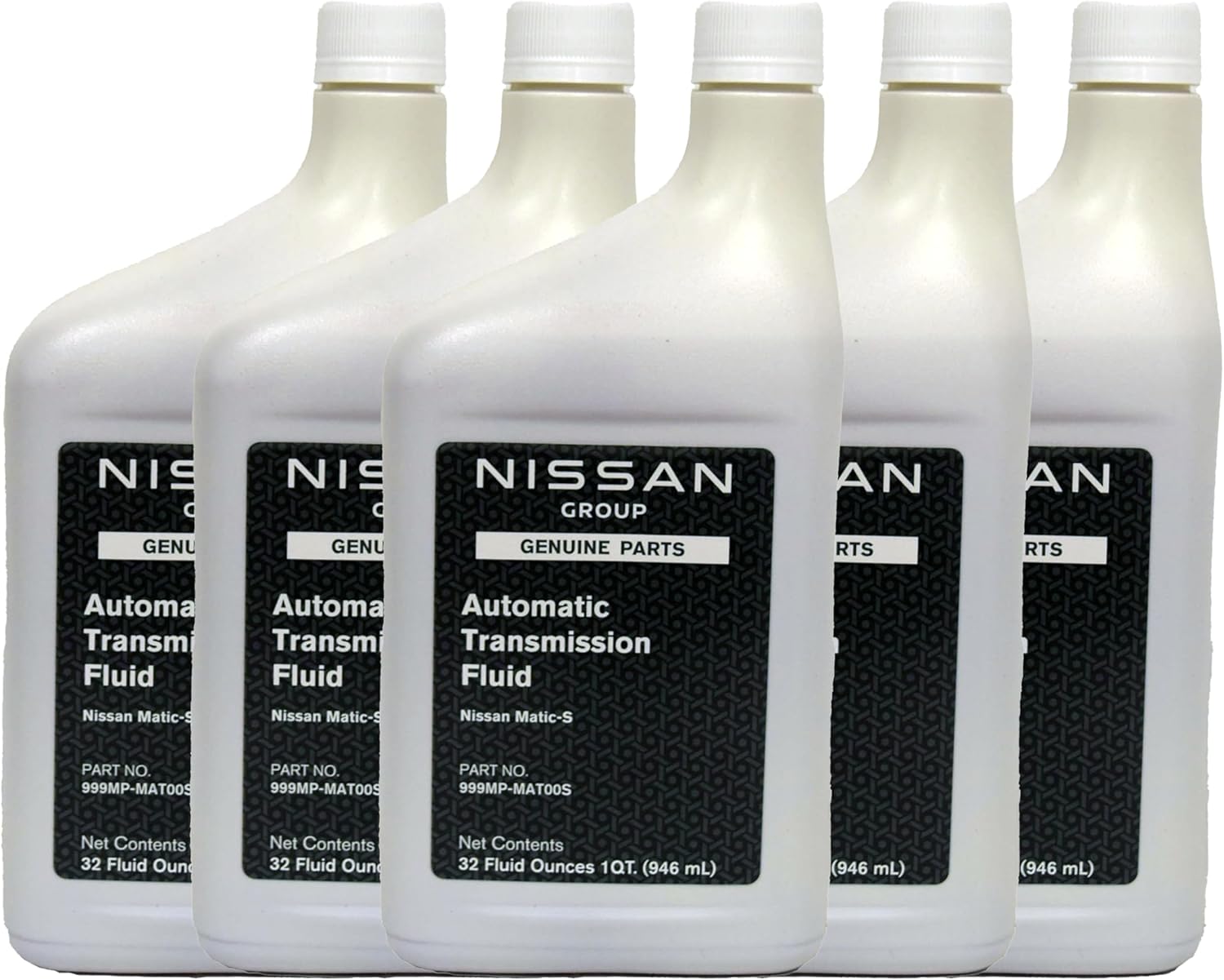
3. Nissan Genuine Matic-S Automatic Transmission Fluid, 5-Quart Pack (5 bottles)
Best OEM Nissan Transmission Fluid
| Brand Name | Nissan |
|---|---|
| Unit Count | 160 Fluid Ounces |
| Item Form | Oil |
| Number of Items | 5 |
This is Nissan's genuine Matic-S automatic transmission fluid supplied as five one-quart bottles, formulated to match the chemistry Nissan recommends for compatible transmissions. It is used during fluid service, fill-ups, and transmission exchanges where manufacturer-spec fluid is required to maintain shift quality and component longevity. Notable features include factory formulation and labeled fitment for Nissan vehicles, which removes guesswork about compatibility and helps preserve the transmission's designed hydraulic and friction characteristics. Practical benefits include consistent shift feel after service and reduced risk of issues that can arise from using nonmatching fluids. Limitations are that it is specific to Nissan specifications so it is not a universal ATF and you must follow the owner's manual for the correct fill procedure and level; improper installation or level can still damage the transmission. This is best for technicians and owners who want to maintain factory fluid chemistry during service on supported Nissan automatic transmissions.
Best for: Buyers who prioritize exact factory chemistry and assured compatibility for Nissan automatic transmission servicing on the Frontier and want a direct manufacturer-specified fluid.
Less Ideal for: People looking for a multi-brand or universal ATF solution or those servicing non-Nissan transmissions should consider different formulations.
- Factory-formulated to Nissan specifications for guaranteed chemical compatibility
- Pack of five one-quart bottles covers most complete fluid changes without mixing fluids
- Consistent friction and hydraulic properties help maintain proper shift quality
- Sold by the vehicle manufacturer which simplifies correct-product selection
- Not suitable as a universal replacement for non-Nissan transmissions that require different ATF chemistries
Verdict: Use this slot for genuine or OEM-spec fluids when you want exact factory chemistry and guaranteed compatibility with Nissan transmission specifications.
4. Valvoline MaxLife Multi-Vehicle Full Synthetic ATF 1 Gallon
Best Gallon / Bulk ATF

| Material | Synthetic |
|---|---|
| Liquid Volume | 1 Gallons |
| Viscosity | 1 |
| Flash Point | 394 Degrees Fahrenheit |
| Model | MaxLife Multi-Vehicle ATF |
Valvoline MaxLife Multi-Vehicle ATF is a one-gallon, full-synthetic transmission fluid designed for broad compatibility with light-duty automatic and many CVT transmissions. It is typically used for full fluid changes or when servicing multiple vehicles, and the gallon size makes it convenient to refill or keep on hand for scheduled maintenance. The formula contains conditioning agents to help maintain seal elasticity and anti-wear additives to reduce component wear, which can translate into fewer leaks and longer transmission life in daily driving. Improved thermal and viscosity stability aims to keep shifting consistent across hot and cold conditions, and the product lists many manufacturer specifications and approvals for widespread fitment. Limitations include reliance on the vehicle maker's fluid spec—some Nissan Frontier models require specific Nissan CVT or ATF formulations, so always confirm compatibility before use. Also, a single-gallon bottle may still be insufficient for full flushes on larger transmissions that need multiple gallons.
Best for: Buyers doing a complete fluid change, servicing several light-duty vehicles, or keeping a ready supply for routine transmission maintenance who prioritize broad compatibility and a factory-quality synthetic formulation.
Less Ideal for: Owners who must use a single exact factory-specified fluid for warranty or repair reasons, or those who need larger bulk volumes beyond one gallon for high-mileage or commercial service.
- Full-synthetic formulation for better thermal and viscosity stability
- Conditioning agents to help maintain seal elasticity and reduce leaks
- Wide manufacturer spec coverage for multi-vehicle compatibility
- One-gallon size suitable for full changes on many light-duty transmissions or stocking for future service
- May not match every vehicle’s required factory transmission specification so compatibility check is necessary
- One gallon can be insufficient for some full flushes that require multiple gallons
Verdict: Choose a gallon- or bulk-sized ATF when you’re doing a full fluid change, servicing multiple vehicles, or stocking up for future maintenance.
5. Castrol Transmax ATF/CVT Universal Automatic Transmission Fluid, 1 Gallon
Best Multi‑Vehicle Universal ATF

| Container Type | Bottle |
|---|---|
| Liquid Volume | 1 Gallons |
| Viscosity | 32 centistokes |
| Item Form | Liquid |
Castrol Transmax ATF/CVT Universal is a full-synthetic transmission fluid designed as a one‑product solution for both traditional stepped automatics and many CVTs. It is typically used for service fills and top-ups where a single universal fluid simplifies maintenance or keeps inventory low. Notable features include Castrol Smooth Drive Technology for adaptive friction control, formulation aimed at high temperature oxidation resistance, and stated protection against copper corrosion. Practical benefits for a Nissan Frontier include broad compatibility with North American and Asian transmissions and improved thermal stability during towing or repeated gear changes. Limitations to consider are that the product is positioned as a universal fluid rather than vehicle-specific factory-replacement fluid, so always confirm Ford, GM, Chrysler, or Nissan service manuals and the Frontier's required ATF specification before a full drain and refill. The 1 gallon bottle is convenient for a complete service on most Frontier transmissions and for keeping a spare on hand for mid-interval top-ups.
Best for: Buyers who want one reliable fluid to cover multiple transmission types and simplify maintenance or parts stocking for a Frontier-focused garage.
Less Ideal for: Technicians or owners who require a strict manufacturer-specified, model-dedicated transmission fluid for warranty-sensitive or OEM-exact service should choose the exact Nissan-specified ATF instead.
- Full-synthetic formulation for stable high-temperature performance
- Compatible with many stepped automatics and CVTs, reducing parts inventory
- Includes Castrol Smooth Drive Technology for adaptive friction control
- Formulated to resist oxidation and protect metal components
- Marketed as a universal fluid so it may not match every manufacturer-specific spec exactly
Verdict: Pick a multi‑vehicle universal fluid when you need one product that safely covers a range of transmission specs and makes for simplified inventory.
6. Valvoline MaxLife Automatic Transmission Fluid with Stop Leak, 32 oz
Best Seal‑Conditioning / High‑Mileage ATF

| Unit Count | 32 Fluid Ounces |
|---|---|
| Material | Mineral or Synthetic Oil |
| Viscosity | 35 |
| Upper Temperature Rating | 390 °F |
Valvoline MaxLife ATF with Stop Leak is a transmission fluid aimed at older vehicles that need seal conditioning and extra protection against wear. In use it replaces standard ATF and adds seal conditioners designed to soften and rejuvenate shrunken or brittle seals, which can reduce minor leaks without tearing the transmission down. The formula also contains anti‑wear and antioxidant additives to help reduce friction and slow fluid breakdown under higher temperatures. For a Nissan Frontier with an aging transmission this product can be added during a fluid change or top‑off to help extend service intervals and address seepage from worn seals. Expect a practical, maintenance‑focused result rather than a permanent mechanical repair for large leaks. It is mineral/synthetic based and comes in a 32 oz bottle that is convenient for partial fills or drip refills. Buyers should follow Nissan fluid specifications and use this as a fix‑up measure for high‑mileage trucks rather than a substitute for needed mechanical work.
Best for: Owners of higher‑mileage Nissan Frontiers looking to reduce minor ATF seepage and add extra wear protection without immediate transmission teardown.
Less Ideal for: Drivers facing obvious or heavy transmission leaks, blown seals, or internal mechanical failures who need parts replacement or professional transmission repair.
- Includes seal‑conditioning additives that can soften and rejuvenate worn transmission seals
- Contains anti‑wear and antioxidant agents to help reduce friction and resist oxidation
- 32 oz bottle size is convenient for partial fluid changes or top‑offs during maintenance
- Not a permanent repair for major leaks or severely damaged seals
Verdict: Use a seal‑conditioning or high‑mileage ATF when working on older transmissions that need seal rejuvenation and extra protection against leaks and wear.
Choosing the Right Nissan Frontier Automatic Transmission Fluid: Key Factors to Consider
Specification Compliance and Approvals
Matched specifications determine whether a fluid is chemically and performance-compatible with your Frontier Automatic transmission. Nissan and transmission manufacturers publish required ATF or fluid spec codes that define friction modifiers, viscosity ranges, and additive packages.
Choosing a fluid that does not meet these specs can alter clutch friction, change engagement timing, or degrade valves in the valve body. Always confirm the fluid's published approvals and technical data to ensure it is appropriate for the Frontier's automatic transmission design and service requirements.
Friction Characteristics and Shift Quality
Friction behavior directly influences how the transmission shifts. Fluids with the correct friction coefficient and stable friction over time produce consistent, smooth shifts from cold and maintain predictable engagement during towing or heavy loads.
If the friction modifiers are too aggressive or fade with age, shifts can become soft, slip-prone, or abrupt. For Frontier owners who tow or frequently drive in city traffic, prioritize fluids noted for stable, repeatable shift feel and controlled clutch engagement.
Thermal Stability and Oxidation Resistance
Transmissions operate at elevated temperatures, and fluid breakdown accelerates when subjected to heat and contamination. A fluid with good thermal stability resists thickening, varnish, and acid formation that can clog passages and speed wear.
For Frontier drivers who tow, haul, or operate in hot climates, oxidation resistance is especially important. Better thermal performance translates to longer service intervals and more predictable hydraulic response under sustained loads.
Viscosity, Shear Stability, and Cold-Start Performance
Viscosity affects hydraulic pressure and lubrication. At low temperatures, the fluid must flow quickly enough to provide immediate hydraulic control; at high temperatures it must retain sufficient viscosity to prevent metal-to-metal contact.
Shear stability ensures the fluid maintains its viscosity after mechanical stress. Fluids that thin excessively under shear can cause delayed engagements or increased wear. Consider the typical climate and service conditions for your Frontier when weighing viscosity and shear retention.
Wear Protection and Additive Package
A robust additive package helps protect clutch surfaces, gears, and bearings from wear and corrosion. Anti-wear agents, detergents, and corrosion inhibitors extend transmission life and maintain clean internal components.
For higher-mileage Frontiers or trucks used for towing, prioritize fluids with proven anti-wear chemistry and detergents that limit deposits. Additive compatibility with seals and clutch materials is also crucial to prevent leaks and preserve friction characteristics.
Seal Compatibility and Leak Prevention
Older transmissions can develop soft or hardened seals. Some fluids contain solvents or chemical packages that can cause swelling or shrinking of seal materials, leading to leaks.
Choosing a fluid formulated for compatibility with the Frontier's seal materials reduces the risk of post-service leaks. If you are switching fluid types, allow time for seals to adjust and inspect for any evidence of seepage after service.
When To Change Your Frontier's Transmission Fluid
Maintenance intervals for transmission fluid vary with use. For light everyday commuting you can follow conservative service intervals recommended by Nissan, but more demanding use such as frequent towing, stop-and-go city driving, or off-road use shortens the effective life of the fluid.
- Change earlier if you notice burning smell, darkened fluid, or gritty particles.
- Consider shorter intervals after heavy towing or repeated hill climbs.
- Check fluid condition visually and by shift feel if you do not have a strict time-based service schedule.
DIY Fluid Change Vs Professional Service
A drain-and-fill procedure replaces only part of the fluid; it is often sufficient for routine maintenance and is straightforward for owners comfortable with basic service. A full flush or machine exchange removes more old fluid but can disturb deposits and should be approached carefully on older transmissions.
Changing the fluid yourself saves cost and lets you choose the exact fluid you want, while professional service can include a pan drop inspection, filter replacement, and torque converter servicing if needed. For Frontier owners with higher mileage, a professional inspection during service helps identify leaks or worn components early.
- Drain-and-fill for routine maintenance and moderate mileage.
- Pan drop and filter change during major service intervals.
- Full flush considered when contamination is evident, but seek advice for high-mileage units.
Towing and Heavy Use Considerations
Towing increases transmission temperature and stress on clutches. Selecting a fluid with higher thermal tolerance and strong anti-wear chemistry reduces the chance of slippage and premature component wear under load. Also ensure the fluid maintains hydraulic control across the temperature range you expect while towing.
If you routinely tow, inspect fluid condition more frequently and consider fluids rated for severe service or high thermal stability. Upgrading cooling capacity, such as using a transmission cooler, is another effective way to protect the transmission during heavy use.
- Monitor fluid temperature during long tows.
- Use higher-stability fluids where frequent towing occurs.
- Combine fluid choice with proper cooling and maintenance.
Interpreting Fluid Labels and Technical Data Sheets
Product labels can be abbreviated or generic; technical data sheets reveal viscosity numbers, approved specifications, and performance test results. Review the TDS to confirm compatibility with Nissan Automatic transmission requirements and to compare thermal and shear stability figures.
Look for specific performance claims supported by test methods on the data sheet rather than marketing language. The TDS will also note recommended service intervals and any seal compatibility information that matters for an older Frontier.
- Compare viscosity grades and shear stability metrics on TDS documents.
- Verify published approvals and Nissan-relevant specs.
- Prefer transparent TDS information over marketing claims.
What To Expect After A Fluid Change
New fluid often results in slightly firmer or more consistent shifting as friction modifiers reset. These changes are normal and may settle after a few hundred miles as the fluid circulates and clutch surfaces recondition.
If you experience persistent harsh shifts, slipping, or leaks after a change, recheck the fluid level and confirm you used a compatible fluid. Persistent problems may indicate mechanical wear rather than fluid choice and should be diagnosed by a technician.
- Initial shift feel may change for a few hundred miles after service.
- Recheck level and condition after a short break-in period.
- Seek diagnostic help for ongoing shifting issues.
Still looking for the perfect fit?
Select your Nissan Frontier configuration to see the most relevant Transmission Fluids recommendations
How We Chose the Best Nissan Frontier Automatic Transmission Fluid
Our selection process prioritized fluids that meet Nissan transmission specifications and that address the practical needs Frontier owners face. We evaluated candidates across several vehicle-focused dimensions: friction and shift quality to ensure smooth upshifts and downshifts; thermal and oxidative stability to resist breakdown under towing or stop-and-go traffic; wear protection and additive chemistry to limit clutch and gear wear over time; viscosity and shear retention to maintain hydraulic control across temperature ranges; and seal compatibility to prevent leaks in older transmissions.We also considered serviceability factors, such as availability in common container sizes and whether the fluid is suitable for drain-and-fill procedures or full fluid exchanges. Fluids that lacked clear compatibility with Nissan Automatic specifications or that relied on vague performance claims were excluded. The final six choices reflect a balance of specification compliance, long-term durability, and predictable shift behavior for the Nissan Frontier Automatic configuration.
Our full evaluation process is outlined in our review methodology.
FAQ
How often should I change the transmission fluid in a Nissan Frontier Automatic?
It depends on use. For normal driving, follow Nissan's baseline schedule, but shorten intervals for towing, heavy loads, or frequent stop-and-go driving. Inspect fluid condition regularly and change earlier if fluid looks dark or smells burnt.
Can I switch to a different type of automatic transmission fluid mid-service?
Switching is possible but should be done with caution. Ensure the new fluid explicitly meets the Nissan Automatic requirements. When switching fluid chemistries, monitor shift feel and seals for a short period after the service.
Will higher-quality fluid improve a slipping transmission?
A better fluid can improve hydraulic control and reduce slipping caused by degraded fluid, but it will not fix slipping due to worn clutches or mechanical faults. If slipping persists after a proper fluid change and correct level, have the transmission inspected.
Is it okay to use universal ATF or any automatic transmission fluid labeled ATF?
Not always. 'Universal' labels can mask differences in friction modifiers and additive chemistry. Use fluids that list compatibility with Nissan Automatic specifications to avoid unintended shift or wear consequences.
Should I change the transmission filter when I change the fluid?
Changing the filter is a good practice during a pan drop service because it removes trapped debris and contaminants. For a simple drain-and-fill, the filter may not be accessible, but plan for a pan drop and filter replacement at major service intervals.
How can I tell if the transmission fluid is overheating?
Signs include dark fluid color, a burnt smell, and degraded shift quality. You may also notice higher operating temperatures on a transmission temperature gauge if equipped. Check fluid condition and service sooner if these symptoms appear.
Final Verdict
For Nissan Frontier Automatic owners, prioritize fluids that meet Nissan specifications, offer stable friction characteristics, and resist thermal breakdown when making a choice. Match the fluid's viscosity and additive package to your typical use, whether daily driving, heavy towing, or high-mileage service.Accept that there are tradeoffs between longevity and initial shift feel, and plan service intervals accordingly. When in doubt, choose fluids with transparent technical data and documented approvals to protect shifting performance and transmission life.
Explore More:
- Check out all Nissan Frontier parts & accessories
- Explore Fluids & Chemicals
- Browse all Accessories
