

Note: This article contains affiliate links. If you click on these links and make a purchase, I may earn a small commission at no extra cost to you. This helps support my research and content. Read my full affiliate disclosure here.
Choosing the right engine oil for your Nissan Frontier I4 matters more than many owners realize. The correct oil helps control wear, maintain fuel economy, and ensure reliable cold starts and long-term durability for this inline-four engine. Using the appropriate viscosity and formulation reduces the risk of sludge and supports consistent oil pressure under highway and city driving.This guide highlights seven top engine oils selected for the Nissan Frontier I4. We shortlisted oils that match common service recommendations and real-world driving needs, then evaluated them for viscosity stability and protection. Read on to find options suited to your driving pattern and maintenance plan before the product summaries.
Looking for other parts? See all Nissan Frontier parts & accessories.
Top Picks at a Glance
| Best Overall Engine Oil Top-performing formula balancing protection, efficiency, and broad compatibility | Valvoline European Vehicle Full Synthetic SAE 5W-30 Motor Oil, 1 qt |  |
| Best Budget Engine Oil Lowest-cost oil that still meets basic OEM/API specifications | Valvoline Daily Protection Synthetic Blend Motor Oil 5W-30, 1 Qt |  |
| Best OEM Nissan Engine Oil Factory-formulated Nissan motor oil sold in genuine OEM packaging | Nissan Genuine Synthetic 0W-20 Motor Oil (6-Quart Case) |  |
| Best Oil Change Kit (Engine Oil) Includes oil plus filter and drain washer for a full service | Nissan Genuine 0W-20 Oil Change Kit with Oil Filter and Copper Washer |  |
| Best Full Synthetic 5W-30 Engine Oil Premium full-synthetic 5W-30 for better thermal stability and protection | ACDelco GM Original Equipment dexos1 Gen 3 Full Synthetic 5W-30 Motor Oil, 5 qt |  |
| Best High-Mileage Engine Oil Formulated with seal conditioners and additives for older engines | Valvoline MaxLife Full Synthetic High Mileage Motor Oil SAE 5W-30 (1 qt, 2-pack) |  |
| Best Bulk / Case Engine Oil Multi-quart case or multi-pack for frequent DIYers and shops | ACDelco dexos1 Gen3 Full Synthetic 5W-30 Motor Oil — 1 qt (Pack of 6) |  |
1. Valvoline European Vehicle Full Synthetic SAE 5W-30 Motor Oil, 1 qt
Best Overall Engine Oil

| Viscosity Level | Low to Medium |
|---|---|
| Container Type | Bottle |
| Liquid Volume | 32 fluid ounces |
| Compatible with Vehicle Type | Car, Truck |
| Flash Point | 441 °F |
Valvoline European Vehicle Full Synthetic 5W-30 is a full synthetic motor oil designed to meet stringent manufacturer specifications and protect high-efficiency engines. It is typically used as a factory-quality replacement oil for everyday driving and highway use where 5W-30 is recommended. Notable features include low-SAPS formulation to protect emissions systems, anti-wear additives for stronger protection against friction and deposits, and conformance to ACEA and multiple manufacturer approvals such as BMW LL-01 and MB-Approval 229.5. In practice this oil delivers stable viscosity across hot and cold conditions, helps prevent sludge and LSPI in modern turbocharged engines, and supports long-term engine cleanliness. Limitations include its focus on European spec performance which may be more than needed for basic commuter engines, and the product is offered in single-quart bottles so quantity planning is required for larger oil changes. For a Nissan Frontier with the I4 engine, this oil provides robust protection if the engine calls for 5W-30 and benefits from low-SAPS chemistry.
Best for: Buyers who want a single, well-rounded 5W-30 full synthetic that emphasizes manufacturer-spec protection and long-term engine cleanliness for regular driving.
Less Ideal for: Those who need a different viscosity grade, a bulk multi-quart package for frequent oil changes, or oils specifically blended for very high-mileage engines.
- Full synthetic formula for strong high and low temperature protection
- Low-SAPS formulation protects emissions equipment and catalytic systems
- Meets ACEA specs and several European OEM approvals for broad manufacturer compatibility
- Anti-wear and detergent additives help reduce deposits and extend engine life
- Sold in single 1 qt bottles which may require buying multiple units for full oil changes
Verdict: Choose this pick when you want a single, well-rounded engine oil that delivers strong wear protection, fuel efficiency, and broad OEM-spec compatibility for everyday driving.
2. Valvoline Daily Protection Synthetic Blend Motor Oil 5W-30, 1 Qt
Best Budget Engine Oil
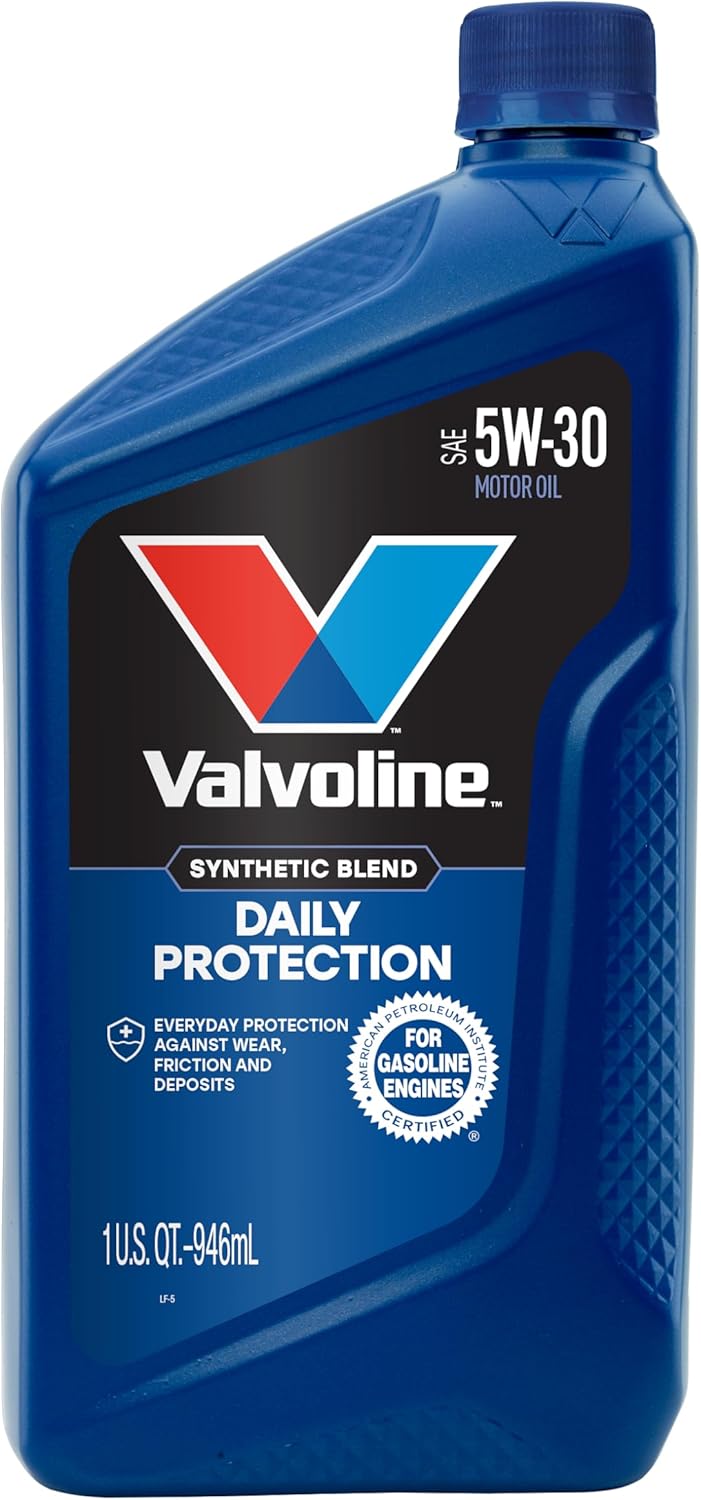
| SAE Viscosity Grade | 5W-30 |
|---|---|
| Compatible Vehicle Type | Car, Truck |
| Flash Point | 394 °F |
| Liquid Volume | 32 fluid ounces |
Valvoline Daily Protection SAE 5W-30 is a synthetic blend formulated for routine oil changes in passenger cars and light-duty trucks. It delivers wear protection, detergent action to fight deposits and sludge, and a low-friction formulation that helps with cold starts and fuel efficiency. Typical use is regular maintenance oil changes where you want a step up from conventional oil without paying for full synthetic. Notable features include industry certifications that meet ILSAC GF-7A and API SP/SN requirements and a viscosity that flows readily at low temperatures. In practice this oil keeps engines clean between services and provides dependable high-temperature protection under normal driving and light towing. Limitations compared with full synthetics are fewer premium additives and potentially shorter intervals under severe driving or high-mileage engines, so expect to follow manufacturer change intervals rather than extend them aggressively.
Best for: Buyers seeking a reliable, low-cost lubricant for scheduled maintenance who prioritize OEM-spec compliance and straightforward value over premium performance.
Less Ideal for: Drivers who regularly tow, track, run extended oil-change intervals, or want maximum protection for high-mileage engines should choose a full synthetic instead.
- Meets ILSAC GF-7A and API SP/SN performance categories for broad compatibility
- Synthetic blend offers improved cold-start flow and reduced engine wear compared with conventional oils
- Detergent additives help resist sludge and keep engines cleaner between changes
- Not a full synthetic so it lacks the extended-drain and extreme-condition protection of premium full synthetics
Verdict: Select this oil if you need a dependable, low-cost lubricant for routine changes that meets minimum OEM/API specs without extra premium additives.
3. Nissan Genuine Synthetic 0W-20 Motor Oil (6-Quart Case)
Best OEM Nissan Engine Oil

| SAE J300 Viscosity Grade | 0W-20 |
|---|---|
| Container Type | Bottle |
| Compatible with Vehicle Type | Car |
| Liquid Volume | 6 Quarts |
This is Nissan-branded synthetic 0W-20 motor oil sold as a case of six quarts and manufactured by ExxonMobil to meet recommended specifications. It is intended for engines that call for 0W-20 and is useful for routine oil changes and extended protection in normal driving conditions. The label states ILSAC GF-5 and API SN/SM/SL compliance and high-temperature protection up to 400 degrees F, so it should preserve engine clearances and lubrication behavior expected by factory service schedules. Being a factory-branded fluid gives confidence for owners who want to maintain manufacturer specifications and warranty alignment. The product is a universal-fit motor oil rather than a vehicle-specific packaged service part, so users still need to confirm viscosity and spec requirements for their Frontier I4. The main limitation is that this is a straight 0W-20 offering with no variant options, so drivers who need a different viscosity or a performance-formulated oil will need an alternative.
Best for: Buyers who prioritize using a factory-branded oil to maintain manufacturer specifications and confidence in warranty-related service, especially for routine maintenance on a Nissan Frontier I4.
Less Ideal for: Drivers seeking a higher-performance, high-mileage, or different-viscosity formulation should consider aftermarket synthetic oils with those specific features.
- Factory-branded formula meeting ILSAC GF-5 and API SN specifications
- Manufactured by ExxonMobil, a major oil producer with consistent quality control
- Supplied as a six-quart case suitable for multiple oil changes or a single change on engines requiring 6 quarts total
- Only offered in 0W-20 viscosity with no alternative viscosities or performance blends listed
Verdict: Pick this when you prefer factory-original oil to preserve factory specifications and parts warranty confidence with a product designed by the manufacturer.
4. Nissan Genuine 0W-20 Oil Change Kit with Oil Filter and Copper Washer
Best Oil Change Kit (Engine Oil)

| Viscosity Grade | 0W-20 |
|---|---|
| Liquid Volume | 5 Quarts |
| Included Filter | Nissan 15208-65F0E |
| Meets | ILSAC GF-5, API SN/SM/SL |
This Nissan oil change kit supplies everything needed for a single engine oil service: five quarts of factory-formulated 0W-20 motor oil, a genuine Nissan oil filter (15208-65F0E), and a copper drain washer. The oil meets ILSAC GF-5 and API SN/SM/SL specifications and is manufactured by ExxonMobil, so it is formulated to match Nissan recommended performance for engines specified to use 0W-20. For a DIYer performing routine maintenance on a Nissan I4 engine, the kit simplifies parts selection and ensures the correct viscosity and a factory-style filter are used. The included copper washer makes the drain plug reseal straightforward. Limitations are that the kit is a single-service pack, so you will need another kit for larger-capacity engines or back-to-back services, and it does not include items like a crushable drain plug or tools. For routine oil-and-filter changes on Nissan four-cylinder engines, this kit keeps the process quick and correctly specified.
Best for: DIY owners who want a single, factory-matched kit that provides the correct oil, OEM-style filter, and drain washer to complete a standard oil change on a Nissan four-cylinder engine.
Less Ideal for: Shops or owners servicing multiple vehicles or engines with larger oil capacities who need bulk oil or multiple filters in one purchase.
- Includes factory-formulated 0W-20 motor oil that meets ILSAC GF-5 and API SN specifications
- Comes with a genuine Nissan oil filter sized for Nissan small-filter applications
- Includes copper drain washer for a proper drain plug seal
- Single-purchase kit simplifies DIY oil-and-filter changes with matched components
- Supplies only one service quantity so additional kits are needed for larger oil capacities or multiple vehicles
- Does not include tools or a crushable drain plug for replacing the hardware itself
Verdict: Buy this kit if you want a single-purchase solution that supplies the correct oil, OEM-style filter, and drain gasket for a complete DIY oil change.
5. ACDelco GM Original Equipment dexos1 Gen 3 Full Synthetic 5W-30 Motor Oil, 5 qt
Best Full Synthetic 5W-30 Engine Oil

| Size | 5 Quarts |
|---|---|
| Viscosity | 5W-30 |
| Fit Type | Vehicle Specific Fit |
| Liquid Volume | 5 Quarts |
This ACDelco dexos1 Gen 3 full-synthetic 5W-30 is designed to protect modern gasoline engines by minimizing wear, resisting oxidation, and promoting cleaner internals. It is typically used as a direct replacement during routine oil changes and is aimed at drivers who want stronger high‑temperature stability and better cold‑start pumpability than conventional oils. Notable features include dexos1 Gen 3 certification, formulation to reduce sludge and varnish, and engineered resistance to viscosity loss from shear. In practical terms that means better protection for timing chains, improved performance during stop‑and‑go city driving, and confidence for longer drain intervals where the vehicle manufacturer permits. Limitations: this product is positioned as a GM‑validated oil and buyers should confirm dexos1 or 5W-30 recommendations for their specific engine; it does not include a warranty and is one grade only, so users needing a different viscosity or a non-dexos spec should look elsewhere.
Best for: Drivers who want a full‑synthetic 5W-30 that prioritizes high‑temperature stability, cold‑start performance, and maximum wear protection for everyday and highway driving in a modern inline‑4 engine.
Less Ideal for: Those who need a different viscosity grade, a non-dexos specification, or a product explicitly marketed for diesel engines should consider alternatives.
- Meets dexos1 Gen 3 specification for modern gasoline engines
- Full synthetic base offers improved oxidation and shear resistance
- Formulated to help prevent sludge and varnish for cleaner engine internals
- Good low-temperature flow for easier cold starts
- Marketed as GM‑validated so buyers should verify compatibility with non-GM engines
Verdict: Choose a full-synthetic 5W-30 when you want higher-temperature stability, improved cold starts, and maximum wear protection compared with conventional or blend oils.
6. Valvoline MaxLife Full Synthetic High Mileage Motor Oil SAE 5W-30 (1 qt, 2-pack)
Best High-Mileage Engine Oil

| Viscosity | 5W-30 |
|---|---|
| Type | Full Synthetic |
| Intended Mileage | Vehicles with 75,000+ miles |
| Volume per pack | 64 fluid ounces |
| Specifications | ILSAC GF-7A, API SP, API SN |
Valvoline MaxLife Full Synthetic 5W-30 is a high-mileage motor oil designed to protect engines that have accumulated significant miles. It contains anti-wear additives and a seal conditioner intended to minimize leaks and slow wear, so you can keep a long-lived engine running more smoothly between services. In use it replaces conventional or blend oils and is suitable for routine oil changes in Nissan Frontier four-cylinder engines that call for 5W-30 viscosity and factory-quality specifications. Notable features include enhanced wear protection, improved sludge resistance, and claimed extra heat defense versus industry baselines. The practical benefits are easier leak management on older seals, reduced oil consumption, and potentially steadier compression and longevity for aging valve trains. Limitations are that benefits depend on correct viscosity and service intervals and that a high-mileage formula cannot reverse severe mechanical wear; it is a preventive and restorative aid rather than a repair. Follow the Frontier owner manual for change intervals and specification compliance.
Best for: Drivers running a Nissan Frontier I4 with high mileage who want an easy factory-quality oil swap that helps condition seals and reduce oil consumption while extending engine life.
Less Ideal for: Those whose Frontier engines have advanced mechanical damage or require mechanical repairs, or owners who prefer conventional oils for budget service intervals.
- Formulated specifically for high-mileage engines with seal conditioners to help reduce leaks.
- Full synthetic base offers stronger wear and heat protection than conventional oils.
- Meets current industry specifications including ILSAC GF-7A and API SP for gasoline engines.
- Available in standard 1-quart bottles suitable for DIY oil changes.
- Claims improved sludge defense to help keep older engines cleaner.
- Not a cure for major mechanical damage; cannot restore severely worn components.
- Benefits require using the correct viscosity and following recommended service intervals.
Verdict: Opt for a high-mileage formula if the engine has significant miles and you want additives that help condition seals, reduce leaks, and restore compression performance.
7. ACDelco dexos1 Gen3 Full Synthetic 5W-30 Motor Oil — 1 qt (Pack of 6)
Best Bulk / Case Engine Oil

| Viscosity grade | 5W-30 |
|---|---|
| Specification | dexos1 Gen3 |
| Container type | Bottle |
| Liquid volume | 1 quarts |
This six-quart pack of ACDelco dexos1 Gen3 5W-30 is a full synthetic motor oil positioned for routine service on passenger cars and light trucks. It is designed to control deposits and oxidation, resist varnish and sludge, and offer improved turbocharger and exhaust particulate filter compatibility versus prior formulations. For a technician or owner changing oil frequently, the case pack keeps the same factory-quality specification across multiple changes so fill-ups remain consistent. The pack uses a vehicle-specific fit approach and lists backward compatibility with older dexos1, ILSAC GF-6 and API SP standards, which helps when replacing oil in older engines that call for 5W-30. Limitations: it is a GM-validated dexos1 Gen3 formulation rather than a Nissan-branded fluid, so buyers should confirm their Frontier I4 engine's required viscosity and spec before use; the product comes in one-quart bottles which need individual handling during service. Overall this pack is practical for anyone who wants consistent, full-synthetic 5W-30 protection and fewer reorders when maintaining multiple Frontier I4 engines or frequent oil-change schedules.
Best for: Anyone performing frequent oil changes on Nissan Frontier I4 engines or servicing multiple Frontier I4 vehicles who wants consistent, factory-quality 5W-30 protection and fewer repeat purchases.
Less Ideal for: If you prefer factory-branded Nissan fluids specified explicitly by Nissan or need a different viscosity than 5W-30 for your Frontier I4, choose an oil matched to that exact spec instead.
- Full synthetic dexos1 Gen3 formulation for strong oxidation resistance and deposit control
- Pack of six one-quart bottles reduces frequency of reordering for frequent oil changes
- Backwards compatible with dexos1, ILSAC GF-6 and API SP standards
- Formulated to help protect turbochargers and improve compatibility with exhaust particulate filters
- Pack contains individual one-quart bottles which require manual transfer and storage rather than bulk dispensing
Verdict: Select a bulk or case pack when you perform frequent oil changes or service multiple vehicles and want lower per-quart cost plus fewer repeat orders.
Choosing the Right Nissan Frontier I4 Engine Oil: Key Factors to Consider
Viscosity Grade
Viscosity grade determines how the oil flows at cold start and at operating temperature. For the Frontier I4, choosing the proper multi-grade viscosity helps preserve oil pressure on start-up while still providing a protective film at highway temperatures.
A thinner oil at low temperatures improves start-up lubrication and reduces engine wear during cold cranking. Conversely, the high-temperature rating ensures the oil does not thin excessively during sustained highway or towing use. Always match the viscosity range to the vehicle's recommended grades and consider climate when selecting between options like 0W-20 and 5W-30.
Synthetic Vs Conventional
Synthetic motor oil typically provides better oxidation resistance and thermal stability than conventional oils. That translates to longer useful oil life, reduced sludge formation, and more consistent viscosity under heat—benefits that help maintain the I4's performance over time.
Conventional oils can be acceptable for low-mileage, gentle-use scenarios, but synthetic or synthetic-blend formulations are often preferable for extending drain intervals, supporting consistent protection in hot weather, and improving cold-start flow in colder climates.
Additive Chemistry and Detergents
Additive packages control wear, neutralize acids, and keep engines clean by suspending contaminants. For the Frontier I4, an oil with robust detergent and dispersant systems reduces the chance of deposits and varnish on pistons and rings, preserving compression and efficiency.
Antioxidants and antiwear additives help protect bearings and cam train components. Choose oils that meet modern API/ILSAC specifications and include proven antiwear chemistry to reduce friction-related wear during both city stop-and-go and prolonged highway operation.
High-Temperature Shear Stability
Shear stability measures how well the oil maintains its viscosity under mechanical stress and heat. Oils that shear down lose film thickness, which reduces protection on bearings and other loaded surfaces. For the I4, consistent viscosity at operating temperature helps preserve oil pressure and reduces metal-to-metal contact.
When evaluating products, look for oils with additives and base stocks designed to resist shear and maintain their high-temperature viscosity rating over the service interval. This is especially important if you regularly drive at sustained highway speeds or tow light loads.
Cold-Start Performance
Cold-start protection is critical because most engine wear occurs in the first seconds after start-up. The oil must flow quickly enough at low temperatures to lubricate bearings and valvetrain components before oil pressure stabilizes.
Lower "W" numbers indicate better low-temperature flow. If you operate the Frontier I4 in cooler climates or take frequent short trips, favor oils with stronger cold-flow properties to reduce wear during startup.
Compatibility With Service Intervals
Your chosen oil should align with the planned service interval, whether you follow the manufacturer schedule or extend drains based on oil analysis. Some synthetic oils are formulated for extended drains, while others are positioned for standard intervals.
Consider how often you perform oil changes, the type of driving you do, and whether you want added protection for longer intervals. Also confirm the oil meets OEM specifications for warranty and compatibility with engine seals and sensors.
Recommended Viscosity Choices for Different Climates
Selecting the right viscosity depends largely on local temperatures and driving habits. For moderate climates and mixed driving, a mid-range multi-grade oil offers a balance of cold-start flow and high-temperature protection. In cooler regions, a lower winter grade helps protect during cold starts. In hotter climates or high-load driving, a slightly thicker high-temperature rating helps maintain film strength.
When deciding between two acceptable grades, err on the side of the cooler-weather option if most trips are short and temperatures dip below freezing. Conversely, choose the higher high-temperature rating if you do a lot of highway miles or light towing.
- Cold climates: prioritize lower "W" numbers for better flow at startup
- Warm climates or heavy use: prioritize higher high-temp ratings to prevent thinning
- Mixed driving: choose a balanced multi-grade that matches manufacturer guidance
Synthetic Vs Synthetic Blend: Practical Trade-Offs
Full synthetic oils generally offer superior oxidation resistance and stable viscosity, which help keep the I4 cleaner and reduce frequency of oil-related maintenance issues. Synthetic blends can deliver many benefits of full synthetics at a lower cost and still provide better protection than conventional oils.
If you plan longer drain intervals or drive in extremes, full synthetic is usually the safer choice. For routine commuting and standard service intervals, a high-quality synthetic blend can be a cost-effective alternative while still improving cold-start performance and deposit control.
- Full synthetic: best for extended drains, extreme temperatures, and heavy use
- Synthetic blend: compromise between protection and cost for everyday driving
- Conventional: acceptable for light use if following short service intervals
Maintaining Oil Health Between Changes
Regular inspections and timely oil changes are essential to preserve engine longevity. Check oil level and color during routine maintenance, and top off with the same viscosity and formulation if needed. For the Frontier I4, frequent short trips can accelerate oil contamination, so monitor conditions closely.
Consider periodic oil analysis if you intend to extend drain intervals. An analysis will reveal oxidation, contamination levels, and whether the additive package is still effective. This data-driven approach helps you avoid premature engine wear and choose an appropriate change interval.
- Check oil level monthly and before long trips
- Use the same viscosity and formulation when topping off
- Consider oil analysis for extended service intervals
Addressing High Mileage Concerns
As the Frontier I4 accumulates miles, seal hardening and increased clearances may change oil consumption and protection needs. Oils formulated for high-mileage engines include conditioners that help maintain seal pliability and can reduce leaks or consumption in older vehicles.
If your I4 has higher mileage and you notice increased consumption or minor seepage, select an oil with high-mileage considerations and monitor for changes. Keep in mind that high-mileage formulations are not a substitute for necessary mechanical repairs but can help manage aging engine characteristics.
- High-mileage oils include conditioners to support older seals
- Monitor consumption after switching to high-mileage formulations
- Address underlying mechanical issues when consumption increases significantly
How Oil Choice Affects Fuel Economy
Viscosity and friction modifiers influence how easily the engine turns, which in turn affects fuel economy marginally. Thinner oils at operating temperature can reduce internal friction and yield small fuel savings, while thicker oils may slightly increase fuel use but offer better wear protection under load.
Balance fuel economy goals against protection requirements. If you prioritize marginal MPG gains, choose an oil with a lower high-temperature viscosity that still meets protection specs. If you tow or frequently carry loads, prioritize protection over slight fuel efficiency gains.
- Lower operating viscosity can improve fuel economy slightly
- Do not sacrifice necessary protection for small MPG gains
- Consider oil viscosity relative to your typical driving and load conditions
Tips for Performing an Oil Change on the Frontier I4
When changing oil, always use the recommended oil filter and the correct oil viscosity and specification. Warm the engine briefly to improve flow, then drain the oil fully before installing the new filter. Tighten the drain plug and filter to the proper torque and refill to the specified level.
Reset any maintenance reminder if present and record the change date and mileage. Proper disposal or recycling of used oil and filters is important for environmental compliance and local regulations.
- Warm engine for a short run before draining to improve flow
- Use the correct oil filter and torque specifications
- Record change date and mileage and recycle used oil responsibly
Still looking for the perfect fit?
Select your Nissan Frontier configuration to see the most relevant Engine Oils recommendations
How We Chose the Best Nissan Frontier I4 Engine Oil
We applied a focused set of filters tailored to the Nissan Frontier I4 to identify oils likely to deliver reliable performance and engine protection. Primary evaluation criteria included viscosity compatibility with manufacturer recommendations, high-temperature shear stability to preserve film thickness under load, wear and deposit control as measured by standard industry benchmarks, and cold-flow properties to ensure good start-up protection in cooler climates.We also considered formulation type and additive packages, prioritizing oils with proven detergent and dispersant systems and those that meet or exceed applicable API and ILSAC specifications. Long-term oil life and compatibility with typical service intervals were reviewed, along with claims for fuel economy impact when relevant. Oils intended solely for racing, additive-packed aftermarket concoctions, or those not meeting basic OEM-grade certifications were excluded.In short, we filtered for engine oils with appropriate viscosity grades, robust additive chemistry, documented specification compliance, and evidence of stable performance across temperature ranges. The resulting shortlist emphasizes practical, service-focused choices for Frontier I4 owners.
Our full evaluation process is outlined in our review methodology.
FAQ
How often should I change oil in a Nissan Frontier I4?
Change intervals depend on the oil type and driving conditions. Using full synthetic typically allows longer intervals aligned with manufacturer guidance, while conventional oils require more frequent changes. Short trips, heavy loads, and dusty conditions usually call for shorter intervals.
Can I switch between 0W-20 and 5W-30 in my Frontier I4?
Switching between recommended viscosities is usually fine if both grades are approved for your vehicle and climate. Consider local temperatures and driving load; 0W-20 improves cold-start flow while 5W-30 offers greater high-temperature film strength. Stick with one viscosity once chosen for consistency.
Is synthetic motor oil worth it for a daily-driven Frontier I4?
Synthetic oil often offers better thermal stability, cleaner operation, and improved cold-start protection, which benefits daily-driven cars. If you want longer intervals or drive in temperature extremes, synthetic is generally worth the investment. For strictly short, low-load use, blends can be a compromise.
Will switching to a high-mileage oil stop oil leaks?
High-mileage oils include conditioners that can help swell seals slightly and reduce minor seepage, but they do not cure mechanical failures. If leaks are significant, mechanical repair is necessary. High-mileage formulations are best used as a maintenance aid rather than a repair solution.
What impact does oil choice have on engine noise or tappet clatter?
Oil viscosity and additive packages can influence valvetrain lubrication and hydraulic lifter operation. Using the correct viscosity usually reduces noise and maintains proper lifter function. If noise persists after an oil change, it may indicate a mechanical issue requiring diagnosis.
Should I use a different oil when towing or carrying heavy loads?
If you frequently tow or carry heavy loads, consider an oil with stronger high-temperature viscosity retention to maintain film strength under sustained load. Choosing a formulation designed to resist shear and preserve viscosity at operating temperature helps protect bearings and other loaded components.
Final Verdict
For the Nissan Frontier I4, prioritize oils that match the recommended viscosity while offering solid shear stability and detergent protection. Choose synthetic formulations when you want longer protection, better cold-start behavior, and greater resistance to thermal breakdown. Match any high-mileage or specialty formulation to the engine condition and monitor performance after switching.Ultimately, balance viscosity needs for your climate and driving style against maintenance preferences. When in doubt, select an oil that meets the required specifications and offers robust protection; that approach minimizes wear and keeps the I4 running reliably.
Explore More:
- Check out all Nissan Frontier parts & accessories
- Explore Fluids & Chemicals
- Browse all Accessories
