

Note: This article contains affiliate links. If you click on these links and make a purchase, I may earn a small commission at no extra cost to you. This helps support my research and content. Read my full affiliate disclosure here.
If you tow, drive in stop-and-go traffic, or want to extend the life of a Toyota Corolla transmission, adding a dedicated cooler can help manage heat and reduce wear. Picking the right Toyota Corolla transmission cooler matters because heat is one of the main causes of transmission breakdown and shortened fluid life. This guide shortlists the top options that fit this Corolla application and explains the practical tradeoffs to consider. Below you will find our top picks and the criteria we used to evaluate cooling performance, fitment, and installation.
Looking for other parts? See all Toyota Corolla parts & accessories.
Top Picks at a Glance
| Best overall The best all-around choice for most situations | TRQ Radiator Assembly with Aluminum Core and Transmission Oil Cooler for Toyota Corolla 2009–2013 (Japan Built, Automatic) |  |
| Best quality Built to a higher standard if you want something more solid | A-Premium Engine Coolant Radiator with Transmission Oil Cooler (fits Toyota Corolla/Matrix/Pontiac Vibe, 1.8L) |  |
| Best Value The sweet spot between price and what you get | Osakesukar 40k Transmission Oil Cooler Kit (Low Pressure Drop) |  |
| Highest Rated A top-rated pick with lots of positive feedback | ACmango 6-Pass Tube-and-Fin Transmission Cooler Kit |  |
| Most popular A crowd favorite that many people choose with confidence | PACEWALKER Transmission Oil Cooler LPD47391 with Mounting Hardware |  |
| Best Seller A high-volume bestseller chosen again and again | Readair Radiator Assembly with Transmission Oil Cooler for Toyota Corolla 2009–2013 L4 1.8L Automatic |  |
1. TRQ Radiator Assembly with Aluminum Core and Transmission Oil Cooler for Toyota Corolla 2009–2013 (Japan Built, Automatic)

| Fitment | Toyota Corolla 2009-2013 Japan built automatic |
|---|---|
| Core Material | Aluminum |
| Core Row Quantity | 1 |
| Core Thickness | 16 mm |
| Transmission Oil Cooler Type | Concentric |
This TRQ radiator assembly replaces the factory unit on Japan-built Toyota Corolla models from 2009 through 2013 with automatic transmission. It combines an aluminum core and plastic tanks with an integrated concentric transmission oil cooler so you replace both cooling functions in one unit. Typical use is a one-for-one swap when the original radiator leaks or the transmission cooler fails; TRQ ships it preassembled to simplify installation and match factory mounting points. Notable features include a single-row, 16 mm core, bottom-left inlet and bottom-right outlet, and included transmission cooler fittings. In practice the aluminum core and cross-flow design provide efficient engine cooling while the internal oil cooler handles transmission cooling without adding a separate component. Important limitations are that the radiator cap and engine oil cooler are not included, and some buyers report the transmission line fittings may not match every factory hose end, which can require swapping fittings or minor adapter work. Expect a straightforward replacement if you confirm Japan-built Corolla fitment before purchase.
Best for: Balanced all-round buyers who want a single, factory-quality replacement that restores both engine and transmission cooling in a Toyota Corolla without specialty upgrades.
Less Ideal for: Drivers seeking performance upgrades, custom transmission cooling setups, or complete cooling system overhauls should look for dedicated high-capacity coolers instead.
- Direct-fit design for Japan-built 2009–2013 Corolla automatics simplifies installation.
- Aluminum core with cross-flow layout improves engine cooling efficiency.
- Integrated concentric transmission oil cooler eliminates separate cooler plumbing.
- Preassembled unit uses factory-style mounting to reduce modification needs.
- Radiator cap and engine oil cooler are not included with the assembly.
- Transmission oil line fittings may not match every factory hose end and could need parts swapping.
Verdict: A convenient, factory-style radiator with an integrated transmission oil cooler that suits most Corolla owners looking for a reliable direct replacement.
2. A-Premium Engine Coolant Radiator with Transmission Oil Cooler (fits Toyota Corolla/Matrix/Pontiac Vibe, 1.8L)

| Transmission Oil Cooler Included | Yes |
|---|---|
| Engine Oil Cooler Included | No |
| Inlet Diameter | 1-3/8 inch |
| Outlet Diameter | 1-3/8 inch |
This A-Premium radiator replaces the factory coolant core and includes a built-in transmission oil cooler, intended as a direct-fit replacement for 1.8L Toyota Corolla, Matrix and Pontiac Vibe models with automatic transmissions. It is used the same way as a stock radiator: remove the old assembly, transfer any necessary sensors or mounting brackets, and install the unit using factory hoses and fittings. Notable features include the integrated transmission cooler, a full core matched to Corolla fitment, and multiple inlet/outlet sizes that mirror OEM connections for straightforward installation. In practice the unit restores engine cooling and provides transmission cooling in one assembly, which simplifies repairs and reduces parts swapping. Some buyers report consistently accurate fit and durable performance while a small number report leaks or faulty sealed ports, so careful pre-install inspection is wise. The product carries a one-year unlimited-mileage guarantee, making it attractive for performance-focused owners who need reliable cooling and transmission oil cooling in a single, factory-style replacement.
Best for: Performance-oriented buyers who prioritize restoring or maintaining reliable engine and transmission cooling with a factory-style replacement that simplifies repairs and keeps installation time low.
Less Ideal for: Drivers seeking a heavy-duty or high-capacity aftermarket radiator for track use or extreme towing should consider purpose-built performance radiators instead.
- Integrated transmission oil cooler eliminates the need for a separate cooler and lines
- Designed to match factory mounting points for direct-fit installation on specified Corolla/Matrix/Vibe models
- Multiple positive owner reports of fitment and packaging reduce installation guesswork
- Backed by a one-year unlimited-mileage guarantee
- A minority of users reported leaks from sealed ports or early failures
- Not suitable if you need an upgraded high-capacity performance radiator beyond factory-equivalent cooling
Verdict: A factory-style replacement radiator with an integrated transmission cooler that fits 1.8L Corolla/Matrix/Vibe models and is best for buyers who want a consolidated, reliable cooling solution rather than a high-capacity performance upgrade.
3. Osakesukar 40k Transmission Oil Cooler Kit (Low Pressure Drop)

| Model | Transmission Oil Cooler Kit |
|---|---|
| Exterior | aluminium alloy |
| Manufacturer | Osakesukar |
This Osakesukar transmission oil cooler kit is a brazed-aluminum add-on cooler intended to reduce transmission fluid temperatures under load. It installs with the provided mounting hardware and hoses and is aimed at towing and heavy-duty cooling protection. In use it increases the heat-dissipation area with close fin spacing to promote airflow through the core, which helps drop temps when the transmission is stressed. The kit is practical for drivers who want to protect a transmission from repeated high-temperature cycles without replacing factory components. Reported benefits include noticeable temp reductions while towing, and the aluminum construction resists corrosion and high temperatures. Downsides to be aware of are variable long-term reliability across units and the supplied hoses and fittings, which some users replaced with higher-quality lines; professional installation is recommended if you are not experienced with transmission plumbing. Because it is an aftermarket part, monitoring for leaks after installation is prudent.
Best for: Practical optimizers looking to extend transmission life on a budget by adding extra cooling before failures occur and who prioritize measurable temperature reduction over brand prestige.
Less Ideal for: Drivers who want a guaranteed long-term factory-quality replacement or who prefer a plug-and-play, warranty-backed dealer solution should consider alternatives.
- Brazed aluminum core for good thermal conductivity and corrosion resistance
- Low pressure drop design to minimize transmission strain while increasing cooling
- Includes mounting hardware and hoses for a complete install
- Fin spacing and heat-sink design maximize airflow and heat dissipation
- Mixed reports on long-term durability with some units developing leaks
- Supplied hoses and fittings may be lower quality and could need replacement
Verdict: A cost-conscious aftermarket cooler that can significantly lower transmission temps for demanding use, but buyers should watch for variable durability and consider upgrading hoses during installation.
4. ACmango 6-Pass Tube-and-Fin Transmission Cooler Kit

| Core type | 6-pass tube-and-fin |
|---|---|
| Compatible line size | 5/16 inch ID |
| Material | T-6061 aluminum |
| Hose working pressure | 145 psi |
This ACmango 6-pass tube-and-fin cooler is a compact transmission heat exchanger meant to lower fluid temps for vehicles driven hard or towing light loads. It installs in front of the radiator or A/C condenser using the included brackets, foam pads, hose, clamps, and adapter, and the high-pressure hose and turbulator-equipped tubes direct fluid for improved heat transfer. For a Toyota Corolla, this cooler can help keep transmission temperatures down during steep hills, heavy city driving, or prolonged highway runs where the factory cooling is marginal. The aluminum construction and pressure testing claims suggest decent corrosion resistance and reliability under normal road use. Limitations are its universal fit approach: the supplied 5/16 inch line and fittings may require additional adapters or different routing on some Corolla model years, and the smaller 6-pass core is not as aggressive as larger aftermarket coolers for heavy towing or sport use. Installation is straightforward for a competent DIYer but may need custom mounting to avoid airflow or clearance issues on some Corollas.
Best for: Reliability-focused buyers who prioritize preserving transmission life on daily-driven Corollas and want an affordable, durable add-on to keep operating temperatures conservative.
Less Ideal for: Drivers who frequently tow heavy loads, run the car on a track, or need maximum cooling capacity should choose a larger, dedicated high-flow cooler instead.
- 6-pass tube-and-fin design improves fluid routing for better heat transfer than a simple line cooler
- Includes hose, clamps, mounting rods and clips so no major extra parts are required for a basic install
- Aluminum construction and factory pressure testing reduce risk of early leaks under normal operating conditions
- Compact footprint fits easily in front-of-radiator locations without large trimming
- Supplied hose and fittings are universal 5/16 inch and may not match every Corolla transmission line without adapters
- Not as large or heavy-duty as high-capacity coolers intended for constant towing or track use
Verdict: A compact, reliable transmission cooler that helps lower fluid temps on Toyota Corolla daily driving but may need adapters or a larger core for heavy-duty cooling needs.
5. PACEWALKER Transmission Oil Cooler LPD47391 with Mounting Hardware
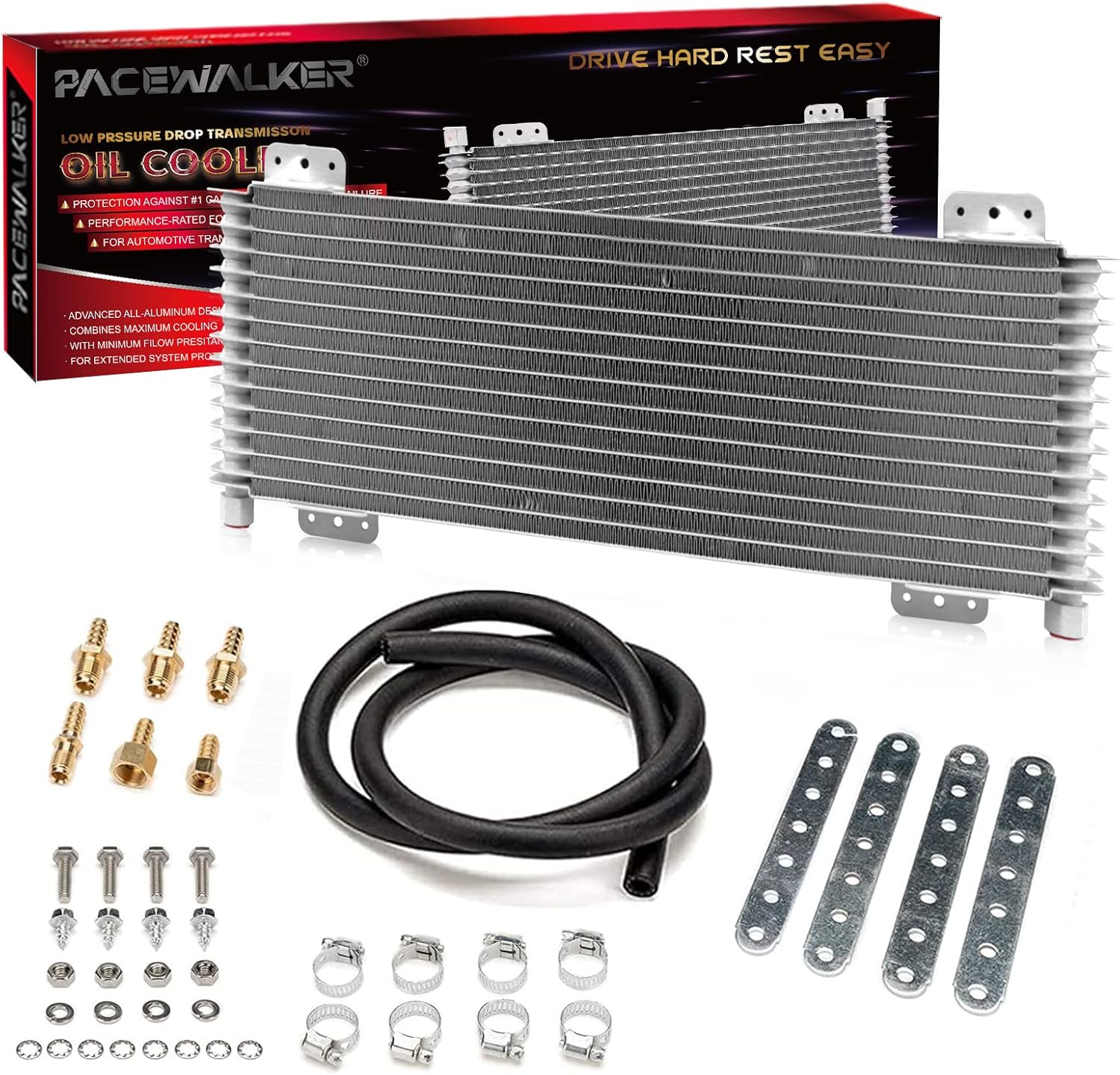
| Material | Stainless Steel |
|---|---|
| Recommended Uses For Product | Automotive |
| Specific Uses For Product | Heavy-duty towing and racing |
| Unit Count | 1.0 Count |
The PACEWALKER LPD47391 is an aftermarket transmission oil cooler intended to pull heat from transmission fluid and lower operating temperatures. It installs in front of the radiator or condenser using the included mounting hardware and is commonly used to support heavier loads or reduce heat in demanding driving. The stainless steel core and tube design provides increased surface area for cooling, and many owners report noticeable drops in transmission temperature after installation. The kit includes basic hoses and fittings but several users found the supplied hose quality and connectors to be weaker than expected, so upgrading to dedicated transmission-grade lines and AN fittings is a common follow-up. Fitment requires some DIY adjustments since the unit is marketed as a universal cooler rather than a Corolla-specific part, so expect to fabricate or adapt mounts and routing on a Toyota Corolla. When properly installed with higher-quality lines the cooler gives reliable temperature control, but the need to replace the supplied hoses and perform custom mounting adds time and cost compared with a vehicle-specific factory-quality replacement.
Best for: A convenience-driven buyer who wants a straightforward cooling upgrade to protect a Corolla used for occasional towing or heavier-than-normal driving and prefers a kit they can install without sourcing many extra parts.
Less Ideal for: Drivers who need a direct-fit, vehicle-specific replacement or those unwilling to perform minor fabrication and upgrade hoses should consider a model tailored for the Corolla or a factory-quality option instead.
- Stainless steel construction for improved durability and corrosion resistance.
- Designed to lower transmission fluid temperatures under heavy load or towing.
- Comes with basic mounting hardware to simplify initial installation.
- Large cooling core suitable for higher-duty applications compared with typical factory coolers.
- Included hoses and fittings are reported as low quality and may fail under prolonged stress.
- Universal design requires modification or custom mounting to fit a Toyota Corolla without vehicle-specific brackets.
Verdict: A capable universal cooler that lowers transmission temps effectively for a Corolla but often needs upgraded hoses and some custom mounting to be a long-term, worry-free solution.
6. Readair Radiator Assembly with Transmission Oil Cooler for Toyota Corolla 2009–2013 L4 1.8L Automatic

| Vehicle fitment | Toyota Corolla 2009-2013 L4 1.8L Automatic (Japan built) |
|---|---|
| Core material | Aluminum multi-louvered core |
| Transmission cooler | Brass integrated cooler |
| Tanks | PA66 GF30 inlet/outlet tanks |
This Readair radiator assembly replaces the factory unit on Toyota Corolla 2009–2013 L4 1.8L automatic cars and integrates a brass transmission oil cooler into the radiator core. It is designed as a direct fit for Japan-built Corollas and uses a high-density, multi-louvered aluminum core with TIG-welded construction and reinforced inlet/outlet tanks to improve cooling efficiency and resist leaks. Typical use is a full radiator swap when the original is leaking, clogged, or the transmission cooler has failed. The kit is marketed as leak-tested and coated for corrosion resistance, which helps in long-term service. Installation is straightforward for a competent DIYer or a technician since it mounts like the factory part, though buyers should expect routine steps such as transferring brackets and hoses. Some users report excellent fit and durability while others report rare quality-control failures, so buyers seeking the lowest risk may want to inspect the unit on delivery and keep the seller contact info handy. The included transmission cooler saves time versus adding an external unit but does mean replacing both functions together if only one system needs service.
Best for: Risk-averse mainstream buyers who prioritize a factory-style, one-piece replacement that restores both engine cooling and the factory transmission cooler without custom work.
Less Ideal for: Owners who want to replace only a single component separately or who prefer premium-brand performance cores and factory-level warranty support should consider alternatives.
- Direct-fit design specifically for Toyota Corolla 2009–2013 L4 1.8L automatic for straightforward installation
- Integrated brass transmission oil cooler removes need for a separate cooler installation
- High-density multi-louvered aluminum core and TIG-welded joints intended for improved cooling and leak resistance
- Coated core and treated tanks for added corrosion protection
- Some customer reports of early failures indicate occasional quality-control inconsistency
- If only the transmission cooler or only the radiator needs replacement, you must replace the entire assembly
Verdict: A cost-effective, direct-fit radiator assembly that restores both engine cooling and the transmission cooler for 2009–2013 Toyota Corolla owners, but inspect on arrival due to occasional quality inconsistencies.
Choosing the Right Toyota Corolla Transmission Cooler: Key Factors to Consider
Cooling Capacity and Heat Rejection
Cooling capacity determines how effectively a cooler lowers transmission fluid temperature under sustained load. A unit with higher heat rejection can maintain safer fluid temperatures during towing, prolonged idling, or hot-weather driving. Consider how much temperature drop the cooler can achieve at typical Corolla operating flows, since a modest radiator-mounted heat exchanger may not be enough for heavy-duty use.
Look for designs that increase surface area and airflow without drastically raising installation complexity. Better heat rejection generally reduces wear on internal transmission components and can preserve fluid life, but it may add bulk or require a location with good airflow.
Fitment and Mounting Options
A cooler that fits the Corolla's available mounting points or brackets will be far easier to install and more secure. Check whether the cooler can mount in front of the radiator, behind the bumper, or at another location that provides adequate airflow while avoiding contact with steering or crash structures. Some kits include vehicle-specific brackets or universal mounting hardware.
Mounting location affects performance because airflow and exposure to road debris vary. A cooler placed where airflow is restricted will underperform, while one placed too close to low-clearance areas may be prone to damage.
Connection Type and Compatibility With Lines
How the cooler connects to the Corolla transmission lines matters for leak-free operation and ease of service. Some coolers use barbed fittings that clamp to flexible lines, while others use threaded fittings or quick-disconnects. Ensure the chosen cooler is compatible with your transmission cooler lines or that an appropriate transmission cooler kit is available.
Mismatched fittings can necessitate adapters or line replacement, which increases install time and potential failure points. Prefer connection options that provide a tight seal and allow straightforward routing without sharp bends.
Heat Exchanger Design and Materials
The internal design of the heat exchanger affects efficiency and longevity. Tube-and-fin or multi-pass designs offer different balances between flow restriction and heat transfer. Materials such as aluminum resist corrosion and transfer heat well but should be paired with quality brazing and protective coatings for road salt environments.
A robust heat exchanger reduces the risk of leaks and supports consistent cooling over time. Consider construction details like fin spacing and core thickness since they influence debris tolerance and maintenance needs.
Ease of Installation and Serviceability
Installation complexity ranges from simple inline swaps to installs that require bumper removal or custom brackets. Factor in whether you can route lines without kinks, access fittings with basic tools, and secure the cooler in a protected location. Some products come as a comprehensive install package, while others are minimal and require additional hardware.
Serviceability also matters for future maintenance. Options that allow easy access to fittings and that avoid permanent modifications will save time and reduce long-term costs.
Durability and Protection Against Road Hazards
Durability is important because coolers mounted ahead of the vehicle are exposed to stones, road debris, and corrosion. Look for protective features such as sturdier fins, guards, or a sealed construction that resists punctures and environmental damage. Corrosion-resistant coatings and quality end tanks improve long-term reliability.
A balance between slim profile for airflow and robust protection against impacts will extend service life and prevent unexpected leaks that could lead to transmission overheating.
How We Chose the Best Toyota Corolla Transmission Cooler
We focused on transmission coolers designed to fit the Toyota Corolla application or compatible mounting locations and that provide measurable reductions in fluid temperature. Our selection criteria emphasized cooling capacity under sustained load, fitment and mounting options for the Corolla, construction quality and corrosion resistance, and how straightforward the unit is to install using common transmission cooler lines or a kit. We also considered heat exchanger design, airflow requirements, and whether the cooler supports inline or external mounting without interfering with existing vehicle components. Products were excluded if they lacked clear Corolla-compatible fitment information, used low-quality materials, or required major custom fabrication for installation. The final list prioritizes units that balance effective cooling, durable construction, and realistic installation effort for a Corolla owner.
Our full evaluation process is outlined in our review methodology.
FAQ
Do I need an external cooler for a Toyota Corolla?
It depends on how you use the vehicle. For normal commuting a Corolla's factory cooling may be adequate. If you frequently tow, drive in heavy traffic, or see high under-hood temperatures, an external cooler often helps lower fluid temperatures and reduce thermal stress on the transmission.
How hard is it to install a transmission cooler on a Corolla?
Installation difficulty varies by cooler design and mount location. Many inline coolers can be installed with basic tools and require routing two lines and securing the unit. Some installs need bumper or splashshield removal for access. Using a transmission cooler kit that matches connection types usually simplifies the process.
Where should a transmission cooler be mounted on a Corolla?
Mount the cooler where it receives steady airflow while staying protected from direct road impacts. Common locations include in front of the radiator or behind the front fascia, provided airflow is adequate. Avoid tight areas that force sharp bends in the lines or put the cooler at risk of being struck by debris.
Will an added cooler change transmission fluid change intervals?
An effective cooler can reduce operating temperatures and potentially extend fluid life, but it does not eliminate the need for regular maintenance. Follow manufacturer guidance for fluid intervals and consider inspecting fluid condition more regularly if the vehicle sees heavy use.
Can a cooler cause problems if installed incorrectly?
Yes. Incorrect line routing, improper fittings, or insufficient mounting can lead to leaks, restricted flow, or physical damage. These issues can increase operating temperatures or cause loss of fluid, so proper installation and leak checks are important after any work.
Conclusion
Choosing the right cooler means balancing cooling performance, fitment for the Corolla, and realistic installation effort. Prioritize units that offer measurable heat rejection, compatible fittings for your transmission cooler lines, and durable construction for road exposure.Be mindful of tradeoffs such as core size versus mounting space and whether a unit requires additional brackets or line adapters. Concentrate on cooling capacity, secure mounting, and reliable connections to get the best long-term protection for the transmission.
Explore More:
- Check out all Toyota Corolla parts & accessories
- Explore Transmission Coolers Maintenance & Repair Guides
- Explore Transmission & Drivetrain
- Browse all Auto Parts
