

Note: This article contains affiliate links. If you click on these links and make a purchase, I may earn a small commission at no extra cost to you. This helps support my research and content. Read my full affiliate disclosure here.
If you drive a Mercedes-Benz ML-Class and tow, carry heavy loads, or regularly face hot weather, upgrading your transmission cooling can reduce wear and maintain consistent shift performance. Choosing the right transmission cooler matters because excessive heat shortens fluid life and can accelerate component wear, leading to costly repairs and degraded drivability.This guide shortlists the top options for the ML-Class, focusing on units that balance cooling capacity, fitment, and installation practicality. We evaluated thermal performance, compatibility with ML-Class transmissions, and ease of installation to produce a concise set of recommended solutions. Read on to see the top picks and how they were assessed before the product list.
Looking for other parts? See all Mercedes-Benz ML-Class parts & accessories.
Top Picks at a Glance
| Best Quality Built to a higher standard if you want something more solid | A-Premium Engine Coolant Radiator Assembly with Transmission Oil Cooler for Mercedes-Benz W166/X166 |  |
| Best Value The sweet spot between price and what you get | Flashpower 30" Dual-Pass Aluminum Finned Transmission Cooler |  |
| Best budget The cheapest option that still gets the job done reliably | WZruibo 40k Transmission Oil Cooler Kit with Mounting Hardware |  |
| Highest Rated A top-rated pick with lots of positive feedback | SINTLY LPD47391 Low Pressure Drop 40k Transmission Oil Cooler |  |
| Most Popular A crowd favorite that many people choose with confidence | KOROP LPD47391 40K Low-Pressure-Drop Transmission Oil Cooler Kit |  |
| Best Seller A high-volume bestseller chosen again and again | JEGS High Performance Transmission Cooler with 11" Fan and 6 AN Fittings |  |
1. A-Premium Engine Coolant Radiator Assembly with Transmission Oil Cooler for Mercedes-Benz W166/X166

| Transmission Oil Cooler Included | Yes |
|---|---|
| Inlet Diameter | 1-1/2 inch |
| Outlet Diameter | 1-1/2 inch |
This radiator assembly combines the engine coolant core with an integrated transmission oil cooler to replace the factory unit on select Mercedes-Benz ML/GL/GLE/GLS W166 and X166 vehicles. It is typically used as a direct replacement during a coolant system or radiator repair where the transmission cooler is also required, eliminating the need to fit a separate cooler. Notable features include the built-in transmission oil cooler, vehicle-specific inlet and outlet diameters, and a one-year unlimited-mileage guarantee. In practice the assembly streamlines installation for shops and experienced DIYers because it bundles both cooling functions in one unit and matches the OEM reference numbers. Limitations include occasional reports of missing fittings and uneven fitment on some vehicles, which may require sourcing small plugs or minor adjustments at installation. Buyers should also verify the exact model year and transmission before ordering to ensure compatibility.
Best for: Performance-oriented owners focused on restoring factory-level cooling and transmission cooling performance quickly and with fewer components, especially those who want a combined replacement part to minimize installation time.
Less Ideal for: Buyers who prefer to replace cooling and transmission components separately or who lack experience handling potential minor fitment adjustments should consider alternatives or professional installation.
- Integrated transmission oil cooler removes need for separate cooler installation
- Sold as a complete radiator assembly for faster replacement and fewer parts
- Matches factory reference numbers for straightforward vehicle identification
- One-year unlimited-mileage guarantee for peace of mind
- Some buyers reported missing coolant plugs or minor fitment issues requiring additional parts
- May need verification of exact model-year fitment due to vehicle-specific differences
Verdict: A single-piece replacement radiator that includes a transmission oil cooler to simplify repairs and restore cooling performance on select Mercedes-Benz W166/X166 models.
2. Flashpower 30" Dual-Pass Aluminum Finned Transmission Cooler

| Length | 30" |
|---|---|
| Fittings | Two 1/4" NPT |
| Core material | Aluminum |
| Configuration | Dual pass |
This Flashpower 30" dual-pass transmission cooler is a straightforward aluminum finned unit intended to add dedicated cooling capacity for automatic transmissions. It is typically mounted ahead of the radiator or behind the grille and plumbed inline with the transmission cooler lines using the two 1/4" NPT ports supplied. The dual-pass design increases fluid contact time and the finned aluminum core improves heat rejection versus radiator-only cooling, which helps maintain lower transmission fluid temperatures during towing, steep grades, or spirited driving. Buyers report clean welds, solid mounting tabs, and reliable sealing when fittings are installed properly. Limitations include the universal fit nature of the unit which means you may need adapters, AN fittings, or custom mounts for some ML-Class installations, and the provided port size may require thread adapters for larger hose fittings. For a budget-conscious upgrade that adds measurable cooling capacity, this cooler gives good performance, but expect some installation work to adapt it to Mercedes-Benz ML-Class plumbing and mounting points.
Best for: Practical optimizers who want an affordable, effective aftermarket cooler to lower transmission temperatures without paying for a vehicle-specific kit.
Less Ideal for: Owners seeking a plug-and-play, vehicle-specific Mercedes‑Benz ML-Class cooler with factory-style fittings and brackets should consider application-specific options instead.
- Dual-pass flow path increases fluid dwell time for better heat transfer.
- Aluminum finned core provides improved heat rejection compared with radiator-only cooling.
- Welded mounting tabs and machine-cut holes simplify bracket attachment and fitting installation.
- Compact 30-inch length fits into many grille or radiator-adjacent locations for additional cooling.
- Universal design requires adapters or custom brackets for vehicle-specific plumbing and mounting.
- Supplied 1/4" NPT fittings may be smaller than some factory lines and could need thread or hose adapters.
Verdict: A cost-effective dual-pass aluminum cooler that delivers noticeable transmission temperature reduction for drivers who are comfortable adapting a universal unit to their ML-Class.
3. WZruibo 40k Transmission Oil Cooler Kit with Mounting Hardware

| Brand Name | WZruibo |
|---|---|
| Part Number | 47391 |
| Model Number | LPD47391 |
| Item Form | Liquid |
The WZruibo 40k Transmission Oil Cooler Kit is an aftermarket add-on that routes transmission fluid through a dedicated finned cooler to lower operating temperature during towing or heavy use. It is typically mounted in front of the vehicle with the included hardware so airflow across the core removes heat that would otherwise stress the transmission. The listing emphasizes heavy-duty cooling capacity for high gross vehicle weight applications and includes fittings and rubber lines to complete a basic installation. In practice this cooler can substantially drop transmission temps when placed where it gets good airflow, which helps prolong transmission life and stabilize shift behavior under load. Common limitations are quality control on the supplied hoses and fittings and occasional leaks reported by users, so plan to fit higher-grade fluid lines and check all connections during installation. Installation requires basic mechanical skills and a backup wrench on the fittings to avoid twisting the cooler ports.
Best for: Budget-conscious owners looking to add extra transmission cooling for towing or heavy-duty use on a Mercedes-Benz ML-Class who prioritize cost-effective protection over a factory-style, plug-and-play solution.
Less Ideal for: Drivers seeking a factory-equivalent direct-fit cooler or those who do not want to source upgraded hoses or perform minor plumbing modifications should consider alternatives.
- Effective at lowering transmission fluid temperatures when mounted with solid airflow.
- Includes mounting hardware for a straightforward exterior installation.
- Large core capacity advertised for heavy towing and sustained load cooling.
- Supplied rubber lines and some fittings have reported failures and may need replacement.
- Quality control issues reported by multiple users, including leaks.
- No vehicle-specific hoses or adapters supplied for factory-fit connections.
Verdict: A low-cost, high-capacity aftermarket cooler that can cut transmission temps for ML-Class towing but expect to upgrade hoses and verify fittings for long-term reliability.
4. SINTLY LPD47391 Low Pressure Drop 40k Transmission Oil Cooler

| Model | LPD47391 40k Transmission Oil Cooler |
|---|---|
| Material | Brazed Aluminum |
| Packaged Weight | 5.74 pounds |
The SINTLY LPD47391 is a low-pressure-drop, brazed-aluminum transmission cooler intended to reduce transmission fluid temperatures under load. It is typically mounted in front of the radiator or A/C condenser and plumbed into the transmission cooler lines to act as an auxiliary or replacement cooler for towing and heavy use. The cooler’s large core area and brazed construction help move heat away from fluid with less flow resistance, which preserves line pressure and avoids stressing factory cooling circuits. Included mounting hardware and a full-size core make it effective for sustained towing or steep grades where the ML-Class can push its transmission hard. Buyers should note the mixed long-term durability reports from users, including occasional leaks and a reported failure after roughly a year, so professional installation and careful routing/protection are advisable. Fitment for Mercedes-Benz ML-Class models requires confirming line locations and space behind the front fascia since the core is relatively large.
Best for: Reliability-focused owners who prioritize preventing transmission overheating during towing or heavy use and prefer a cost-effective, factory-replacement-style auxiliary cooler.
Less Ideal for: Owners who cannot accommodate a larger aftermarket core in the ML-Class front-end or who prefer a premium-brand lifetime-tested cooler should consider alternatives.
- Brazed aluminum construction for efficient heat transfer and corrosion resistance
- Low pressure drop design reduces flow restriction and preserves transmission line pressure
- Large core area provides strong continuous cooling under towing or heavy load
- Includes mounting hardware for a straightforward install in common front-end locations
- Some users report leaks or cracking after extended use indicating inconsistent long-term durability
- Core size may be too large for tight front-end spaces on certain ML-Class model years
Verdict: A budget-minded, brazed-aluminum low-pressure-drop cooler built to lower transmission temperatures during heavy towing and continuous use.
5. KOROP LPD47391 40K Low-Pressure-Drop Transmission Oil Cooler Kit

| Material | Alloy Steel, Aluminum |
|---|---|
| Connector Type | Flare |
| Thread Type | NPT |
| Thread Size | 3/8 |
This KOROP LPD47391 40K transmission cooler is a brazed-aluminum, low-pressure-drop unit designed to lower transmission fluid temperatures in vehicles used for towing or heavier duty use. It installs as an inline cooler and is supplied with brackets, bolts, fittings, and hoses to simplify mounting in common aftermarket locations. The cooler’s brazed construction and advertised 30 percent higher heat transfer translate to noticeably lower operating temps for drivers who tow or push their transmission hard. Included hardware and multiple fittings make it convenient for a one-stop upgrade when replacing or supplementing a factory cooler. Some buyers report inconsistent hose quality and occasional need to modify mounting points or fittings to match factory lines, so expect minor installation work on certain models. For Mercedes-Benz ML-Class owners looking to reduce transmission operating temperatures during towing or spirited driving, this kit provides a practical cooling improvement without needing custom fabrication.
Best for: Convenience-driven owners who want a straightforward, bolt-on upgrade to lower transmission temps during towing or heavier use without sourcing additional parts.
Less Ideal for: Drivers who prefer an exact factory-fit replacement or who need vehicle-specific, plug-and-play coolers with guaranteed factory fittings should consider model-specific alternatives.
- Brazed aluminum construction improves durability and heat transfer
- Low-pressure-drop design helps maintain line pressure while increasing cooling
- Comes with mounting hardware and assorted fittings for easier installation
- Advertised to provide up to 30% more cooling versus standard coolers
- Supplied hoses have been reported to fail on some units, requiring replacement
- Fitting type and mounting brackets may need modification to match factory connections
Verdict: A convenient, higher-capacity brazed-aluminum transmission cooler kit that lowers operating temperatures with included hardware for easier installation.
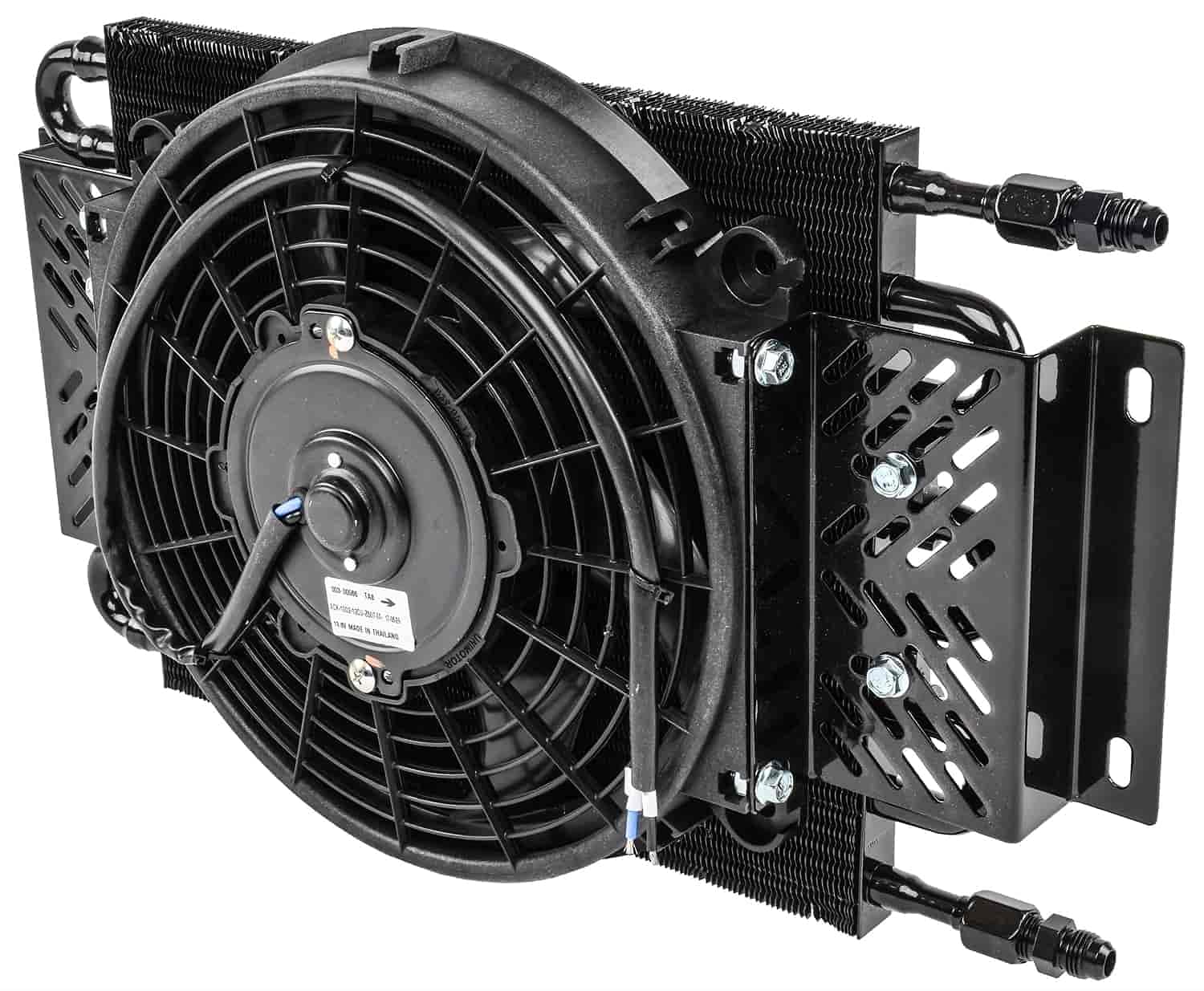
6. JEGS High Performance Transmission Cooler with 11" Fan and 6 AN Fittings
| Cooling Method | Air |
|---|---|
| Air Flow Capacity | 500 Cubic Feet Per Minute |
| Maximum Rotational Speed | 2500 RPM |
| Power Connector Type | 6-Pin |
| Wattage | 672 watts |
This JEGS transmission cooler is a compact kit that pairs a bar-and-plate cooler with an 11-inch fan capable of 500 CFM airflow and reversible pusher/puller operation. It is intended for use where extra transmission cooling is needed, mounting in front of the radiator or in an airflow path and plumbed with the supplied -6 AN union fittings. The fan’s 5.6 amp draw and 6-pin connector make wiring straightforward and the unit’s small footprint fits tighter engine bays. In practice the cooler helps lower fluid temperatures under towing or heavy-load conditions, but real-world effectiveness depends on mounting location and vehicle airflow. Several users report fan failures and mixed durability impressions, so expect variable longevity compared with higher-end aftermarket coolers. Installation is typical for an add-on cooler and may require adapters or custom hoses for dealer-style Mercedes-Benz ML-Class lines. Choose this for a budget-conscious cooling boost but be prepared to verify fan wiring and mounting for reliable long-term service.
Best for: Risk-averse mainstream buyers seeking an affordable transmission cooling upgrade for occasional towing or heavy-duty use on an ML-Class who prioritize a straightforward, space-saving install and immediate temperature control.
Less Ideal for: Drivers wanting a guaranteed factory-quality, long-term solution or those seeking a model-specific plug-and-play cooler tailored to Mercedes-Benz ML-Class without any modification.
- Compact footprint fits tighter engine bays where space is limited.
- Reversible fan can be set as a pusher or puller to match available airflow.
- Includes -6 AN union fittings and mounting brackets for straightforward plumbing and attachment.
- High airflow fan (500 CFM) provides active cooling when mounted in the airstream.
- Some users report early fan failures indicating inconsistent long-term reliability.
- Not vehicle-specific; may require hose/adapters for Mercedes-Benz ML-Class connections and professional fitment for best results.
Verdict: A compact, budget-friendly transmission cooler that can lower fluid temperatures for ML-Class use but may require careful installation and carries mixed reports on fan durability.
Choosing the Right Mercedes-Benz ML-Class Transmission Cooler: Key Factors to Consider
Cooling Capacity
Cooling capacity determines how effectively a unit lowers transmission fluid temperature under load. Higher capacity units typically feature denser fin arrays, larger core surface area, or multi-pass flow paths that increase heat transfer. In practical terms, greater cooling capacity helps prevent temperature spikes during towing or steep climbs, which reduces thermal breakdown of fluid and extends component life.
When evaluating this factor, consider the typical loads you place on the vehicle and whether you frequently operate in hot climates. Overengineering for light, city-only use adds weight and complexity, while insufficient capacity for heavy towing can leave you vulnerable to overheating.
Fitment and Compatibility
Fitment is critical for the ML-Class because transmission cooling lines and mounting points vary by model year and powertrain. A cooler that matches factory hose sizes, uses supplied adapters, or is designed specifically for the model reduces the need for cutting or custom brackets. Proper compatibility minimizes leak risk and ensures consistent flow rates through the transmission cooler circuit.
When assessing fitment, check hose connection types, required mounting locations, and whether the cooler obstructs airflow or other service points. A well-matched unit preserves system integrity and simplifies installation.
Installation Complexity
Installation complexity affects both cost and the likelihood of successful implementation. Some coolers attach inline to existing transmission cooler lines with plug-and-play fittings, while others require additional mounting brackets, hose splicing, or relocation of components. Simpler installs reduce the chance of mistakes like incorrect hose routing or loose clamps that can cause leaks.
Consider whether you will install the cooler yourself or use a technician. If professional installation is not an option, prioritize units that include complete hardware, clear instructions, and hose fittings sized for the ML-Class to minimize troubleshooting.
Materials and Durability
Materials influence corrosion resistance, longevity, and the cooler's ability to withstand thermal cycling. Brazed aluminum cores and corrosion-resistant fittings offer a good balance of weight and durability. Plastic end tanks or low-grade metals may be more vulnerable to cracking or galvanic corrosion over time, especially if exposed to road salt or debris.
Durable construction also reduces the risk of leaks at seams and fittings. Look for robust hose terminations, solid mounting feet, and protective fin designs that resist clogging and physical damage from road debris.
Fluid Flow and Pressure Drop
The cooler must allow sufficient fluid flow without causing excessive pressure drop, which can impair transmission lubrication and cooling circuit performance. Overly restrictive cores or small-diameter fittings may reduce flow rates and create hot spots in the transmission.
Review specifications or documentation for recommended flow rates and ensure the cooler's internal passage design and hose sizes are compatible with the ML-Class transmission pump output. Balanced flow preserves cooling efficiency while maintaining safe operating pressures.
Serviceability and Maintenance
Ease of inspection, cleaning, and repair affects long-term ownership. Designs that allow access to mounting hardware, have replaceable hoses or fittings, and resist clogging simplify routine checks and repairs. Consider whether the unit can be flushed or visually inspected without major disassembly.
Good serviceability reduces downtime and maintenance costs. If the cooler is mounted in a protected yet accessible area, you can more easily detect early signs of leakage or damage and address them before they become serious.
How We Chose the Best Mercedes-Benz ML-Class Transmission Cooler
We prioritized options that are specifically compatible with Mercedes-Benz ML-Class transmission plumbing and mounting layouts, ensuring straightforward fitment without extensive modification. Thermal capacity was a core criterion, measured by manufacturer-stated heat rejection and design features such as fin density and internal flow passages. Ease of installation was judged by whether the unit uses the vehicle's existing cooler lines, provided mounting brackets, and clear hardware or hose routing instructions.We also considered construction quality, focusing on materials that resist corrosion and sustain repeated temperature cycling, such as brazed aluminum cores and reinforced hose fittings. Serviceability and long-term reliability were assessed by inspecting line connections, potential leak points, and whether the design allows for routine inspection and maintenance.Exclusions: we excluded universal or heavily modified setups that require extensive fabrication, products with ambiguous fitment claims, and items lacking clear specifications for ML-Class compatibility. The final list favors solutions that balance effective heat rejection, secure fitment, and installer-friendly design.
Our full evaluation process is outlined in our review methodology.
FAQ
Do I need an auxiliary transmission cooler for a Mercedes-Benz ML-Class?
Whether you need an auxiliary cooler depends on how you use the vehicle. If you tow frequently, carry heavy loads, or regularly drive in high ambient temperatures, an auxiliary cooler often helps keep fluid temperatures lower and more stable. For light, everyday driving in mild climates, the factory cooler may be adequate.
How difficult is it to install a transmission cooler on an ML-Class?
Installation difficulty varies by design. Some kits attach inline to existing transmission cooler lines with simple hose connections and supplied brackets, making them accessible for a competent DIYer. Other installs may require routing hoses through tight areas or fabricating mounts, which is better handled by a professional.
What are common signs of transmission cooler issues?
Common indicators include higher than normal transmission operating temperatures, a burning odor from the transmission area, or visible fluid leaks near cooler lines and fittings. You may also notice slipping or rough shifting if fluid overheating has progressed. These symptoms often appear gradually and depend on the underlying cause.
Will an external cooler affect transmission fluid pressure?
A well-designed external cooler should not negatively affect fluid pressure if hose diameters and internal passages are appropriate for the transmission's pump output. Excessive restriction or improperly sized fittings can increase pressure drop, so it is important to select a cooler with compatible flow characteristics.
Can I use a universal cooler on an ML-Class?
Universal coolers can work, but they may require additional hoses, adapters, or custom mounting, increasing installation complexity. If you choose a universal unit, verify hose sizes, fitting types, and available mounting locations to ensure a clean and reliable installation.
How does cooler placement affect performance?
Placement matters because airflow and protection from debris influence heat rejection and longevity. Mounting the cooler where it receives steady front-facing airflow improves cooling efficiency. Avoid locations that obstruct other components or expose the unit to excessive road debris without adequate protection.
Conclusion
Choosing the right transmission cooler for an ML-Class means balancing cooling capacity, proper fitment, and ease of installation. Prioritize units that match the vehicle's hose sizes and mounting points, offer sufficient heat rejection for your typical loads, and use durable materials to resist corrosion and wear.Keep in mind tradeoffs between capacity and complexity: larger coolers provide better temperature control under heavy use but can be bulkier and harder to fit. Focus on solutions that meet your towing and climate needs while minimizing installation hassle and long-term maintenance.
Explore More:
- Check out all Mercedes-Benz ML-Class parts & accessories
- Explore Transmission Coolers Maintenance & Repair Guides
- Explore Transmission & Drivetrain
- Browse all Auto Parts
